Genetic Programming
Recursion, Lambda Abstractions and Genetic Programming
  by Tina Yu and Chris Clack


                                                         Yun-Yan Chi
Outline

❖Introduction                   ❖Experimentation

  ❖Background                     ❖fitness
  ❖The problem with recursion     ❖crossover

  ❖Presentations                ❖Resulting and analysis

  ❖The experiment                 ❖Experiment result

❖New strategy                     ❖Performance
  ❖Implicit recursion           ❖Conclusion

  ❖λ abstraction

  ❖Type system
Background - Genetic Programming

• [Nichael L. Cramer - 1985]


• [John R. Koza - 1992]


• evolutionary-based search strategy


• dynamic and tree-structure representation


• favors the use of programming language that naturally embody tree structure
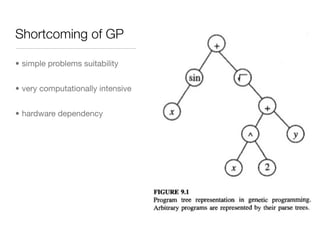
Shortcoming of GP

• simple problems suitability


• very computationally intensive


• hardware dependency
Enhance GP

• John R. Koza - 1994


• supporting modules in program representation


   • module creation


   • module reuse


• e.g. function, data structure, loop, recursive etc.


• here, we focus on the behavior of recursion
The problem with recursion (1/3)

• infinite loop in strict evaluation


   • finite limit on recursive calls [Brave - 1996]


   • finite limit on execution time [Wong & Leung - 1996]


   • the “Map” function [Clack & Yu - 1997]


      • “Map”, a higher-order function, can work on a finite list


• a non-terminated program with good properties
  may or may not be discarded in selection step
The problem with recursion (2/3)

• infinite loop in lazy evaluation


   • all the pervious methods are suitable in this evaluating strategy


      • “map” can also work on a infinite list in lazy evaluation very well


• with lazy strategy, we can keep some potential solutions
  that contain infinite loop
The problem with recursion (3/3)

• without semantics measuring


• GP uses a syntactic approach to construct programs


   • will not consider any semantical conditions


• here, using type system to describe semantics, very lightly
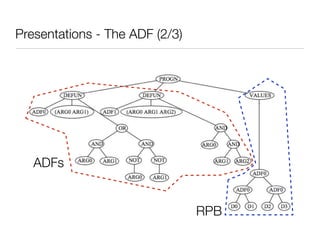
Presentations - The ADF (1/3)

• Automatically Defined Function (ADF) [Koza - 1994]

• Divide and Conquer:


• each program in population contains two main parts:
  i. result-producing branch (RPB)
  ii.definition of one or more functions (ADFs)
Presentations - The ADF (2/3)


   ADFs


                                RPB
Presentations - The ADF (3/3)

• there are two kind of module creating in ADFs


  i. statically, define ADFs before running GP

     - have no opportunity to explore more advantageous structure


  ii.randomly, define ADFs during the 1st generation

     - crazy computationally expensive


• using GP with ADF is more powerful approach than using GP alone
Presentations - The λ abstraction

• λ abstraction is a kind of anonymous


• λ abstraction can to do everything what ADF can


• it can be easy to reuse by supporting with higher-order function
  what could take function as argument


• by the using of higher-order function, we can adopt a middle ground:
  dynamically module specify
The experiment (1/2)

• Even-N-Parity problem

• has been used as a difficult problem for GP [Koza - 1992]

• returning True if an even number of input are true

• Function Set {AND, OR, NAND, NOR}

• Terminal Set {b0, b1, ..., bN-1} with N boolean variables

• testing instance consists of all the binary strings with length N


                     [00110100] → 3 → False
                     [01100101] → 4 → True
The experiment (2/2)

• using GP only [Koza - 1992]

  • can solve the problem with very high accuracy when 1 ≤ N ≤ 5

• using GP with ADF [Koza - 1994]

  • can solve this problem up to N = 11

• using GP with a logic grammar [Wong & Leung - 1996]

  • according to the Curry-Howard Isomorphism, a logic system consists a
    type system that can describe some semantics

  • strong enough to handle any value of N

  • however, any noisy case will increase the computational cost
New strategy

• there are three key concepts


  i. implicit recursion


     - to generate general solutions that work for any value of N


  ii.λ abstraction (higher-order function)


     - to present the module mechanism


  iii.type system


     - to preserve the structure (semantics) of program
Implicit recursion (1/2)

• this term, “implicit recursion”, states a kind of function that define the
  structure of recursion


• i.e. implicit recursion is a higher-order function that takes another function as
  the behavior of recursion, i.e. semantics


• usually, implicit recursions are also polymorphic


• there are several higher-order functions: fold, map, filter, etc...


• in fact, all of those functions can be defined by fold


• thus, we take foldr, a specific fold, to specify recursive structure of program
Implicit recursion (2/2)

• fold have two major advantages


  I. with implicit recursion, the program do not produce infinite loop


     - can use the pre-defined recursive structure only

  II. fold is very suitable because fold takes a list as input and return a single
     value


     - functor is just a structural definition without any semantics
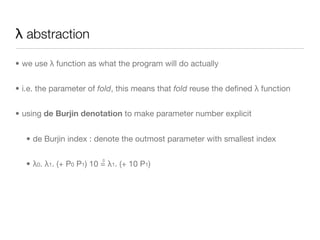
λ abstraction

• we use λ function as what the program will do actually


• i.e. the parameter of fold, this means that fold reuse the defined λ function


• using de Burjin denotation to make parameter number explicit


   • de Burjin index : denote the outmost parameter with smallest index

                          β
   • λ0. λ1. (+ P0 P1) 10 = λ1. (+ 10 P1)
Type system (1/4)

• using type system to reserve the structure of program


  • for example: in even-n-parity, program :: [Bool] → Bool


• we can also using type system to run GP with slight semantics


• perform type checking during crossover and mutation


  • to ensure the resulting program is reasonable
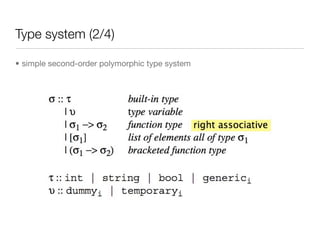
Type system (2/4)

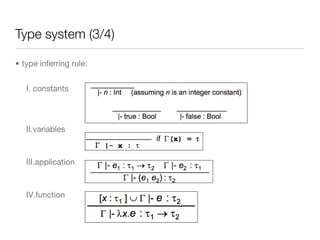
• simple second-order polymorphic type system
Type system (3/4)

• type inferring rule:


   I. constants


   II.variables


   III.application


   IV.function
Type system (4/4)

• foldr :: (a→b→b) →b →[a] →b

   • glue function (induction) (a→b→b) →b →[a] →b

   • base case                    (a→b→b) →b →[a] →b


• foldr takes two arguments and return a function
  that takes a list of some type a and return a single value with type b

• example: foldr (+) 0 [1,2,3] = foldr (+) 0 (1:(2:(3:[ ]))) = (1+(2+(3+0))) = 6

• another example: foldr xor F [T,F] = (xor T (xor F F)) = (xor T F) = T

• another example: foldr (λ.λ.and T P1) T [1,2] = ((λ.λ.and T P1) 1 ((λ.λ.and T P1)
  2 ((λ.λ.and T P1) T))) = ((λ.λ.and T P1) 1 ((λ.λ.and T P1) 2 T)) = ((λ.λ.and T P1) 1
  T) = and T T = T
Experimentation

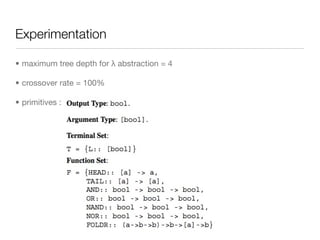
• maximum tree depth for λ abstraction = 4

• crossover rate = 100%

• primitives :
Experimentation

• maximum depth of nested recursion = 100


• simple example with depth = 2


                                  foldr
                      +                     [1,2,3]
                                  foldr

                      +                     [1,2,3]
                                   0
Selection of fitness cases & error handling

• even-2-parity, as even patterns - 4 cases


• even-3-parity, as odd patterns - 8 cases


• total 12 cases


• is hoped that generated programs can work for any value of N


• error will occur during run-time by implying a function into a value


• we capture this kind of error by type system and exception


• using a flag to mark this solution for penalty during fitness evaluation
Fitness design

• each potential solution is evaluated against all of the fitness cases

   • correct => 1

   • incorrect => 0

   • run-time error => 0.5


• computing the summation of all result


• thus, 0 ≤ fitness of a potential solution ≤ 12
Selection of cut-point

• because of the using of fold and λ abstract, a node with a less depth will have
  a stronger description:
                                   foldr
                         +                       [1,2,3]
                                   foldr

                         +                       [1,2,3]
                                     0
• adopting a method: node have a higher chance to be selected by crossover if
  it is more close root
Crossover and mutation (1/2)

• by de Burjin denotation and type system


• we can explicit two useful informations during the major operation of GP


   i. the number of parameters of function


   ii.the type signature of function


• during crossover, the selection of a cut-point must be valid and reasonable


• i.e. both parents will exchange subtree with same type signature and
  parameters’ number
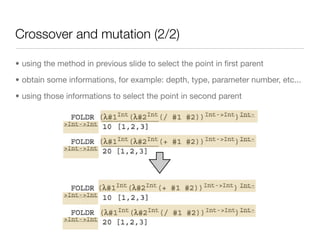
Crossover and mutation (2/2)

• using the method in previous slide to select the point in first parent

• obtain some informations, for example: depth, type, parameter number, etc...

• using those informations to select the point in second parent
Experiment result (1/3)

• Fitness cases = 12


• start with 60 runs (initial individuals), population number = 60


• 57 (final individual) of them find a solution that work for any value of N
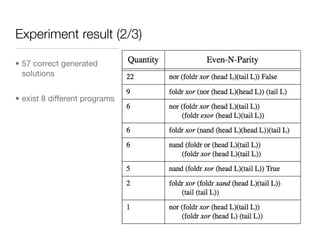
Experiment result (2/3)

• 57 correct generated
  solutions


• exist 8 different programs
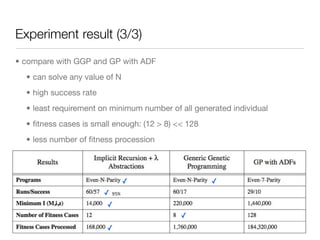
Experiment result (3/3)
• compare with GGP and GP with ADF
  • can solve any value of N
  • high success rate
  • least requirement on minimum number of all generated individual
  • fitness cases is small enough: (12 > 8) << 128
  • less number of fitness procession


                                  ✓                 ✓
                        ✓   95%

                        ✓
                                            ✓
                        ✓
Performance

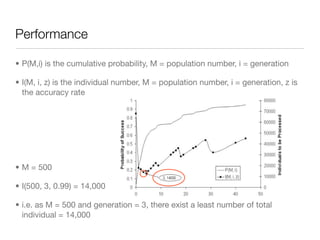
• P(M,i) is the cumulative probability, M = population number, i = generation

• I(M, i, z) is the individual number, M = population number, i = generation, z is
  the accuracy rate


• M = 500

• I(500, 3, 0.99) = 14,000

• i.e. as M = 500 and generation = 3, there exist a least number of total
  individual = 14,000
Conclusion

• λ abstraction and fold can improve GP


• because original GP simulates structures and contents both, however, the
  using of λ and fold can reduce the effort in structural evolution


• makes GP focus on contents only


• in other word, there use a higher-order methods to describe the syntactical
  structure and remainder are semantical contents that can be found by GP

Genetic programming

  • 1.
    Genetic Programming Recursion, LambdaAbstractions and Genetic Programming by Tina Yu and Chris Clack Yun-Yan Chi
  • 2.
    Outline ❖Introduction ❖Experimentation ❖Background ❖fitness ❖The problem with recursion ❖crossover ❖Presentations ❖Resulting and analysis ❖The experiment ❖Experiment result ❖New strategy ❖Performance ❖Implicit recursion ❖Conclusion ❖λ abstraction ❖Type system
  • 3.
    Background - GeneticProgramming • [Nichael L. Cramer - 1985] • [John R. Koza - 1992] • evolutionary-based search strategy • dynamic and tree-structure representation • favors the use of programming language that naturally embody tree structure
  • 4.
    Shortcoming of GP •simple problems suitability • very computationally intensive • hardware dependency
  • 5.
    Enhance GP • JohnR. Koza - 1994 • supporting modules in program representation • module creation • module reuse • e.g. function, data structure, loop, recursive etc. • here, we focus on the behavior of recursion
  • 6.
    The problem withrecursion (1/3) • infinite loop in strict evaluation • finite limit on recursive calls [Brave - 1996] • finite limit on execution time [Wong & Leung - 1996] • the “Map” function [Clack & Yu - 1997] • “Map”, a higher-order function, can work on a finite list • a non-terminated program with good properties may or may not be discarded in selection step
  • 7.
    The problem withrecursion (2/3) • infinite loop in lazy evaluation • all the pervious methods are suitable in this evaluating strategy • “map” can also work on a infinite list in lazy evaluation very well • with lazy strategy, we can keep some potential solutions that contain infinite loop
  • 8.
    The problem withrecursion (3/3) • without semantics measuring • GP uses a syntactic approach to construct programs • will not consider any semantical conditions • here, using type system to describe semantics, very lightly
  • 9.
    Presentations - TheADF (1/3) • Automatically Defined Function (ADF) [Koza - 1994] • Divide and Conquer: • each program in population contains two main parts: i. result-producing branch (RPB) ii.definition of one or more functions (ADFs)
  • 10.
    Presentations - TheADF (2/3) ADFs RPB
  • 11.
    Presentations - TheADF (3/3) • there are two kind of module creating in ADFs i. statically, define ADFs before running GP - have no opportunity to explore more advantageous structure ii.randomly, define ADFs during the 1st generation - crazy computationally expensive • using GP with ADF is more powerful approach than using GP alone
  • 12.
    Presentations - Theλ abstraction • λ abstraction is a kind of anonymous • λ abstraction can to do everything what ADF can • it can be easy to reuse by supporting with higher-order function what could take function as argument • by the using of higher-order function, we can adopt a middle ground: dynamically module specify
  • 13.
    The experiment (1/2) •Even-N-Parity problem • has been used as a difficult problem for GP [Koza - 1992] • returning True if an even number of input are true • Function Set {AND, OR, NAND, NOR} • Terminal Set {b0, b1, ..., bN-1} with N boolean variables • testing instance consists of all the binary strings with length N [00110100] → 3 → False [01100101] → 4 → True
  • 14.
    The experiment (2/2) •using GP only [Koza - 1992] • can solve the problem with very high accuracy when 1 ≤ N ≤ 5 • using GP with ADF [Koza - 1994] • can solve this problem up to N = 11 • using GP with a logic grammar [Wong & Leung - 1996] • according to the Curry-Howard Isomorphism, a logic system consists a type system that can describe some semantics • strong enough to handle any value of N • however, any noisy case will increase the computational cost
  • 15.
    New strategy • thereare three key concepts i. implicit recursion - to generate general solutions that work for any value of N ii.λ abstraction (higher-order function) - to present the module mechanism iii.type system - to preserve the structure (semantics) of program
  • 16.
    Implicit recursion (1/2) •this term, “implicit recursion”, states a kind of function that define the structure of recursion • i.e. implicit recursion is a higher-order function that takes another function as the behavior of recursion, i.e. semantics • usually, implicit recursions are also polymorphic • there are several higher-order functions: fold, map, filter, etc... • in fact, all of those functions can be defined by fold • thus, we take foldr, a specific fold, to specify recursive structure of program
  • 17.
    Implicit recursion (2/2) •fold have two major advantages I. with implicit recursion, the program do not produce infinite loop - can use the pre-defined recursive structure only II. fold is very suitable because fold takes a list as input and return a single value - functor is just a structural definition without any semantics
  • 18.
    λ abstraction • weuse λ function as what the program will do actually • i.e. the parameter of fold, this means that fold reuse the defined λ function • using de Burjin denotation to make parameter number explicit • de Burjin index : denote the outmost parameter with smallest index β • λ0. λ1. (+ P0 P1) 10 = λ1. (+ 10 P1)
  • 19.
    Type system (1/4) •using type system to reserve the structure of program • for example: in even-n-parity, program :: [Bool] → Bool • we can also using type system to run GP with slight semantics • perform type checking during crossover and mutation • to ensure the resulting program is reasonable
  • 20.
    Type system (2/4) •simple second-order polymorphic type system
  • 21.
    Type system (3/4) •type inferring rule: I. constants II.variables III.application IV.function
  • 22.
    Type system (4/4) •foldr :: (a→b→b) →b →[a] →b • glue function (induction) (a→b→b) →b →[a] →b • base case (a→b→b) →b →[a] →b • foldr takes two arguments and return a function that takes a list of some type a and return a single value with type b • example: foldr (+) 0 [1,2,3] = foldr (+) 0 (1:(2:(3:[ ]))) = (1+(2+(3+0))) = 6 • another example: foldr xor F [T,F] = (xor T (xor F F)) = (xor T F) = T • another example: foldr (λ.λ.and T P1) T [1,2] = ((λ.λ.and T P1) 1 ((λ.λ.and T P1) 2 ((λ.λ.and T P1) T))) = ((λ.λ.and T P1) 1 ((λ.λ.and T P1) 2 T)) = ((λ.λ.and T P1) 1 T) = and T T = T
  • 23.
    Experimentation • maximum treedepth for λ abstraction = 4 • crossover rate = 100% • primitives :
  • 24.
    Experimentation • maximum depthof nested recursion = 100 • simple example with depth = 2 foldr + [1,2,3] foldr + [1,2,3] 0
  • 25.
    Selection of fitnesscases & error handling • even-2-parity, as even patterns - 4 cases • even-3-parity, as odd patterns - 8 cases • total 12 cases • is hoped that generated programs can work for any value of N • error will occur during run-time by implying a function into a value • we capture this kind of error by type system and exception • using a flag to mark this solution for penalty during fitness evaluation
  • 26.
    Fitness design • eachpotential solution is evaluated against all of the fitness cases • correct => 1 • incorrect => 0 • run-time error => 0.5 • computing the summation of all result • thus, 0 ≤ fitness of a potential solution ≤ 12
  • 27.
    Selection of cut-point •because of the using of fold and λ abstract, a node with a less depth will have a stronger description: foldr + [1,2,3] foldr + [1,2,3] 0 • adopting a method: node have a higher chance to be selected by crossover if it is more close root
  • 28.
    Crossover and mutation(1/2) • by de Burjin denotation and type system • we can explicit two useful informations during the major operation of GP i. the number of parameters of function ii.the type signature of function • during crossover, the selection of a cut-point must be valid and reasonable • i.e. both parents will exchange subtree with same type signature and parameters’ number
  • 29.
    Crossover and mutation(2/2) • using the method in previous slide to select the point in first parent • obtain some informations, for example: depth, type, parameter number, etc... • using those informations to select the point in second parent
  • 30.
    Experiment result (1/3) •Fitness cases = 12 • start with 60 runs (initial individuals), population number = 60 • 57 (final individual) of them find a solution that work for any value of N
  • 31.
    Experiment result (2/3) •57 correct generated solutions • exist 8 different programs
  • 32.
    Experiment result (3/3) •compare with GGP and GP with ADF • can solve any value of N • high success rate • least requirement on minimum number of all generated individual • fitness cases is small enough: (12 > 8) << 128 • less number of fitness procession ✓ ✓ ✓ 95% ✓ ✓ ✓
  • 33.
    Performance • P(M,i) isthe cumulative probability, M = population number, i = generation • I(M, i, z) is the individual number, M = population number, i = generation, z is the accuracy rate • M = 500 • I(500, 3, 0.99) = 14,000 • i.e. as M = 500 and generation = 3, there exist a least number of total individual = 14,000
  • 34.
    Conclusion • λ abstractionand fold can improve GP • because original GP simulates structures and contents both, however, the using of λ and fold can reduce the effort in structural evolution • makes GP focus on contents only • in other word, there use a higher-order methods to describe the syntactical structure and remainder are semantical contents that can be found by GP