Software Testing:

A Research Travelogue 

(2000–2014)
Alessandro Orso	

School of Computer Science
College of Computing	

Georgia Institute of Technology	

http://www.cc.gatech.edu/~orso
Gregg Rothermel	

Department of Computer Science
and Engineering	

University of Nebraska – Lincoln	

http://www.cse.unl.edu/~grother
Partially supported by: NSF, IBM, Google, and MSR
Software Testing:

A Research Travelogue 

(2000–2014)
Alessandro Orso	

School of Computer Science
College of Computing	

Georgia Institute of Technology	

http://www.cc.gatech.edu/~orso
Gregg Rothermel	

Department of Computer Science
and Engineering	

University of Nebraska – Lincoln	

http://www.cse.unl.edu/~grother
Partially supported by: NSF, IBM, Google, and MSR
Software Testing
Most used approach
and investigated
0
4
8
12
16
2000 2002 2004 2006 2008 2010 2012 2014
Number of papers on testing at ICSE from 2000 to 2014
Software Testing
Most used approach
and investigated
Testing – A Travelogue
14 years
A Travelogue – Our goal
14 years
Discuss most successful research
in software testing since 2000
Identify most significant challenges
and opportunities
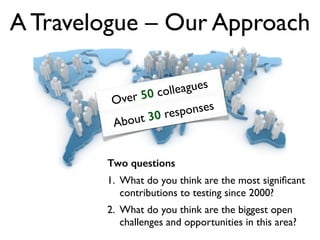
A Travelogue – Our Approach
Two questions
1. What do you think are the most significant
contributions to testing since 2000?	

2. What do you think are the biggest open
challenges and opportunities in this area?
Over 50 colleagues
About 30 responses
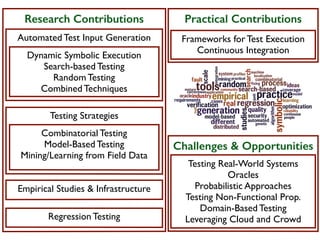
In a Nutshell
Challenges & Opportunities
Testing Real-World Systems	

Oracles	

Probabilistic Approaches	

Testing Non-Functional Prop.	

Domain-Based Testing 	

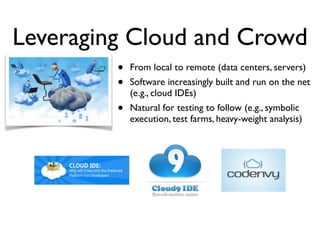
Leveraging Cloud and Crowd
Research Contributions
Automated Test Input Generation	

Dynamic Symbolic Execution	

Search-based Testing	

Random Testing	

Combined Techniques
Testing Strategies
Combinatorial Testing	

Model-Based Testing	

Mining/Learning from Field Data
Regression Testing
Empirical Studies & Infrastructure
Practical Contributions
Frameworks for Test Execution	

Continuous Integration
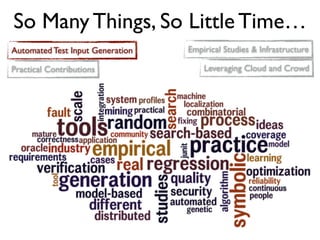
So Many Things, So Little Time…
Automated Test Input Generation Empirical Studies & Infrastructure
Practical Contributions Leveraging Cloud and Crowd
So Many Things, So Little Time…
Practical Contributions Leveraging Cloud and Crowd
Automated Test Input Generation Empirical Studies & Infrastructure
Automated Test Input Generation
Input
Not new, but resurgence	

• Symbolic execution	

• Search-based testing	

• Random/fuzz testing	

• Combined techniques
Achieve coverage goal	

Reach a given point/state{
Technical improvements	

Powerful machines	

Powerful decision procedures	

Careful engineering
Not new, but resurgence	

• Symbolic execution	

• Search-based testing	

• Random/fuzz testing	

• Combined techniques
Achieve coverage goal	

Reach a given point/state{
Technical improvements	

Powerful machines	

Powerful decision procedures	

Careful engineering
Input
Automated Test Input Generation
Symbolic Execution
1.	
  int	
  testme(int	
  x,	
  int	
  y)	
  {	
  
2.	
  	
  	
  int	
  z;	
  
3.	
  	
  	
  if	
  (x	
  <	
  0)	
  
4.	


  return	
  -­‐x;	
  
5.	
  	
  	
  z	
  =	
  x	
  -­‐	
  y;	


6.	
  	
  	
  if	
  (y	
  >	
  z)	
  
7.	


  fail();	
  
8.	
  	
  	
  return	
  z;	
  
9.	
  }
symbolic	
  state:	
  
	
  x=x0,	
  y=y0	
  
path	
  condition:	
  
	
  true
symbolic	
  state:	
  
	
  x=x0,	
  y=y0,	
  z=x0-­‐y0	
  
path	
  condition:	
  
	
  x0≥0,	
  y0>x0/2 Solver
solution:	
  
	
  x0=1,	
  y0=1
Symbolic Execution
1.	
  int	
  testme(int	
  x,	
  int	
  y)	
  {	
  
2.	
  	
  	
  int	
  z;	
  
3.	
  	
  	
  if	
  (x	
  <	
  0)	
  
4.	


  return	
  -­‐x;	
  
5.	
  	
  	
  z	
  =	
  cmplxFnct(x,	
  y);	


6.	
  	
  	
  if	
  (y	
  >	
  z)	
  
7.	


  fail();	
  
8.	
  	
  	
  return	
  z;	
  
9.	
  }
symbolic	
  state:	
  
	
  x=x0,	
  y=y0	
  
path	
  condition:	
  
	
  true
Symbolic Execution
1.	
  int	
  testme(int	
  x,	
  int	
  y)	
  {	
  
2.	
  	
  	
  int	
  z;	
  
3.	
  	
  	
  if	
  (x	
  <	
  0)	
  
4.	


  return	
  -­‐x;	
  
5.	
  	
  	
  z	
  =	
  cmplxFnct(x,	
  y);	


6.	
  	
  	
  if	
  (y	
  >	
  z)	
  
7.	


  fail();	
  
8.	
  	
  	
  return	
  z;	
  
9.	
  }
symbolic	
  state:	
  
	
  x=x0,	
  y=y0	
  
path	
  condition:	
  
	
  true
path	
  condition:	


  x0≥0,	
  y0>cmplxFnct(10,	
  10) Solver
?
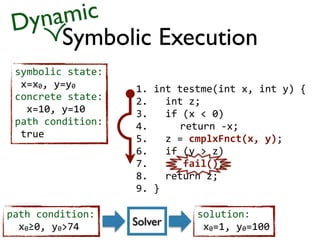
Symbolic Execution
1.	
  int	
  testme(int	
  x,	
  int	
  y)	
  {	
  
2.	
  	
  	
  int	
  z;	
  
3.	
  	
  	
  if	
  (x	
  <	
  0)	
  
4.	


  return	
  -­‐x;	
  
5.	
  	
  	
  z	
  =	
  cmplxFnct(x,	
  y);	


6.	
  	
  	
  if	
  (y	
  >	
  z)	
  
7.	


  fail();	
  
8.	
  	
  	
  return	
  z;	
  
9.	
  }
Dynamic
symbolic	
  state:	
  
	
  x=x0,	
  y=y0	
  
concrete	
  state:	


  x=10,	
  y=10	
  
path	
  condition:	
  
	
  true
path	
  condition:	


  x0≥0,	
  y0>74 Solver
solution:	
  
	
  x0=1,	
  y0=100
Symbolic Execution
1.	
  int	
  testme(int	
  x,	
  int	
  y)	
  {	
  
2.	
  	
  	
  int	
  z;	
  
3.	
  	
  	
  if	
  (x	
  <	
  0)	
  
4.	


  return	
  -­‐x;	
  
5.	
  	
  	
  z	
  =	
  cmplxFnct(x,	
  y);	


6.	
  	
  	
  if	
  (y	
  >	
  z)	
  
7.	


  fail();	
  
8.	
  	
  	
  return	
  z;	
  
9.	
  }
Dynamic
symbolic	
  state:	
  
	
  x=x0,	
  y=y0	
  
concrete	
  state:	


  x=10,	
  y=10	
  
path	
  condition:	
  
	
  true
path	
  condition:	


  x0≥0,	
  y0>74 Solver
solution:	
  
	
  x0=1,	
  y0=100
Success Stories	

• Academia: countless citations (e.g., over 1300
for DART), publications, and applications	

• Tools: Crest, Klee, Pex, Sage, Symbolic JPF, …	

• Industry: Microsoft, NASA, IBM, Fujitsu, …
Symbolic Execution
1.	
  int	
  testme(int	
  x,	
  int	
  y)	
  {	
  
2.	
  	
  	
  int	
  z;	
  
3.	
  	
  	
  if	
  (x	
  <	
  0)	
  
4.	


  return	
  -­‐x;	
  
5.	
  	
  	
  z	
  =	
  cmplxFnct(x,	
  y);	


6.	
  	
  	
  if	
  (y	
  >	
  z)	
  
7.	


  fail();	
  
8.	
  	
  	
  return	
  z;	
  
9.	
  }
Dynamic
symbolic	
  state:	
  
	
  x=x0,	
  y=y0	
  
concrete	
  state:	


  x=10,	
  y=10	
  
path	
  condition:	
  
	
  true
path	
  condition:	


  x0≥0,	
  y0>74 Solver
solution:	
  
	
  x0=1,	
  y0=100
Success Stories	

• Academia: countless citations (e.g., over 1300
for DART), publications, and applications	

• Tools: Crest, Klee, Pex, Sage, Symbolic JPF, …	

• Industry: Microsoft, NASA, IBM, Fujitsu, …
Open Challenges	

• Highly structured inputs 	

• External libraries	

• Large complex programs	

• Oracle problem
So Many Things, So Little Time…
Automated Test Input Generation
Practical Contributions Leveraging Cloud and Crowd
Empirical Studies & Infrastructure
• Testing is heuristic ➡ must be empirically evaluated
None
52%
Examples
4%
Case studies
27%
Experiments
17%
• State of the art in ~2000:
study on 224 papers on
testing (1994–2003)
• Things have changed
dramatically since then:	

• Empirical evaluations
almost required	

• Artifact evaluations at
various conferences
• Increased availability of experiment objects	

• Repositories: SIR (over 600 companies/institution
registered, over 500 papers used it), Bugbench,
iBugs, Marmoset, SAMATE Reference Dataset, …	

• Open-source systems, often large and available
with versions, tests, bug reports, …	

!
• Increased availability of supporting infrastructure 

(analysis tools, coverage tools, mutation tools, …)	

!
• Increased understanding of empirical methodologies
Empirical Studies & Infrastructure
(What Changed?)
So Many Things, So Little Time…
Automated Test Input Generation
Practical Contributions Leveraging Cloud and Crowd
Empirical Studies & Infrastructure
Practical Contributions
• Frameworks for test execution
• Shortening of the testing process life cycle
Practical Contributions
• Frameworks for test execution
• Shortening of the testing process life cycle
• Dramatically improved the stat of the art	

• Indirectly affected research	

• Examples:
Practical Contributions
• Frameworks for test execution
• Shortening of the testing process life cycle
• From integrating and testing “at the end”,

to early integration and testing,

to continuous integration (CI)
• Widely used in industry	

• Examples:
Hudson Jenkins Travis
So Many Things, So Little Time…
Automated Test Input Generation
Practical Contributions Leveraging Cloud and Crowd
Empirical Studies & Infrastructure
Leveraging Cloud and Crowd
• From local to remote (data centers, servers)	

• Software increasingly built and run on the net

(e.g., cloud IDEs)	

• Natural for testing to follow (e.g., symbolic
execution, test farms, heavy-weight analysis)
Leveraging Cloud and Crowd
• Testing is still very much human intensive	

• It makes sense to leverage the crowd in testing	

• This has been happening for some time, both
in academia and in industry	

• Interesting new directions (game based testing
and verification, crowd oracles, …)
Leveraging Cloud and Crowd
• Testing is still very much human intensive	

• It makes sense to leverage the crowd in testing	

• This has been happening for some time, both
in academia and in industry	

• Interesting new directions (game based testing
and verification, crowd oracles, …)
• Testing as a game?	

• Must be a game people
are willing to play	

• Must be easier than the
original problem
In Summary
• Incredible amount of work on testing	

• Yet, things are not that different…
…or are they?
• Automated testing	

• Empirical evaluation	

• Testing strategies
• Testing tools	

• Testing process 	

• …
Future Directions
"It's hard to make predictions,

especially about the future."	

(source unclear)
Future Directions
"It's hard to make predictions,

especially about the future."	

(source unclear)
But if you twist

my arm…
Testing Real-World Systems	

Oracles	

Probabilistic Approaches	

Testing Non-Functional Properties	

Domain-Based Testing 	

Leveraging Cloud and Crowd
Future Directions
"It's hard to make predictions,

especially about the future."	

(source unclear)
And a personal
message
• Stop chasing full automation	

• True for other related areas too

(e.g., debugging, program repair)	

• Use the different players for what
they are best at doing	

• Human: creativity	

• Computer: computation-intensive,
repetitive, error-prone, etc. tasks
With much appreciated
input/contributions from
• Alex Groce	

• Andrea Arcuri	

• Andreas Zeller	

• Andy Podgurski	

• Antonia Bertolino	

• Atif Memon	

• Corina Pasareanu	

• Darko Marinov	

• David Rosenblum	

• Elaine Weyuker	

• John Regehr	

• Lionel Briand	

• Lori Pollock	

• Mark Grechanik	

• Natalia Juristo	

• Paolo Tonella	

• Patrice Godefroid	

• Per Runeson	

• Peter Santhanam	

• Phil McMinn	

• Phyllis Frankl	

• Robert Hierons	

• Satish Chandra	

• Sebastian Elbaum	

• Sriram Rajamani	

• T.Y. Chen	

• Tom Ostrand	

• Wes Masri	

• WillemVisser	

• Yves Le Traon
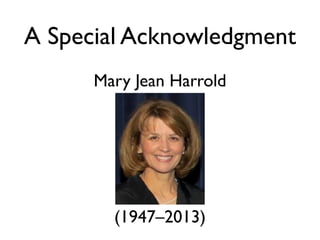
A Special Acknowledgment
(1947–2013)
Mary Jean Harrold

Software Testing:
 A Research Travelogue 
(2000–2014)

  • 1.
    Software Testing:
 A ResearchTravelogue 
 (2000–2014) Alessandro Orso School of Computer Science College of Computing Georgia Institute of Technology http://www.cc.gatech.edu/~orso Gregg Rothermel Department of Computer Science and Engineering University of Nebraska – Lincoln http://www.cse.unl.edu/~grother Partially supported by: NSF, IBM, Google, and MSR
  • 2.
    Software Testing:
 A ResearchTravelogue 
 (2000–2014) Alessandro Orso School of Computer Science College of Computing Georgia Institute of Technology http://www.cc.gatech.edu/~orso Gregg Rothermel Department of Computer Science and Engineering University of Nebraska – Lincoln http://www.cse.unl.edu/~grother Partially supported by: NSF, IBM, Google, and MSR
  • 3.
    Software Testing Most usedapproach and investigated 0 4 8 12 16 2000 2002 2004 2006 2008 2010 2012 2014 Number of papers on testing at ICSE from 2000 to 2014
  • 4.
    Software Testing Most usedapproach and investigated
  • 5.
    Testing – ATravelogue 14 years
  • 6.
    A Travelogue –Our goal 14 years Discuss most successful research in software testing since 2000 Identify most significant challenges and opportunities
  • 7.
    A Travelogue –Our Approach Two questions 1. What do you think are the most significant contributions to testing since 2000? 2. What do you think are the biggest open challenges and opportunities in this area? Over 50 colleagues About 30 responses
  • 8.
  • 9.
    Challenges & Opportunities TestingReal-World Systems Oracles Probabilistic Approaches Testing Non-Functional Prop. Domain-Based Testing Leveraging Cloud and Crowd Research Contributions Automated Test Input Generation Dynamic Symbolic Execution Search-based Testing Random Testing Combined Techniques Testing Strategies Combinatorial Testing Model-Based Testing Mining/Learning from Field Data Regression Testing Empirical Studies & Infrastructure Practical Contributions Frameworks for Test Execution Continuous Integration
  • 10.
    So Many Things,So Little Time… Automated Test Input Generation Empirical Studies & Infrastructure Practical Contributions Leveraging Cloud and Crowd
  • 11.
    So Many Things,So Little Time… Practical Contributions Leveraging Cloud and Crowd Automated Test Input Generation Empirical Studies & Infrastructure
  • 12.
    Automated Test InputGeneration Input Not new, but resurgence • Symbolic execution • Search-based testing • Random/fuzz testing • Combined techniques Achieve coverage goal Reach a given point/state{ Technical improvements Powerful machines Powerful decision procedures Careful engineering
  • 13.
    Not new, butresurgence • Symbolic execution • Search-based testing • Random/fuzz testing • Combined techniques Achieve coverage goal Reach a given point/state{ Technical improvements Powerful machines Powerful decision procedures Careful engineering Input Automated Test Input Generation
  • 14.
    Symbolic Execution 1.  int  testme(int  x,  int  y)  {   2.      int  z;   3.      if  (x  <  0)   4.          return  -­‐x;   5.      z  =  x  -­‐  y;       6.      if  (y  >  z)   7.            fail();   8.      return  z;   9.  } symbolic  state:    x=x0,  y=y0   path  condition:    true symbolic  state:    x=x0,  y=y0,  z=x0-­‐y0   path  condition:    x0≥0,  y0>x0/2 Solver solution:    x0=1,  y0=1
  • 15.
    Symbolic Execution 1.  int  testme(int  x,  int  y)  {   2.      int  z;   3.      if  (x  <  0)   4.          return  -­‐x;   5.      z  =  cmplxFnct(x,  y);       6.      if  (y  >  z)   7.            fail();   8.      return  z;   9.  } symbolic  state:    x=x0,  y=y0   path  condition:    true
  • 16.
    Symbolic Execution 1.  int  testme(int  x,  int  y)  {   2.      int  z;   3.      if  (x  <  0)   4.          return  -­‐x;   5.      z  =  cmplxFnct(x,  y);       6.      if  (y  >  z)   7.            fail();   8.      return  z;   9.  } symbolic  state:    x=x0,  y=y0   path  condition:    true path  condition:      x0≥0,  y0>cmplxFnct(10,  10) Solver ?
  • 17.
    Symbolic Execution 1.  int  testme(int  x,  int  y)  {   2.      int  z;   3.      if  (x  <  0)   4.          return  -­‐x;   5.      z  =  cmplxFnct(x,  y);       6.      if  (y  >  z)   7.            fail();   8.      return  z;   9.  } Dynamic symbolic  state:    x=x0,  y=y0   concrete  state:      x=10,  y=10   path  condition:    true path  condition:      x0≥0,  y0>74 Solver solution:    x0=1,  y0=100
  • 18.
    Symbolic Execution 1.  int  testme(int  x,  int  y)  {   2.      int  z;   3.      if  (x  <  0)   4.          return  -­‐x;   5.      z  =  cmplxFnct(x,  y);       6.      if  (y  >  z)   7.            fail();   8.      return  z;   9.  } Dynamic symbolic  state:    x=x0,  y=y0   concrete  state:      x=10,  y=10   path  condition:    true path  condition:      x0≥0,  y0>74 Solver solution:    x0=1,  y0=100 Success Stories • Academia: countless citations (e.g., over 1300 for DART), publications, and applications • Tools: Crest, Klee, Pex, Sage, Symbolic JPF, … • Industry: Microsoft, NASA, IBM, Fujitsu, …
  • 19.
    Symbolic Execution 1.  int  testme(int  x,  int  y)  {   2.      int  z;   3.      if  (x  <  0)   4.          return  -­‐x;   5.      z  =  cmplxFnct(x,  y);       6.      if  (y  >  z)   7.            fail();   8.      return  z;   9.  } Dynamic symbolic  state:    x=x0,  y=y0   concrete  state:      x=10,  y=10   path  condition:    true path  condition:      x0≥0,  y0>74 Solver solution:    x0=1,  y0=100 Success Stories • Academia: countless citations (e.g., over 1300 for DART), publications, and applications • Tools: Crest, Klee, Pex, Sage, Symbolic JPF, … • Industry: Microsoft, NASA, IBM, Fujitsu, … Open Challenges • Highly structured inputs • External libraries • Large complex programs • Oracle problem
  • 20.
    So Many Things,So Little Time… Automated Test Input Generation Practical Contributions Leveraging Cloud and Crowd Empirical Studies & Infrastructure
  • 21.
    Empirical Studies &Infrastructure • Testing is heuristic ➡ must be empirically evaluated None 52% Examples 4% Case studies 27% Experiments 17% • State of the art in ~2000: study on 224 papers on testing (1994–2003) • Things have changed dramatically since then: • Empirical evaluations almost required • Artifact evaluations at various conferences
  • 22.
    • Increased availabilityof experiment objects • Repositories: SIR (over 600 companies/institution registered, over 500 papers used it), Bugbench, iBugs, Marmoset, SAMATE Reference Dataset, … • Open-source systems, often large and available with versions, tests, bug reports, … ! • Increased availability of supporting infrastructure 
 (analysis tools, coverage tools, mutation tools, …) ! • Increased understanding of empirical methodologies Empirical Studies & Infrastructure (What Changed?)
  • 23.
    So Many Things,So Little Time… Automated Test Input Generation Practical Contributions Leveraging Cloud and Crowd Empirical Studies & Infrastructure
  • 24.
    Practical Contributions • Frameworksfor test execution • Shortening of the testing process life cycle
  • 25.
    Practical Contributions • Frameworksfor test execution • Shortening of the testing process life cycle • Dramatically improved the stat of the art • Indirectly affected research • Examples:
  • 26.
    Practical Contributions • Frameworksfor test execution • Shortening of the testing process life cycle • From integrating and testing “at the end”,
 to early integration and testing,
 to continuous integration (CI) • Widely used in industry • Examples: Hudson Jenkins Travis
  • 27.
    So Many Things,So Little Time… Automated Test Input Generation Practical Contributions Leveraging Cloud and Crowd Empirical Studies & Infrastructure
  • 28.
    Leveraging Cloud andCrowd • From local to remote (data centers, servers) • Software increasingly built and run on the net
 (e.g., cloud IDEs) • Natural for testing to follow (e.g., symbolic execution, test farms, heavy-weight analysis)
  • 29.
    Leveraging Cloud andCrowd • Testing is still very much human intensive • It makes sense to leverage the crowd in testing • This has been happening for some time, both in academia and in industry • Interesting new directions (game based testing and verification, crowd oracles, …)
  • 30.
    Leveraging Cloud andCrowd • Testing is still very much human intensive • It makes sense to leverage the crowd in testing • This has been happening for some time, both in academia and in industry • Interesting new directions (game based testing and verification, crowd oracles, …) • Testing as a game? • Must be a game people are willing to play • Must be easier than the original problem
  • 31.
    In Summary • Incredibleamount of work on testing • Yet, things are not that different… …or are they? • Automated testing • Empirical evaluation • Testing strategies • Testing tools • Testing process • …
  • 32.
    Future Directions "It's hardto make predictions,
 especially about the future." (source unclear)
  • 33.
    Future Directions "It's hardto make predictions,
 especially about the future." (source unclear) But if you twist
 my arm… Testing Real-World Systems Oracles Probabilistic Approaches Testing Non-Functional Properties Domain-Based Testing Leveraging Cloud and Crowd
  • 34.
    Future Directions "It's hardto make predictions,
 especially about the future." (source unclear) And a personal message • Stop chasing full automation • True for other related areas too
 (e.g., debugging, program repair) • Use the different players for what they are best at doing • Human: creativity • Computer: computation-intensive, repetitive, error-prone, etc. tasks
  • 35.
    With much appreciated input/contributionsfrom • Alex Groce • Andrea Arcuri • Andreas Zeller • Andy Podgurski • Antonia Bertolino • Atif Memon • Corina Pasareanu • Darko Marinov • David Rosenblum • Elaine Weyuker • John Regehr • Lionel Briand • Lori Pollock • Mark Grechanik • Natalia Juristo • Paolo Tonella • Patrice Godefroid • Per Runeson • Peter Santhanam • Phil McMinn • Phyllis Frankl • Robert Hierons • Satish Chandra • Sebastian Elbaum • Sriram Rajamani • T.Y. Chen • Tom Ostrand • Wes Masri • WillemVisser • Yves Le Traon
  • 36.