MODULE 2
Problem Solving Agents – Searching for
solutions- Uninformed Search Strategies
– Informed Search Strategies, heuristic
functions.
Artificial intelligence
• Intelligence : “Ability to learn, understand,
and think”.
• The study of the capacity of machines to
simulate intelligent human behavior.
• AI is the study of how to make computers
make things which at the moment people
do better.
ARTIFICIAL
INTELLIGENCE
2
Problem solving System
•Define the problem.
•Analyze the problem.
•Isolate & represent the task
knowledge necessary to solve the
problem.
•Choose the best problem- solving
techniques & apply it to the problem.
ARTIFICIAL
INTELLIGENCE
3
Formal description for defining
a problem
•Representation :
•State Space
• It contains set of all the possible states of
the relevant problem
•Initial State
•Goal State
•Transformation Rules
ARTIFICIAL
INTELLIGENCE
4
Production Systems
• Production System Consists of
• A set of rules :
(Pattern) Operation to be performed
• One / more Knowledge/ databases
• Control strategy –specifies order in which
rules will be compared
• Rule applier
ARTIFICIAL
INTELLIGENCE
5
State-Space Tree
•State-Space Tree. A space state
tree is a tree that represents all of
the possible states of the
problem, from the root as an
initial state to the leaf as a
terminal state.
ARTIFICIAL
INTELLIGENCE
6
ARTIFICIAL
INTELLIGENCE
7
ARTIFICIAL
INTELLIGENCE
8
ARTIFICIAL
INTELLIGENCE
9
ARTIFICIAL
INTELLIGENCE
10
ARTIFICIAL
INTELLIGENCE
11
ARTIFICIAL
INTELLIGENCE
12
ARTIFICIAL
INTELLIGENCE
13
ARTIFICIAL
INTELLIGENCE
14
ARTIFICIAL
INTELLIGENCE
15
ARTIFICIAL
INTELLIGENCE
16
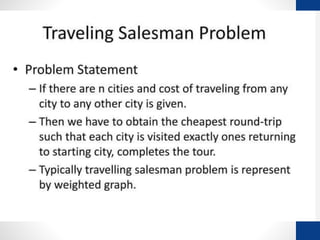
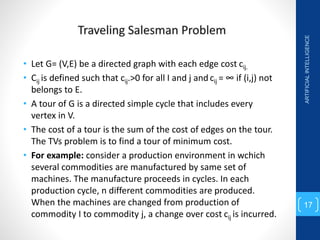
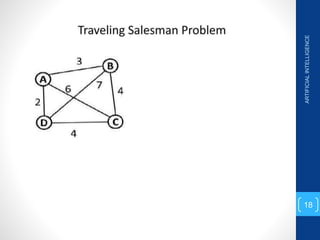
• Let G= (V,E) be a directed graph with each edge cost cij.
• Cij is defined such that cij.>0 for all I and j and cij = ∞ if (i,j) not
belongs to E.
• A tour of G is a directed simple cycle that includes every
vertex in V.
• The cost of a tour is the sum of the cost of edges on the tour.
The TVs problem is to find a tour of minimum cost.
• For example: consider a production environment in wchich
several commodities are manufactured by same set of
machines. The manufacture proceeds in cycles. In each
production cycle, n different commodities are produced.
When the machines are changed from production of
commodity I to commodity j, a change over cost cij is incurred.
ARTIFICIAL
INTELLIGENCE
17
ARTIFICIAL
INTELLIGENCE
18
Tower of Hanoi
ARTIFICIAL
INTELLIGENCE
19
Tower of Hanoi
ARTIFICIAL
INTELLIGENCE
20
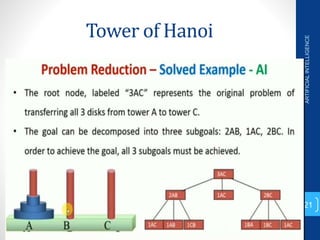
Tower of Hanoi
ARTIFICIAL
INTELLIGENCE
21
ARTIFICIAL
INTELLIGENCE
22
ARTIFICIAL
INTELLIGENCE
23
ARTIFICIAL
INTELLIGENCE
24
ARTIFICIAL
INTELLIGENCE
25
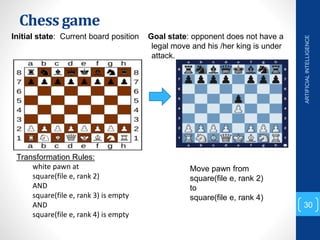
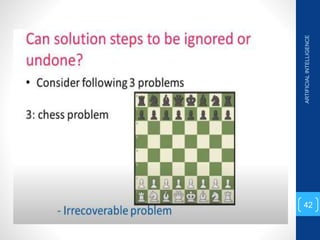
Chess board- problem
• Defining the problem as a state space search:
• Start the problem of play chess.
• 1st we have to specify the starting position of chess board, the
rules that define the legal moves, and the board positions that
represent a win for one side or the other.
• Problem description:
• Consider a chess board 8x8 array where each position
contains a symbol standing for the appropriate piece in
the official chess opening position
ARTIFICIAL
INTELLIGENCE
26
Chess board- problem
• Goal state:
• The goal of any board in which the opponent does not have a
legal move and his or her king is under attack.
• Legal move from initial state to final state.
• If we write legal moves of roughly 10120 possible board
positions.
ARTIFICIAL
INTELLIGENCE
27
Game Playing
ARTIFICIAL
INTELLIGENCE
28
Game Playing
ARTIFICIAL
INTELLIGENCE
29
Chess game
ARTIFICIAL
INTELLIGENCE
30
Transformation Rules:
white pawn at
square(file e, rank 2)
AND
square(file e, rank 3) is empty
AND
square(file e, rank 4) is empty
Initial state: Current board position Goal state: opponent does not have a
legal move and his /her king is under
attack.
Move pawn from
square(file e, rank 2)
to
square(file e, rank 4)
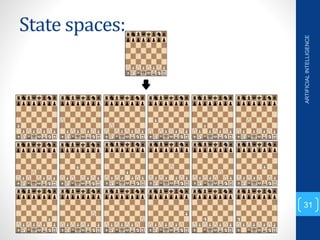
State spaces:
ARTIFICIAL
INTELLIGENCE
31
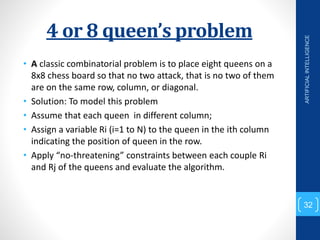
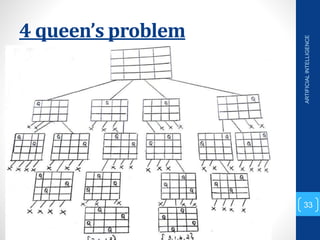
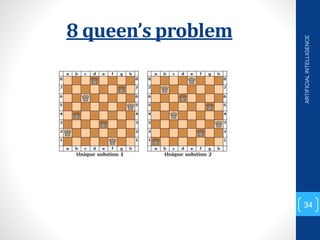
4 or 8 queen’s problem
• A classic combinatorial problem is to place eight queens on a
8x8 chess board so that no two attack, that is no two of them
are on the same row, column, or diagonal.
• Solution: To model this problem
• Assume that each queen in different column;
• Assign a variable Ri (i=1 to N) to the queen in the ith column
indicating the position of queen in the row.
• Apply “no-threatening” constraints between each couple Ri
and Rj of the queens and evaluate the algorithm.
ARTIFICIAL
INTELLIGENCE
32
4 queen’s problem
ARTIFICIAL
INTELLIGENCE
33
8 queen’s problem
ARTIFICIAL
INTELLIGENCE
34
ARTIFICIAL
INTELLIGENCE
35
ARTIFICIAL
INTELLIGENCE
36
ARTIFICIAL
INTELLIGENCE
37
ARTIFICIAL
INTELLIGENCE
38
ARTIFICIAL
INTELLIGENCE
39
ARTIFICIAL
INTELLIGENCE
40
ARTIFICIAL
INTELLIGENCE
41
ARTIFICIAL
INTELLIGENCE
42
ARTIFICIAL
INTELLIGENCE
43
ARTIFICIAL
INTELLIGENCE
44
ARTIFICIAL
INTELLIGENCE
45
ARTIFICIAL
INTELLIGENCE
46
ARTIFICIAL
INTELLIGENCE
47
ARTIFICIAL
INTELLIGENCE
48
ARTIFICIAL
INTELLIGENCE
49
ARTIFICIAL
INTELLIGENCE
50
ARTIFICIAL
INTELLIGENCE
51
ARTIFICIAL
INTELLIGENCE
52
ARTIFICIAL
INTELLIGENCE
53
ARTIFICIAL
INTELLIGENCE
54
ARTIFICIAL
INTELLIGENCE
55
ARTIFICIAL
INTELLIGENCE
56
ARTIFICIAL
INTELLIGENCE
57
ARTIFICIAL
INTELLIGENCE
58
ARTIFICIAL
INTELLIGENCE
59
ARTIFICIAL
INTELLIGENCE
60
ARTIFICIAL
INTELLIGENCE
61
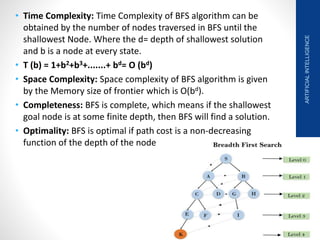
• Time Complexity: Time Complexity of BFS algorithm can be
obtained by the number of nodes traversed in BFS until the
shallowest Node. Where the d= depth of shallowest solution
and b is a node at every state.
• T (b) = 1+b2+b3+.......+ bd= O (bd)
• Space Complexity: Space complexity of BFS algorithm is given
by the Memory size of frontier which is O(bd).
• Completeness: BFS is complete, which means if the shallowest
goal node is at some finite depth, then BFS will find a solution.
• Optimality: BFS is optimal if path cost is a non-decreasing
function of the depth of the node
ARTIFICIAL
INTELLIGENCE
62
ARTIFICIAL
INTELLIGENCE
63
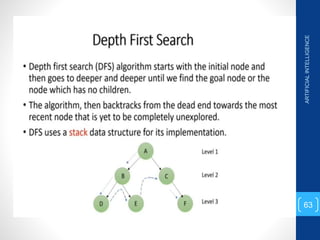
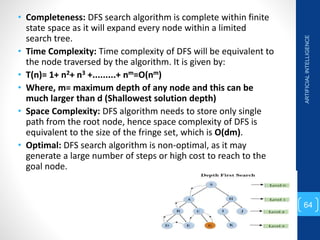
• Completeness: DFS search algorithm is complete within finite
state space as it will expand every node within a limited
search tree.
• Time Complexity: Time complexity of DFS will be equivalent to
the node traversed by the algorithm. It is given by:
• T(n)= 1+ n2+ n3 +.........+ nm=O(nm)
• Where, m= maximum depth of any node and this can be
much larger than d (Shallowest solution depth)
• Space Complexity: DFS algorithm needs to store only single
path from the root node, hence space complexity of DFS is
equivalent to the size of the fringe set, which is O(dm).
• Optimal: DFS search algorithm is non-optimal, as it may
generate a large number of steps or high cost to reach to the
goal node.
ARTIFICIAL
INTELLIGENCE
64
ARTIFICIAL
INTELLIGENCE
65
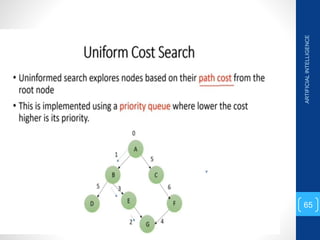
• Completeness:
• Uniform-cost search is complete, such as if there is a solution, UCS
will find it.
• Time Complexity:
• Let C* is Cost of the optimal solution, and ε is each step to get
closer to the goal node. Then the number of steps is = C*/ε. Here we
have taken +1, as we start from state 0 and end to C*/ε.
• Hence, the worst-case time complexity of Uniform-cost search
isO(b1 + [C*/ε])/.
• Space Complexity:
• The same logic is for space complexity so, the worst-case space
complexity of Uniform-cost search is O(b1 + [C*/ε]).
• Optimal:
• Uniform-cost search is always optimal as it only selects a path with
the lowest path cost.
ARTIFICIAL
INTELLIGENCE
66
ARTIFICIAL
INTELLIGENCE
67
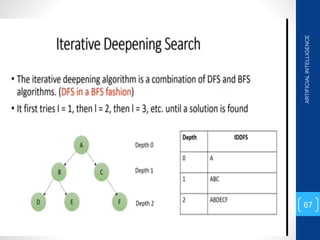
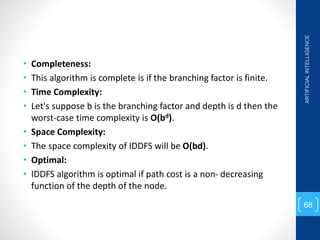
• Completeness:
• This algorithm is complete is if the branching factor is finite.
• Time Complexity:
• Let's suppose b is the branching factor and depth is d then the
worst-case time complexity is O(bd).
• Space Complexity:
• The space complexity of IDDFS will be O(bd).
• Optimal:
• IDDFS algorithm is optimal if path cost is a non- decreasing
function of the depth of the node.
ARTIFICIAL
INTELLIGENCE
68
ARTIFICIAL
INTELLIGENCE
69
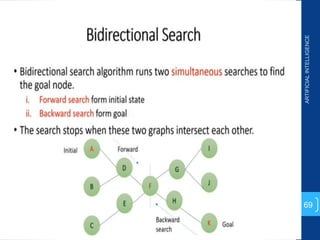
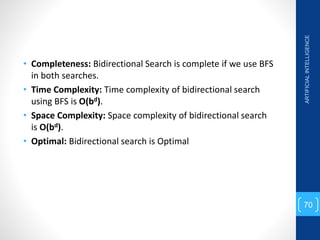
• Completeness: Bidirectional Search is complete if we use BFS
in both searches.
• Time Complexity: Time complexity of bidirectional search
using BFS is O(bd).
• Space Complexity: Space complexity of bidirectional search
is O(bd).
• Optimal: Bidirectional search is Optimal
ARTIFICIAL
INTELLIGENCE
70
ARTIFICIAL
INTELLIGENCE
71
ARTIFICIAL
INTELLIGENCE
72
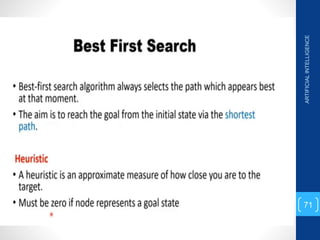
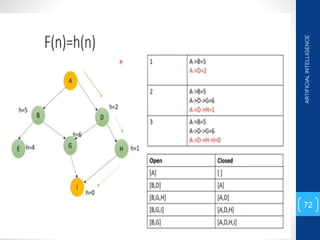
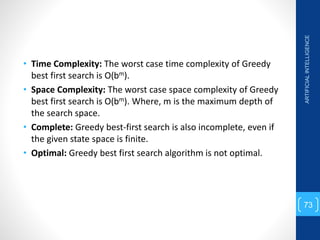
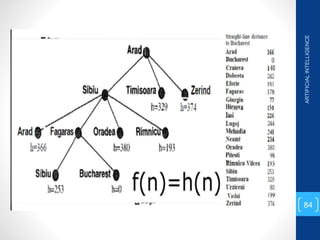
• Time Complexity: The worst case time complexity of Greedy
best first search is O(bm).
• Space Complexity: The worst case space complexity of Greedy
best first search is O(bm). Where, m is the maximum depth of
the search space.
• Complete: Greedy best-first search is also incomplete, even if
the given state space is finite.
• Optimal: Greedy best first search algorithm is not optimal.
ARTIFICIAL
INTELLIGENCE
73
ARTIFICIAL
INTELLIGENCE
74
ARTIFICIAL
INTELLIGENCE
75
ARTIFICIAL
INTELLIGENCE
76
ARTIFICIAL
INTELLIGENCE
77
ARTIFICIAL
INTELLIGENCE
78
ARTIFICIAL
INTELLIGENCE
79
ARTIFICIAL
INTELLIGENCE
80
ARTIFICIAL
INTELLIGENCE
81
ARTIFICIAL
INTELLIGENCE
82
ARTIFICIAL
INTELLIGENCE
83
ARTIFICIAL
INTELLIGENCE
84
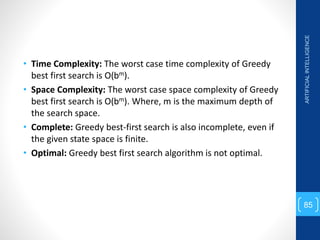
• Time Complexity: The worst case time complexity of Greedy
best first search is O(bm).
• Space Complexity: The worst case space complexity of Greedy
best first search is O(bm). Where, m is the maximum depth of
the search space.
• Complete: Greedy best-first search is also incomplete, even if
the given state space is finite.
• Optimal: Greedy best first search algorithm is not optimal.
ARTIFICIAL
INTELLIGENCE
85
ARTIFICIAL
INTELLIGENCE
86
ARTIFICIAL
INTELLIGENCE
87
ARTIFICIAL
INTELLIGENCE
88
ARTIFICIAL
INTELLIGENCE
89
ARTIFICIAL
INTELLIGENCE
90
ARTIFICIAL
INTELLIGENCE
91
ARTIFICIAL
INTELLIGENCE
92
ARTIFICIAL
INTELLIGENCE
93
ARTIFICIAL
INTELLIGENCE
94
ARTIFICIAL
INTELLIGENCE
95
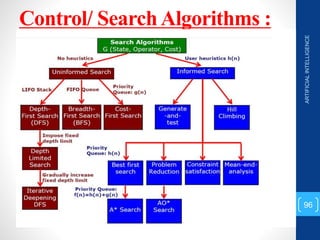
Control/ SearchAlgorithms :
ARTIFICIAL
INTELLIGENCE
96

Module_2_rks in Artificial intelligence in Expert System