Online Machine Learning in
Streaming Applications
Stavros Kontopoulos (Principal Engineer, Lightbend)
@s_kontopoulos
&
Debasish Ghosh (Principal Engineer, Lightbend)
@debasishg
{stavros.kontopoulos, debasish.ghosh}@lightbend.com
Agenda
• Data Streams meet Machine Learning. How they differ from
static data sets.
• Learning systems for data streams
• Adaptive learning model
• Evaluation metrics
• The ADWIN algorithm and the complete cycle of training
streaming systems
• The Hoeffding Tree based classifiers
2
Formalizing Data Streams
● Difference with batch learning using
static data sets
● The data stream model
● Challenges of stream based learning
Batch Learning
• Static data set to generate an output
hypothesis
• One shot data analysis - fixed stable
feature space
• Assume stationarity of data
4
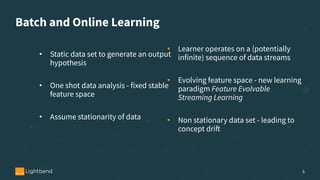
Batch and Online Learning
• Static data set to generate an output
hypothesis
• One shot data analysis - fixed stable
feature space
• Assume stationarity of data
5
• Learner operates on a (potentially
infinite) sequence of data streams
• Evolving feature space - new learning
paradigm Feature Evolvable
Streaming Learning
• Non stationary data set - leading to
concept drift
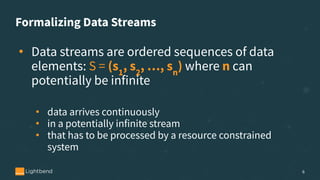
Formalizing Data Streams
• Data streams are ordered sequences of data
elements: S = (s1
, s2
, …, sn
) where n can
potentially be infinite
• data arrives continuously
• in a potentially infinite stream
• that has to be processed by a resource constrained
system
6
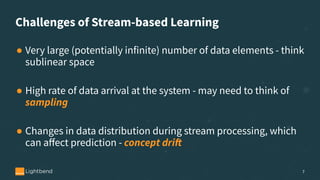
Challenges of Stream-based Learning
● Very large (potentially infinite) number of data elements - think
sublinear space
● High rate of data arrival at the system - may need to think of
sampling
● Changes in data distribution during stream processing, which
can affect prediction - concept drift
7
Learning Systems for Data Streams
● Dimensions of learning
● Classification problems
● Concept drift
Learning Systems for Data Streams
Desirable properties of learning systems for efficiently mining continuous,
high-volume, open ended data streams (Hulten and Domingoes, 20011
):
● Require small constant time per data example
● Use fixed amount of main memory, irrespective of the number of
examples
● Build a decision model using a single scan over the training data
● Generate an anytime model independent of the order of the examples
● Ability to deal with concept drift
1
Hulten, G., & Domingos, P. (2001). Catching up with the data: research issues in mining data streams. In Proc. of workshop on research
issues in data mining and knowledge discovery, Santa Barbara, USA.
9
Dimensions of Learning
● Space - the available memory is fixed
● Learning Time - process incoming examples at the rate
they arrive
● Generalization Power - how effective the model is at
capturing the true underlying concept
10
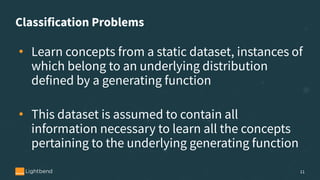
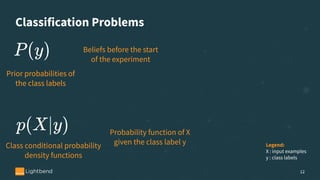
Classification Problems
• Learn concepts from a static dataset, instances of
which belong to an underlying distribution
defined by a generating function
• This dataset is assumed to contain all
information necessary to learn all the concepts
pertaining to the underlying generating function
11
Classification Problems
12
Legend:
X : input examples
y : class labels
Prior probabilities of
the class labels
Class conditional probability
density functions
Prior probabilities of
the class labels
Beliefs before the start
of the experiment
Probability function of X
given the class label y
Classification Problems
13
Legend:
X : input examples
y : class labels
Prior probabilities of
the class labels
Class conditional probability
density functions
Posterior - Probability that the sample to
be classified is a y, given the data set
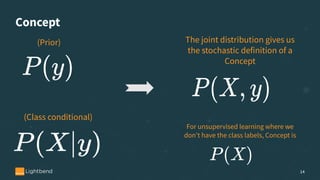
Concept
14
(Prior)
(Class conditional)
The joint distribution gives us
the stochastic definition of a
Concept
For unsupervised learning where we
don't have the class labels, Concept is
Streaming Classification Assumptions
• Data are not necessarily iid
• Solutions are approximate based on one pass of the data
• Error Estimation requires special estimators for non-stationary
distributions: Prequential Accuracy
• if example per class distribution is imbalanced use the Cohen statistic
(Kappa statistic)
• McNemar's test or Q testing with fading factors for statistical
significance when comparing two classifiers
• If distribution is stationary a holdout approach can be used.
15
Concept Drift
Because data is expected to evolve over time, especially in
dynamically changing environments, where non stationarity is
typical, the underlying distribution can change dynamically over
time.
Concept drift between time point t0
and time point t1
can be
defined as:
16
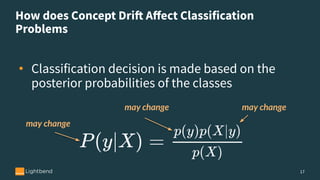
How does Concept Drift Affect Classification
Problems
17
• Classification decision is made based on the
posterior probabilities of the classes
may changemay change
may change
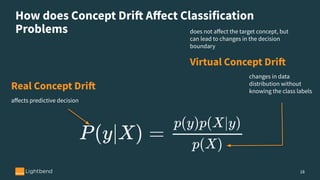
How does Concept Drift Affect Classification
Problems
18
affects predictive decision
changes in data
distribution without
knowing the class labels
Real Concept Drift
Virtual Concept Drift
does not affect the target concept, but
can lead to changes in the decision
boundary
Real and Virtual Concept Drifts
19
(Source) A Survey on Concept Drift Adaptation - Joao Gama et al. ACM Computing Surveys, 46, 4, March 2014
DOI: http://dx.doi.org/10.1145/2523813
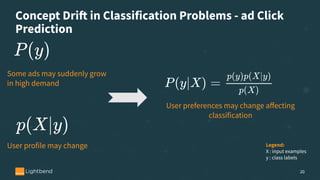
Concept Drift in Classification Problems - ad Click
Prediction
20
Legend:
X : input examples
y : class labels
Some ads may suddenly grow
in high demand
User profile may change
User preferences may change affecting
classification
Adaptive Learning Model
● how to adapt to evolving data over time
● detecting concept drift and adapting to it
Adaptive Learning Model
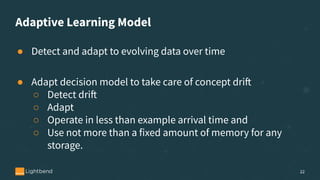
● Detect and adapt to evolving data over time
● Adapt decision model to take care of concept drift
○ Detect drift
○ Adapt
○ Operate in less than example arrival time and
○ Use not more than a fixed amount of memory for any
storage.
22
Adaptive Learning Model
23
Legend:
X : input examples
y : class labels
L : decision model for prediction
based on a learning algorithm y = L(X)
Step 1: Predict
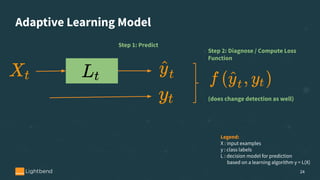
Adaptive Learning Model
24
Legend:
X : input examples
y : class labels
L : decision model for prediction
based on a learning algorithm y = L(X)
Step 1: Predict
Step 2: Diagnose / Compute Loss
Function
(does change detection as well)
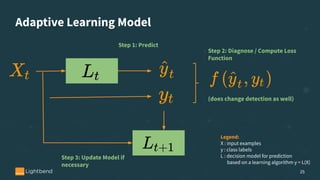
Adaptive Learning Model
25
Legend:
X : input examples
y : class labels
L : decision model for prediction
based on a learning algorithm y = L(X)
Step 1: Predict
Step 2: Diagnose / Compute Loss
Function
Step 3: Update Model if
necessary
(does change detection as well)
26
João Gama, Indrė Žliobaitė, Albert Bifet, Mykola Pechenizkiy, and Abdelhamid Bouchachia. 2014. A survey
on concept drift adaptation. ACM Comput. Surv. 46, 4, Article 44 (March 2014), 37 pages. DOI:
https://doi.org/10.1145/2523813
Evaluation Metrics
● Difference from batch mode
● Prequential evaluation model (test-then-train)
Evaluation Metrics - Batch
Examples of the form of pairs Decision Model output
Error!
Error rate is the probability of observing
Learning Model
(Train)
Evaluation Metrics - Streaming
• Incorporate new information at the speed data arrives
• Detect changes and adapt the model to the most recent
information
• Forget outdated information
Evaluation Metrics - Streaming
30
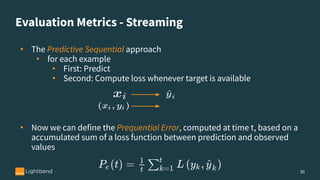
• The Predictive Sequential approach
• for each example
• First: Predict
• Second: Compute loss whenever target is available
• Now we can define the Prequential Error, computed at time t, based on a
accumulated sum of a loss function between prediction and observed
values
Prequential Evaluation
• Evolution of learning as a process
• The model becomes better and better as we see more and
more examples
• Recency is important - compute the prequential error using a
forgetting mechanism
31
Forgetting mechanism for error estimation
● Prequential accuracy over a sliding window of a specific size
with the most recent observations
● Fading factors that weigh observations using a decay factor
𝛂
32
Techniques to overcome Concept Drift
● The ADWIN Algorithm - based on sliding windows of dynamic size, where
the algorithm ensures that the window of data closely approximates the current
concept distribution
● Hoeffding Adaptive Trees - a data structure where the base learner is able
to adapt to new training data in case of concept drift
An Adaptive Windowing Algorithm with
forgetfulness
34
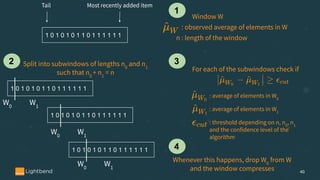
The ADWIN Algorithm
● Windows of varying size (recomputed online)
● Automatically grows the window when no change occurs and shrinks it
when data changes
● Whenever two “large enough” sub-windows exhibit “distinct enough”
averages
○ We can conclude that the corresponding “expected values” are
different
○ The older portion of the window is dropped
35
The ADWIN Algorithm - Notations and Settings
• a (possibly infinite) sequence of real values x1
, x2
, .. , xt
, ..
• a confidence value 𝛿 ∈ (0, 1)
• the value of xt
is available only at time t
• each xt
is generated according to some distribution Dt
independent of every t
• 𝜇t
and 𝜎t
2
denote the expected value and variance of xt
when it is drawn according to Dt
• xt
is always in [0, 1]
36
1 0 1 0 1 0 1 1 0 1 1 1 1 1 1
Window W
: observed average of elements in W
Tail Most recently added item
n : length of the window
1
1 0 1 0 1 0 1 1 0 1 1 1 1 1 1
Window W
: observed average of elements in W
Tail Most recently added item
n : length of the window
1 0 1 0 1 0 1 1 0 1 1 1 1 1 1
1 0 1 0 1 0 1 1 0 1 1 1 1 1 1
1 0 1 0 1 0 1 1 0 1 1 1 1 1 1
W0
W1
W0
W1
W0
W1
Split into subwindows of lengths n0
and n1
such that n0
+ n1
= n
1
2
39
1 0 1 0 1 0 1 1 0 1 1 1 1 1 1
Window W
: observed average of elements in W
Tail Most recently added item
n : length of the window
1 0 1 0 1 0 1 1 0 1 1 1 1 1 1
1 0 1 0 1 0 1 1 0 1 1 1 1 1 1
1 0 1 0 1 0 1 1 0 1 1 1 1 1 1
W0
W1
W0
W1
W0
W1
Split into subwindows of lengths n0
and n1
such that n0
+ n1
= n For each of the subwindows check if
: average of elements in W0
: average of elements in W1
1
2 3
: threshold depending on n, n0
, n1
and the confidence level of the
algorithm
40
1 0 1 0 1 0 1 1 0 1 1 1 1 1 1
Window W
: observed average of elements in W
Tail Most recently added item
n : length of the window
1 0 1 0 1 0 1 1 0 1 1 1 1 1 1
1 0 1 0 1 0 1 1 0 1 1 1 1 1 1
1 0 1 0 1 0 1 1 0 1 1 1 1 1 1
W0
W1
W0
W1
W0
W1
Split into subwindows of lengths n0
and n1
such that n0
+ n1
= n For each of the subwindows check if
: average of elements in W0
: average of elements in W1
1
2 3
: threshold depending on n, n0
, n1
and the confidence level of the
algorithm
Whenever this happens, drop W0
from W
and the window compresses
4
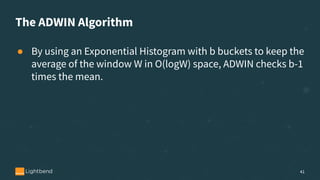
The ADWIN Algorithm
● By using an Exponential Histogram with b buckets to keep the
average of the window W in O(logW) space, ADWIN checks b-1
times the mean.
41
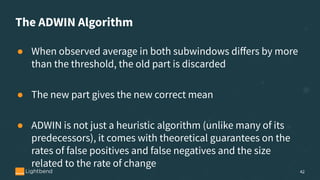
The ADWIN Algorithm
● When observed average in both subwindows differs by more
than the threshold, the old part is discarded
● The new part gives the new correct mean
● ADWIN is not just a heuristic algorithm (unlike many of its
predecessors), it comes with theoretical guarantees on the
rates of false positives and false negatives and the size
related to the rate of change
42
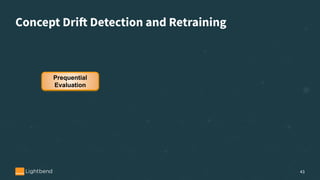
43
Prequential
Evaluation
Concept Drift Detection and Retraining
44
Prequential
Evaluation
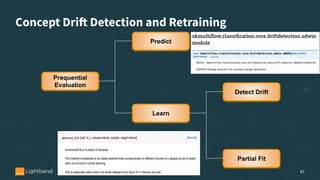
Predict
Learn
Concept Drift Detection and Retraining
45
Prequential
Evaluation
Predict
Learn
Detect Drift
Partial Fit
Concept Drift Detection and Retraining
46
Prequential
Evaluation
Predict
Learn
Detect Drift
Partial Fit
Concept Drift Detection and Retraining
47
Prequential
Evaluation
Predict
Learn
Detect Drift
Partial Fit
Concept Drift Detection and Retraining
48
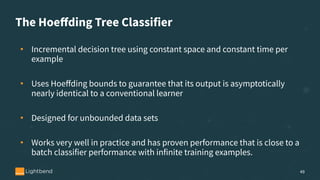
The Hoeffding Tree Classifier
• Incremental decision tree using constant space and constant time per
example
• Uses Hoeffding bounds to guarantee that its output is asymptotically
nearly identical to a conventional learner
• Designed for unbounded data sets
• Works very well in practice and has proven performance that is close to a
batch classifier performance with infinite training examples.
49
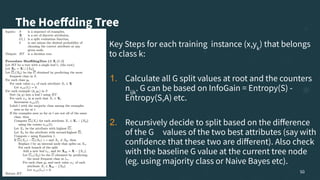
The Hoeffding Tree
Key Steps for each training instance (x,yk
) that belongs
to class k:
1. Calculate all G split values at root and the counters
nijk
. G can be based on InfoGain = Entropy(S) -
Entropy(S,A) etc.
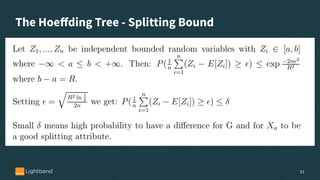
2. Recursively decide to split based on the difference
of the G values of the two best attributes (say with
confidence that these two are different). Also check
with the baseline G value at the current tree node
(eg. using majority class or Naive Bayes etc).
50
The Hoeffding Tree - Splitting Bound
51
The Hoeffding Tree
Later improvements:
• VFDT, CVFDT (concept drift support and using a sliding
window), VFDTc & UFFT (numeric values and concept drift
support)
• Hoeffding Adaptive Tree (uses ADWIN for the concept drift)
Common G functions like Gini Index cannot be expressed as
independent random variables so formally the Hoeffding bound
is not appropriate but works in practice. McDiarmid inequality is
considered state of the art in this area.
52
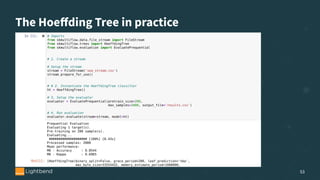
The Hoeffding Tree in practice
53
The Hoeffding Adaptive Tree
Key idea: Whenever change
is detected as we traverse a
node, we start a new
sub-tree.
54
Demo
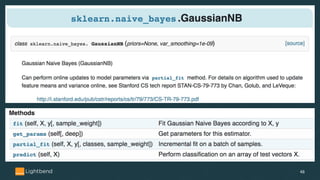
https://github.com/debasishg/strata-ny-2019/blob/master/conce
pt-drift/test-GaussianNB.ipynb
55
56
Thank You Stavros Kontopoulos
stavros.kontopoulos@lightbend.com
@s_kontopoulos
Debasish Ghosh
debasish.ghosh@lightbend.com
@debasishg

Online machine learning in Streaming Applications

  • 1.
    Online Machine Learningin Streaming Applications Stavros Kontopoulos (Principal Engineer, Lightbend) @s_kontopoulos & Debasish Ghosh (Principal Engineer, Lightbend) @debasishg {stavros.kontopoulos, debasish.ghosh}@lightbend.com
  • 2.
    Agenda • Data Streamsmeet Machine Learning. How they differ from static data sets. • Learning systems for data streams • Adaptive learning model • Evaluation metrics • The ADWIN algorithm and the complete cycle of training streaming systems • The Hoeffding Tree based classifiers 2
  • 3.
    Formalizing Data Streams ●Difference with batch learning using static data sets ● The data stream model ● Challenges of stream based learning
  • 4.
    Batch Learning • Staticdata set to generate an output hypothesis • One shot data analysis - fixed stable feature space • Assume stationarity of data 4
  • 5.
    Batch and OnlineLearning • Static data set to generate an output hypothesis • One shot data analysis - fixed stable feature space • Assume stationarity of data 5 • Learner operates on a (potentially infinite) sequence of data streams • Evolving feature space - new learning paradigm Feature Evolvable Streaming Learning • Non stationary data set - leading to concept drift
  • 6.
    Formalizing Data Streams •Data streams are ordered sequences of data elements: S = (s1 , s2 , …, sn ) where n can potentially be infinite • data arrives continuously • in a potentially infinite stream • that has to be processed by a resource constrained system 6
  • 7.
    Challenges of Stream-basedLearning ● Very large (potentially infinite) number of data elements - think sublinear space ● High rate of data arrival at the system - may need to think of sampling ● Changes in data distribution during stream processing, which can affect prediction - concept drift 7
  • 8.
    Learning Systems forData Streams ● Dimensions of learning ● Classification problems ● Concept drift
  • 9.
    Learning Systems forData Streams Desirable properties of learning systems for efficiently mining continuous, high-volume, open ended data streams (Hulten and Domingoes, 20011 ): ● Require small constant time per data example ● Use fixed amount of main memory, irrespective of the number of examples ● Build a decision model using a single scan over the training data ● Generate an anytime model independent of the order of the examples ● Ability to deal with concept drift 1 Hulten, G., & Domingos, P. (2001). Catching up with the data: research issues in mining data streams. In Proc. of workshop on research issues in data mining and knowledge discovery, Santa Barbara, USA. 9
  • 10.
    Dimensions of Learning ●Space - the available memory is fixed ● Learning Time - process incoming examples at the rate they arrive ● Generalization Power - how effective the model is at capturing the true underlying concept 10
  • 11.
    Classification Problems • Learnconcepts from a static dataset, instances of which belong to an underlying distribution defined by a generating function • This dataset is assumed to contain all information necessary to learn all the concepts pertaining to the underlying generating function 11
  • 12.
    Classification Problems 12 Legend: X :input examples y : class labels Prior probabilities of the class labels Class conditional probability density functions Prior probabilities of the class labels Beliefs before the start of the experiment Probability function of X given the class label y
  • 13.
    Classification Problems 13 Legend: X :input examples y : class labels Prior probabilities of the class labels Class conditional probability density functions Posterior - Probability that the sample to be classified is a y, given the data set
  • 14.
    Concept 14 (Prior) (Class conditional) The jointdistribution gives us the stochastic definition of a Concept For unsupervised learning where we don't have the class labels, Concept is
  • 15.
    Streaming Classification Assumptions •Data are not necessarily iid • Solutions are approximate based on one pass of the data • Error Estimation requires special estimators for non-stationary distributions: Prequential Accuracy • if example per class distribution is imbalanced use the Cohen statistic (Kappa statistic) • McNemar's test or Q testing with fading factors for statistical significance when comparing two classifiers • If distribution is stationary a holdout approach can be used. 15
  • 16.
    Concept Drift Because datais expected to evolve over time, especially in dynamically changing environments, where non stationarity is typical, the underlying distribution can change dynamically over time. Concept drift between time point t0 and time point t1 can be defined as: 16
  • 17.
    How does ConceptDrift Affect Classification Problems 17 • Classification decision is made based on the posterior probabilities of the classes may changemay change may change
  • 18.
    How does ConceptDrift Affect Classification Problems 18 affects predictive decision changes in data distribution without knowing the class labels Real Concept Drift Virtual Concept Drift does not affect the target concept, but can lead to changes in the decision boundary
  • 19.
    Real and VirtualConcept Drifts 19 (Source) A Survey on Concept Drift Adaptation - Joao Gama et al. ACM Computing Surveys, 46, 4, March 2014 DOI: http://dx.doi.org/10.1145/2523813
  • 20.
    Concept Drift inClassification Problems - ad Click Prediction 20 Legend: X : input examples y : class labels Some ads may suddenly grow in high demand User profile may change User preferences may change affecting classification
  • 21.
    Adaptive Learning Model ●how to adapt to evolving data over time ● detecting concept drift and adapting to it
  • 22.
    Adaptive Learning Model ●Detect and adapt to evolving data over time ● Adapt decision model to take care of concept drift ○ Detect drift ○ Adapt ○ Operate in less than example arrival time and ○ Use not more than a fixed amount of memory for any storage. 22
  • 23.
    Adaptive Learning Model 23 Legend: X: input examples y : class labels L : decision model for prediction based on a learning algorithm y = L(X) Step 1: Predict
  • 24.
    Adaptive Learning Model 24 Legend: X: input examples y : class labels L : decision model for prediction based on a learning algorithm y = L(X) Step 1: Predict Step 2: Diagnose / Compute Loss Function (does change detection as well)
  • 25.
    Adaptive Learning Model 25 Legend: X: input examples y : class labels L : decision model for prediction based on a learning algorithm y = L(X) Step 1: Predict Step 2: Diagnose / Compute Loss Function Step 3: Update Model if necessary (does change detection as well)
  • 26.
    26 João Gama, IndrėŽliobaitė, Albert Bifet, Mykola Pechenizkiy, and Abdelhamid Bouchachia. 2014. A survey on concept drift adaptation. ACM Comput. Surv. 46, 4, Article 44 (March 2014), 37 pages. DOI: https://doi.org/10.1145/2523813
  • 27.
    Evaluation Metrics ● Differencefrom batch mode ● Prequential evaluation model (test-then-train)
  • 28.
    Evaluation Metrics -Batch Examples of the form of pairs Decision Model output Error! Error rate is the probability of observing Learning Model (Train)
  • 29.
    Evaluation Metrics -Streaming • Incorporate new information at the speed data arrives • Detect changes and adapt the model to the most recent information • Forget outdated information
  • 30.
    Evaluation Metrics -Streaming 30 • The Predictive Sequential approach • for each example • First: Predict • Second: Compute loss whenever target is available • Now we can define the Prequential Error, computed at time t, based on a accumulated sum of a loss function between prediction and observed values
  • 31.
    Prequential Evaluation • Evolutionof learning as a process • The model becomes better and better as we see more and more examples • Recency is important - compute the prequential error using a forgetting mechanism 31
  • 32.
    Forgetting mechanism forerror estimation ● Prequential accuracy over a sliding window of a specific size with the most recent observations ● Fading factors that weigh observations using a decay factor 𝛂 32
  • 33.
    Techniques to overcomeConcept Drift ● The ADWIN Algorithm - based on sliding windows of dynamic size, where the algorithm ensures that the window of data closely approximates the current concept distribution ● Hoeffding Adaptive Trees - a data structure where the base learner is able to adapt to new training data in case of concept drift
  • 34.
    An Adaptive WindowingAlgorithm with forgetfulness 34
  • 35.
    The ADWIN Algorithm ●Windows of varying size (recomputed online) ● Automatically grows the window when no change occurs and shrinks it when data changes ● Whenever two “large enough” sub-windows exhibit “distinct enough” averages ○ We can conclude that the corresponding “expected values” are different ○ The older portion of the window is dropped 35
  • 36.
    The ADWIN Algorithm- Notations and Settings • a (possibly infinite) sequence of real values x1 , x2 , .. , xt , .. • a confidence value 𝛿 ∈ (0, 1) • the value of xt is available only at time t • each xt is generated according to some distribution Dt independent of every t • 𝜇t and 𝜎t 2 denote the expected value and variance of xt when it is drawn according to Dt • xt is always in [0, 1] 36
  • 37.
    1 0 10 1 0 1 1 0 1 1 1 1 1 1 Window W : observed average of elements in W Tail Most recently added item n : length of the window 1
  • 38.
    1 0 10 1 0 1 1 0 1 1 1 1 1 1 Window W : observed average of elements in W Tail Most recently added item n : length of the window 1 0 1 0 1 0 1 1 0 1 1 1 1 1 1 1 0 1 0 1 0 1 1 0 1 1 1 1 1 1 1 0 1 0 1 0 1 1 0 1 1 1 1 1 1 W0 W1 W0 W1 W0 W1 Split into subwindows of lengths n0 and n1 such that n0 + n1 = n 1 2
  • 39.
    39 1 0 10 1 0 1 1 0 1 1 1 1 1 1 Window W : observed average of elements in W Tail Most recently added item n : length of the window 1 0 1 0 1 0 1 1 0 1 1 1 1 1 1 1 0 1 0 1 0 1 1 0 1 1 1 1 1 1 1 0 1 0 1 0 1 1 0 1 1 1 1 1 1 W0 W1 W0 W1 W0 W1 Split into subwindows of lengths n0 and n1 such that n0 + n1 = n For each of the subwindows check if : average of elements in W0 : average of elements in W1 1 2 3 : threshold depending on n, n0 , n1 and the confidence level of the algorithm
  • 40.
    40 1 0 10 1 0 1 1 0 1 1 1 1 1 1 Window W : observed average of elements in W Tail Most recently added item n : length of the window 1 0 1 0 1 0 1 1 0 1 1 1 1 1 1 1 0 1 0 1 0 1 1 0 1 1 1 1 1 1 1 0 1 0 1 0 1 1 0 1 1 1 1 1 1 W0 W1 W0 W1 W0 W1 Split into subwindows of lengths n0 and n1 such that n0 + n1 = n For each of the subwindows check if : average of elements in W0 : average of elements in W1 1 2 3 : threshold depending on n, n0 , n1 and the confidence level of the algorithm Whenever this happens, drop W0 from W and the window compresses 4
  • 41.
    The ADWIN Algorithm ●By using an Exponential Histogram with b buckets to keep the average of the window W in O(logW) space, ADWIN checks b-1 times the mean. 41
  • 42.
    The ADWIN Algorithm ●When observed average in both subwindows differs by more than the threshold, the old part is discarded ● The new part gives the new correct mean ● ADWIN is not just a heuristic algorithm (unlike many of its predecessors), it comes with theoretical guarantees on the rates of false positives and false negatives and the size related to the rate of change 42
  • 43.
  • 44.
  • 45.
  • 46.
  • 47.
  • 48.
  • 49.
    The Hoeffding TreeClassifier • Incremental decision tree using constant space and constant time per example • Uses Hoeffding bounds to guarantee that its output is asymptotically nearly identical to a conventional learner • Designed for unbounded data sets • Works very well in practice and has proven performance that is close to a batch classifier performance with infinite training examples. 49
  • 50.
    The Hoeffding Tree KeySteps for each training instance (x,yk ) that belongs to class k: 1. Calculate all G split values at root and the counters nijk . G can be based on InfoGain = Entropy(S) - Entropy(S,A) etc. 2. Recursively decide to split based on the difference of the G values of the two best attributes (say with confidence that these two are different). Also check with the baseline G value at the current tree node (eg. using majority class or Naive Bayes etc). 50
  • 51.
    The Hoeffding Tree- Splitting Bound 51
  • 52.
    The Hoeffding Tree Laterimprovements: • VFDT, CVFDT (concept drift support and using a sliding window), VFDTc & UFFT (numeric values and concept drift support) • Hoeffding Adaptive Tree (uses ADWIN for the concept drift) Common G functions like Gini Index cannot be expressed as independent random variables so formally the Hoeffding bound is not appropriate but works in practice. McDiarmid inequality is considered state of the art in this area. 52
  • 53.
    The Hoeffding Treein practice 53
  • 54.
    The Hoeffding AdaptiveTree Key idea: Whenever change is detected as we traverse a node, we start a new sub-tree. 54
  • 55.
  • 56.
  • 57.
    Thank You StavrosKontopoulos stavros.kontopoulos@lightbend.com @s_kontopoulos Debasish Ghosh debasish.ghosh@lightbend.com @debasishg