Presented by

      Gaurav Gunjan
Govt. Engg College,Bikaner
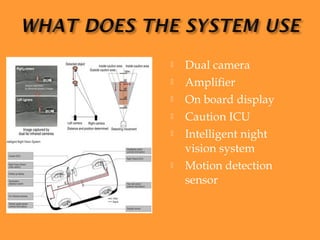
   Dual camera
   Amplifier
   On board display
   Caution ICU
   Intelligent night
    vision system
   Motion detection
    sensor
   Vehicle Speed Sensor

   Daylight Sensors

   Night Vision Sensor

   Vehicular Output
    Sensors
   A signal processor translates the thermo gram data to an image
    suitable for display on a monitor.
   the range of an FIR system was over three times further than that
    obtained with NIR — 119 m compared with 35 m.
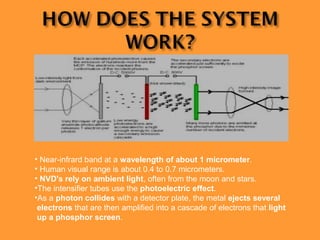
• Near-infrard band at a wavelength of about 1 micrometer.
• Human visual range is about 0.4 to 0.7 micrometers.
• NVD's rely on ambient light, often from the moon and stars.
•The intensifier tubes use the photoelectric effect.
•As a photon collides with a detector plate, the metal ejects several
 electrons that are then amplified into a cascade of electrons that light
 up a phosphor screen.
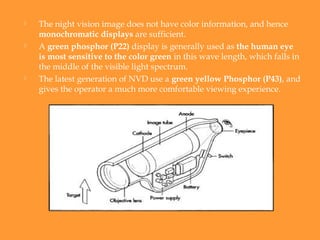
   The night vision image does not have color information, and hence
    monochromatic displays are sufficient.
   A green phosphor (P22) display is generally used as the human eye
    is most sensitive to the color green in this wave length, which falls in
    the middle of the visible light spectrum.
   The latest generation of NVD use a green yellow Phosphor (P43), and
    gives the operator a much more comfortable viewing experience.
   Definition: 420 TV Lines
   Scan Frequency: 60Hz
   Minimum Illumination: 0
    LUX
   120 degree super wide
    viewing angle
   Size : 28mm x 42 mm
   Operation Temp : -20C ~ 50C
   Operating Voltage: DC 12-
    Volt
   Inside Mount: fits into most
    vehicle key holes
   Water Resistant
   Full Motion Real Time
    Colour Video without delay.
   Standard video output
   Increment Control: Auto
Analysis of US traffic fatalities by the University of Michigan Transport
     Research Institute (UMTRI) has shown :

    The risk of a pedestrian fatality is around four times higher at night
     than during daylight hours.
    Higher alcohol consumption, increased fatigue, greater exposure to
     animals on the road and reduced range of vision are some of the
     important factors owing to the same.
    One reason that driving at night is so difficult is that high-beam
     headlights can rarely be used owing to the frequent presence of
     oncoming traffic.
    Older drivers, who typically have shorter detection distances of just
     30–50 m for dark objects when driving with low-beams and facing
     oncoming vehicles.
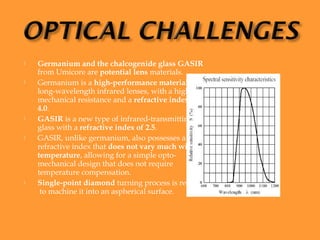
   Germanium and the chalcogenide glass GASIR
    from Umicore are potential lens materials.
   Germanium is a high-performance material for
    long-wavelength infrared lenses, with a high
    mechanical resistance and a refractive index of
    4.0.
   GASIR is a new type of infrared-transmitting
    glass with a refractive index of 2.5.
   GASIR, unlike germanium, also possesses a
    refractive index that does not vary much with
    temperature, allowing for a simple opto-
    mechanical design that does not require
    temperature compensation.
   Single-point diamond turning process is required
     to machine it into an aspherical surface.
   Connect to any type of
    monitor with a composite
    yellow RCA jack for
    crystal clear resolution.
   Mounted inside will fit
    into most vehicle key
    holes, no other installation
    needed
   Small compact size
   Waterproof
   Low power consumption
   High sensitivity
   Low maintenance
   Easy and comprehensive
    installation
It has become the need of the hour to have these kinds
of hybrid safety systems on the latest automobiles that
could save the lives of many. Many such ideas are yet to
come and it is the duty of young budding engineers to
think innovatively and work upon developing such
techniques one of which being the night vision sensors
used in cars and other automobiles that are proving to be
a great success in the west and this should be
implemented immediately on the Indian terrain and
reduce the catastrophic incidents that occur on the roads
especially during the night times.
THANK YOU

Night vision car

  • 1.
    Presented by Gaurav Gunjan Govt. Engg College,Bikaner
  • 3.
    Dual camera  Amplifier  On board display  Caution ICU  Intelligent night vision system  Motion detection sensor
  • 4.
    Vehicle Speed Sensor  Daylight Sensors  Night Vision Sensor  Vehicular Output Sensors
  • 5.
    A signal processor translates the thermo gram data to an image suitable for display on a monitor.  the range of an FIR system was over three times further than that obtained with NIR — 119 m compared with 35 m.
  • 6.
    • Near-infrard bandat a wavelength of about 1 micrometer. • Human visual range is about 0.4 to 0.7 micrometers. • NVD's rely on ambient light, often from the moon and stars. •The intensifier tubes use the photoelectric effect. •As a photon collides with a detector plate, the metal ejects several electrons that are then amplified into a cascade of electrons that light up a phosphor screen.
  • 7.
    The night vision image does not have color information, and hence monochromatic displays are sufficient.  A green phosphor (P22) display is generally used as the human eye is most sensitive to the color green in this wave length, which falls in the middle of the visible light spectrum.  The latest generation of NVD use a green yellow Phosphor (P43), and gives the operator a much more comfortable viewing experience.
  • 8.
    Definition: 420 TV Lines  Scan Frequency: 60Hz  Minimum Illumination: 0 LUX  120 degree super wide viewing angle  Size : 28mm x 42 mm  Operation Temp : -20C ~ 50C  Operating Voltage: DC 12- Volt  Inside Mount: fits into most vehicle key holes  Water Resistant  Full Motion Real Time Colour Video without delay.  Standard video output  Increment Control: Auto
  • 9.
    Analysis of UStraffic fatalities by the University of Michigan Transport Research Institute (UMTRI) has shown :  The risk of a pedestrian fatality is around four times higher at night than during daylight hours.  Higher alcohol consumption, increased fatigue, greater exposure to animals on the road and reduced range of vision are some of the important factors owing to the same.  One reason that driving at night is so difficult is that high-beam headlights can rarely be used owing to the frequent presence of oncoming traffic.  Older drivers, who typically have shorter detection distances of just 30–50 m for dark objects when driving with low-beams and facing oncoming vehicles.
  • 10.
    Germanium and the chalcogenide glass GASIR from Umicore are potential lens materials.  Germanium is a high-performance material for long-wavelength infrared lenses, with a high mechanical resistance and a refractive index of 4.0.  GASIR is a new type of infrared-transmitting glass with a refractive index of 2.5.  GASIR, unlike germanium, also possesses a refractive index that does not vary much with temperature, allowing for a simple opto- mechanical design that does not require temperature compensation.  Single-point diamond turning process is required to machine it into an aspherical surface.
  • 11.
    Connect to any type of monitor with a composite yellow RCA jack for crystal clear resolution.  Mounted inside will fit into most vehicle key holes, no other installation needed  Small compact size  Waterproof  Low power consumption  High sensitivity  Low maintenance  Easy and comprehensive installation
  • 12.
    It has becomethe need of the hour to have these kinds of hybrid safety systems on the latest automobiles that could save the lives of many. Many such ideas are yet to come and it is the duty of young budding engineers to think innovatively and work upon developing such techniques one of which being the night vision sensors used in cars and other automobiles that are proving to be a great success in the west and this should be implemented immediately on the Indian terrain and reduce the catastrophic incidents that occur on the roads especially during the night times.
  • 13.