Biomass Gasification System
for Rural Electrification
Prof. Dr. Krishna Raj Shrestha
Research Centre for Applied Science and
Technology (RECAST)
Tribhuvan University
Kathmandu, Nepal
Project Team
• Prof.Dr.Krishna Raj Shrestha-TeamLeader
• Uttara Bajracharya -Sociologist
• Rajib Thakur- Energy Engineer
• Bijay Raj Subedee- Biotechnologist
• Roshan Kumar Amatya -Senior Mechanics
• Sushil Karmacharya - Senior Mechanics
• Dambar Bahadur Ale - Helper
Introduction
• Biomass refers to all forms of organic matter produced
as products of photosynthesis. Biomass has long served
as one of the primary energy forms utilized by human
being for essential activities aside from nutrition.
Different forms of biomass are
• Forest based products
• Timber, fuel wood, wood chips/shavings, saw dust, a
milling residue, forest waste like leaves, twigs, shrubs,
herbs herbal products, etc.
• Agriculture based products
• Aquatic plants
• Animal dung and human waste.
Energy Consumption Situation by fuel
type
79.6%
2.8%
3.9%
12.3%
1.2%
0.1%
376.3 MGJ
Biomass
Grid electricity
Coal
Petroleum
Renewable
Others
Source :WECS Survey
,2011
Gasification
Biomass gasification is basically conversion of solid
biomass (i.e. wood/ wood wastes, agro-residues and
organic industrial wastes) into a combustible gas
mixture. It is carried out in an enclosed reactor
operating at about 900oC where in a part of the
biomass is combusted by air to provide the heat. The
resulting gas known as producer gas contains CO(15
-29 %), CO2 (5 -15 %), H2 (5 -12 %), N2 (50 –65 %) and
small amounts of hydrocarbon gases. The calorific
value of the gas ranges from 1200-1500 kcal/m3.
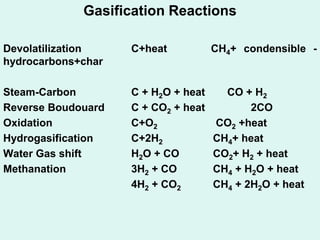
Gasification Reactions
Devolatilization C+heat CH4+ condensible -
hydrocarbons+char
Steam-Carbon C + H2O + heat CO + H2
Reverse Boudouard C + CO2 + heat 2CO
Oxidation C+O2 CO2 +heat
Hydrogasification C+2H2 CH4+ heat
Water Gas shift H2O + CO CO2+ H2 + heat
Methanation 3H2 + CO CH4 + H2O + heat
4H2 + CO2 CH4 + 2H2O + heat
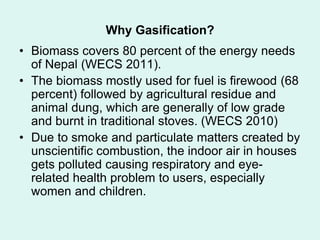
Why Gasification?
• Biomass covers 80 percent of the energy needs
of Nepal (WECS 2011).
• The biomass mostly used for fuel is firewood (68
percent) followed by agricultural residue and
animal dung, which are generally of low grade
and burnt in traditional stoves. (WECS 2010)
• Due to smoke and particulate matters created by
unscientific combustion, the indoor air in houses
gets polluted causing respiratory and eye-
related health problem to users, especially
women and children.
Different waste biomass
Lantana camera Mugwort – Tite pati
Banmara Mikania Macrantha
- Banmasa
Pine needles
Agro residues
Crop type Area
[Ha]
Crop Prod
[MT]
Residue
type
RPR* Total Residue
Prod [MT]
Paddy 1,531,493 5,072,248 Total
residue
1.68 8,521,376
Husk 0.267 1,354,290
Maize 871387 2179414 Total
residue
5,389,691
stalk 2 4,358,828
cob 0.273 594,980
husk 0.2 435,883
Millet 278030 315067 stalk 1.08 340,272
Wheat 765317 1846142 straw 1.75 3,230,748
Buckwheat 10339 10021 Straw 1 10,021
Barley 27966 34829.8 straw 1.75 60,952
Agro residues (cont)
Crop type Area
[Ha]
Crop Prod
[MT]
Residue type RPR Total Residue
Prod [MT]
Oil Seed 214835 179145 Stalk 4.01 71,837
Sugarcane 64472 2930047 Bagasse 0.29 849,714
tops/leaves 0.3 879,014
Total 1,728,728
Jute 10540 14424 Stick 2 28,848
Soybean 29281.8 28269.8 Total 98,944.3
Straw 2.5 70,674.5
Pods 1 28,269.8
Black Gram 27496.2 22482.4 Straw/stick 1.66 37,320
Cotton 135 133 Sticks 2.75 365.75
Coconut Husk 0.419 NA
Shell 0.12 NA
Coffee 1780 425000 Husk 2.1 892,500
Ground nut 2736 3869 Husk 0.477 1,845
Straw 2.30 8,899
Saw Dust
Twigs and branches
Different Forest waste
• Banmara - 1.78 kg/m2 (17 tons/ha)
• Pine needles - 4.5 million tons (382,944.80
ha pine forest area)
• Besarmi jhar - 5-6 kgs/m2
• Saal leaves - 2,019,600 tons of leaf litter per
year
- 5 tons of waste materials/month
• Mikania micrantha - ~ 600,000 tons of dried
Mikania (20 districts)
Besarmi jhar, Saal leaves
and leaf litter
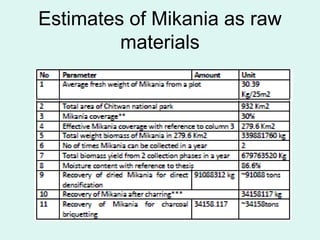
Estimates of Mikania as raw
materials
Municipal Solid waste
No. Type of waste 1976 1981 1985 1988 1995 1999 2000 2004 2008
1 Organic 67.8 60.0 67.5 58.1 65.0 67.5 69.84 67 68.0
2 Paper 6.5 19.3 6.0 6.2 4.0 8.8 8.5 10 10.0
3 Rubber 0.0 0.0 0.0 0.4 1.0 0.3 0.54 0.24 mix1
4 Leather - - - - - - 0.12 - -
5 Wood 2.7 1.6 0.0 0.5 3.0 0.6 0.73 - -
6 Plastic 0.3 3.6 2.6 2.0 5.0 11.4 9.17 16 13.0
7 Bone - - - - - - 0.23 - -
8 Textile 6.5 5.3 2.7 2.0 3.0 3.6 3.02 4 2.0
9 Ferrous metal 4.9 3.4 2.2 0.4 1.0 0.9 0.87 1 -
10 Aluminium - - - - - - 0.05 - -
11 Metal - - - - - - - - 1.0
12 Sand dust - - - - - - - - 1.0
12 Glass 1.3 3.4 4.0 1.6 1.0 1.6 2.5 1 4.0
13 Construction
debris/Others
10.0 3.4 15.0 28.9 17.0 5.3 4.33 1.24 1.0
From simple calculations, this gives about 181 tons of plastics, 186 tons of
paper, 36 tons of textiles and 15 tons of woody matter on a daily basis
58 municipalities in Nepal and the amount of waste generated by these
municipalities per day comes to 2813.13 tons. Out of this amount of generated
waste, 2164.49 tons are collected.
Industrial waste
• Waste from veneer industries
• Furniture, handicraft (wooden frames), etc.
– Bira Furniture in Patan - 10-15 tons of wood
waste per month
– Lalitkaltmak Kastha Udyog - (~0.5 tons) of Saw
dust and 1-1.5 tons of wooden strips are
generated per week
Subject Amount in Cu.ft.
processed per
day
Waste per day
(taking 50%)
Density of
soft wood
Total Amount
waste per day
Waste from Sri Om
Veneer
400 cft.
(300-500cft)
200 cft. =
5.66 m3
53lb/cft*
(670kg/m3)
3792kg or
3.8 tons
Total Amount of waste generated from 200 industries from all over Nepal 758.440 tons
Current use by local people and boilers and tea drying = 25% 189.610 tons
Unutilized waste that can be used for briquetting = 75% 568.830 tons
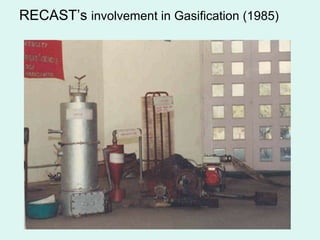
RECAST’s involvement in Gasification (1985)
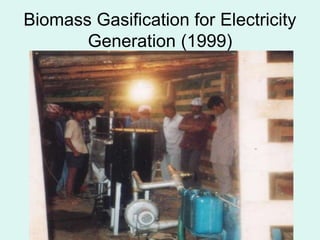
Biomass Gasification for Electricity
Generation (1999)
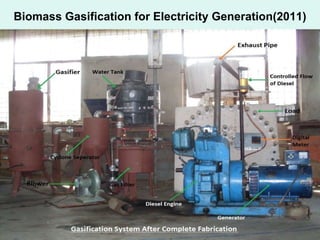
Biomass Gasification for Electricity Generation(2011)
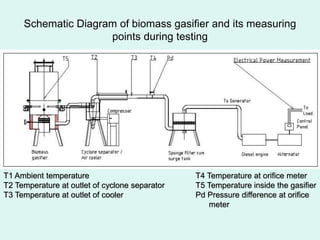
Schematic Diagram of biomass gasifier and its measuring
points during testing
T1 Ambient temperature T4 Temperature at orifice meter
T2 Temperature at outlet of cyclone separator T5 Temperature inside the gasifier
T3 Temperature at outlet of cooler Pd Pressure difference at orifice
meter
Gasifier
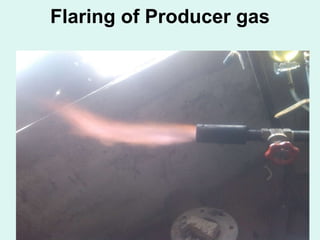
Flaring of Producer gas
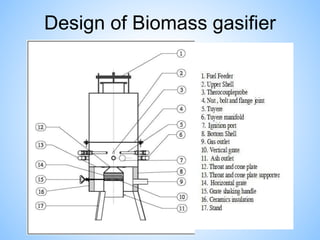
Design of Biomass gasifier
Cyclone separator
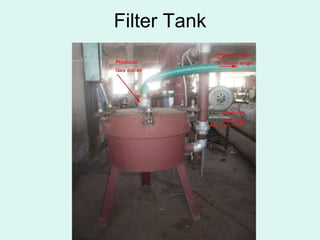
Filter Tank
Air Heater (9 kW capacity) to
test the real output of the plant
Measuring Instruments used
during the testing
Multi channel temperature scanner
K type thermo couple
Orifice flow meter
True RMS clamp on meter
Balance up to 100 kg.
Portable gas analyzer ( For Co measurement
of producer gas)
Stop watch
burette 1000 ml
Test results
`
Load
(kW)
Ambient
Temperatu
re
T1(o
C)
T2
(oC) T3(oC)
T4
(oC) T5(oC)
Pressure
difference
( cm of
water)
Gas
quantity
(m3
/secon
d
Gas
quantity
(m3
/Hour
Time
taken to
consume
100ml
Diesel
consumpt
ion per
hour
(liter) Mode
Diesel/
Producr
e gas
ratio
Charcole
consump
tion (Kg)
12.30 6.00 24.00 2.53 2.37 Diesel 100.00 0.00
1.00 6.00 24.00 79.00 19.00 84.00 457.00 8.00 0.00 14.15 4.23 1.42 Duel 59.81
1.30 6.00 27.00 156.00 62.00 164.00 525.00 7.00 0.00 13.00 3.19 1.88 Duel 79.31
2.00 6.00 30.00 203.00 84.00 208.00 530.00 8.50 0.00 14.58 5.06 1.19 Duel 50.00
2.30 6.00 33.00 265.00 112.00 247.00 560.00 7.00 0.00 13.00 5.13 1.17 Duel 49.32
3.00 6.00 33.00 192.00 84.00 196.00 459.00 8.50 0.00 14.20 5.06 1.19 Duel 50.00
Average 6.00 30.75 204.00 85.50 203.75 518.50 8.00 0.00 13.70 4.53 1.32 57.69 2.80
7.00
Time
Load
(kW)
Ambient
Temperatu
re
T1(o
C)
T2
(oC) T3(oC)
T4
(oC) T5(oC)
Pressure
difference
(cmof
water)
Gas
quantity
(m3
/second
Gas
quantity
(m3
/Hour)
Time
takento
consume
100
ml(minut
Diesel
consumpt
ionper
hour
(liter) Mode
Diesel/P
roducre
gasratio
Charcole
consump
tion(Kg)
12.30 3.00 28.00 28.00 28.00 28.00 28.00 3.96 1.52 Diesel 100.00 0.00
1.00 3.00 28.00 142.00 94.00 140.00 1052.00 3.00 0.00 8.92 5.05 1.19 Duel 78.42
1.30 3.00 29.00 168.00 94.00 178.00 1293.00 4.00 0.00 10.10 5.93 1.01 Duel 66.78
2.00 3.00 32.00 253.00 127.00 269.00 1440.00 3.00 0.00 8.92 4.40 1.36 Duel 90.00
2.30 3.00 34.00 238.00 119.00 215.00 1440.00 3.00 0.00 8.92 5.08 1.18 Duel 77.91
Average 3.00 30.75 200.25 108.50 200.50 1306.25 3.25 0.00 9.21 5.12 1.17 78.28 2kg/hour
4.00
Efficiency Calculation
Mass flowrate of
producergas
(m3/hour) (mg)
Calorificvalue of
producergas
(Kcal/m3)(cg)
Output
(mg*cg)
(Kcal/hour)
Mass flow
rate of Solid
fule
(Kg/hour)
(ms)
Calorificvalue of
Solidfuel
(Kcal/Kg) (cs)
Input
(ms*cs)
(Kcal/hour)
Efficiency
(%)
9.21 1167.15 10752.37 2.00 6794.00 13588.00 79.13
13.70 1167.15 15984.94 2.80 6794.00 19023.20 84.03
Efficiency of Biomasss gasifier at diffferent load condition
Powerproduce
fromgenerator
(KW)
Tharmalenergy
required(Kcal/hour
)
Diesel
consumed
(liter/hour)
Calorific
valueof
diesel(Kcal/
lit)
Thermelenergy
imputsfrom
diesel
(Kcal/hour)
Producer
Gas
consumpti
on(m3/h)
Calorific
valueof
producer
gas
(Kcal/m3)
Thermel
energy
imputs
from
producer
Total
Energy
imputs Efficiency
3.00 2580.00 1.17 9281.00 10858.77 9.21 1167.15 10752.37 21611.14 11.94
6.00 5160.00 1.32 9281.00 12250.92 13.70 1167.15 15984.94 28235.86 18.27
Efficiency DualMode
Power (kW)
Efficiency of
Gasifier
Efficiency of
CI engin and
Overall
efficiency
3.00 79.13 11.94 9.45
6.00 84.03 18.27 15.36
Overall efficiency of the Gasification
Powerproduce
fromgenerator
(KW)
Tharmal energy
required
(Kcal/hour)
Diesel
consumed
(liter/hour)
Calorific
value of
diesel(Kcal/
lit)
Thermel energy
imputs from
diesel
(Kcal/hour) Efficiency
3.00 2580.00 1.52 9281.00 14107.12 18.29
6.00 5160.00 2.27 9281.00 21067.87 24.49
9.00 7740.00 2.57 9281.00 23852.17 32.45
Efficieny Diesel mode
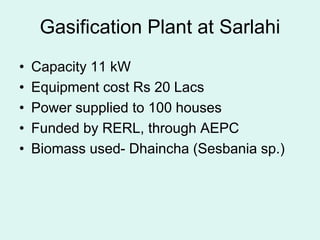
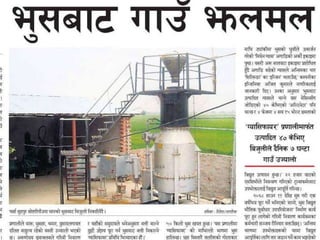
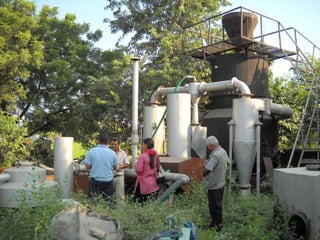
Gasification Plant at Sarlahi
• Capacity 11 kW
• Equipment cost Rs 20 Lacs
• Power supplied to 100 houses
• Funded by RERL, through AEPC
• Biomass used- Dhaincha (Sesbania sp.)
Rice Husk Gasification Plant
• 32 K.W Plant at Suhapur sohari, Parsa Dist.
• Husk Power System (P) Ltd., Bihar
• Plant Cost Rs 52 Lacs.
• Funded by Poverty Alleviation Fund and DDC Parsa
• Fuel consumption- 50 kg RH per hour
• Power supplied to 209 houses in the community
• Run by community-earns Rs 70,000/- by supplying
power and Rice milling
• Charges Rs 80/- per family per months per CFL bulb
• Rice Sheller mill- 12 Quintal Paddy produces 350 kg
of Rice Husk.
Further developments in this area…..
• Alternative Energy Promotion Centre(AEPC) has conducted
feasibility study in the Terai region of Nepal to install Biomass
Gasification Plant for Rural Electrification. Such a unit has
been tested in Sarlahi district aiming to pilot a site in the
district.
• There are more than 40 gasification plants that are
successfully operating in India and overseas for heat and
power applications. (TERI 2010)
• Renewable Nepal Program of Kathmandu University (KU) is
also working on a Project namely “Design, fabrication and
testing of a biomass gasifier for small size petrol and diesel
engines” since August, 2010.(KU 2010)
• China is expected to achieve the most rapid growth in
gasification worldwide. Since 2004, 29 new gasification plants
have been licensed or built in China.
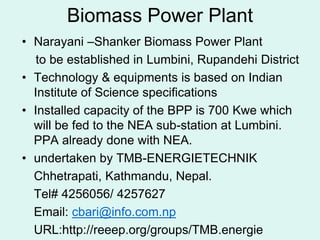
Biomass Power Plant
• Narayani –Shanker Biomass Power Plant
to be established in Lumbini, Rupandehi District
• Technology & equipments is based on Indian
Institute of Science specifications
• Installed capacity of the BPP is 700 Kwe which
will be fed to the NEA sub-station at Lumbini.
PPA already done with NEA.
• undertaken by TMB-ENERGIETECHNIK
Chhetrapati, Kathmandu, Nepal.
Tel# 4256056/ 4257627
Email: cbari@info.com.np
URL:http://reeep.org/groups/TMB.energie
• Biomass contributes nearly 80 % of the total energy demand in Nepal. Its
efficient utilization coupled with co-generation of value added products
can provide a dependable and economic route.
• Use of partially pyrolyzed biomass materials eliminates the problem
relating to tar formation.
• The performance evaluation of the gasification plant showed that this
unit is capable of generating producer gas of 1167 kcal/Nm3 energy to
power 20 H.P engine generator on dual fuel mode with 51% replacement
of diesel oil. This shows that the gasification plant could be used for
generating electricity in the rural areas as a decentralized power unit
after carrying out some field tests.
• Biomass gasification can offer an attractive alternative renewable
energy system especially in rural areas where biomass fuel is available.
Thus can provide community based small-scale independent power
plants.
Conclusion and recommendation
Recommendation
• Proper training on the Fabrication and use of the
biomass gasification plant for electricity generation
should be given to the rural communities before the
technology is disseminated in the field.
• There should be Policy support from the government like
providing subsidies for the promotion and development
of this technology.
• The technology of the gasification system is simple in
construction and requires negligible maintenance during
its operation.
• Field trials and demonstrations should be done in order to
convince the rural communities for generating electricity
through biomass gasification.
• Elaborate testing of the gasification plant on various partially
pyrolyzed biomass materials should be done.
• Various biomass residues should be characterized to establish
their suitability for gasification.
• Different biomass material such as forest residues like pine
needles, agricultural waste, briquettes, etc. should also be tried
as feeding materials in the gasifier in order to save forest.
• Scope for other industrial application should be ventured.
Scope for Further Studies
Acknowledgements
• University Grant Commission
• Executive Director, RECAST, T.U.
• Kathmandu University
• TERI and IIT-Delhi, India.
• AEPC
Gasifier presentation - Prof. K.R.Shrestha

Gasifier presentation - Prof. K.R.Shrestha

  • 1.
    Biomass Gasification System forRural Electrification Prof. Dr. Krishna Raj Shrestha Research Centre for Applied Science and Technology (RECAST) Tribhuvan University Kathmandu, Nepal
  • 2.
    Project Team • Prof.Dr.KrishnaRaj Shrestha-TeamLeader • Uttara Bajracharya -Sociologist • Rajib Thakur- Energy Engineer • Bijay Raj Subedee- Biotechnologist • Roshan Kumar Amatya -Senior Mechanics • Sushil Karmacharya - Senior Mechanics • Dambar Bahadur Ale - Helper
  • 3.
    Introduction • Biomass refersto all forms of organic matter produced as products of photosynthesis. Biomass has long served as one of the primary energy forms utilized by human being for essential activities aside from nutrition. Different forms of biomass are • Forest based products • Timber, fuel wood, wood chips/shavings, saw dust, a milling residue, forest waste like leaves, twigs, shrubs, herbs herbal products, etc. • Agriculture based products • Aquatic plants • Animal dung and human waste.
  • 4.
    Energy Consumption Situationby fuel type 79.6% 2.8% 3.9% 12.3% 1.2% 0.1% 376.3 MGJ Biomass Grid electricity Coal Petroleum Renewable Others Source :WECS Survey ,2011
  • 5.
    Gasification Biomass gasification isbasically conversion of solid biomass (i.e. wood/ wood wastes, agro-residues and organic industrial wastes) into a combustible gas mixture. It is carried out in an enclosed reactor operating at about 900oC where in a part of the biomass is combusted by air to provide the heat. The resulting gas known as producer gas contains CO(15 -29 %), CO2 (5 -15 %), H2 (5 -12 %), N2 (50 –65 %) and small amounts of hydrocarbon gases. The calorific value of the gas ranges from 1200-1500 kcal/m3.
  • 6.
    Gasification Reactions Devolatilization C+heatCH4+ condensible - hydrocarbons+char Steam-Carbon C + H2O + heat CO + H2 Reverse Boudouard C + CO2 + heat 2CO Oxidation C+O2 CO2 +heat Hydrogasification C+2H2 CH4+ heat Water Gas shift H2O + CO CO2+ H2 + heat Methanation 3H2 + CO CH4 + H2O + heat 4H2 + CO2 CH4 + 2H2O + heat
  • 8.
    Why Gasification? • Biomasscovers 80 percent of the energy needs of Nepal (WECS 2011). • The biomass mostly used for fuel is firewood (68 percent) followed by agricultural residue and animal dung, which are generally of low grade and burnt in traditional stoves. (WECS 2010) • Due to smoke and particulate matters created by unscientific combustion, the indoor air in houses gets polluted causing respiratory and eye- related health problem to users, especially women and children.
  • 9.
    Different waste biomass Lantanacamera Mugwort – Tite pati Banmara Mikania Macrantha - Banmasa Pine needles
  • 10.
    Agro residues Crop typeArea [Ha] Crop Prod [MT] Residue type RPR* Total Residue Prod [MT] Paddy 1,531,493 5,072,248 Total residue 1.68 8,521,376 Husk 0.267 1,354,290 Maize 871387 2179414 Total residue 5,389,691 stalk 2 4,358,828 cob 0.273 594,980 husk 0.2 435,883 Millet 278030 315067 stalk 1.08 340,272 Wheat 765317 1846142 straw 1.75 3,230,748 Buckwheat 10339 10021 Straw 1 10,021 Barley 27966 34829.8 straw 1.75 60,952
  • 11.
    Agro residues (cont) Croptype Area [Ha] Crop Prod [MT] Residue type RPR Total Residue Prod [MT] Oil Seed 214835 179145 Stalk 4.01 71,837 Sugarcane 64472 2930047 Bagasse 0.29 849,714 tops/leaves 0.3 879,014 Total 1,728,728 Jute 10540 14424 Stick 2 28,848 Soybean 29281.8 28269.8 Total 98,944.3 Straw 2.5 70,674.5 Pods 1 28,269.8 Black Gram 27496.2 22482.4 Straw/stick 1.66 37,320 Cotton 135 133 Sticks 2.75 365.75 Coconut Husk 0.419 NA Shell 0.12 NA Coffee 1780 425000 Husk 2.1 892,500 Ground nut 2736 3869 Husk 0.477 1,845 Straw 2.30 8,899
  • 12.
  • 13.
  • 14.
    Different Forest waste •Banmara - 1.78 kg/m2 (17 tons/ha) • Pine needles - 4.5 million tons (382,944.80 ha pine forest area) • Besarmi jhar - 5-6 kgs/m2 • Saal leaves - 2,019,600 tons of leaf litter per year - 5 tons of waste materials/month • Mikania micrantha - ~ 600,000 tons of dried Mikania (20 districts)
  • 15.
    Besarmi jhar, Saalleaves and leaf litter
  • 16.
    Estimates of Mikaniaas raw materials
  • 17.
    Municipal Solid waste No.Type of waste 1976 1981 1985 1988 1995 1999 2000 2004 2008 1 Organic 67.8 60.0 67.5 58.1 65.0 67.5 69.84 67 68.0 2 Paper 6.5 19.3 6.0 6.2 4.0 8.8 8.5 10 10.0 3 Rubber 0.0 0.0 0.0 0.4 1.0 0.3 0.54 0.24 mix1 4 Leather - - - - - - 0.12 - - 5 Wood 2.7 1.6 0.0 0.5 3.0 0.6 0.73 - - 6 Plastic 0.3 3.6 2.6 2.0 5.0 11.4 9.17 16 13.0 7 Bone - - - - - - 0.23 - - 8 Textile 6.5 5.3 2.7 2.0 3.0 3.6 3.02 4 2.0 9 Ferrous metal 4.9 3.4 2.2 0.4 1.0 0.9 0.87 1 - 10 Aluminium - - - - - - 0.05 - - 11 Metal - - - - - - - - 1.0 12 Sand dust - - - - - - - - 1.0 12 Glass 1.3 3.4 4.0 1.6 1.0 1.6 2.5 1 4.0 13 Construction debris/Others 10.0 3.4 15.0 28.9 17.0 5.3 4.33 1.24 1.0 From simple calculations, this gives about 181 tons of plastics, 186 tons of paper, 36 tons of textiles and 15 tons of woody matter on a daily basis 58 municipalities in Nepal and the amount of waste generated by these municipalities per day comes to 2813.13 tons. Out of this amount of generated waste, 2164.49 tons are collected.
  • 18.
    Industrial waste • Wastefrom veneer industries • Furniture, handicraft (wooden frames), etc. – Bira Furniture in Patan - 10-15 tons of wood waste per month – Lalitkaltmak Kastha Udyog - (~0.5 tons) of Saw dust and 1-1.5 tons of wooden strips are generated per week Subject Amount in Cu.ft. processed per day Waste per day (taking 50%) Density of soft wood Total Amount waste per day Waste from Sri Om Veneer 400 cft. (300-500cft) 200 cft. = 5.66 m3 53lb/cft* (670kg/m3) 3792kg or 3.8 tons Total Amount of waste generated from 200 industries from all over Nepal 758.440 tons Current use by local people and boilers and tea drying = 25% 189.610 tons Unutilized waste that can be used for briquetting = 75% 568.830 tons
  • 20.
    RECAST’s involvement inGasification (1985)
  • 21.
    Biomass Gasification forElectricity Generation (1999)
  • 22.
    Biomass Gasification forElectricity Generation(2011)
  • 23.
    Schematic Diagram ofbiomass gasifier and its measuring points during testing T1 Ambient temperature T4 Temperature at orifice meter T2 Temperature at outlet of cyclone separator T5 Temperature inside the gasifier T3 Temperature at outlet of cooler Pd Pressure difference at orifice meter
  • 24.
  • 25.
  • 26.
  • 27.
  • 28.
  • 29.
    Air Heater (9kW capacity) to test the real output of the plant
  • 30.
    Measuring Instruments used duringthe testing Multi channel temperature scanner K type thermo couple Orifice flow meter True RMS clamp on meter Balance up to 100 kg. Portable gas analyzer ( For Co measurement of producer gas) Stop watch burette 1000 ml
  • 31.
    Test results ` Load (kW) Ambient Temperatu re T1(o C) T2 (oC) T3(oC) T4 (oC)T5(oC) Pressure difference ( cm of water) Gas quantity (m3 /secon d Gas quantity (m3 /Hour Time taken to consume 100ml Diesel consumpt ion per hour (liter) Mode Diesel/ Producr e gas ratio Charcole consump tion (Kg) 12.30 6.00 24.00 2.53 2.37 Diesel 100.00 0.00 1.00 6.00 24.00 79.00 19.00 84.00 457.00 8.00 0.00 14.15 4.23 1.42 Duel 59.81 1.30 6.00 27.00 156.00 62.00 164.00 525.00 7.00 0.00 13.00 3.19 1.88 Duel 79.31 2.00 6.00 30.00 203.00 84.00 208.00 530.00 8.50 0.00 14.58 5.06 1.19 Duel 50.00 2.30 6.00 33.00 265.00 112.00 247.00 560.00 7.00 0.00 13.00 5.13 1.17 Duel 49.32 3.00 6.00 33.00 192.00 84.00 196.00 459.00 8.50 0.00 14.20 5.06 1.19 Duel 50.00 Average 6.00 30.75 204.00 85.50 203.75 518.50 8.00 0.00 13.70 4.53 1.32 57.69 2.80 7.00 Time Load (kW) Ambient Temperatu re T1(o C) T2 (oC) T3(oC) T4 (oC) T5(oC) Pressure difference (cmof water) Gas quantity (m3 /second Gas quantity (m3 /Hour) Time takento consume 100 ml(minut Diesel consumpt ionper hour (liter) Mode Diesel/P roducre gasratio Charcole consump tion(Kg) 12.30 3.00 28.00 28.00 28.00 28.00 28.00 3.96 1.52 Diesel 100.00 0.00 1.00 3.00 28.00 142.00 94.00 140.00 1052.00 3.00 0.00 8.92 5.05 1.19 Duel 78.42 1.30 3.00 29.00 168.00 94.00 178.00 1293.00 4.00 0.00 10.10 5.93 1.01 Duel 66.78 2.00 3.00 32.00 253.00 127.00 269.00 1440.00 3.00 0.00 8.92 4.40 1.36 Duel 90.00 2.30 3.00 34.00 238.00 119.00 215.00 1440.00 3.00 0.00 8.92 5.08 1.18 Duel 77.91 Average 3.00 30.75 200.25 108.50 200.50 1306.25 3.25 0.00 9.21 5.12 1.17 78.28 2kg/hour 4.00
  • 32.
    Efficiency Calculation Mass flowrateof producergas (m3/hour) (mg) Calorificvalue of producergas (Kcal/m3)(cg) Output (mg*cg) (Kcal/hour) Mass flow rate of Solid fule (Kg/hour) (ms) Calorificvalue of Solidfuel (Kcal/Kg) (cs) Input (ms*cs) (Kcal/hour) Efficiency (%) 9.21 1167.15 10752.37 2.00 6794.00 13588.00 79.13 13.70 1167.15 15984.94 2.80 6794.00 19023.20 84.03 Efficiency of Biomasss gasifier at diffferent load condition Powerproduce fromgenerator (KW) Tharmalenergy required(Kcal/hour ) Diesel consumed (liter/hour) Calorific valueof diesel(Kcal/ lit) Thermelenergy imputsfrom diesel (Kcal/hour) Producer Gas consumpti on(m3/h) Calorific valueof producer gas (Kcal/m3) Thermel energy imputs from producer Total Energy imputs Efficiency 3.00 2580.00 1.17 9281.00 10858.77 9.21 1167.15 10752.37 21611.14 11.94 6.00 5160.00 1.32 9281.00 12250.92 13.70 1167.15 15984.94 28235.86 18.27 Efficiency DualMode
  • 33.
    Power (kW) Efficiency of Gasifier Efficiencyof CI engin and Overall efficiency 3.00 79.13 11.94 9.45 6.00 84.03 18.27 15.36 Overall efficiency of the Gasification Powerproduce fromgenerator (KW) Tharmal energy required (Kcal/hour) Diesel consumed (liter/hour) Calorific value of diesel(Kcal/ lit) Thermel energy imputs from diesel (Kcal/hour) Efficiency 3.00 2580.00 1.52 9281.00 14107.12 18.29 6.00 5160.00 2.27 9281.00 21067.87 24.49 9.00 7740.00 2.57 9281.00 23852.17 32.45 Efficieny Diesel mode
  • 36.
    Gasification Plant atSarlahi • Capacity 11 kW • Equipment cost Rs 20 Lacs • Power supplied to 100 houses • Funded by RERL, through AEPC • Biomass used- Dhaincha (Sesbania sp.)
  • 38.
    Rice Husk GasificationPlant • 32 K.W Plant at Suhapur sohari, Parsa Dist. • Husk Power System (P) Ltd., Bihar • Plant Cost Rs 52 Lacs. • Funded by Poverty Alleviation Fund and DDC Parsa • Fuel consumption- 50 kg RH per hour • Power supplied to 209 houses in the community • Run by community-earns Rs 70,000/- by supplying power and Rice milling • Charges Rs 80/- per family per months per CFL bulb • Rice Sheller mill- 12 Quintal Paddy produces 350 kg of Rice Husk.
  • 40.
    Further developments inthis area….. • Alternative Energy Promotion Centre(AEPC) has conducted feasibility study in the Terai region of Nepal to install Biomass Gasification Plant for Rural Electrification. Such a unit has been tested in Sarlahi district aiming to pilot a site in the district. • There are more than 40 gasification plants that are successfully operating in India and overseas for heat and power applications. (TERI 2010) • Renewable Nepal Program of Kathmandu University (KU) is also working on a Project namely “Design, fabrication and testing of a biomass gasifier for small size petrol and diesel engines” since August, 2010.(KU 2010) • China is expected to achieve the most rapid growth in gasification worldwide. Since 2004, 29 new gasification plants have been licensed or built in China.
  • 41.
    Biomass Power Plant •Narayani –Shanker Biomass Power Plant to be established in Lumbini, Rupandehi District • Technology & equipments is based on Indian Institute of Science specifications • Installed capacity of the BPP is 700 Kwe which will be fed to the NEA sub-station at Lumbini. PPA already done with NEA. • undertaken by TMB-ENERGIETECHNIK Chhetrapati, Kathmandu, Nepal. Tel# 4256056/ 4257627 Email: cbari@info.com.np URL:http://reeep.org/groups/TMB.energie
  • 42.
    • Biomass contributesnearly 80 % of the total energy demand in Nepal. Its efficient utilization coupled with co-generation of value added products can provide a dependable and economic route. • Use of partially pyrolyzed biomass materials eliminates the problem relating to tar formation. • The performance evaluation of the gasification plant showed that this unit is capable of generating producer gas of 1167 kcal/Nm3 energy to power 20 H.P engine generator on dual fuel mode with 51% replacement of diesel oil. This shows that the gasification plant could be used for generating electricity in the rural areas as a decentralized power unit after carrying out some field tests. • Biomass gasification can offer an attractive alternative renewable energy system especially in rural areas where biomass fuel is available. Thus can provide community based small-scale independent power plants. Conclusion and recommendation
  • 43.
    Recommendation • Proper trainingon the Fabrication and use of the biomass gasification plant for electricity generation should be given to the rural communities before the technology is disseminated in the field. • There should be Policy support from the government like providing subsidies for the promotion and development of this technology. • The technology of the gasification system is simple in construction and requires negligible maintenance during its operation.
  • 44.
    • Field trialsand demonstrations should be done in order to convince the rural communities for generating electricity through biomass gasification. • Elaborate testing of the gasification plant on various partially pyrolyzed biomass materials should be done. • Various biomass residues should be characterized to establish their suitability for gasification. • Different biomass material such as forest residues like pine needles, agricultural waste, briquettes, etc. should also be tried as feeding materials in the gasifier in order to save forest. • Scope for other industrial application should be ventured. Scope for Further Studies
  • 45.
    Acknowledgements • University GrantCommission • Executive Director, RECAST, T.U. • Kathmandu University • TERI and IIT-Delhi, India. • AEPC