Unit 3 Environmental Science:
School Assessed Coursework for Area of Study 1
SAC 1B: A report in multimedia format
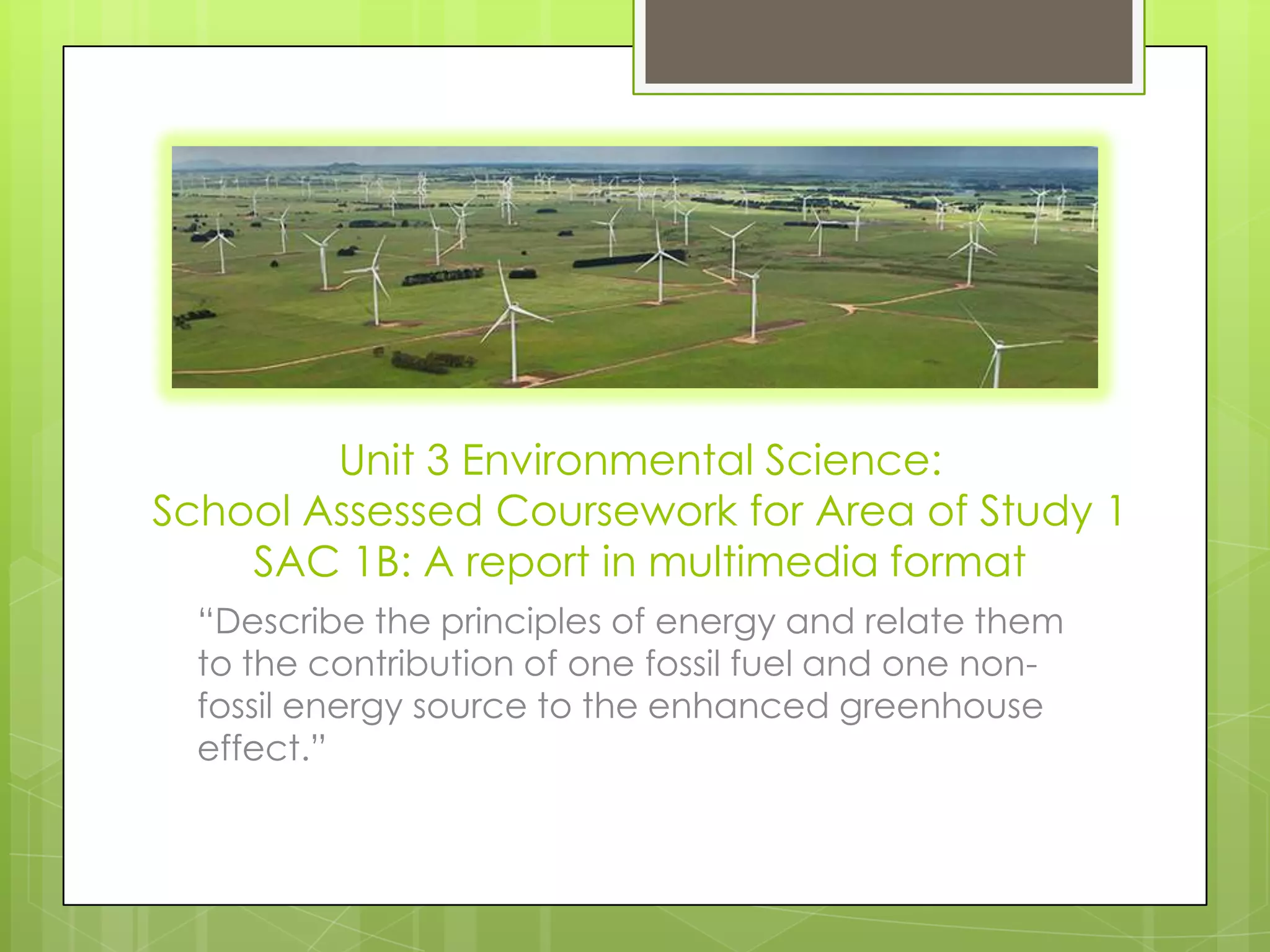
“Describe the principles of energy and relate them
to the contribution of one fossil fuel and one non-
fossil energy source to the enhanced greenhouse
effect.”
quick comparison
Mortlake Gas-Fired Power Plant
 Fossil fuel
 100 hectare total land
 20 hectare site
 550 Mega Watt capacity
 $650 million
 Peak load
 Reliable – 6 minutes to turn on
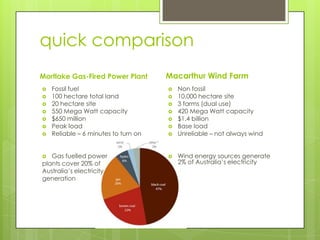
 Gas fuelled power
plants cover 20% of
Australia’s electricity
generation
Macarthur Wind Farm
 Non fossil
 10,000 hectare site
 3 farms (dual use)
 420 Mega Watt capacity
 $1.4 billion
 Base load
 Unreliable – not always wind
 Wind energy sources generate
2% of Australia’s electricity
introduction to gas & wind
gas energy
 Gas is a fossil fuel, non-renewable
energy source.
 Natural gas is formed as a result
of the combustion of
decomposed plants and animals
buried under layers of rock and
soil for millions of years.
 Natural gas is found underground
in oil reserves.
wind energy
 Wind is a non-fossil, renewable
energy source.
 Wind is formed when sunlight falls
unevenly on the earth, heating
the air unevenly. The circulation
of the warm air rising and cool air
moving in to replace it, produces
wind.
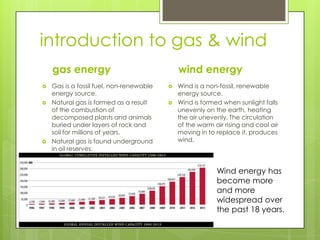
Wind energy has
become more
and more
widespread over
the past 18 years.
extraction
gas
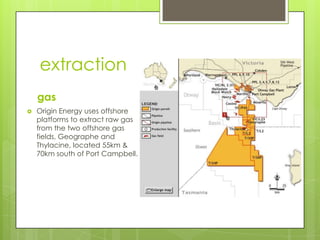
 Origin Energy uses offshore
platforms to extract raw gas
from the two offshore gas
fields, Geographe and
Thylacine, located 55km &
70km south of Port Campbell.
transport
gas
 After being extracted
offshore, gas is transported
through offshore and
onshore pipelines to the
Otway gas processing
plant. From there the gas is
piped to the Mortlake gas-
fired power plant.
 The electricity produced
travels through large pipes
to a transformer and then
high voltage power lines.
wind
 Turbine parts
transported by boat
and trucks
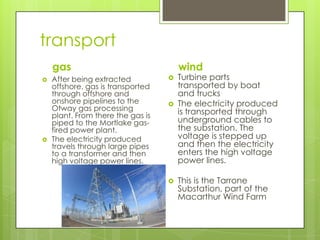
 The electricity produced
is transported through
underground cables to
the substation. The
voltage is stepped up
and then the electricity
enters the high voltage
power lines.
 This is the Tarrone
Substation, part of the
Macarthur Wind Farm
use
gas wind
 Wind is used to generate
electricity
 Wind turns the turbine blades
which turn a low speed shaft
 The low speed shaft enters the
gearbox which connects to
the high speed shaft
 The high speed shaft enters the
generator
 The generator rotates and
produces electricity
 Gas can be used for heating,
cooking or generating electricity.
 The use of natural gas to generate
electricity is similar to the engine of
a car.
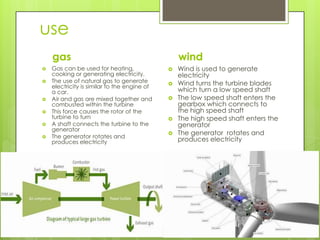
 Air and gas are mixed together and
combusted within the turbine
 This force causes the rotor of the
turbine to turn
 A shaft connects the turbine to the
generator
 The generator rotates and
produces electricity
economic impacts
gas
 The Mortlake Gas-fired
Power Station cost
$650 million to
construct
 The construction
created jobs, there are
10 staff altogether but
only 6 are required if
only one turbine is
turned on and
generating electricity
wind
 AGL Macarthur Wind Farm
Community Fund Program
provides financial assistance to
community projects and
groups.
 $5000 per turbine per year is
payed to the farmers that
have turbines on their land.
 The Macarthur Wind Farm cost
$1.4 billion to construct
 The construction created 400
jobs (250 for locals), there are
20 local staff currently on site
 Other main costs include spare
parts and council rates
social impacts
gas
 Origins commitment:
“Origin respects the rights
and interests of the
communities in which we
operate by working safely
and being mindful of, and
attentive to, the
environmental and social
impact of the resources,
products and services we
use or provide to others.”
 People in the area do not
enjoy the look of the power
station
wind
 Citizens that live near the wind
farm complain that the
turbines make a noise and that
they have become ill because
of the turbines, it has been
proved that this is a result of
anxiety and that the turbines
are not at fault.
 Some people do not like the
look of the structures on the
wind farm
 The Macarthur Wind Farm are
always happy to have school
students or visitors to take a
tour of the wind farm
environmental impacts
gas
 The Mortlake Gas-Fired Power Station
takes up a 20 hectare site, but own the
100 hectare block of land around the site.
Origin have considered planning the
construction of another two gas turbines,
but other than that the remaining land is
being wasted
 The Mortlake plant has been built on land
which native animals such as Emus and
Kangaroos are often seen and Origin have
done nothing to recreate more habitats
for them after taking away their home.
 The combustion of natural gas emits
greenhouse gases such as carbon dioxide
and water vapour which contributes to
the enhanced greenhouse effect
 Natural Gas is a fossil fuel and is being
used in much larger amounts than how
much is being produced
wind
 The Macarthur Wind Farm
takes up 10,00 hectares, but
the land is dual use so the
landholders can continue to
run livestock.
 Before construction, AGL
employed environmentalists to
observe the land to certify that
the proposed sites of the wind
towers did not obstruct native
animals habitats.
 Animals can be effected by
wind farms. For example, birds
can fly into the turbine blades
and die.
 The use of machinery during
construction emitted
greenhouse gases.
greenhouse effect
natural
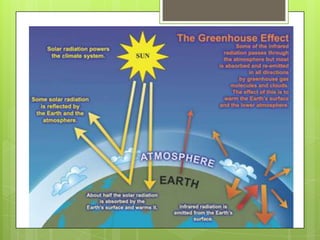
 Heat energy from the sun beams
onto the earth, some of it passes
through a blanket of gases in our
atmosphere and some is absorbed
by the blanket of gases.
 This blanket of gases is made up of
greenhouse gases, without this
blanket all the heat energy would
escape and the average
temperature of the earth would be
-18°C
 Natural greenhouse gases are
carbon dioxide, water
vapour, methane, sulfur dioxide
and nitrous oxides
enhanced
 Human activities including
the burning of fossil fuels
(gas) are creating more
greenhouse gases, which
means more heat energy is
absorbed and the earth
gets hotter.
 Man-made or unnatural
greenhouse gases are
hydrofluorocarbons (HFC’s)
and chlorofluorocarbons
(CFC’s)
contribution to the
greenhouse effect
gas
 Gas contributes to
the enhanced
greenhouse effect
by burning natural
gas and emitting
greenhouse gases.
wind
 Wind farms only
contribute to the
greenhouse effect
during construction.
 Wind farms are very
clean and a
sustainable source of
energy.
strategies/policies
International:
 Kyoto Protocol
 International Carbon
Action Partnership
National:
 Carbon Tax
 CSIRO Climate
Adaptation National
Research Flagship
 Climate Change
Adaptation Research
Facility
State:
 Victorian Climate
Change Adaption Plan
Local:
 Cities for Climate
Change Protection
(Moyne Shire joined)
bibliography / references
 http://www.originenergy.com.au
 http://www.agl.com.au
 Issues of sustainability: VCE environmental science, units 3&4, 3rd edition
 http://www.alliantenergykids.com/EnergyBasics/AllAboutNaturalGas/000511
 http://www.originenergy.com.au/1717/Otway-Basin
 http://www.originenergy.com.au/3573/Otway-gas-project
 http://www.agl.com.au/macarthur/
 http://www.originenergy.com.au/1376/Mortlake-Power-Station
 AGL Macarthur Wind Farm PowerPoint – Brendan Ryan
 Mortlake Power Station Fact Sheet
 http://www.sciencearchive.org.au
 http://www.climatechange.gov.au/climate-change/adapting-climate-
change/adaptation-framework/government-actions
 http://www.climatechange.vic.gov.au/adapting-to-climate-change/Victorian-
Climate-Change-Adaptation-Plan

Gas versus Wind as an Energy Source - Nick

  • 1.
    Unit 3 EnvironmentalScience: School Assessed Coursework for Area of Study 1 SAC 1B: A report in multimedia format “Describe the principles of energy and relate them to the contribution of one fossil fuel and one non- fossil energy source to the enhanced greenhouse effect.”
  • 2.
    quick comparison Mortlake Gas-FiredPower Plant  Fossil fuel  100 hectare total land  20 hectare site  550 Mega Watt capacity  $650 million  Peak load  Reliable – 6 minutes to turn on  Gas fuelled power plants cover 20% of Australia’s electricity generation Macarthur Wind Farm  Non fossil  10,000 hectare site  3 farms (dual use)  420 Mega Watt capacity  $1.4 billion  Base load  Unreliable – not always wind  Wind energy sources generate 2% of Australia’s electricity
  • 3.
    introduction to gas& wind gas energy  Gas is a fossil fuel, non-renewable energy source.  Natural gas is formed as a result of the combustion of decomposed plants and animals buried under layers of rock and soil for millions of years.  Natural gas is found underground in oil reserves. wind energy  Wind is a non-fossil, renewable energy source.  Wind is formed when sunlight falls unevenly on the earth, heating the air unevenly. The circulation of the warm air rising and cool air moving in to replace it, produces wind. Wind energy has become more and more widespread over the past 18 years.
  • 4.
    extraction gas  Origin Energyuses offshore platforms to extract raw gas from the two offshore gas fields, Geographe and Thylacine, located 55km & 70km south of Port Campbell.
  • 5.
    transport gas  After beingextracted offshore, gas is transported through offshore and onshore pipelines to the Otway gas processing plant. From there the gas is piped to the Mortlake gas- fired power plant.  The electricity produced travels through large pipes to a transformer and then high voltage power lines. wind  Turbine parts transported by boat and trucks  The electricity produced is transported through underground cables to the substation. The voltage is stepped up and then the electricity enters the high voltage power lines.  This is the Tarrone Substation, part of the Macarthur Wind Farm
  • 6.
    use gas wind  Windis used to generate electricity  Wind turns the turbine blades which turn a low speed shaft  The low speed shaft enters the gearbox which connects to the high speed shaft  The high speed shaft enters the generator  The generator rotates and produces electricity  Gas can be used for heating, cooking or generating electricity.  The use of natural gas to generate electricity is similar to the engine of a car.  Air and gas are mixed together and combusted within the turbine  This force causes the rotor of the turbine to turn  A shaft connects the turbine to the generator  The generator rotates and produces electricity
  • 7.
    economic impacts gas  TheMortlake Gas-fired Power Station cost $650 million to construct  The construction created jobs, there are 10 staff altogether but only 6 are required if only one turbine is turned on and generating electricity wind  AGL Macarthur Wind Farm Community Fund Program provides financial assistance to community projects and groups.  $5000 per turbine per year is payed to the farmers that have turbines on their land.  The Macarthur Wind Farm cost $1.4 billion to construct  The construction created 400 jobs (250 for locals), there are 20 local staff currently on site  Other main costs include spare parts and council rates
  • 8.
    social impacts gas  Originscommitment: “Origin respects the rights and interests of the communities in which we operate by working safely and being mindful of, and attentive to, the environmental and social impact of the resources, products and services we use or provide to others.”  People in the area do not enjoy the look of the power station wind  Citizens that live near the wind farm complain that the turbines make a noise and that they have become ill because of the turbines, it has been proved that this is a result of anxiety and that the turbines are not at fault.  Some people do not like the look of the structures on the wind farm  The Macarthur Wind Farm are always happy to have school students or visitors to take a tour of the wind farm
  • 9.
    environmental impacts gas  TheMortlake Gas-Fired Power Station takes up a 20 hectare site, but own the 100 hectare block of land around the site. Origin have considered planning the construction of another two gas turbines, but other than that the remaining land is being wasted  The Mortlake plant has been built on land which native animals such as Emus and Kangaroos are often seen and Origin have done nothing to recreate more habitats for them after taking away their home.  The combustion of natural gas emits greenhouse gases such as carbon dioxide and water vapour which contributes to the enhanced greenhouse effect  Natural Gas is a fossil fuel and is being used in much larger amounts than how much is being produced wind  The Macarthur Wind Farm takes up 10,00 hectares, but the land is dual use so the landholders can continue to run livestock.  Before construction, AGL employed environmentalists to observe the land to certify that the proposed sites of the wind towers did not obstruct native animals habitats.  Animals can be effected by wind farms. For example, birds can fly into the turbine blades and die.  The use of machinery during construction emitted greenhouse gases.
  • 10.
    greenhouse effect natural  Heatenergy from the sun beams onto the earth, some of it passes through a blanket of gases in our atmosphere and some is absorbed by the blanket of gases.  This blanket of gases is made up of greenhouse gases, without this blanket all the heat energy would escape and the average temperature of the earth would be -18°C  Natural greenhouse gases are carbon dioxide, water vapour, methane, sulfur dioxide and nitrous oxides enhanced  Human activities including the burning of fossil fuels (gas) are creating more greenhouse gases, which means more heat energy is absorbed and the earth gets hotter.  Man-made or unnatural greenhouse gases are hydrofluorocarbons (HFC’s) and chlorofluorocarbons (CFC’s)
  • 12.
    contribution to the greenhouseeffect gas  Gas contributes to the enhanced greenhouse effect by burning natural gas and emitting greenhouse gases. wind  Wind farms only contribute to the greenhouse effect during construction.  Wind farms are very clean and a sustainable source of energy.
  • 13.
    strategies/policies International:  Kyoto Protocol International Carbon Action Partnership National:  Carbon Tax  CSIRO Climate Adaptation National Research Flagship  Climate Change Adaptation Research Facility State:  Victorian Climate Change Adaption Plan Local:  Cities for Climate Change Protection (Moyne Shire joined)
  • 14.
    bibliography / references http://www.originenergy.com.au  http://www.agl.com.au  Issues of sustainability: VCE environmental science, units 3&4, 3rd edition  http://www.alliantenergykids.com/EnergyBasics/AllAboutNaturalGas/000511  http://www.originenergy.com.au/1717/Otway-Basin  http://www.originenergy.com.au/3573/Otway-gas-project  http://www.agl.com.au/macarthur/  http://www.originenergy.com.au/1376/Mortlake-Power-Station  AGL Macarthur Wind Farm PowerPoint – Brendan Ryan  Mortlake Power Station Fact Sheet  http://www.sciencearchive.org.au  http://www.climatechange.gov.au/climate-change/adapting-climate- change/adaptation-framework/government-actions  http://www.climatechange.vic.gov.au/adapting-to-climate-change/Victorian- Climate-Change-Adaptation-Plan