Unit 3 Environmental Science:
School Assessed Coursework for Area of Study 1
SAC 1B: A report in poster or multimedia format
Carl Hansen
Extraction, transport and uses
Extraction
• Natural gas is extracted from underground rock by drilling a well, and is captured by
sending a pressurized liquid fracking solution down the well, which makes the gas rise
to the top for capture.
• Wind is used to turn blades which turn a motor, and the kinetic energy is converted into
electrical energy, with around 40% efficiency.
Transport
• Gas is transported via pipelines
• Wind energy is transported as electrical energy through power lines
Uses
• Gas can be burned to produce heat which is then converted to electrical energy, which
is around 30% efficient. It can also be directly burned for heating and cooking, which is
approximately 90% efficiency.
• Electricity produced from wind can be used for anything.
Land Modification
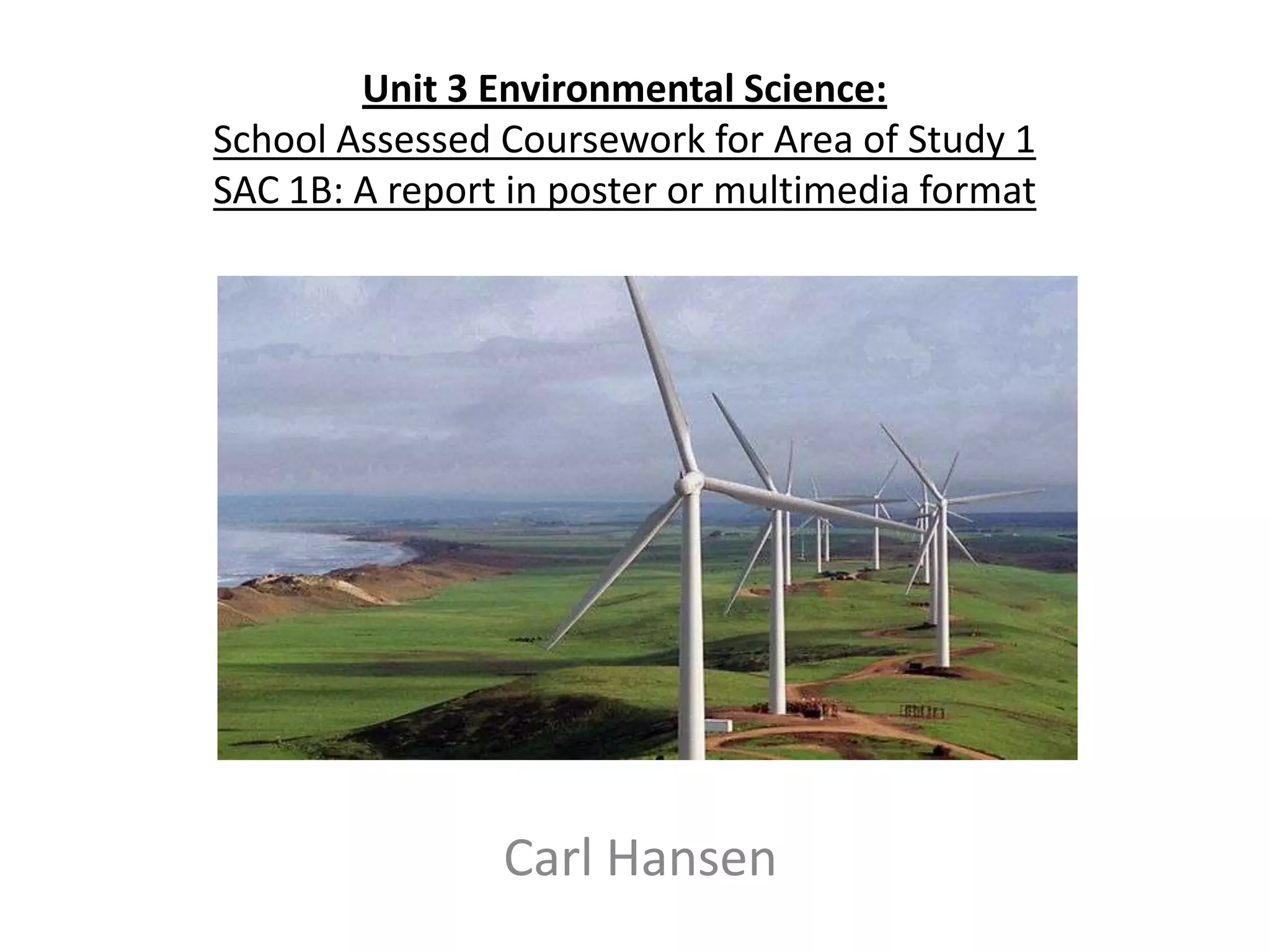
• The Macarthur wind farm is the biggest in the Southern
Hemisphere, containing 140 3mw turbines (enough energy to
power 220,000 households), and taking up 5500 hectares.
Land was not modified apart form roads to access the
turbines, as the cleared farmland was already suitable for
turbines to be placed in. Cattle and sheep can still graze
around the turbines.
• The 550 MW gas-fired open cycle power station at Mortlake,
is the largest in Victoria. It was completed in 2012, and
involves a 83km underground gas pipeline to connect to the
Otway gas plant at Port Campbell. This required significant
land modification to install. The area around the gas plant is
restricted access.
Influence on the enhanced
greenhouse effect
• Natural gas accounts for around 20% of the worlds
energy use, but it’s effect on the greenhouse effect is
around 50% less than brown coal. However, it is still
a fossil fuel and does produce carbon emissions,
which contribute to the enhanced greenhouse effect
• Wind energy has no influence on the enhanced
greenhouse effect, as it does not produce any
greenhouse gases.
Social Impacts
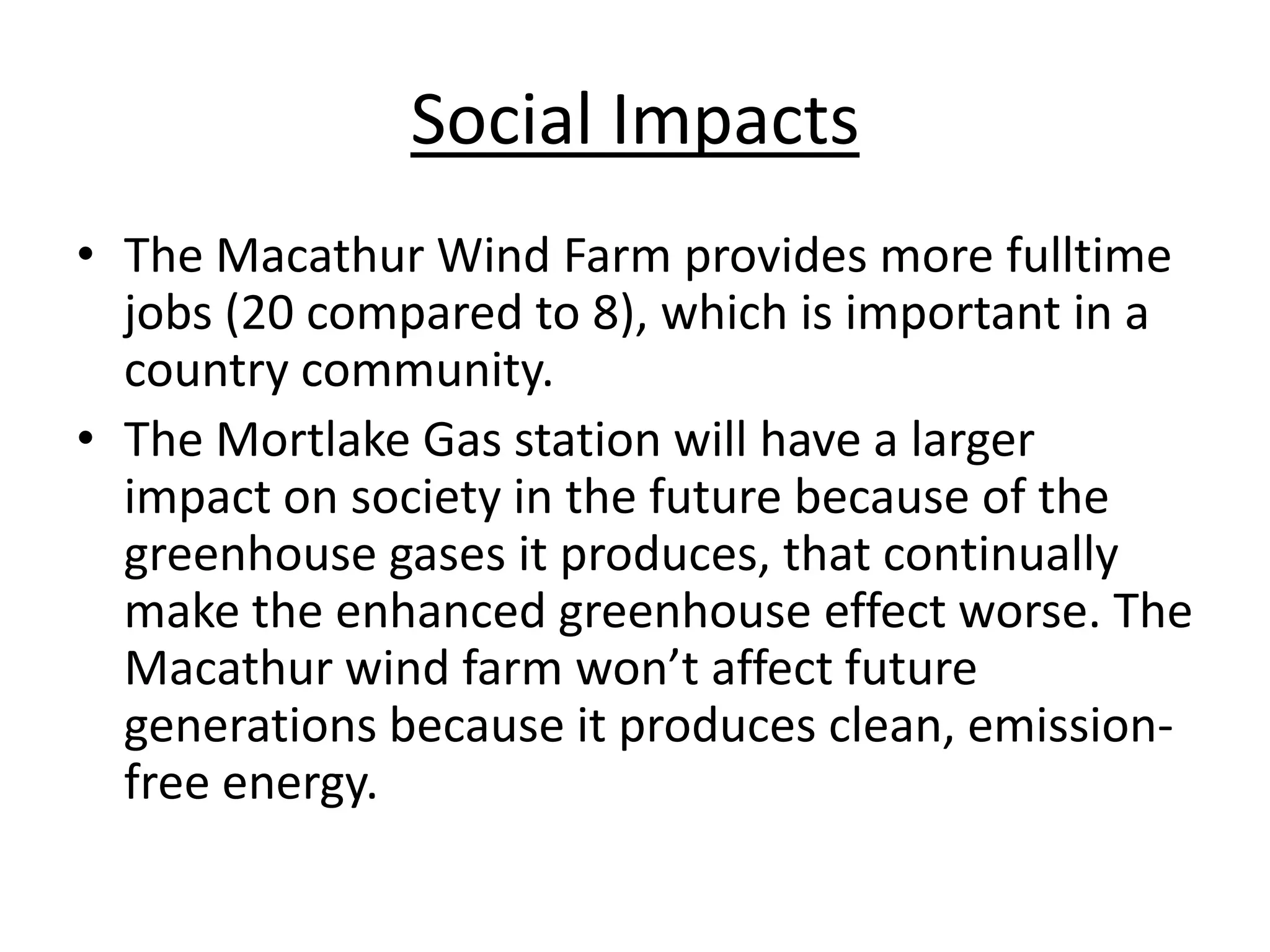
• The Macathur Wind Farm provides more fulltime
jobs (20 compared to 8), which is important in a
country community.
• The Mortlake Gas station will have a larger
impact on society in the future because of the
greenhouse gases it produces, that continually
make the enhanced greenhouse effect worse. The
Macathur wind farm won’t affect future
generations because it produces clean, emission-
free energy.
Economic Impacts
• As natural gas and other
fossil fuels become scarcer,
they will in turn become
more expensive. This will
mean that wind power and
other renewable sources
become more popular.
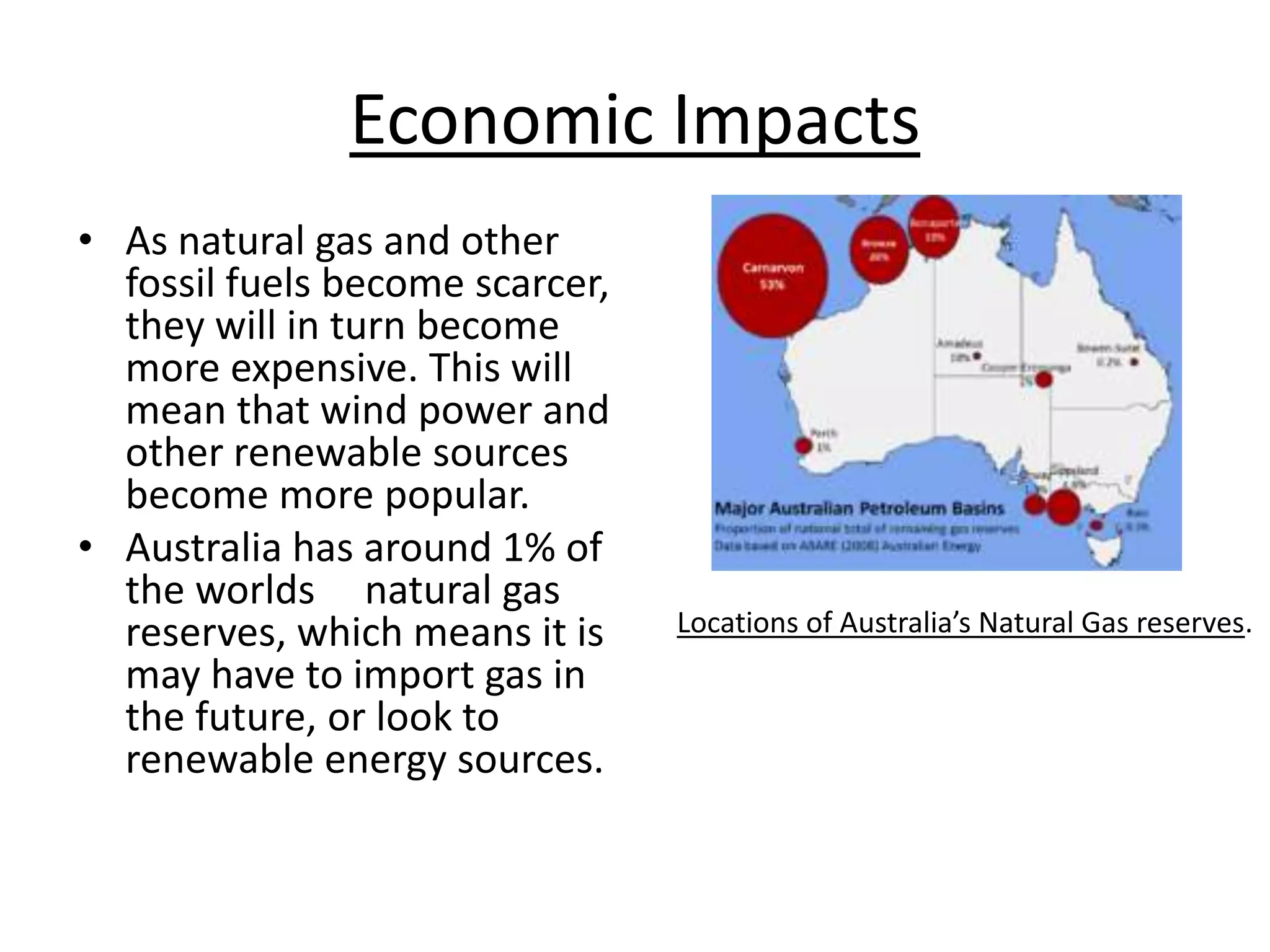
• Australia has around 1% of
the worlds natural gas
reserves, which means it is
may have to import gas in
the future, or look to
renewable energy sources.
Locations of Australia’s Natural Gas reserves.
Environmental Impacts
• While the Macarthur wind farm takes up 5
times more space than the Mortlake gas plant
(500ha Vs. 100ha), it has less impact on the
environment because it produces clean wind
energy that has no influence on the enhanced
greenhouse effect, where's the gas plant
releases greenhouse gases.
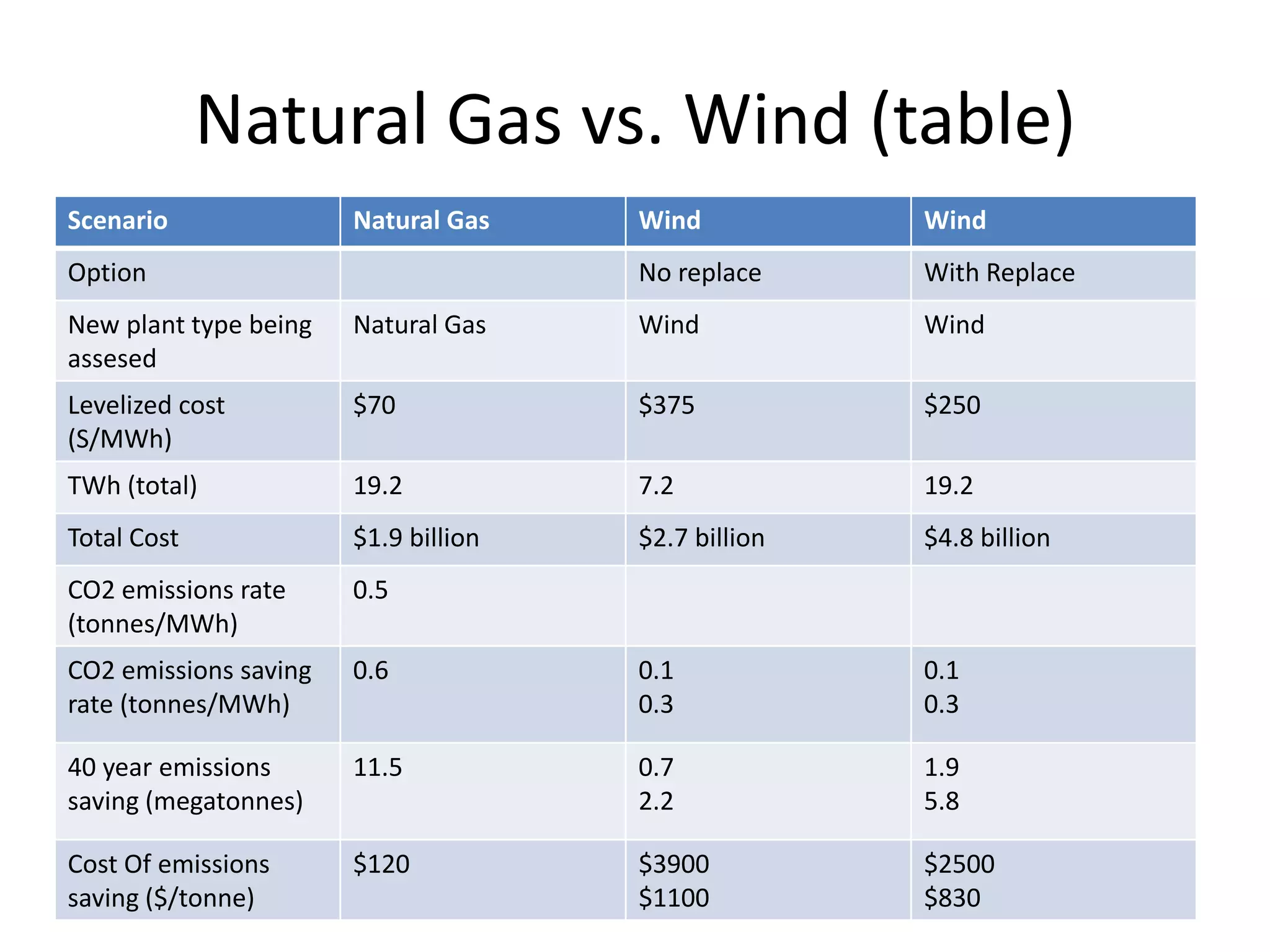
Natural Gas vs. Wind (table)
Scenario Natural Gas Wind Wind
Option No replace With Replace
New plant type being
assesed
Natural Gas Wind Wind
Levelized cost
(S/MWh)
$70 $375 $250
TWh (total) 19.2 7.2 19.2
Total Cost $1.9 billion $2.7 billion $4.8 billion
CO2 emissions rate
(tonnes/MWh)
0.5
CO2 emissions saving
rate (tonnes/MWh)
0.6 0.1
0.3
0.1
0.3
40 year emissions
saving (megatonnes)
11.5 0.7
2.2
1.9
5.8
Cost Of emissions
saving ($/tonne)
$120 $3900
$1100
$2500
$830
International level
International Panel on Climate Change
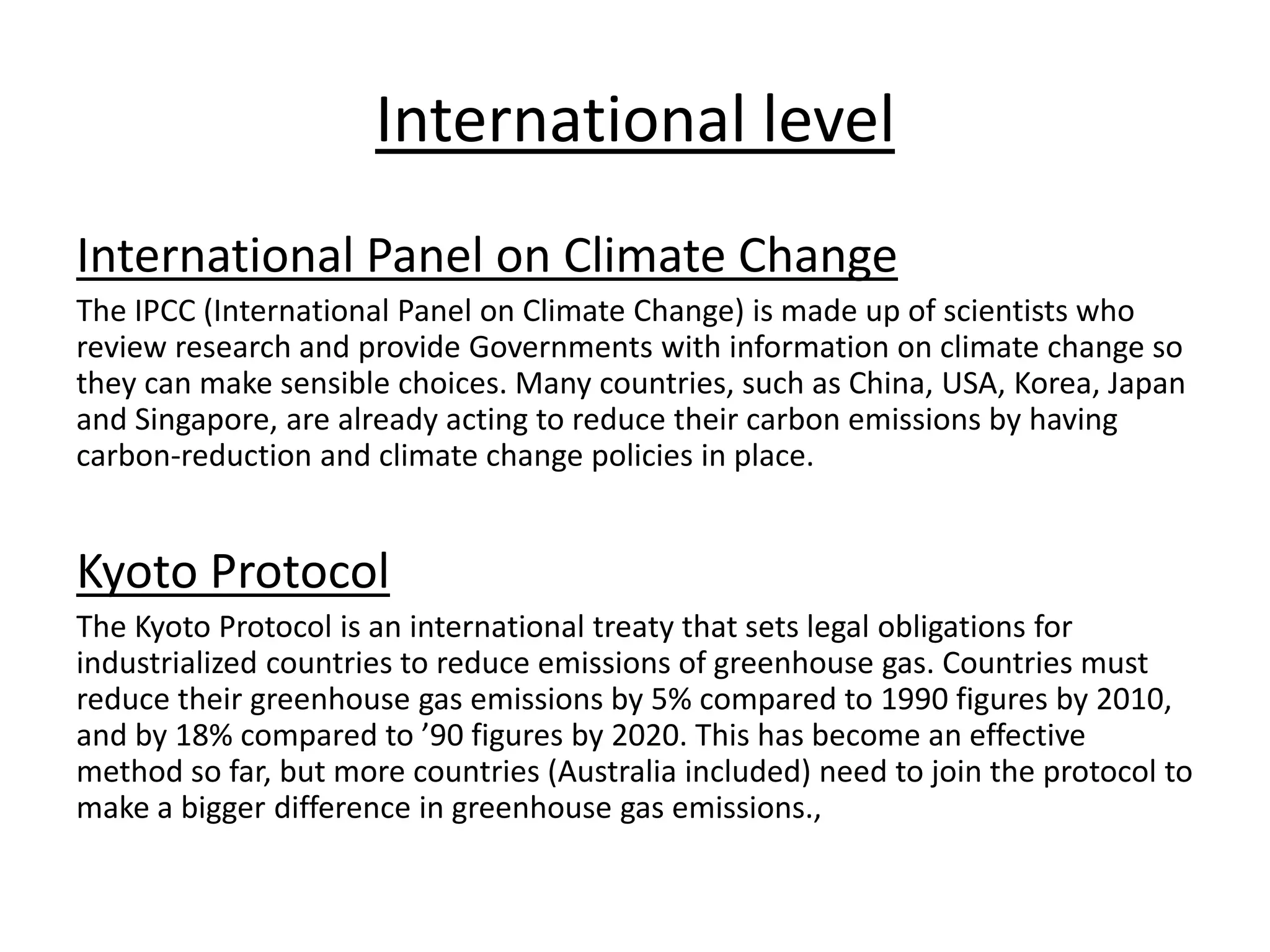
The IPCC (International Panel on Climate Change) is made up of scientists who
review research and provide Governments with information on climate change so
they can make sensible choices. Many countries, such as China, USA, Korea, Japan
and Singapore, are already acting to reduce their carbon emissions by having
carbon-reduction and climate change policies in place.
Kyoto Protocol
The Kyoto Protocol is an international treaty that sets legal obligations for
industrialized countries to reduce emissions of greenhouse gas. Countries must
reduce their greenhouse gas emissions by 5% compared to 1990 figures by 2010,
and by 18% compared to ’90 figures by 2020. This has become an effective
method so far, but more countries (Australia included) need to join the protocol to
make a bigger difference in greenhouse gas emissions.,
National level
CSIRO & BOM
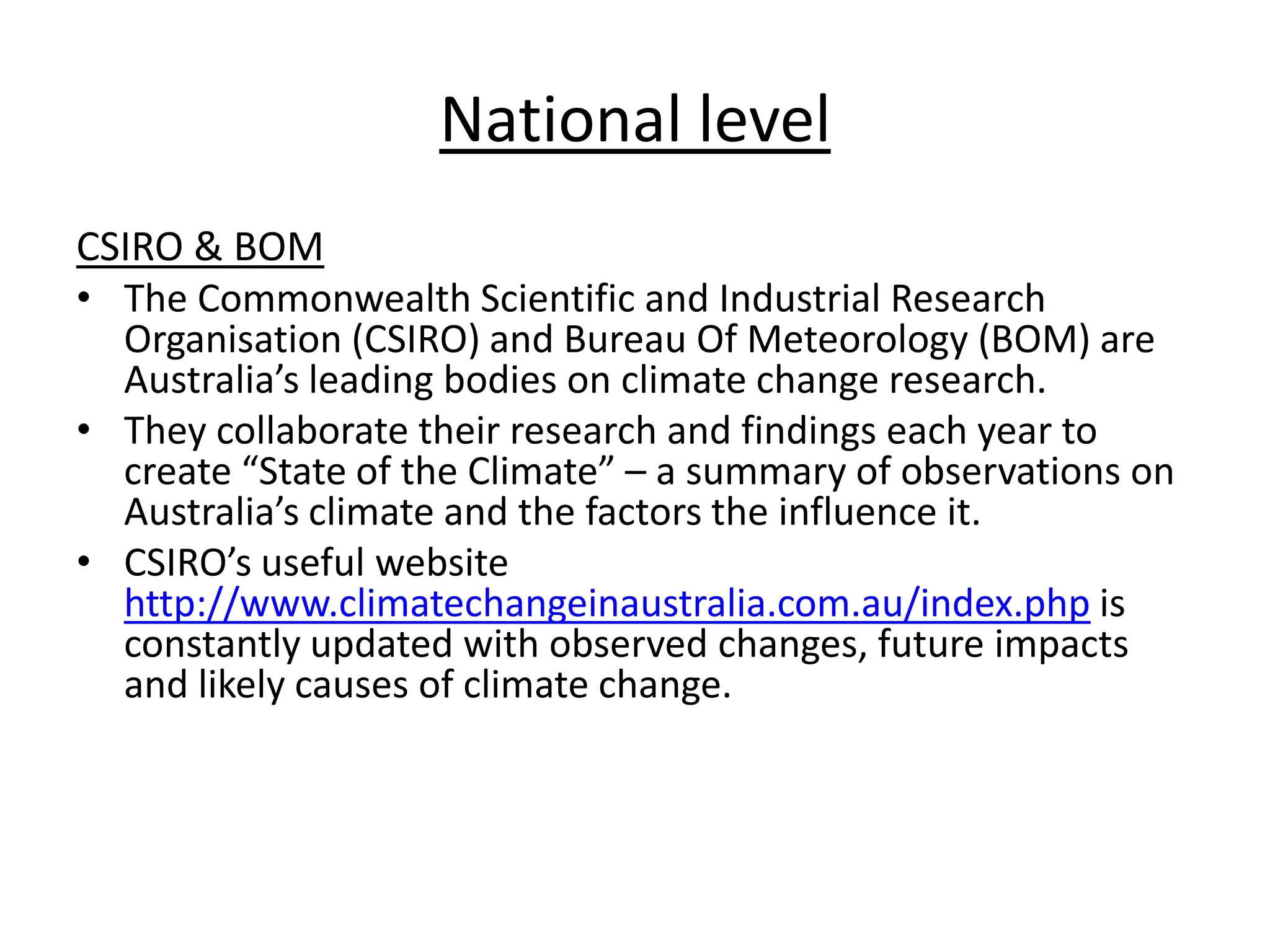
• The Commonwealth Scientific and Industrial Research
Organisation (CSIRO) and Bureau Of Meteorology (BOM) are
Australia’s leading bodies on climate change research.
• They collaborate their research and findings each year to
create “State of the Climate” – a summary of observations on
Australia’s climate and the factors the influence it.
• CSIRO’s useful website
http://www.climatechangeinaustralia.com.au/index.php is
constantly updated with observed changes, future impacts
and likely causes of climate change.
State level
EPA
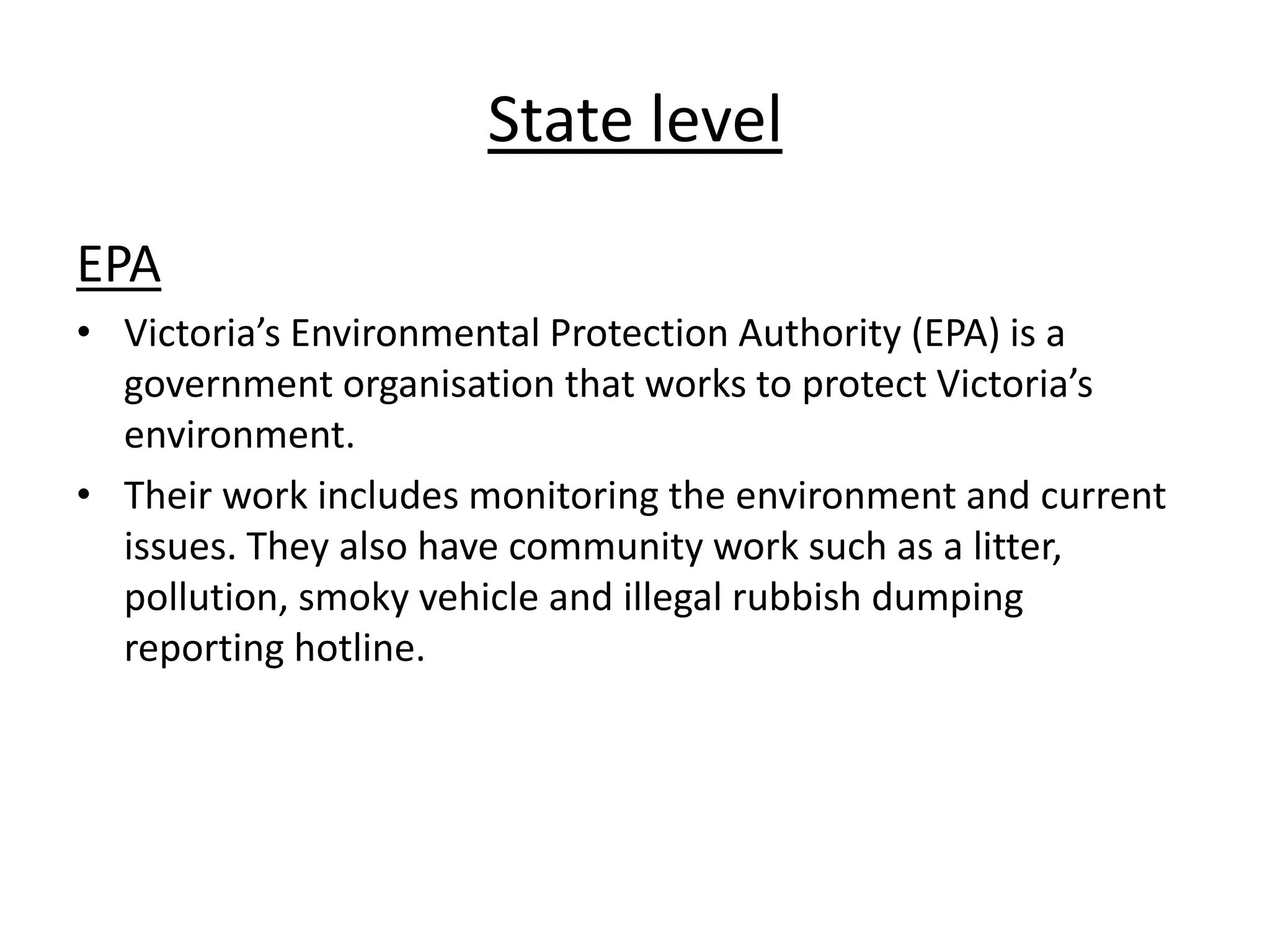
• Victoria’s Environmental Protection Authority (EPA) is a
government organisation that works to protect Victoria’s
environment.
• Their work includes monitoring the environment and current
issues. They also have community work such as a litter,
pollution, smoky vehicle and illegal rubbish dumping
reporting hotline.
Local level
Community Climate Change Project
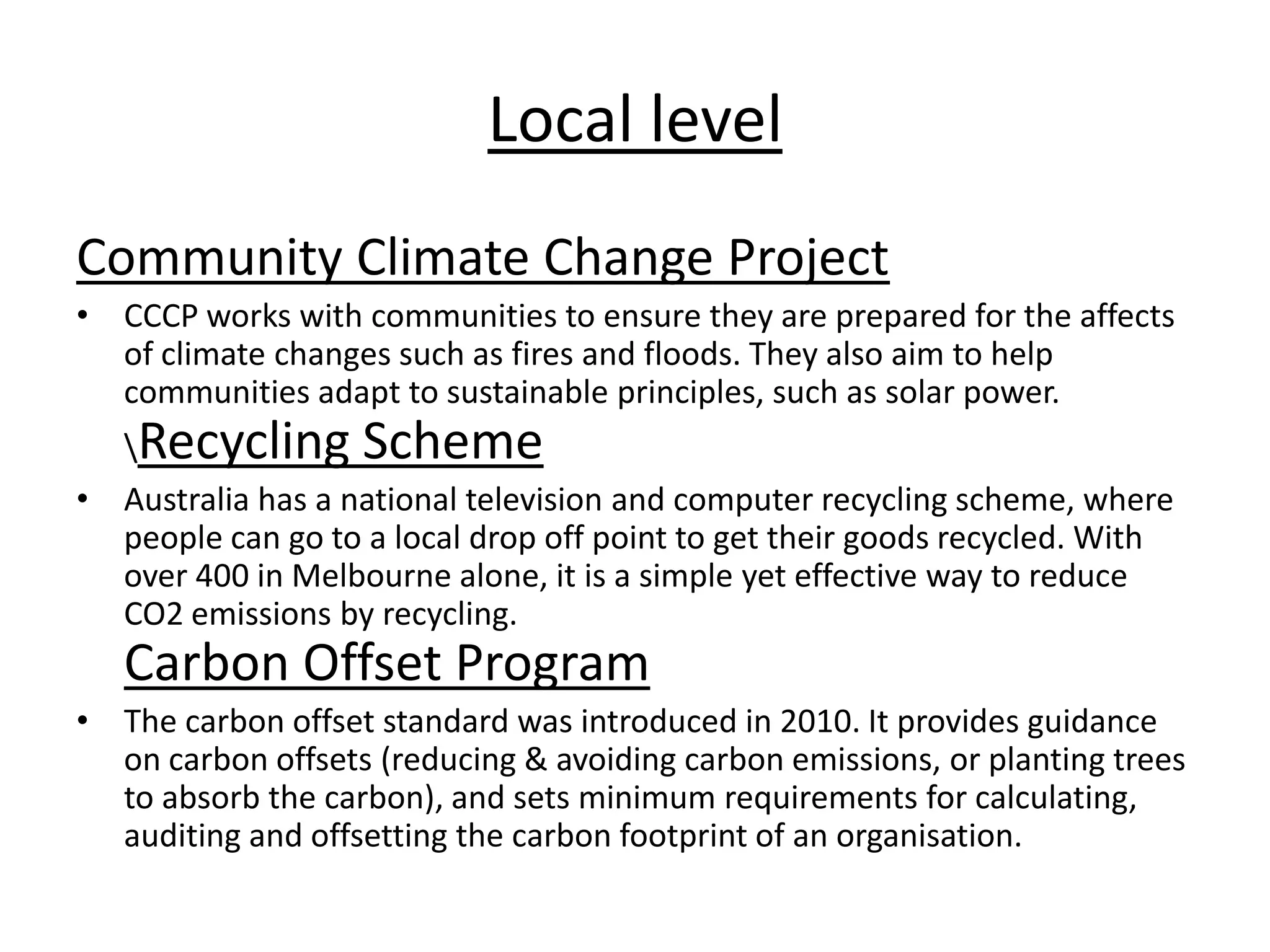
• CCCP works with communities to ensure they are prepared for the affects
of climate changes such as fires and floods. They also aim to help
communities adapt to sustainable principles, such as solar power.
Recycling Scheme
• Australia has a national television and computer recycling scheme, where
people can go to a local drop off point to get their goods recycled. With
over 400 in Melbourne alone, it is a simple yet effective way to reduce
CO2 emissions by recycling.
Carbon Offset Program
• The carbon offset standard was introduced in 2010. It provides guidance
on carbon offsets (reducing & avoiding carbon emissions, or planting trees
to absorb the carbon), and sets minimum requirements for calculating,
auditing and offsetting the carbon footprint of an organisation.
References
• http://www.global.tdk.com/know/answer/a11/index.htm
• http://www.gazprominfo.com/articles/natural-gas-transportation/
• http://www.agl.com.au/about-agl/how-we-source-energy/renewable-
energy/macarthur-wind-farm/the-project
• http://www.originenergy.com.au/1376/Mortlake-Power-Station
• http://www.epa.vic.gov.au/
• http://www.pksf-cccp-bd.org/
• http://www.environment.gov.au/topics/environment-protection/national-
waste-policy/television-and-computer-recycling-scheme-0
• http://www.ipcc.ch/
• http://www.climatechangeinaustralia.com.au/index.php

Gas versus Wind as an Energy Source - Carl

  • 1.
    Unit 3 EnvironmentalScience: School Assessed Coursework for Area of Study 1 SAC 1B: A report in poster or multimedia format Carl Hansen
  • 2.
    Extraction, transport anduses Extraction • Natural gas is extracted from underground rock by drilling a well, and is captured by sending a pressurized liquid fracking solution down the well, which makes the gas rise to the top for capture. • Wind is used to turn blades which turn a motor, and the kinetic energy is converted into electrical energy, with around 40% efficiency. Transport • Gas is transported via pipelines • Wind energy is transported as electrical energy through power lines Uses • Gas can be burned to produce heat which is then converted to electrical energy, which is around 30% efficient. It can also be directly burned for heating and cooking, which is approximately 90% efficiency. • Electricity produced from wind can be used for anything.
  • 3.
    Land Modification • TheMacarthur wind farm is the biggest in the Southern Hemisphere, containing 140 3mw turbines (enough energy to power 220,000 households), and taking up 5500 hectares. Land was not modified apart form roads to access the turbines, as the cleared farmland was already suitable for turbines to be placed in. Cattle and sheep can still graze around the turbines. • The 550 MW gas-fired open cycle power station at Mortlake, is the largest in Victoria. It was completed in 2012, and involves a 83km underground gas pipeline to connect to the Otway gas plant at Port Campbell. This required significant land modification to install. The area around the gas plant is restricted access.
  • 4.
    Influence on theenhanced greenhouse effect • Natural gas accounts for around 20% of the worlds energy use, but it’s effect on the greenhouse effect is around 50% less than brown coal. However, it is still a fossil fuel and does produce carbon emissions, which contribute to the enhanced greenhouse effect • Wind energy has no influence on the enhanced greenhouse effect, as it does not produce any greenhouse gases.
  • 5.
    Social Impacts • TheMacathur Wind Farm provides more fulltime jobs (20 compared to 8), which is important in a country community. • The Mortlake Gas station will have a larger impact on society in the future because of the greenhouse gases it produces, that continually make the enhanced greenhouse effect worse. The Macathur wind farm won’t affect future generations because it produces clean, emission- free energy.
  • 6.
    Economic Impacts • Asnatural gas and other fossil fuels become scarcer, they will in turn become more expensive. This will mean that wind power and other renewable sources become more popular. • Australia has around 1% of the worlds natural gas reserves, which means it is may have to import gas in the future, or look to renewable energy sources. Locations of Australia’s Natural Gas reserves.
  • 7.
    Environmental Impacts • Whilethe Macarthur wind farm takes up 5 times more space than the Mortlake gas plant (500ha Vs. 100ha), it has less impact on the environment because it produces clean wind energy that has no influence on the enhanced greenhouse effect, where's the gas plant releases greenhouse gases.
  • 8.
    Natural Gas vs.Wind (table) Scenario Natural Gas Wind Wind Option No replace With Replace New plant type being assesed Natural Gas Wind Wind Levelized cost (S/MWh) $70 $375 $250 TWh (total) 19.2 7.2 19.2 Total Cost $1.9 billion $2.7 billion $4.8 billion CO2 emissions rate (tonnes/MWh) 0.5 CO2 emissions saving rate (tonnes/MWh) 0.6 0.1 0.3 0.1 0.3 40 year emissions saving (megatonnes) 11.5 0.7 2.2 1.9 5.8 Cost Of emissions saving ($/tonne) $120 $3900 $1100 $2500 $830
  • 9.
    International level International Panelon Climate Change The IPCC (International Panel on Climate Change) is made up of scientists who review research and provide Governments with information on climate change so they can make sensible choices. Many countries, such as China, USA, Korea, Japan and Singapore, are already acting to reduce their carbon emissions by having carbon-reduction and climate change policies in place. Kyoto Protocol The Kyoto Protocol is an international treaty that sets legal obligations for industrialized countries to reduce emissions of greenhouse gas. Countries must reduce their greenhouse gas emissions by 5% compared to 1990 figures by 2010, and by 18% compared to ’90 figures by 2020. This has become an effective method so far, but more countries (Australia included) need to join the protocol to make a bigger difference in greenhouse gas emissions.,
  • 10.
    National level CSIRO &BOM • The Commonwealth Scientific and Industrial Research Organisation (CSIRO) and Bureau Of Meteorology (BOM) are Australia’s leading bodies on climate change research. • They collaborate their research and findings each year to create “State of the Climate” – a summary of observations on Australia’s climate and the factors the influence it. • CSIRO’s useful website http://www.climatechangeinaustralia.com.au/index.php is constantly updated with observed changes, future impacts and likely causes of climate change.
  • 11.
    State level EPA • Victoria’sEnvironmental Protection Authority (EPA) is a government organisation that works to protect Victoria’s environment. • Their work includes monitoring the environment and current issues. They also have community work such as a litter, pollution, smoky vehicle and illegal rubbish dumping reporting hotline.
  • 12.
    Local level Community ClimateChange Project • CCCP works with communities to ensure they are prepared for the affects of climate changes such as fires and floods. They also aim to help communities adapt to sustainable principles, such as solar power. Recycling Scheme • Australia has a national television and computer recycling scheme, where people can go to a local drop off point to get their goods recycled. With over 400 in Melbourne alone, it is a simple yet effective way to reduce CO2 emissions by recycling. Carbon Offset Program • The carbon offset standard was introduced in 2010. It provides guidance on carbon offsets (reducing & avoiding carbon emissions, or planting trees to absorb the carbon), and sets minimum requirements for calculating, auditing and offsetting the carbon footprint of an organisation.
  • 13.
    References • http://www.global.tdk.com/know/answer/a11/index.htm • http://www.gazprominfo.com/articles/natural-gas-transportation/ •http://www.agl.com.au/about-agl/how-we-source-energy/renewable- energy/macarthur-wind-farm/the-project • http://www.originenergy.com.au/1376/Mortlake-Power-Station • http://www.epa.vic.gov.au/ • http://www.pksf-cccp-bd.org/ • http://www.environment.gov.au/topics/environment-protection/national- waste-policy/television-and-computer-recycling-scheme-0 • http://www.ipcc.ch/ • http://www.climatechangeinaustralia.com.au/index.php