Gas Plant Unit Processing
Prepared by:
Bafreen Amjad Aza M.Ali
Darya Mahdi Harikar Mekail
Safeen Dlshad
Supervisor
MR. Abdulsalam Daneshvar
University of Zakho
College of Engineering
Petroleum Engineering Dep.
Petroleum & natural
gas formation
Role of gas plant
Introduction
Important
support
components
Utilities
Safety systems
Process control
Plant
processes
List of content
Gas Treating
Gas Dehydration
Outlet Compression
Liquids Processing
Sulfur Recovery
Inlet Compression
Storage And Transportation
Field Operations And Inlet Receiving
 Natural gas :A mixture of gaseous hydrocarbons occurring in reservoirs of
porous rock (commonly sand or sandstone) capped by impervious strata. It is
often associated with petroleum, with which it has a common origin in the
decomposition of organic matter in sedimentary deposits.
3
INTRODUCTIONOutline
►Introduction
♦ Petroleum & natural
gas formation
♦ Role of gas plant
♦ Plant processes
• Field operations and
inlet receiving
• Inlet compression
• Gas treating
• Gas Dehydration
• Outlet compression
• Liquids processing
• Sulfur recovery
• Storage and
transportation
♦ Important support
components
• Utilities
• Process control
• Safety systems
Gas plant unit processing
Bafreen Amjad
Methane (CH4)
Ethane (C2H6)
Propane (C3H8)
Condensate (C5H12 – C10H22)
Nitrogen (N2)
Carbon Dioxide (CO2)
Hydrogen Sulphide
(H2S)Helium (He)
4
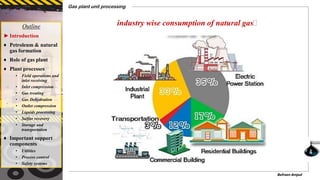
industry wise consumption of natural gasOutline
►Introduction
♦ Petroleum & natural
gas formation
♦ Role of gas plant
♦ Plant processes
• Field operations and
inlet receiving
• Inlet compression
• Gas treating
• Gas Dehydration
• Outlet compression
• Liquids processing
• Sulfur recovery
• Storage and
transportation
♦ Important support
components
• Utilities
• Process control
• Safety systems
Gas plant unit processing
Bafreen Amjad
5
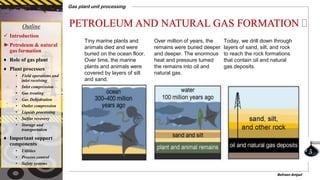
PETROLEUM AND NATURAL GAS FORMATION
Tiny marine plants and
animals died and were
buried on the ocean floor.
Over time, the marine
plants and animals were
covered by layers of silt
and sand.
Over million of years, the
remains were buried deeper
and deeper. The enormous
heat and pressure tumed
the remains into oil and
natural gas.
Today, we drill down through
layers of sand, silt, and rock
to reach the rock formations
that contain oil and natural
gas deposits.
Outline
 Introduction
►Petroleum & natural
gas formation
♦ Role of gas plant
♦ Plant processes
• Field operations and
inlet receiving
• Inlet compression
• Gas treating
• Gas Dehydration
• Outlet compression
• Liquids processing
• Sulfur recovery
• Storage and
transportation
♦ Important support
components
• Utilities
• Process control
• Safety systems
Gas plant unit processing
Bafreen Amjad
6
ROLE OF GAS PLANT
• Gas plants play a variety of roles in the oil and gas industry. Some
primary purposes plants include:
 Dehydration of gas to reduce corrosion and to prevent gas hydrate
formation. These plants commonly are found on offshore platforms,
where associated gas is separated from oil and dehydrated.
Depending upon pipeline infrastructure, the gas may be recombined
the before it is put into pipeline to shore.
 Upgrading sub quality gas. To make the gas marketable, the
undesired diluents N2, H2S, and CO2 are removed. Of the three
components, N2 is the most difficult to remove because it requires
cryogenic processing when large volumes are processed
Outline
 Introduction
 Petroleum & natural
gas formation
►Role of gas plant
♦ Plant processes
• Field operations and
inlet receiving
• Inlet compression
• Gas treating
• Gas Dehydration
• Outlet compression
• Liquids processing
• Sulfur recovery
• Storage and
transportation
♦ Important support
components
• Utilities
• Process control
• Safety systems
Gas plant unit processing
Bafreen Amjad
7
Outline
 Introduction
 Petroleum & natural
gas formation
►Role of gas plant
♦ Plant processes
• Field operations and
inlet receiving
• Inlet compression
• Gas treating
• Gas Dehydration
• Outlet compression
• Liquids processing
• Sulfur recovery
• Storage and
transportation
♦ Important support
components
• Utilities
• Process control
• Safety systems
Gas plant unit processing
Bafreen Amjad
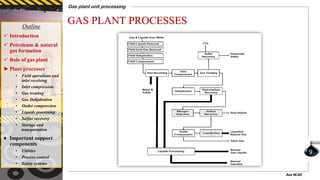
GAS PLANT PROCESSES
8
Outline
 Introduction
 Petroleum & natural
gas formation
 Role of gas plant
►Plant processes
• Field operations and
inlet receiving
• Inlet compression
• Gas treating
• Gas Dehydration
• Outlet compression
• Liquids processing
• Sulfur recovery
• Storage and
transportation
♦ Important support
components
• Utilities
• Process control
• Safety systems
Gas plant unit processing
Aza M.Ali
GAS PLANT PROCESSES
9
Outline
 Introduction
 Petroleum & natural
gas formation
 Role of gas plant
►Plant processes
• Field operations and
inlet receiving
• Inlet compression
• Gas treating
• Gas Dehydration
• Outlet compression
• Liquids processing
• Sulfur recovery
• Storage and
transportation
♦ Important support
components
• Utilities
• Process control
• Safety systems
Gas plant unit processing
Aza M.Ali
Effect of impurities found in Natural GasOutline
 Introduction
 Petroleum & natural
gas formation
 Role of gas plant
 Plant processes
► Field operations and
inlet receiving
• Inlet compression
• Gas treating
• Gas Dehydration
• Outlet compression
• Liquids processing
• Sulfur recovery
• Storage and
transportation
♦ Important support
components
• Utilities
• Process control
• Safety systems
Gas plant unit processing
Aza M.Ali
10
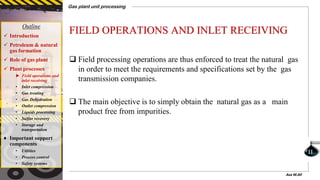
FIELD OPERATIONS AND INLET RECEIVING
 Field processing operations are thus enforced to treat the natural gas
in order to meet the requirements and specifications set by the gas
transmission companies.
 The main objective is to simply obtain the natural gas as a main
product free from impurities.
Outline
 Introduction
 Petroleum & natural
gas formation
 Role of gas plant
 Plant processes
► Field operations and
inlet receiving
• Inlet compression
• Gas treating
• Gas Dehydration
• Outlet compression
• Liquids processing
• Sulfur recovery
• Storage and
transportation
♦ Important support
components
• Utilities
• Process control
• Safety systems
Gas plant unit processing
11
Aza M.Ali
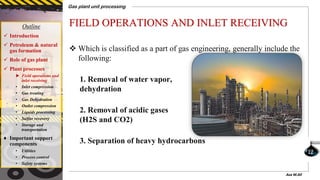
FIELD OPERATIONS AND INLET RECEIVING
 Which is classified as a part of gas engineering, generally include the
following:
1. Removal of water vapor,
dehydration
2. Removal of acidic gases
(H2S and CO2)
3. Separation of heavy hydrocarbons
Outline
 Introduction
 Petroleum & natural
gas formation
 Role of gas plant
 Plant processes
► Field operations and
inlet receiving
• Inlet compression
• Gas treating
• Gas Dehydration
• Outlet compression
• Liquids processing
• Sulfur recovery
• Storage and
transportation
♦ Important support
components
• Utilities
• Process control
• Safety systems
Gas plant unit processing
12
Aza M.Ali
INLET COMPRESSION
 Most plants have inlet compression, but compression requirements
vary.
 In gas transmission, two basic types of compressors are used:
reciprocating and centrifugal compressors.
 Reciprocating compressors are usually driven by either electric
motors or gas engines.
 While centrifugal compressors use gas turbines or electric motors as
drivers.
Outline
 Introduction
 Petroleum & natural
gas formation
 Role of gas plant
 Plant processes
 Field operations and
inlet receiving
► Inlet compression
• Gas treating
• Gas Dehydration
• Outlet compression
• Liquids processing
• Sulfur recovery
• Storage and
transportation
♦ Important support
components
• Utilities
• Process control
• Safety systems
Gas plant unit processing
Aza M.Ali
13
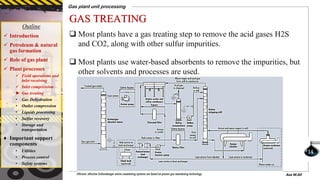
GAS TREATING
 Most plants have a gas treating step to remove the acid gases H2S
and CO2, along with other sulfur impurities.
 Most plants use water-based absorbents to remove the impurities, but
other solvents and processes are used.
Outline
 Introduction
 Petroleum & natural
gas formation
 Role of gas plant
 Plant processes
 Field operations and
inlet receiving
 Inlet compression
► Gas treating
• Gas Dehydration
• Outlet compression
• Liquids processing
• Sulfur recovery
• Storage and
transportation
♦ Important support
components
• Utilities
• Process control
• Safety systems
Gas plant unit processing
Aza M.Ali
14
GAS DEHYDRATIONOutline
 Introduction
 Petroleum & natural
gas formation
 Role of gas plant
 Plant processes
 Field operations and
inlet receiving
 Inlet compression
 Gas treating
► Gas Dehydration
• Outlet compression
• Liquids processing
• Sulfur recovery
• Storage and
transportation
♦ Important support
components
• Utilities
• Process control
• Safety systems
Gas plant unit processing
Harikar Mikail
15
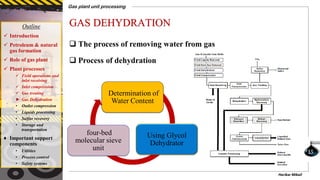
 The process of removing water from gas
 Process of dehydration
Determination of
Water Content
Using Glycol
Dehydrator
four-bed
molecular sieve
unit
GAS DEHYDRATIONOutline
 Introduction
 Petroleum & natural
gas formation
 Role of gas plant
 Plant processes
 Field operations and
inlet receiving
 Inlet compression
 Gas treating
► Gas Dehydration
• Outlet compression
• Liquids processing
• Sulfur recovery
• Storage and
transportation
♦ Important support
components
• Utilities
• Process control
• Safety systems
Gas plant unit processing
Harikar Mikail
16
 Impact of Gas Dehydration
 Gas hydrates..
 Corrosion
 Calorific value
 Gas specifications.
 Downstream processing
OUTLET COMPRESSIONOutline
 Introduction
 Petroleum & natural
gas formation
 Role of gas plant
 Plant processes
 Field operations and
inlet receiving
 Inlet compression
 Gas treating
 Gas Dehydration
► Outlet compression
• Liquids processing
• Sulfur recovery
• Storage and
transportation
♦ Important support
components
• Utilities
• Process control
• Safety systems
Gas plant unit processing
17
 Most plants must compress the gas before it goes to the
pipeline.
 To transport the maximum possible volume
 Safety
 To avoid the corrosion in pipelines
 We can transport the gas for 2000km without reduction of
pressure
Harikar Mikail
LIQUID PROCESSINGOutline
 Introduction
 Petroleum & natural
gas formation
 Role of gas plant
 Plant processes
 Field operations and
inlet receiving
 Inlet compression
 Gas treating
 Gas Dehydration
 Outlet compression
► Liquids processing
• Sulfur recovery
• Storage and
transportation
♦ Important support
components
• Utilities
• Process control
• Safety systems
Gas plant unit processing
18
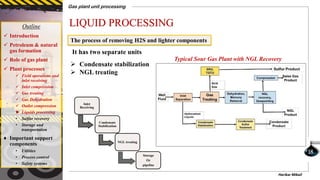
It has two separate units
 Condensate stabilization
 NGL treating
The process of removing H2S and lighter components
Inlet
Receiving
Condensate
Stabilization
NGL treating
Storage
Or
pipeline
Typical Sour Gas Plant with NGL Recovery
Harikar Mikail
SULFUR RECOVERY
 Sulfur recovery refers to conversion of hydrogen sulfide(h2s) to elemental sulfur.
 byproduct of natural gas processing comes from Hydrogen sulfide
 The most common conversion method clause process 90 -95 % recovery.
 Approximately percent of recovered sulfur is produced by the clause process.
 Any further conversion of the sulfur gases must be done by catalytic reaction.
Outline
 Introduction
 Petroleum & natural
gas formation
 Role of gas plant
 Plant processes
 Field operations and
inlet receiving
 Inlet compression
 Gas treating
 Gas Dehydration
 Outlet compression
 Liquids processing
► Sulfur recovery
• Storage and
transportation
♦ Important support
components
• Utilities
• Process control
• Safety systems
Gas plant unit processing
Darya Mahdi
19
Clause process
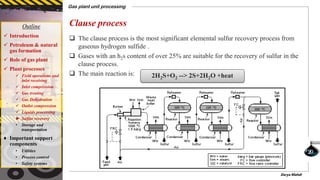
 The clause process is the most significant elemental sulfur recovery process from
gaseous hydrogen sulfide .
 Gases with an h2s content of over 25% are suitable for the recovery of sulfur in the
clause process.
 The main reaction is:
Outline
 Introduction
 Petroleum & natural
gas formation
 Role of gas plant
 Plant processes
 Field operations and
inlet receiving
 Inlet compression
 Gas treating
 Gas Dehydration
 Outlet compression
 Liquids processing
► Sulfur recovery
• Storage and
transportation
♦ Important support
components
• Utilities
• Process control
• Safety systems
Gas plant unit processing
2H2S+O2 --> 2S+2H2O +heat
Darya Mahdi
20
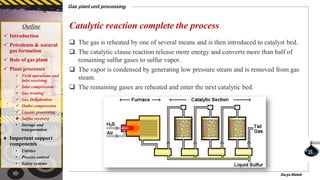
Catalytic reaction complete the process
 The gas is reheated by one of several means and is then introduced to catalyst bed.
 The catalytic clause reaction release more energy and converts more than half of
remaining sulfur gases to sulfur vapor.
 The vapor is condensed by generating low pressure steam and is removed from gas
steam.
 The remaining gases are reheated and enter the next catalytic bed.
Outline
 Introduction
 Petroleum & natural
gas formation
 Role of gas plant
 Plant processes
 Field operations and
inlet receiving
 Inlet compression
 Gas treating
 Gas Dehydration
 Outlet compression
 Liquids processing
► Sulfur recovery
• Storage and
transportation
♦ Important support
components
• Utilities
• Process control
• Safety systems
Gas plant unit processing
Darya Mahdi
21
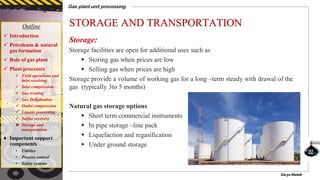
STORAGE AND TRANSPORTATION
Storage:
Storage facilities are open for additional uses such as
 Storing gas when prices are low
 Selling gas when prices are high
Storage provide a volume of working gas for a long –term steady with drawal of the
gas (typically 3to 5 months)
Natural gas storage options
 Short term commercial instruments
 In pipe storage –line pack
 Liquefaction and regasification
 Under ground storage
Outline
 Introduction
 Petroleum & natural
gas formation
 Role of gas plant
 Plant processes
 Field operations and
inlet receiving
 Inlet compression
 Gas treating
 Gas Dehydration
 Outlet compression
 Liquids processing
 Sulfur recovery
► Storage and
transportation
♦ Important support
components
• Utilities
• Process control
• Safety systems
Gas plant unit processing
Darya Mahdi
22
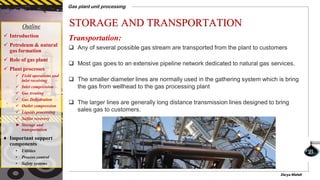
STORAGE AND TRANSPORTATION
Transportation:
 Any of several possible gas stream are transported from the plant to customers
 Most gas goes to an extensive pipeline network dedicated to natural gas services.
 The smaller diameter lines are normally used in the gathering system which is bring
the gas from wellhead to the gas processing plant
 The larger lines are generally long distance transmission lines designed to bring
sales gas to customers.
Outline
 Introduction
 Petroleum & natural
gas formation
 Role of gas plant
 Plant processes
 Field operations and
inlet receiving
 Inlet compression
 Gas treating
 Gas Dehydration
 Outlet compression
 Liquids processing
 Sulfur recovery
► Storage and
transportation
♦ Important support
components
• Utilities
• Process control
• Safety systems
Gas plant unit processing
Darya Mahdi
23
IMPORTANT SUPPORT COMPONENTS
 Some important components of all gas plants.
These components include:
Outline
 Introduction
 Petroleum & natural
gas formation
 Role of gas plant
 Plant processes
 Field operations and
inlet receiving
 Inlet compression
 Gas treating
 Gas Dehydration
 Outlet compression
 Liquids processing
 Sulfur recovery
 Storage and
transportation
►Important support
components
• Utilities
• Process control
• Safety systems
Gas plant unit processing
LNG plant in Hammerfest, Norway
Safeen Dlshad
24
I. Utilities
II. Process Control
III. Safety Systems
Utilities
 Utilities include power, heating fluids (steam), cooling water, instrument air,
nitrogen-purge gas, and fuel gas.
 Most gas plants purchase electrical power.
 Cogeneration plants are becoming more attractive options for reduction of
operating costs.
 Cooling water is used primarily in heat exchangers on compressors.
 Nitrogen is used as a purge gas around rotating seals, as well as to purge and
blanket vessels.
 In many cases, the enriched nitrogen is obtained from membrane or pressure swing
adsorption (PSA) separation, If large volumes are required, cryogenic fractionation
of air is the most economical process.
Outline
 Introduction
 Petroleum & natural
gas formation
 Role of gas plant
 Plant processes
 Field operations and
inlet receiving
 Inlet compression
 Gas treating
 Gas Dehydration
 Outlet compression
 Liquids processing
 Sulfur recovery
 Storage and
transportation
 Important support
components
► Utilities
• Process control
• Safety systems
Gas plant unit processing
Safeen Dlshad
25
Process Control
 Most plants use a distributed control system (DCS) for individual
units to provide both process control and operation history.
 Advanced process control (APC) system uses multivariable
algorithms that are programmed to perform online optimization.
 One important use of supervisory control and data acquisition
(SCADA) is the monitoring of field operations, with the capability
of controlling the process unit equipment, flow valves, and
compressor stations from the gas plant.
Outline
 Introduction
 Petroleum & natural
gas formation
 Role of gas plant
 Plant processes
 Field operations and
inlet receiving
 Inlet compression
 Gas treating
 Gas Dehydration
 Outlet compression
 Liquids processing
 Sulfur recovery
 Storage and
transportation
 Important support
components
 Utilities
► Process control
• Safety systems
Gas plant unit processing
Safeen Dlshad
26
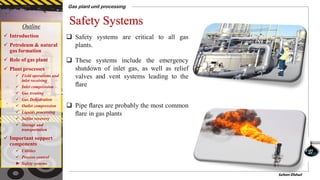
Safety Systems
 Safety systems are critical to all gas
plants.
 These systems include the emergency
shutdown of inlet gas, as well as relief
valves and vent systems leading to the
flare
 Pipe flares are probably the most common
flare in gas plants
Outline
 Introduction
 Petroleum & natural
gas formation
 Role of gas plant
 Plant processes
 Field operations and
inlet receiving
 Inlet compression
 Gas treating
 Gas Dehydration
 Outlet compression
 Liquids processing
 Sulfur recovery
 Storage and
transportation
 Important support
components
 Utilities
 Process control
► Safety systems
Gas plant unit processing
Safeen Dlshad
27
28
Gas plant unit processing

Gas plant unit process

  • 1.
    Gas Plant UnitProcessing Prepared by: Bafreen Amjad Aza M.Ali Darya Mahdi Harikar Mekail Safeen Dlshad Supervisor MR. Abdulsalam Daneshvar University of Zakho College of Engineering Petroleum Engineering Dep.
  • 2.
    Petroleum & natural gasformation Role of gas plant Introduction Important support components Utilities Safety systems Process control Plant processes List of content Gas Treating Gas Dehydration Outlet Compression Liquids Processing Sulfur Recovery Inlet Compression Storage And Transportation Field Operations And Inlet Receiving
  • 3.
     Natural gas:A mixture of gaseous hydrocarbons occurring in reservoirs of porous rock (commonly sand or sandstone) capped by impervious strata. It is often associated with petroleum, with which it has a common origin in the decomposition of organic matter in sedimentary deposits. 3 INTRODUCTIONOutline ►Introduction ♦ Petroleum & natural gas formation ♦ Role of gas plant ♦ Plant processes • Field operations and inlet receiving • Inlet compression • Gas treating • Gas Dehydration • Outlet compression • Liquids processing • Sulfur recovery • Storage and transportation ♦ Important support components • Utilities • Process control • Safety systems Gas plant unit processing Bafreen Amjad Methane (CH4) Ethane (C2H6) Propane (C3H8) Condensate (C5H12 – C10H22) Nitrogen (N2) Carbon Dioxide (CO2) Hydrogen Sulphide (H2S)Helium (He)
  • 4.
    4 industry wise consumptionof natural gasOutline ►Introduction ♦ Petroleum & natural gas formation ♦ Role of gas plant ♦ Plant processes • Field operations and inlet receiving • Inlet compression • Gas treating • Gas Dehydration • Outlet compression • Liquids processing • Sulfur recovery • Storage and transportation ♦ Important support components • Utilities • Process control • Safety systems Gas plant unit processing Bafreen Amjad
  • 5.
    5 PETROLEUM AND NATURALGAS FORMATION Tiny marine plants and animals died and were buried on the ocean floor. Over time, the marine plants and animals were covered by layers of silt and sand. Over million of years, the remains were buried deeper and deeper. The enormous heat and pressure tumed the remains into oil and natural gas. Today, we drill down through layers of sand, silt, and rock to reach the rock formations that contain oil and natural gas deposits. Outline  Introduction ►Petroleum & natural gas formation ♦ Role of gas plant ♦ Plant processes • Field operations and inlet receiving • Inlet compression • Gas treating • Gas Dehydration • Outlet compression • Liquids processing • Sulfur recovery • Storage and transportation ♦ Important support components • Utilities • Process control • Safety systems Gas plant unit processing Bafreen Amjad
  • 6.
    6 ROLE OF GASPLANT • Gas plants play a variety of roles in the oil and gas industry. Some primary purposes plants include:  Dehydration of gas to reduce corrosion and to prevent gas hydrate formation. These plants commonly are found on offshore platforms, where associated gas is separated from oil and dehydrated. Depending upon pipeline infrastructure, the gas may be recombined the before it is put into pipeline to shore.  Upgrading sub quality gas. To make the gas marketable, the undesired diluents N2, H2S, and CO2 are removed. Of the three components, N2 is the most difficult to remove because it requires cryogenic processing when large volumes are processed Outline  Introduction  Petroleum & natural gas formation ►Role of gas plant ♦ Plant processes • Field operations and inlet receiving • Inlet compression • Gas treating • Gas Dehydration • Outlet compression • Liquids processing • Sulfur recovery • Storage and transportation ♦ Important support components • Utilities • Process control • Safety systems Gas plant unit processing Bafreen Amjad
  • 7.
    7 Outline  Introduction  Petroleum& natural gas formation ►Role of gas plant ♦ Plant processes • Field operations and inlet receiving • Inlet compression • Gas treating • Gas Dehydration • Outlet compression • Liquids processing • Sulfur recovery • Storage and transportation ♦ Important support components • Utilities • Process control • Safety systems Gas plant unit processing Bafreen Amjad
  • 8.
    GAS PLANT PROCESSES 8 Outline Introduction  Petroleum & natural gas formation  Role of gas plant ►Plant processes • Field operations and inlet receiving • Inlet compression • Gas treating • Gas Dehydration • Outlet compression • Liquids processing • Sulfur recovery • Storage and transportation ♦ Important support components • Utilities • Process control • Safety systems Gas plant unit processing Aza M.Ali
  • 9.
    GAS PLANT PROCESSES 9 Outline Introduction  Petroleum & natural gas formation  Role of gas plant ►Plant processes • Field operations and inlet receiving • Inlet compression • Gas treating • Gas Dehydration • Outlet compression • Liquids processing • Sulfur recovery • Storage and transportation ♦ Important support components • Utilities • Process control • Safety systems Gas plant unit processing Aza M.Ali
  • 10.
    Effect of impuritiesfound in Natural GasOutline  Introduction  Petroleum & natural gas formation  Role of gas plant  Plant processes ► Field operations and inlet receiving • Inlet compression • Gas treating • Gas Dehydration • Outlet compression • Liquids processing • Sulfur recovery • Storage and transportation ♦ Important support components • Utilities • Process control • Safety systems Gas plant unit processing Aza M.Ali 10
  • 11.
    FIELD OPERATIONS ANDINLET RECEIVING  Field processing operations are thus enforced to treat the natural gas in order to meet the requirements and specifications set by the gas transmission companies.  The main objective is to simply obtain the natural gas as a main product free from impurities. Outline  Introduction  Petroleum & natural gas formation  Role of gas plant  Plant processes ► Field operations and inlet receiving • Inlet compression • Gas treating • Gas Dehydration • Outlet compression • Liquids processing • Sulfur recovery • Storage and transportation ♦ Important support components • Utilities • Process control • Safety systems Gas plant unit processing 11 Aza M.Ali
  • 12.
    FIELD OPERATIONS ANDINLET RECEIVING  Which is classified as a part of gas engineering, generally include the following: 1. Removal of water vapor, dehydration 2. Removal of acidic gases (H2S and CO2) 3. Separation of heavy hydrocarbons Outline  Introduction  Petroleum & natural gas formation  Role of gas plant  Plant processes ► Field operations and inlet receiving • Inlet compression • Gas treating • Gas Dehydration • Outlet compression • Liquids processing • Sulfur recovery • Storage and transportation ♦ Important support components • Utilities • Process control • Safety systems Gas plant unit processing 12 Aza M.Ali
  • 13.
    INLET COMPRESSION  Mostplants have inlet compression, but compression requirements vary.  In gas transmission, two basic types of compressors are used: reciprocating and centrifugal compressors.  Reciprocating compressors are usually driven by either electric motors or gas engines.  While centrifugal compressors use gas turbines or electric motors as drivers. Outline  Introduction  Petroleum & natural gas formation  Role of gas plant  Plant processes  Field operations and inlet receiving ► Inlet compression • Gas treating • Gas Dehydration • Outlet compression • Liquids processing • Sulfur recovery • Storage and transportation ♦ Important support components • Utilities • Process control • Safety systems Gas plant unit processing Aza M.Ali 13
  • 14.
    GAS TREATING  Mostplants have a gas treating step to remove the acid gases H2S and CO2, along with other sulfur impurities.  Most plants use water-based absorbents to remove the impurities, but other solvents and processes are used. Outline  Introduction  Petroleum & natural gas formation  Role of gas plant  Plant processes  Field operations and inlet receiving  Inlet compression ► Gas treating • Gas Dehydration • Outlet compression • Liquids processing • Sulfur recovery • Storage and transportation ♦ Important support components • Utilities • Process control • Safety systems Gas plant unit processing Aza M.Ali 14
  • 15.
    GAS DEHYDRATIONOutline  Introduction Petroleum & natural gas formation  Role of gas plant  Plant processes  Field operations and inlet receiving  Inlet compression  Gas treating ► Gas Dehydration • Outlet compression • Liquids processing • Sulfur recovery • Storage and transportation ♦ Important support components • Utilities • Process control • Safety systems Gas plant unit processing Harikar Mikail 15  The process of removing water from gas  Process of dehydration Determination of Water Content Using Glycol Dehydrator four-bed molecular sieve unit
  • 16.
    GAS DEHYDRATIONOutline  Introduction Petroleum & natural gas formation  Role of gas plant  Plant processes  Field operations and inlet receiving  Inlet compression  Gas treating ► Gas Dehydration • Outlet compression • Liquids processing • Sulfur recovery • Storage and transportation ♦ Important support components • Utilities • Process control • Safety systems Gas plant unit processing Harikar Mikail 16  Impact of Gas Dehydration  Gas hydrates..  Corrosion  Calorific value  Gas specifications.  Downstream processing
  • 17.
    OUTLET COMPRESSIONOutline  Introduction Petroleum & natural gas formation  Role of gas plant  Plant processes  Field operations and inlet receiving  Inlet compression  Gas treating  Gas Dehydration ► Outlet compression • Liquids processing • Sulfur recovery • Storage and transportation ♦ Important support components • Utilities • Process control • Safety systems Gas plant unit processing 17  Most plants must compress the gas before it goes to the pipeline.  To transport the maximum possible volume  Safety  To avoid the corrosion in pipelines  We can transport the gas for 2000km without reduction of pressure Harikar Mikail
  • 18.
    LIQUID PROCESSINGOutline  Introduction Petroleum & natural gas formation  Role of gas plant  Plant processes  Field operations and inlet receiving  Inlet compression  Gas treating  Gas Dehydration  Outlet compression ► Liquids processing • Sulfur recovery • Storage and transportation ♦ Important support components • Utilities • Process control • Safety systems Gas plant unit processing 18 It has two separate units  Condensate stabilization  NGL treating The process of removing H2S and lighter components Inlet Receiving Condensate Stabilization NGL treating Storage Or pipeline Typical Sour Gas Plant with NGL Recovery Harikar Mikail
  • 19.
    SULFUR RECOVERY  Sulfurrecovery refers to conversion of hydrogen sulfide(h2s) to elemental sulfur.  byproduct of natural gas processing comes from Hydrogen sulfide  The most common conversion method clause process 90 -95 % recovery.  Approximately percent of recovered sulfur is produced by the clause process.  Any further conversion of the sulfur gases must be done by catalytic reaction. Outline  Introduction  Petroleum & natural gas formation  Role of gas plant  Plant processes  Field operations and inlet receiving  Inlet compression  Gas treating  Gas Dehydration  Outlet compression  Liquids processing ► Sulfur recovery • Storage and transportation ♦ Important support components • Utilities • Process control • Safety systems Gas plant unit processing Darya Mahdi 19
  • 20.
    Clause process  Theclause process is the most significant elemental sulfur recovery process from gaseous hydrogen sulfide .  Gases with an h2s content of over 25% are suitable for the recovery of sulfur in the clause process.  The main reaction is: Outline  Introduction  Petroleum & natural gas formation  Role of gas plant  Plant processes  Field operations and inlet receiving  Inlet compression  Gas treating  Gas Dehydration  Outlet compression  Liquids processing ► Sulfur recovery • Storage and transportation ♦ Important support components • Utilities • Process control • Safety systems Gas plant unit processing 2H2S+O2 --> 2S+2H2O +heat Darya Mahdi 20
  • 21.
    Catalytic reaction completethe process  The gas is reheated by one of several means and is then introduced to catalyst bed.  The catalytic clause reaction release more energy and converts more than half of remaining sulfur gases to sulfur vapor.  The vapor is condensed by generating low pressure steam and is removed from gas steam.  The remaining gases are reheated and enter the next catalytic bed. Outline  Introduction  Petroleum & natural gas formation  Role of gas plant  Plant processes  Field operations and inlet receiving  Inlet compression  Gas treating  Gas Dehydration  Outlet compression  Liquids processing ► Sulfur recovery • Storage and transportation ♦ Important support components • Utilities • Process control • Safety systems Gas plant unit processing Darya Mahdi 21
  • 22.
    STORAGE AND TRANSPORTATION Storage: Storagefacilities are open for additional uses such as  Storing gas when prices are low  Selling gas when prices are high Storage provide a volume of working gas for a long –term steady with drawal of the gas (typically 3to 5 months) Natural gas storage options  Short term commercial instruments  In pipe storage –line pack  Liquefaction and regasification  Under ground storage Outline  Introduction  Petroleum & natural gas formation  Role of gas plant  Plant processes  Field operations and inlet receiving  Inlet compression  Gas treating  Gas Dehydration  Outlet compression  Liquids processing  Sulfur recovery ► Storage and transportation ♦ Important support components • Utilities • Process control • Safety systems Gas plant unit processing Darya Mahdi 22
  • 23.
    STORAGE AND TRANSPORTATION Transportation: Any of several possible gas stream are transported from the plant to customers  Most gas goes to an extensive pipeline network dedicated to natural gas services.  The smaller diameter lines are normally used in the gathering system which is bring the gas from wellhead to the gas processing plant  The larger lines are generally long distance transmission lines designed to bring sales gas to customers. Outline  Introduction  Petroleum & natural gas formation  Role of gas plant  Plant processes  Field operations and inlet receiving  Inlet compression  Gas treating  Gas Dehydration  Outlet compression  Liquids processing  Sulfur recovery ► Storage and transportation ♦ Important support components • Utilities • Process control • Safety systems Gas plant unit processing Darya Mahdi 23
  • 24.
    IMPORTANT SUPPORT COMPONENTS Some important components of all gas plants. These components include: Outline  Introduction  Petroleum & natural gas formation  Role of gas plant  Plant processes  Field operations and inlet receiving  Inlet compression  Gas treating  Gas Dehydration  Outlet compression  Liquids processing  Sulfur recovery  Storage and transportation ►Important support components • Utilities • Process control • Safety systems Gas plant unit processing LNG plant in Hammerfest, Norway Safeen Dlshad 24 I. Utilities II. Process Control III. Safety Systems
  • 25.
    Utilities  Utilities includepower, heating fluids (steam), cooling water, instrument air, nitrogen-purge gas, and fuel gas.  Most gas plants purchase electrical power.  Cogeneration plants are becoming more attractive options for reduction of operating costs.  Cooling water is used primarily in heat exchangers on compressors.  Nitrogen is used as a purge gas around rotating seals, as well as to purge and blanket vessels.  In many cases, the enriched nitrogen is obtained from membrane or pressure swing adsorption (PSA) separation, If large volumes are required, cryogenic fractionation of air is the most economical process. Outline  Introduction  Petroleum & natural gas formation  Role of gas plant  Plant processes  Field operations and inlet receiving  Inlet compression  Gas treating  Gas Dehydration  Outlet compression  Liquids processing  Sulfur recovery  Storage and transportation  Important support components ► Utilities • Process control • Safety systems Gas plant unit processing Safeen Dlshad 25
  • 26.
    Process Control  Mostplants use a distributed control system (DCS) for individual units to provide both process control and operation history.  Advanced process control (APC) system uses multivariable algorithms that are programmed to perform online optimization.  One important use of supervisory control and data acquisition (SCADA) is the monitoring of field operations, with the capability of controlling the process unit equipment, flow valves, and compressor stations from the gas plant. Outline  Introduction  Petroleum & natural gas formation  Role of gas plant  Plant processes  Field operations and inlet receiving  Inlet compression  Gas treating  Gas Dehydration  Outlet compression  Liquids processing  Sulfur recovery  Storage and transportation  Important support components  Utilities ► Process control • Safety systems Gas plant unit processing Safeen Dlshad 26
  • 27.
    Safety Systems  Safetysystems are critical to all gas plants.  These systems include the emergency shutdown of inlet gas, as well as relief valves and vent systems leading to the flare  Pipe flares are probably the most common flare in gas plants Outline  Introduction  Petroleum & natural gas formation  Role of gas plant  Plant processes  Field operations and inlet receiving  Inlet compression  Gas treating  Gas Dehydration  Outlet compression  Liquids processing  Sulfur recovery  Storage and transportation  Important support components  Utilities  Process control ► Safety systems Gas plant unit processing Safeen Dlshad 27
  • 28.