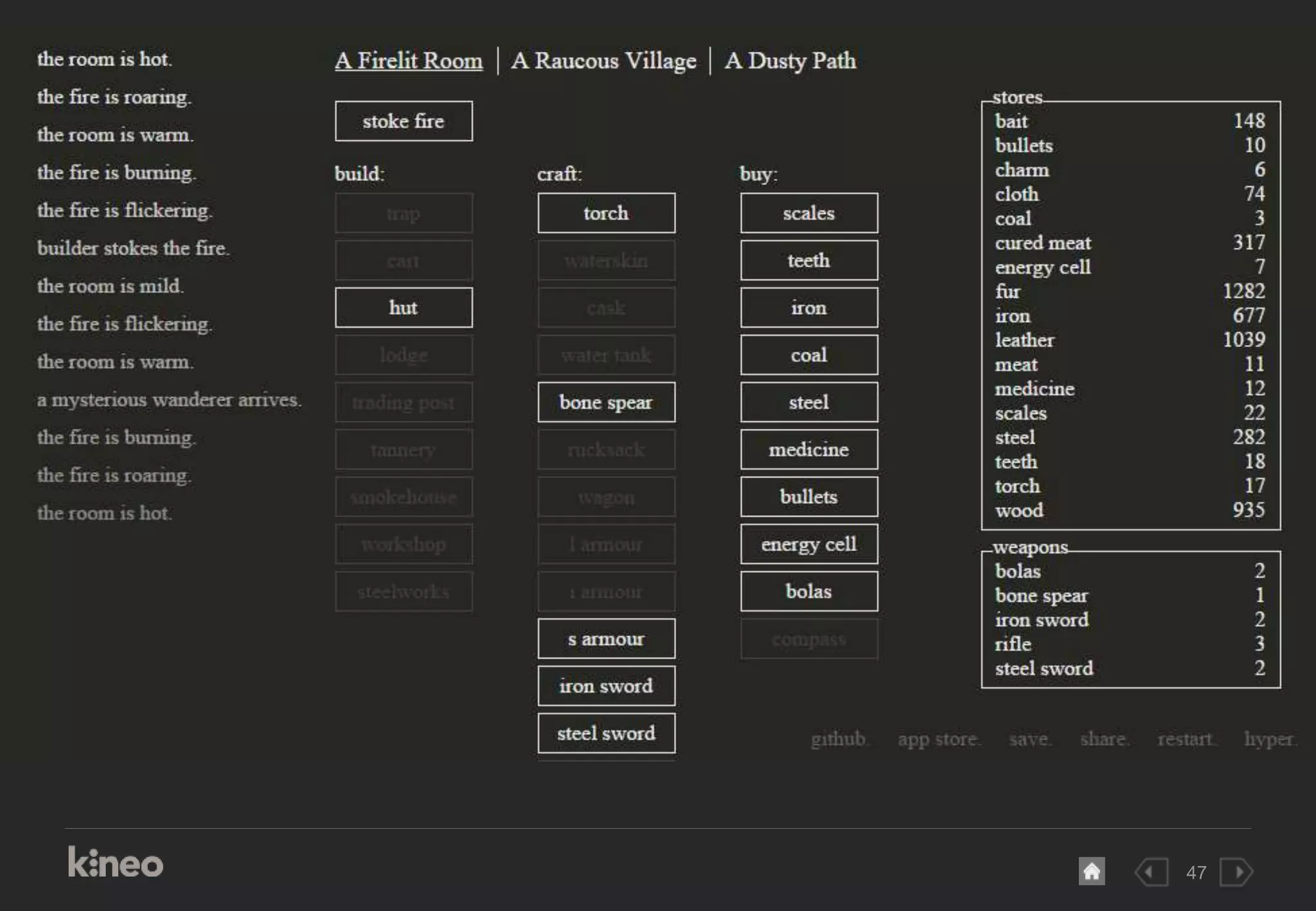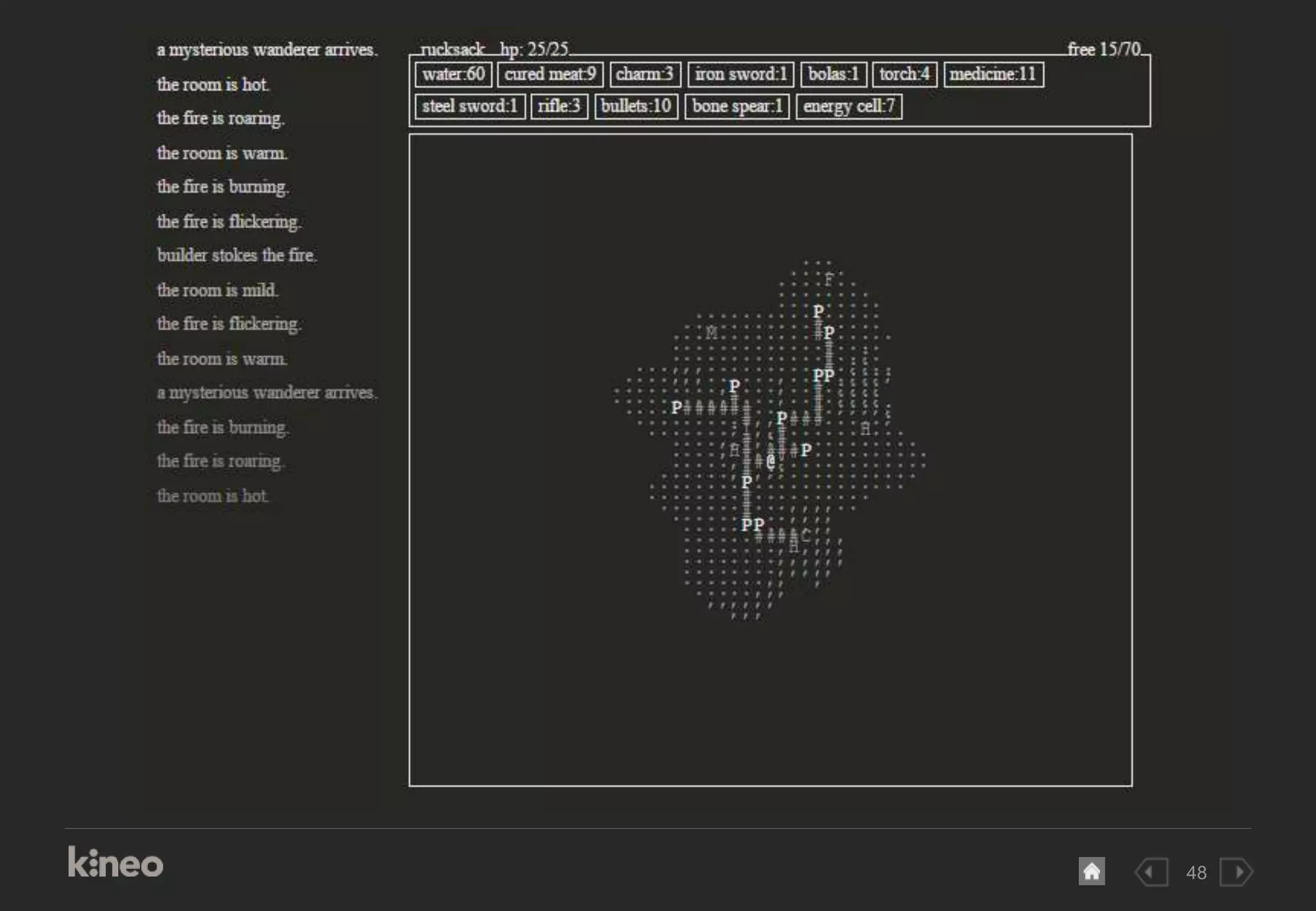
We begin in a dark room.
The room is freezing.
The fire is dead.
Light fire.
Stoke fire.
The light from the fire spills from
the windows, out into the dark.
A fire-lit room
The room is warm.
Stoke fire.
A fire-lit room
A ragged stranger stumbles
through the door and collapses
in the corner, shivering.
Stoke fire.
The wood is running out.
Stores .
Wood 3
A Fire-lit Room A Silent Forest
Gather wood
Stores .
Wood 3
A Fire-lit Room A Silent Forest
The sky is grey and cold. There
is a chill wind.
Where to go from here?
Onward to
“gamification”
7
Not another
leaderboard!
Richard Durham, Senior Instructional Designer
22nd July 2015
8
AGENDA
 A Dark Room
What is gamification, really?
How are games used now?
What are we missing?
An appeal to play
What else can games do?
9
What is gamification, really?
But have you ever been asked, “What is a game?”
You might have been asked to
define this before.
“It’s the use of game-thinking and
game mechanics in a non-game
context in order to engage users
and solve problems.”
10
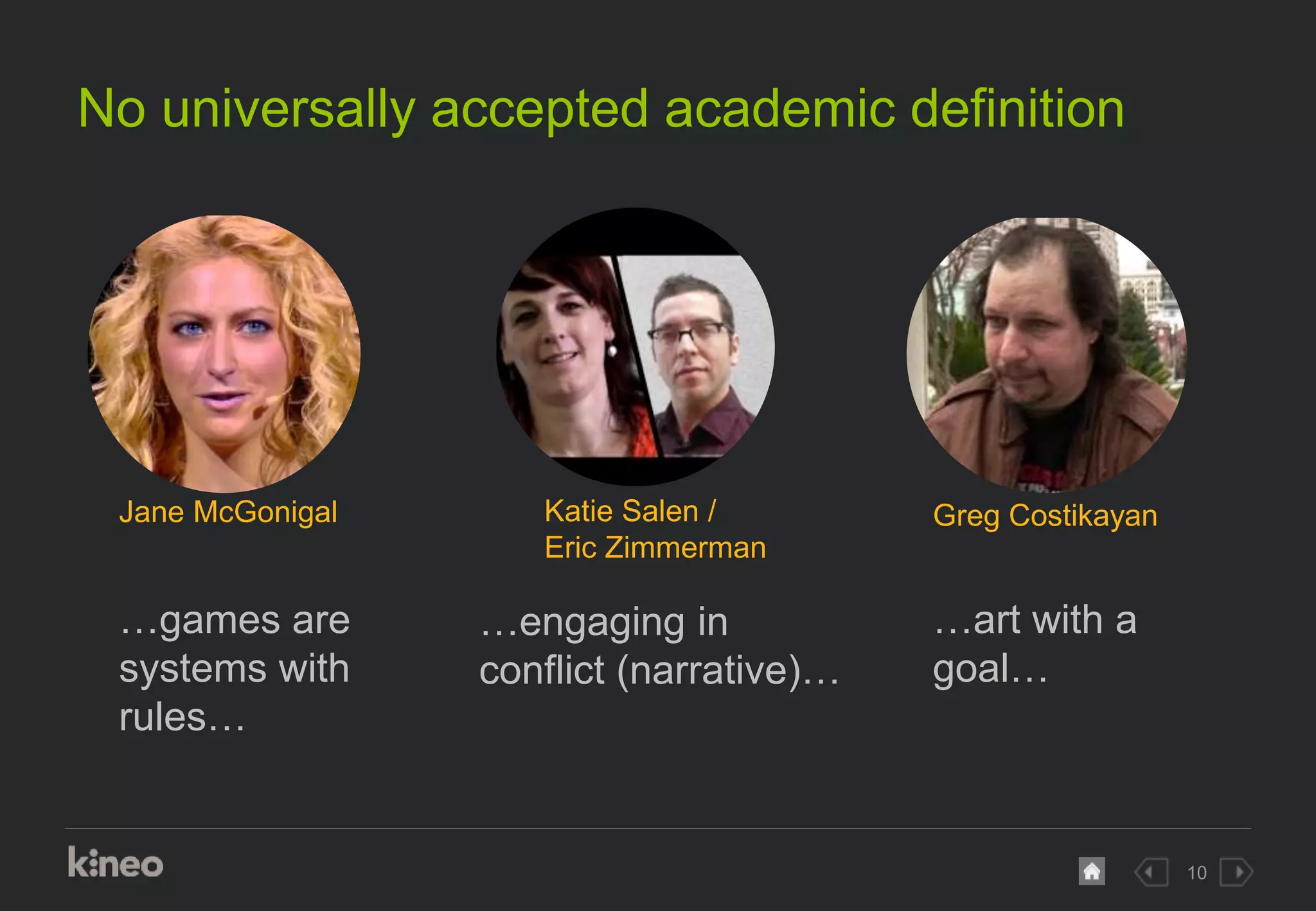
No universally accepted academic definition
…engaging in
conflict (narrative)…
…games are
systems with
rules…
…art with a
goal…
Jane McGonigal Katie Salen /
Eric Zimmerman
Greg Costikayan
11
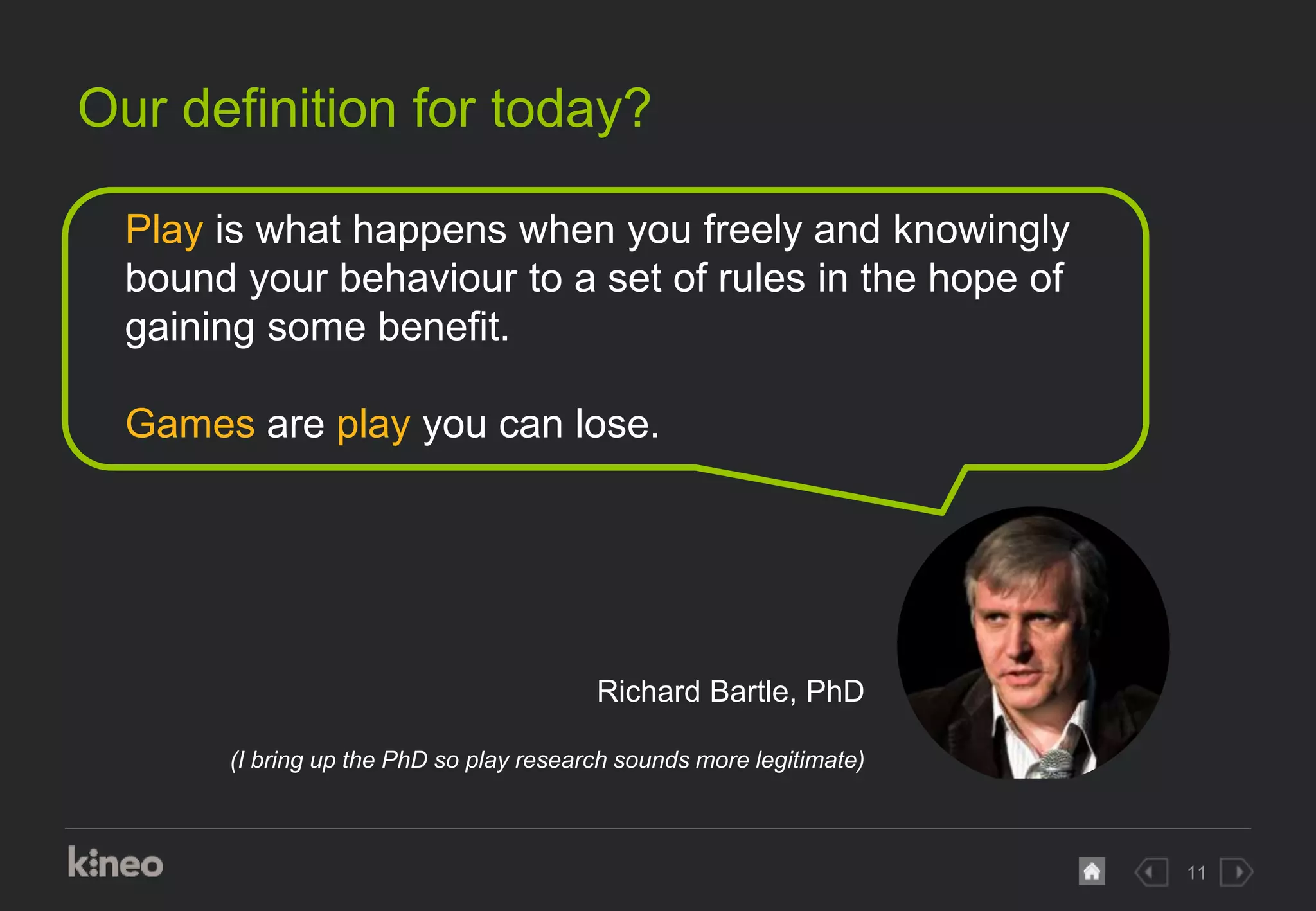
Our definition for today?
Play is what happens when you freely and knowingly
bound your behaviour to a set of rules in the hope of
gaining some benefit.
Games are play you can lose.
Richard Bartle, PhD
(I bring up the PhD so play research sounds more legitimate)
12
How are games used now?
13
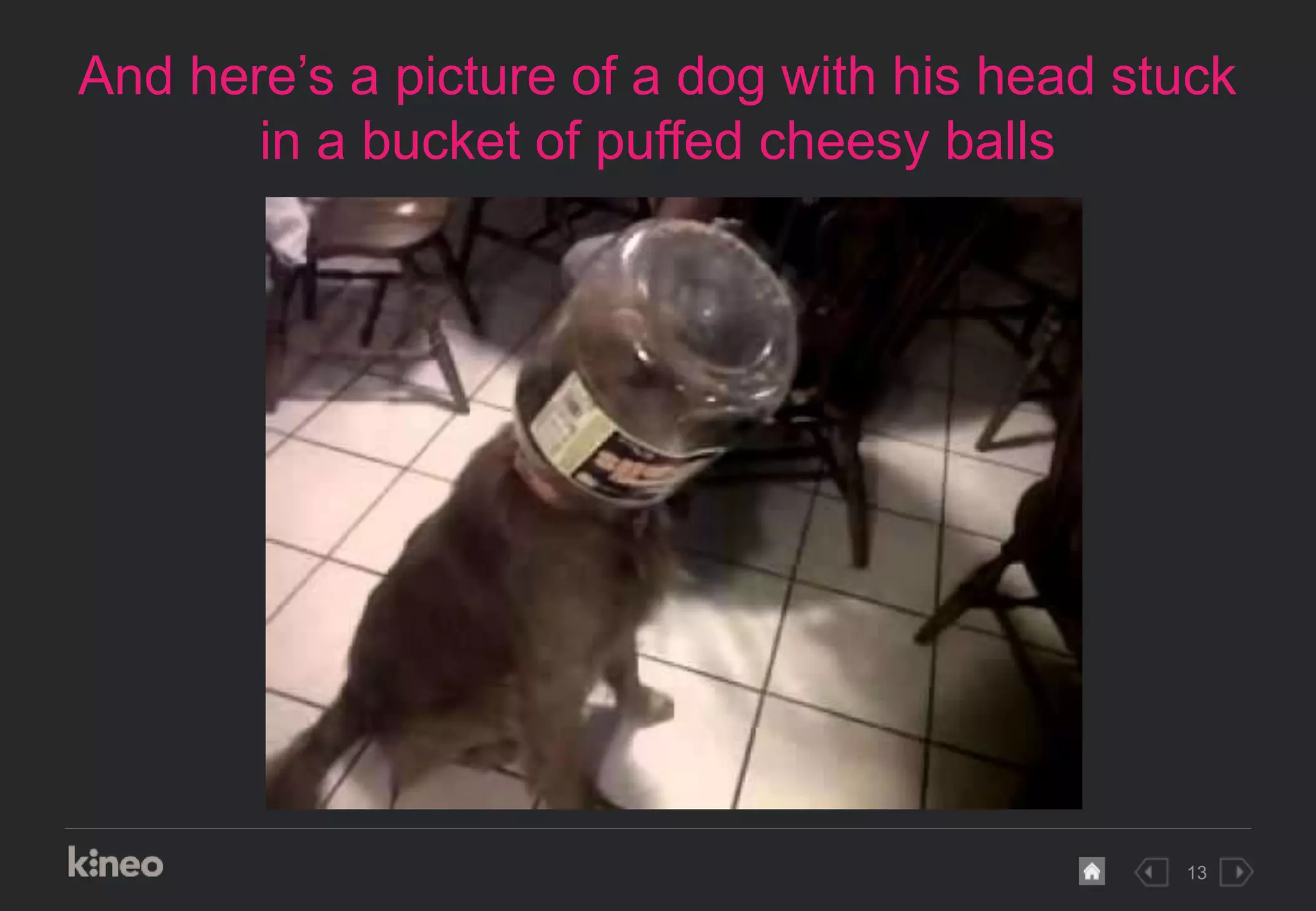
And here’s a picture of a dog with his head stuck
in a bucket of puffed cheesy balls
14
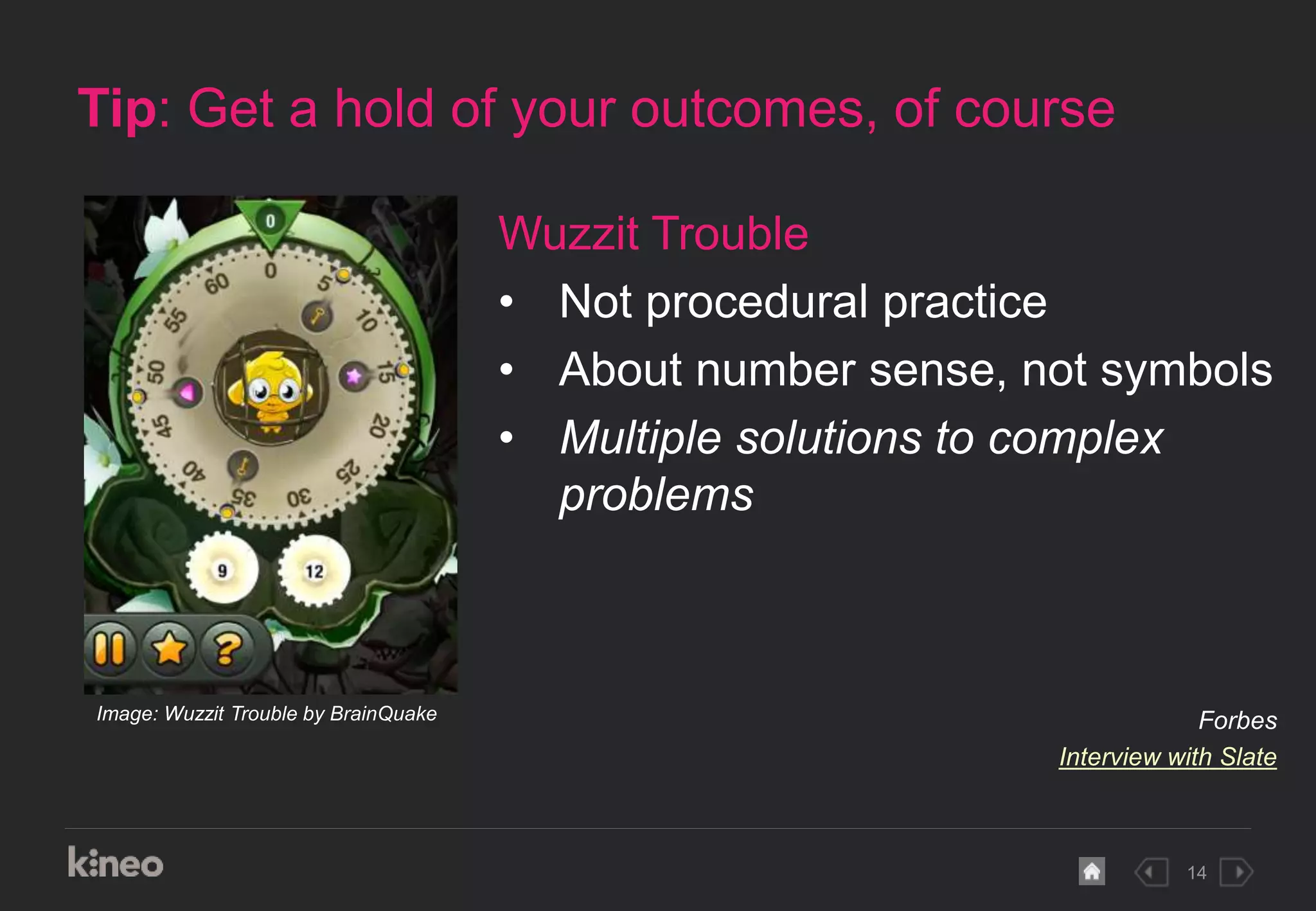
Tip: Get a hold of your outcomes, of course
Image: Wuzzit Trouble by BrainQuake
Wuzzit Trouble
• Not procedural practice
• About number sense, not symbols
• Multiple solutions to complex
problems
Forbes
Interview with Slate
15
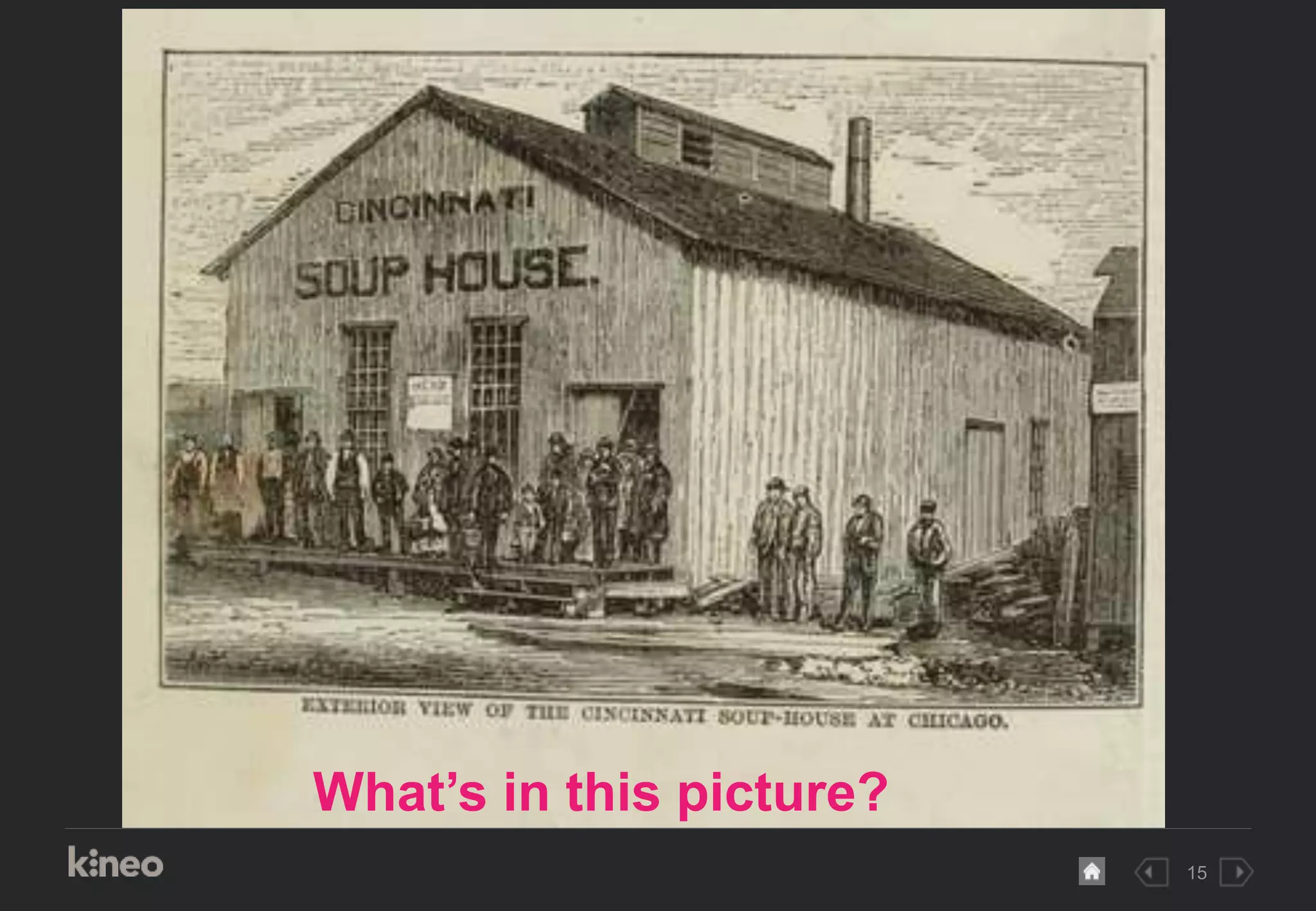
What’s in this picture?
16
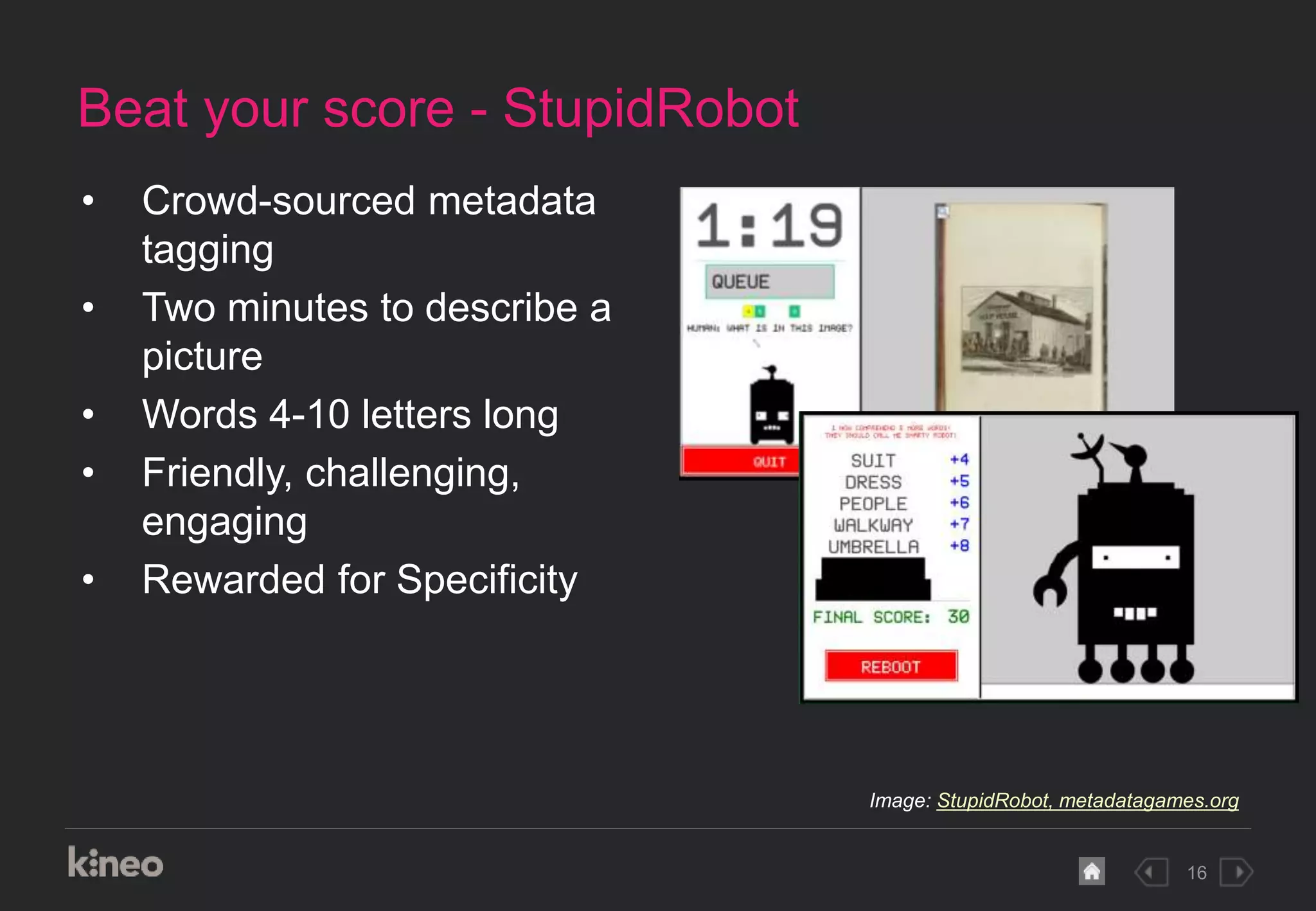
Beat your score - StupidRobot
• Crowd-sourced metadata
tagging
• Two minutes to describe a
picture
• Words 4-10 letters long
• Friendly, challenging,
engaging
• Rewarded for Specificity
Image: StupidRobot, metadatagames.org
17
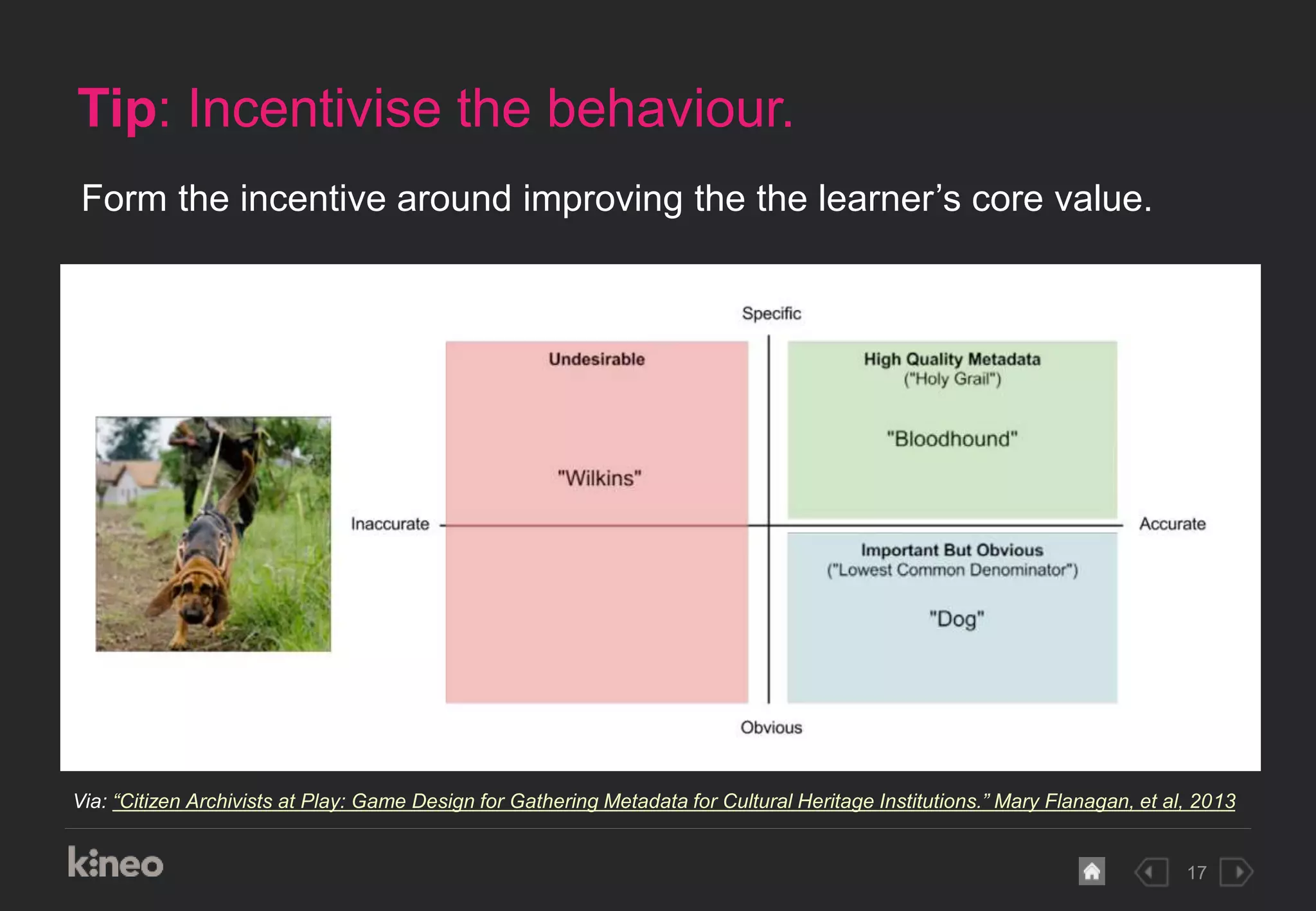
Tip: Incentivise the behaviour.
Via: “Citizen Archivists at Play: Game Design for Gathering Metadata for Cultural Heritage Institutions.” Mary Flanagan, et al, 2013
Form the incentive around improving the the learner’s core value.
18
Leaderboards in games
Know where
you stand!
Encourage
competition!
19
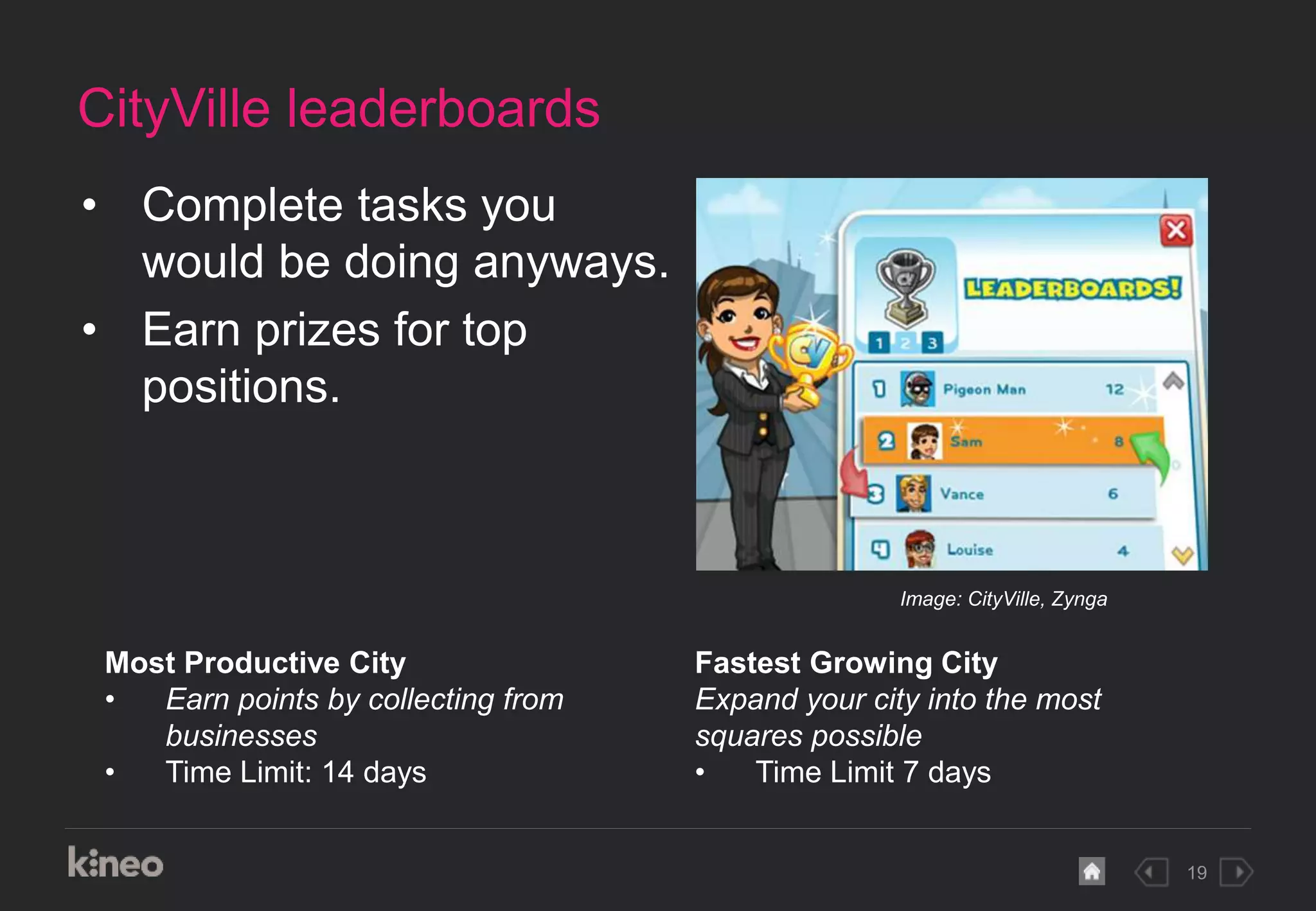
CityVille leaderboards
• Complete tasks you
would be doing anyways.
• Earn prizes for top
positions.
Image: CityVille, Zynga
Fastest Growing City
Expand your city into the most
squares possible
• Time Limit 7 days
Most Productive City
• Earn points by collecting from
businesses
• Time Limit: 14 days
20
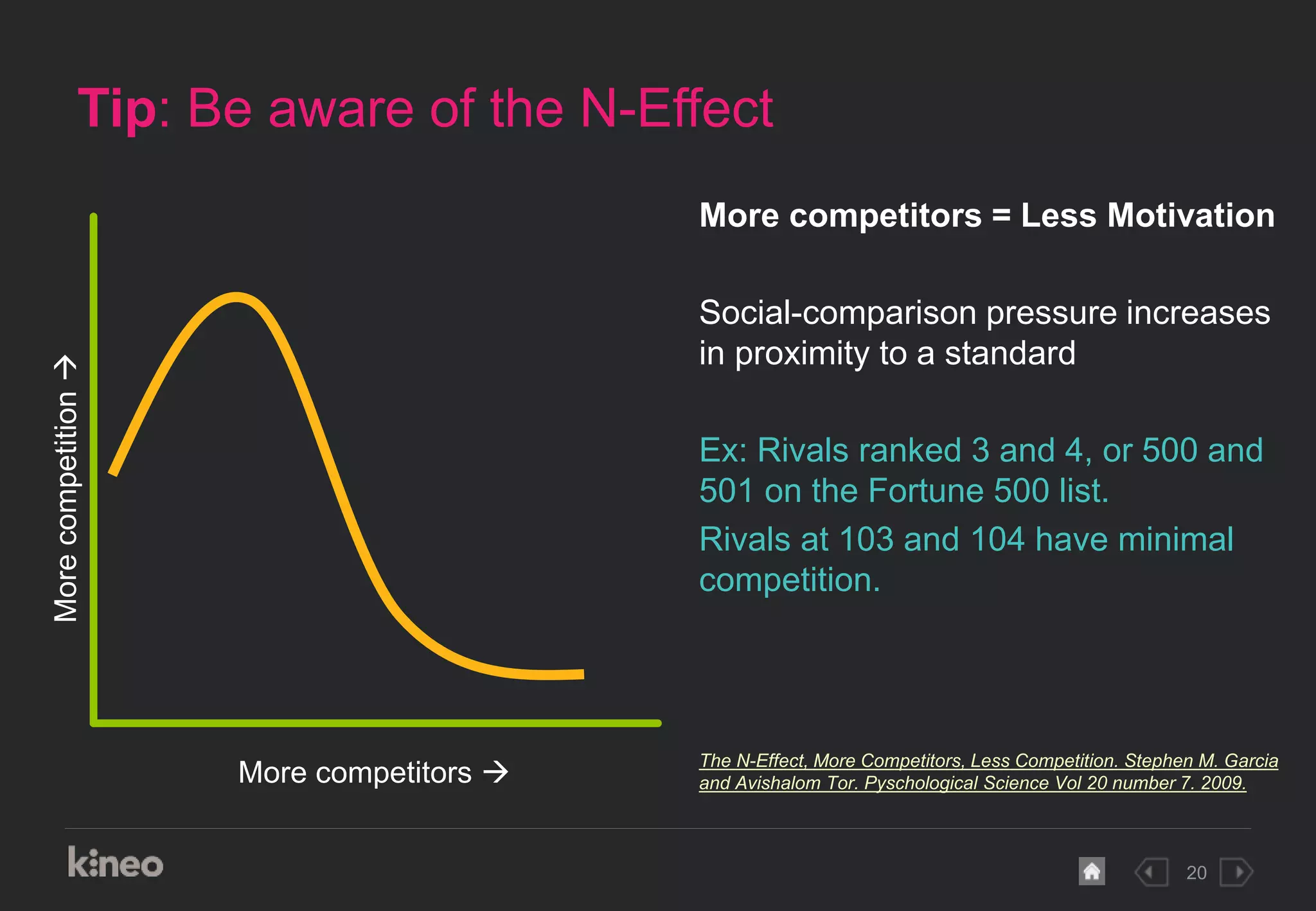
Tip: Be aware of the N-Effect
More competitors = Less Motivation
Social-comparison pressure increases
in proximity to a standard
Ex: Rivals ranked 3 and 4, or 500 and
501 on the Fortune 500 list.
Rivals at 103 and 104 have minimal
competition.
The N-Effect, More Competitors, Less Competition. Stephen M. Garcia
and Avishalom Tor. Pyschological Science Vol 20 number 7. 2009.More competitors 
Morecompetition
21
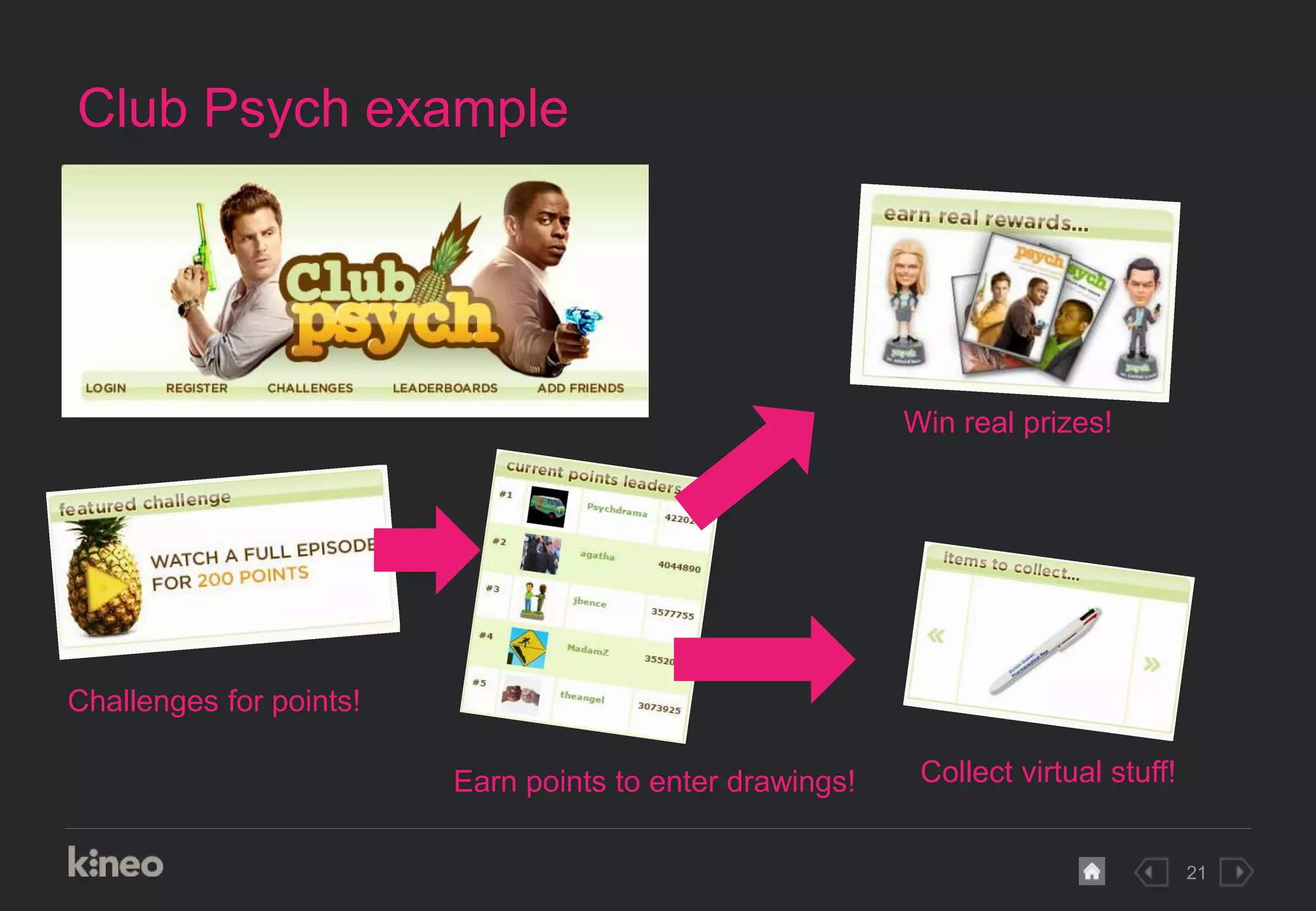
Club Psych example
Challenges for points!
Collect virtual stuff!Earn points to enter drawings!
Win real prizes!
22
However….
Engagement can not be “gamed” into existence.
23
Engagement is not “gamed”
“People claim [loyalty programmes] to be important
to their decision making, but the truth is they really
don’t seem to actually impact their behaviour over
the long run.
Andrew Lewis, managing director at TRA
New Zealand Marketing, July/August 2015
24
Tip: Reward with personalisation, emotion
“What is evident when successful loyalty
programmes are examined against those
that fail to create change is that they create
stronger emotional bonds between the
customer and the brand.”
Andrew Lewis, managing director at TRA
New Zealand Marketing, July/August 2015
25
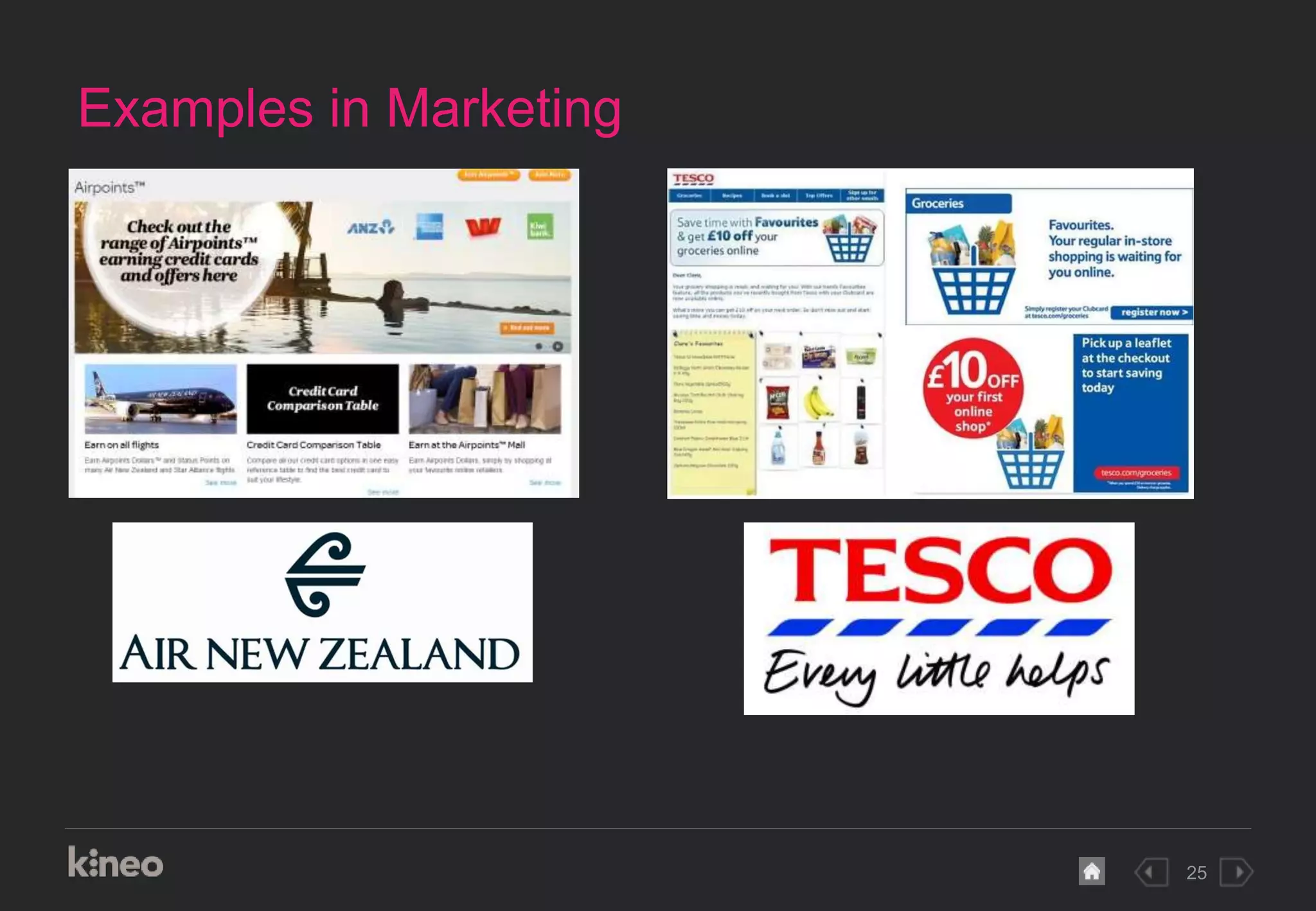
Examples in Marketing
26
AGENDA
 A Dark Room
 What is gamification, really?
 How are games used now?
What are we missing?
An appeal to play
What else can games do?
27
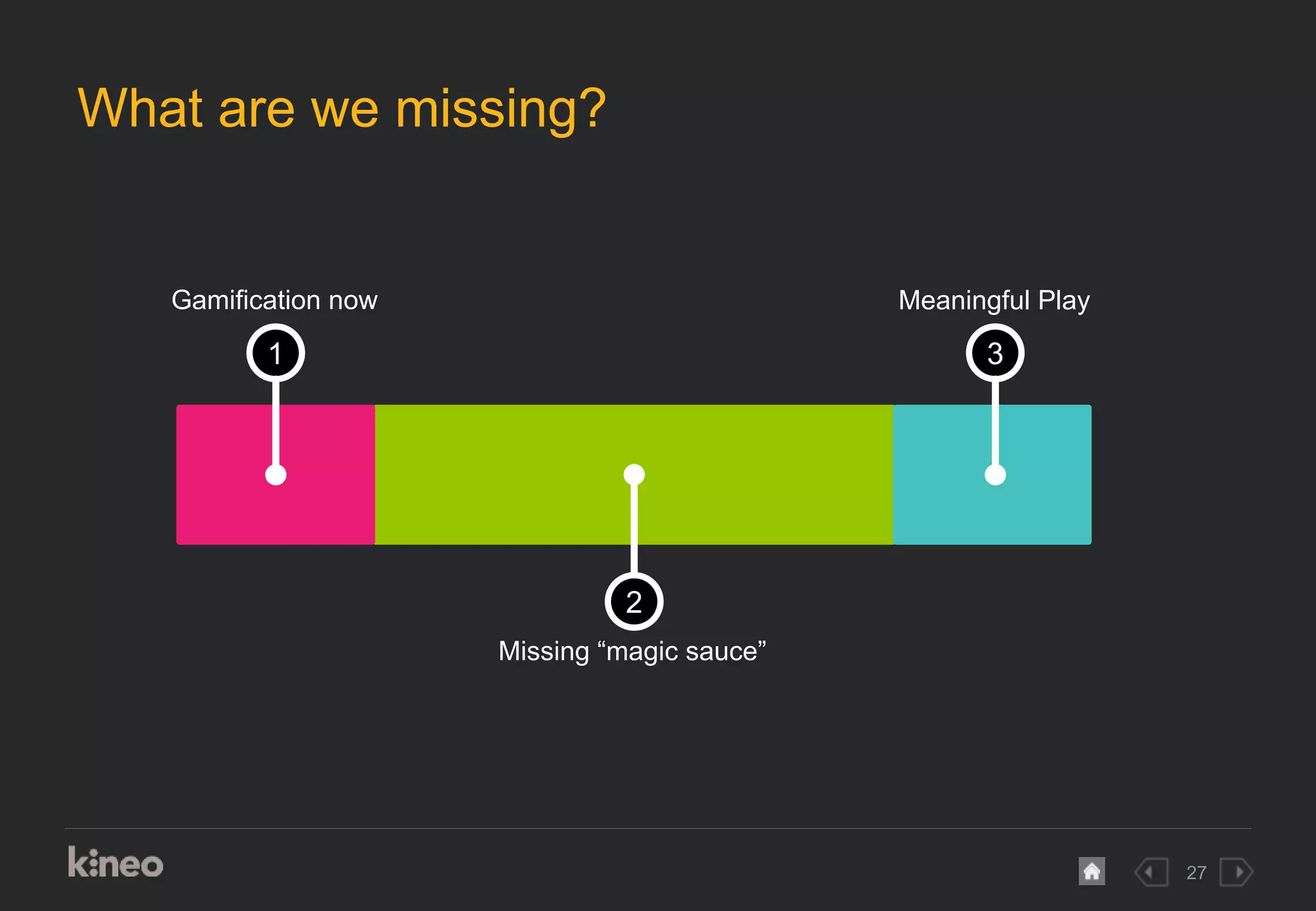
What are we missing?
1
2
3
Gamification now
Missing “magic sauce”
Meaningful Play
28
This picture of a baby Giraffe
29
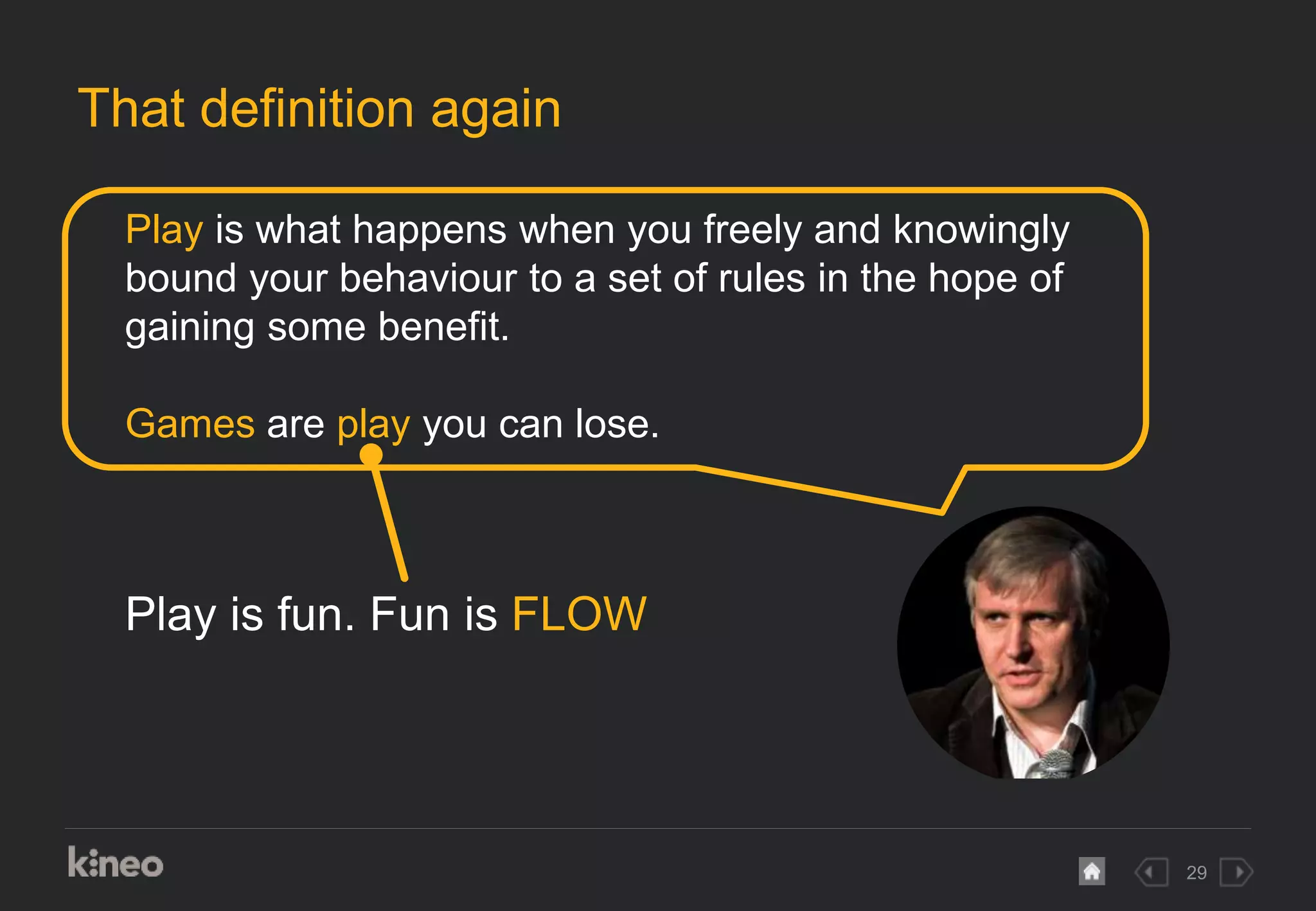
That definition again
Play is what happens when you freely and knowingly
bound your behaviour to a set of rules in the hope of
gaining some benefit.
Games are play you can lose.
Play is fun. Fun is FLOW
30
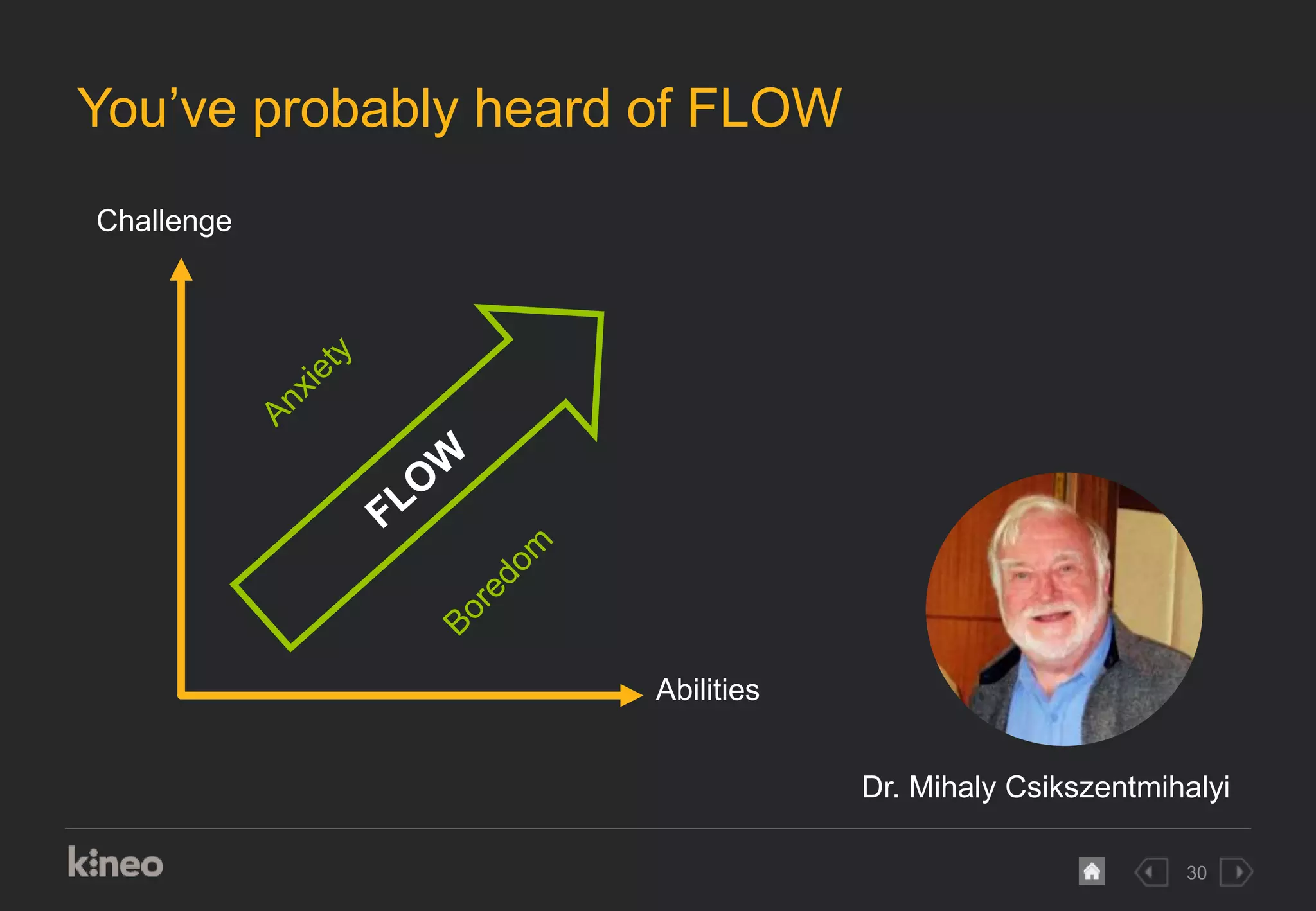
You’ve probably heard of FLOW
Dr. Mihaly Csikszentmihalyi
Abilities
Challenge
31
An Appeal
to Play
“The Magic Sauce”
32
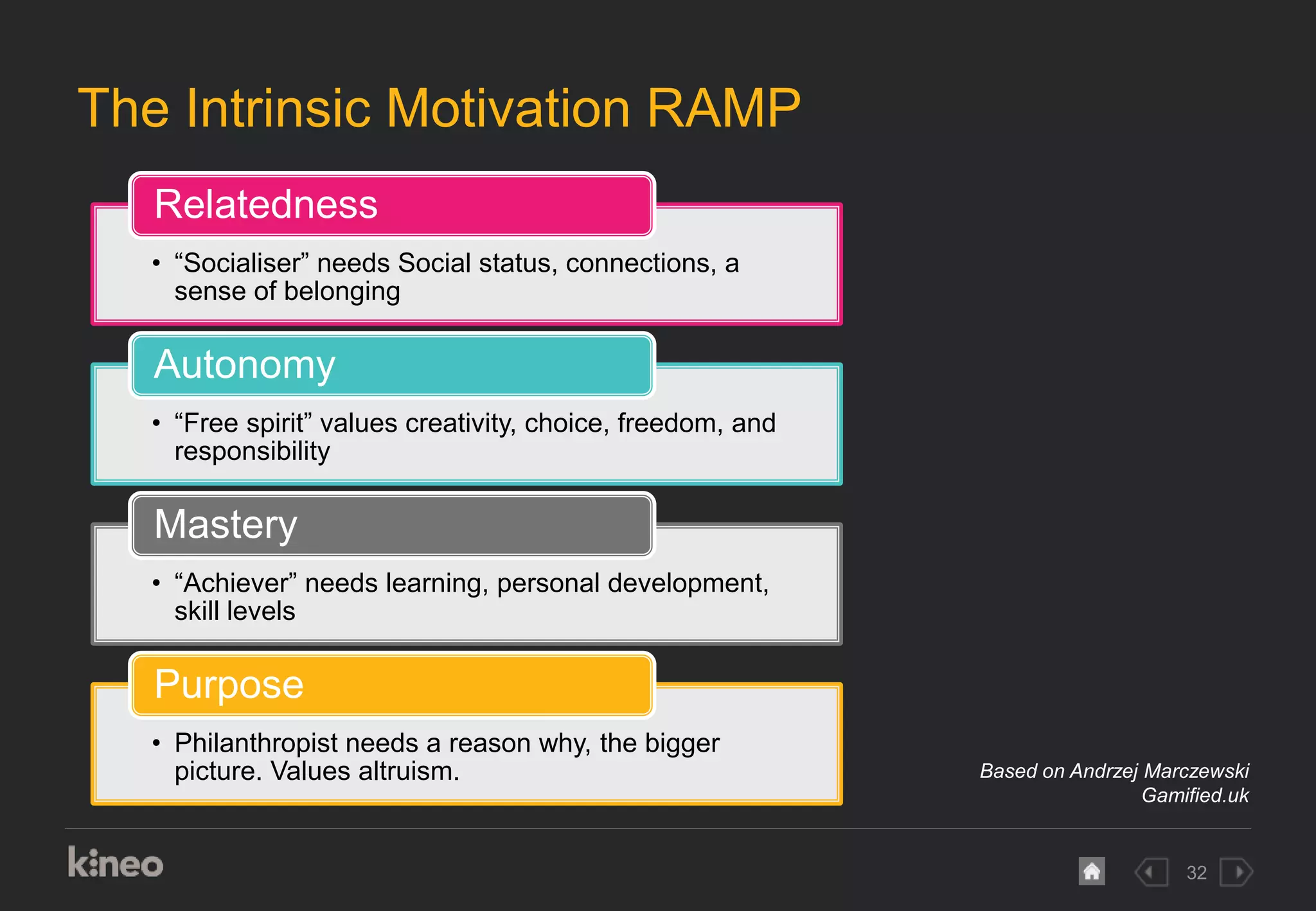
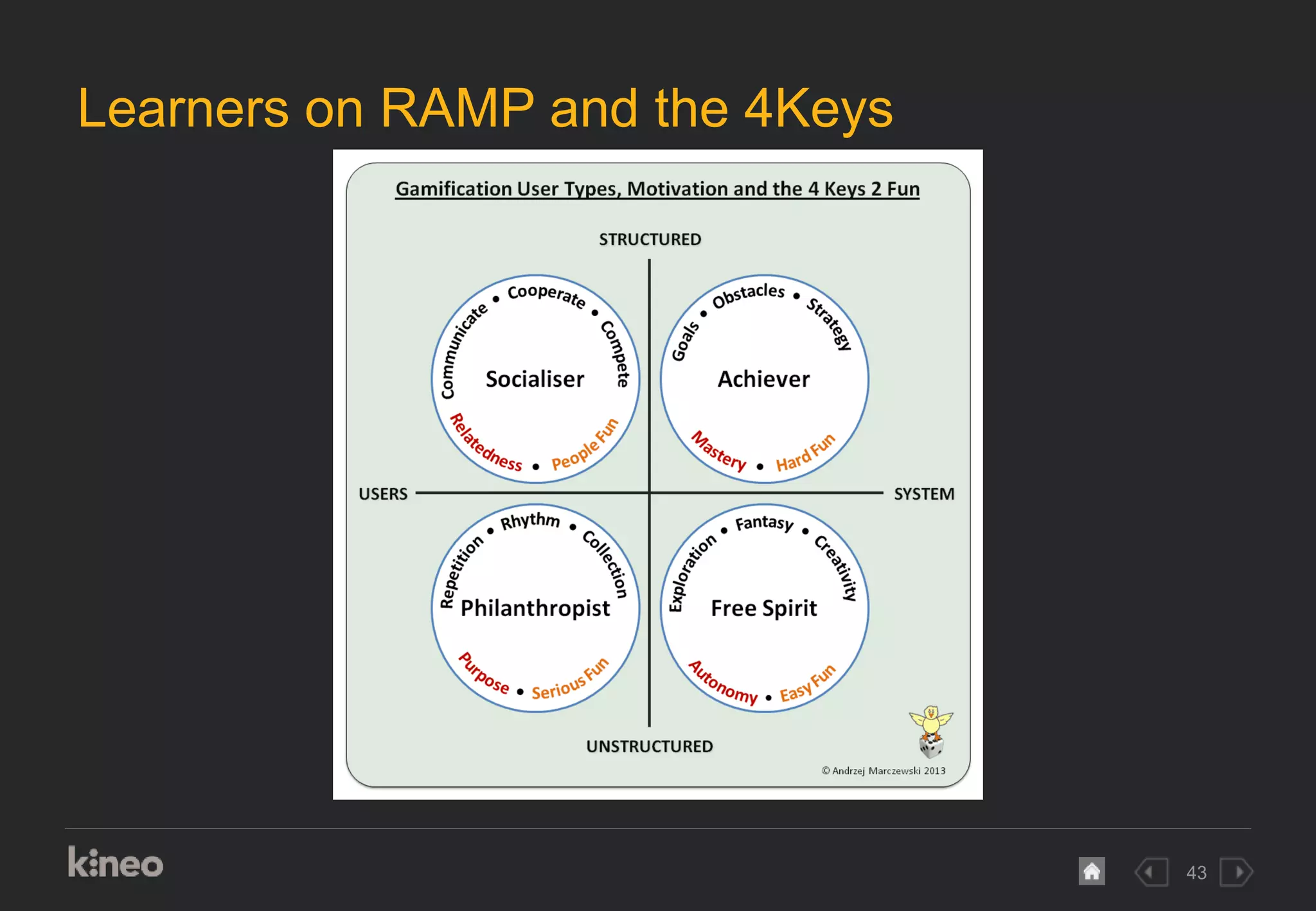
The Intrinsic Motivation RAMP
• “Socialiser” needs Social status, connections, a
sense of belonging
Relatedness
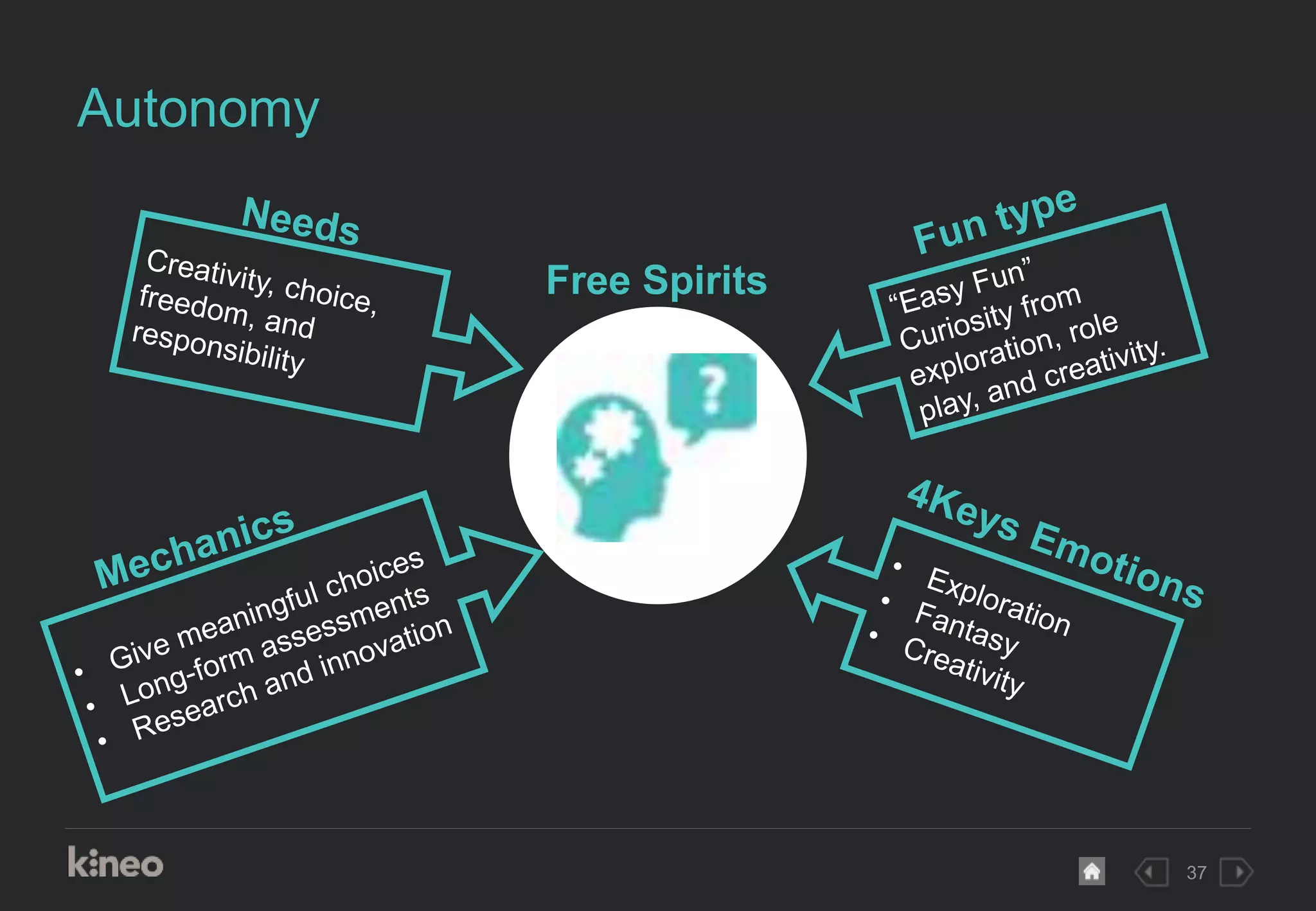
• “Free spirit” values creativity, choice, freedom, and
responsibility
Autonomy
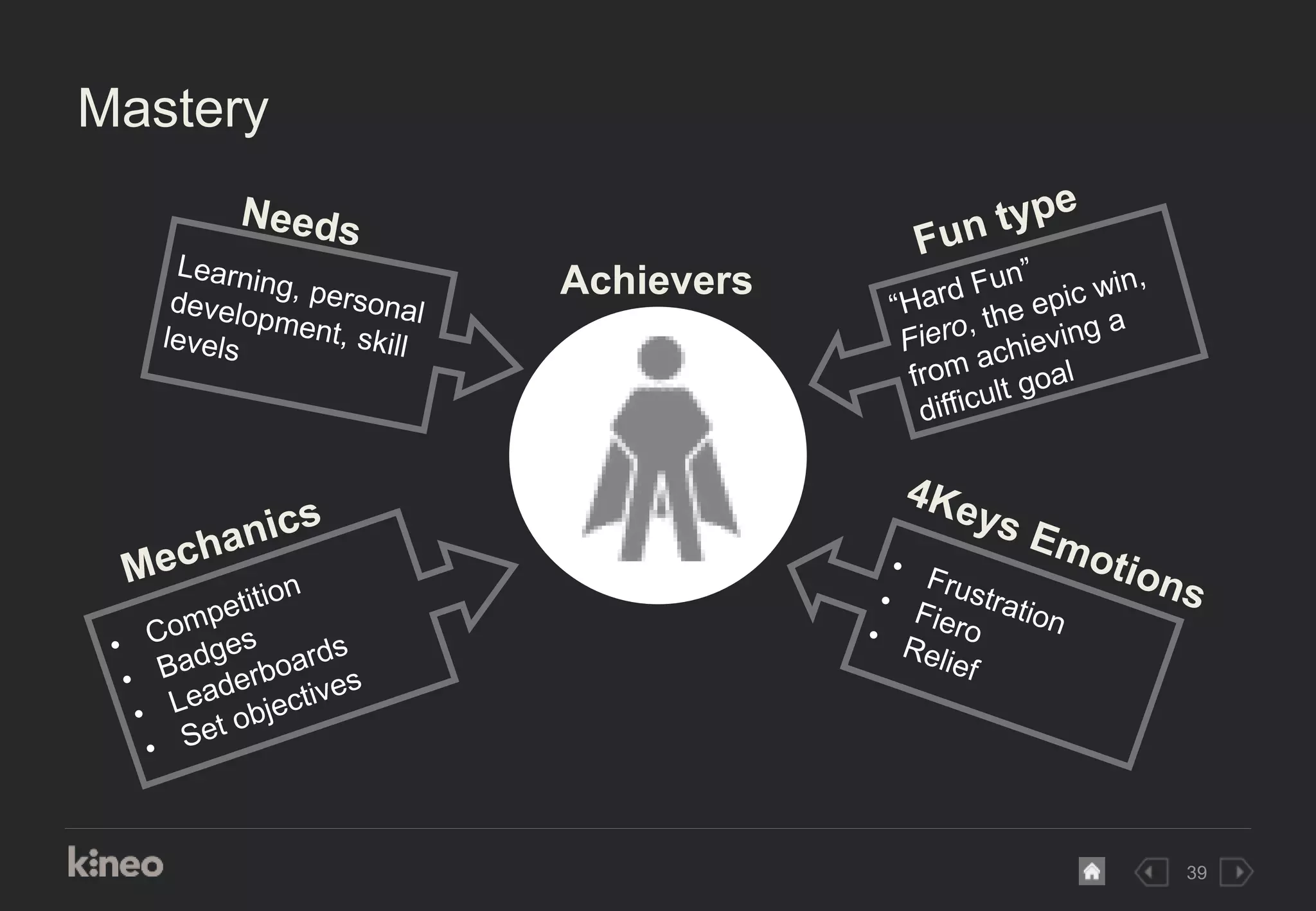
• “Achiever” needs learning, personal development,
skill levels
Mastery
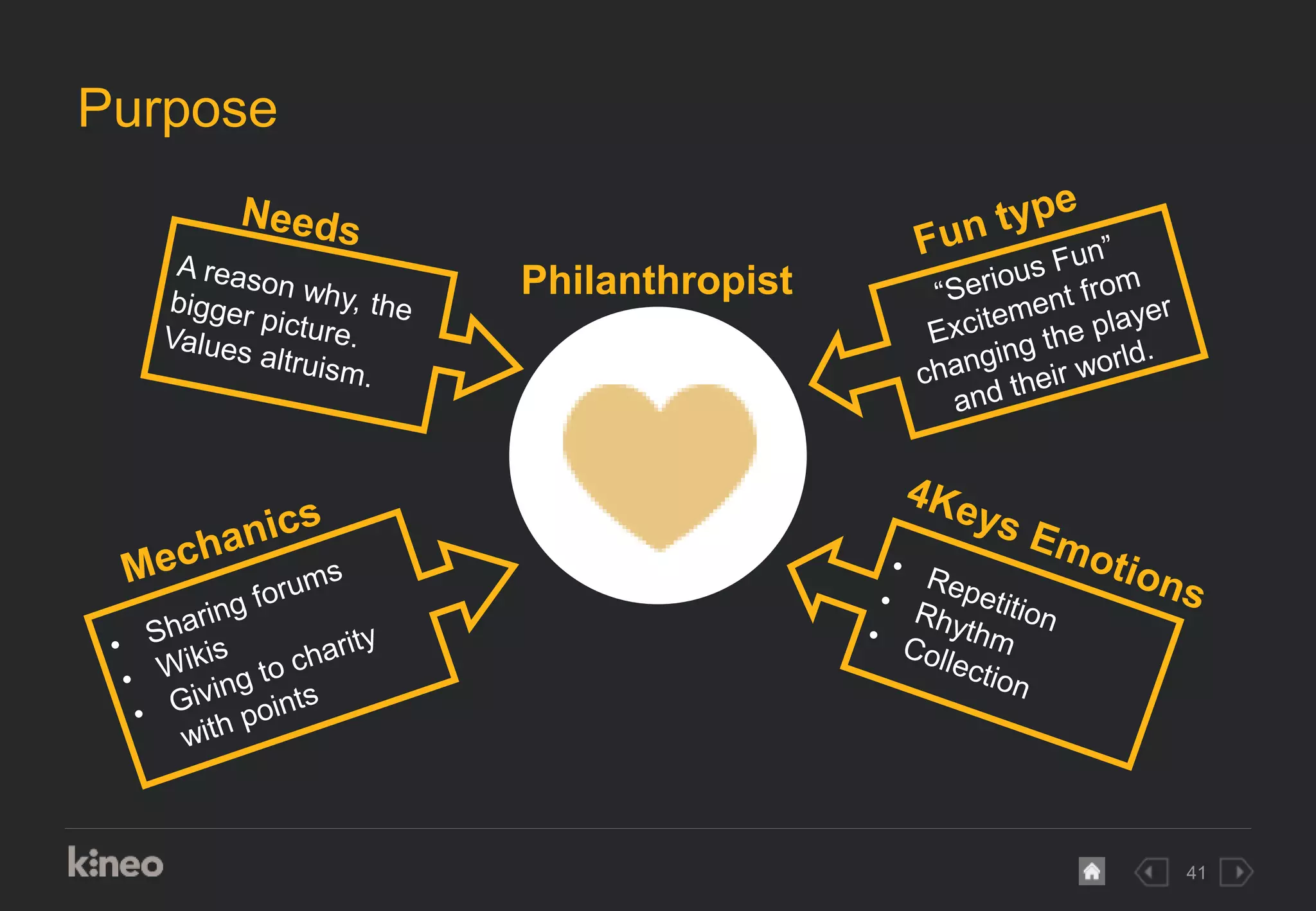
• Philanthropist needs a reason why, the bigger
picture. Values altruism.
Purpose
Based on Andrzej Marczewski
Gamified.uk
33
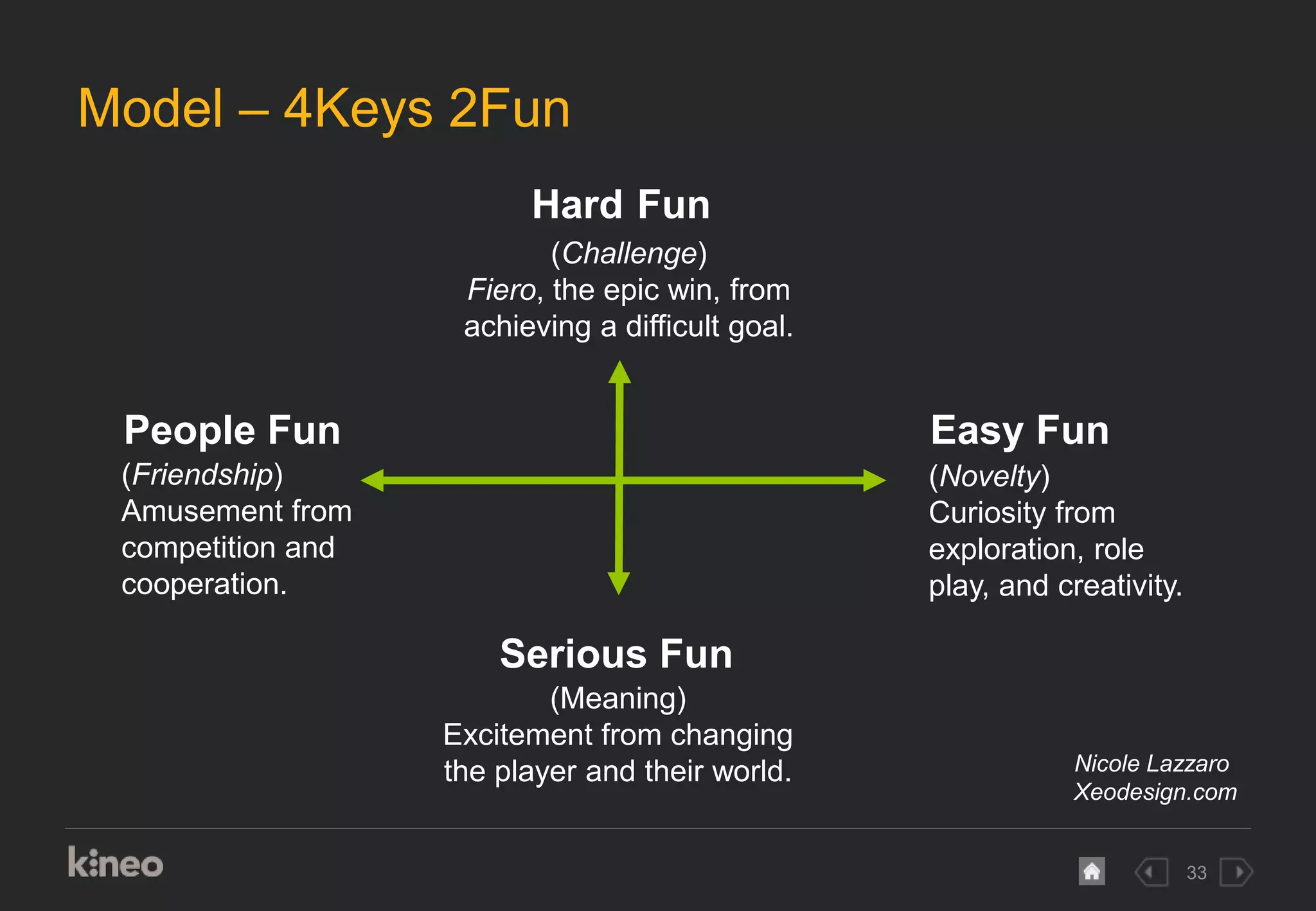
Model – 4Keys 2Fun
Hard Fun
Easy Fun
Serious Fun
People Fun
(Meaning)
Excitement from changing
the player and their world.
(Novelty)
Curiosity from
exploration, role
play, and creativity.
(Challenge)
Fiero, the epic win, from
achieving a difficult goal.
(Friendship)
Amusement from
competition and
cooperation.
Nicole Lazzaro
Xeodesign.com
34
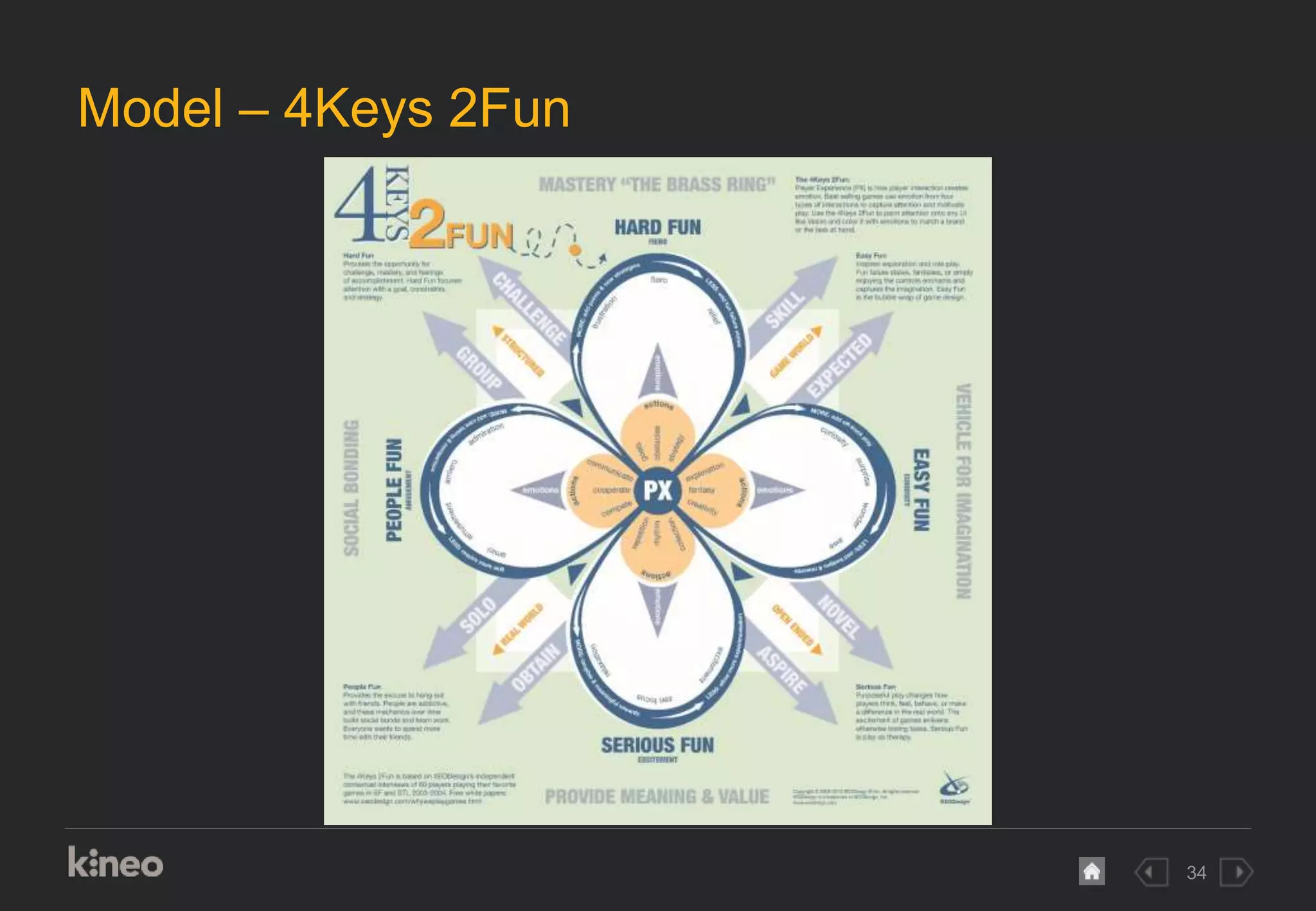
Model – 4Keys 2Fun
35
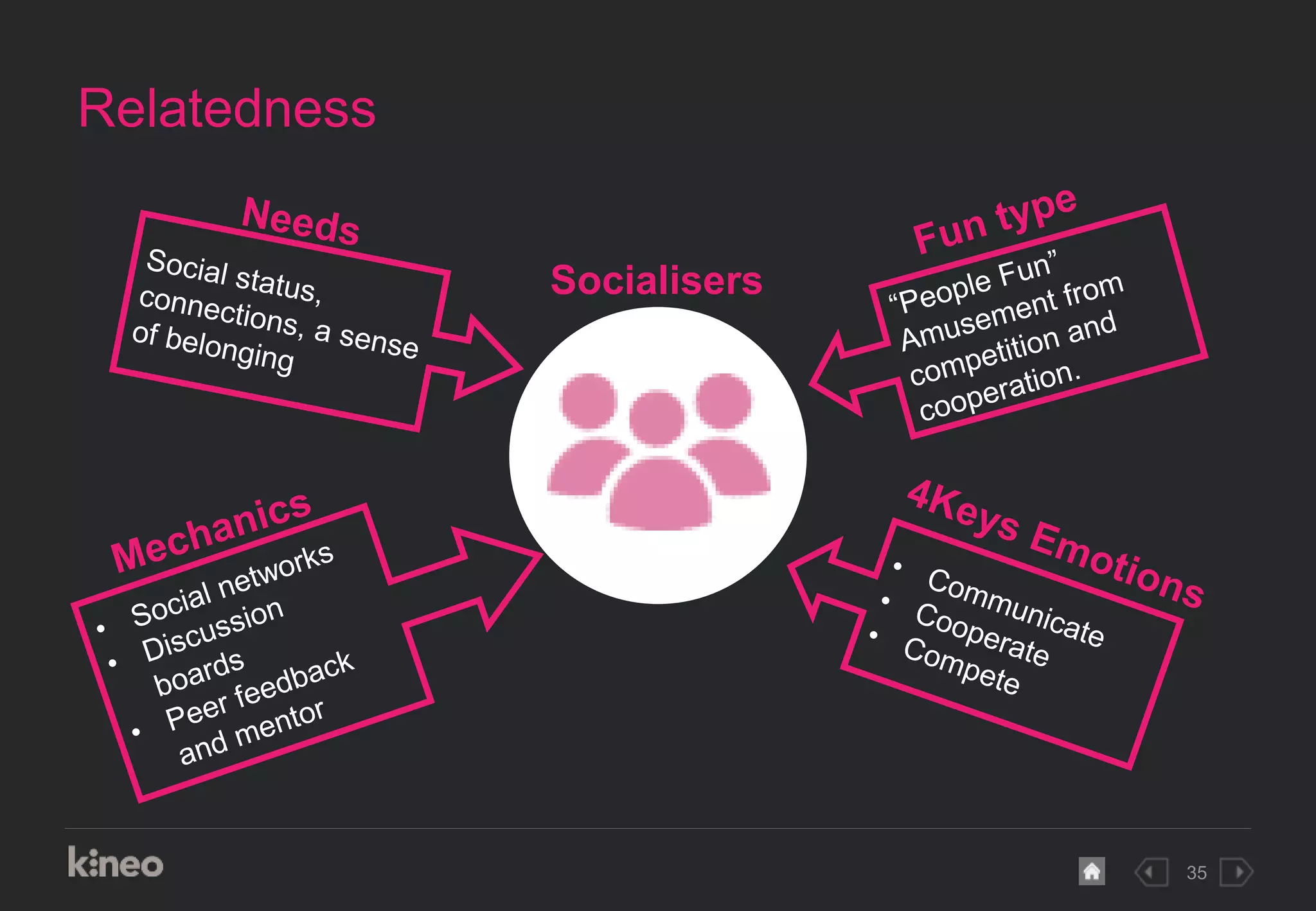
Relatedness
Socialisers
36
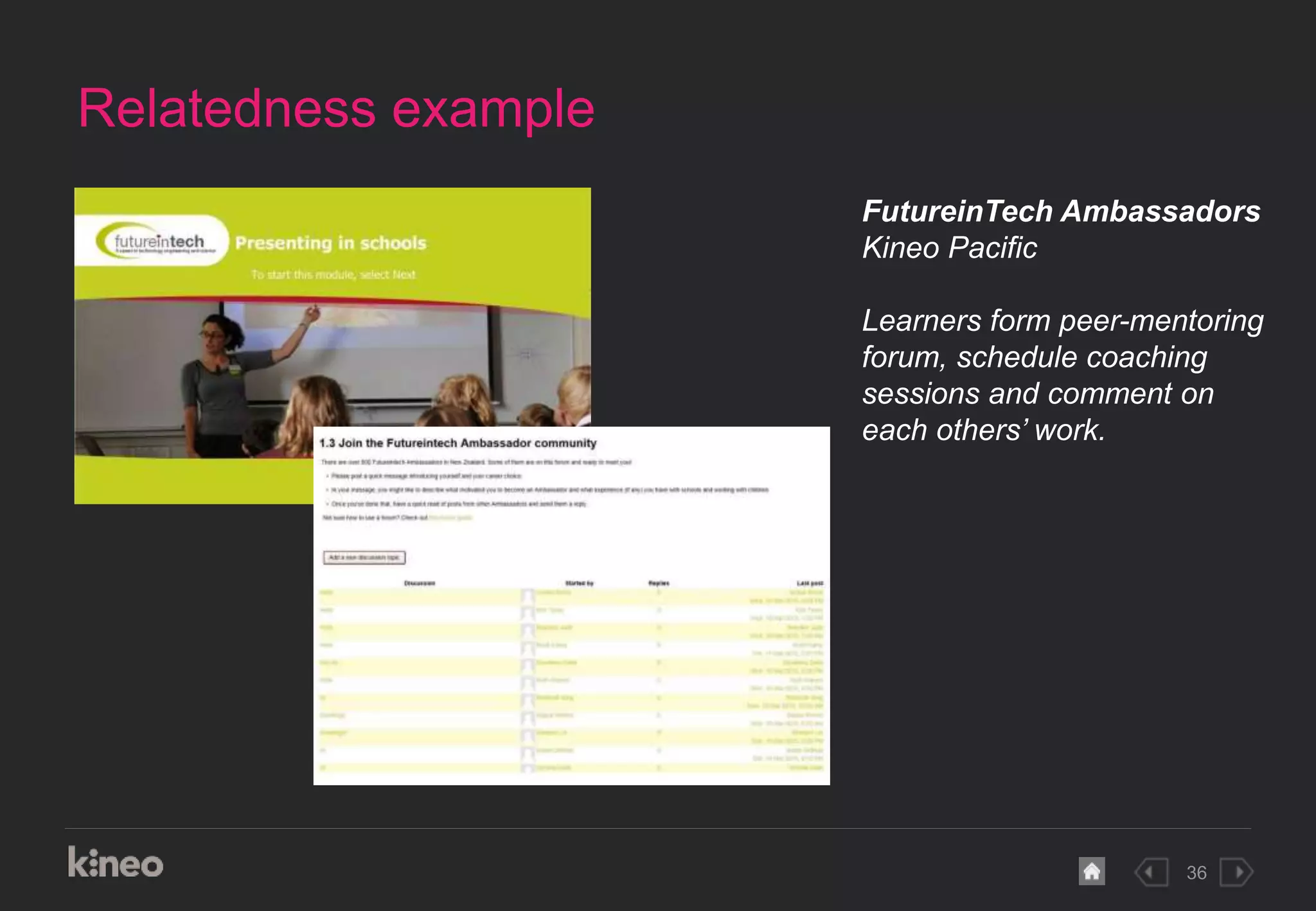
Relatedness example
FutureinTech Ambassadors
Kineo Pacific
Learners form peer-mentoring
forum, schedule coaching
sessions and comment on
each others’ work.
37
Autonomy
Free Spirits
38
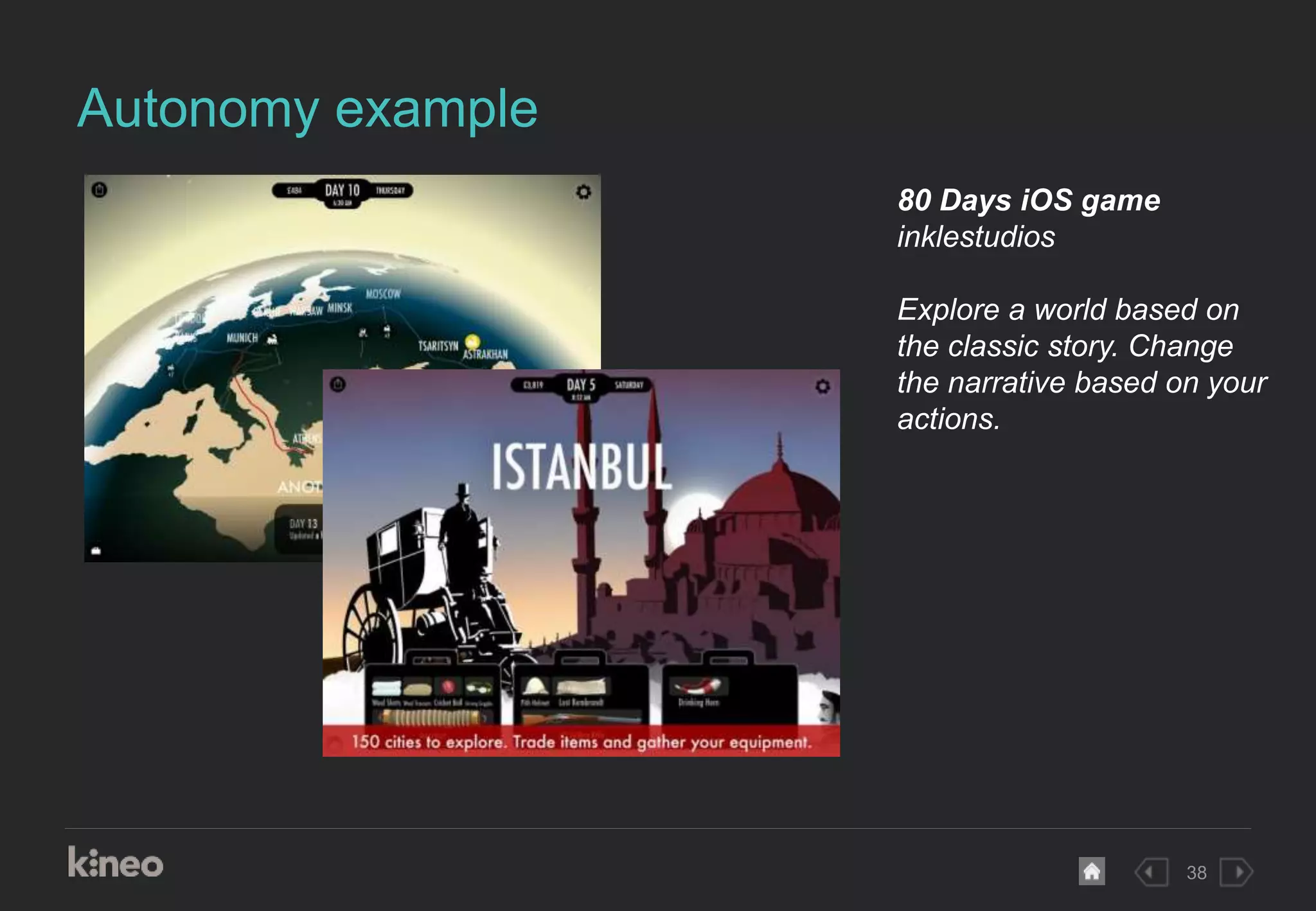
Autonomy example
80 Days iOS game
inklestudios
Explore a world based on
the classic story. Change
the narrative based on your
actions.
39
Mastery
Achievers
40
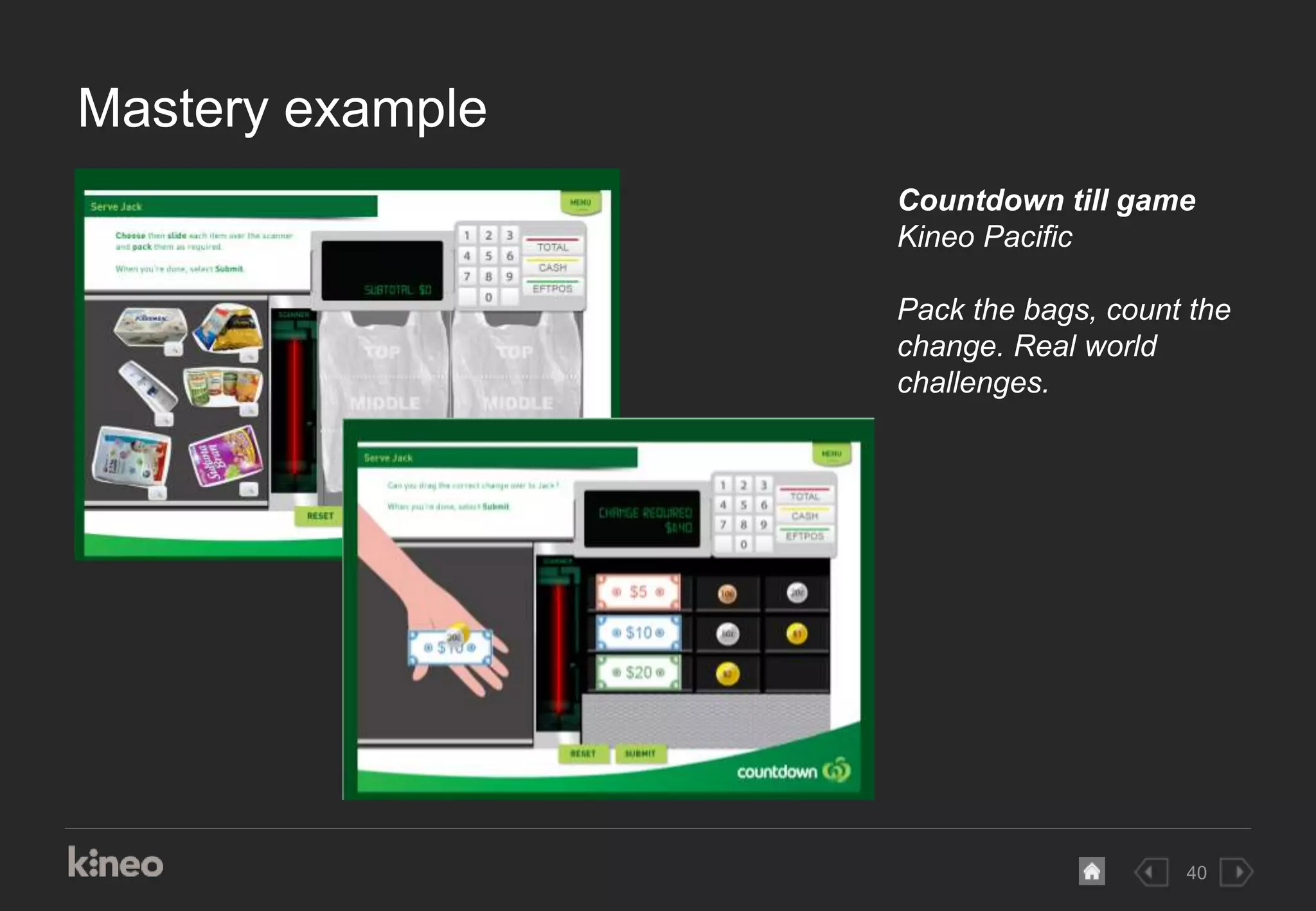
Mastery example
Countdown till game
Kineo Pacific
Pack the bags, count the
change. Real world
challenges.
41
Purpose
Philanthropist
42
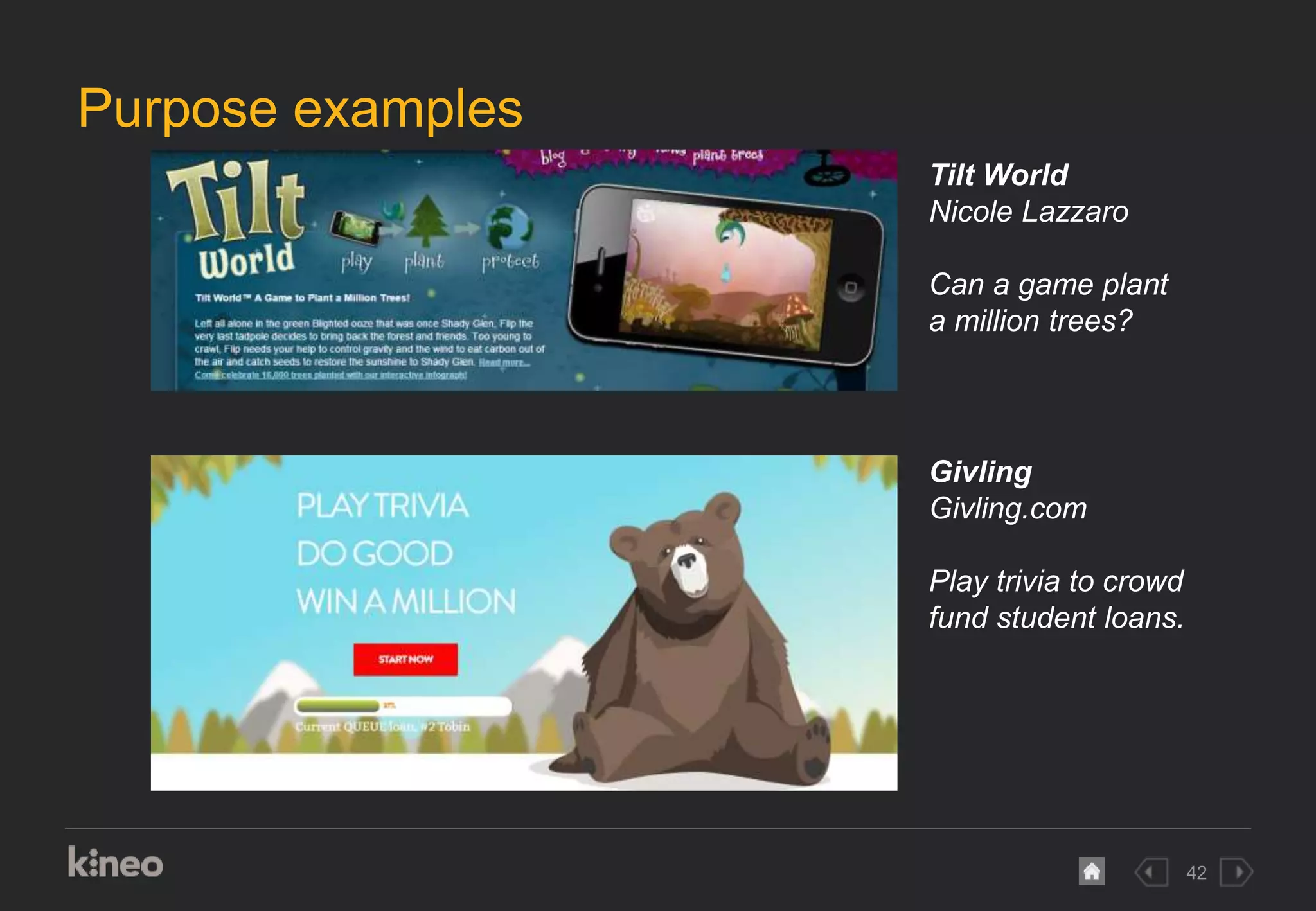
Purpose examples
Tilt World
Nicole Lazzaro
Can a game plant
a million trees?
Givling
Givling.com
Play trivia to crowd
fund student loans.
43
Learners on RAMP and the 4Keys
44
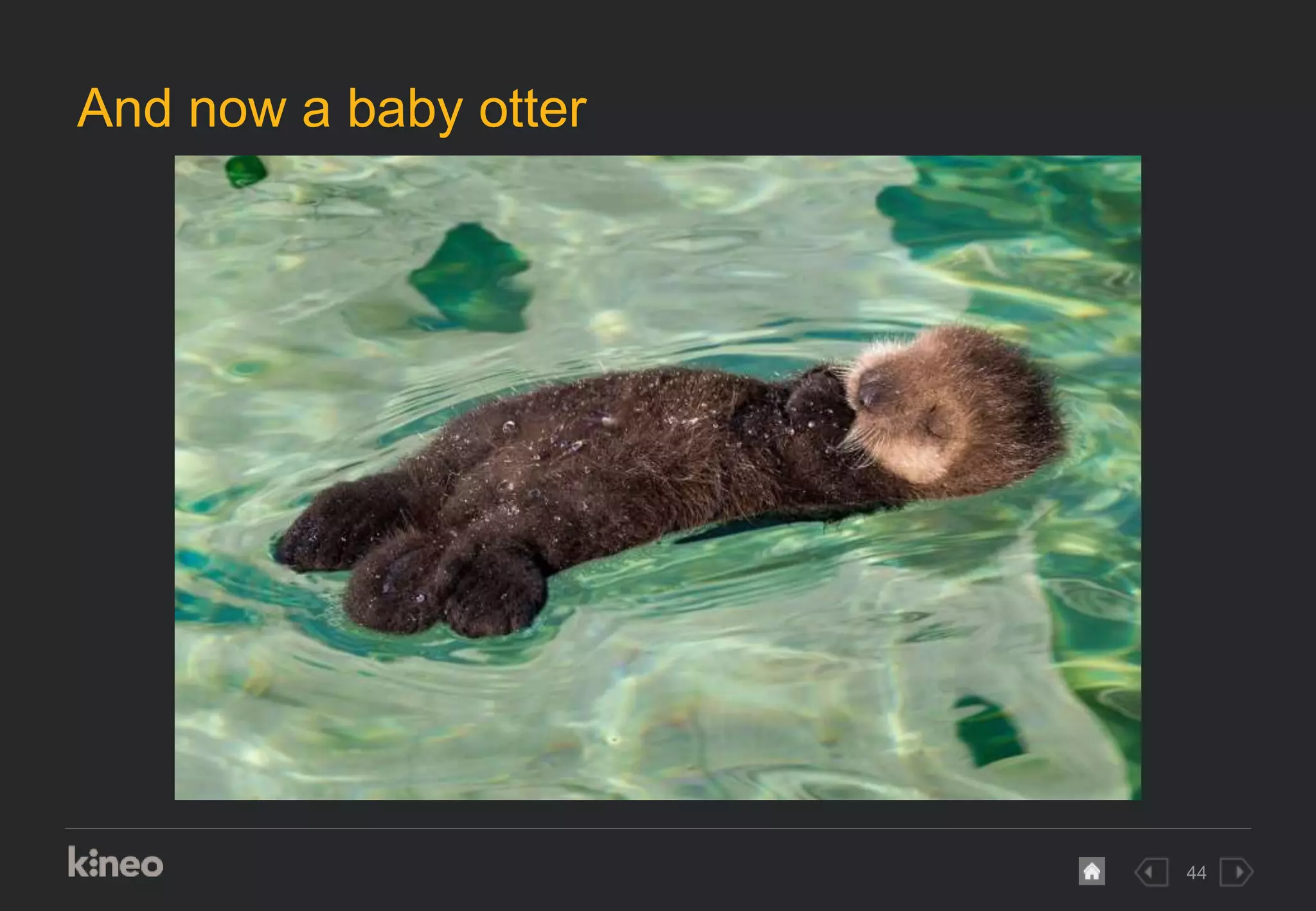
And now a baby otter
45
AGENDA
 A Dark Room
 What is gamification, really?
 How are games used now?
 What are we missing?
 An appeal to play
What else can games do?
46
What else
can games
do?
47
48
49
1. What are the learner’s motivations?
• We are making learning for humans. Involve their
psychology.
2. How can we incorporate fun?
• There’s more than high-score.
3. What are we measuring?
• Measuring something tells the learners that its
important. Grading it means they’ll “game” it.
Ask ourselves
50
51
Improving performance through
learning and technology

Not Another Leaderboard! Or How I Learned to Love Gamification

  • 1.
    We begin ina dark room. The room is freezing. The fire is dead. Light fire.
  • 2.
    Stoke fire. The lightfrom the fire spills from the windows, out into the dark. A fire-lit room
  • 3.
    The room iswarm. Stoke fire. A fire-lit room A ragged stranger stumbles through the door and collapses in the corner, shivering.
  • 4.
    Stoke fire. The woodis running out. Stores . Wood 3 A Fire-lit Room A Silent Forest
  • 5.
    Gather wood Stores . Wood3 A Fire-lit Room A Silent Forest The sky is grey and cold. There is a chill wind.
  • 6.
    Where to gofrom here? Onward to “gamification”
  • 7.
    7 Not another leaderboard! Richard Durham,Senior Instructional Designer 22nd July 2015
  • 8.
    8 AGENDA  A DarkRoom What is gamification, really? How are games used now? What are we missing? An appeal to play What else can games do?
  • 9.
    9 What is gamification,really? But have you ever been asked, “What is a game?” You might have been asked to define this before. “It’s the use of game-thinking and game mechanics in a non-game context in order to engage users and solve problems.”
  • 10.
    10 No universally acceptedacademic definition …engaging in conflict (narrative)… …games are systems with rules… …art with a goal… Jane McGonigal Katie Salen / Eric Zimmerman Greg Costikayan
  • 11.
    11 Our definition fortoday? Play is what happens when you freely and knowingly bound your behaviour to a set of rules in the hope of gaining some benefit. Games are play you can lose. Richard Bartle, PhD (I bring up the PhD so play research sounds more legitimate)
  • 12.
  • 13.
    13 And here’s apicture of a dog with his head stuck in a bucket of puffed cheesy balls
  • 14.
    14 Tip: Get ahold of your outcomes, of course Image: Wuzzit Trouble by BrainQuake Wuzzit Trouble • Not procedural practice • About number sense, not symbols • Multiple solutions to complex problems Forbes Interview with Slate
  • 15.
  • 16.
    16 Beat your score- StupidRobot • Crowd-sourced metadata tagging • Two minutes to describe a picture • Words 4-10 letters long • Friendly, challenging, engaging • Rewarded for Specificity Image: StupidRobot, metadatagames.org
  • 17.
    17 Tip: Incentivise thebehaviour. Via: “Citizen Archivists at Play: Game Design for Gathering Metadata for Cultural Heritage Institutions.” Mary Flanagan, et al, 2013 Form the incentive around improving the the learner’s core value.
  • 18.
    18 Leaderboards in games Knowwhere you stand! Encourage competition!
  • 19.
    19 CityVille leaderboards • Completetasks you would be doing anyways. • Earn prizes for top positions. Image: CityVille, Zynga Fastest Growing City Expand your city into the most squares possible • Time Limit 7 days Most Productive City • Earn points by collecting from businesses • Time Limit: 14 days
  • 20.
    20 Tip: Be awareof the N-Effect More competitors = Less Motivation Social-comparison pressure increases in proximity to a standard Ex: Rivals ranked 3 and 4, or 500 and 501 on the Fortune 500 list. Rivals at 103 and 104 have minimal competition. The N-Effect, More Competitors, Less Competition. Stephen M. Garcia and Avishalom Tor. Pyschological Science Vol 20 number 7. 2009.More competitors  Morecompetition
  • 21.
    21 Club Psych example Challengesfor points! Collect virtual stuff!Earn points to enter drawings! Win real prizes!
  • 22.
    22 However…. Engagement can notbe “gamed” into existence.
  • 23.
    23 Engagement is not“gamed” “People claim [loyalty programmes] to be important to their decision making, but the truth is they really don’t seem to actually impact their behaviour over the long run. Andrew Lewis, managing director at TRA New Zealand Marketing, July/August 2015
  • 24.
    24 Tip: Reward withpersonalisation, emotion “What is evident when successful loyalty programmes are examined against those that fail to create change is that they create stronger emotional bonds between the customer and the brand.” Andrew Lewis, managing director at TRA New Zealand Marketing, July/August 2015
  • 25.
  • 26.
    26 AGENDA  A DarkRoom  What is gamification, really?  How are games used now? What are we missing? An appeal to play What else can games do?
  • 27.
    27 What are wemissing? 1 2 3 Gamification now Missing “magic sauce” Meaningful Play
  • 28.
    28 This picture ofa baby Giraffe
  • 29.
    29 That definition again Playis what happens when you freely and knowingly bound your behaviour to a set of rules in the hope of gaining some benefit. Games are play you can lose. Play is fun. Fun is FLOW
  • 30.
    30 You’ve probably heardof FLOW Dr. Mihaly Csikszentmihalyi Abilities Challenge
  • 31.
  • 32.
    32 The Intrinsic MotivationRAMP • “Socialiser” needs Social status, connections, a sense of belonging Relatedness • “Free spirit” values creativity, choice, freedom, and responsibility Autonomy • “Achiever” needs learning, personal development, skill levels Mastery • Philanthropist needs a reason why, the bigger picture. Values altruism. Purpose Based on Andrzej Marczewski Gamified.uk
  • 33.
    33 Model – 4Keys2Fun Hard Fun Easy Fun Serious Fun People Fun (Meaning) Excitement from changing the player and their world. (Novelty) Curiosity from exploration, role play, and creativity. (Challenge) Fiero, the epic win, from achieving a difficult goal. (Friendship) Amusement from competition and cooperation. Nicole Lazzaro Xeodesign.com
  • 34.
  • 35.
  • 36.
    36 Relatedness example FutureinTech Ambassadors KineoPacific Learners form peer-mentoring forum, schedule coaching sessions and comment on each others’ work.
  • 37.
  • 38.
    38 Autonomy example 80 DaysiOS game inklestudios Explore a world based on the classic story. Change the narrative based on your actions.
  • 39.
  • 40.
    40 Mastery example Countdown tillgame Kineo Pacific Pack the bags, count the change. Real world challenges.
  • 41.
  • 42.
    42 Purpose examples Tilt World NicoleLazzaro Can a game plant a million trees? Givling Givling.com Play trivia to crowd fund student loans.
  • 43.
    43 Learners on RAMPand the 4Keys
  • 44.
    44 And now ababy otter
  • 45.
    45 AGENDA  A DarkRoom  What is gamification, really?  How are games used now?  What are we missing?  An appeal to play What else can games do?
  • 46.
  • 47.
  • 48.
  • 49.
    49 1. What arethe learner’s motivations? • We are making learning for humans. Involve their psychology. 2. How can we incorporate fun? • There’s more than high-score. 3. What are we measuring? • Measuring something tells the learners that its important. Grading it means they’ll “game” it. Ask ourselves
  • 50.
  • 51.

Editor's Notes

  • #2 Reference: A Dark Room, by Doublespeak Games: http://adarkroom.doublespeakgames.com/
  • #7 Marco story .Games as learning vs. online textbooks
  • #10 Without asking the further question, we will be relegated to surface levels of “game mechanics” that one finds in the cheap fix of gambling and addictive feedback loops.
  • #12 We’ll come back to this idea of play. Natch.
  • #13 Gamification too often means making a game out of learning, to win points/powers/or some other reward for practicing math, spelling or another school subject. The best educational games capture what’s already fun about learning and make That central to the game. “If you’re good at arithmetic, Math Blaster’s fun, because it reinforces that you’re good at math. If you’re not understanding arithmetic, you’re getting nowhere with this.” - Eric Klopfer
  • #15 “non-routine type that the students had been unlikely to have encountered before.” It was what education researchers call a “complex performance task.” That means it could have multiple solutions, but can’t be solved using the technique taught in class. Students first need to figure out what the question is even asking, then they need to make decisions about how to solve it. Eric Klopfer
  • #17 Drugs for your brain.
  • #18 Drugs for your brain.
  • #19 winner by Magicon from the Noun Project
  • #20 Drugs for your brain. Down side – let’s do a global leaderboard! ~150
  • #21 Link to research: http://www-personal.umich.edu/~smgarcia/pubs/n-effect.pdf
  • #22 Works because the challenges are tied to the core experience and value users have. Prizes work for the same reason, they are significant.
  • #25 Works because the challenges are tied to the core experience and value users have. Prizes work for the same reason, they are significant.
  • #30 Example Monopoly, with a couple, where one keeps giving money to the other player.
  • #31 Mee-hi Cheek-senth-mee-hi-ly More to fun, than just challenge. Reading a good story, is fun. Exploring a cave is fun. Image by Ehirsh (Own work) [Public domain], via Wikimedia Commons
  • #32 Unless the learning is simple, rote, we should treat encouraging learning the same way as encouraging creativity. Will form longevity of interest.
  • #33 The FLOW as traditionally thought is primarily Hard Fun or Serious fun.
  • #34 The FLOW as traditionally thought is primarily Hard Fun or Serious fun. Ob
  • #35 http://www.xeodesign.com/the-4-keys-to-fun/