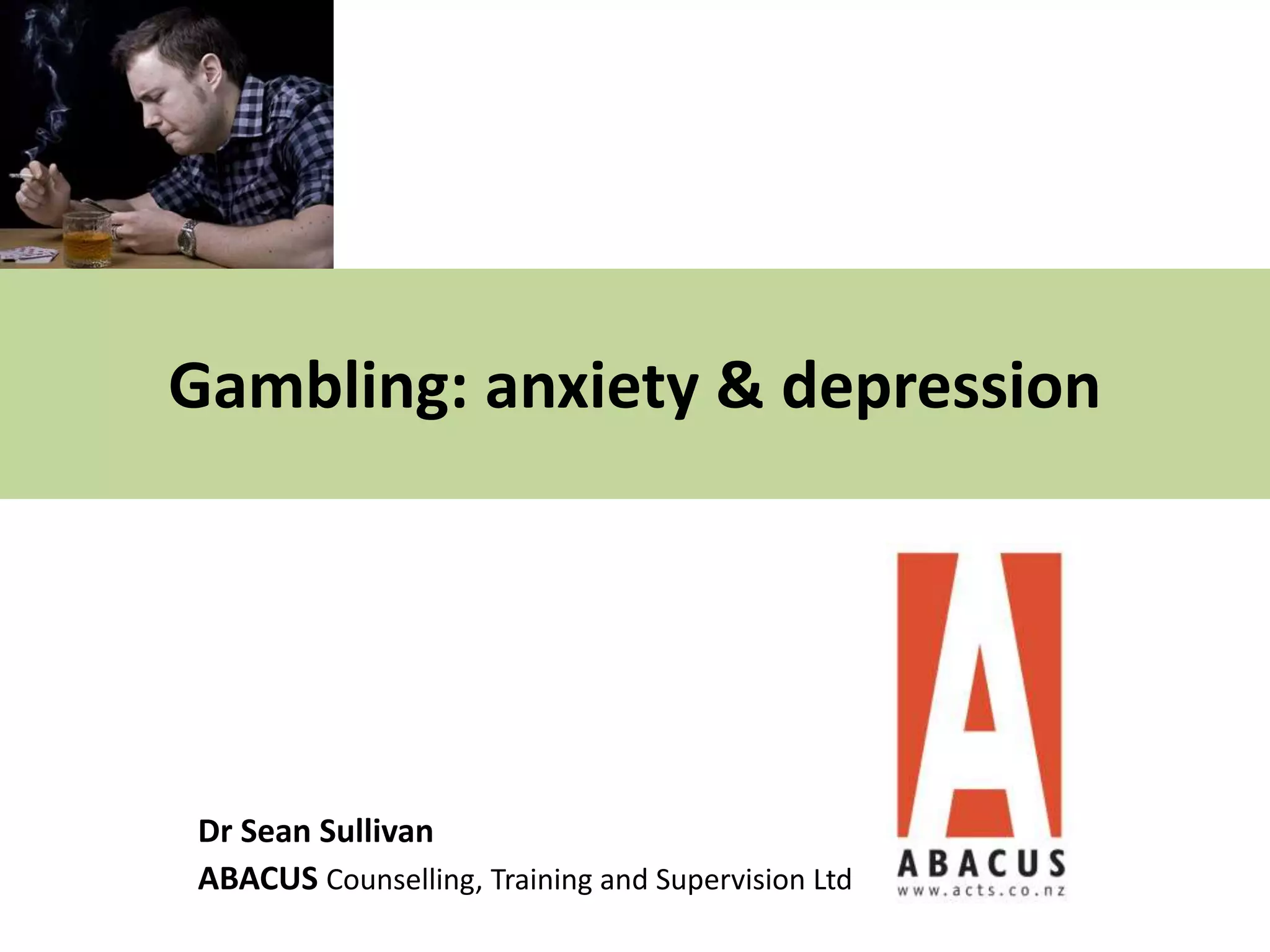
Gambling: anxiety & depression
Dr Sean Sullivan
ABACUS Counselling, Training and Supervision Ltd
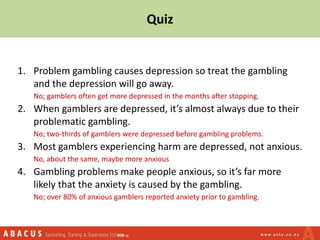
Quiz
1. Problem gambling causes depression so treat the gambling
and the depression will go away.
No; gamblers often get more depressed in the months after stopping.
2. When gamblers are depressed, it’s almost always due to their
problematic gambling.
No; two-thirds of gamblers were depressed before gambling problems.
3. Most gamblers experiencing harm are depressed, not anxious.
No, about the same, maybe more anxious
4. Gambling problems make people anxious, so it’s far more
likely that the anxiety is caused by the gambling.
No; over 80% of anxious gamblers reported anxiety prior to gambling.
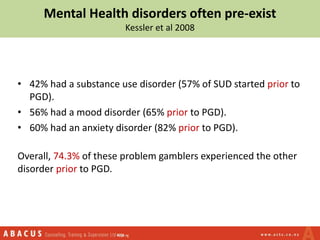
Mental Health disorders often pre-exist
Kessler et al 2008
• 42% had a substance use disorder (57% of SUD started prior to
PGD).
• 56% had a mood disorder (65% prior to PGD).
• 60% had an anxiety disorder (82% prior to PGD).
Overall, 74.3% of these problem gamblers experienced the other
disorder prior to PGD.
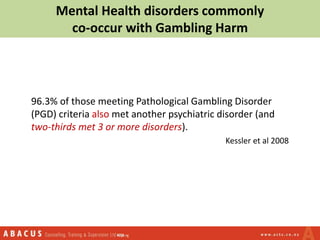
Mental Health disorders commonly
co-occur with Gambling Harm
96.3% of those meeting Pathological Gambling Disorder
(PGD) criteria also met another psychiatric disorder (and
two-thirds met 3 or more disorders).
Kessler et al 2008
Discuss in pairs
• Why would people who are anxious or depressed be more
likely to develop a problem with gambling?
• How would this knowledge change the approach you took
(formulating a treatment plan) with interventions for the
person’s gambling/anxiety/depression?
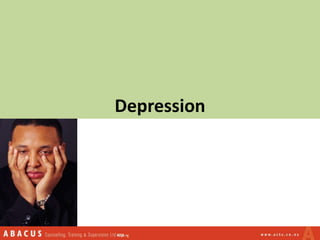
Depression
Major Depressive Disorder
Significant levels of stress/function impairment with 5 or more of (with
at least one of criteria 1) or 2) for the same 2-week period (and is a
change from past functioning):
1. Depressed mood most day.
2. Markedly less interest or pleasure most activities.
3. Significant weight loss or gain (5% p/month).
4. Sleep problems.
5. Agitation or slowing down.
6. Fatigue or loss of energy.
7. Feelings of worthlessness or guilt.
8. Reduced ability to concentrate, make decisions.
9. Thoughts of suicide (or plans/attempts).
Depression
• Can affect approx 6% of the population in NZ each year.
• After one depressive episode, chances of another = 50-60%;
after two, 70%; three 90%.
• Heritable: 1.5 – 3x more likely if first degree relatives have it.
NZ Guidelines group, 2006
Depression
(a stepped care approach)
• Most adults with mild depression can be treated in
primary care by their GP.
• Intensity of intervention determined by the severity of
depression.
• Can carry out repeated assessment to evaluate the
effectiveness of interventions.
• If not responding or severity increases apply greater
interventions.
• Treatment goal is remission of symptoms and prevention
of recurrence.
Depression Screen
Whooley et al 1997 (Note: these are included in CHAT screen)
1) During the last month, have you often been bothered by
feeling down, depressed or hopeless?
2) During the past month, have you often been bothered by
having little interest or pleasure in doing things?
If yes to one or both, give feedback and ask if it is something they
would like help with and if so, offer further assessment. If not,
gauge severity, act accordingly and monitor safety.
How depressive symptoms
affect treatment participation
• Difficulty in concentrating and integrating information.
• Trouble keeping appointments.
• Lack of energy to participate in programme activities such as
group therapy, family therapy, AA/NA meetings, youth groups
and recreational activities.
• Lack of perceived ability or motivation to change.
• Belief that he or she is beyond help.
• Difficulty engaging in recovery activities because of social
withdrawal.
• Being overwhelmed by feelings (sadness, anger,
hopelessness).
Assessment and management of depression
• Check for level of supports (family/whanau and friends;
employment/economic situation); social, other health carers.
• Check current self-harm risk (asking directly doesn’t increase
risk); risk for others (eg children).
• Ask if OK to phone/check in, to monitor risk and deterioration.
• Educate on diet, exercise, relaxation techniques, sleep.
• Mild depression: self help strategies can work well. Moderate
depression: psychological therapies and antidepressant
medication can work equally well.
• Severe depression: the use of (stronger) antidepressants is
usually indicated, and is enhanced with additional counselling.
Teach self-help techniques
for depressed mood (CBT)
It may be hard to get going if mild to moderately depressed, but
clients usually feel better when they do (behavioural activation):
• Plan a timetable with clients for daily activities e.g.
– meals
– appointments, commitments
– fill in the gaps with at least one thing they enjoy, and some physical activity
– plan to include others if they don’t feel like doing things.
• If running late, skip to next item.
• Reward themselves for what they have done.
• Teach problem solving therapy for issues that arise.
• Structure sleep times – read/watch TV if they can’t sleep, then try.
again; discuss diet, alcohol and caffeine use.
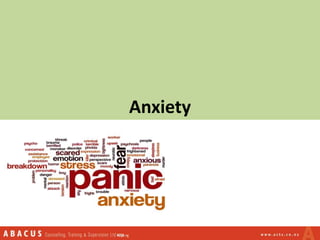
Anxiety
What is ‘anxiety’?
• Common emotion that prepares for ‘fight or flight’.
• But if not appropriate and is persistent, then may be
distressing and cause problems in our well-being.
• These anxiety problems have a wide range of symptoms and
these symptoms have been categorised into five main
categories.
Are these anxiety disorders?
• Mary was involved in a car accident in which her best friend
died. She can’t sit in the front seat and is particularly anxious
at night when travelling.
• Peter found that he started to use P when aged 15 as was
uncomfortable at parties speaking to girls and got tongue-tied.
The P changed his life and he could talk to anyone. But now
he’s in treatment…
• Jenny hates spiders. She was bitten by one in Australia and
nearly died. She is aware there are not usually very poisonous
spiders here, but every now and then she reads of one being
found in shipping containers – couldn’t it escape?
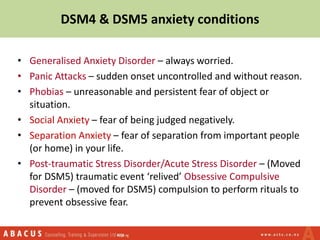
DSM4 & DSM5 anxiety conditions
• Generalised Anxiety Disorder – always worried.
• Panic Attacks – sudden onset uncontrolled and without reason.
• Phobias – unreasonable and persistent fear of object or
situation.
• Social Anxiety – fear of being judged negatively.
• Separation Anxiety – fear of separation from important people
(or home) in your life.
• Post-traumatic Stress Disorder/Acute Stress Disorder – (Moved
for DSM5) traumatic event ‘relived’ Obsessive Compulsive
Disorder – (moved for DSM5) compulsion to perform rituals to
prevent obsessive fear.
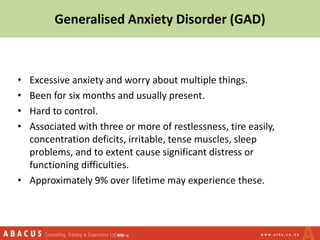
Generalised Anxiety Disorder (GAD)
• Excessive anxiety and worry about multiple things.
• Been for six months and usually present.
• Hard to control.
• Associated with three or more of restlessness, tire easily,
concentration deficits, irritable, tense muscles, sleep
problems, and to extent cause significant distress or
functioning difficulties.
• Approximately 9% over lifetime may experience these.
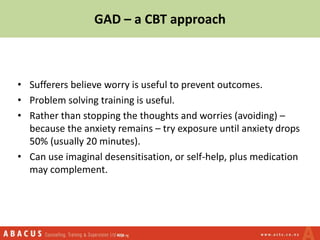
GAD – a CBT approach
• Sufferers believe worry is useful to prevent outcomes.
• Problem solving training is useful.
• Rather than stopping the thoughts and worries (avoiding) –
because the anxiety remains – try exposure until anxiety drops
50% (usually 20 minutes).
• Can use imaginal desensitisation, or self-help, plus medication
may complement.
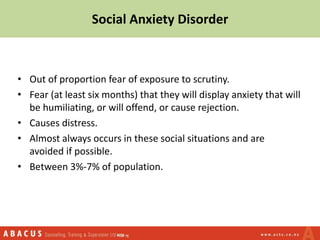
Social Anxiety Disorder
• Out of proportion fear of exposure to scrutiny.
• Fear (at least six months) that they will display anxiety that will
be humiliating, or will offend, or cause rejection.
• Causes distress.
• Almost always occurs in these social situations and are
avoided if possible.
• Between 3%-7% of population.
Panic Disorder
• Recurrent & expected periods of intense fear with 4 or more
other symptoms (below) that peak within 10 mins.
• Racing heart, sweating, trembling, breathless, feeling
shocked, chest pain, nausea, depersonalisation, fear losing
control/crazy, fear dying, numbed, chills/flushes.
• Can be with agoraphobia (difficult escape/embarrassing).
• Group therapy often helpful.
• Self-help (bibliotherapy) effective.
• CBT plus medication effective.
• Psycho-education important that physical damage is not
occurring.
• Exposure.
Panic Disorder
Agoraphobia
• Two or more over six months of:
– Using public transport.
– Being in open spaces.
– Being in enclosed places.
– Being in a crowd or in a line.
– Being outside of home alone.
• Avoids these for fear of panic or embarrassment.
• Out of proportion and almost always present in these situations,
and causes distress.
Phobias
Typically lasts 6 months or more:
• Fear/anxiety about a specific thing or situation.
• Strong or persistent excessive fear in presence of
object/situation.
• Exposure to it leads to anxiety (or even panic attack).
• Recognises excessive.
• Avoided (or endured with anxiety).
• Interferes with functioning.
• Out of proportion.
• With children, anxiety crying or clinging or tantrums.
• May result in rapid recovery.
• Some exposures difficult e.g. flying and virtual reality may be a
better approach than real exposure.
• Often group format has been found to be effective.
• Face to face better than self-help.
Phobias
• Separated out from anxiety in DSM5.
• Gradual exposure to triggers for the thoughts together with
response prevention.
• Realisation that no harm changes belief in necessity for the
OCD behaviour.
• Exposure gradually, asking not to perform the avoidant
response, and discussing the positive (non-crisis) outcome.
• Hoarders a separate subgroup.
Obsessive Compulsive Disorder (OCD)
• Recurrent and persistent thoughts, images or impulses that
are intrusive, cause distress, not about real-life problems, try
to neutralise them, recognised as due to own mind.
• Driven to perform a rigid response to prevent/reduce a crisis,
response not connected to crisis or is excessive.
• Aimed at reducing anxiety or distress.
• Often realises unreasonable/excessive, and causes
dysfunction, distress, or time-consuming.
Obsessive Compulsive Disorder (OCD)
Post Traumatic Stress Disorder (PTSD)
• Follows exposure to a traumatic or stressful experience.
• Comprises a mix of fear, lack of enjoyment/depression,
anger/aggression.
• Sub-types: Can be delayed onset and dissociation.
Various criterion for PTSD
For more than one month (prior is Acute Stress Disorder)
• Exposure to death, threatened death, actual or threatened
serious injury or sexual violence (either direct, witnessed,
indirect (close friend, violent/accident) or repeated indirect
exposure to aversive details of such events (but not through
media) – can be health/police professionals/other first
responders.
• Trauma re-experienced (either recurrent intrusive memories,
nightmares, dissociative flashbacks, ongoing stress exposure
after the trauma, physical reactions to trauma stimuli).
• Avoidance – ongoing efforts to avoidance of (either)
thoughts/feelings related to the trauma, external reminders
(e.g. people, places).
• Negative changes in thoughts and mood that worsened after
the trauma (either) inability to recall aspects of the event,
negative beliefs about yourself or the world, blaming self or
others for the trauma, negative feelings (e.g. guilt, fear)
reduced interest in activities, feeling alienation from others, no
positive feelings.
• Changes in arousal & reactions (two of either) irritable or
aggressive, reckless or destructive, over-vigilant, easily startled,
hard to concentrate, poor sleep.
Various criterion for PTSD
Also:
• Distress, or difficulty in functioning (but not due to drugs or
illness).
• Can be either of the subtypes of Depersonalisation (feeling
detached from self, dreamlike) or Derealisation (feels unreal,
distorted).
• Can be ‘With Delayed Expression’ if symptoms don’t appear
until at least 6 months after the trauma.
• Can occur in under 6 year olds ‘Preschool Subtype’ with
symptoms coming out in play.
• Removed requirement of ‘response involved intense fear,
helplessness or horror’.
Various criterion for PTSD
Suicide risk
Suicide risk
DSM: “Of individuals in treatment for Pathological Gambling,
20% are reported to have attempted suicide”
Of 70 patients admitted to an Auckland hospital following a
suicide attempt, 17.3% were screened positive for problem
gambling and:
• 83% used gambling machines.
• 75% scored positive on the Cage alcohol screen
(cf 31% of gambling screen negatives).
• 42% alcohol involved in the attempt by PGs
(cf 16% of gambling screen negatives).
• Were more likely to be Maori.
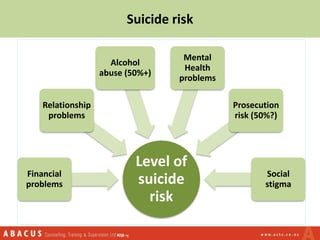
Level of
suicide
risk
Financial
problems
Relationship
problems
Alcohol
abuse (50%+)
Mental
Health
problems
Prosecution
risk (50%?)
Social
stigma
Suicide risk
Screening for anxiety & depression
Practioners Handbook
When clients come for help the problem of their most concern is
usually gambling. However:
• Almost all clients will be affected by coexisting MH problems.
• Commonly these with be anxiety (40%+) and depression
(50%+).
• Screening all clients for these is important.
The CHAT: a New Zealand systematic CEP screen
• Developed in NZ originally for primary health.
• Now starting to be widely used.
• Covers 9 topics with 16 (main) questions around addictions and
health lifestyle issues.
• Originally topics were common but overlooked issues but
happen to be strongly related to addictions and particularly PG.
• Is brief, validated for Asian, Māori, Pacific, and each set of two
(or one) questions are in turn validated and published in
research journals.
Why use CHAT screen?
• The move towards integrating interventions for addictions and
coexisting mental health problems has some evidential support
(Todd 2010 Te Ariari).
• Especially appropriate, as addictions have high CEP such as
anxiety, depression, AOD.
• CHAT offers additional tests for lifestyle and sub-clinical CEP
issues that otherwise may not be tested for (exercise, abuse,
anger).
Because:
• CEP is addressed (co-existing mental health problems).
• If not addressing other issues (smoking, other addictions such
as alcohol/other drugs, anxiety, being abused, anger, exercise)
may miss a key issue for initiating change, resistance to change,
or relapse risk.
• By systematically screening for these issues may avoid missing
them and enhance good practice.
Why use CHAT screen?
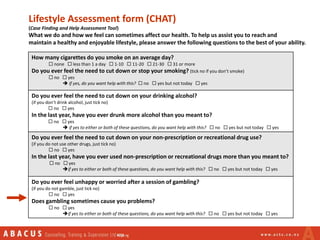
Lifestyle Assessment form (CHAT)
(Case Finding and Help Assessment Tool)
What we do and how we feel can sometimes affect our health. To help us assist you to reach and
maintain a healthy and enjoyable lifestyle, please answer the following questions to the best of your ability.
How many cigarettes do you smoke on an average day?
 none  less than 1 a day  1-10  11-20  21-30  31 or more
Do you ever feel the need to cut down or stop your smoking? (tick no if you don’t smoke)
 no  yes
 if yes, do you want help with this?  no  yes but not today  yes
Do you ever feel the need to cut down on your drinking alcohol?
(if you don’t drink alcohol, just tick no)
 no  yes
In the last year, have you ever drunk more alcohol than you meant to?
 no  yes
 if yes to either or both of these questions, do you want help with this?  no  yes but not today  yes
Do you ever feel the need to cut down on your non-prescription or recreational drug use?
(if you do not use other drugs, just tick no)
 no  yes
In the last year, have you ever used non-prescription or recreational drugs more than you meant to?
 no  yes
if yes to either or both of these questions, do you want help with this?  no  yes but not today  yes
Do you ever feel unhappy or worried after a session of gambling?
(if you do not gamble, just tick no)
 no  yes
Does gambling sometimes cause you problems?
 no  yes
if yes to either or both of these questions, do you want help with this?  no  yes but not today  yes
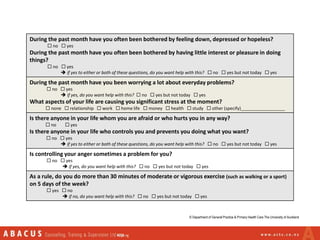
During the past month have you often been bothered by feeling down, depressed or hopeless?
 no  yes
During the past month have you often been bothered by having little interest or pleasure in doing
things?
 no  yes
 if yes to either or both of these questions, do you want help with this?  no  yes but not today  yes
During the past month have you been worrying a lot about everyday problems?
 no  yes
 if yes, do you want help with this?  no  yes but not today  yes
What aspects of your life are causing you significant stress at the moment?
 none  relationship  work  home life  money  health  study  other (specify)__________________
Is there anyone in your life whom you are afraid or who hurts you in any way?
 no  yes
Is there anyone in your life who controls you and prevents you doing what you want?
 no  yes
 if yes to either or both of these questions, do you want help with this?  no  yes but not today  yes
Is controlling your anger sometimes a problem for you?
 no  yes
 if yes, do you want help with this?  no  yes but not today  yes
As a rule, do you do more than 30 minutes of moderate or vigorous exercise (such as walking or a sport)
on 5 days of the week?
 yes  no
 if no, do you want help with this?  no  yes but not today  yes
© Department of General Practice & Primary Health Care The University of Auckland
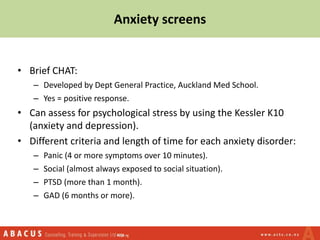
Anxiety screens
• Brief CHAT:
– Developed by Dept General Practice, Auckland Med School.
– Yes = positive response.
• Can assess for psychological stress by using the Kessler K10
(anxiety and depression).
• Different criteria and length of time for each anxiety disorder:
– Panic (4 or more symptoms over 10 minutes).
– Social (almost always exposed to social situation).
– PTSD (more than 1 month).
– GAD (6 months or more).
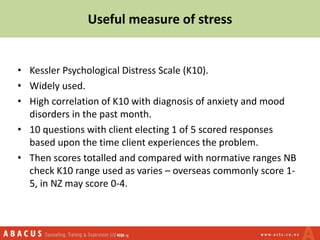
Useful measure of stress
• Kessler Psychological Distress Scale (K10).
• Widely used.
• High correlation of K10 with diagnosis of anxiety and mood
disorders in the past month.
• 10 questions with client electing 1 of 5 scored responses
based upon the time client experiences the problem.
• Then scores totalled and compared with normative ranges NB
check K10 range used as varies – overseas commonly score 1-
5, in NZ may score 0-4.
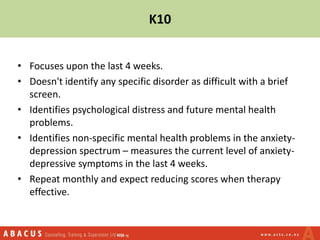
K10
• Focuses upon the last 4 weeks.
• Doesn't identify any specific disorder as difficult with a brief
screen.
• Identifies psychological distress and future mental health
problems.
• Identifies non-specific mental health problems in the anxiety-
depression spectrum – measures the current level of anxiety-
depressive symptoms in the last 4 weeks.
• Repeat monthly and expect reducing scores when therapy
effective.
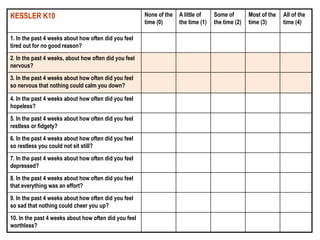
KESSLER K10 None of the
time (0)
A little of
the time (1)
Some of
the time (2)
Most of the
time (3)
All of the
time (4)
1. In the past 4 weeks about how often did you feel
tired out for no good reason?
2. In the past 4 weeks, about how often did you feel
nervous?
3. In the past 4 weeks about how often did you feel
so nervous that nothing could calm you down?
4. In the past 4 weeks about how often did you feel
hopeless?
5. In the past 4 weeks about how often did you feel
restless or fidgety?
6. In the past 4 weeks about how often did you feel
so restless you could not sit still?
7. In the past 4 weeks about how often did you feel
depressed?
8. In the past 4 weeks about how often did you feel
that everything was an effort?
9. In the past 4 weeks about how often did you feel
so sad that nothing could cheer you up?
10. In the past 4 weeks about how often did you feel
worthless?
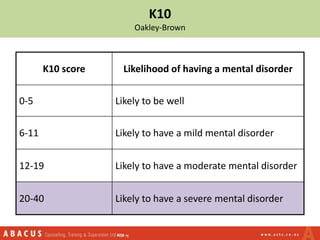
K10
Oakley-Brown
K10 score Likelihood of having a mental disorder
0-5 Likely to be well
6-11 Likely to have a mild mental disorder
12-19 Likely to have a moderate mental disorder
20-40 Likely to have a severe mental disorder
Interventions when Gambling Harm
also presents with significant
co-existing problems
Specific issues in treatment: gambling harm
• Useful to screen for depression and check for suicidal ideation,
as gamblers often feel vulnerable & hopeless on disclosure and
feel shame and guilt - effects on family and finances.
• Deal with stigma re gamblers - reframe from selfish, cold,
uncaring (hence shame, guilt and “hidden” disorder) to
education re addiction, and address issues of gambler’s fallacy
(real odds, “randomness”).
• Often more co-existing problems in problem gamblers
(awareness of medication possibilities; check for
depression/anxiety/other MH/PD).
Examples of brief interventions
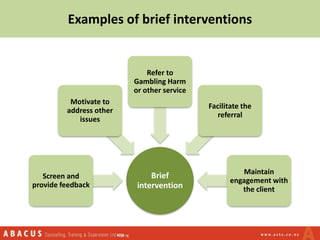
Brief
intervention
Screen and
provide feedback
Motivate to
address other
issues
Refer to
Gambling Harm
or other service
Facilitate the
referral
Maintain
engagement with
the client
Summary
• The importance of screening everyone for depression and
anxiety.
• Why we should integrate treatment for these with gambling.
• Why families presence helps.
• Why risk is increased when they co-occur with gambling.
• Remember: clients are more likely to have depression and
anxiety as well as the gambling.

Gambling Anxiety & Depression

  • 1.
    Gambling: anxiety &depression Dr Sean Sullivan ABACUS Counselling, Training and Supervision Ltd
  • 2.
    Quiz 1. Problem gamblingcauses depression so treat the gambling and the depression will go away. No; gamblers often get more depressed in the months after stopping. 2. When gamblers are depressed, it’s almost always due to their problematic gambling. No; two-thirds of gamblers were depressed before gambling problems. 3. Most gamblers experiencing harm are depressed, not anxious. No, about the same, maybe more anxious 4. Gambling problems make people anxious, so it’s far more likely that the anxiety is caused by the gambling. No; over 80% of anxious gamblers reported anxiety prior to gambling.
  • 3.
    Mental Health disordersoften pre-exist Kessler et al 2008 • 42% had a substance use disorder (57% of SUD started prior to PGD). • 56% had a mood disorder (65% prior to PGD). • 60% had an anxiety disorder (82% prior to PGD). Overall, 74.3% of these problem gamblers experienced the other disorder prior to PGD.
  • 4.
    Mental Health disorderscommonly co-occur with Gambling Harm 96.3% of those meeting Pathological Gambling Disorder (PGD) criteria also met another psychiatric disorder (and two-thirds met 3 or more disorders). Kessler et al 2008
  • 5.
    Discuss in pairs •Why would people who are anxious or depressed be more likely to develop a problem with gambling? • How would this knowledge change the approach you took (formulating a treatment plan) with interventions for the person’s gambling/anxiety/depression?
  • 6.
  • 7.
    Major Depressive Disorder Significantlevels of stress/function impairment with 5 or more of (with at least one of criteria 1) or 2) for the same 2-week period (and is a change from past functioning): 1. Depressed mood most day. 2. Markedly less interest or pleasure most activities. 3. Significant weight loss or gain (5% p/month). 4. Sleep problems. 5. Agitation or slowing down. 6. Fatigue or loss of energy. 7. Feelings of worthlessness or guilt. 8. Reduced ability to concentrate, make decisions. 9. Thoughts of suicide (or plans/attempts).
  • 8.
    Depression • Can affectapprox 6% of the population in NZ each year. • After one depressive episode, chances of another = 50-60%; after two, 70%; three 90%. • Heritable: 1.5 – 3x more likely if first degree relatives have it. NZ Guidelines group, 2006
  • 9.
    Depression (a stepped careapproach) • Most adults with mild depression can be treated in primary care by their GP. • Intensity of intervention determined by the severity of depression. • Can carry out repeated assessment to evaluate the effectiveness of interventions. • If not responding or severity increases apply greater interventions. • Treatment goal is remission of symptoms and prevention of recurrence.
  • 10.
    Depression Screen Whooley etal 1997 (Note: these are included in CHAT screen) 1) During the last month, have you often been bothered by feeling down, depressed or hopeless? 2) During the past month, have you often been bothered by having little interest or pleasure in doing things? If yes to one or both, give feedback and ask if it is something they would like help with and if so, offer further assessment. If not, gauge severity, act accordingly and monitor safety.
  • 11.
    How depressive symptoms affecttreatment participation • Difficulty in concentrating and integrating information. • Trouble keeping appointments. • Lack of energy to participate in programme activities such as group therapy, family therapy, AA/NA meetings, youth groups and recreational activities. • Lack of perceived ability or motivation to change. • Belief that he or she is beyond help. • Difficulty engaging in recovery activities because of social withdrawal. • Being overwhelmed by feelings (sadness, anger, hopelessness).
  • 12.
    Assessment and managementof depression • Check for level of supports (family/whanau and friends; employment/economic situation); social, other health carers. • Check current self-harm risk (asking directly doesn’t increase risk); risk for others (eg children). • Ask if OK to phone/check in, to monitor risk and deterioration. • Educate on diet, exercise, relaxation techniques, sleep. • Mild depression: self help strategies can work well. Moderate depression: psychological therapies and antidepressant medication can work equally well. • Severe depression: the use of (stronger) antidepressants is usually indicated, and is enhanced with additional counselling.
  • 13.
    Teach self-help techniques fordepressed mood (CBT) It may be hard to get going if mild to moderately depressed, but clients usually feel better when they do (behavioural activation): • Plan a timetable with clients for daily activities e.g. – meals – appointments, commitments – fill in the gaps with at least one thing they enjoy, and some physical activity – plan to include others if they don’t feel like doing things. • If running late, skip to next item. • Reward themselves for what they have done. • Teach problem solving therapy for issues that arise. • Structure sleep times – read/watch TV if they can’t sleep, then try. again; discuss diet, alcohol and caffeine use.
  • 14.
  • 15.
    What is ‘anxiety’? •Common emotion that prepares for ‘fight or flight’. • But if not appropriate and is persistent, then may be distressing and cause problems in our well-being. • These anxiety problems have a wide range of symptoms and these symptoms have been categorised into five main categories.
  • 16.
    Are these anxietydisorders? • Mary was involved in a car accident in which her best friend died. She can’t sit in the front seat and is particularly anxious at night when travelling. • Peter found that he started to use P when aged 15 as was uncomfortable at parties speaking to girls and got tongue-tied. The P changed his life and he could talk to anyone. But now he’s in treatment… • Jenny hates spiders. She was bitten by one in Australia and nearly died. She is aware there are not usually very poisonous spiders here, but every now and then she reads of one being found in shipping containers – couldn’t it escape?
  • 17.
    DSM4 & DSM5anxiety conditions • Generalised Anxiety Disorder – always worried. • Panic Attacks – sudden onset uncontrolled and without reason. • Phobias – unreasonable and persistent fear of object or situation. • Social Anxiety – fear of being judged negatively. • Separation Anxiety – fear of separation from important people (or home) in your life. • Post-traumatic Stress Disorder/Acute Stress Disorder – (Moved for DSM5) traumatic event ‘relived’ Obsessive Compulsive Disorder – (moved for DSM5) compulsion to perform rituals to prevent obsessive fear.
  • 18.
    Generalised Anxiety Disorder(GAD) • Excessive anxiety and worry about multiple things. • Been for six months and usually present. • Hard to control. • Associated with three or more of restlessness, tire easily, concentration deficits, irritable, tense muscles, sleep problems, and to extent cause significant distress or functioning difficulties. • Approximately 9% over lifetime may experience these.
  • 19.
    GAD – aCBT approach • Sufferers believe worry is useful to prevent outcomes. • Problem solving training is useful. • Rather than stopping the thoughts and worries (avoiding) – because the anxiety remains – try exposure until anxiety drops 50% (usually 20 minutes). • Can use imaginal desensitisation, or self-help, plus medication may complement.
  • 20.
    Social Anxiety Disorder •Out of proportion fear of exposure to scrutiny. • Fear (at least six months) that they will display anxiety that will be humiliating, or will offend, or cause rejection. • Causes distress. • Almost always occurs in these social situations and are avoided if possible. • Between 3%-7% of population.
  • 21.
    Panic Disorder • Recurrent& expected periods of intense fear with 4 or more other symptoms (below) that peak within 10 mins. • Racing heart, sweating, trembling, breathless, feeling shocked, chest pain, nausea, depersonalisation, fear losing control/crazy, fear dying, numbed, chills/flushes. • Can be with agoraphobia (difficult escape/embarrassing).
  • 22.
    • Group therapyoften helpful. • Self-help (bibliotherapy) effective. • CBT plus medication effective. • Psycho-education important that physical damage is not occurring. • Exposure. Panic Disorder
  • 23.
    Agoraphobia • Two ormore over six months of: – Using public transport. – Being in open spaces. – Being in enclosed places. – Being in a crowd or in a line. – Being outside of home alone. • Avoids these for fear of panic or embarrassment. • Out of proportion and almost always present in these situations, and causes distress.
  • 24.
    Phobias Typically lasts 6months or more: • Fear/anxiety about a specific thing or situation. • Strong or persistent excessive fear in presence of object/situation. • Exposure to it leads to anxiety (or even panic attack). • Recognises excessive. • Avoided (or endured with anxiety). • Interferes with functioning. • Out of proportion. • With children, anxiety crying or clinging or tantrums.
  • 25.
    • May resultin rapid recovery. • Some exposures difficult e.g. flying and virtual reality may be a better approach than real exposure. • Often group format has been found to be effective. • Face to face better than self-help. Phobias
  • 26.
    • Separated outfrom anxiety in DSM5. • Gradual exposure to triggers for the thoughts together with response prevention. • Realisation that no harm changes belief in necessity for the OCD behaviour. • Exposure gradually, asking not to perform the avoidant response, and discussing the positive (non-crisis) outcome. • Hoarders a separate subgroup. Obsessive Compulsive Disorder (OCD)
  • 27.
    • Recurrent andpersistent thoughts, images or impulses that are intrusive, cause distress, not about real-life problems, try to neutralise them, recognised as due to own mind. • Driven to perform a rigid response to prevent/reduce a crisis, response not connected to crisis or is excessive. • Aimed at reducing anxiety or distress. • Often realises unreasonable/excessive, and causes dysfunction, distress, or time-consuming. Obsessive Compulsive Disorder (OCD)
  • 28.
    Post Traumatic StressDisorder (PTSD) • Follows exposure to a traumatic or stressful experience. • Comprises a mix of fear, lack of enjoyment/depression, anger/aggression. • Sub-types: Can be delayed onset and dissociation.
  • 29.
    Various criterion forPTSD For more than one month (prior is Acute Stress Disorder) • Exposure to death, threatened death, actual or threatened serious injury or sexual violence (either direct, witnessed, indirect (close friend, violent/accident) or repeated indirect exposure to aversive details of such events (but not through media) – can be health/police professionals/other first responders. • Trauma re-experienced (either recurrent intrusive memories, nightmares, dissociative flashbacks, ongoing stress exposure after the trauma, physical reactions to trauma stimuli).
  • 30.
    • Avoidance –ongoing efforts to avoidance of (either) thoughts/feelings related to the trauma, external reminders (e.g. people, places). • Negative changes in thoughts and mood that worsened after the trauma (either) inability to recall aspects of the event, negative beliefs about yourself or the world, blaming self or others for the trauma, negative feelings (e.g. guilt, fear) reduced interest in activities, feeling alienation from others, no positive feelings. • Changes in arousal & reactions (two of either) irritable or aggressive, reckless or destructive, over-vigilant, easily startled, hard to concentrate, poor sleep. Various criterion for PTSD
  • 31.
    Also: • Distress, ordifficulty in functioning (but not due to drugs or illness). • Can be either of the subtypes of Depersonalisation (feeling detached from self, dreamlike) or Derealisation (feels unreal, distorted). • Can be ‘With Delayed Expression’ if symptoms don’t appear until at least 6 months after the trauma. • Can occur in under 6 year olds ‘Preschool Subtype’ with symptoms coming out in play. • Removed requirement of ‘response involved intense fear, helplessness or horror’. Various criterion for PTSD
  • 32.
  • 33.
    Suicide risk DSM: “Ofindividuals in treatment for Pathological Gambling, 20% are reported to have attempted suicide” Of 70 patients admitted to an Auckland hospital following a suicide attempt, 17.3% were screened positive for problem gambling and: • 83% used gambling machines. • 75% scored positive on the Cage alcohol screen (cf 31% of gambling screen negatives). • 42% alcohol involved in the attempt by PGs (cf 16% of gambling screen negatives). • Were more likely to be Maori.
  • 34.
  • 35.
  • 36.
    Practioners Handbook When clientscome for help the problem of their most concern is usually gambling. However: • Almost all clients will be affected by coexisting MH problems. • Commonly these with be anxiety (40%+) and depression (50%+). • Screening all clients for these is important.
  • 37.
    The CHAT: aNew Zealand systematic CEP screen • Developed in NZ originally for primary health. • Now starting to be widely used. • Covers 9 topics with 16 (main) questions around addictions and health lifestyle issues. • Originally topics were common but overlooked issues but happen to be strongly related to addictions and particularly PG. • Is brief, validated for Asian, Māori, Pacific, and each set of two (or one) questions are in turn validated and published in research journals.
  • 38.
    Why use CHATscreen? • The move towards integrating interventions for addictions and coexisting mental health problems has some evidential support (Todd 2010 Te Ariari). • Especially appropriate, as addictions have high CEP such as anxiety, depression, AOD. • CHAT offers additional tests for lifestyle and sub-clinical CEP issues that otherwise may not be tested for (exercise, abuse, anger).
  • 39.
    Because: • CEP isaddressed (co-existing mental health problems). • If not addressing other issues (smoking, other addictions such as alcohol/other drugs, anxiety, being abused, anger, exercise) may miss a key issue for initiating change, resistance to change, or relapse risk. • By systematically screening for these issues may avoid missing them and enhance good practice. Why use CHAT screen?
  • 40.
    Lifestyle Assessment form(CHAT) (Case Finding and Help Assessment Tool) What we do and how we feel can sometimes affect our health. To help us assist you to reach and maintain a healthy and enjoyable lifestyle, please answer the following questions to the best of your ability. How many cigarettes do you smoke on an average day?  none  less than 1 a day  1-10  11-20  21-30  31 or more Do you ever feel the need to cut down or stop your smoking? (tick no if you don’t smoke)  no  yes  if yes, do you want help with this?  no  yes but not today  yes Do you ever feel the need to cut down on your drinking alcohol? (if you don’t drink alcohol, just tick no)  no  yes In the last year, have you ever drunk more alcohol than you meant to?  no  yes  if yes to either or both of these questions, do you want help with this?  no  yes but not today  yes Do you ever feel the need to cut down on your non-prescription or recreational drug use? (if you do not use other drugs, just tick no)  no  yes In the last year, have you ever used non-prescription or recreational drugs more than you meant to?  no  yes if yes to either or both of these questions, do you want help with this?  no  yes but not today  yes Do you ever feel unhappy or worried after a session of gambling? (if you do not gamble, just tick no)  no  yes Does gambling sometimes cause you problems?  no  yes if yes to either or both of these questions, do you want help with this?  no  yes but not today  yes
  • 41.
    During the pastmonth have you often been bothered by feeling down, depressed or hopeless?  no  yes During the past month have you often been bothered by having little interest or pleasure in doing things?  no  yes  if yes to either or both of these questions, do you want help with this?  no  yes but not today  yes During the past month have you been worrying a lot about everyday problems?  no  yes  if yes, do you want help with this?  no  yes but not today  yes What aspects of your life are causing you significant stress at the moment?  none  relationship  work  home life  money  health  study  other (specify)__________________ Is there anyone in your life whom you are afraid or who hurts you in any way?  no  yes Is there anyone in your life who controls you and prevents you doing what you want?  no  yes  if yes to either or both of these questions, do you want help with this?  no  yes but not today  yes Is controlling your anger sometimes a problem for you?  no  yes  if yes, do you want help with this?  no  yes but not today  yes As a rule, do you do more than 30 minutes of moderate or vigorous exercise (such as walking or a sport) on 5 days of the week?  yes  no  if no, do you want help with this?  no  yes but not today  yes © Department of General Practice & Primary Health Care The University of Auckland
  • 42.
    Anxiety screens • BriefCHAT: – Developed by Dept General Practice, Auckland Med School. – Yes = positive response. • Can assess for psychological stress by using the Kessler K10 (anxiety and depression). • Different criteria and length of time for each anxiety disorder: – Panic (4 or more symptoms over 10 minutes). – Social (almost always exposed to social situation). – PTSD (more than 1 month). – GAD (6 months or more).
  • 43.
    Useful measure ofstress • Kessler Psychological Distress Scale (K10). • Widely used. • High correlation of K10 with diagnosis of anxiety and mood disorders in the past month. • 10 questions with client electing 1 of 5 scored responses based upon the time client experiences the problem. • Then scores totalled and compared with normative ranges NB check K10 range used as varies – overseas commonly score 1- 5, in NZ may score 0-4.
  • 44.
    K10 • Focuses uponthe last 4 weeks. • Doesn't identify any specific disorder as difficult with a brief screen. • Identifies psychological distress and future mental health problems. • Identifies non-specific mental health problems in the anxiety- depression spectrum – measures the current level of anxiety- depressive symptoms in the last 4 weeks. • Repeat monthly and expect reducing scores when therapy effective.
  • 45.
    KESSLER K10 Noneof the time (0) A little of the time (1) Some of the time (2) Most of the time (3) All of the time (4) 1. In the past 4 weeks about how often did you feel tired out for no good reason? 2. In the past 4 weeks, about how often did you feel nervous? 3. In the past 4 weeks about how often did you feel so nervous that nothing could calm you down? 4. In the past 4 weeks about how often did you feel hopeless? 5. In the past 4 weeks about how often did you feel restless or fidgety? 6. In the past 4 weeks about how often did you feel so restless you could not sit still? 7. In the past 4 weeks about how often did you feel depressed? 8. In the past 4 weeks about how often did you feel that everything was an effort? 9. In the past 4 weeks about how often did you feel so sad that nothing could cheer you up? 10. In the past 4 weeks about how often did you feel worthless?
  • 46.
    K10 Oakley-Brown K10 score Likelihoodof having a mental disorder 0-5 Likely to be well 6-11 Likely to have a mild mental disorder 12-19 Likely to have a moderate mental disorder 20-40 Likely to have a severe mental disorder
  • 47.
    Interventions when GamblingHarm also presents with significant co-existing problems
  • 48.
    Specific issues intreatment: gambling harm • Useful to screen for depression and check for suicidal ideation, as gamblers often feel vulnerable & hopeless on disclosure and feel shame and guilt - effects on family and finances. • Deal with stigma re gamblers - reframe from selfish, cold, uncaring (hence shame, guilt and “hidden” disorder) to education re addiction, and address issues of gambler’s fallacy (real odds, “randomness”). • Often more co-existing problems in problem gamblers (awareness of medication possibilities; check for depression/anxiety/other MH/PD).
  • 49.
    Examples of briefinterventions Brief intervention Screen and provide feedback Motivate to address other issues Refer to Gambling Harm or other service Facilitate the referral Maintain engagement with the client
  • 50.
    Summary • The importanceof screening everyone for depression and anxiety. • Why we should integrate treatment for these with gambling. • Why families presence helps. • Why risk is increased when they co-occur with gambling. • Remember: clients are more likely to have depression and anxiety as well as the gambling.