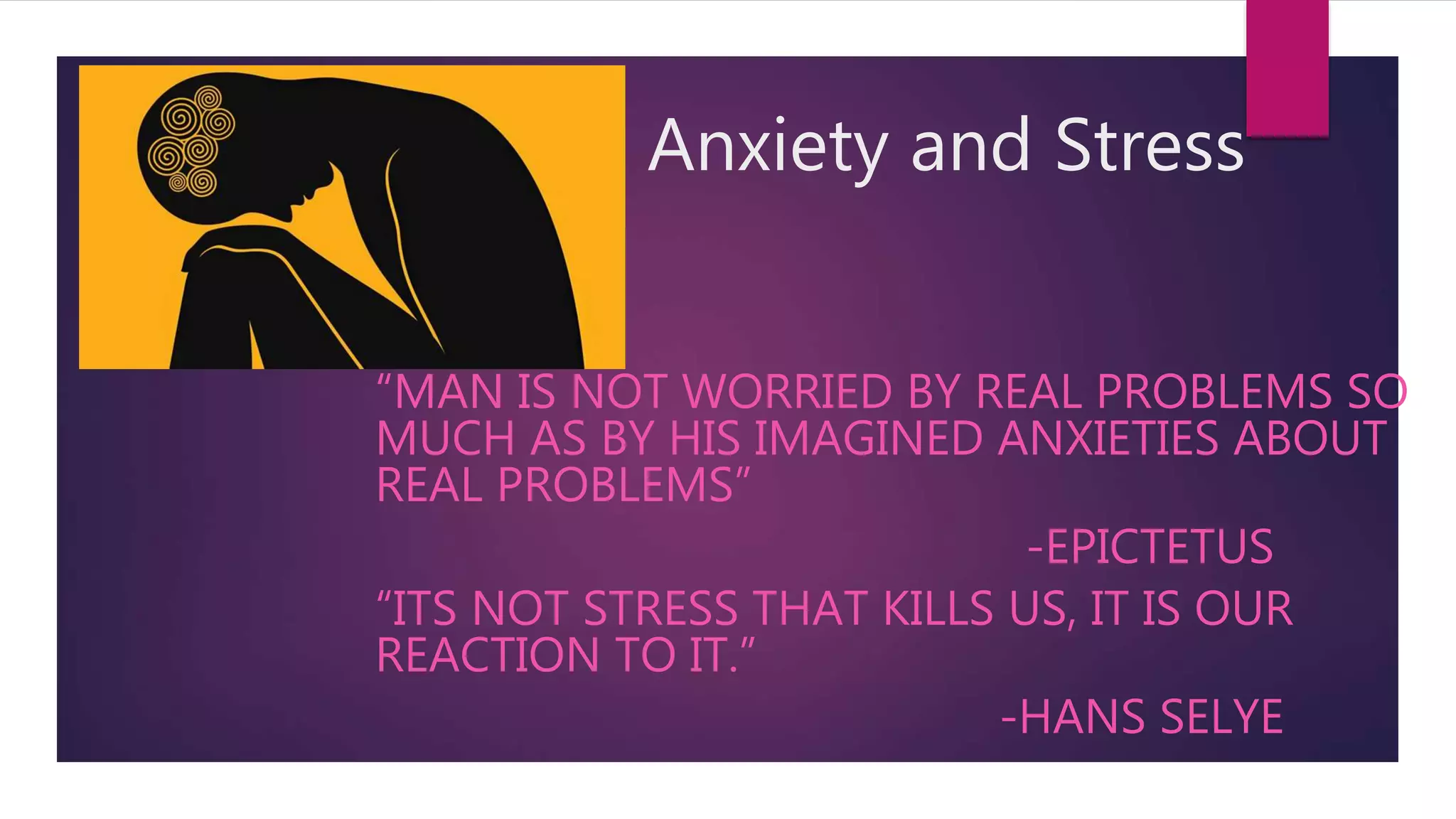
Anxiety and Stress
“MAN IS NOT WORRIED BY REAL PROBLEMS SO
MUCH AS BY HIS IMAGINED ANXIETIES ABOUT
REAL PROBLEMS”
-EPICTETUS
“ITS NOT STRESS THAT KILLS US, IT IS OUR
REACTION TO IT.”
-HANS SELYE
What is Anxiety?
 Anxiety is a feeling of apprehension or fear. This arises out of the
anticipation of danger.
 Sometimes the cause of anxiety is known and sometimes unknown
or unrecognized.
Then what is fear?
 In case of fear, the object of fear or stimulus is present.
 The threat is real, imminent and objective danger, which threatens
life and survival.
 The fight or flight or freeze response is activated. (Sympathetic
Nervous System)
Is Anxiety always bad?
 Not really !!
 But, why?
 Anxiety helps us get our work done. It pushes us to do our work;
when undone would get us into trouble.
 Ex: Exams!!
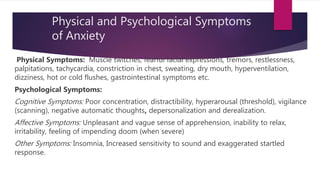
Physical and Psychological Symptoms
of Anxiety
Physical Symptoms: Muscle twitches, fearful facial expressions, tremors, restlessness,
palpitations, tachycardia, constriction in chest, sweating, dry mouth, hyperventilation,
dizziness, hot or cold flushes, gastrointestinal symptoms etc.
Psychological Symptoms:
Cognitive Symptoms: Poor concentration, distractibility, hyperarousal (threshold), vigilance
(scanning), negative automatic thoughts, depersonalization and derealization.
Affective Symptoms: Unpleasant and vague sense of apprehension, inability to relax,
irritability, feeling of impending doom (when severe)
Other Symptoms: Insomnia, Increased sensitivity to sound and exaggerated startled
response.
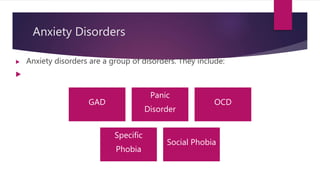
Anxiety Disorders
 Anxiety disorders are a group of disorders. They include:

GAD
Panic
Disorder
OCD
Specific
Phobia
Social Phobia
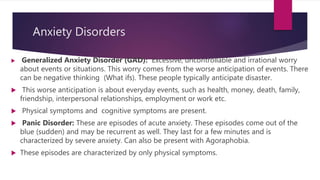
Anxiety Disorders
 Generalized Anxiety Disorder (GAD): Excessive, uncontrollable and irrational worry
about events or situations. This worry comes from the worse anticipation of events. There
can be negative thinking (What ifs). These people typically anticipate disaster.
 This worse anticipation is about everyday events, such as health, money, death, family,
friendship, interpersonal relationships, employment or work etc.
 Physical symptoms and cognitive symptoms are present.
 Panic Disorder: These are episodes of acute anxiety. These episodes come out of the
blue (sudden) and may be recurrent as well. They last for a few minutes and is
characterized by severe anxiety. Can also be present with Agoraphobia.
 These episodes are characterized by only physical symptoms.
Anxiety Disorders
 Obsessive Compulsive Disorder: This disorder is characterized by obsessions and
compulsions.
 Obsession is an idea or image that intrudes our conscious awareness repeatedly.
Patient tries to resist these thoughts; he/she fails to do so.
 Compulsions are the behaviors that follow the obsessions. These compulsions reduce
the anxiety associated with obsessions. These behaviors are repeatedly done,
consuming most of day in these compulsions.
 Specific phobia: In this kind of anxiety disorder there is a presence of a stimulus. But,
anticipation of the phobic stimulus present there could lead to consistent phobic
avoidance.
 It is the irrational fear of objects or situations.
 Example: Arachnophobia (spiders), Acrophobia (fear oh high places), claustrophobia
(closed spaces) and Zoophobia (animals).
Social Anxiety
 It is different from just being shy.
 It is an Irrational fear of social interaction or activities like performing activities in the presence of other people,
social interaction with people, giving presentations and speeches etc.
 Person might be afraid of criticism from others, embarrassing oneself etc.
 Fear of group participation and activities, being observed, meeting new people, eating or drinking in public.
 Causes significant distress and significant functional deficit- social, occupational etc.
 Maladaptive Coping strategies may include alcohol and other drugs) is used to overcome Social Anxiety
 People with social anxiety can actively try to cope through avoiding social interactions, social places and events.
 Some other symptoms are- self-conscious in social situations and feel embarrassed and awkward. Give
excuses to avoid, sweating, feeling nauseous, stiff body ( rigidity) increased heart rate when they are in social
situations or when performing.
Causes
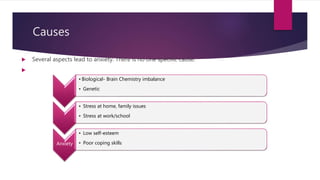
 Several aspects lead to anxiety. There is no one specific cause.

• Biological- Brain Chemistry imbalance
• Genetic
• Stress at home, family issues
• Stress at work/school
Anxiety
• Low self-esteem
• Poor coping skills
How to manage Anxiety
 Clinically: Anxiety disorders can be managed through medication
prescribed by Psychiatrists.
 Other alternative to medication is Therapy. Like CBT- Cognitive
Behavior Therapy. Thoughts lead to behavior. So, here the stimulus is
thoughts and the response is anxiety.
 Medication, Yoga, Exercise can also relieve Anxiety.
 For specific phobia, systematic desensitization is used-
Exam Anxiety Management
 Ask for help! There is nothing wrong in asking for help. Consult a trained psychologist or a
Psychiatrist. Talk to your teachers or family. You may no be in a position to help yourself,
but others can!!
 Eat healthy, exercise.
 Sleep well. 8 hours of sleep is absolutely necessary.
 Understand the concept instead of byhearting. This helps you remember better and help
you apply your knowledge better.
 Time Management is key. Keep a schedule on what you will study day-to-day and for how
long. But, try and keep it a little flexible.
 Have confidence in yourself. You can do it, if you try.
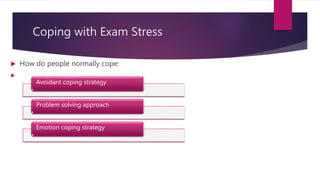
Coping with Exam Stress
 How do people normally cope:

Avoidant coping strategy
Problem solving approach
Emotion coping strategy
Managing the work
 If you procrastinate starting to study. Introspect why. This introspection helps you
understand yourself. After this awareness, you could try to search for solutions to
solve this.
 Anxiety could lead to avoidance behavior (procrastination), but it only results in
more severe anxiety. So, Try a problem solving approach.
 There could be a lot to study. So, organize and manage your time. Break down the
huge chunks of work into simpler ones.
 Try to start your work willingly. If this is not possible, there could be a reason for
this as well. Think about it.
Coping with stress emotionally
 Take a break. Don’t feel guilty about it, you deserve it. Do something you love, do
something that relaxes you. It does not mean avoiding the work. Starting with a relaxed
mind helps you grasp it better. (Mental Resources).
 Don’t worry about it. Think about it.
 Don’t engage in negative thinking. No what ifs. Starting a thought with ‘what if’ might
only lead to a negative thought follow up.
 Engage in positive self-talk.
 Being calm, hopeful and optimistic about it helps.
Relaxation Techniques
 Progressive Muscle Relaxation
 Guided Imagery
 Biofeedback
 Aromatherapy
 Music therapy
 Nature therapy- nature walks
“
”
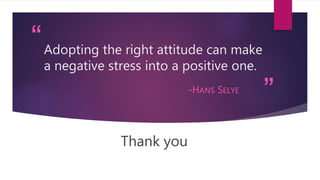
Adopting the right attitude can make
a negative stress into a positive one.
-HANS SELYE
Thank you
“
”
References
A Short Textbook of Psychiatry, 2011- Neeraj Ahuja, 7th edition
DSM- V, American Psychiatric Association
Website: National Institute of Mental Health: Social Anxiety Disorder: More Than Just Shyness-
https://www.nimh.nih.gov/health/publications/social-anxiety-disorder-more-than-just-
shyness/index.shtml#:~:text=Social%20anxiety%20disorder%20(also%20called,to%20make%20and%20keep%20frie
nds.

Anxiety presentation

  • 1.
    Anxiety and Stress “MANIS NOT WORRIED BY REAL PROBLEMS SO MUCH AS BY HIS IMAGINED ANXIETIES ABOUT REAL PROBLEMS” -EPICTETUS “ITS NOT STRESS THAT KILLS US, IT IS OUR REACTION TO IT.” -HANS SELYE
  • 2.
    What is Anxiety? Anxiety is a feeling of apprehension or fear. This arises out of the anticipation of danger.  Sometimes the cause of anxiety is known and sometimes unknown or unrecognized.
  • 3.
    Then what isfear?  In case of fear, the object of fear or stimulus is present.  The threat is real, imminent and objective danger, which threatens life and survival.  The fight or flight or freeze response is activated. (Sympathetic Nervous System)
  • 4.
    Is Anxiety alwaysbad?  Not really !!  But, why?  Anxiety helps us get our work done. It pushes us to do our work; when undone would get us into trouble.  Ex: Exams!!
  • 5.
    Physical and PsychologicalSymptoms of Anxiety Physical Symptoms: Muscle twitches, fearful facial expressions, tremors, restlessness, palpitations, tachycardia, constriction in chest, sweating, dry mouth, hyperventilation, dizziness, hot or cold flushes, gastrointestinal symptoms etc. Psychological Symptoms: Cognitive Symptoms: Poor concentration, distractibility, hyperarousal (threshold), vigilance (scanning), negative automatic thoughts, depersonalization and derealization. Affective Symptoms: Unpleasant and vague sense of apprehension, inability to relax, irritability, feeling of impending doom (when severe) Other Symptoms: Insomnia, Increased sensitivity to sound and exaggerated startled response.
  • 6.
    Anxiety Disorders  Anxietydisorders are a group of disorders. They include:  GAD Panic Disorder OCD Specific Phobia Social Phobia
  • 7.
    Anxiety Disorders  GeneralizedAnxiety Disorder (GAD): Excessive, uncontrollable and irrational worry about events or situations. This worry comes from the worse anticipation of events. There can be negative thinking (What ifs). These people typically anticipate disaster.  This worse anticipation is about everyday events, such as health, money, death, family, friendship, interpersonal relationships, employment or work etc.  Physical symptoms and cognitive symptoms are present.  Panic Disorder: These are episodes of acute anxiety. These episodes come out of the blue (sudden) and may be recurrent as well. They last for a few minutes and is characterized by severe anxiety. Can also be present with Agoraphobia.  These episodes are characterized by only physical symptoms.
  • 8.
    Anxiety Disorders  ObsessiveCompulsive Disorder: This disorder is characterized by obsessions and compulsions.  Obsession is an idea or image that intrudes our conscious awareness repeatedly. Patient tries to resist these thoughts; he/she fails to do so.  Compulsions are the behaviors that follow the obsessions. These compulsions reduce the anxiety associated with obsessions. These behaviors are repeatedly done, consuming most of day in these compulsions.  Specific phobia: In this kind of anxiety disorder there is a presence of a stimulus. But, anticipation of the phobic stimulus present there could lead to consistent phobic avoidance.  It is the irrational fear of objects or situations.  Example: Arachnophobia (spiders), Acrophobia (fear oh high places), claustrophobia (closed spaces) and Zoophobia (animals).
  • 9.
    Social Anxiety  Itis different from just being shy.  It is an Irrational fear of social interaction or activities like performing activities in the presence of other people, social interaction with people, giving presentations and speeches etc.  Person might be afraid of criticism from others, embarrassing oneself etc.  Fear of group participation and activities, being observed, meeting new people, eating or drinking in public.  Causes significant distress and significant functional deficit- social, occupational etc.  Maladaptive Coping strategies may include alcohol and other drugs) is used to overcome Social Anxiety  People with social anxiety can actively try to cope through avoiding social interactions, social places and events.  Some other symptoms are- self-conscious in social situations and feel embarrassed and awkward. Give excuses to avoid, sweating, feeling nauseous, stiff body ( rigidity) increased heart rate when they are in social situations or when performing.
  • 10.
    Causes  Several aspectslead to anxiety. There is no one specific cause.  • Biological- Brain Chemistry imbalance • Genetic • Stress at home, family issues • Stress at work/school Anxiety • Low self-esteem • Poor coping skills
  • 11.
    How to manageAnxiety  Clinically: Anxiety disorders can be managed through medication prescribed by Psychiatrists.  Other alternative to medication is Therapy. Like CBT- Cognitive Behavior Therapy. Thoughts lead to behavior. So, here the stimulus is thoughts and the response is anxiety.  Medication, Yoga, Exercise can also relieve Anxiety.  For specific phobia, systematic desensitization is used-
  • 12.
    Exam Anxiety Management Ask for help! There is nothing wrong in asking for help. Consult a trained psychologist or a Psychiatrist. Talk to your teachers or family. You may no be in a position to help yourself, but others can!!  Eat healthy, exercise.  Sleep well. 8 hours of sleep is absolutely necessary.  Understand the concept instead of byhearting. This helps you remember better and help you apply your knowledge better.  Time Management is key. Keep a schedule on what you will study day-to-day and for how long. But, try and keep it a little flexible.  Have confidence in yourself. You can do it, if you try.
  • 13.
    Coping with ExamStress  How do people normally cope:  Avoidant coping strategy Problem solving approach Emotion coping strategy
  • 14.
    Managing the work If you procrastinate starting to study. Introspect why. This introspection helps you understand yourself. After this awareness, you could try to search for solutions to solve this.  Anxiety could lead to avoidance behavior (procrastination), but it only results in more severe anxiety. So, Try a problem solving approach.  There could be a lot to study. So, organize and manage your time. Break down the huge chunks of work into simpler ones.  Try to start your work willingly. If this is not possible, there could be a reason for this as well. Think about it.
  • 15.
    Coping with stressemotionally  Take a break. Don’t feel guilty about it, you deserve it. Do something you love, do something that relaxes you. It does not mean avoiding the work. Starting with a relaxed mind helps you grasp it better. (Mental Resources).  Don’t worry about it. Think about it.  Don’t engage in negative thinking. No what ifs. Starting a thought with ‘what if’ might only lead to a negative thought follow up.  Engage in positive self-talk.  Being calm, hopeful and optimistic about it helps.
  • 16.
    Relaxation Techniques  ProgressiveMuscle Relaxation  Guided Imagery  Biofeedback  Aromatherapy  Music therapy  Nature therapy- nature walks
  • 17.
    “ ” Adopting the rightattitude can make a negative stress into a positive one. -HANS SELYE Thank you
  • 18.
    “ ” References A Short Textbookof Psychiatry, 2011- Neeraj Ahuja, 7th edition DSM- V, American Psychiatric Association Website: National Institute of Mental Health: Social Anxiety Disorder: More Than Just Shyness- https://www.nimh.nih.gov/health/publications/social-anxiety-disorder-more-than-just- shyness/index.shtml#:~:text=Social%20anxiety%20disorder%20(also%20called,to%20make%20and%20keep%20frie nds.