Lets Get Real
Real Skills & Problem Gambling


Sean Sullivan
ABACUS Counselling Training & Supervision Ltd
Abstract
Lets Get Real & Problem Gambling Treatment
Lets Get Real describes the essential knowledge, skills and attitudes for
effective mental health and addiction treatment. There are seven skill sets
described as Real Skills, for short, that have both a broad definition and three
indicator levels (essential, practitioner and leader) of what is required to achieve
these. The aim or purpose of Lets Get Real is to:
   •  Help everyone working across services that assist those affected by mental
      health and addiction (and clients) to understand each other better
   •  Ensure all know what is best practice
   •  Is a complement to different competencies of the various health
      professionals (i.e. overview of essential, skills and attitudes)
   •  Improve ability for practitioners to move between services
   •  Improve workforce development, and
   •  Increase our accountability, especially to service users
From late 2008 this framework started to be rolled out.
This training will cover the expectations of Lets Get Real, the values and
attitudes upon which they are based, and how they will fit with the draft problem
gambling treatment competencies.
Why do we need LGR?

•  Addiction and Mental Health services (including Problem
   Gambling) have tended to develop separately over time
•  However, Mental Health (MH) and Addiction treatment
   services are part of the larger Mental Health field
•  Clients commonly affected with a range of (mental)
   health issues
•  It is for the benefit of clients and the MH and Addiction
   treatment workforce that these treatment services ‘speak
   the same language’ and as far as possible have similar
   perspectives towards treatment
For example

•  A recovery aim is adopted across these services
•  Recovery is living well in the presence or absence of
   mental illness and the losses that can be associated with
   it. Each person with mental illness needs to define for
   themselves what living well means to them.
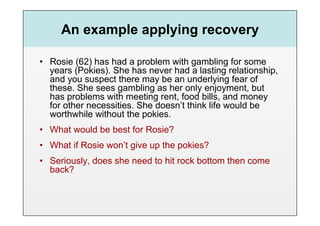
An example applying recovery

•  Rosie (62) has had a problem with gambling for some
   years (Pokies). She has never had a lasting relationship,
   and you suspect there may be an underlying fear of
   these. She sees gambling as her only enjoyment, but
   has problems with meeting rent, food bills, and money
   for other necessities. She doesn’t think life would be
   worthwhile without the pokies.
•  What would be best for Rosie?
•  What if Rosie won’t give up the pokies?
•  Seriously, does she need to hit rock bottom then come
   back?
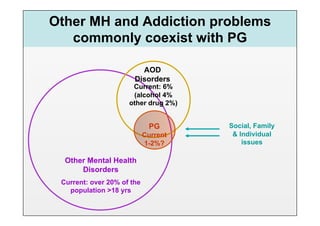
Other MH and Addiction problems
   commonly coexist with PG

                         AOD
                       Disorders
                      Current: 6%
                      (alcohol 4%
                     other drug 2%)


                             PG       Social, Family
                            Current    & Individual
                            1-2%?         issues

  Other Mental Health
      Disorders
 Current: over 20% of the
   population >18 yrs
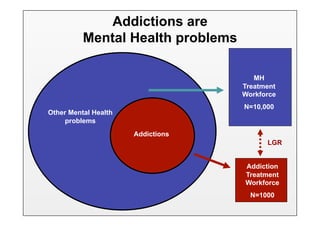
Addictions are
          Mental Health problems

                                      MH
                                   Treatment
                                   Workforce
                                   N=10,000
Other Mental Health
     problems
                      Addictions
                                         LGR


                                   Addiction
                                   Treatment
                                   Workforce
                                     N=1000
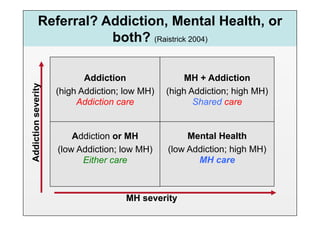
Referral? Addiction, Mental Health, or
                       both? (Raistrick 2004)

                            Addiction                MH + Addiction
Addiction severity


                     (high Addiction; low MH)   (high Addiction; high MH)
                          Addiction care               Shared care


                         Addiction or MH             Mental Health
                     (low Addiction; low MH)    (low Addiction; high MH)
                           Either care                 MH care


                                      MH severity
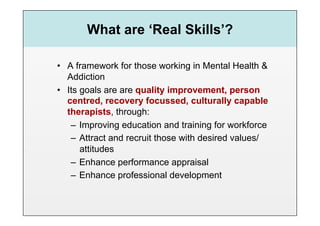
What are ‘Real Skills’?

•  A framework for those working in Mental Health &
   Addiction
•  Its goals are are quality improvement, person
   centred, recovery focussed, culturally capable
   therapists, through:
    –  Improving education and training for workforce
    –  Attract and recruit those with desired values/
       attitudes
    –  Enhance performance appraisal
    –  Enhance professional development
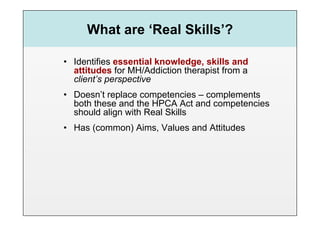
What are ‘Real Skills’?

•  Identifies essential knowledge, skills and
   attitudes for MH/Addiction therapist from a
   client’s perspective
•  Doesn’t replace competencies – complements
   both these and the HPCA Act and competencies
   should align with Real Skills
•  Has (common) Aims, Values and Attitudes
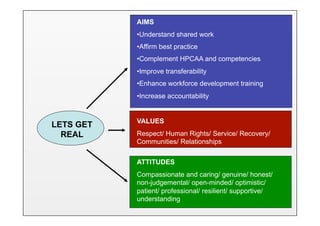
AIMS
           • Understand shared work
           • Affirm best practice
           • Complement HPCAA and competencies
           • Improve transferability
           • Enhance workforce development training
           • Increase accountability


           VALUES
LETS GET
  REAL     Respect/ Human Rights/ Service/ Recovery/
           Communities/ Relationships

           ATTITUDES
           Compassionate and caring/ genuine/ honest/
           non-judgemental/ open-minded/ optimistic/
           patient/ professional/ resilient/ supportive/
           understanding
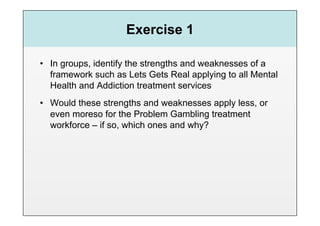
Exercise 1

•  In groups, identify the strengths and weaknesses of a
   framework such as Lets Gets Real applying to all Mental
   Health and Addiction treatment services
•  Would these strengths and weaknesses apply less, or
   even moreso for the Problem Gambling treatment
   workforce – if so, which ones and why?
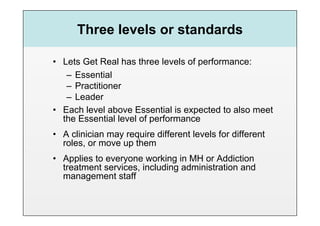
Three levels or standards

•  Lets Get Real has three levels of performance:
    –  Essential
    –  Practitioner
    –  Leader
•  Each level above Essential is expected to also meet
   the Essential level of performance
•  A clinician may require different levels for different
   roles, or move up them
•  Applies to everyone working in MH or Addiction
   treatment services, including administration and
   management staff
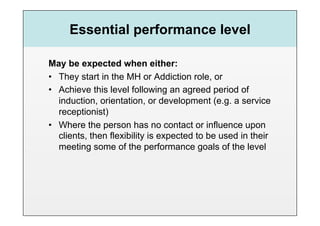
Essential performance level

May be expected when either:
•  They start in the MH or Addiction role, or
•  Achieve this level following an agreed period of
   induction, orientation, or development (e.g. a service
   receptionist)
•  Where the person has no contact or influence upon
   clients, then flexibility is expected to be used in their
   meeting some of the performance goals of the level
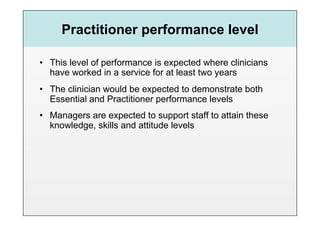
Practitioner performance level

•  This level of performance is expected where clinicians
   have worked in a service for at least two years
•  The clinician would be expected to demonstrate both
   Essential and Practitioner performance levels
•  Managers are expected to support staff to attain these
   knowledge, skills and attitude levels
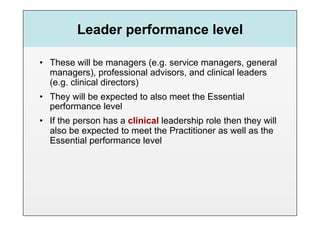
Leader performance level

•  These will be managers (e.g. service managers, general
   managers), professional advisors, and clinical leaders
   (e.g. clinical directors)
•  They will be expected to also meet the Essential
   performance level
•  If the person has a clinical leadership role then they will
   also be expected to meet the Practitioner as well as the
   Essential performance level
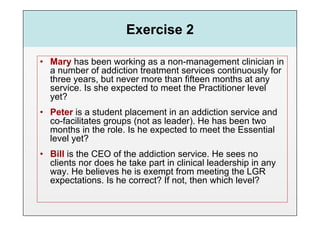
Exercise 2

•  Mary has been working as a non-management clinician in
   a number of addiction treatment services continuously for
   three years, but never more than fifteen months at any
   service. Is she expected to meet the Practitioner level
   yet?
•  Peter is a student placement in an addiction service and
   co-facilitates groups (not as leader). He has been two
   months in the role. Is he expected to meet the Essential
   level yet?
•  Bill is the CEO of the addiction service. He sees no
   clients nor does he take part in clinical leadership in any
   way. He believes he is exempt from meeting the LGR
   expectations. Is he correct? If not, then which level?
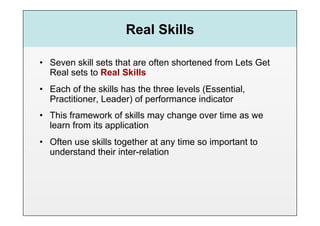
Real Skills

•  Seven skill sets that are often shortened from Lets Get
   Real sets to Real Skills
•  Each of the skills has the three levels (Essential,
   Practitioner, Leader) of performance indicator
•  This framework of skills may change over time as we
   learn from its application
•  Often use skills together at any time so important to
   understand their inter-relation
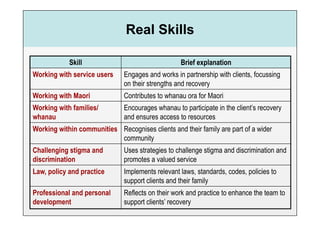
Real Skills

            Skill                                  Brief explanation
Working with service users     Engages and works in partnership with clients, focussing
                               on their strengths and recovery
Working with Maori             Contributes to whanau ora for Maori
Working with families/         Encourages whanau to participate in the client’s recovery
whanau                         and ensures access to resources
Working within communities Recognises clients and their family are part of a wider
                           community
Challenging stigma and         Uses strategies to challenge stigma and discrimination and
discrimination                 promotes a valued service
Law, policy and practice       Implements relevant laws, standards, codes, policies to
                               support clients and their family
Professional and personal      Reflects on their work and practice to enhance the team to
development                    support clients’ recovery
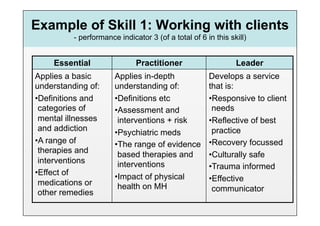
Example of Skill 1: Working with clients
          - performance indicator 3 (of a total of 6 in this skill)


    Essential                 Practitioner                     Leader
Applies a basic        Applies in-depth               Develops a service
understanding of:      understanding of:              that is:
• Definitions and      • Definitions etc              • Responsive to client
 categories of         • Assessment and                needs
 mental illnesses       interventions + risk          • Reflective of best
 and addiction                                         practice
                       • Psychiatric meds
• A range of           • The range of evidence        • Recovery focussed
 therapies and          based therapies and           • Culturally safe
 interventions          interventions                 • Trauma informed
• Effect of            • Impact of physical           • Effective
 medications or         health on MH
 other remedies                                        communicator
Exercise 3

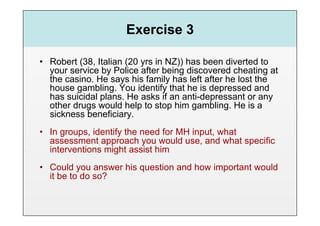
•  Robert (38, Italian (20 yrs in NZ)) has been diverted to
   your service by Police after being discovered cheating at
   the casino. He says his family has left after he lost the
   house gambling. You identify that he is depressed and
   has suicidal plans. He asks if an anti-depressant or any
   other drugs would help to stop him gambling. He is a
   sickness beneficiary.
•  In groups, identify the need for MH input, what
   assessment approach you would use, and what specific
   interventions might assist him
•  Could you answer his question and how important would
   it be to do so?
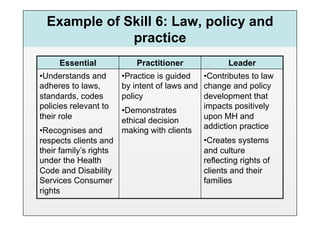
Example of Skill 6: Law, policy and
              practice
     Essential              Practitioner             Leader
• Understands and       • Practice is guided  • Contributes to law
adheres to laws,        by intent of laws and change and policy
standards, codes        policy                development that
policies relevant to                          impacts positively
                        • Demonstrates
their role              ethical decision      upon MH and
• Recognises and        making with clients addiction practice
respects clients and                          • Creates systems
their family’s rights                         and culture
under the Health                              reflecting rights of
Code and Disability                           clients and their
Services Consumer                             families
rights
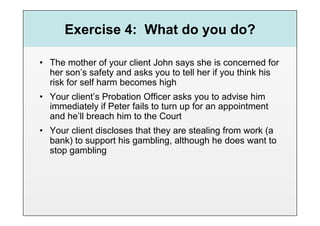
Exercise 4: What do you do?

•  The mother of your client John says she is concerned for
   her son’s safety and asks you to tell her if you think his
   risk for self harm becomes high
•  Your client’s Probation Officer asks you to advise him
   immediately if Peter fails to turn up for an appointment
   and he’ll breach him to the Court
•  Your client discloses that they are stealing from work (a
   bank) to support his gambling, although he does want to
   stop gambling
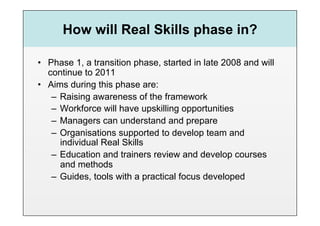
How will Real Skills phase in?

•  Phase 1, a transition phase, started in late 2008 and will
   continue to 2011
•  Aims during this phase are:
    –  Raising awareness of the framework
    –  Workforce will have upskilling opportunities
    –  Managers can understand and prepare
    –  Organisations supported to develop team and
       individual Real Skills
    –  Education and trainers review and develop courses
       and methods
    –  Guides, tools with a practical focus developed
Conclusion

•  Lets Get Real is a framework that applies to all those
   who work in services that treat, care for and support
   people with mental illnesses and/or addictions
•  It is currently being rolled out under phase one
   (2008-2011), and will be operational following that
•  Real Skills are a set of skills within the Lets Get Real
   framework
•  These will be aligned with sector competencies, not
   replace them
Conclusion

Additional skill sets have or will be developed under Real
Skills plus for:
   –  Working with Pacific peoples – LGR plus Seitapu
   –  Working in infant, child and youth mental health and
      alcohol and other drug services –LGR plus CAMHS
   –  Working in alcohol and other drug services –to be
      drafted
   –  No plans as yet for problem gambling workers
                                                         end

Real Skills – Competencies Workshop for Clinicians – An Introduction to Let's Get Real

  • 1.
    Lets Get Real RealSkills & Problem Gambling Sean Sullivan ABACUS Counselling Training & Supervision Ltd
  • 2.
    Abstract Lets Get Real& Problem Gambling Treatment Lets Get Real describes the essential knowledge, skills and attitudes for effective mental health and addiction treatment. There are seven skill sets described as Real Skills, for short, that have both a broad definition and three indicator levels (essential, practitioner and leader) of what is required to achieve these. The aim or purpose of Lets Get Real is to: •  Help everyone working across services that assist those affected by mental health and addiction (and clients) to understand each other better •  Ensure all know what is best practice •  Is a complement to different competencies of the various health professionals (i.e. overview of essential, skills and attitudes) •  Improve ability for practitioners to move between services •  Improve workforce development, and •  Increase our accountability, especially to service users From late 2008 this framework started to be rolled out. This training will cover the expectations of Lets Get Real, the values and attitudes upon which they are based, and how they will fit with the draft problem gambling treatment competencies.
  • 3.
    Why do weneed LGR? •  Addiction and Mental Health services (including Problem Gambling) have tended to develop separately over time •  However, Mental Health (MH) and Addiction treatment services are part of the larger Mental Health field •  Clients commonly affected with a range of (mental) health issues •  It is for the benefit of clients and the MH and Addiction treatment workforce that these treatment services ‘speak the same language’ and as far as possible have similar perspectives towards treatment
  • 4.
    For example •  Arecovery aim is adopted across these services •  Recovery is living well in the presence or absence of mental illness and the losses that can be associated with it. Each person with mental illness needs to define for themselves what living well means to them.
  • 5.
    An example applyingrecovery •  Rosie (62) has had a problem with gambling for some years (Pokies). She has never had a lasting relationship, and you suspect there may be an underlying fear of these. She sees gambling as her only enjoyment, but has problems with meeting rent, food bills, and money for other necessities. She doesn’t think life would be worthwhile without the pokies. •  What would be best for Rosie? •  What if Rosie won’t give up the pokies? •  Seriously, does she need to hit rock bottom then come back?
  • 6.
    Other MH andAddiction problems commonly coexist with PG AOD Disorders Current: 6% (alcohol 4% other drug 2%) PG Social, Family Current & Individual 1-2%? issues Other Mental Health Disorders Current: over 20% of the population >18 yrs
  • 7.
    Addictions are Mental Health problems MH Treatment Workforce N=10,000 Other Mental Health problems Addictions LGR Addiction Treatment Workforce N=1000
  • 8.
    Referral? Addiction, MentalHealth, or both? (Raistrick 2004) Addiction MH + Addiction Addiction severity (high Addiction; low MH) (high Addiction; high MH) Addiction care Shared care Addiction or MH Mental Health (low Addiction; low MH) (low Addiction; high MH) Either care MH care MH severity
  • 9.
    What are ‘RealSkills’? •  A framework for those working in Mental Health & Addiction •  Its goals are are quality improvement, person centred, recovery focussed, culturally capable therapists, through: –  Improving education and training for workforce –  Attract and recruit those with desired values/ attitudes –  Enhance performance appraisal –  Enhance professional development
  • 10.
    What are ‘RealSkills’? •  Identifies essential knowledge, skills and attitudes for MH/Addiction therapist from a client’s perspective •  Doesn’t replace competencies – complements both these and the HPCA Act and competencies should align with Real Skills •  Has (common) Aims, Values and Attitudes
  • 11.
    AIMS • Understand shared work • Affirm best practice • Complement HPCAA and competencies • Improve transferability • Enhance workforce development training • Increase accountability VALUES LETS GET REAL Respect/ Human Rights/ Service/ Recovery/ Communities/ Relationships ATTITUDES Compassionate and caring/ genuine/ honest/ non-judgemental/ open-minded/ optimistic/ patient/ professional/ resilient/ supportive/ understanding
  • 12.
    Exercise 1 •  Ingroups, identify the strengths and weaknesses of a framework such as Lets Gets Real applying to all Mental Health and Addiction treatment services •  Would these strengths and weaknesses apply less, or even moreso for the Problem Gambling treatment workforce – if so, which ones and why?
  • 13.
    Three levels orstandards •  Lets Get Real has three levels of performance: –  Essential –  Practitioner –  Leader •  Each level above Essential is expected to also meet the Essential level of performance •  A clinician may require different levels for different roles, or move up them •  Applies to everyone working in MH or Addiction treatment services, including administration and management staff
  • 14.
    Essential performance level Maybe expected when either: •  They start in the MH or Addiction role, or •  Achieve this level following an agreed period of induction, orientation, or development (e.g. a service receptionist) •  Where the person has no contact or influence upon clients, then flexibility is expected to be used in their meeting some of the performance goals of the level
  • 15.
    Practitioner performance level • This level of performance is expected where clinicians have worked in a service for at least two years •  The clinician would be expected to demonstrate both Essential and Practitioner performance levels •  Managers are expected to support staff to attain these knowledge, skills and attitude levels
  • 16.
    Leader performance level • These will be managers (e.g. service managers, general managers), professional advisors, and clinical leaders (e.g. clinical directors) •  They will be expected to also meet the Essential performance level •  If the person has a clinical leadership role then they will also be expected to meet the Practitioner as well as the Essential performance level
  • 17.
    Exercise 2 •  Maryhas been working as a non-management clinician in a number of addiction treatment services continuously for three years, but never more than fifteen months at any service. Is she expected to meet the Practitioner level yet? •  Peter is a student placement in an addiction service and co-facilitates groups (not as leader). He has been two months in the role. Is he expected to meet the Essential level yet? •  Bill is the CEO of the addiction service. He sees no clients nor does he take part in clinical leadership in any way. He believes he is exempt from meeting the LGR expectations. Is he correct? If not, then which level?
  • 18.
    Real Skills •  Sevenskill sets that are often shortened from Lets Get Real sets to Real Skills •  Each of the skills has the three levels (Essential, Practitioner, Leader) of performance indicator •  This framework of skills may change over time as we learn from its application •  Often use skills together at any time so important to understand their inter-relation
  • 19.
    Real Skills Skill Brief explanation Working with service users Engages and works in partnership with clients, focussing on their strengths and recovery Working with Maori Contributes to whanau ora for Maori Working with families/ Encourages whanau to participate in the client’s recovery whanau and ensures access to resources Working within communities Recognises clients and their family are part of a wider community Challenging stigma and Uses strategies to challenge stigma and discrimination and discrimination promotes a valued service Law, policy and practice Implements relevant laws, standards, codes, policies to support clients and their family Professional and personal Reflects on their work and practice to enhance the team to development support clients’ recovery
  • 20.
    Example of Skill1: Working with clients - performance indicator 3 (of a total of 6 in this skill) Essential Practitioner Leader Applies a basic Applies in-depth Develops a service understanding of: understanding of: that is: • Definitions and • Definitions etc • Responsive to client categories of • Assessment and needs mental illnesses interventions + risk • Reflective of best and addiction practice • Psychiatric meds • A range of • The range of evidence • Recovery focussed therapies and based therapies and • Culturally safe interventions interventions • Trauma informed • Effect of • Impact of physical • Effective medications or health on MH other remedies communicator
  • 21.
    Exercise 3 •  Robert(38, Italian (20 yrs in NZ)) has been diverted to your service by Police after being discovered cheating at the casino. He says his family has left after he lost the house gambling. You identify that he is depressed and has suicidal plans. He asks if an anti-depressant or any other drugs would help to stop him gambling. He is a sickness beneficiary. •  In groups, identify the need for MH input, what assessment approach you would use, and what specific interventions might assist him •  Could you answer his question and how important would it be to do so?
  • 22.
    Example of Skill6: Law, policy and practice Essential Practitioner Leader • Understands and • Practice is guided • Contributes to law adheres to laws, by intent of laws and change and policy standards, codes policy development that policies relevant to impacts positively • Demonstrates their role ethical decision upon MH and • Recognises and making with clients addiction practice respects clients and • Creates systems their family’s rights and culture under the Health reflecting rights of Code and Disability clients and their Services Consumer families rights
  • 23.
    Exercise 4: Whatdo you do? •  The mother of your client John says she is concerned for her son’s safety and asks you to tell her if you think his risk for self harm becomes high •  Your client’s Probation Officer asks you to advise him immediately if Peter fails to turn up for an appointment and he’ll breach him to the Court •  Your client discloses that they are stealing from work (a bank) to support his gambling, although he does want to stop gambling
  • 24.
    How will RealSkills phase in? •  Phase 1, a transition phase, started in late 2008 and will continue to 2011 •  Aims during this phase are: –  Raising awareness of the framework –  Workforce will have upskilling opportunities –  Managers can understand and prepare –  Organisations supported to develop team and individual Real Skills –  Education and trainers review and develop courses and methods –  Guides, tools with a practical focus developed
  • 25.
    Conclusion •  Lets GetReal is a framework that applies to all those who work in services that treat, care for and support people with mental illnesses and/or addictions •  It is currently being rolled out under phase one (2008-2011), and will be operational following that •  Real Skills are a set of skills within the Lets Get Real framework •  These will be aligned with sector competencies, not replace them
  • 26.
    Conclusion Additional skill setshave or will be developed under Real Skills plus for: –  Working with Pacific peoples – LGR plus Seitapu –  Working in infant, child and youth mental health and alcohol and other drug services –LGR plus CAMHS –  Working in alcohol and other drug services –to be drafted –  No plans as yet for problem gambling workers end