

IN THE NAME OFIN THE NAME OF
ALLAHALLAH
THE MOST MERCIFUL ANDTHE MOST MERCIFUL AND
BENIFICIENTBENIFICIENT
WARM WELCOME TOWARM WELCOME TO
OUR PRESENTATIONOUR PRESENTATION
DARK RAYDARK RAY
GROUP MEMBER :GROUP MEMBER :
1.HARES IBNE KASHEM (151-15-5368)1.HARES IBNE KASHEM (151-15-5368)
2.MD.MASUD PARVAZE (151-15-5203)2.MD.MASUD PARVAZE (151-15-5203)
3.CLINTON PLASID ROZARIO (151-15-5077)3.CLINTON PLASID ROZARIO (151-15-5077)
4.BAYZID AHAMMED (151-15-5139)4.BAYZID AHAMMED (151-15-5139)
5.TAHSIN JAWAD (151-15-5140)5.TAHSIN JAWAD (151-15-5140)
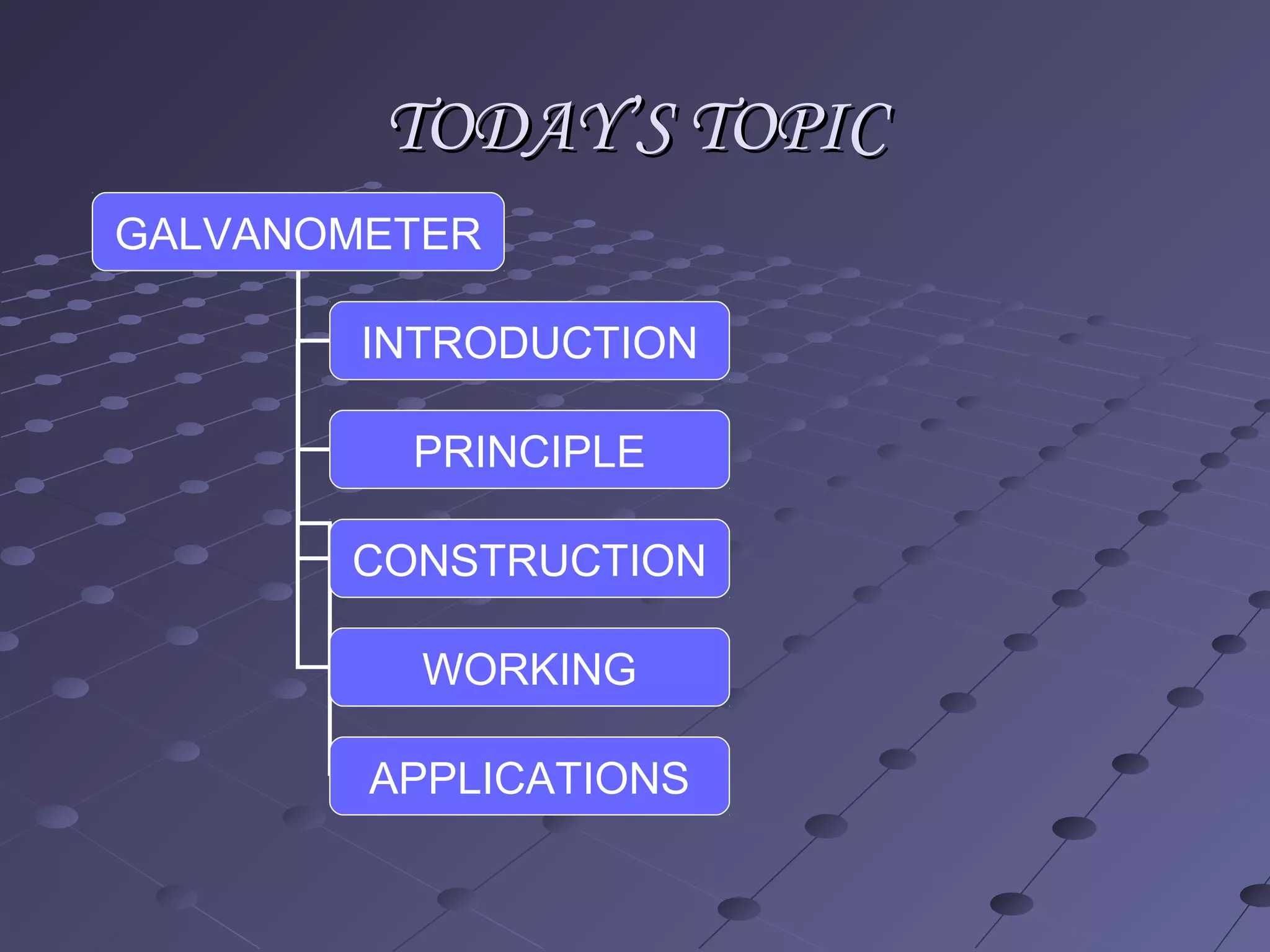
TODAY’S TOPICTODAY’S TOPIC
GALVANOMETER
INTRODUCTION
PRINCIPLE
CONSTRUCTION
WORKING
APPLICATIONS
INTRODUCTIONINTRODUCTION
Galvanometer is an electromechanical instrumentGalvanometer is an electromechanical instrument
which is used for the detection of electric currentswhich is used for the detection of electric currents
    through electric circuits. Being a sensitive    through electric circuits. Being a sensitive
instrument, Galvanometer can not be used for theinstrument, Galvanometer can not be used for the
    measurement of heavy currents. However we can    measurement of heavy currents. However we can
measure very small currents by using galvanometermeasure very small currents by using galvanometer
but     the primary purpose of galvanometer is thebut     the primary purpose of galvanometer is the
detection of electric current not the measurement ofdetection of electric current not the measurement of
current.current.
principalsprincipals
The Basic principle of Galvanometer is PMMCThe Basic principle of Galvanometer is PMMC
(permanent magnetic moving coil)(permanent magnetic moving coil)
Galvanometer works on the principle of conversion ofGalvanometer works on the principle of conversion of
electrical energy into mechanical energy. When aelectrical energy into mechanical energy. When a
    current flows in a magnetic field it experiences a    current flows in a magnetic field it experiences a
magnetic torque. If it is free to rotate under amagnetic torque. If it is free to rotate under a
    controlling torque, it rotates through an angle    controlling torque, it rotates through an angle
proportional to the current flowing through it.proportional to the current flowing through it.
WORKINGWORKING
When a current passes through the galvanometer coil,When a current passes through the galvanometer coil,
it experiences a magnetic deflecting torque,     whichit experiences a magnetic deflecting torque,     which
tends to rotate it from its rest position. As the coiltends to rotate it from its rest position. As the coil
rotates it produces a twist in the suspension     strip.rotates it produces a twist in the suspension     strip.
The twist in the strip produces an electric restoringThe twist in the strip produces an electric restoring
torque. The coil rotates until the elastic     restoringtorque. The coil rotates until the elastic     restoring
torque due to the strip does not equal and cancels thetorque due to the strip does not equal and cancels the
deflecting magnetic torque, then it     attainsdeflecting magnetic torque, then it     attains
equilibrium and stops rotating any furthers.equilibrium and stops rotating any furthers.
APLLICATIONAPLLICATION SS
VOLTMETERVOLTMETER
WHAT IS A VOLTMETER?WHAT IS A VOLTMETER?
It is the most common instrument used toIt is the most common instrument used to
measure voltagemeasure voltage
It measure either AC or DC voltageIt measure either AC or DC voltage
It is a measure of the voltage between twoIt is a measure of the voltage between two
points of an electrical currentpoints of an electrical current
TYPES OF VOLTMETERTYPES OF VOLTMETER
INSTRUMENTINSTRUMENT
AnalogAnalog
The readings are shown on a scaleThe readings are shown on a scale
DigitalDigital
The readings are displayed on a LCD orThe readings are displayed on a LCD or
LED display panelLED display panel
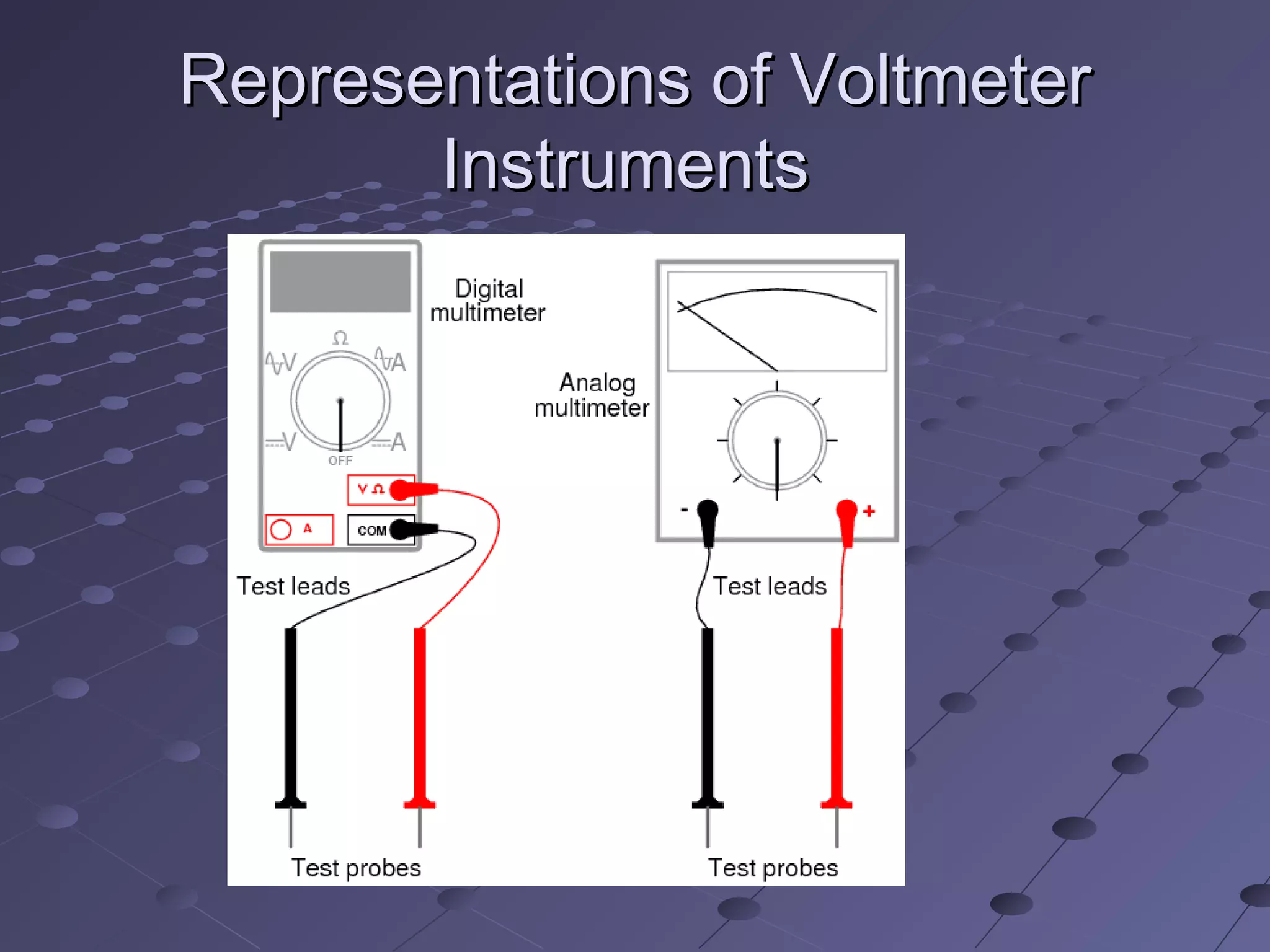
Representations of VoltmeterRepresentations of Voltmeter
InstrumentsInstruments
How Does the Voltmeter Work?How Does the Voltmeter Work?
Work on the principle of Ohm’s LawWork on the principle of Ohm’s Law
Potential Difference = Current ×Potential Difference = Current ×
ResistanceResistance
(Volts)= (Amperes) ×(Volts)= (Amperes) ×
(Ohms)(Ohms)
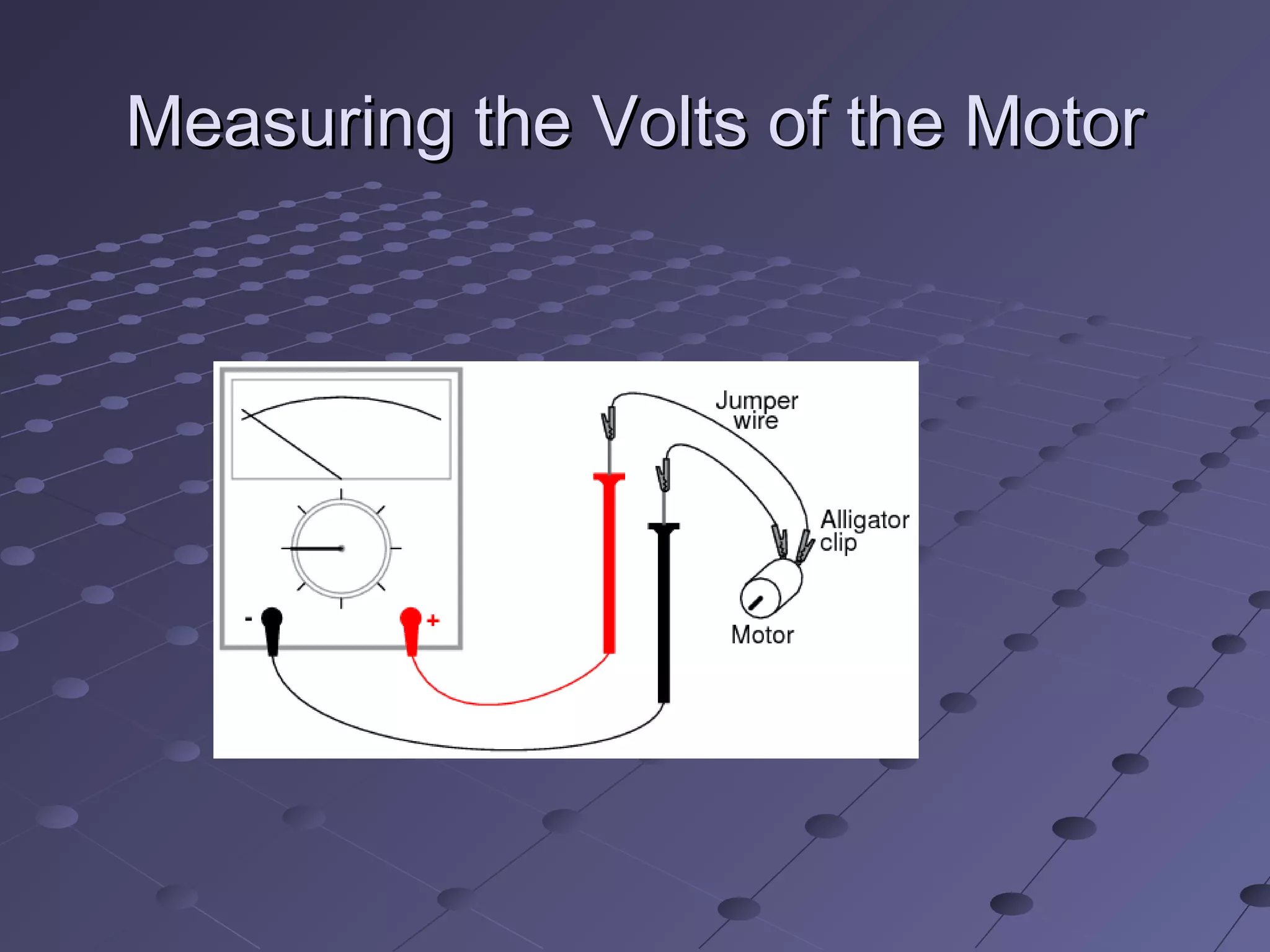
Measuring the Volts of the MotorMeasuring the Volts of the Motor
The voltmeter indicates polarity byThe voltmeter indicates polarity by
direction by needle movement with andirection by needle movement with an
analog instrument.analog instrument.
For a digital instrumentFor a digital instrument polarity ispolarity is
indicated by theindicated by the signsign of the numericalof the numerical
valuevalue
When measuring a voltage difference thereWhen measuring a voltage difference there
are always two leads coming from theare always two leads coming from the
instrument that will have to be connected toinstrument that will have to be connected to
the two points in your circuit across whichthe two points in your circuit across which
the voltage appears.the voltage appears.
Voltage might be any of the followingVoltage might be any of the following::
Across an element embedded in a circuit.Across an element embedded in a circuit.
The output of a transducer measuring someThe output of a transducer measuring some
physical variable like temperature, pH, etc.physical variable like temperature, pH, etc.
THANK YOUTHANK YOU
Galvanmometer

Galvanmometer

  • 1.
    IN THE NAMEOFIN THE NAME OF ALLAHALLAH THE MOST MERCIFUL ANDTHE MOST MERCIFUL AND BENIFICIENTBENIFICIENT
  • 2.
    WARM WELCOME TOWARMWELCOME TO OUR PRESENTATIONOUR PRESENTATION
  • 3.
    DARK RAYDARK RAY GROUPMEMBER :GROUP MEMBER : 1.HARES IBNE KASHEM (151-15-5368)1.HARES IBNE KASHEM (151-15-5368) 2.MD.MASUD PARVAZE (151-15-5203)2.MD.MASUD PARVAZE (151-15-5203) 3.CLINTON PLASID ROZARIO (151-15-5077)3.CLINTON PLASID ROZARIO (151-15-5077) 4.BAYZID AHAMMED (151-15-5139)4.BAYZID AHAMMED (151-15-5139) 5.TAHSIN JAWAD (151-15-5140)5.TAHSIN JAWAD (151-15-5140)
  • 4.
  • 5.
    INTRODUCTIONINTRODUCTION Galvanometer is anelectromechanical instrumentGalvanometer is an electromechanical instrument which is used for the detection of electric currentswhich is used for the detection of electric currents     through electric circuits. Being a sensitive    through electric circuits. Being a sensitive instrument, Galvanometer can not be used for theinstrument, Galvanometer can not be used for the     measurement of heavy currents. However we can    measurement of heavy currents. However we can measure very small currents by using galvanometermeasure very small currents by using galvanometer but     the primary purpose of galvanometer is thebut     the primary purpose of galvanometer is the detection of electric current not the measurement ofdetection of electric current not the measurement of current.current.
  • 6.
    principalsprincipals The Basic principleof Galvanometer is PMMCThe Basic principle of Galvanometer is PMMC (permanent magnetic moving coil)(permanent magnetic moving coil) Galvanometer works on the principle of conversion ofGalvanometer works on the principle of conversion of electrical energy into mechanical energy. When aelectrical energy into mechanical energy. When a     current flows in a magnetic field it experiences a    current flows in a magnetic field it experiences a magnetic torque. If it is free to rotate under amagnetic torque. If it is free to rotate under a     controlling torque, it rotates through an angle    controlling torque, it rotates through an angle proportional to the current flowing through it.proportional to the current flowing through it.
  • 8.
    WORKINGWORKING When a currentpasses through the galvanometer coil,When a current passes through the galvanometer coil, it experiences a magnetic deflecting torque,     whichit experiences a magnetic deflecting torque,     which tends to rotate it from its rest position. As the coiltends to rotate it from its rest position. As the coil rotates it produces a twist in the suspension     strip.rotates it produces a twist in the suspension     strip. The twist in the strip produces an electric restoringThe twist in the strip produces an electric restoring torque. The coil rotates until the elastic     restoringtorque. The coil rotates until the elastic     restoring torque due to the strip does not equal and cancels thetorque due to the strip does not equal and cancels the deflecting magnetic torque, then it     attainsdeflecting magnetic torque, then it     attains equilibrium and stops rotating any furthers.equilibrium and stops rotating any furthers.
  • 9.
  • 11.
  • 12.
    WHAT IS AVOLTMETER?WHAT IS A VOLTMETER? It is the most common instrument used toIt is the most common instrument used to measure voltagemeasure voltage It measure either AC or DC voltageIt measure either AC or DC voltage It is a measure of the voltage between twoIt is a measure of the voltage between two points of an electrical currentpoints of an electrical current
  • 13.
    TYPES OF VOLTMETERTYPESOF VOLTMETER INSTRUMENTINSTRUMENT AnalogAnalog The readings are shown on a scaleThe readings are shown on a scale DigitalDigital The readings are displayed on a LCD orThe readings are displayed on a LCD or LED display panelLED display panel
  • 14.
    Representations of VoltmeterRepresentationsof Voltmeter InstrumentsInstruments
  • 15.
    How Does theVoltmeter Work?How Does the Voltmeter Work? Work on the principle of Ohm’s LawWork on the principle of Ohm’s Law Potential Difference = Current ×Potential Difference = Current × ResistanceResistance (Volts)= (Amperes) ×(Volts)= (Amperes) × (Ohms)(Ohms)
  • 16.
    Measuring the Voltsof the MotorMeasuring the Volts of the Motor
  • 17.
    The voltmeter indicatespolarity byThe voltmeter indicates polarity by direction by needle movement with andirection by needle movement with an analog instrument.analog instrument. For a digital instrumentFor a digital instrument polarity ispolarity is indicated by theindicated by the signsign of the numericalof the numerical valuevalue
  • 18.
    When measuring avoltage difference thereWhen measuring a voltage difference there are always two leads coming from theare always two leads coming from the instrument that will have to be connected toinstrument that will have to be connected to the two points in your circuit across whichthe two points in your circuit across which the voltage appears.the voltage appears. Voltage might be any of the followingVoltage might be any of the following:: Across an element embedded in a circuit.Across an element embedded in a circuit. The output of a transducer measuring someThe output of a transducer measuring some physical variable like temperature, pH, etc.physical variable like temperature, pH, etc.
  • 19.