ANSWER1
Galvanometer
Definition: The galvanometer is the device used for detecting the presence of small current and
voltage or for measuring their magnitude. The galvanometer is mainly used in the bridges
and potentiometer where they indicate the null deflection or zero current.
Moving Coil Galvanometer
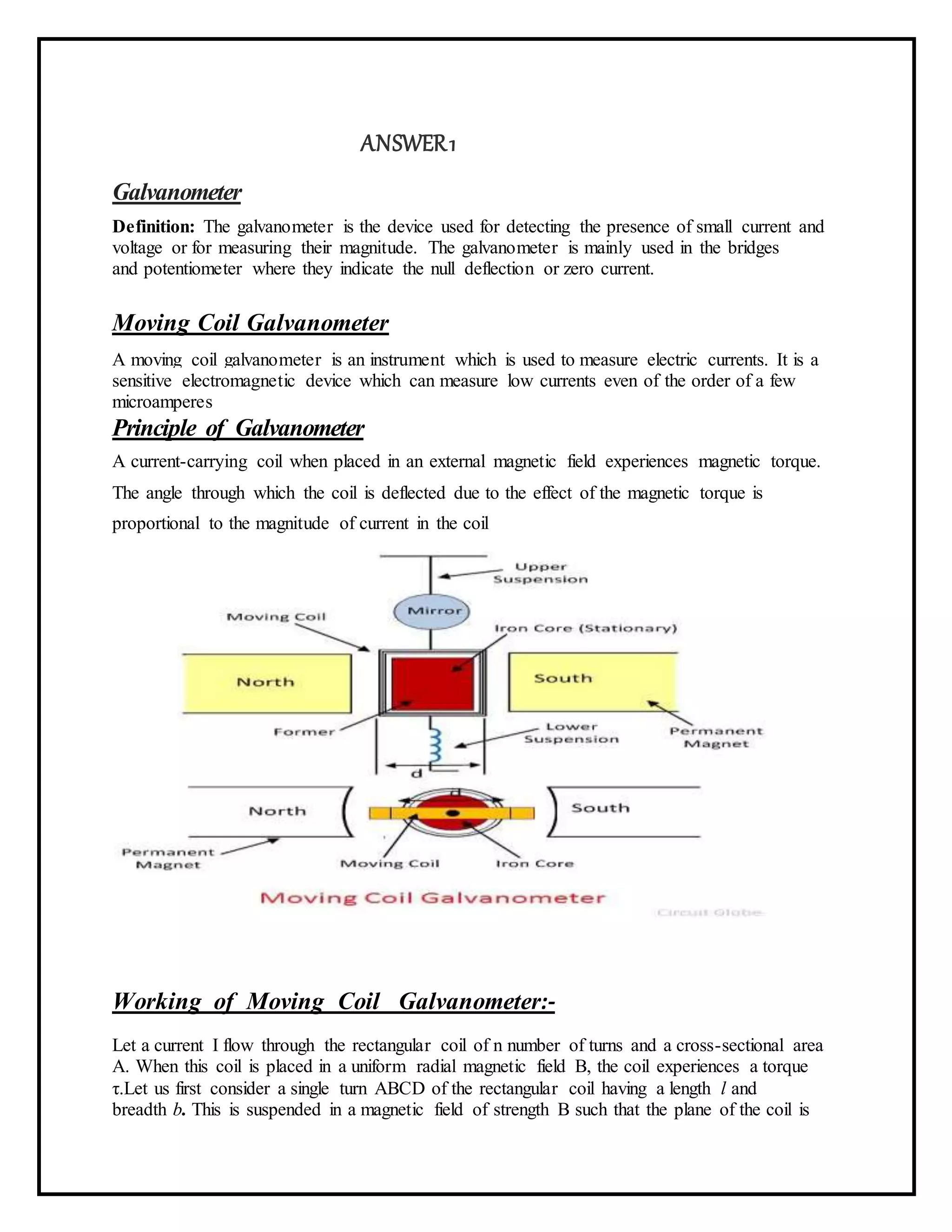
A moving coil galvanometer is an instrument which is used to measure electric currents. It is a
sensitive electromagnetic device which can measure low currents even of the order of a few
microamperes
Principle of Galvanometer
A current-carrying coil when placed in an external magnetic field experiences magnetic torque.
The angle through which the coil is deflected due to the effect of the magnetic torque is
proportional to the magnitude of current in the coil
Working of Moving Coil Galvanometer:-
Let a current I flow through the rectangular coil of n number of turns and a cross-sectional area
A. When this coil is placed in a uniform radial magnetic field B, the coil experiences a torque
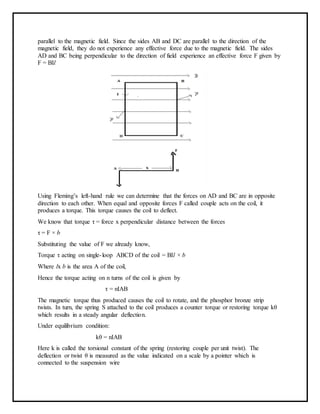
τ.Let us first consider a single turn ABCD of the rectangular coil having a length l and
breadth b. This is suspended in a magnetic field of strength B such that the plane of the coil is
parallel to the magnetic field. Since the sides AB and DC are parallel to the direction of the
magnetic field, they do not experience any effective force due to the magnetic field. The sides
AD and BC being perpendicular to the direction of field experience an effective force F given by
F = BIl
Using Fleming’s left-hand rule we can determine that the forces on AD and BC are in opposite
direction to each other. When equal and opposite forces F called couple acts on the coil, it
produces a torque. This torque causes the coil to deflect.
We know that torque τ = force x perpendicular distance between the forces
τ = F × b
Substituting the value of F we already know,
Torque τ acting on single-loop ABCD of the coil = BIl × b
Where lx b is the area A of the coil,
Hence the torque acting on n turns of the coil is given by
τ = nIAB
The magnetic torque thus produced causes the coil to rotate, and the phosphor bronze strip
twists. In turn, the spring S attached to the coil produces a counter torque or restoring torque kθ
which results in a steady angular deflection.
Under equilibrium condition:
kθ = nIAB
Here k is called the torsional constant of the spring (restoring couple per unit twist). The
deflection or twist θ is measured as the value indicated on a scale by a pointer which is
connected to the suspension wire
θ= ( nAB / k)I
Therefore θ ∝ I
The quantity nAB / k is a constant for a given galvanometer. Hence it is understood that the
deflection that occurs the galvanometer is directly proportional to the current that flows through
it.
APPPLICATION IN VOLTMETER:-
Conversion Of Galvanometer To Voltmeter
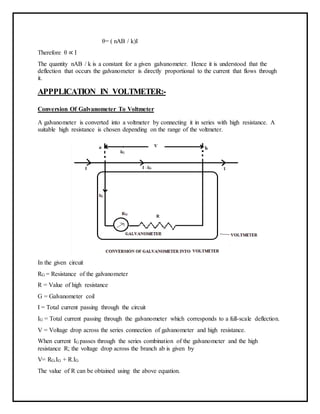
A galvanometer is converted into a voltmeter by connecting it in series with high resistance. A
suitable high resistance is chosen depending on the range of the voltmeter.
In the given circuit
RG = Resistance of the galvanometer
R = Value of high resistance
G = Galvanometer coil
I = Total current passing through the circuit
IG = Total current passing through the galvanometer which corresponds to a full-scale deflection.
V = Voltage drop across the series connection of galvanometer and high resistance.
When current IG passes through the series combination of the galvanometer and the high
resistance R; the voltage drop across the branch ab is given by
V= RG.IG + R.IG
The value of R can be obtained using the above equation.
APPPLICATION IN AMMETER:-
Conversion Of Galvanometer To Ammeter
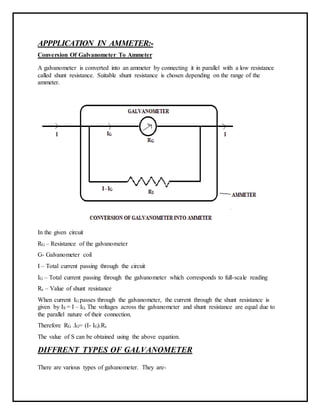
A galvanometer is converted into an ammeter by connecting it in parallel with a low resistance
called shunt resistance. Suitable shunt resistance is chosen depending on the range of the
ammeter.
In the given circuit
RG – Resistance of the galvanometer
G- Galvanometer coil
I – Total current passing through the circuit
IG – Total current passing through the galvanometer which corresponds to full-scale reading
Rs – Value of shunt resistance
When current IG passes through the galvanometer, the current through the shunt resistance is
given by IS = I – IG. The voltages across the galvanometer and shunt resistance are equal due to
the parallel nature of their connection.
Therefore RG .IG= (I- IG).Rs
The value of S can be obtained using the above equation.
DIFFRENT TYPES OF GALVANOMETER
There are various types of galvanometer. They are-
 Tangent Galvanometer: it works by using a compass needle to compare the magnetic
field generated by an unknown current to the magnetic field of the Earth. It was used
earlier. It was first given by Claude Pouillet in 1837. It contains an insulated copper wire
coil on a non-magnetic circular frame.
 Astatic Galvanometer: it does not use the Earth’s magnetic field for measuring the
current. It was developed by Leopoldo Nobili in 1825. It contains two magnetized
needles that run parallel to each other, suspended by a silk thread, with their magnetic
poles reversed. The lower needle gets deflected by the passing current’s magnetic field.
The second needle cancels out the diapole movement of the first one to cancel out the
effects of Earth’s magnetic field.
 Mirror Galvanometer: it is used to achieve higher sensitivity for detecting extremely
small currents. It contains horizontal magnets which are suspended from a fine fiber
inside of the vertical coil, with an attached mirror to its magnets. A beam of light reflects
from the mirror acts as a long mass-less pointer by falling on a graduated scale across the
room.
 Ballistic Galvanometer: it is sensitive in mature and used to measure the quantity of
charge that is discharged through it. The moving part of the galvanometer has a large
moment of inertia, giving it a long oscillation period. It may be of the moving coil type or
of the moving magnet type.
ANSWER2
Hot Wire Instrument:-
Definition:
The instruments which use the heating effect of the current for knowing their
magnitude suchtype of instrument is known as the hot wire instrument.
Principle o f Hot wire instrument:-
It works on the principle that the length of the wire increases because of the
heating effect of the current flow through it.
Constructionofthe HotWire Instrument
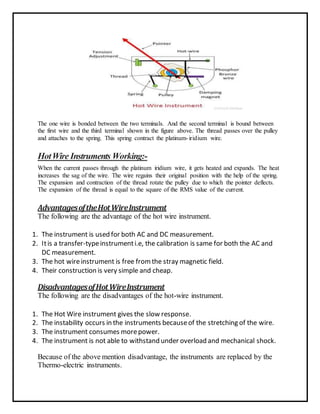
The construction of the hot-wire instruments is shown in the figure below. The
current whose magnitude is used to be determined is passed through the platinum-
iridium wire. The hot wire instrument uses two-wire.
The one wire is bonded between the two terminals. And the second terminal is bound between
the first wire and the third terminal shown in the figure above. The thread passes over the pulley
and attaches to the spring. This spring contract the platinum-iridium wire.
HotWire Instruments Working:-
When the current passes through the platinum iridium wire, it gets heated and expands. The heat
increases the sag of the wire. The wire regains their original position with the help of the spring.
The expansion and contraction of the thread rotate the pulley due to which the pointer deflects.
The expansion of the thread is equal to the square of the RMS value of the current.
AdvantagesoftheHotWireInstrument
The following are the advantage of the hot wire instrument.
1. The instrument is used for both AC and DC measurement.
2. Itis a transfer-typeinstrumenti.e, the calibration is same for both the AC and
DC measurement.
3. The hot wireinstrument is free fromthe stray magnetic field.
4. Their construction is very simple and cheap.
DisadvantagesofHotWireInstrument
The following are the disadvantages of the hot-wire instrument.
1. The Hot Wire instrument gives the slow response.
2. The instability occurs in the instruments becauseof the stretching of the wire.
3. The instrument consumes morepower.
4. The instrument is not able to withstand under overload and mechanical shock.
Because of the above mention disadvantage, the instruments are replaced by the
Thermo-electric instruments.
DYNAMOMETER
DEFINATION:-
A dynamometer or "dyno" for short, is a device for simultaneously measuring
the torque and rotational speed (RPM) of an engine, motor or other rotating
prime mover so that its instantaneous power may be calculated, and usually
displayed by the dynamometer itself as kW or bhp.
PRINCIPLE:-
The deflection of the pointer of a dynamometer instrument is proportional to
the current through the moving coil, but it is also proportional to the flux
density of the magnetic field set up by the fixed field coils. This means, of
course, the deflection is also proportional the current through the fixed field
coils.
WORKING OF DYNAMOMETER
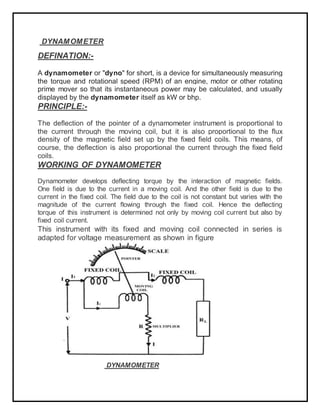
Dynamometer develops deflecting torque by the interaction of magnetic fields.
One field is due to the current in a moving coil. And the other field is due to the
current in the fixed coil. The field due to the coil is not constant but varies with the
magnitude of the current flowing through the fixed coil. Hence the deflecting
torque of this instrument is determined not only by moving coil current but also by
fixed coil current.
This instrument with its fixed and moving coil connected in series is
adapted for voltage measurement as shown in figure
DYNAMOMETER
Watt-Hour Meter
DEFINATION:-
Energy Meteror Watt-Hour Meter is an electrical instrument that measures the
amount of electrical energy used by the consumers.
Principle:-
The basic principle of induction type energy meter is electromagnetic
induction. When alternating current flow though two suitably located coils
produces rotating magnetic field which is cut by the metallic disc suspended
near to the coils thus emf induce in the disc which is circulates eddy current in
it
Working of the Energy Meter:-
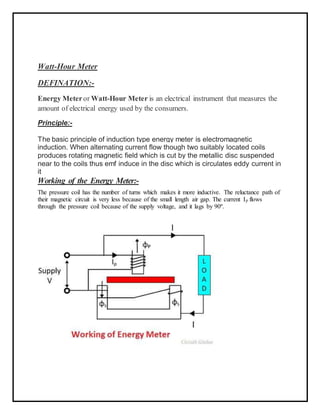
The pressure coil has the number of turns which makes it more inductive. The reluctance path of
their magnetic circuit is very less because of the small length air gap. The current Ip flows
through the pressure coil because of the supply voltage, and it lags by 90º.
The Ip produces the two Φp which is again divided into Φp1 and Φp2. The major portion of the
flux Φp1 passes through the side gap because of low reluctance. The flux Φp2 goes through the
disc and induces the driving torque which rotates the aluminium disc.
The flux Φp is proportional to the applied voltage, and it is lagged by an angle of 90º. The flux is
alternating and hence induces an eddy current Iep in the disc.
The load current passes through the current coil induces the flux Φs. This flux causes the eddy
current Ies on the disc. The eddy current Ies interacts with the flux Φp, and the eddy current
Iep interacts with Φs to produce the another torque. These torques are opposite in direction, and
the net torque is the difference between these two.
Thermo Instruments:-
Definition: -
The instrument in which the concept of heat is involved in it.
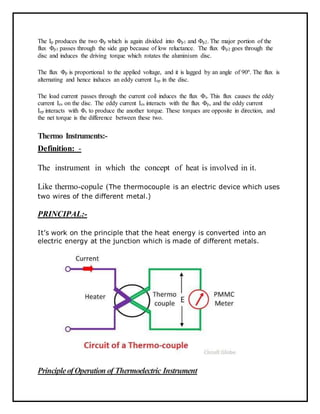
Like thermo-copule (The thermocouple is an electric device which uses
two wires of the different metal.)
PRINCIPAL:-
It’s work on the principle that the heat energy is converted into an
electric energy at the junction which is made of different metals.
PrincipleofOperation of Thermoelectric Instrument
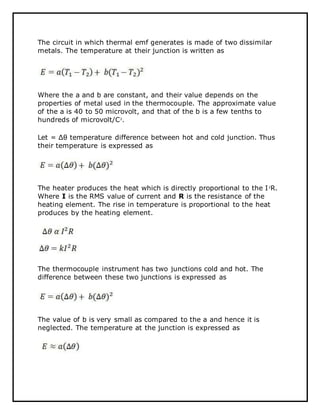
The circuit in which thermal emf generates is made of two dissimilar
metals. The temperature at their junction is written as
Where the a and b are constant, and their value depends on the
properties of metal used in the thermocouple. The approximate value
of the a is 40 to 50 microvolt, and that of the b is a few tenths to
hundreds of microvolt/C2
.
Let = Δθ temperature difference between hot and cold junction. Thus
their temperature is expressed as
The heater produces the heat which is directly proportional to the I2
R.
Where I is the RMS value of current and R is the resistance of the
heating element. The rise in temperature is proportional to the heat
produces by the heating element.
The thermocouple instrument has two junctions cold and hot. The
difference between these two junctions is expressed as
The value of b is very small as compared to the a and hence it is
neglected. The temperature at the junction is expressed as
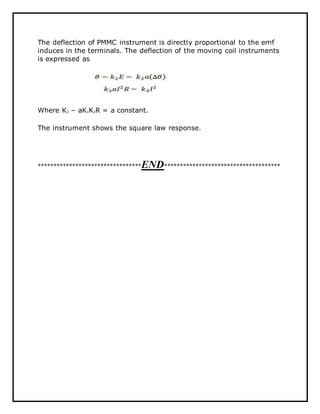
The deflection of PMMC instrument is directly proportional to the emf
induces in the terminals. The deflection of the moving coil instruments
is expressed as
Where K3 – aK1K2R = a constant.
The instrument shows the square law response.
*********************************END*************************************

Answer 1 sir teehseen

  • 1.
    ANSWER1 Galvanometer Definition: The galvanometeris the device used for detecting the presence of small current and voltage or for measuring their magnitude. The galvanometer is mainly used in the bridges and potentiometer where they indicate the null deflection or zero current. Moving Coil Galvanometer A moving coil galvanometer is an instrument which is used to measure electric currents. It is a sensitive electromagnetic device which can measure low currents even of the order of a few microamperes Principle of Galvanometer A current-carrying coil when placed in an external magnetic field experiences magnetic torque. The angle through which the coil is deflected due to the effect of the magnetic torque is proportional to the magnitude of current in the coil Working of Moving Coil Galvanometer:- Let a current I flow through the rectangular coil of n number of turns and a cross-sectional area A. When this coil is placed in a uniform radial magnetic field B, the coil experiences a torque τ.Let us first consider a single turn ABCD of the rectangular coil having a length l and breadth b. This is suspended in a magnetic field of strength B such that the plane of the coil is
  • 2.
    parallel to themagnetic field. Since the sides AB and DC are parallel to the direction of the magnetic field, they do not experience any effective force due to the magnetic field. The sides AD and BC being perpendicular to the direction of field experience an effective force F given by F = BIl Using Fleming’s left-hand rule we can determine that the forces on AD and BC are in opposite direction to each other. When equal and opposite forces F called couple acts on the coil, it produces a torque. This torque causes the coil to deflect. We know that torque τ = force x perpendicular distance between the forces τ = F × b Substituting the value of F we already know, Torque τ acting on single-loop ABCD of the coil = BIl × b Where lx b is the area A of the coil, Hence the torque acting on n turns of the coil is given by τ = nIAB The magnetic torque thus produced causes the coil to rotate, and the phosphor bronze strip twists. In turn, the spring S attached to the coil produces a counter torque or restoring torque kθ which results in a steady angular deflection. Under equilibrium condition: kθ = nIAB Here k is called the torsional constant of the spring (restoring couple per unit twist). The deflection or twist θ is measured as the value indicated on a scale by a pointer which is connected to the suspension wire
  • 3.
    θ= ( nAB/ k)I Therefore θ ∝ I The quantity nAB / k is a constant for a given galvanometer. Hence it is understood that the deflection that occurs the galvanometer is directly proportional to the current that flows through it. APPPLICATION IN VOLTMETER:- Conversion Of Galvanometer To Voltmeter A galvanometer is converted into a voltmeter by connecting it in series with high resistance. A suitable high resistance is chosen depending on the range of the voltmeter. In the given circuit RG = Resistance of the galvanometer R = Value of high resistance G = Galvanometer coil I = Total current passing through the circuit IG = Total current passing through the galvanometer which corresponds to a full-scale deflection. V = Voltage drop across the series connection of galvanometer and high resistance. When current IG passes through the series combination of the galvanometer and the high resistance R; the voltage drop across the branch ab is given by V= RG.IG + R.IG The value of R can be obtained using the above equation.
  • 4.
    APPPLICATION IN AMMETER:- ConversionOf Galvanometer To Ammeter A galvanometer is converted into an ammeter by connecting it in parallel with a low resistance called shunt resistance. Suitable shunt resistance is chosen depending on the range of the ammeter. In the given circuit RG – Resistance of the galvanometer G- Galvanometer coil I – Total current passing through the circuit IG – Total current passing through the galvanometer which corresponds to full-scale reading Rs – Value of shunt resistance When current IG passes through the galvanometer, the current through the shunt resistance is given by IS = I – IG. The voltages across the galvanometer and shunt resistance are equal due to the parallel nature of their connection. Therefore RG .IG= (I- IG).Rs The value of S can be obtained using the above equation. DIFFRENT TYPES OF GALVANOMETER There are various types of galvanometer. They are-
  • 5.
     Tangent Galvanometer:it works by using a compass needle to compare the magnetic field generated by an unknown current to the magnetic field of the Earth. It was used earlier. It was first given by Claude Pouillet in 1837. It contains an insulated copper wire coil on a non-magnetic circular frame.  Astatic Galvanometer: it does not use the Earth’s magnetic field for measuring the current. It was developed by Leopoldo Nobili in 1825. It contains two magnetized needles that run parallel to each other, suspended by a silk thread, with their magnetic poles reversed. The lower needle gets deflected by the passing current’s magnetic field. The second needle cancels out the diapole movement of the first one to cancel out the effects of Earth’s magnetic field.  Mirror Galvanometer: it is used to achieve higher sensitivity for detecting extremely small currents. It contains horizontal magnets which are suspended from a fine fiber inside of the vertical coil, with an attached mirror to its magnets. A beam of light reflects from the mirror acts as a long mass-less pointer by falling on a graduated scale across the room.  Ballistic Galvanometer: it is sensitive in mature and used to measure the quantity of charge that is discharged through it. The moving part of the galvanometer has a large moment of inertia, giving it a long oscillation period. It may be of the moving coil type or of the moving magnet type. ANSWER2 Hot Wire Instrument:- Definition: The instruments which use the heating effect of the current for knowing their magnitude suchtype of instrument is known as the hot wire instrument. Principle o f Hot wire instrument:- It works on the principle that the length of the wire increases because of the heating effect of the current flow through it. Constructionofthe HotWire Instrument The construction of the hot-wire instruments is shown in the figure below. The current whose magnitude is used to be determined is passed through the platinum- iridium wire. The hot wire instrument uses two-wire.
  • 6.
    The one wireis bonded between the two terminals. And the second terminal is bound between the first wire and the third terminal shown in the figure above. The thread passes over the pulley and attaches to the spring. This spring contract the platinum-iridium wire. HotWire Instruments Working:- When the current passes through the platinum iridium wire, it gets heated and expands. The heat increases the sag of the wire. The wire regains their original position with the help of the spring. The expansion and contraction of the thread rotate the pulley due to which the pointer deflects. The expansion of the thread is equal to the square of the RMS value of the current. AdvantagesoftheHotWireInstrument The following are the advantage of the hot wire instrument. 1. The instrument is used for both AC and DC measurement. 2. Itis a transfer-typeinstrumenti.e, the calibration is same for both the AC and DC measurement. 3. The hot wireinstrument is free fromthe stray magnetic field. 4. Their construction is very simple and cheap. DisadvantagesofHotWireInstrument The following are the disadvantages of the hot-wire instrument. 1. The Hot Wire instrument gives the slow response. 2. The instability occurs in the instruments becauseof the stretching of the wire. 3. The instrument consumes morepower. 4. The instrument is not able to withstand under overload and mechanical shock. Because of the above mention disadvantage, the instruments are replaced by the Thermo-electric instruments.
  • 7.
    DYNAMOMETER DEFINATION:- A dynamometer or"dyno" for short, is a device for simultaneously measuring the torque and rotational speed (RPM) of an engine, motor or other rotating prime mover so that its instantaneous power may be calculated, and usually displayed by the dynamometer itself as kW or bhp. PRINCIPLE:- The deflection of the pointer of a dynamometer instrument is proportional to the current through the moving coil, but it is also proportional to the flux density of the magnetic field set up by the fixed field coils. This means, of course, the deflection is also proportional the current through the fixed field coils. WORKING OF DYNAMOMETER Dynamometer develops deflecting torque by the interaction of magnetic fields. One field is due to the current in a moving coil. And the other field is due to the current in the fixed coil. The field due to the coil is not constant but varies with the magnitude of the current flowing through the fixed coil. Hence the deflecting torque of this instrument is determined not only by moving coil current but also by fixed coil current. This instrument with its fixed and moving coil connected in series is adapted for voltage measurement as shown in figure DYNAMOMETER
  • 8.
    Watt-Hour Meter DEFINATION:- Energy MeterorWatt-Hour Meter is an electrical instrument that measures the amount of electrical energy used by the consumers. Principle:- The basic principle of induction type energy meter is electromagnetic induction. When alternating current flow though two suitably located coils produces rotating magnetic field which is cut by the metallic disc suspended near to the coils thus emf induce in the disc which is circulates eddy current in it Working of the Energy Meter:- The pressure coil has the number of turns which makes it more inductive. The reluctance path of their magnetic circuit is very less because of the small length air gap. The current Ip flows through the pressure coil because of the supply voltage, and it lags by 90º.
  • 9.
    The Ip producesthe two Φp which is again divided into Φp1 and Φp2. The major portion of the flux Φp1 passes through the side gap because of low reluctance. The flux Φp2 goes through the disc and induces the driving torque which rotates the aluminium disc. The flux Φp is proportional to the applied voltage, and it is lagged by an angle of 90º. The flux is alternating and hence induces an eddy current Iep in the disc. The load current passes through the current coil induces the flux Φs. This flux causes the eddy current Ies on the disc. The eddy current Ies interacts with the flux Φp, and the eddy current Iep interacts with Φs to produce the another torque. These torques are opposite in direction, and the net torque is the difference between these two. Thermo Instruments:- Definition: - The instrument in which the concept of heat is involved in it. Like thermo-copule (The thermocouple is an electric device which uses two wires of the different metal.) PRINCIPAL:- It’s work on the principle that the heat energy is converted into an electric energy at the junction which is made of different metals. PrincipleofOperation of Thermoelectric Instrument
  • 10.
    The circuit inwhich thermal emf generates is made of two dissimilar metals. The temperature at their junction is written as Where the a and b are constant, and their value depends on the properties of metal used in the thermocouple. The approximate value of the a is 40 to 50 microvolt, and that of the b is a few tenths to hundreds of microvolt/C2 . Let = Δθ temperature difference between hot and cold junction. Thus their temperature is expressed as The heater produces the heat which is directly proportional to the I2 R. Where I is the RMS value of current and R is the resistance of the heating element. The rise in temperature is proportional to the heat produces by the heating element. The thermocouple instrument has two junctions cold and hot. The difference between these two junctions is expressed as The value of b is very small as compared to the a and hence it is neglected. The temperature at the junction is expressed as
  • 11.
    The deflection ofPMMC instrument is directly proportional to the emf induces in the terminals. The deflection of the moving coil instruments is expressed as Where K3 – aK1K2R = a constant. The instrument shows the square law response. *********************************END*************************************