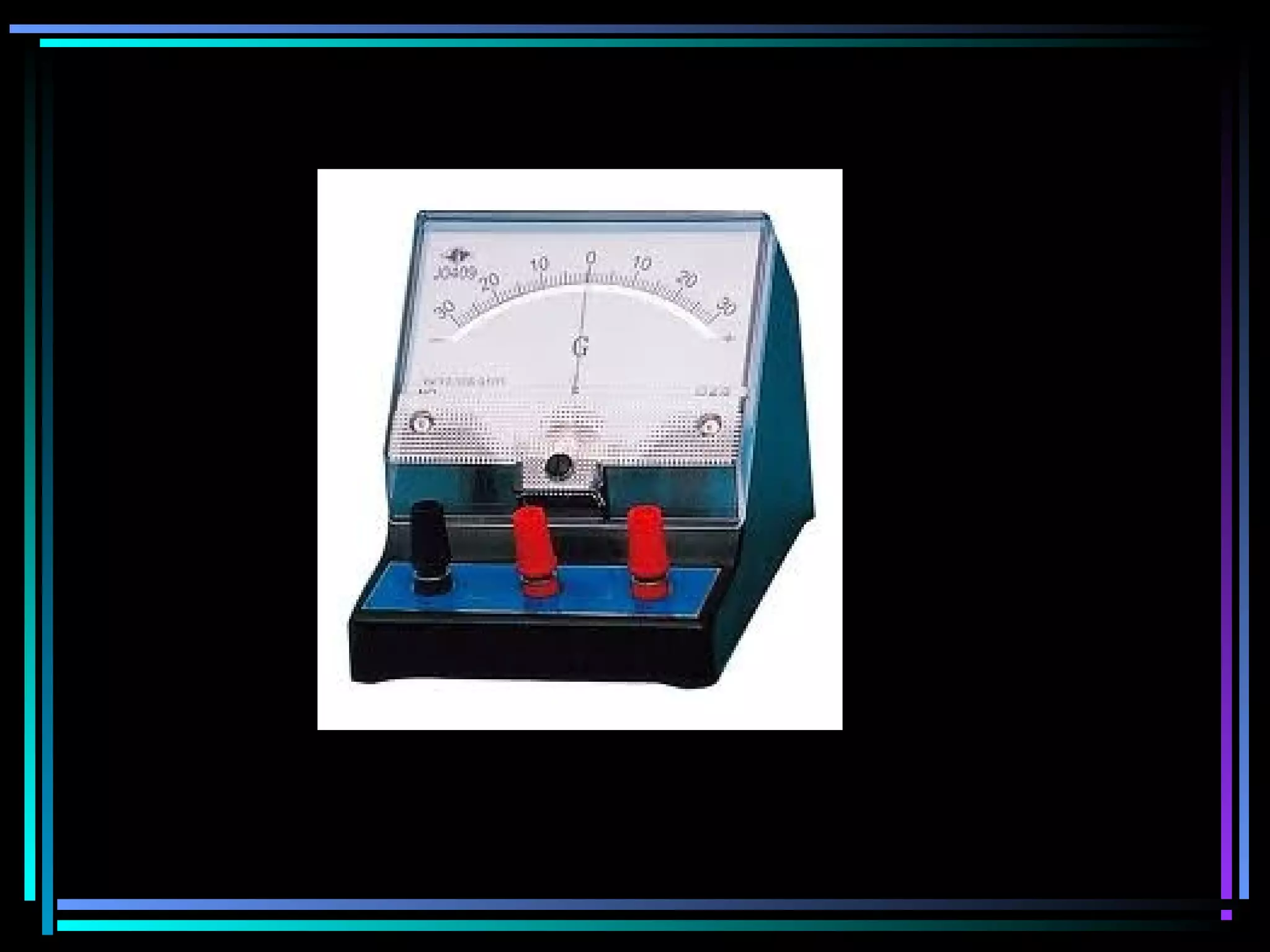
Galvano
Meter
What is the definition of "galvanometer"?

A basic device for measuring a small electric
current by means of a mechanical motion
derived from electromagnetic forces produced
by the current.
Principle Of Galvano Meter:
• Galvanometer works on the principle of conversion
of electrical energy into mechanical energy. When
a current flows in a magnetic field it experiences a
magnetic torque. If it is free to rotate under a
controlling torque, it rotates through an angle
proportional to the current flowing through it.
What is the principle of ballistic
galvanometer?
• when current passes through a coil of
b.g then it rotates in a magnetic field
and measures the quantity of charge
rather than current .
ESSENTIAL PARTS OF
GALVANOMETER
• There are five essential parts of a
Galvanometer.
1. A U-shaped permanent magnet with
concave poles.
2. Flat rectangular coil of thin enameled
insulated wire ‘C’.
3. A soft iron cylinder 'B'.
4. A pointer or needle.
5. A scale.
CONSTRUCTION
• The flat rectangular coil of thin enameled insulated wire of
suitable number of turns wound on a light nonmetallic or
aluminum frame is suspended between the cylindrically concave
poles of magnet by a thin phosphor bronze strip. One end of the
wire of the coil is soldered to strip. The other end of the strip
fixed to the frame of the galvanometer and connected to an
external terminal. It serves as one leas current lead through
which the current enters or leaves the coil. The other end of the
wire of the coil is soldered to a loose and soft spiral of wire
connected to another external terminal. The soft spiral of a wire
serves as the other current lead. A soft-iron cylinder, coaxial
with the pole pieces, is placed within the frame of the coil and is
fixed to the body of the galvanometer. In the space between it
and the pole pieces, where the coil moves freely, the soft iron
cylinder makes the magnetic field stronger and radial such that
into whatever position the coil rotates, the magnetic field is
always parallel to its plane.
WORKING :
• When a current passes through the
galvanometer coil, it experiences a magnetic
deflecting torque, which tends to rotate it from
its rest position. As the coil rotates it produces
a twist in the suspension strip. The twist in the
strip produces an electric restoring torque.
The coil rotates until the elastic restoring
torque due to the strip does not equal and
cancels the deflecting magnetic torque, then it
attains equilibrium and stops rotating any
furthers.
Applications:
• A galvanometer is a type of ammeter: an
instrument for detecting and measuring
electric current. It is an analog
electromechanical transducer that produces a
rotary deflection of some type of pointer in
response to electric current flowing through
its coil. The term has expanded to include
uses of the same mechanism in recording,
positioning, and servomechanism equipment
Uses :
• Laser Scanning.
its used to detect and measure electric
current Answer It's an ammeter. It's
used to detect and measure electric
current. To measure small amounts of
current in a circuit, it is utilized with the
motor effect.
Tangential galvano meter:
• To measure small amounts of current in a circuit,
it is utilized with the motor effect.

th
By

tu
es

d

nt o
e

g
Bri
f

ht V

M
ion
is

wa
Ja

o

o
lC
de

lH
dU
Co

ssa
a

e
lleg

H

u
rip
a

hah
nS

act#
nt

4
923
+

Pak
r

.
tan
is

747
358
29
Galvano Meter

Galvano Meter

  • 1.
  • 3.
    What is thedefinition of "galvanometer"? A basic device for measuring a small electric current by means of a mechanical motion derived from electromagnetic forces produced by the current.
  • 4.
    Principle Of GalvanoMeter: • Galvanometer works on the principle of conversion of electrical energy into mechanical energy. When a current flows in a magnetic field it experiences a magnetic torque. If it is free to rotate under a controlling torque, it rotates through an angle proportional to the current flowing through it.
  • 5.
    What is theprinciple of ballistic galvanometer? • when current passes through a coil of b.g then it rotates in a magnetic field and measures the quantity of charge rather than current .
  • 6.
    ESSENTIAL PARTS OF GALVANOMETER •There are five essential parts of a Galvanometer. 1. A U-shaped permanent magnet with concave poles. 2. Flat rectangular coil of thin enameled insulated wire ‘C’. 3. A soft iron cylinder 'B'. 4. A pointer or needle. 5. A scale.
  • 7.
    CONSTRUCTION • The flatrectangular coil of thin enameled insulated wire of suitable number of turns wound on a light nonmetallic or aluminum frame is suspended between the cylindrically concave poles of magnet by a thin phosphor bronze strip. One end of the wire of the coil is soldered to strip. The other end of the strip fixed to the frame of the galvanometer and connected to an external terminal. It serves as one leas current lead through which the current enters or leaves the coil. The other end of the wire of the coil is soldered to a loose and soft spiral of wire connected to another external terminal. The soft spiral of a wire serves as the other current lead. A soft-iron cylinder, coaxial with the pole pieces, is placed within the frame of the coil and is fixed to the body of the galvanometer. In the space between it and the pole pieces, where the coil moves freely, the soft iron cylinder makes the magnetic field stronger and radial such that into whatever position the coil rotates, the magnetic field is always parallel to its plane.
  • 8.
    WORKING : • Whena current passes through the galvanometer coil, it experiences a magnetic deflecting torque, which tends to rotate it from its rest position. As the coil rotates it produces a twist in the suspension strip. The twist in the strip produces an electric restoring torque. The coil rotates until the elastic restoring torque due to the strip does not equal and cancels the deflecting magnetic torque, then it attains equilibrium and stops rotating any furthers.
  • 9.
    Applications: • A galvanometeris a type of ammeter: an instrument for detecting and measuring electric current. It is an analog electromechanical transducer that produces a rotary deflection of some type of pointer in response to electric current flowing through its coil. The term has expanded to include uses of the same mechanism in recording, positioning, and servomechanism equipment
  • 10.
    Uses : • LaserScanning. its used to detect and measure electric current Answer It's an ammeter. It's used to detect and measure electric current. To measure small amounts of current in a circuit, it is utilized with the motor effect.
  • 11.
    Tangential galvano meter: •To measure small amounts of current in a circuit, it is utilized with the motor effect. th By tu es d nt o e g Bri f ht V M ion is wa Ja o o lC de lH dU Co ssa a e lleg H u rip a hah nS act# nt 4 923 + Pak r . tan is 747 358 29