Gallstone Disease
Dr.N.Murugesan ,MS
Objectives
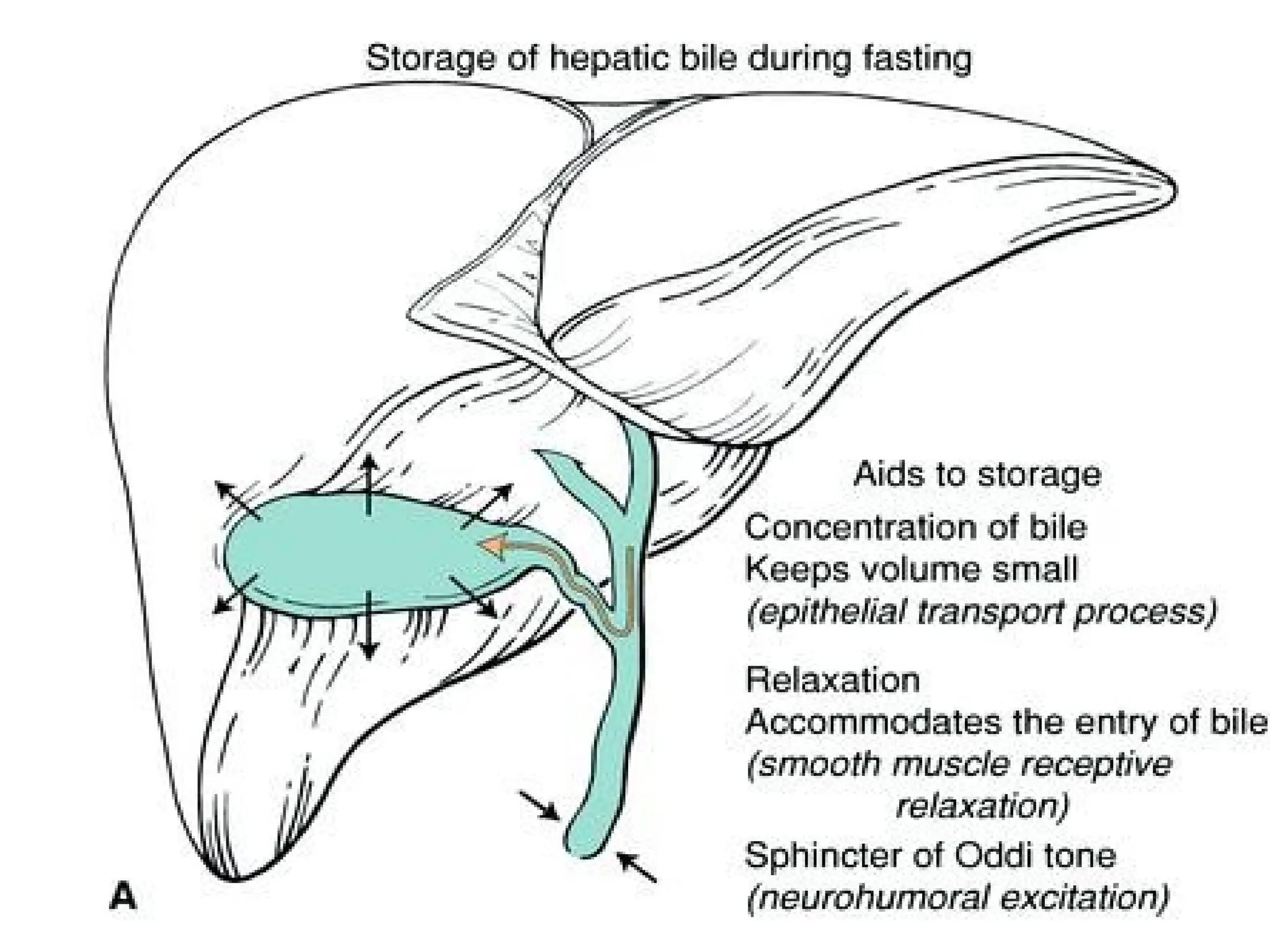
• Basic biliary anatomy and physiology
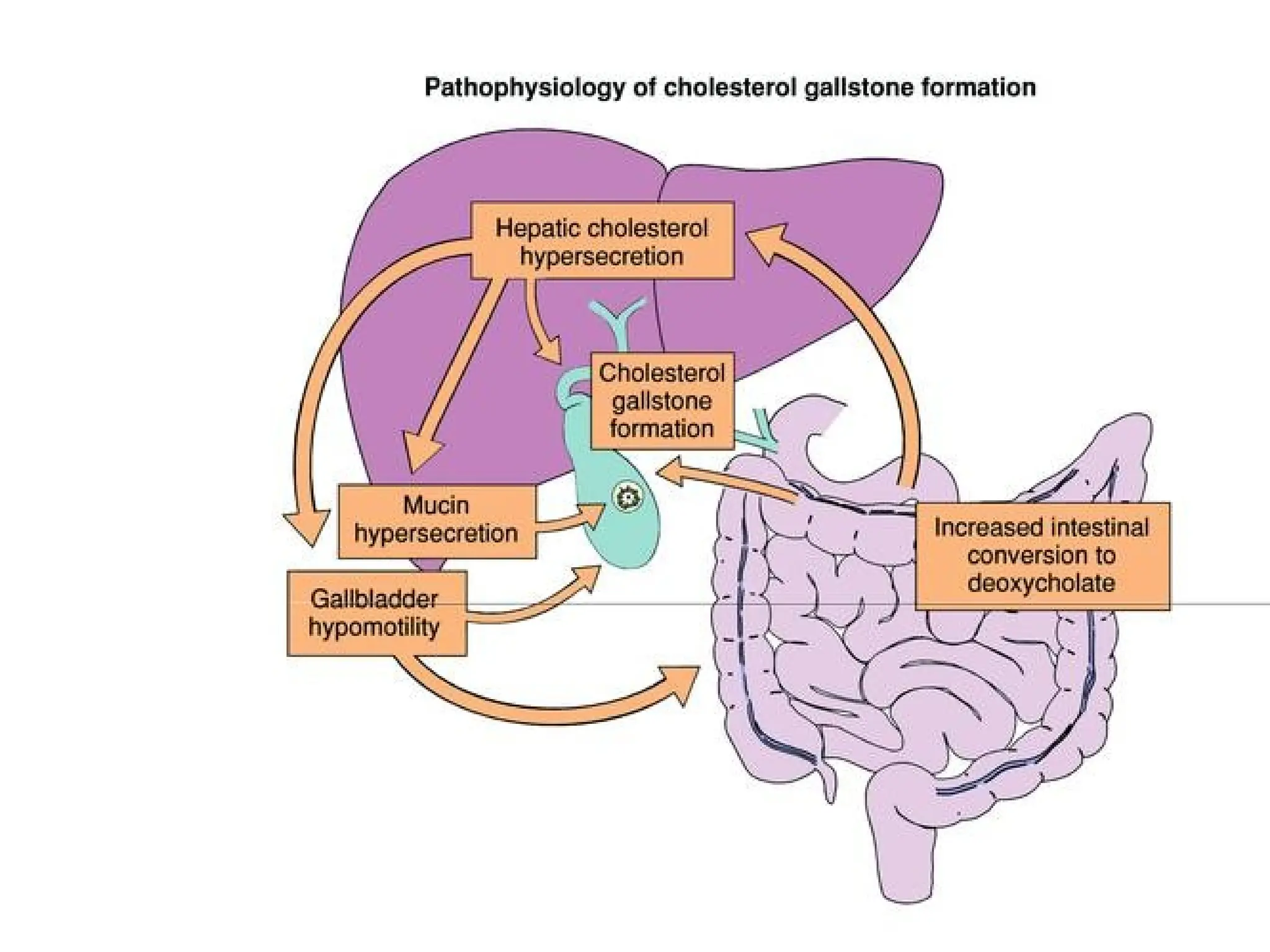
• Pathophysiology of gallstone disease
• Clinical manifestations of gallstone disease
• Complications of gallstone disease
• Investigation and management of gallstone
disease
Gallbladder Surface Anatomy
• Lies in the right upper quadrant, under the
costal margin at the level of the 9th
costal
cartilage
• The level of the 9th
costal cartilage can be
palpated as a distinct notch
Gallstones
• Common (20% population)
• Cholesterol stones in West
• Female proponderance (3/1)
• Risk factors
– Obesity
– Oestrogen
– Hypercholesterolaemia
– Increasing age
– 5 F’s
Clinical Manifestations
• Asymptomatic
• Cholecystitis
• Biliary colic
• Complications
– Jaundice
– Pancreatitis
– Cholangitis
– Gallstone ileus
– Carcinoma of gallbladder
Acute Cholecystitis
• Acute inflammation of the gallbladder
• Usually associated with calculi (stones)
– Calculus causes obstruction at Hartmann's
pouch or cystic duct
• Less commonly with biliary sludge
• A-calculus (no-stone) cholecystitis rare
• Bacterial infection in 50% only
• Recurrent attacks result in fibrosed thickened
gallbladder (chronic cholecystitis)
Acute Cholecystitis Clinical Features
Pain
• Sudden onset
• Post-prandial
• RUQ—around to back
• Constant
• Associated nausea and vomiting
• May last several hours to days
• Recurrent attacks common
Acute Cholecystitis
Signs
• Pyrexia (37.5-38.5)
• Associated jaundice signifies CBD blockage
– CBD stone or Mirrizi’s Syndrome
• Abdominal tenderness localized to RUQ
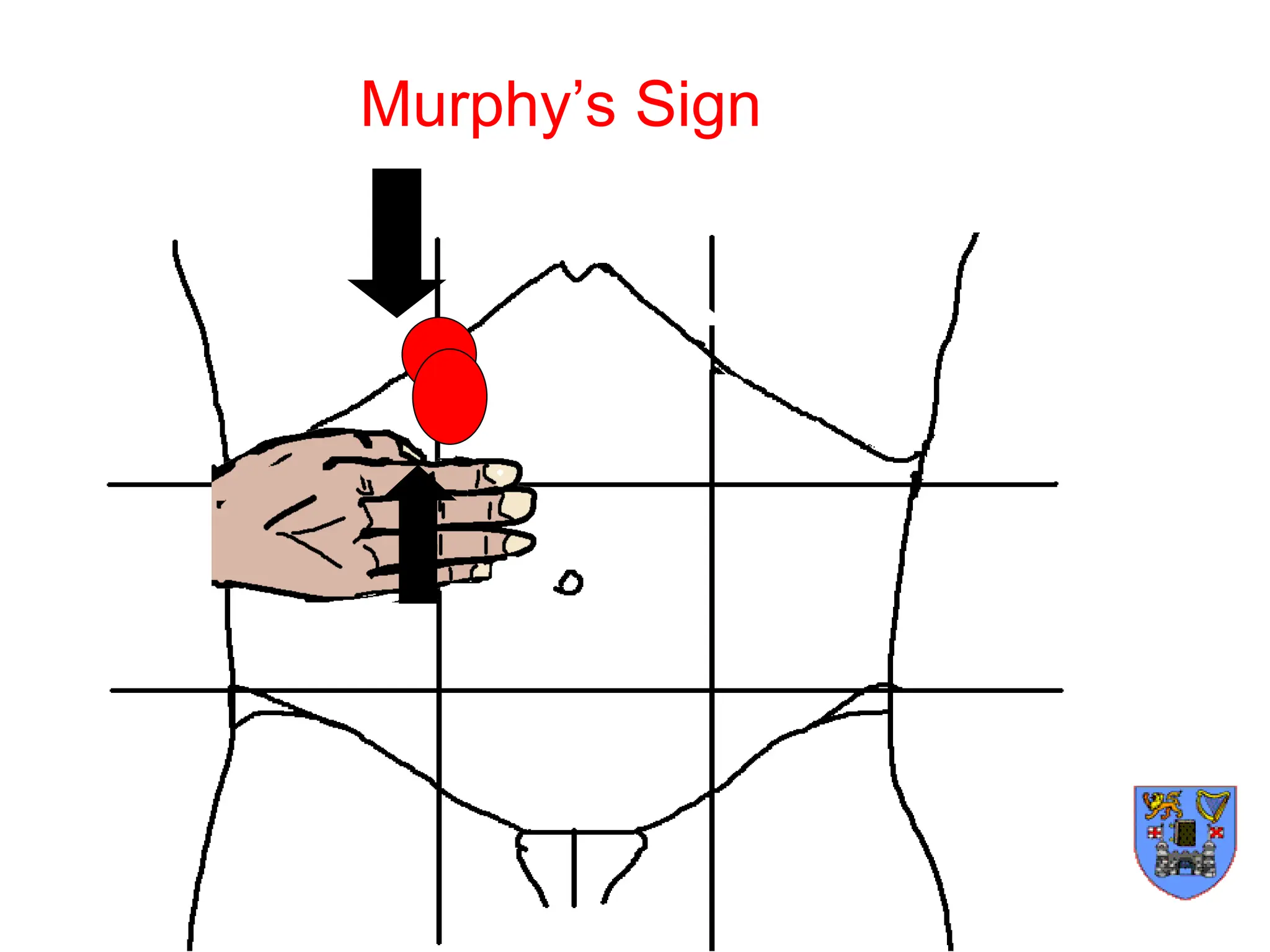
• Murphys’ sign positive
Murphys’ Sign
• Inspiratory arrest with manual pressure below
the gallbladder
Murphy’s Sign
Biliary Colic
• Pain associated with passage of stone
• Usually not colicky but constant (a misnomer)
• As cholecystitis but not
not associated with fever/
leucocytosis and positive Murphys’ sign
• Usually resolves after minutes- few hours
Complications
• Empyema/ mucocele
• Obstructive jaundice
• Ascending cholangitis
• Pancreatitis
Charcots’ Triad- Ascending cholangitis
1. Pain
2. Fever
3. Jaundice
Courvoisiers’ Law
In the presence of jaundice a palpable
gallbladder is most likely due to malignant
obstruction of the bile duct
• Based on presumption that patients with gallstones
have chronically inflammed, fibrosed gallbladders
incapable of distension
• Does not always hold true e.g.
– Empyema + CBD stone
Acute Cholecystitis - Investigation
• Bloods
– FBC (WCC)
– LFT’s (Bilirubin, GGT, Alk Phos)
– Amylase
• Imaging
– CXR
– Ultrasound
– CT
• Special tests
Acute Cholcystitis – Special tests
• Endoscopic Retrograde Cholecystogram (ERCP)
– Diagnostic and therapeutic
• Magnetic Resonance Imaging (MRC)
• Other forms of Cholangiography
– Intra-operative
– Percutaneous Transhepatic (PTC)
– Oral cholangiogram
Acute Cholecystitis – Management
• Restrict Oral intake (NPO)
– Intravenous fluids
– Ng tube aspiration (for vomiting)
• Analgesia
– Morphine
• Intravenous antibiotics
– Gram negative cover
(co-amoxiclav—gentamicin—piperacillin)
• Cholecystectomy after resolution
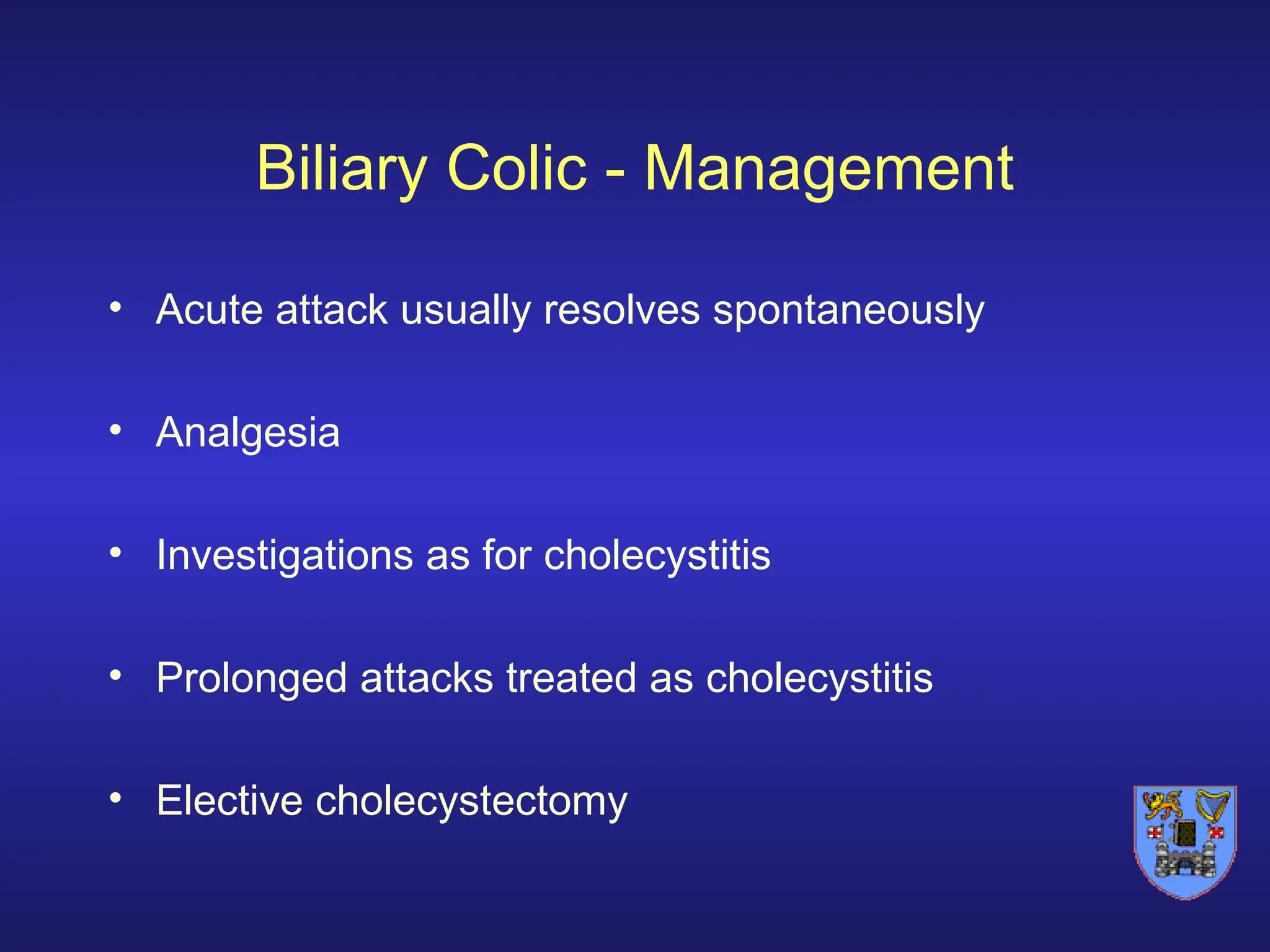
Biliary Colic - Management
• Acute attack usually resolves spontaneously
• Analgesia
• Investigations as for cholecystitis
• Prolonged attacks treated as cholecystitis
• Elective cholecystectomy
Ascending Cholangitis
• Charcots’ Triad
• Investigations
– FBC, LFT's, Amylase, US
• Management
– Resuscitation (IV fluids)
– Antibiotics (G-negative cover)
– Intensive monitoring (urometry)
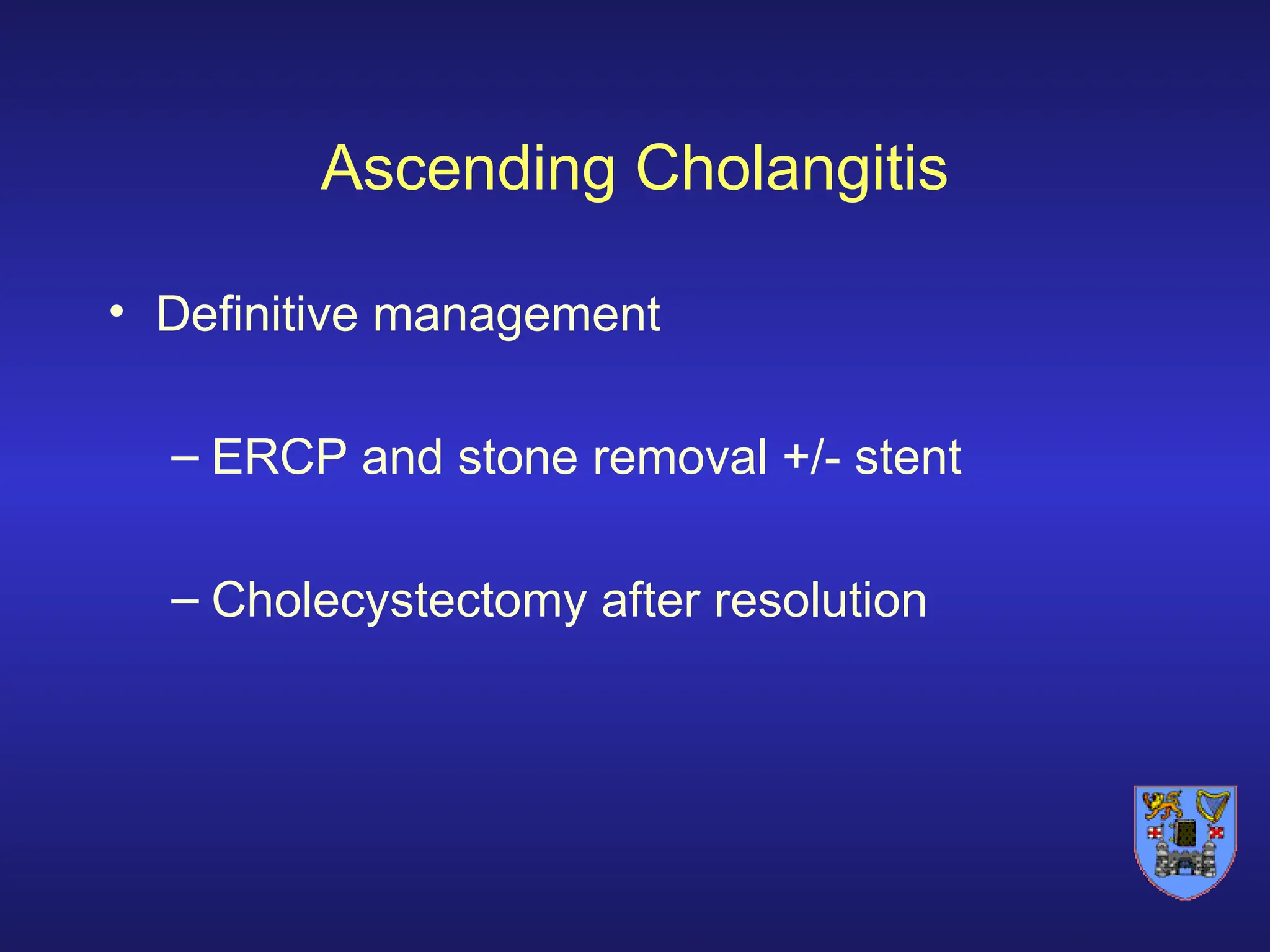
Ascending Cholangitis
• Definitive management
– ERCP and stone removal +/- stent
– Cholecystectomy after resolution
Gallstone Pancreatitis
• Commonest cause of Pancreatitis
• More severe than alcohol Pancreatitis
• Due to CBD stones irritating pancreas
– Obstruction at ampulla of Vater
– Irritation in pancreatic portion of CBD
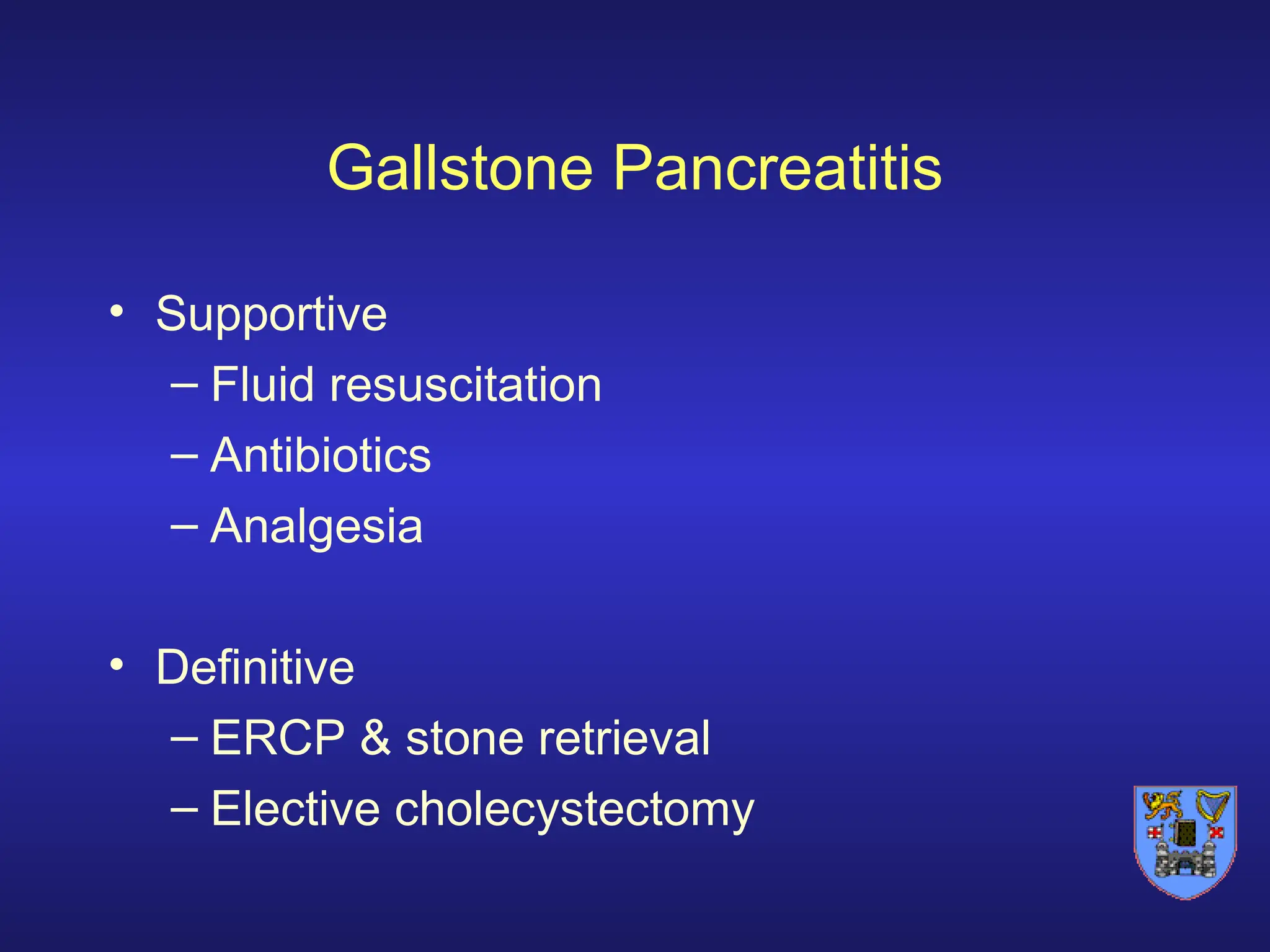
Gallstone Pancreatitis
• Supportive
– Fluid resuscitation
– Antibiotics
– Analgesia
• Definitive
– ERCP & stone retrieval
– Elective cholecystectomy
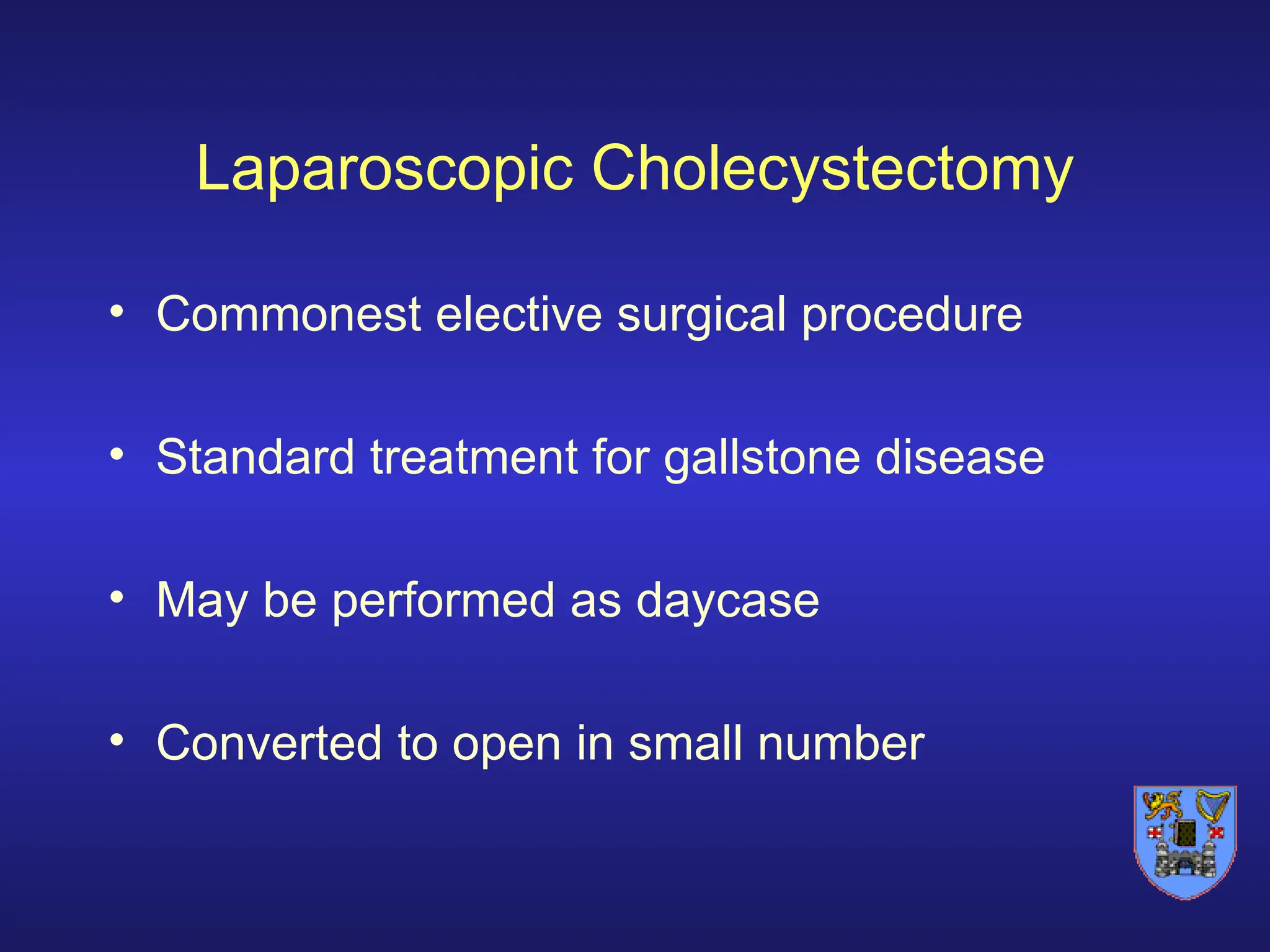
Laparoscopic Cholecystectomy
• Commonest elective surgical procedure
• Standard treatment for gallstone disease
• May be performed as daycase
• Converted to open in small number
Complications
• Trauma
• Common bile duct (CBD)
• Intestine
• Liver
• Haemorrhage
• Vessel injury
• Liver injury
• Cystic artery clips
• Infection
• Biliary peritonitis
Late Complications
• Post cholecystectomy syndrome
– Rare
– Pain
– Occasionally due to stones in the biliary tree
• Port site hernia
– Umbilical
– 10mm port sites
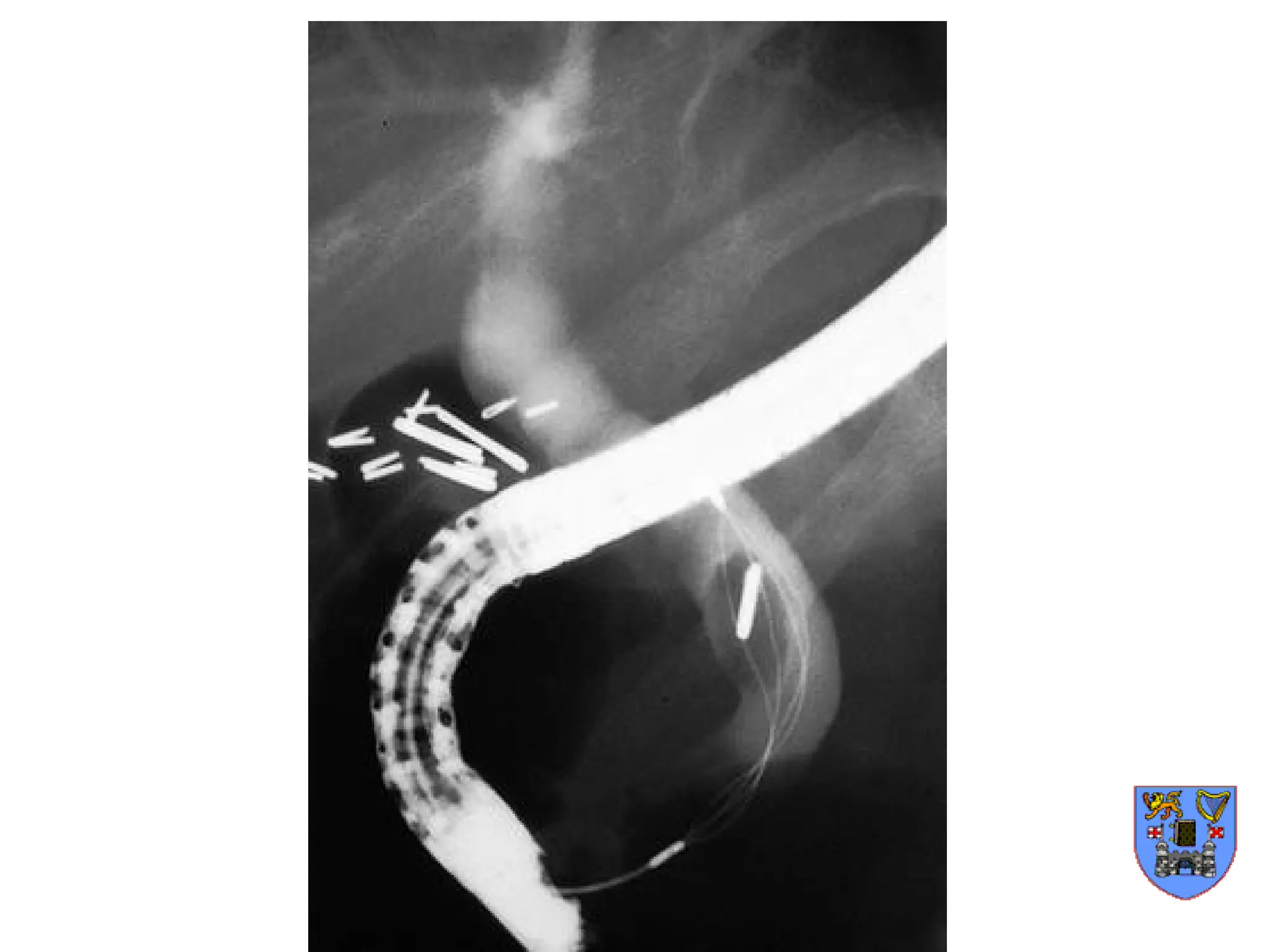
ERCP
Endoscopic Retrograde Cholangio Pancreato Graphy
• Usually performed by gastroenterologists
• Diagnostic and therapeutic
• Indicated in jaundiced patients
• Ampulla of Vater cannulated
• Demonstrates ductal anatomy
• Allows biopsy of malignant lesions
• Therapeutic in relieving obstruction
– Stone retrieval or Stenting
Summary
• Gallstones are common
• Usually asymptomatic
• Clinical manifestations
– Cholecystitis
– Biliary colic
• Complications
– Ascending cholangitis (Charcots' Triad)
• Treatment
– Laparoscopic cholecystectomy
– ERCP

Gallstones cholelithiasis, gall bladder .ppt

  • 1.
  • 2.
    Objectives • Basic biliaryanatomy and physiology • Pathophysiology of gallstone disease • Clinical manifestations of gallstone disease • Complications of gallstone disease • Investigation and management of gallstone disease
  • 3.
    Gallbladder Surface Anatomy •Lies in the right upper quadrant, under the costal margin at the level of the 9th costal cartilage • The level of the 9th costal cartilage can be palpated as a distinct notch
  • 10.
    Gallstones • Common (20%population) • Cholesterol stones in West • Female proponderance (3/1) • Risk factors – Obesity – Oestrogen – Hypercholesterolaemia – Increasing age – 5 F’s
  • 11.
    Clinical Manifestations • Asymptomatic •Cholecystitis • Biliary colic • Complications – Jaundice – Pancreatitis – Cholangitis – Gallstone ileus – Carcinoma of gallbladder
  • 12.
    Acute Cholecystitis • Acuteinflammation of the gallbladder • Usually associated with calculi (stones) – Calculus causes obstruction at Hartmann's pouch or cystic duct • Less commonly with biliary sludge • A-calculus (no-stone) cholecystitis rare • Bacterial infection in 50% only • Recurrent attacks result in fibrosed thickened gallbladder (chronic cholecystitis)
  • 13.
    Acute Cholecystitis ClinicalFeatures Pain • Sudden onset • Post-prandial • RUQ—around to back • Constant • Associated nausea and vomiting • May last several hours to days • Recurrent attacks common
  • 14.
    Acute Cholecystitis Signs • Pyrexia(37.5-38.5) • Associated jaundice signifies CBD blockage – CBD stone or Mirrizi’s Syndrome • Abdominal tenderness localized to RUQ • Murphys’ sign positive
  • 15.
    Murphys’ Sign • Inspiratoryarrest with manual pressure below the gallbladder
  • 16.
  • 17.
    Biliary Colic • Painassociated with passage of stone • Usually not colicky but constant (a misnomer) • As cholecystitis but not not associated with fever/ leucocytosis and positive Murphys’ sign • Usually resolves after minutes- few hours
  • 18.
    Complications • Empyema/ mucocele •Obstructive jaundice • Ascending cholangitis • Pancreatitis
  • 19.
    Charcots’ Triad- Ascendingcholangitis 1. Pain 2. Fever 3. Jaundice
  • 20.
    Courvoisiers’ Law In thepresence of jaundice a palpable gallbladder is most likely due to malignant obstruction of the bile duct • Based on presumption that patients with gallstones have chronically inflammed, fibrosed gallbladders incapable of distension • Does not always hold true e.g. – Empyema + CBD stone
  • 21.
    Acute Cholecystitis -Investigation • Bloods – FBC (WCC) – LFT’s (Bilirubin, GGT, Alk Phos) – Amylase • Imaging – CXR – Ultrasound – CT • Special tests
  • 22.
    Acute Cholcystitis –Special tests • Endoscopic Retrograde Cholecystogram (ERCP) – Diagnostic and therapeutic • Magnetic Resonance Imaging (MRC) • Other forms of Cholangiography – Intra-operative – Percutaneous Transhepatic (PTC) – Oral cholangiogram
  • 23.
    Acute Cholecystitis –Management • Restrict Oral intake (NPO) – Intravenous fluids – Ng tube aspiration (for vomiting) • Analgesia – Morphine • Intravenous antibiotics – Gram negative cover (co-amoxiclav—gentamicin—piperacillin) • Cholecystectomy after resolution
  • 24.
    Biliary Colic -Management • Acute attack usually resolves spontaneously • Analgesia • Investigations as for cholecystitis • Prolonged attacks treated as cholecystitis • Elective cholecystectomy
  • 25.
    Ascending Cholangitis • Charcots’Triad • Investigations – FBC, LFT's, Amylase, US • Management – Resuscitation (IV fluids) – Antibiotics (G-negative cover) – Intensive monitoring (urometry)
  • 26.
    Ascending Cholangitis • Definitivemanagement – ERCP and stone removal +/- stent – Cholecystectomy after resolution
  • 27.
    Gallstone Pancreatitis • Commonestcause of Pancreatitis • More severe than alcohol Pancreatitis • Due to CBD stones irritating pancreas – Obstruction at ampulla of Vater – Irritation in pancreatic portion of CBD
  • 28.
    Gallstone Pancreatitis • Supportive –Fluid resuscitation – Antibiotics – Analgesia • Definitive – ERCP & stone retrieval – Elective cholecystectomy
  • 29.
    Laparoscopic Cholecystectomy • Commonestelective surgical procedure • Standard treatment for gallstone disease • May be performed as daycase • Converted to open in small number
  • 30.
    Complications • Trauma • Commonbile duct (CBD) • Intestine • Liver • Haemorrhage • Vessel injury • Liver injury • Cystic artery clips • Infection • Biliary peritonitis
  • 31.
    Late Complications • Postcholecystectomy syndrome – Rare – Pain – Occasionally due to stones in the biliary tree • Port site hernia – Umbilical – 10mm port sites
  • 32.
    ERCP Endoscopic Retrograde CholangioPancreato Graphy • Usually performed by gastroenterologists • Diagnostic and therapeutic • Indicated in jaundiced patients • Ampulla of Vater cannulated • Demonstrates ductal anatomy • Allows biopsy of malignant lesions • Therapeutic in relieving obstruction – Stone retrieval or Stenting
  • 34.
    Summary • Gallstones arecommon • Usually asymptomatic • Clinical manifestations – Cholecystitis – Biliary colic • Complications – Ascending cholangitis (Charcots' Triad) • Treatment – Laparoscopic cholecystectomy – ERCP