IOSR Journal of Mathematics (IOSR-JM)
e-ISSN: 2278-5728,p-ISSN: 2319-765X, Volume 6, Issue 4 (May. - Jun. 2013), PP 35-42
www.iosrjournals.org
www.iosrjournals.org 35 | Page
Cordial Labelling Of K-Regular Bipartite Graphs for K = 1, 2,
N, N-1 Where K Is Cardinality of Each Bipartition
Pranali Sapre
JJT University, Jhunjhunu, Rajasthan, India
Assistant Professor,Vidyavardhini‟s College of Engineering & Technology
Vasai Road Dist. Thane. Maharashtra
Abstract: In the labelling of graphs one of the types is cordial labelling. In this we label the vertices 0 or 1 and
then every edge will have a label 0 or 1 if the end vertices of the edge have same or different labellings
respectively. Here we are going find whether a k-regular bipartite graph can be cordial for different values of k.
I. Introduction :
 Regular graph: A graph G is said to be a regular graph if degree of each vertex a same. It is called k-regular
if degree of each vertex is k.
 Bipartite graph: Let G be a graph. If the vertex of G is divided into two subsets A and B such that there is
no edge „ab‟ with BbaorAba  ,, then G is said to be bipartite that is, Every edge of G joins a
vertex in A to a vertex in B.
The sets A and B are called partite sets of G.
 Complete graph: A graph in which every vertex is adjacent to every other vertex is a complete graph. For a
complete graph on n vertices degree of each vertex is n-1.
 Complete bipartite graph: A bipartite graph G with bipartition ( A,B ) is said to be complete bipartite if
every vertex in A is adjacent to every vertex in B and vice versa.
 Cycle: A closed path is called a cycle.
 Labelling of a graph:
Vertex labelling :It is a mapping from set of vertices to set of natural numbers .
Edge labelling :It is a mapping from set of edges to set of natural numbers .
 Cordial labelling: For a given graph G label the vertices of G „0‟ or „1‟. And every edge ''ab of G will be
labeled as „0‟ if the labeling of the vertices „a‟ and „b‟ are same and will be labeled as „1‟ if the labeling of
the vertices „a‟ and „b‟ are different. Then this labeling is called a “cordial labeling” or the graph G is called
a “cordial graph” iff,
1'1''0'
1'1''0'


labelededgesofnumberlabelededgesofnumber
labeledvertivesofnumberlabeledverticesofnumber
Theorem 1. If G is a 1- regular bipartite graph with partite sets A and B with | A | = | B | = n Then
G is cordial iff n = 0, 1, 3 mod 4.
Case I. n = 4m
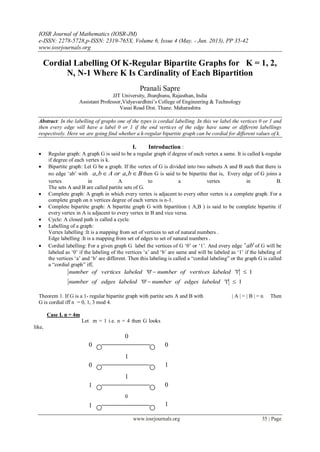
Let m = 1 i.e. n = 4 then G looks
like,
1
0
0
1
0
0
0
1
1
0
1
0
1
0
1
Cordial labeling of k-regular bipartite graphs for k = 1, 2, n, n-1 where k is cardinality of
www.iosrjournals.org 36 | Page
This can be labeled as shown is figure. This is CORDIAL.
Now for n = 4m for m > 1 „G‟ can be considered as combination of graph shown above and hence can be
labeled repeatedly as above which is CORDIAL.
Hence,
G IS CORDIAL FOR n = 4m
Case II. n = 4m + 1
Consider Zmformn  14
Consider any edge „uv‟ E ( G ), for BvAu  ,
Then G – {uv} is a bipartite graph with n = 4m. Hence it has a cordial labeling as given in case ( i ) which
gives,
| # of edges labeled „0‟- # of edges labeled „1‟| = 0 hence along with the same labeling if we label “u” as „0‟
and “v” as „1‟ we get,
| # of vertices labeled „0‟- # of vertices labeled „1‟| = 0 and
| # of edges labeled „0‟- # of edges labeled „1‟| = 1
Hence it is cordial.
G IS CORDIAL FOR n = 4m+1
Case III. Let n = 4m + 2
Consider Zmformn  24
|A| = |B|= 4m+2
Assume G is cordial.
Let 0 be the number of vertices in A labeled „0‟
Let 1 be the number of vertices in A labeled „1‟
Let 0 be the number of vertices in B labeled „0‟
Let 1 be the number of vertices in B labeled „1‟
Total number of edges „ab‟ where „a‟ is labeled 0 and Bb = 0
Total number of edges „ab‟ where „b‟ is labeled 0 and Aa  = 0 -------*
Total number of edges „ab‟ where „a‟ is labeled 1 and Bb = 1
Total number of edges „ab‟ where „b‟ is labeled 1 and Aa  = 1
Let number of edges of type 0 – 0 ( i.e. edge „ab‟ where „a‟ and „b‟ both are labeled „0‟) be „x‟
And Let number of edges of type 1 – 1 be „y‟
From *
Number of edges of type 0 – 1 and 1 – 0 are, x200  
Number of edges of type 0 – 1 and 1 – 0 are, y211  
 x200   = y211  
But 1100   By assumption G is cordial
 x = y
But total number of edges = 4m+2
Number of edges labeled „0‟ = Number of edges labeled „1‟ G is cordial
 x + y = 2m+1
Cordial labeling of k-regular bipartite graphs for k = 1, 2, n, n-1 where k is cardinality of
www.iosrjournals.org 37 | Page

2
1
2
1
 myandmx
Contradiction.
Hence „G‟ is not cordial for n=4m+2
G IS NOT CORDIAL FOR n = 4m+2
Case IV Let n = 4m + 3
Consider Zmformn  34
|A| = |B|= 4m+3
Let „G‟ be a graph n = 4m+3
Consider any three edges ),(),,(),,( 332211 vuvuvu with BvandAu ii  for i =1,2,3
Then G - 332211 ,,,,, vuvuvu is a graph with n = 4m
By case i it has a cordial labeling with
| # of vertices labeled „0‟- # of vertices labeled „1‟| = 0 and
| # of edges labeled „0‟- # of edges labeled „1‟| = 0
Along with the same labeling label 332211 ,,,,, vuvuvu as follows,
1,1,1,,, 332211 asvasuasvoasuoasvoasu
Then number of vertices labeled 0 = Then number of vertices labeled 1
And labeling of 0),(,1),(,0),( 332211 isvuisvuisvu
Then number of vertices labeled 0 = Then number of vertices labeled „1‟+1
| # of vertices labeled „0‟- # of vertices labeled „1‟| = 0 and
| # of edges labeled „0‟- # of edges labeled „1‟| = 1
‟G‟ is cordial
G IS CORDIAL FOR n = 4m+3
Hence the result.
Theorem 2. If G is a 2- regular bipartite graph with partite sets A and B with | A | = | B | = n
Then G is cordial iff every component of G can be written as cycle of length 4m
Let „G‟ be a bipartite regular graph of degree „2‟.
We know that, “ If „G‟ is a regular bipartite graph of degree „2‟ then it can always be written as disjoint union of
even cycles.
Let „G‟ be the graph which is the cycle of length „2n‟
Claim : Cycle of length 2n is cordial iff n is even.
Part (a) : To prove: n is even G is cordial.
Part (b) : To prove: G is cordial  n is even.
i.e. To prove: n is odd G is not cordial.
Proof of (a): Consider a cycle of length m = 2n where n is even.
Let n = 2p m = 4p
Let ,1,4,5,4,3,2,1 ...... aaaaaaa p be the given cycle where ,ia is adjacent to ,1ia
For 14..........3,2,1  pi and ,4 pa is adjacent to ,1a
Cordial labeling of k-regular bipartite graphs for k = 1, 2, n, n-1 where k is cardinality of
www.iosrjournals.org 38 | Page
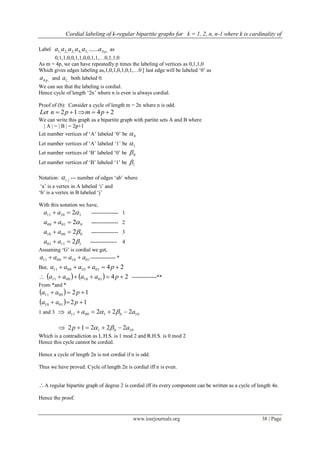
Label ,4,5,4,3,2,1 ...... paaaaaa as
0,1,1,0,0,1,1,0,0,1,1,…0,1,1,0
As m = 4p, we can have repeatedly p times the labeling of vertices as 0,1,1,0
Which gives edges labeling as,1,0,1,0,1,0,1,…0 [ last edge will be labeled „0‟ as
,4 pa and ,1a both labeled 0.
We can see that the labeling is cordial.
Hence cycle of length „2n‟ where n is even is always cordial.
Proof of (b): Consider a cycle of length m = 2n where n is odd.
2412  pmpnLet
We can write this graph as a bipartite graph with partite sets A and B where
| A | = | B | = 2p+1
Let number vertices of „A‟ labeled „0‟ be 0
Let number vertices of „A‟ labeled „1‟ be 1
Let number vertices of „B‟ labeled „0‟ be 0
Let number vertices of „B‟ labeled „1‟ be 1
Notation: ji --- number of edges „ab‟ where
„a‟ is a vertex in A labeled „i‟ and
„b‟ is a vertex in B labeled „j‟
With this notation we have,
11011 2 aa --------------- 1
00100 2 aa --------------- 2
00010 2 aa --------------- 3
11101 2 aa --------------- 4
Assuming „G‟ is cordial we get,
01100011 aaaa  -------------- *
But, 2401100011  paaaa
     2401100011  paaaa --------------**
From *and *
 
  12
12
0110
0011


paa
paa
1 and 3  10010011 222 aaa  
 1001 22212 ap  
Which is a contradiction as L.H.S. is 1 mod 2 and R.H.S. is 0 mod 2
Hence this cycle cannot be cordial.
Hence a cycle of length 2n is not cordial if n is odd.
Thus we have proved: Cycle of length 2n is cordial iff n is even.
A regular bipartite graph of degree 2 is cordial iff its every component can be written as a cycle of length 4n.
Hence the proof.
Cordial labeling of k-regular bipartite graphs for k = 1, 2, n, n-1 where k is cardinality of
www.iosrjournals.org 39 | Page
Theorem 3. If G is a n- regular bipartite graph with partite sets A and B with | A | = | B | = n
Then G is cordial
Let
},...,{
},...,{
21
21
n
n
bbbB
aaaA


Case I : n is even
Let n = 2m
Label naaa ,..., 21 as „0‟ and mmm aaa 221 ,...,  as „1‟.
For set B label any „m‟ vertices as „0‟ any „m‟ as „1‟
W.l.g. let nbbb ,..., 21 are „0‟ and mmm bbb 221 ,...,  are „1‟
For the vertex 1a :The edges incident on 1a are,
,212111,12111 ,...,,..., mmmm babababababa  out of which,
mbababa 12111 ,..., are labeled „0‟ and ,212111 ,..., mmm bababa  are labeled „1‟.
Which gives equal number of edges labeled 0 and 1 each equal to „m‟
Similarly for remaining vertices.
Hence we have in all
2
2m edges labeled o and
2
2m edges labeled 1.
 | # of edges labeled „0‟- # of edges labeled „1‟| = 1
‟G‟ is cordial
Case II : n is odd
Let n = 2m+1
Consider A – { u } and B – { v } for some uv  V (G)
Then by case ( i ) it has a cordial labeling with
2
2m edges labeled 0 and
2
2m edges labeled 1
Now label u as 0 and v as 1
As it is complete bipartite we have edges,
uvubububububub mmmm ,,...,,,..., 22121  which are labeled as
0, 0, … 0, 1, 1, …. 1, 1 respectively giving m edges labeled 0 and m+1 edges labeled 1.
Also, vavavavavava mmmm 22121 ,....,,,...,,  which are labeled as
1, 1,… 1, 0, 0, …. 0 respectively giving m edges labeled 0 and m edges labeled 1.
In all we get, Number of edges labeled 0 = mm 22 2
 and
Number of edges labeled 1 = 122 2
 mm
| # of edges labeled „0‟- # of edges labeled „1‟| = 1
‟G‟ is cordial
Hence the proof.
Theorem 4. If G is a n- regular bipartite graph with partite sets A and B with | A | = | B | = n
Then G is cordial iff n = 0, 1 mod 4.
Case ( i ) : n = 4m
Let A = { 1a , },...,2 naa and B ={ },..., 21 nbbb
And G is a (k-1) bipartite graph with partite sets A,B.
It can be obtained by removing one and only one edge of every vertex of a complete graph.
Label maaa 221 ,..., as 0 and mmm aaa 42212 ,...,  as 1
Then we can have „G‟ is a graph obtained by removing
mimii bababa 421 421 ,.....,, where kjii iiforbb kj
 from the complete bipartite graph.
We will rename the vertices in the set „B‟ such that the edges removes are,
mmbababa 442211 ,...,
Cordial labeling of k-regular bipartite graphs for k = 1, 2, n, n-1 where k is cardinality of
www.iosrjournals.org 40 | Page
Now label mbbb 421 ,..., as,
mbbb ,..., 21 as „0‟ , mmm bbb 221 ,...,  as „1‟ , mmm bbb 32212 ,...,  as „0‟ , mmm bbb 42313 ,...,  as „1‟ ,
Then the edges removed from the complete graph are labeled as,
mmbababa ,..., 2211 ________ 0,0,…0 ______ total „m‟ edges
mmmmmm bababa 222211 ,...,  ________ 1,1,…1 ______ total „m‟ edges
mmmmmm bababa 3322221212 ,...,  ________ 0,0,…0 ______ total „m‟ edges
mmmmmm bababa 4423231313 ,...,  ________ 1,1,…1 ______ total „m‟ edges
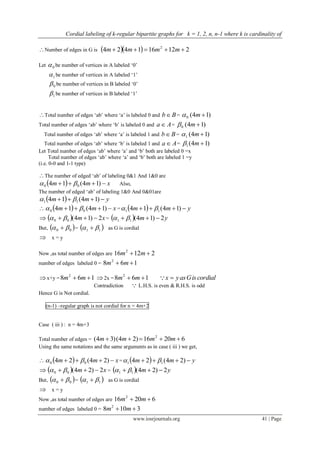
 For „G‟ Number of vertices labeled 0= number of vertices labeled 1= 4m
And Number of edges labeled 0= number of edges labeled 1= mm 28 2

( from the case k = n )
| # of vertices labeled „0‟- # of vertices labeled „1‟| = 0
and
| # of edges labeled „0‟- # of edges labeled „1‟| = 0
‟G‟ is cordial
Case ( ii ) : n = 4m+1
As G is a (n-1)-regular bipartite graph , with the partitions A and B
Where A = { 1a , },...,2 naa and B ={ },..., 21 nbbb
By case ( i ) with the similar arguments let G is obtained from the complete bipartite graph by deleting the edges,
1414442211 ,,...,  mmmm babababa Where,
12221 ,,..., mm aaaa are labeled as 0 and 142222 ,...,  mmm aaa as 1.
Now label the vertices of B as follows.
mbbb ,..., 21 as „0‟ , 12221 ,,...,  mmmm bbbb as „1‟ , 132222 ,...,  mmm bbb as „0‟ , 142323 ,...,  mmm bbb
as „1‟ ,
The edges removed from the complete graph and there labelings are as follows :
mmbababa ,..., 2211 ________ 0,0,…0 ______ total „m‟ edges
1212222211 ,,...,  mmmmmmmm babababa _______ 1,1,…1 ______ total „m+1‟ edges
131332322222 ,..,,  mmmmmm bababa ________ 1,1,…1 ______ total „m‟ edges
141433332323 ,...,  mmmmmm bababa ________ 0,0,…0 ______ total „m‟ edges
Number of edges labeled 1 are
 
mm
mmmm
28
1148
2
2


Number of edges labeled 0 are
mm
mmmm
28
48
2
2


Number of edges labeled 1= Number of edges labeled 0
Hence G is cordial.
(n-1) –regular graph is cordial for n = 4m+1
Case ( iii ) : n = 4m+2
As G is a (n-1)-regular bipartite graph, with the partitions A and B
Where A = { 1a , },...,2 naa and B ={ },..., 21 nbbb
Cordial labeling of k-regular bipartite graphs for k = 1, 2, n, n-1 where k is cardinality of
www.iosrjournals.org 41 | Page
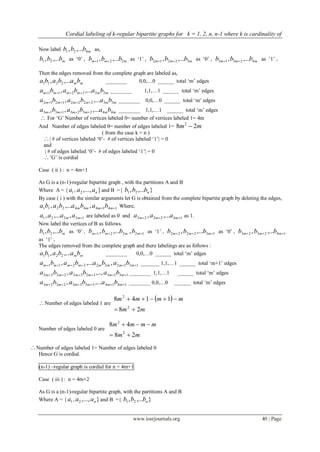
Number of edges in G is    212161424 2
 mmmm
Let 0 be number of vertices in A labeled „0‟
1 be number of vertices in A labeled „1‟
0 be number of vertices in B labeled „0‟
1 be number of vertices in B labeled „1‟
Total number of edges „ab‟ where „a‟ is labeled 0 and Bb = )14(0 m
Total number of edges „ab‟ where „b‟ is labeled 0 and Aa  = )14(0 m
Total number of edges „ab‟ where „a‟ is labeled 1 and Bb = )14(1 m
Total number of edges „ab‟ where „b‟ is labeled 1 and Aa  = )14(1 m
Let Total number of edges „ab‟ where „a‟ and „b‟ both are labeled 0 =x
Total number of edges „ab‟ where „a‟ and „b‟ both are labeled 1 =y
(i.e. 0-0 and 1-1 type)
The number of edged „ab‟ of labeling 0&1 And 1&0 are
  xmm  )14(14 00  Also,
The number of edged „ab‟ of labeling 1&0 And 0&01are
  ymm  )14(14 11 
   xmm  )14(14 00  =   ymm  )14(14 11 
   xm 2)14(00   =   ym 2)14(11  
But,  00   =  11   as G is cordial
 x = y
Now ,as total number of edges are 21216 2
 mm
number of edges labeled 0 = 168 2
 mm
x+y = 168 2
 mm 2x = 168 2
 mm cordialisGasyx 
Contradiction  L.H.S. is even & R.H.S. is odd
Hence G is Not cordial.
(n-1) –regular graph is not cordial for n = 4m+2
Case ( iii ) : n = 4m+3
Total number of edges = 62016)24()34( 2
 mmmm
Using the same notations and the same arguments as in case ( iii ) we get,
   xmm  )24(24 00  =   ymm  )24(24 11 
   xm 2)24(00   =   ym 2)24(11  
But,  00   =  11   as G is cordial
 x = y
Now ,as total number of edges are 62016 2
 mm
number of edges labeled 0 = 3108 2
 mm
Cordial labeling of k-regular bipartite graphs for k = 1, 2, n, n-1 where k is cardinality of
www.iosrjournals.org 42 | Page
x+y = 3108 2
 mm
2x = 3108 2
 mm cordialisGasyx 
Contradiction  L.H.S. is even & R.H.S. is odd
Hence G is NOT cordial
(n-1) –regular graph is not cordial for n = 4m+3
Hence the proof.
II. Conclusion
 If G is a 1-regular bipartite graph with partite sets „A‟ and „B‟ such that | A | = | B | = n then „G‟ is cordial
iff n = 0 , 1 , 3 mod 4
 If G is a 2-regular bipartite graph with partite sets „A‟ and „B‟ such that | A | = | B | = n then „G‟ is cordial
iff its every component is a cycle of length 4m.
 If G is a n-regular 3n bipartite graph with partite sets „A‟ and „B‟ such that | A | = | B | = n then „G‟ is
cordial .
 If G is a 1n -regular bipartite graph with partite sets „A‟ and „B‟ such that | A | = | B | = n then „G‟ is
cordial iff .4mod1,0n
References
[1] L.CAI,X.ZHU, (2001), “Gaming coloring index of graphs”, Journal of graph theory, 36, 144-155
[2] XUDING ZHU, (1999), “The game coloring number of planar graphs”, Journal of Combinatorial Theory Series B, 75, 245-258
[3] H. YEH, XUDING ZHUING, (2003), “4-colorable, 6-regular toroidal graphs”, Discrete Mathematics, 273, 1-3,261-274
[4] X.ZHU, (2006), “Recent development in circular coloring of graphs”, Topics in discrete mathematics, spinger 5, 497-550
[5] H.CHANG, X.ZHU, (2008), “Coloring games on outerplanar graphs & trees”, Discrete mathematics,doi10.1016/j.disc, 9-15
[6] H. HAJIABLOHASSAN, X. ZHU, (2003),: The circular chromatic number and mycielski construction”, Journal of graph
theory,404, 106-115

Cordial Labelling Of K-Regular Bipartite Graphs for K = 1, 2, N, N-1 Where K Is Cardinality of Each Bipartition

  • 1.
    IOSR Journal ofMathematics (IOSR-JM) e-ISSN: 2278-5728,p-ISSN: 2319-765X, Volume 6, Issue 4 (May. - Jun. 2013), PP 35-42 www.iosrjournals.org www.iosrjournals.org 35 | Page Cordial Labelling Of K-Regular Bipartite Graphs for K = 1, 2, N, N-1 Where K Is Cardinality of Each Bipartition Pranali Sapre JJT University, Jhunjhunu, Rajasthan, India Assistant Professor,Vidyavardhini‟s College of Engineering & Technology Vasai Road Dist. Thane. Maharashtra Abstract: In the labelling of graphs one of the types is cordial labelling. In this we label the vertices 0 or 1 and then every edge will have a label 0 or 1 if the end vertices of the edge have same or different labellings respectively. Here we are going find whether a k-regular bipartite graph can be cordial for different values of k. I. Introduction :  Regular graph: A graph G is said to be a regular graph if degree of each vertex a same. It is called k-regular if degree of each vertex is k.  Bipartite graph: Let G be a graph. If the vertex of G is divided into two subsets A and B such that there is no edge „ab‟ with BbaorAba  ,, then G is said to be bipartite that is, Every edge of G joins a vertex in A to a vertex in B. The sets A and B are called partite sets of G.  Complete graph: A graph in which every vertex is adjacent to every other vertex is a complete graph. For a complete graph on n vertices degree of each vertex is n-1.  Complete bipartite graph: A bipartite graph G with bipartition ( A,B ) is said to be complete bipartite if every vertex in A is adjacent to every vertex in B and vice versa.  Cycle: A closed path is called a cycle.  Labelling of a graph: Vertex labelling :It is a mapping from set of vertices to set of natural numbers . Edge labelling :It is a mapping from set of edges to set of natural numbers .  Cordial labelling: For a given graph G label the vertices of G „0‟ or „1‟. And every edge ''ab of G will be labeled as „0‟ if the labeling of the vertices „a‟ and „b‟ are same and will be labeled as „1‟ if the labeling of the vertices „a‟ and „b‟ are different. Then this labeling is called a “cordial labeling” or the graph G is called a “cordial graph” iff, 1'1''0' 1'1''0'   labelededgesofnumberlabelededgesofnumber labeledvertivesofnumberlabeledverticesofnumber Theorem 1. If G is a 1- regular bipartite graph with partite sets A and B with | A | = | B | = n Then G is cordial iff n = 0, 1, 3 mod 4. Case I. n = 4m Let m = 1 i.e. n = 4 then G looks like, 1 0 0 1 0 0 0 1 1 0 1 0 1 0 1
  • 2.
    Cordial labeling ofk-regular bipartite graphs for k = 1, 2, n, n-1 where k is cardinality of www.iosrjournals.org 36 | Page This can be labeled as shown is figure. This is CORDIAL. Now for n = 4m for m > 1 „G‟ can be considered as combination of graph shown above and hence can be labeled repeatedly as above which is CORDIAL. Hence, G IS CORDIAL FOR n = 4m Case II. n = 4m + 1 Consider Zmformn  14 Consider any edge „uv‟ E ( G ), for BvAu  , Then G – {uv} is a bipartite graph with n = 4m. Hence it has a cordial labeling as given in case ( i ) which gives, | # of edges labeled „0‟- # of edges labeled „1‟| = 0 hence along with the same labeling if we label “u” as „0‟ and “v” as „1‟ we get, | # of vertices labeled „0‟- # of vertices labeled „1‟| = 0 and | # of edges labeled „0‟- # of edges labeled „1‟| = 1 Hence it is cordial. G IS CORDIAL FOR n = 4m+1 Case III. Let n = 4m + 2 Consider Zmformn  24 |A| = |B|= 4m+2 Assume G is cordial. Let 0 be the number of vertices in A labeled „0‟ Let 1 be the number of vertices in A labeled „1‟ Let 0 be the number of vertices in B labeled „0‟ Let 1 be the number of vertices in B labeled „1‟ Total number of edges „ab‟ where „a‟ is labeled 0 and Bb = 0 Total number of edges „ab‟ where „b‟ is labeled 0 and Aa  = 0 -------* Total number of edges „ab‟ where „a‟ is labeled 1 and Bb = 1 Total number of edges „ab‟ where „b‟ is labeled 1 and Aa  = 1 Let number of edges of type 0 – 0 ( i.e. edge „ab‟ where „a‟ and „b‟ both are labeled „0‟) be „x‟ And Let number of edges of type 1 – 1 be „y‟ From * Number of edges of type 0 – 1 and 1 – 0 are, x200   Number of edges of type 0 – 1 and 1 – 0 are, y211    x200   = y211   But 1100   By assumption G is cordial  x = y But total number of edges = 4m+2 Number of edges labeled „0‟ = Number of edges labeled „1‟ G is cordial  x + y = 2m+1
  • 3.
    Cordial labeling ofk-regular bipartite graphs for k = 1, 2, n, n-1 where k is cardinality of www.iosrjournals.org 37 | Page  2 1 2 1  myandmx Contradiction. Hence „G‟ is not cordial for n=4m+2 G IS NOT CORDIAL FOR n = 4m+2 Case IV Let n = 4m + 3 Consider Zmformn  34 |A| = |B|= 4m+3 Let „G‟ be a graph n = 4m+3 Consider any three edges ),(),,(),,( 332211 vuvuvu with BvandAu ii  for i =1,2,3 Then G - 332211 ,,,,, vuvuvu is a graph with n = 4m By case i it has a cordial labeling with | # of vertices labeled „0‟- # of vertices labeled „1‟| = 0 and | # of edges labeled „0‟- # of edges labeled „1‟| = 0 Along with the same labeling label 332211 ,,,,, vuvuvu as follows, 1,1,1,,, 332211 asvasuasvoasuoasvoasu Then number of vertices labeled 0 = Then number of vertices labeled 1 And labeling of 0),(,1),(,0),( 332211 isvuisvuisvu Then number of vertices labeled 0 = Then number of vertices labeled „1‟+1 | # of vertices labeled „0‟- # of vertices labeled „1‟| = 0 and | # of edges labeled „0‟- # of edges labeled „1‟| = 1 ‟G‟ is cordial G IS CORDIAL FOR n = 4m+3 Hence the result. Theorem 2. If G is a 2- regular bipartite graph with partite sets A and B with | A | = | B | = n Then G is cordial iff every component of G can be written as cycle of length 4m Let „G‟ be a bipartite regular graph of degree „2‟. We know that, “ If „G‟ is a regular bipartite graph of degree „2‟ then it can always be written as disjoint union of even cycles. Let „G‟ be the graph which is the cycle of length „2n‟ Claim : Cycle of length 2n is cordial iff n is even. Part (a) : To prove: n is even G is cordial. Part (b) : To prove: G is cordial  n is even. i.e. To prove: n is odd G is not cordial. Proof of (a): Consider a cycle of length m = 2n where n is even. Let n = 2p m = 4p Let ,1,4,5,4,3,2,1 ...... aaaaaaa p be the given cycle where ,ia is adjacent to ,1ia For 14..........3,2,1  pi and ,4 pa is adjacent to ,1a
  • 4.
    Cordial labeling ofk-regular bipartite graphs for k = 1, 2, n, n-1 where k is cardinality of www.iosrjournals.org 38 | Page Label ,4,5,4,3,2,1 ...... paaaaaa as 0,1,1,0,0,1,1,0,0,1,1,…0,1,1,0 As m = 4p, we can have repeatedly p times the labeling of vertices as 0,1,1,0 Which gives edges labeling as,1,0,1,0,1,0,1,…0 [ last edge will be labeled „0‟ as ,4 pa and ,1a both labeled 0. We can see that the labeling is cordial. Hence cycle of length „2n‟ where n is even is always cordial. Proof of (b): Consider a cycle of length m = 2n where n is odd. 2412  pmpnLet We can write this graph as a bipartite graph with partite sets A and B where | A | = | B | = 2p+1 Let number vertices of „A‟ labeled „0‟ be 0 Let number vertices of „A‟ labeled „1‟ be 1 Let number vertices of „B‟ labeled „0‟ be 0 Let number vertices of „B‟ labeled „1‟ be 1 Notation: ji --- number of edges „ab‟ where „a‟ is a vertex in A labeled „i‟ and „b‟ is a vertex in B labeled „j‟ With this notation we have, 11011 2 aa --------------- 1 00100 2 aa --------------- 2 00010 2 aa --------------- 3 11101 2 aa --------------- 4 Assuming „G‟ is cordial we get, 01100011 aaaa  -------------- * But, 2401100011  paaaa      2401100011  paaaa --------------** From *and *     12 12 0110 0011   paa paa 1 and 3  10010011 222 aaa    1001 22212 ap   Which is a contradiction as L.H.S. is 1 mod 2 and R.H.S. is 0 mod 2 Hence this cycle cannot be cordial. Hence a cycle of length 2n is not cordial if n is odd. Thus we have proved: Cycle of length 2n is cordial iff n is even. A regular bipartite graph of degree 2 is cordial iff its every component can be written as a cycle of length 4n. Hence the proof.
  • 5.
    Cordial labeling ofk-regular bipartite graphs for k = 1, 2, n, n-1 where k is cardinality of www.iosrjournals.org 39 | Page Theorem 3. If G is a n- regular bipartite graph with partite sets A and B with | A | = | B | = n Then G is cordial Let },...,{ },...,{ 21 21 n n bbbB aaaA   Case I : n is even Let n = 2m Label naaa ,..., 21 as „0‟ and mmm aaa 221 ,...,  as „1‟. For set B label any „m‟ vertices as „0‟ any „m‟ as „1‟ W.l.g. let nbbb ,..., 21 are „0‟ and mmm bbb 221 ,...,  are „1‟ For the vertex 1a :The edges incident on 1a are, ,212111,12111 ,...,,..., mmmm babababababa  out of which, mbababa 12111 ,..., are labeled „0‟ and ,212111 ,..., mmm bababa  are labeled „1‟. Which gives equal number of edges labeled 0 and 1 each equal to „m‟ Similarly for remaining vertices. Hence we have in all 2 2m edges labeled o and 2 2m edges labeled 1.  | # of edges labeled „0‟- # of edges labeled „1‟| = 1 ‟G‟ is cordial Case II : n is odd Let n = 2m+1 Consider A – { u } and B – { v } for some uv  V (G) Then by case ( i ) it has a cordial labeling with 2 2m edges labeled 0 and 2 2m edges labeled 1 Now label u as 0 and v as 1 As it is complete bipartite we have edges, uvubububububub mmmm ,,...,,,..., 22121  which are labeled as 0, 0, … 0, 1, 1, …. 1, 1 respectively giving m edges labeled 0 and m+1 edges labeled 1. Also, vavavavavava mmmm 22121 ,....,,,...,,  which are labeled as 1, 1,… 1, 0, 0, …. 0 respectively giving m edges labeled 0 and m edges labeled 1. In all we get, Number of edges labeled 0 = mm 22 2  and Number of edges labeled 1 = 122 2  mm | # of edges labeled „0‟- # of edges labeled „1‟| = 1 ‟G‟ is cordial Hence the proof. Theorem 4. If G is a n- regular bipartite graph with partite sets A and B with | A | = | B | = n Then G is cordial iff n = 0, 1 mod 4. Case ( i ) : n = 4m Let A = { 1a , },...,2 naa and B ={ },..., 21 nbbb And G is a (k-1) bipartite graph with partite sets A,B. It can be obtained by removing one and only one edge of every vertex of a complete graph. Label maaa 221 ,..., as 0 and mmm aaa 42212 ,...,  as 1 Then we can have „G‟ is a graph obtained by removing mimii bababa 421 421 ,.....,, where kjii iiforbb kj  from the complete bipartite graph. We will rename the vertices in the set „B‟ such that the edges removes are, mmbababa 442211 ,...,
  • 6.
    Cordial labeling ofk-regular bipartite graphs for k = 1, 2, n, n-1 where k is cardinality of www.iosrjournals.org 40 | Page Now label mbbb 421 ,..., as, mbbb ,..., 21 as „0‟ , mmm bbb 221 ,...,  as „1‟ , mmm bbb 32212 ,...,  as „0‟ , mmm bbb 42313 ,...,  as „1‟ , Then the edges removed from the complete graph are labeled as, mmbababa ,..., 2211 ________ 0,0,…0 ______ total „m‟ edges mmmmmm bababa 222211 ,...,  ________ 1,1,…1 ______ total „m‟ edges mmmmmm bababa 3322221212 ,...,  ________ 0,0,…0 ______ total „m‟ edges mmmmmm bababa 4423231313 ,...,  ________ 1,1,…1 ______ total „m‟ edges  For „G‟ Number of vertices labeled 0= number of vertices labeled 1= 4m And Number of edges labeled 0= number of edges labeled 1= mm 28 2  ( from the case k = n ) | # of vertices labeled „0‟- # of vertices labeled „1‟| = 0 and | # of edges labeled „0‟- # of edges labeled „1‟| = 0 ‟G‟ is cordial Case ( ii ) : n = 4m+1 As G is a (n-1)-regular bipartite graph , with the partitions A and B Where A = { 1a , },...,2 naa and B ={ },..., 21 nbbb By case ( i ) with the similar arguments let G is obtained from the complete bipartite graph by deleting the edges, 1414442211 ,,...,  mmmm babababa Where, 12221 ,,..., mm aaaa are labeled as 0 and 142222 ,...,  mmm aaa as 1. Now label the vertices of B as follows. mbbb ,..., 21 as „0‟ , 12221 ,,...,  mmmm bbbb as „1‟ , 132222 ,...,  mmm bbb as „0‟ , 142323 ,...,  mmm bbb as „1‟ , The edges removed from the complete graph and there labelings are as follows : mmbababa ,..., 2211 ________ 0,0,…0 ______ total „m‟ edges 1212222211 ,,...,  mmmmmmmm babababa _______ 1,1,…1 ______ total „m+1‟ edges 131332322222 ,..,,  mmmmmm bababa ________ 1,1,…1 ______ total „m‟ edges 141433332323 ,...,  mmmmmm bababa ________ 0,0,…0 ______ total „m‟ edges Number of edges labeled 1 are   mm mmmm 28 1148 2 2   Number of edges labeled 0 are mm mmmm 28 48 2 2   Number of edges labeled 1= Number of edges labeled 0 Hence G is cordial. (n-1) –regular graph is cordial for n = 4m+1 Case ( iii ) : n = 4m+2 As G is a (n-1)-regular bipartite graph, with the partitions A and B Where A = { 1a , },...,2 naa and B ={ },..., 21 nbbb
  • 7.
    Cordial labeling ofk-regular bipartite graphs for k = 1, 2, n, n-1 where k is cardinality of www.iosrjournals.org 41 | Page Number of edges in G is    212161424 2  mmmm Let 0 be number of vertices in A labeled „0‟ 1 be number of vertices in A labeled „1‟ 0 be number of vertices in B labeled „0‟ 1 be number of vertices in B labeled „1‟ Total number of edges „ab‟ where „a‟ is labeled 0 and Bb = )14(0 m Total number of edges „ab‟ where „b‟ is labeled 0 and Aa  = )14(0 m Total number of edges „ab‟ where „a‟ is labeled 1 and Bb = )14(1 m Total number of edges „ab‟ where „b‟ is labeled 1 and Aa  = )14(1 m Let Total number of edges „ab‟ where „a‟ and „b‟ both are labeled 0 =x Total number of edges „ab‟ where „a‟ and „b‟ both are labeled 1 =y (i.e. 0-0 and 1-1 type) The number of edged „ab‟ of labeling 0&1 And 1&0 are   xmm  )14(14 00  Also, The number of edged „ab‟ of labeling 1&0 And 0&01are   ymm  )14(14 11     xmm  )14(14 00  =   ymm  )14(14 11     xm 2)14(00   =   ym 2)14(11   But,  00   =  11   as G is cordial  x = y Now ,as total number of edges are 21216 2  mm number of edges labeled 0 = 168 2  mm x+y = 168 2  mm 2x = 168 2  mm cordialisGasyx  Contradiction  L.H.S. is even & R.H.S. is odd Hence G is Not cordial. (n-1) –regular graph is not cordial for n = 4m+2 Case ( iii ) : n = 4m+3 Total number of edges = 62016)24()34( 2  mmmm Using the same notations and the same arguments as in case ( iii ) we get,    xmm  )24(24 00  =   ymm  )24(24 11     xm 2)24(00   =   ym 2)24(11   But,  00   =  11   as G is cordial  x = y Now ,as total number of edges are 62016 2  mm number of edges labeled 0 = 3108 2  mm
  • 8.
    Cordial labeling ofk-regular bipartite graphs for k = 1, 2, n, n-1 where k is cardinality of www.iosrjournals.org 42 | Page x+y = 3108 2  mm 2x = 3108 2  mm cordialisGasyx  Contradiction  L.H.S. is even & R.H.S. is odd Hence G is NOT cordial (n-1) –regular graph is not cordial for n = 4m+3 Hence the proof. II. Conclusion  If G is a 1-regular bipartite graph with partite sets „A‟ and „B‟ such that | A | = | B | = n then „G‟ is cordial iff n = 0 , 1 , 3 mod 4  If G is a 2-regular bipartite graph with partite sets „A‟ and „B‟ such that | A | = | B | = n then „G‟ is cordial iff its every component is a cycle of length 4m.  If G is a n-regular 3n bipartite graph with partite sets „A‟ and „B‟ such that | A | = | B | = n then „G‟ is cordial .  If G is a 1n -regular bipartite graph with partite sets „A‟ and „B‟ such that | A | = | B | = n then „G‟ is cordial iff .4mod1,0n References [1] L.CAI,X.ZHU, (2001), “Gaming coloring index of graphs”, Journal of graph theory, 36, 144-155 [2] XUDING ZHU, (1999), “The game coloring number of planar graphs”, Journal of Combinatorial Theory Series B, 75, 245-258 [3] H. YEH, XUDING ZHUING, (2003), “4-colorable, 6-regular toroidal graphs”, Discrete Mathematics, 273, 1-3,261-274 [4] X.ZHU, (2006), “Recent development in circular coloring of graphs”, Topics in discrete mathematics, spinger 5, 497-550 [5] H.CHANG, X.ZHU, (2008), “Coloring games on outerplanar graphs & trees”, Discrete mathematics,doi10.1016/j.disc, 9-15 [6] H. HAJIABLOHASSAN, X. ZHU, (2003),: The circular chromatic number and mycielski construction”, Journal of graph theory,404, 106-115