IOSR Journal of Mechanical and Civil Engineering (IOSR-JMCE)
e-ISSN: 2278-1684,p-ISSN: 2320-334X, Volume 12, Issue 5 Ver. V (Sep. - Oct. 2015), PP 35-40
www.iosrjournals.org
DOI: 10.9790/1684-12553540 www.iosrjournals.org 35 | Page
Studies on Strength Characteristics of Concrete by Partial
Replacement of Sand with Granulated BlastFurnace Slag
U. Vamsi mohan1
,Dr.K.Nagendra Prasad2
, S. Praveen Kumar Reddy3
1
Associate Professor, Department of Civil Engineering, Sri Venkateswara College of Engineering and
Technology, Chittoor-517217, Andhra Pradesh, India,
2
Professor, Department of Civil Engineering, Sri Venkateswara University, Tirupati
3
Postgraduate Student, Department of Civil Engineering, Sri Venkateswara College of Engineering and
Technology, Chittoor-517217, Andhra Pradesh, India,
Abstract: The Iron and steel industries produce a huge quantity of Granulated blast furnace slag as a
byproduct, which is a non–biodegradable waste material, from that only a small percentage of it is used by
cement industries to manufacture cement. In the present investigation Granulated Blast Furnace Slag from local
industries has been utilized to find its suitability as a fine aggregate in concrete making. Replacing all or some
portion of natural sand with slag would lead to considerable environmental benefits. The experimental result
showsthat the replacing of natural sand by 10%,20%, and 30%with Granulated Blast Furnace Slag causes
negligible degradation in strength at 0.6 % and 0.7% of water cement ratio. But the compressive strength of
Granulated Blast Furnace Slag concrete is found to be higher than that of conventional concrete at the age of
3,7,14, 28, 56 and 90 days at 0.4% and0.5% of water cement ratio.
Keywords:Compressive strength, Control mix, Granulated Blast Furnace slag (GBFS),Replacement of sand,
water- cement ratio(w/c)
I. Introduction
Due to scarcity of suitable river sand for use as fine aggregate in construction applications and recent
construction boom has led to a drastic increase in price additionally various government agencies have put
somerestrictions on sand quarrying to conserve this diminishing natural resources. This has prompted many
engineers to look for other alternative materials that are cheaper while possessing similar characteristics. One
such alternative is “blast furnace slag” which is a byproduct from steel industry. The use of slag in making
concrete or mortar by partial/full replacement of river sand not only provides economy in cost of construction
but also solves the problem of disposal of slag.The pozzolanic material used in the project was Granulated Blast
Furnace Slag (GBFS).
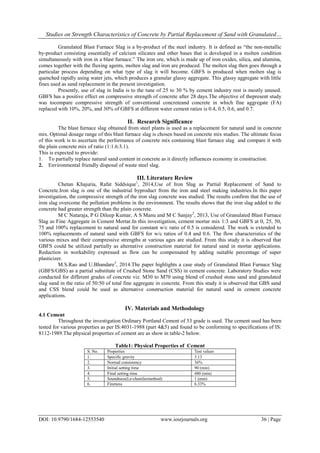
Figure 1: General Schematic view of blast furnace operation and slag productions.
Studies on Strength Characteristics of Concrete by Partial Replacement of Sand with Granulated…
DOI: 10.9790/1684-12553540 www.iosrjournals.org 36 | Page
Granulated Blast Furnace Slag is a by-product of the steel industry. It is defined as “the non-metallic
by-product consisting essentially of calcium silicates and other bases that is developed in a molten condition
simultaneously with iron in a blast furnace.” The iron ore, which is made up of iron oxides, silica, and alumina,
comes together with the fluxing agents, molten slag and iron are produced. The molten slag then goes through a
particular process depending on what type of slag it will become. GBFS is produced when molten slag is
quenched rapidly using water jets, which produces a granular glassy aggregate. This glassy aggregate with little
fines used as sand replacement in the present investigation.
Presently, use of slag in India is to the tune of 25 to 30 % by cement industry rest is mostly unused.
GBFS has a positive effect on compressive strength of concrete after 28 days.The objective of thepresent study
was tocompare compressive strength of conventional concreteand concrete in which fine aggregate (FA)
replaced with 10%, 20%, and 30% of GBFS at different water cement ratios is 0.4, 0.5, 0.6, and 0.7.
II. Research Significance
The blast furnace slag obtained from steel plants is used as a replacement for natural sand in concrete
mix. Optimal dosage range of this blast furnace slag is chosen based on concrete mix studies. The ultimate focus
of this work is to ascertain the performance of concrete mix containing blast furnace slag and compare it with
the plain concrete mix of ratio (1:1.6:3.1).
This is expected to provide:
1. To partially replace natural sand content in concrete as it directly influences economy in construction.
2. Environmental friendly disposal of waste steel slag.
III. Literature Review
Chetan Khajuria, Rafat Siddsique1
, 2014,Use of Iron Slag as Partial Replacement of Sand to
Concrete.Iron slag is one of the industrial byproduct from the iron and steel making industries.In this paper
investigation, the compressive strength of the iron slag concrete was studied. The results confirm that the use of
iron slag overcome the pollution problems in the environment. The results shows that the iron slag added to the
concrete had greater strength than the plain concrete.
M C Nataraja, P G Dileep Kumar, A S Manu and M C Sanjay2
, 2013, Use of Granulated Blast Furnace
Slag as Fine Aggregate in Cement Mortar.In this investigation, cement mortar mix 1:3 and GBFS at 0, 25, 50,
75 and 100% replacement to natural sand for constant w/c ratio of 0.5 is considered. The work is extended to
100% replacements of natural sand with GBFS for w/c ratios of 0.4 and 0.6. The flow characteristics of the
various mixes and their compressive strengths at various ages are studied. From this study it is observed that
GBFS could be utilized partially as alternative construction material for natural sand in mortar applications.
Reduction in workability expressed as flow can be compensated by adding suitable percentage of super
plasticizer.
M.S.Rao and U.Bhandare3
, 2014.The paper highlights a case study of Granulated Blast Furnace Slag
(GBFS/GBS) as a partial substitute of Crushed Stone Sand (CSS) in cement concrete. Laboratory Studies were
conducted for different grades of concrete viz. M30 to M70 using blend of crushed stone sand and granulated
slag sand in the ratio of 50:50 of total fine aggregate in concrete. From this study it is observed that GBS sand
and CSS blend could be used as alternative construction material for natural sand in cement concrete
applications.
IV. Materials and Methodology
4.1 Cement
Throughout the investigation Ordinary Portland Cement of 53 grade is used. The cement used has been
tested for various properties as per IS:4031-1988 (part 4&5) and found to be conforming to specifications of IS:
8112-1989.The physical properties of cement are as show in table-2 below.
Table1: Physical Properties of Cement
S. No. Properties Test values
1. Specific gravity 3.13
2. Normal consistency 36%
3. Initial setting time 90 (min)
4. Final setting time 480 (min)
5. Soundness(Le-chateliermethod) 1 (mm)
6. Fineness 6.33%
Studies on Strength Characteristics of Concrete by Partial Replacement of Sand with Granulated…
DOI: 10.9790/1684-12553540 www.iosrjournals.org 37 | Page
4.2 Fine Aggregates (SAND & GBFS)
4.2.1 Sand
Naturally available sand is used as fine aggregate in the present work. The most common constituent of
sand is silica, usually in the form of quartz, which is chemical inert and hard. The sand is free from clayey
matter, silt and organic impurities etc. Hence used as a fine aggregate in concrete. The size of sand is that
passing through 4.75 and retained on 150 micron IS sieve.Natural sand used confirms to grading zone-II as per
IS:383(1970).
4.2.2 Granulated Blast Furnace Slag
Blast furnace slag is a non-metallic byproduct consisting essentially of calcium silicates and other
bases. The exact concentrations of elements vary slightly depending on where and how the slag is produced. The
size of slag is that passing through 4.75 and retained on 150 micron IS sieve is also used as sand up to 30%
replacement of sand. The used slag contains both fines and sand sized particles.The blast furnace slag obtained
from steel plants used in this study has chemical composition is given in below table 1
Table2: Chemical Composition of Slag
Composition Percentage
CaO (%) 30-40
SiO2 (%) 28-42
Al2O3 (%) 5-22
MgO(%) 5-15
S(%) 1-2
Fe2O3 (%) 0.3-1.7
Minor Components 5
The physical properties of Sand and GBFS such asspecific gravity, water absorption, etc., were determined as
per IS: 2386(1963).
Table3: Physical Properties of Fine Aggregates
S. No. Properties Fine Aggregates
Natural sand(NS) GBFS
1. Specific gravity 2.67 2.07
2. Water absorption 0.82(%) 9.642(%)
3. Bulking of sand 30(%) 18.46(%)
4. Fineness modulus 2.48 2.37
5. Moisture content - 20.58(%)
4.3 Coarse Aggregate
The coarse aggregate is free from clayey matter, silt and organic impurities etc. Coarse aggregate is
tested for specific gravity, in accordance with IS: 2386-1963. The maximum size of 20 mm is used as a coarse
aggregate in concrete. For most of building constructions, the coarse aggregate consists of gravel or crushed
stone up to 20mm size. However, in massive structures, such as dams, the coarse aggregate may include natural
stones or rock.
Table4: Physical Properties of Coarse Aggregate
S. No. Properties Test values
1. Specific gravity 2.66
2. Water absorption 0.423(%)
3. Fineness modulus 3.91
V. Experimental Study
For the w/c Ratio 0.4, 0.5, 0.6, and 0.7, the various quantities of the aggregate are shown in table 5 and
water quantities in table6. Where Cement: Fine Aggregate(FA): Coarse Aggregate(CA) proportion used is
1:1.59:3.1.
Table 5: Quantities of Aggregate
S. No. Particulars Plain concrete Mix 10% of GBFS 20% of GBFS 30% of GBFS
1. Cement in kg/m3
372 372 372 372
2. GBFS in kg/m3
0 59.23 118.46 177.69
3. Sand in kg/m3
592.3 533.07 473.84 414.61
4. Coarse Aggregate in
kg/m3 1161.25 1161.25 1161.25 1161.25
Studies on Strength Characteristics of Concrete by Partial Replacement of Sand with Granulated…
DOI: 10.9790/1684-12553540 www.iosrjournals.org 38 | Page
Table 6: Quantities of Water
S. No. Particular
Water Cement ratio(w/c)
0.4 0.5 0.6 0.7
1. Water in lt/m3
149 186 223.2 260.4
NOTE: All thus quantities are calculated for 1m3
of concrete.
VI. Results & Discussion
6.1 Compressive Strength
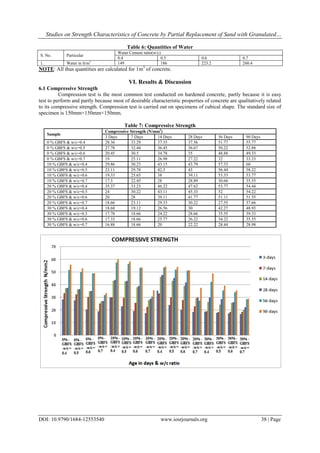
Compression test is the most common test conducted on hardened concrete, partly because it is easy
test to perform and partly because most of desirable characteristic properties of concrete are qualitatively related
to its compressive strength. Compression test is carried out on specimens of cubical shape. The standard size of
specimen is 150mm×150mm×150mm.
Table 7: Compressive Strength
Sample
Compressive Strength (N/mm2
)
3 Days 7 Days 14 Days 28 Days 56 Days 90 Days
0 % GBFS & w/c=0.4 28.36 33.29 37.35 37.56 51.77 55.77
0 % GBFS & w/c=0.5 27.78 32.44 36.45 36.67 50.22 52.88
0 % GBFS & w/c=0.6 20.45 30.5 34.78 35 48.88 49.33
0 % GBFS & w/c=0.7 19 25.11 26.98 27.22 32 33.33
10 % GBFS & w/c=0.4 29.86 30.23 43.15 43.79 57.33 60
10 % GBFS & w/c=0.5 23.11 29.78 42.5 43 56.44 58.22
10 % GBFS & w/c=0.6 19.33 25.65 38 39.11 53.33 53.77
10 % GBFS & w/c=0.7 17.5 22.45 28 28.89 30.66 35.55
20 % GBFS & w/c=0.4 35.37 33.23 46.22 47.62 53.77 54.44
20 % GBFS & w/c=0.5 24 30.22 43.11 45.33 52 54.22
20 % GBFS & w/c=0.6 20 28 39.11 41.77 51.11 51.55
20 % GBFS & w/c=0.7 18.66 23.11 29.33 30.22 27.55 37.66
30 % GBFS & w/c=0.4 18.68 19.12 26.56 30 42.27 48.93
30 % GBFS & w/c=0.5 17.78 18.66 24.22 28.66 35.55 39.33
30 % GBFS & w/c=0.6 17.33 18.66 25.77 26.22 34.22 35.55
30 % GBFS & w/c=0.7 16.88 18.66 20 22.22 28.44 28.98
Studies on Strength Characteristics of Concrete by Partial Replacement of Sand with Granulated…
DOI: 10.9790/1684-12553540 www.iosrjournals.org 39 | Page
Table8: Percentage of Increase in Compressive Strength at W/C Ratio 0.4
Days
Without
Replacement
10%Replacement
%ofincrease/
decrease
20%Replacement
%ofincrease/
decrease
30%Replacement
%ofincrease/
decrease
3 28.36 29.86 5.29 35.37 24.71 18.68 -34.13
7 33.29 30.23 -9.19 33.23 -0.23 19.12 -42.56
14 37.35 43.15 15.53 46.22 23.74 26.56 -28.83
28 37.56 43.79 16.58 47.62 26.78 30 -20.12
56 51.77 57.33 10.74 53.77 3.86 42.27 -18.35
90 55.77 60 7.58 54.44 -2.28 48.93 -12.26
Table 9: Percentage of Increase in Compressive Strength at W/C Ratio 0.5
Days
Without
Replacement
10%Replacement
%ofincrease/
decrease
20%Replacement
%ofincrease/
decrease
30%Replacement
%0fincrease/
decrease
3 27.78 23.11 -16.81 24 -13.60 17.78 -35.99
7 32.44 29.78 -8.19 30.22 -6.84 18.66 -42.47
14 36.45 42.5 16.59 43.11 18.27 24.22 -33.55
28 36.67 43 17.26 45.33 23.61 28.66 -21.84
56 50.22 56.44 12.38 52 3.54 35.55 -29.21
90 52.88 58.22 10.09 54.22 2.53 39.33 -25.62
Table 10: Percentage of Increase in Compressive Strength at W/C Ratio 0.6
Days
Without
Replacement
10%Replacement
%ofincrease/
decrease
20%Replacement
%ofincrease/
decrease
30%Replacement
%ofincrease/
decrease
3 20.45 19.33 -5.47 20 -2.20 17.33 -15.25
7 30.5 25.65 -15.90 28 -8.19 18.66 -38.81
14 34.78 38 9.26 39.11 12.44 25.77 -25.90
28 35 39.11 11.74 41.77 19.34 26.22 -25.08
56 48.48 53.33 10.00 51.11 5.42 34.22 -29.41
90 49.33 53.77 9.00 51.55 4.50 35.55 -27.93
Table 11: Percentage of Increase in Compressive Strength at W/C Ratio 0.7
Days
Without
Replacement
10%Replacement
%ofincrease/
decrease
20%Replacement
%ofincrease/
decrease
30%Replacement
%ofincrease/
decrease
3 19 17.5 -7.89 18.66 -1.78 16.88 -11.15
7 25.11 22.45 -10.59 23.11 -7.96 18.66 -25.68
14 26.98 28 3.78 29.33 8.71 20 -25.87
28 27.22 28.89 6.13 30.22 11.02 22.22 -18.36
56 32 30.66 -4.18 27.55 -13.90 28.44 -11.12
90 33.33 35.55 6.66 37.66 12.99 28.98 -13.05
Studies on Strength Characteristics of Concrete by Partial Replacement of Sand with Granulated…
DOI: 10.9790/1684-12553540 www.iosrjournals.org 40 | Page
VII. Concluding Remarks
Based on limited experimental investigations conducted following concluding remarks may be made.
1. The results show that at water cement ratio of 0.4 there is 26.78% increase in 28 days compressive strength
of concrete when 20% slag is used and 16.58% increase when 10% slag is used.
2. At water cement ratio of 0.5 there is 23.61% increase in 28 days compressive strength of concrete when
20% slag is used and 17.26% increase when 10% slag is used.
3. At water cement ratio of 0.6 there is 19.34% increase in 28 days compressive strength of concrete when
20% slag is used and 11.74% increase when 10% slag is used.
4. At water cement ratio of 0.7 there is 11.02% increase in 28 days compressive strength of concrete when
20% slag is used and 6.13% increase when 10% slag is used.-
5. Hence we can conclude that with the increase in the water cement ratio the workability is increased but the
strength of the concrete decreases.
6. The strength of 3rd
day and 7th
day for slag replacement is less compared to normal concrete mix. The real
gain of strength is noticed after 7 days as it gives even more strength than normal concrete mix.
7. By using the slag as an ingredient of concrete we can reduce environmental pollution and also preserve the
natural resources.
References
[1]. Chetan Khajuria, RafatSiddsique, 2014 Use Of Iron Slag As Partial Replacement Of Sand To Concrete, Volume 3, Issue 6, June
2014.
[2]. M C Nataraja, P G Dileep Kumar, A S Manu and M C Sanjay Use Of Granulated Blast Furnace Slag As Fine Aggregate In Cement
Mortar,Vol.2, No.2, May 2013.
[3]. M.S. Rao and U. Bhandare, Application of Blast Furnace Slag Sand in Cement Concrete–A Case Study, ISSN 2278-3652 Volume
5, Number 4 (2014), pp. 453-458.
[4]. IS: 12269-2013: Specification for 53-grade Ordinary Portland Cement, Bureau of Indian Standards, New Delhi.
[5]. IS: 4031-1988: Methods of physical tests for hydraulic cement, Bureau of Indian Standards, New Delhi.
[6]. IS: 516-1959, Method of Tests for Strength of Concrete, Bureau of Indian Standard (Eleven reprint), New Delhi, 1985.
[7]. IS: 383-1970: Specification for Coarse and Fine Aggregates from Natural Sources for Concrete, Bureau of Indian Standards, New
Delhi, 1993.
[8]. IS: 5512-1983: Specification for Flow Table for use in Tests of Hydraulic Cements and Pozzolanic Materials, Bureau of Indian
Standards, New Delhi.
[9]. IS: 2386-1963: Method of Tests for Aggregate for Concrete, Bureau of Indian Standards, New Delhi, 1982.

G012553540

  • 1.
    IOSR Journal ofMechanical and Civil Engineering (IOSR-JMCE) e-ISSN: 2278-1684,p-ISSN: 2320-334X, Volume 12, Issue 5 Ver. V (Sep. - Oct. 2015), PP 35-40 www.iosrjournals.org DOI: 10.9790/1684-12553540 www.iosrjournals.org 35 | Page Studies on Strength Characteristics of Concrete by Partial Replacement of Sand with Granulated BlastFurnace Slag U. Vamsi mohan1 ,Dr.K.Nagendra Prasad2 , S. Praveen Kumar Reddy3 1 Associate Professor, Department of Civil Engineering, Sri Venkateswara College of Engineering and Technology, Chittoor-517217, Andhra Pradesh, India, 2 Professor, Department of Civil Engineering, Sri Venkateswara University, Tirupati 3 Postgraduate Student, Department of Civil Engineering, Sri Venkateswara College of Engineering and Technology, Chittoor-517217, Andhra Pradesh, India, Abstract: The Iron and steel industries produce a huge quantity of Granulated blast furnace slag as a byproduct, which is a non–biodegradable waste material, from that only a small percentage of it is used by cement industries to manufacture cement. In the present investigation Granulated Blast Furnace Slag from local industries has been utilized to find its suitability as a fine aggregate in concrete making. Replacing all or some portion of natural sand with slag would lead to considerable environmental benefits. The experimental result showsthat the replacing of natural sand by 10%,20%, and 30%with Granulated Blast Furnace Slag causes negligible degradation in strength at 0.6 % and 0.7% of water cement ratio. But the compressive strength of Granulated Blast Furnace Slag concrete is found to be higher than that of conventional concrete at the age of 3,7,14, 28, 56 and 90 days at 0.4% and0.5% of water cement ratio. Keywords:Compressive strength, Control mix, Granulated Blast Furnace slag (GBFS),Replacement of sand, water- cement ratio(w/c) I. Introduction Due to scarcity of suitable river sand for use as fine aggregate in construction applications and recent construction boom has led to a drastic increase in price additionally various government agencies have put somerestrictions on sand quarrying to conserve this diminishing natural resources. This has prompted many engineers to look for other alternative materials that are cheaper while possessing similar characteristics. One such alternative is “blast furnace slag” which is a byproduct from steel industry. The use of slag in making concrete or mortar by partial/full replacement of river sand not only provides economy in cost of construction but also solves the problem of disposal of slag.The pozzolanic material used in the project was Granulated Blast Furnace Slag (GBFS). Figure 1: General Schematic view of blast furnace operation and slag productions.
  • 2.
    Studies on StrengthCharacteristics of Concrete by Partial Replacement of Sand with Granulated… DOI: 10.9790/1684-12553540 www.iosrjournals.org 36 | Page Granulated Blast Furnace Slag is a by-product of the steel industry. It is defined as “the non-metallic by-product consisting essentially of calcium silicates and other bases that is developed in a molten condition simultaneously with iron in a blast furnace.” The iron ore, which is made up of iron oxides, silica, and alumina, comes together with the fluxing agents, molten slag and iron are produced. The molten slag then goes through a particular process depending on what type of slag it will become. GBFS is produced when molten slag is quenched rapidly using water jets, which produces a granular glassy aggregate. This glassy aggregate with little fines used as sand replacement in the present investigation. Presently, use of slag in India is to the tune of 25 to 30 % by cement industry rest is mostly unused. GBFS has a positive effect on compressive strength of concrete after 28 days.The objective of thepresent study was tocompare compressive strength of conventional concreteand concrete in which fine aggregate (FA) replaced with 10%, 20%, and 30% of GBFS at different water cement ratios is 0.4, 0.5, 0.6, and 0.7. II. Research Significance The blast furnace slag obtained from steel plants is used as a replacement for natural sand in concrete mix. Optimal dosage range of this blast furnace slag is chosen based on concrete mix studies. The ultimate focus of this work is to ascertain the performance of concrete mix containing blast furnace slag and compare it with the plain concrete mix of ratio (1:1.6:3.1). This is expected to provide: 1. To partially replace natural sand content in concrete as it directly influences economy in construction. 2. Environmental friendly disposal of waste steel slag. III. Literature Review Chetan Khajuria, Rafat Siddsique1 , 2014,Use of Iron Slag as Partial Replacement of Sand to Concrete.Iron slag is one of the industrial byproduct from the iron and steel making industries.In this paper investigation, the compressive strength of the iron slag concrete was studied. The results confirm that the use of iron slag overcome the pollution problems in the environment. The results shows that the iron slag added to the concrete had greater strength than the plain concrete. M C Nataraja, P G Dileep Kumar, A S Manu and M C Sanjay2 , 2013, Use of Granulated Blast Furnace Slag as Fine Aggregate in Cement Mortar.In this investigation, cement mortar mix 1:3 and GBFS at 0, 25, 50, 75 and 100% replacement to natural sand for constant w/c ratio of 0.5 is considered. The work is extended to 100% replacements of natural sand with GBFS for w/c ratios of 0.4 and 0.6. The flow characteristics of the various mixes and their compressive strengths at various ages are studied. From this study it is observed that GBFS could be utilized partially as alternative construction material for natural sand in mortar applications. Reduction in workability expressed as flow can be compensated by adding suitable percentage of super plasticizer. M.S.Rao and U.Bhandare3 , 2014.The paper highlights a case study of Granulated Blast Furnace Slag (GBFS/GBS) as a partial substitute of Crushed Stone Sand (CSS) in cement concrete. Laboratory Studies were conducted for different grades of concrete viz. M30 to M70 using blend of crushed stone sand and granulated slag sand in the ratio of 50:50 of total fine aggregate in concrete. From this study it is observed that GBS sand and CSS blend could be used as alternative construction material for natural sand in cement concrete applications. IV. Materials and Methodology 4.1 Cement Throughout the investigation Ordinary Portland Cement of 53 grade is used. The cement used has been tested for various properties as per IS:4031-1988 (part 4&5) and found to be conforming to specifications of IS: 8112-1989.The physical properties of cement are as show in table-2 below. Table1: Physical Properties of Cement S. No. Properties Test values 1. Specific gravity 3.13 2. Normal consistency 36% 3. Initial setting time 90 (min) 4. Final setting time 480 (min) 5. Soundness(Le-chateliermethod) 1 (mm) 6. Fineness 6.33%
  • 3.
    Studies on StrengthCharacteristics of Concrete by Partial Replacement of Sand with Granulated… DOI: 10.9790/1684-12553540 www.iosrjournals.org 37 | Page 4.2 Fine Aggregates (SAND & GBFS) 4.2.1 Sand Naturally available sand is used as fine aggregate in the present work. The most common constituent of sand is silica, usually in the form of quartz, which is chemical inert and hard. The sand is free from clayey matter, silt and organic impurities etc. Hence used as a fine aggregate in concrete. The size of sand is that passing through 4.75 and retained on 150 micron IS sieve.Natural sand used confirms to grading zone-II as per IS:383(1970). 4.2.2 Granulated Blast Furnace Slag Blast furnace slag is a non-metallic byproduct consisting essentially of calcium silicates and other bases. The exact concentrations of elements vary slightly depending on where and how the slag is produced. The size of slag is that passing through 4.75 and retained on 150 micron IS sieve is also used as sand up to 30% replacement of sand. The used slag contains both fines and sand sized particles.The blast furnace slag obtained from steel plants used in this study has chemical composition is given in below table 1 Table2: Chemical Composition of Slag Composition Percentage CaO (%) 30-40 SiO2 (%) 28-42 Al2O3 (%) 5-22 MgO(%) 5-15 S(%) 1-2 Fe2O3 (%) 0.3-1.7 Minor Components 5 The physical properties of Sand and GBFS such asspecific gravity, water absorption, etc., were determined as per IS: 2386(1963). Table3: Physical Properties of Fine Aggregates S. No. Properties Fine Aggregates Natural sand(NS) GBFS 1. Specific gravity 2.67 2.07 2. Water absorption 0.82(%) 9.642(%) 3. Bulking of sand 30(%) 18.46(%) 4. Fineness modulus 2.48 2.37 5. Moisture content - 20.58(%) 4.3 Coarse Aggregate The coarse aggregate is free from clayey matter, silt and organic impurities etc. Coarse aggregate is tested for specific gravity, in accordance with IS: 2386-1963. The maximum size of 20 mm is used as a coarse aggregate in concrete. For most of building constructions, the coarse aggregate consists of gravel or crushed stone up to 20mm size. However, in massive structures, such as dams, the coarse aggregate may include natural stones or rock. Table4: Physical Properties of Coarse Aggregate S. No. Properties Test values 1. Specific gravity 2.66 2. Water absorption 0.423(%) 3. Fineness modulus 3.91 V. Experimental Study For the w/c Ratio 0.4, 0.5, 0.6, and 0.7, the various quantities of the aggregate are shown in table 5 and water quantities in table6. Where Cement: Fine Aggregate(FA): Coarse Aggregate(CA) proportion used is 1:1.59:3.1. Table 5: Quantities of Aggregate S. No. Particulars Plain concrete Mix 10% of GBFS 20% of GBFS 30% of GBFS 1. Cement in kg/m3 372 372 372 372 2. GBFS in kg/m3 0 59.23 118.46 177.69 3. Sand in kg/m3 592.3 533.07 473.84 414.61 4. Coarse Aggregate in kg/m3 1161.25 1161.25 1161.25 1161.25
  • 4.
    Studies on StrengthCharacteristics of Concrete by Partial Replacement of Sand with Granulated… DOI: 10.9790/1684-12553540 www.iosrjournals.org 38 | Page Table 6: Quantities of Water S. No. Particular Water Cement ratio(w/c) 0.4 0.5 0.6 0.7 1. Water in lt/m3 149 186 223.2 260.4 NOTE: All thus quantities are calculated for 1m3 of concrete. VI. Results & Discussion 6.1 Compressive Strength Compression test is the most common test conducted on hardened concrete, partly because it is easy test to perform and partly because most of desirable characteristic properties of concrete are qualitatively related to its compressive strength. Compression test is carried out on specimens of cubical shape. The standard size of specimen is 150mm×150mm×150mm. Table 7: Compressive Strength Sample Compressive Strength (N/mm2 ) 3 Days 7 Days 14 Days 28 Days 56 Days 90 Days 0 % GBFS & w/c=0.4 28.36 33.29 37.35 37.56 51.77 55.77 0 % GBFS & w/c=0.5 27.78 32.44 36.45 36.67 50.22 52.88 0 % GBFS & w/c=0.6 20.45 30.5 34.78 35 48.88 49.33 0 % GBFS & w/c=0.7 19 25.11 26.98 27.22 32 33.33 10 % GBFS & w/c=0.4 29.86 30.23 43.15 43.79 57.33 60 10 % GBFS & w/c=0.5 23.11 29.78 42.5 43 56.44 58.22 10 % GBFS & w/c=0.6 19.33 25.65 38 39.11 53.33 53.77 10 % GBFS & w/c=0.7 17.5 22.45 28 28.89 30.66 35.55 20 % GBFS & w/c=0.4 35.37 33.23 46.22 47.62 53.77 54.44 20 % GBFS & w/c=0.5 24 30.22 43.11 45.33 52 54.22 20 % GBFS & w/c=0.6 20 28 39.11 41.77 51.11 51.55 20 % GBFS & w/c=0.7 18.66 23.11 29.33 30.22 27.55 37.66 30 % GBFS & w/c=0.4 18.68 19.12 26.56 30 42.27 48.93 30 % GBFS & w/c=0.5 17.78 18.66 24.22 28.66 35.55 39.33 30 % GBFS & w/c=0.6 17.33 18.66 25.77 26.22 34.22 35.55 30 % GBFS & w/c=0.7 16.88 18.66 20 22.22 28.44 28.98
  • 5.
    Studies on StrengthCharacteristics of Concrete by Partial Replacement of Sand with Granulated… DOI: 10.9790/1684-12553540 www.iosrjournals.org 39 | Page Table8: Percentage of Increase in Compressive Strength at W/C Ratio 0.4 Days Without Replacement 10%Replacement %ofincrease/ decrease 20%Replacement %ofincrease/ decrease 30%Replacement %ofincrease/ decrease 3 28.36 29.86 5.29 35.37 24.71 18.68 -34.13 7 33.29 30.23 -9.19 33.23 -0.23 19.12 -42.56 14 37.35 43.15 15.53 46.22 23.74 26.56 -28.83 28 37.56 43.79 16.58 47.62 26.78 30 -20.12 56 51.77 57.33 10.74 53.77 3.86 42.27 -18.35 90 55.77 60 7.58 54.44 -2.28 48.93 -12.26 Table 9: Percentage of Increase in Compressive Strength at W/C Ratio 0.5 Days Without Replacement 10%Replacement %ofincrease/ decrease 20%Replacement %ofincrease/ decrease 30%Replacement %0fincrease/ decrease 3 27.78 23.11 -16.81 24 -13.60 17.78 -35.99 7 32.44 29.78 -8.19 30.22 -6.84 18.66 -42.47 14 36.45 42.5 16.59 43.11 18.27 24.22 -33.55 28 36.67 43 17.26 45.33 23.61 28.66 -21.84 56 50.22 56.44 12.38 52 3.54 35.55 -29.21 90 52.88 58.22 10.09 54.22 2.53 39.33 -25.62 Table 10: Percentage of Increase in Compressive Strength at W/C Ratio 0.6 Days Without Replacement 10%Replacement %ofincrease/ decrease 20%Replacement %ofincrease/ decrease 30%Replacement %ofincrease/ decrease 3 20.45 19.33 -5.47 20 -2.20 17.33 -15.25 7 30.5 25.65 -15.90 28 -8.19 18.66 -38.81 14 34.78 38 9.26 39.11 12.44 25.77 -25.90 28 35 39.11 11.74 41.77 19.34 26.22 -25.08 56 48.48 53.33 10.00 51.11 5.42 34.22 -29.41 90 49.33 53.77 9.00 51.55 4.50 35.55 -27.93 Table 11: Percentage of Increase in Compressive Strength at W/C Ratio 0.7 Days Without Replacement 10%Replacement %ofincrease/ decrease 20%Replacement %ofincrease/ decrease 30%Replacement %ofincrease/ decrease 3 19 17.5 -7.89 18.66 -1.78 16.88 -11.15 7 25.11 22.45 -10.59 23.11 -7.96 18.66 -25.68 14 26.98 28 3.78 29.33 8.71 20 -25.87 28 27.22 28.89 6.13 30.22 11.02 22.22 -18.36 56 32 30.66 -4.18 27.55 -13.90 28.44 -11.12 90 33.33 35.55 6.66 37.66 12.99 28.98 -13.05
  • 6.
    Studies on StrengthCharacteristics of Concrete by Partial Replacement of Sand with Granulated… DOI: 10.9790/1684-12553540 www.iosrjournals.org 40 | Page VII. Concluding Remarks Based on limited experimental investigations conducted following concluding remarks may be made. 1. The results show that at water cement ratio of 0.4 there is 26.78% increase in 28 days compressive strength of concrete when 20% slag is used and 16.58% increase when 10% slag is used. 2. At water cement ratio of 0.5 there is 23.61% increase in 28 days compressive strength of concrete when 20% slag is used and 17.26% increase when 10% slag is used. 3. At water cement ratio of 0.6 there is 19.34% increase in 28 days compressive strength of concrete when 20% slag is used and 11.74% increase when 10% slag is used. 4. At water cement ratio of 0.7 there is 11.02% increase in 28 days compressive strength of concrete when 20% slag is used and 6.13% increase when 10% slag is used.- 5. Hence we can conclude that with the increase in the water cement ratio the workability is increased but the strength of the concrete decreases. 6. The strength of 3rd day and 7th day for slag replacement is less compared to normal concrete mix. The real gain of strength is noticed after 7 days as it gives even more strength than normal concrete mix. 7. By using the slag as an ingredient of concrete we can reduce environmental pollution and also preserve the natural resources. References [1]. Chetan Khajuria, RafatSiddsique, 2014 Use Of Iron Slag As Partial Replacement Of Sand To Concrete, Volume 3, Issue 6, June 2014. [2]. M C Nataraja, P G Dileep Kumar, A S Manu and M C Sanjay Use Of Granulated Blast Furnace Slag As Fine Aggregate In Cement Mortar,Vol.2, No.2, May 2013. [3]. M.S. Rao and U. Bhandare, Application of Blast Furnace Slag Sand in Cement Concrete–A Case Study, ISSN 2278-3652 Volume 5, Number 4 (2014), pp. 453-458. [4]. IS: 12269-2013: Specification for 53-grade Ordinary Portland Cement, Bureau of Indian Standards, New Delhi. [5]. IS: 4031-1988: Methods of physical tests for hydraulic cement, Bureau of Indian Standards, New Delhi. [6]. IS: 516-1959, Method of Tests for Strength of Concrete, Bureau of Indian Standard (Eleven reprint), New Delhi, 1985. [7]. IS: 383-1970: Specification for Coarse and Fine Aggregates from Natural Sources for Concrete, Bureau of Indian Standards, New Delhi, 1993. [8]. IS: 5512-1983: Specification for Flow Table for use in Tests of Hydraulic Cements and Pozzolanic Materials, Bureau of Indian Standards, New Delhi. [9]. IS: 2386-1963: Method of Tests for Aggregate for Concrete, Bureau of Indian Standards, New Delhi, 1982.