Dr. B. Krishna Rao et al. Int. Journal of Engineering Research and Applications www.ijera.com
ISSN : 2248-9622, Vol. 5, Issue 7, ( Part - 1) July 2015, pp.36-40
www.ijera.com 36 | P a g e
Replacement of Natural Fine Aggregate With Air Cooled Blast
Furnace Slag An Industrial By Product
Dr. B. Krishna Rao*
, Dr.M.Swaroopa Rani**
, A Siva Sai Teja***
(* Associate Professor, Department of Civil Engineering, J.N.T.U.K, KAKINADA, A.P; India,)
( ** Associate Professor, Department of Civil Engineering, J.N.T.U.K, KAKINADA, A.P; India,)
( *** P.G student, J.N.T. UNIVERSITY, KAKINADA, A.P, India)
Abstract
The aim of the investigation is to replace natural fine aggregatewith Air Cooled Blast Furnace Slag in OPC
concrete. At present, nearly million tons of slag is being produced in the steel plants, in India. The generation of
slag would be dual problem in disposal difficulty and environmental pollution. Some strategies should be used
to utilize the slag effectively. Considering physical properties of metallurgical slags and a series of possibilities
for their use in the field of civil constructions, this report demonstrates the possibilities of using air cooled blast
furnace slag as partial replacement of sand in concrete. A total of five concrete mixes, containing 0%, 12.5%,
25%, 37.5% and 50% partial replacement of regular sand with air cooled blast furnace slag are investigated in
the laboratory. These mixes were tested to determine axial compressive strength, split tensile strength, and
flexural strength for 7days, 28days, 56days and 90days.
Key Words: Fine aggregate, Blast Furnace Slag, Concrete, Workability and Strength.
I. Introduction:
Natural sand is the most commonly used
building material in any part of the world and they
sustain their status, because of demand, utilization
and expansion of construction activity all over the
world. Further among one of the challenge before the
concrete construction industry is to satisfy the needs
of human society, by the protection of environment
and also by meeting the requirements of our growing
population. The natural sand is the most scarcely
available and restrictive intensive component of
concrete. The production of concrete without any
restriction can be increased by partially replacing
natural sand with Air Cooled Blast Furnace Slag
(ACBFS).
During the manufacturing of steel and pig-iron,
slag is generated as a by-product. It is produced by
action of various fluxes and is closely mixed with, a
wanted mineral in an ore deposit materials within the
iron ore during the process of pig iron making in blast
furnace and steel manufacturing in steel melting shop.
Primarily, the slag consists of calcium, magnesium,
manganese and aluminum silicates in various
combinations. The cooling process of slag is
responsible mainly for generating different types of
slag required for various end-use consumers.
Although, the chemical composition of slag may
remain unchanged, physical properties vary widely
with the changing process of cooling.
There are economic, environmental, and social
benefits derived from the effective use of ACBFS
rather than disposing of it as waste. As a result, the
beneficial use of ACBFS has broad positive impacts
on sustainability, a consideration of increasing
importance. First, the use of ACBFS makes economic
sense for the iron producers, who financially benefit
from the sale of the material while avoiding disposal
costs, and it is also an economic benefit to the direct
user of ACBFS (e.g., ready-mix producer,
contractor), who obtains a reclaimed aggregate that is
relatively inexpensive compared to most naturally
derived material. Use of ACBFS also economically
benefits the public, who realize overall cost savings
due to the reduced price of the material during initial
construction.
II. Literature Review
K V Subrahmanyam, U Arun Kumar and Dr. P
V Satyanarayana (2014)
They had studied the utilization of non-conventional
waste materials like steel slag, copper slag, Scrap
tyres, fly ash etc. in road construction activities which
gradually gaining significant importance in India.
Owing to the increase in construction cost of roads at
an alarming rate there is an increase in the cost of
conventional road materials. Steel slag is a waste
material produced as a by-product during the
oxidation of steel pellets in an electric arc furnace.
This by-product can be used as replacement of
aggregates in pavement layers. Due to increase in the
motor vehicles day by day tends to increase in heaps
of discarded rubber tyres. One of the main issues
RESEARCH ARTICLE OPEN ACCESS
Dr. B. Krishna Rao et al. Int. Journal of Engineering Research and Applications www.ijera.com
ISSN : 2248-9622, Vol. 5, Issue 7, ( Part - 1) July 2015, pp.36-40
www.ijera.com 37 | P a g e
associated with the management of scrap rubber tyres
has been their proper disposal. A study was
conducted to investigate the possibility of using
Granulated Blast Furnace Slag (GBFS) and also with
Waste Rubber Tyre (WRT) with various blended
mixes of conventional aggregates in sub base layer
with different percentages separately. Their study also
presents the result of experimental investigation on
the influence of Rice husk ash (RHA) on the index
properties of Red soil which is used as filler material
in sub base layer.
Dr. K. Chinnaraju, V R Ramkumar, K Lineesh, S
Nithya and V Sathish (2013)
They had made an attempt to use steel slag, a by-
product from steel industry as replacement for coarse
aggregate in concrete and eco sand which is a
commercial by-product of cement manufacturing
process introduced by ACC Cements as fine
aggregate replacement. Initial optimization of
materials was done with 7 days strength. M30 grade
of concrete was used. Possible optimum replacement
of slag material was found to be 60% and possible
optimum replacement for eco sand was found to be
40%.Tests on compressive strength, flexural strength,
split tensile strength at 7 days and 28 days, and water
absorption at 28 days were conducted on specimens.
It was concluded that replacing some percentage of
coarse aggregate with steel slag enhances the
strength. The results showed that replacing about 60
percent of steel slag aggregates for coarse aggregate
and 40percent of eco sand for fine aggregate will not
have any adverse effect on the strength of the
concrete.
Manjit Kaur and Mr. Sanjeev Naval (2013)
Had investigated on the effect of Ground granulated
blast furnace slag and saw dust on the mechanical
properties of concrete, when coarse aggregates is
replaced by Ground granulated blast furnace slag and
saw dust is replaced in different percentages i.e.0%,
5%, 10%, 15%, 20%, and 25% with the Fine
aggregates (sand). The main parameters investigated
were cube compressive strength and weight of
concrete. The tests were conducted on concrete with
ratio 1:1.5:3.The test results indicate that with the use
of blast furnace slag by fully replacing coarse
aggregates and partially replacing saw dust by fine
aggregates in different percentages i.e. 0%, 5%, 10%,
15%, 20%, and 25%, the weight of concrete decreases
with the increase in the percentage of saw dust. The
compressive strength decrease with the increase in
percentage of saw dust. The reduction percentage in
the compressive strength is 27.14%, 44.16%,50.46%,
64%, 76.53%, 80.60% Replacement of sand by saw
dust reduce the unit weight of concrete and make it
light weight. The cost of concrete also decreases with
the increase in percentage of saw dust. Test result
show that, the concrete become lighter than
conventional concrete and reducing the
environmental hazard and making the concrete
economical.
III. Experimental Details
It was proposed to investigate the properties of
concrete, cast with partial replacement of fine
aggregate with 0%, 12.5%, 25%, 37.5% and 50%
proportions of ACBFS and cured in water for 7days,
28days, 56days, and 90days. In this experimental
work, physical properties of materials used in the
experimental work were determined. M30 grade of
reference concrete was mixed and cured in potable
water.
3.1 Properties of the materials
3.1.1 Cement: Ordinary Portland Cement (OPC) of
53 Grade (Hemadri cement) from a single lot was
used throughout the course of the investigation. It was
fresh and without any lumps. The specific gravity of
cement obtained is 3.09
3.1.2 Fine Aggregate: The fine aggregate used is
natural sand obtained from the river Godavari
conforming to grading zone-II of IS: 10262-2009.
The specific gravity and fineness modulus are 2.61
and 2.46 respectively.
3.1.3 Coarse Aggregate: Crushed granite angular
aggregate of size 20mm are used and the aggregates
are free from dust before used in the concrete. The
specific gravity and fineness modulus are 2.70 and
8.83 respectively.
3.1.4 Water: This is the least expensive but most
important ingredient of concrete. A good thumb rule
to follow is that if water is pure enough for drinking it
is suitable for mixing concrete.Locally available
portable water was used for mixing and curing
3.1.5 Air Cooled Blast Furnace Slag: It is collected
from Vizag steel plant, Vishakhapatnam, Andhra
Pradesh. Specific gravity test was conducted for air
cooled blast furnace slag and the result obtained is
2.52.
IV. Specimen Details:
Cube specimens of150 mm size for compressive
strength, Cylinder specimens of 150 mm diameter x
300 mm height and prisms ofsize 100 mm x 100 mm
x 500 mm were casted to study the mechanical
strength properties such as compressivestrength, split
tensile strength and flexural strength according to
Indian standards.
V. Mix Proportion:
Cement: Fine aggregate: Coarse aggregate = 1: 1.809:
3.24
VI. Test Results:
A total of 60 cubes, cylinders and beams were
casted for the five mixes. i.e., for each mix 12 cubes,
cylinders and beams were prepared respectively.
Dr. B. Krishna Rao et al. Int. Journal of Engineering Research and Applications www.ijera.com
ISSN : 2248-9622, Vol. 5, Issue 7, ( Part - 1) July 2015, pp.36-40
www.ijera.com 38 | P a g e
Testing of the specimens was done at 7 days, 28 days,
56days and 90 days, at the rate of 3 cubes, cylinders
and 3 beams for each mix on that particular day. The
average value of the 3 specimens is reported as the
strength at that particular age.Compressive strength,
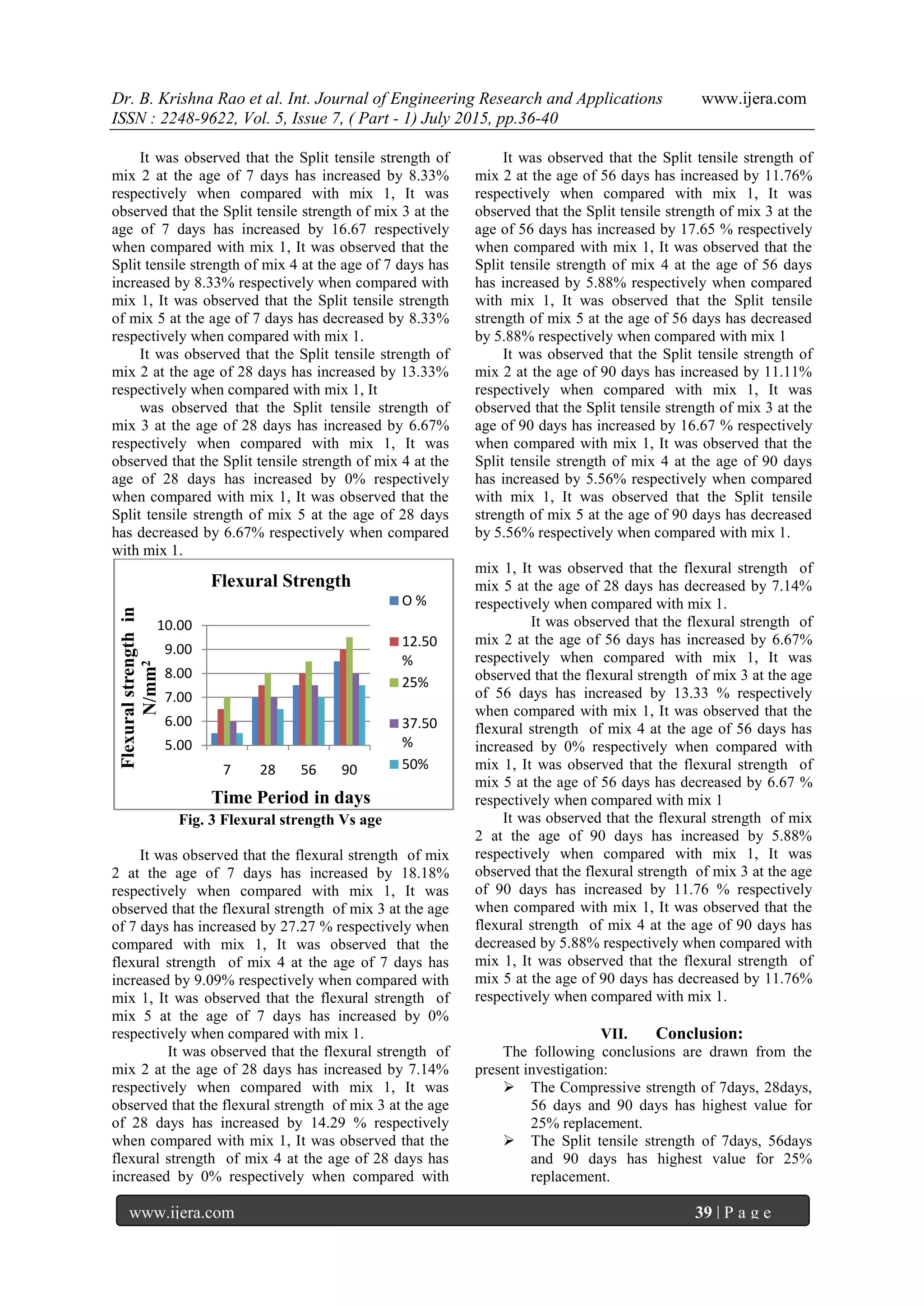
split tensile strength and flexural strength of concrete
tested on cubes, cylinders and beams respectively at
different partial replacement of air cooled blast
furnace slag was shown in below.
Table 1 Test results of compressive, split tensile and flexural strength of concrete
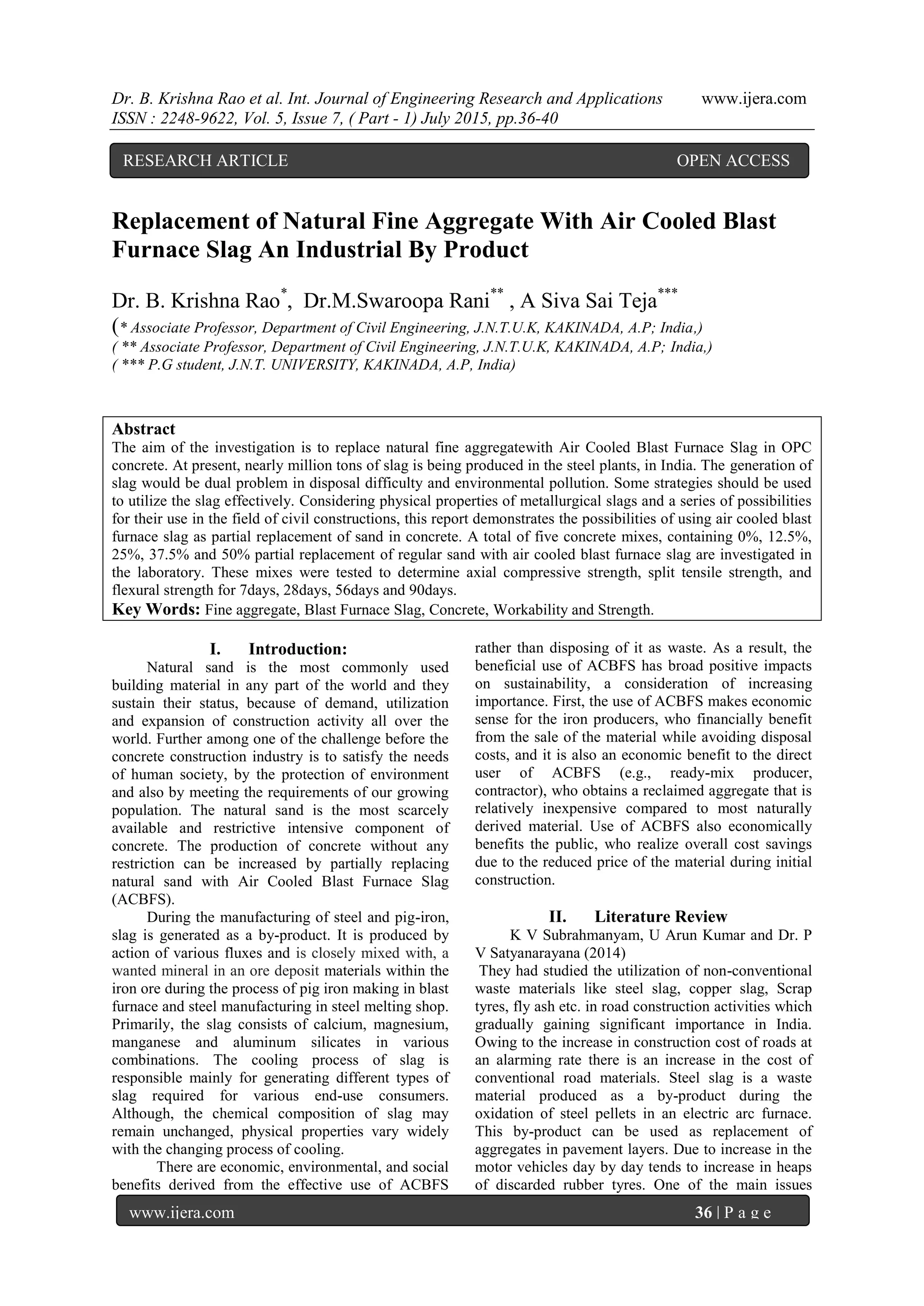
Fig. 1 Compressive strength Vs age
It was observed that the compressive strength of
mix 2 at the age of 7 days has increased by 4.92%
respectively when compared with mix 1, It was
observed that the compressive strength of mix 3 at the
age of 7 days has increased by 8.2% respectively
when compared with mix 1, It was observed that the
compressive strength of mix 4 at the age of 7 days has
increased by 1.64% respectively when compared with
mix 1, It was observed that the compressive strength
of mix 5 at the age of 7 days has decreased by 3.28%
respectively when compared with mix 1.
It was observed that the compressive strength of
mix 2 at the age of 28 days has increased by 1.15%
respectively when compared with mix 1, It was
observed that the compressive strength of mix 3
at the age of 28 days has increased by 2.30%
respectively when compared with mix 1, It was
observed that the compressive strength of mix 4 at the
age of 28 days has decreased by 1.15% respectively
when compared with mix 1, It was observed that the
compressive strength of mix 5 at the age of 28 days
has decreased by 2.30% respectively when compared
with mix 1.
It was observed that the compressive
strength of mix 2 at the age of 56 days has increased
by 3.23% respectively when compared with mix 1, It
was observed that the compressive strength of mix 3
at the age of 56 days has increased by 6.45%
respectively when compared with mix 1, It was
observed that the compressive strength of mix 4 at the
age of 56 days has decreased by 1.08% respectively
when compared with mix 1, It was observed that the
compressive strength of mix 5 at the age of 56 days
has decreased by 3.23% respectively when compared
with mix 1.
It was observed that the compressive strength
of mix 2 at the age of 90 days has increased by 3.06%
respectively when compared with mix 1, It was
observed that the compressive strength of mix 3 at the
age of 90 days has increased by 5.10% respectively
when compared with mix 1, It was observed that the
compressive strength of mix 4 at the age of 90 days
has increased by 2.04% respectively when compared
with mix 1, It was observed that the compressive
strength of mix 5 at the age of 90 days has decreased
by 3.06% respectively when compared with mix 1.
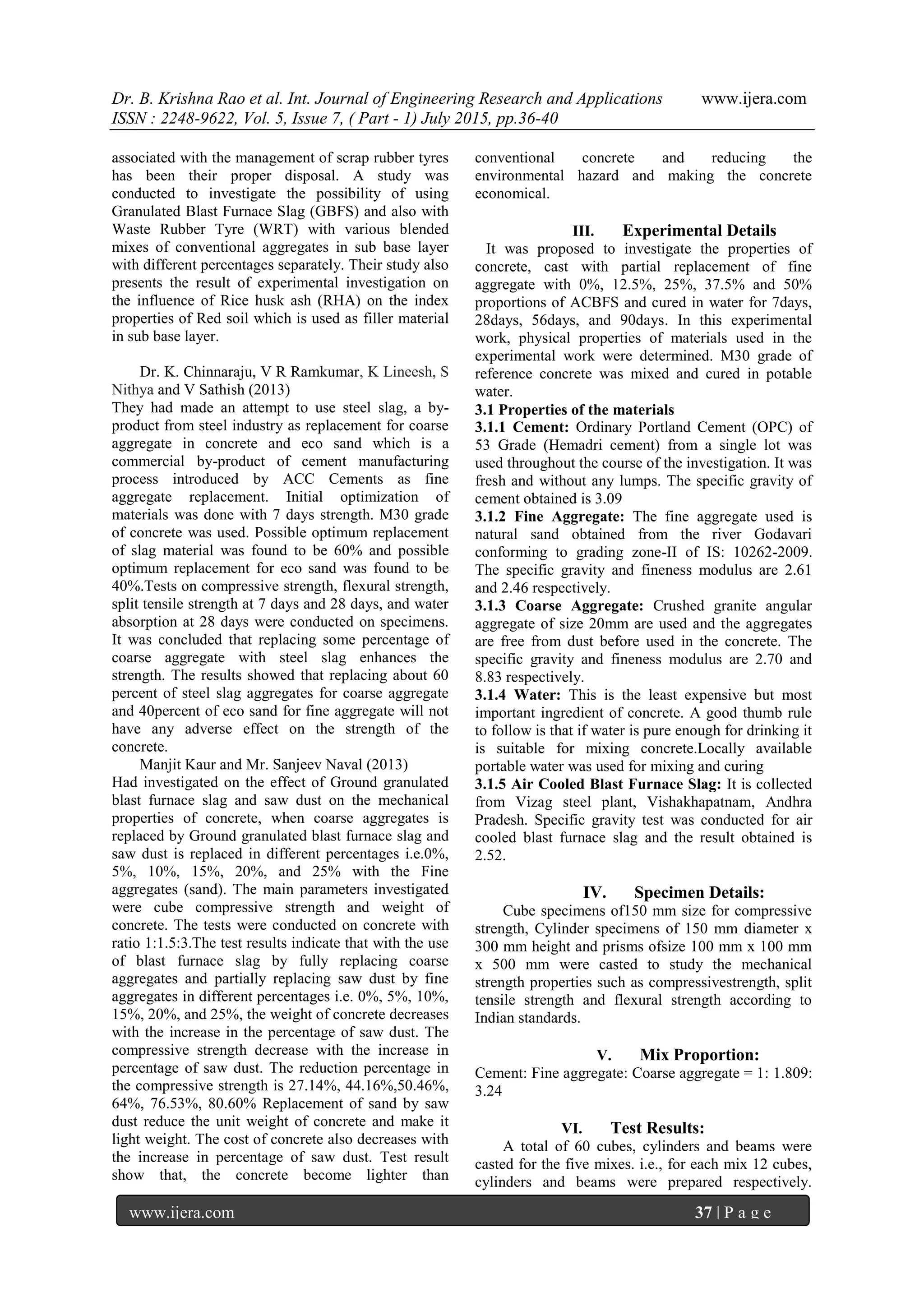
Fig. 2 Split tensile strength Vs age
0.00
10.00
20.00
30.00
40.00
50.00
7 28 56 90
Compressivestrength
inN/mm2
Time Period in Days
Compressive Strength
O %
12.50
%
25%
37.50
%
50%
1.50
2.00
2.50
3.00
3.50
7 28 56 90
Splittensilestrength
inN/mm2
Time period in days
Split Tensile Strength
O %
12.5
0%
25%
37.5
0%
50%
S.
No
Mix.
Id.
% of
ACBFS
Compressive strength (MPa) Split tensile strength (MPa) Flexural strength (MPa)
7d 28d 56d 90d 7d 28d 56d 90d 7d 28d 56d 90d
1. Mix 1 0 27.11 38.67 41.33 43.56 1.70 2.12 2.41 2.55 5.50 7.00 7.50 8.50
2. Mix 2 12.5 28.44 39.11 42.67 44.89 1.84 2.41 2.69 2.83 6.50 7.50 8.00 9.00
3. Mix 3 25 29.33 39.56 44.00 45.78 1.98 2.26 2.83 2.97 7.00 8.00 8.50 9.50
4. Mix 4 37.5 27.56 38.22 40.89 44.44 1.84 2.12 2.55 2.69 6.00 7.00 7.50 8.00
5. Mix 5 50 26.22 37.78 40.00 42.22 1.90 1.98 2.26 2.41 5.50 6.50 7.00 7.50
Dr. B. Krishna Rao et al. Int. Journal of Engineering Research and Applications www.ijera.com
ISSN : 2248-9622, Vol. 5, Issue 7, ( Part - 1) July 2015, pp.36-40
www.ijera.com 39 | P a g e
It was observed that the Split tensile strength of
mix 2 at the age of 7 days has increased by 8.33%
respectively when compared with mix 1, It was
observed that the Split tensile strength of mix 3 at the
age of 7 days has increased by 16.67 respectively
when compared with mix 1, It was observed that the
Split tensile strength of mix 4 at the age of 7 days has
increased by 8.33% respectively when compared with
mix 1, It was observed that the Split tensile strength
of mix 5 at the age of 7 days has decreased by 8.33%
respectively when compared with mix 1.
It was observed that the Split tensile strength of
mix 2 at the age of 28 days has increased by 13.33%
respectively when compared with mix 1, It
was observed that the Split tensile strength of
mix 3 at the age of 28 days has increased by 6.67%
respectively when compared with mix 1, It was
observed that the Split tensile strength of mix 4 at the
age of 28 days has increased by 0% respectively
when compared with mix 1, It was observed that the
Split tensile strength of mix 5 at the age of 28 days
has decreased by 6.67% respectively when compared
with mix 1.
It was observed that the Split tensile strength of
mix 2 at the age of 56 days has increased by 11.76%
respectively when compared with mix 1, It was
observed that the Split tensile strength of mix 3 at the
age of 56 days has increased by 17.65 % respectively
when compared with mix 1, It was observed that the
Split tensile strength of mix 4 at the age of 56 days
has increased by 5.88% respectively when compared
with mix 1, It was observed that the Split tensile
strength of mix 5 at the age of 56 days has decreased
by 5.88% respectively when compared with mix 1
It was observed that the Split tensile strength of
mix 2 at the age of 90 days has increased by 11.11%
respectively when compared with mix 1, It was
observed that the Split tensile strength of mix 3 at the
age of 90 days has increased by 16.67 % respectively
when compared with mix 1, It was observed that the
Split tensile strength of mix 4 at the age of 90 days
has increased by 5.56% respectively when compared
with mix 1, It was observed that the Split tensile
strength of mix 5 at the age of 90 days has decreased
by 5.56% respectively when compared with mix 1.
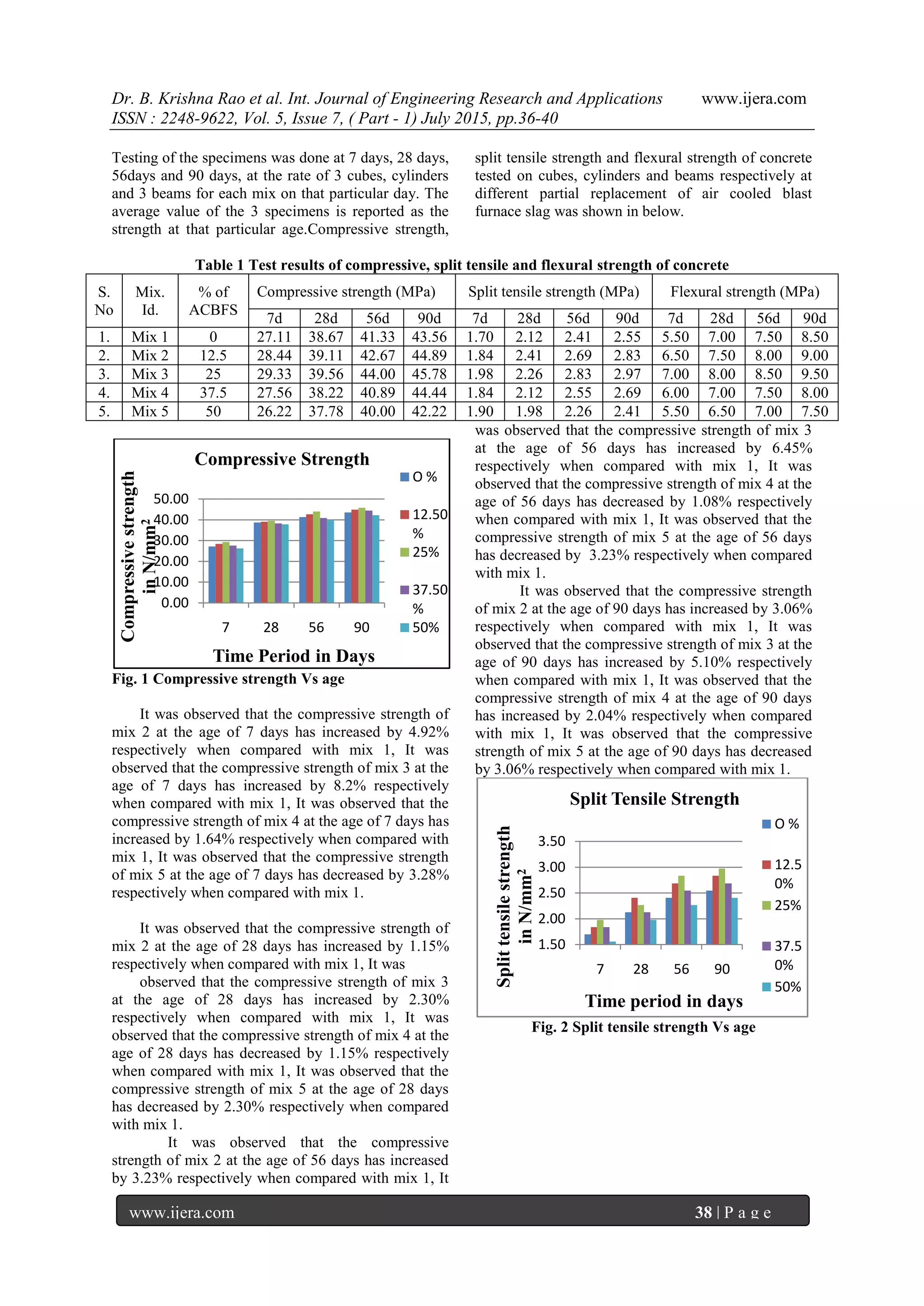
Fig. 3 Flexural strength Vs age
It was observed that the flexural strength of mix
2 at the age of 7 days has increased by 18.18%
respectively when compared with mix 1, It was
observed that the flexural strength of mix 3 at the age
of 7 days has increased by 27.27 % respectively when
compared with mix 1, It was observed that the
flexural strength of mix 4 at the age of 7 days has
increased by 9.09% respectively when compared with
mix 1, It was observed that the flexural strength of
mix 5 at the age of 7 days has increased by 0%
respectively when compared with mix 1.
It was observed that the flexural strength of
mix 2 at the age of 28 days has increased by 7.14%
respectively when compared with mix 1, It was
observed that the flexural strength of mix 3 at the age
of 28 days has increased by 14.29 % respectively
when compared with mix 1, It was observed that the
flexural strength of mix 4 at the age of 28 days has
increased by 0% respectively when compared with
mix 1, It was observed that the flexural strength of
mix 5 at the age of 28 days has decreased by 7.14%
respectively when compared with mix 1.
It was observed that the flexural strength of
mix 2 at the age of 56 days has increased by 6.67%
respectively when compared with mix 1, It was
observed that the flexural strength of mix 3 at the age
of 56 days has increased by 13.33 % respectively
when compared with mix 1, It was observed that the
flexural strength of mix 4 at the age of 56 days has
increased by 0% respectively when compared with
mix 1, It was observed that the flexural strength of
mix 5 at the age of 56 days has decreased by 6.67 %
respectively when compared with mix 1
It was observed that the flexural strength of mix
2 at the age of 90 days has increased by 5.88%
respectively when compared with mix 1, It was
observed that the flexural strength of mix 3 at the age
of 90 days has increased by 11.76 % respectively
when compared with mix 1, It was observed that the
flexural strength of mix 4 at the age of 90 days has
decreased by 5.88% respectively when compared with
mix 1, It was observed that the flexural strength of
mix 5 at the age of 90 days has decreased by 11.76%
respectively when compared with mix 1.
VII. Conclusion:
The following conclusions are drawn from the
present investigation:
 The Compressive strength of 7days, 28days,
56 days and 90 days has highest value for
25% replacement.
 The Split tensile strength of 7days, 56days
and 90 days has highest value for 25%
replacement.
5.00
6.00
7.00
8.00
9.00
10.00
7 28 56 90
Flexuralstrengthin
N/mm2
Time Period in days
Flexural Strength
O %
12.50
%
25%
37.50
%
50%
Dr. B. Krishna Rao et al. Int. Journal of Engineering Research and Applications www.ijera.com
ISSN : 2248-9622, Vol. 5, Issue 7, ( Part - 1) July 2015, pp.36-40
www.ijera.com 40 | P a g e
 The Split tensile strength of 28 days has
highest value for 12.5% replacement
 The flexural strength of 7days, 28days,
56days and 90 days has highest value for
25% replacement.
References
[1] B G Buddhdev, Dr. H R Varia
(2014),“Feasibility Study on Application of
Blast Furnace Slag in Pavement
Concrete.”International Journal of
Innovative Research in Science, Engineering
and Technology, Vol. 3, Issue 3, ISSN:
2319-8753.
[2] P.S.Kothai and R. Malathy (2013),
“Enhancement of Concrete properties by
Steel slag as a Partial Replacement Material
for Coarse Aggregates.” Australian Journal
of Basic and Applied Sciences, 7(12), Pages:
278-285.
[3] Manjit Kaur, Mr. Sanjeev Naval, (2012),
“Performance of Ground Granulated Blast
Furnace Slag Concrete with Partial
Replacement of Sand by Saw Dust.” IOSR
Journal of Mechanical and Civil Engineering
(IOSRJMCE) ISSN: 2278-1684 Volume 2,
Issue 6, PP 26-30.
[4] Tamilarasan V S and Perumal P (2012),
“Performance Study of Concrete using
GGBS as a Partial Replacement Material for
Cement.” European Journal of Scientific
Research, Vol. 88, No. 1, pp.155-163.
[5] Mohammed Nadeem and Pofale A D (2012),
“Replacement of Natural Fine Aggregate
with Granular Slag - A Waste Industrial By-
Product in Cement Mortar Applications as
Alternative Construction Materials.”
International Journal of Engineering
Research and Applications, Vol. 2, No. 5,
pp. 1258-1264.
[6] Nazari A., Riahi S. (2010), “Splitting tensile
strength of concrete using ground
granulated blast furnace slag and SiO2 nano
particles as binder.” Energy and Building
Vol. 43 pp 864-872.
[7] Ismail Z.Z., AL-Hashmi E.A. (2007),
“Reuse of waste iron as a partial
replacement of sand in concrete.” Waste
Management Vol. 28 pp 2048-2053.
[8] Pundhir N K S, Kamaraj C and Nanda P K
(2005), “Use of Copper Slag as
Construction Material in Bituminous
Pavement.” Journal of Scientific &
Industrial Research, Vol. 64, pp. 997-1002.
[9] Maslehuddin M., Sharif M. Aifarabi.,
Shameem M., Ibrahim M., Barry M.S.
(2002), “Comparison of properties of steel
slag and crushed limestone aggregate
concretes.” Construction and Building
Material Vol. 17 pp 105-112.
[10]Nataraja M C, Nagaraj T S and Ashok
Reddy (2001), “Proportioning Concrete
Mixes with Quarry Waste.” International
Journal of Cement, Concrete and
Aggregates, Vol. 23, No. 2, pp. 1-7.

Replacement of Natural Fine Aggregate With Air Cooled Blast Furnace Slag An Industrial By Product

  • 1.
    Dr. B. KrishnaRao et al. Int. Journal of Engineering Research and Applications www.ijera.com ISSN : 2248-9622, Vol. 5, Issue 7, ( Part - 1) July 2015, pp.36-40 www.ijera.com 36 | P a g e Replacement of Natural Fine Aggregate With Air Cooled Blast Furnace Slag An Industrial By Product Dr. B. Krishna Rao* , Dr.M.Swaroopa Rani** , A Siva Sai Teja*** (* Associate Professor, Department of Civil Engineering, J.N.T.U.K, KAKINADA, A.P; India,) ( ** Associate Professor, Department of Civil Engineering, J.N.T.U.K, KAKINADA, A.P; India,) ( *** P.G student, J.N.T. UNIVERSITY, KAKINADA, A.P, India) Abstract The aim of the investigation is to replace natural fine aggregatewith Air Cooled Blast Furnace Slag in OPC concrete. At present, nearly million tons of slag is being produced in the steel plants, in India. The generation of slag would be dual problem in disposal difficulty and environmental pollution. Some strategies should be used to utilize the slag effectively. Considering physical properties of metallurgical slags and a series of possibilities for their use in the field of civil constructions, this report demonstrates the possibilities of using air cooled blast furnace slag as partial replacement of sand in concrete. A total of five concrete mixes, containing 0%, 12.5%, 25%, 37.5% and 50% partial replacement of regular sand with air cooled blast furnace slag are investigated in the laboratory. These mixes were tested to determine axial compressive strength, split tensile strength, and flexural strength for 7days, 28days, 56days and 90days. Key Words: Fine aggregate, Blast Furnace Slag, Concrete, Workability and Strength. I. Introduction: Natural sand is the most commonly used building material in any part of the world and they sustain their status, because of demand, utilization and expansion of construction activity all over the world. Further among one of the challenge before the concrete construction industry is to satisfy the needs of human society, by the protection of environment and also by meeting the requirements of our growing population. The natural sand is the most scarcely available and restrictive intensive component of concrete. The production of concrete without any restriction can be increased by partially replacing natural sand with Air Cooled Blast Furnace Slag (ACBFS). During the manufacturing of steel and pig-iron, slag is generated as a by-product. It is produced by action of various fluxes and is closely mixed with, a wanted mineral in an ore deposit materials within the iron ore during the process of pig iron making in blast furnace and steel manufacturing in steel melting shop. Primarily, the slag consists of calcium, magnesium, manganese and aluminum silicates in various combinations. The cooling process of slag is responsible mainly for generating different types of slag required for various end-use consumers. Although, the chemical composition of slag may remain unchanged, physical properties vary widely with the changing process of cooling. There are economic, environmental, and social benefits derived from the effective use of ACBFS rather than disposing of it as waste. As a result, the beneficial use of ACBFS has broad positive impacts on sustainability, a consideration of increasing importance. First, the use of ACBFS makes economic sense for the iron producers, who financially benefit from the sale of the material while avoiding disposal costs, and it is also an economic benefit to the direct user of ACBFS (e.g., ready-mix producer, contractor), who obtains a reclaimed aggregate that is relatively inexpensive compared to most naturally derived material. Use of ACBFS also economically benefits the public, who realize overall cost savings due to the reduced price of the material during initial construction. II. Literature Review K V Subrahmanyam, U Arun Kumar and Dr. P V Satyanarayana (2014) They had studied the utilization of non-conventional waste materials like steel slag, copper slag, Scrap tyres, fly ash etc. in road construction activities which gradually gaining significant importance in India. Owing to the increase in construction cost of roads at an alarming rate there is an increase in the cost of conventional road materials. Steel slag is a waste material produced as a by-product during the oxidation of steel pellets in an electric arc furnace. This by-product can be used as replacement of aggregates in pavement layers. Due to increase in the motor vehicles day by day tends to increase in heaps of discarded rubber tyres. One of the main issues RESEARCH ARTICLE OPEN ACCESS
  • 2.
    Dr. B. KrishnaRao et al. Int. Journal of Engineering Research and Applications www.ijera.com ISSN : 2248-9622, Vol. 5, Issue 7, ( Part - 1) July 2015, pp.36-40 www.ijera.com 37 | P a g e associated with the management of scrap rubber tyres has been their proper disposal. A study was conducted to investigate the possibility of using Granulated Blast Furnace Slag (GBFS) and also with Waste Rubber Tyre (WRT) with various blended mixes of conventional aggregates in sub base layer with different percentages separately. Their study also presents the result of experimental investigation on the influence of Rice husk ash (RHA) on the index properties of Red soil which is used as filler material in sub base layer. Dr. K. Chinnaraju, V R Ramkumar, K Lineesh, S Nithya and V Sathish (2013) They had made an attempt to use steel slag, a by- product from steel industry as replacement for coarse aggregate in concrete and eco sand which is a commercial by-product of cement manufacturing process introduced by ACC Cements as fine aggregate replacement. Initial optimization of materials was done with 7 days strength. M30 grade of concrete was used. Possible optimum replacement of slag material was found to be 60% and possible optimum replacement for eco sand was found to be 40%.Tests on compressive strength, flexural strength, split tensile strength at 7 days and 28 days, and water absorption at 28 days were conducted on specimens. It was concluded that replacing some percentage of coarse aggregate with steel slag enhances the strength. The results showed that replacing about 60 percent of steel slag aggregates for coarse aggregate and 40percent of eco sand for fine aggregate will not have any adverse effect on the strength of the concrete. Manjit Kaur and Mr. Sanjeev Naval (2013) Had investigated on the effect of Ground granulated blast furnace slag and saw dust on the mechanical properties of concrete, when coarse aggregates is replaced by Ground granulated blast furnace slag and saw dust is replaced in different percentages i.e.0%, 5%, 10%, 15%, 20%, and 25% with the Fine aggregates (sand). The main parameters investigated were cube compressive strength and weight of concrete. The tests were conducted on concrete with ratio 1:1.5:3.The test results indicate that with the use of blast furnace slag by fully replacing coarse aggregates and partially replacing saw dust by fine aggregates in different percentages i.e. 0%, 5%, 10%, 15%, 20%, and 25%, the weight of concrete decreases with the increase in the percentage of saw dust. The compressive strength decrease with the increase in percentage of saw dust. The reduction percentage in the compressive strength is 27.14%, 44.16%,50.46%, 64%, 76.53%, 80.60% Replacement of sand by saw dust reduce the unit weight of concrete and make it light weight. The cost of concrete also decreases with the increase in percentage of saw dust. Test result show that, the concrete become lighter than conventional concrete and reducing the environmental hazard and making the concrete economical. III. Experimental Details It was proposed to investigate the properties of concrete, cast with partial replacement of fine aggregate with 0%, 12.5%, 25%, 37.5% and 50% proportions of ACBFS and cured in water for 7days, 28days, 56days, and 90days. In this experimental work, physical properties of materials used in the experimental work were determined. M30 grade of reference concrete was mixed and cured in potable water. 3.1 Properties of the materials 3.1.1 Cement: Ordinary Portland Cement (OPC) of 53 Grade (Hemadri cement) from a single lot was used throughout the course of the investigation. It was fresh and without any lumps. The specific gravity of cement obtained is 3.09 3.1.2 Fine Aggregate: The fine aggregate used is natural sand obtained from the river Godavari conforming to grading zone-II of IS: 10262-2009. The specific gravity and fineness modulus are 2.61 and 2.46 respectively. 3.1.3 Coarse Aggregate: Crushed granite angular aggregate of size 20mm are used and the aggregates are free from dust before used in the concrete. The specific gravity and fineness modulus are 2.70 and 8.83 respectively. 3.1.4 Water: This is the least expensive but most important ingredient of concrete. A good thumb rule to follow is that if water is pure enough for drinking it is suitable for mixing concrete.Locally available portable water was used for mixing and curing 3.1.5 Air Cooled Blast Furnace Slag: It is collected from Vizag steel plant, Vishakhapatnam, Andhra Pradesh. Specific gravity test was conducted for air cooled blast furnace slag and the result obtained is 2.52. IV. Specimen Details: Cube specimens of150 mm size for compressive strength, Cylinder specimens of 150 mm diameter x 300 mm height and prisms ofsize 100 mm x 100 mm x 500 mm were casted to study the mechanical strength properties such as compressivestrength, split tensile strength and flexural strength according to Indian standards. V. Mix Proportion: Cement: Fine aggregate: Coarse aggregate = 1: 1.809: 3.24 VI. Test Results: A total of 60 cubes, cylinders and beams were casted for the five mixes. i.e., for each mix 12 cubes, cylinders and beams were prepared respectively.
  • 3.
    Dr. B. KrishnaRao et al. Int. Journal of Engineering Research and Applications www.ijera.com ISSN : 2248-9622, Vol. 5, Issue 7, ( Part - 1) July 2015, pp.36-40 www.ijera.com 38 | P a g e Testing of the specimens was done at 7 days, 28 days, 56days and 90 days, at the rate of 3 cubes, cylinders and 3 beams for each mix on that particular day. The average value of the 3 specimens is reported as the strength at that particular age.Compressive strength, split tensile strength and flexural strength of concrete tested on cubes, cylinders and beams respectively at different partial replacement of air cooled blast furnace slag was shown in below. Table 1 Test results of compressive, split tensile and flexural strength of concrete Fig. 1 Compressive strength Vs age It was observed that the compressive strength of mix 2 at the age of 7 days has increased by 4.92% respectively when compared with mix 1, It was observed that the compressive strength of mix 3 at the age of 7 days has increased by 8.2% respectively when compared with mix 1, It was observed that the compressive strength of mix 4 at the age of 7 days has increased by 1.64% respectively when compared with mix 1, It was observed that the compressive strength of mix 5 at the age of 7 days has decreased by 3.28% respectively when compared with mix 1. It was observed that the compressive strength of mix 2 at the age of 28 days has increased by 1.15% respectively when compared with mix 1, It was observed that the compressive strength of mix 3 at the age of 28 days has increased by 2.30% respectively when compared with mix 1, It was observed that the compressive strength of mix 4 at the age of 28 days has decreased by 1.15% respectively when compared with mix 1, It was observed that the compressive strength of mix 5 at the age of 28 days has decreased by 2.30% respectively when compared with mix 1. It was observed that the compressive strength of mix 2 at the age of 56 days has increased by 3.23% respectively when compared with mix 1, It was observed that the compressive strength of mix 3 at the age of 56 days has increased by 6.45% respectively when compared with mix 1, It was observed that the compressive strength of mix 4 at the age of 56 days has decreased by 1.08% respectively when compared with mix 1, It was observed that the compressive strength of mix 5 at the age of 56 days has decreased by 3.23% respectively when compared with mix 1. It was observed that the compressive strength of mix 2 at the age of 90 days has increased by 3.06% respectively when compared with mix 1, It was observed that the compressive strength of mix 3 at the age of 90 days has increased by 5.10% respectively when compared with mix 1, It was observed that the compressive strength of mix 4 at the age of 90 days has increased by 2.04% respectively when compared with mix 1, It was observed that the compressive strength of mix 5 at the age of 90 days has decreased by 3.06% respectively when compared with mix 1. Fig. 2 Split tensile strength Vs age 0.00 10.00 20.00 30.00 40.00 50.00 7 28 56 90 Compressivestrength inN/mm2 Time Period in Days Compressive Strength O % 12.50 % 25% 37.50 % 50% 1.50 2.00 2.50 3.00 3.50 7 28 56 90 Splittensilestrength inN/mm2 Time period in days Split Tensile Strength O % 12.5 0% 25% 37.5 0% 50% S. No Mix. Id. % of ACBFS Compressive strength (MPa) Split tensile strength (MPa) Flexural strength (MPa) 7d 28d 56d 90d 7d 28d 56d 90d 7d 28d 56d 90d 1. Mix 1 0 27.11 38.67 41.33 43.56 1.70 2.12 2.41 2.55 5.50 7.00 7.50 8.50 2. Mix 2 12.5 28.44 39.11 42.67 44.89 1.84 2.41 2.69 2.83 6.50 7.50 8.00 9.00 3. Mix 3 25 29.33 39.56 44.00 45.78 1.98 2.26 2.83 2.97 7.00 8.00 8.50 9.50 4. Mix 4 37.5 27.56 38.22 40.89 44.44 1.84 2.12 2.55 2.69 6.00 7.00 7.50 8.00 5. Mix 5 50 26.22 37.78 40.00 42.22 1.90 1.98 2.26 2.41 5.50 6.50 7.00 7.50
  • 4.
    Dr. B. KrishnaRao et al. Int. Journal of Engineering Research and Applications www.ijera.com ISSN : 2248-9622, Vol. 5, Issue 7, ( Part - 1) July 2015, pp.36-40 www.ijera.com 39 | P a g e It was observed that the Split tensile strength of mix 2 at the age of 7 days has increased by 8.33% respectively when compared with mix 1, It was observed that the Split tensile strength of mix 3 at the age of 7 days has increased by 16.67 respectively when compared with mix 1, It was observed that the Split tensile strength of mix 4 at the age of 7 days has increased by 8.33% respectively when compared with mix 1, It was observed that the Split tensile strength of mix 5 at the age of 7 days has decreased by 8.33% respectively when compared with mix 1. It was observed that the Split tensile strength of mix 2 at the age of 28 days has increased by 13.33% respectively when compared with mix 1, It was observed that the Split tensile strength of mix 3 at the age of 28 days has increased by 6.67% respectively when compared with mix 1, It was observed that the Split tensile strength of mix 4 at the age of 28 days has increased by 0% respectively when compared with mix 1, It was observed that the Split tensile strength of mix 5 at the age of 28 days has decreased by 6.67% respectively when compared with mix 1. It was observed that the Split tensile strength of mix 2 at the age of 56 days has increased by 11.76% respectively when compared with mix 1, It was observed that the Split tensile strength of mix 3 at the age of 56 days has increased by 17.65 % respectively when compared with mix 1, It was observed that the Split tensile strength of mix 4 at the age of 56 days has increased by 5.88% respectively when compared with mix 1, It was observed that the Split tensile strength of mix 5 at the age of 56 days has decreased by 5.88% respectively when compared with mix 1 It was observed that the Split tensile strength of mix 2 at the age of 90 days has increased by 11.11% respectively when compared with mix 1, It was observed that the Split tensile strength of mix 3 at the age of 90 days has increased by 16.67 % respectively when compared with mix 1, It was observed that the Split tensile strength of mix 4 at the age of 90 days has increased by 5.56% respectively when compared with mix 1, It was observed that the Split tensile strength of mix 5 at the age of 90 days has decreased by 5.56% respectively when compared with mix 1. Fig. 3 Flexural strength Vs age It was observed that the flexural strength of mix 2 at the age of 7 days has increased by 18.18% respectively when compared with mix 1, It was observed that the flexural strength of mix 3 at the age of 7 days has increased by 27.27 % respectively when compared with mix 1, It was observed that the flexural strength of mix 4 at the age of 7 days has increased by 9.09% respectively when compared with mix 1, It was observed that the flexural strength of mix 5 at the age of 7 days has increased by 0% respectively when compared with mix 1. It was observed that the flexural strength of mix 2 at the age of 28 days has increased by 7.14% respectively when compared with mix 1, It was observed that the flexural strength of mix 3 at the age of 28 days has increased by 14.29 % respectively when compared with mix 1, It was observed that the flexural strength of mix 4 at the age of 28 days has increased by 0% respectively when compared with mix 1, It was observed that the flexural strength of mix 5 at the age of 28 days has decreased by 7.14% respectively when compared with mix 1. It was observed that the flexural strength of mix 2 at the age of 56 days has increased by 6.67% respectively when compared with mix 1, It was observed that the flexural strength of mix 3 at the age of 56 days has increased by 13.33 % respectively when compared with mix 1, It was observed that the flexural strength of mix 4 at the age of 56 days has increased by 0% respectively when compared with mix 1, It was observed that the flexural strength of mix 5 at the age of 56 days has decreased by 6.67 % respectively when compared with mix 1 It was observed that the flexural strength of mix 2 at the age of 90 days has increased by 5.88% respectively when compared with mix 1, It was observed that the flexural strength of mix 3 at the age of 90 days has increased by 11.76 % respectively when compared with mix 1, It was observed that the flexural strength of mix 4 at the age of 90 days has decreased by 5.88% respectively when compared with mix 1, It was observed that the flexural strength of mix 5 at the age of 90 days has decreased by 11.76% respectively when compared with mix 1. VII. Conclusion: The following conclusions are drawn from the present investigation:  The Compressive strength of 7days, 28days, 56 days and 90 days has highest value for 25% replacement.  The Split tensile strength of 7days, 56days and 90 days has highest value for 25% replacement. 5.00 6.00 7.00 8.00 9.00 10.00 7 28 56 90 Flexuralstrengthin N/mm2 Time Period in days Flexural Strength O % 12.50 % 25% 37.50 % 50%
  • 5.
    Dr. B. KrishnaRao et al. Int. Journal of Engineering Research and Applications www.ijera.com ISSN : 2248-9622, Vol. 5, Issue 7, ( Part - 1) July 2015, pp.36-40 www.ijera.com 40 | P a g e  The Split tensile strength of 28 days has highest value for 12.5% replacement  The flexural strength of 7days, 28days, 56days and 90 days has highest value for 25% replacement. References [1] B G Buddhdev, Dr. H R Varia (2014),“Feasibility Study on Application of Blast Furnace Slag in Pavement Concrete.”International Journal of Innovative Research in Science, Engineering and Technology, Vol. 3, Issue 3, ISSN: 2319-8753. [2] P.S.Kothai and R. Malathy (2013), “Enhancement of Concrete properties by Steel slag as a Partial Replacement Material for Coarse Aggregates.” Australian Journal of Basic and Applied Sciences, 7(12), Pages: 278-285. [3] Manjit Kaur, Mr. Sanjeev Naval, (2012), “Performance of Ground Granulated Blast Furnace Slag Concrete with Partial Replacement of Sand by Saw Dust.” IOSR Journal of Mechanical and Civil Engineering (IOSRJMCE) ISSN: 2278-1684 Volume 2, Issue 6, PP 26-30. [4] Tamilarasan V S and Perumal P (2012), “Performance Study of Concrete using GGBS as a Partial Replacement Material for Cement.” European Journal of Scientific Research, Vol. 88, No. 1, pp.155-163. [5] Mohammed Nadeem and Pofale A D (2012), “Replacement of Natural Fine Aggregate with Granular Slag - A Waste Industrial By- Product in Cement Mortar Applications as Alternative Construction Materials.” International Journal of Engineering Research and Applications, Vol. 2, No. 5, pp. 1258-1264. [6] Nazari A., Riahi S. (2010), “Splitting tensile strength of concrete using ground granulated blast furnace slag and SiO2 nano particles as binder.” Energy and Building Vol. 43 pp 864-872. [7] Ismail Z.Z., AL-Hashmi E.A. (2007), “Reuse of waste iron as a partial replacement of sand in concrete.” Waste Management Vol. 28 pp 2048-2053. [8] Pundhir N K S, Kamaraj C and Nanda P K (2005), “Use of Copper Slag as Construction Material in Bituminous Pavement.” Journal of Scientific & Industrial Research, Vol. 64, pp. 997-1002. [9] Maslehuddin M., Sharif M. Aifarabi., Shameem M., Ibrahim M., Barry M.S. (2002), “Comparison of properties of steel slag and crushed limestone aggregate concretes.” Construction and Building Material Vol. 17 pp 105-112. [10]Nataraja M C, Nagaraj T S and Ashok Reddy (2001), “Proportioning Concrete Mixes with Quarry Waste.” International Journal of Cement, Concrete and Aggregates, Vol. 23, No. 2, pp. 1-7.