


Gene TherapyGene Therapy
By
Mostafa A. Askar
Definition of Gene Therapy
Aim of Gene Therapy
DNA delivery in Gene Therapy; How & With What
General Principles of Gene Therapy
Gene Therapy Approach
Gene Therapy Problems
Inherited Diseases Treated by Gene Therapy; Trails
Types of Gene Therapy
Definition of Gene Therapy
Aim of Gene Therapy
DNA delivery in Gene Therapy; How & With What
General Principles of Gene Therapy
Gene Therapy Approach
Gene Therapy Problems
Inherited Diseases Treated by Gene Therapy; Trails
Types of Gene Therapy
Gene Therapy: is the insertion,
alteration, or removal of genes within an
individual's cells and biological tissues
to treat disease.
It is a technique for correcting defective
genes.
Definition of Gene Therapy
Aim of Gene Therapy
DNA delivery in Gene Therapy; How & With What
General Principles of Gene Therapy
Gene Therapy Approach
Gene Therapy Problems
Inherited Diseases Treated by Gene Therapy; Trails
Types of Gene Therapy
Aim of Gene Therapy
The most common form of gene therapy
involves the insertion of functional genes into
an unspecified genomic location in order to
replace a mutated gene, but other forms
involve directly correcting the mutation or
modifying normal gene that
enables a viral infection.
Definition of Gene Therapy
Aim of Gene Therapy
DNA delivery in Gene Therapy; How & With What
General Principles of Gene Therapy
Gene Therapy Approach
Gene Therapy Problems
Inherited Diseases Treated by Gene Therapy; Trails
Types of Gene Therapy
 Somatic gene therapy
 In Utero gene therapy
 Germ line gene therapy
Types of gene therapy
In the case of somatic gene therapy, the
therapeutic genes are transferred into
the somatic cells of a patient. Any
modifications and effects will be
restricted to the individual patient only,
and will not be inherited by the patient's
offspring or later generations.
Somatic gene therapy
InIn UteroUtero gene therapygene therapy
It involves gene therapy of fetuses
whilst in the womb. There is some
concern that the germline
will be affected.
In this case; Germ cells (Ex. sperm or
eggs) are modified by the introduction
of functional genes, which are
integrated into their genomes.
Therefore, the change due to therapy
would be heritable and would be passed
on to later generations.
Germ line gene therapy
Definition of Gene Therapy
Aim of Gene Therapy
DNA delivery in Gene Therapy; How & With What
General Principles of Gene Therapy
Gene Therapy Approach
Gene Therapy Problems
Inherited Diseases Treated by Gene Therapy; Trails
Types of Gene Therapy
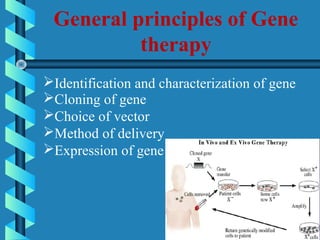
General principles of Gene
therapy
Identification and characterization of gene
Cloning of gene
Choice of vector
Method of delivery
Expression of gene
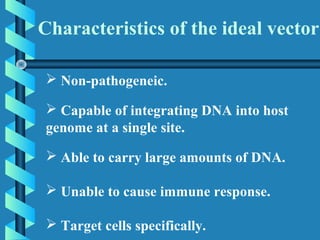
 Non-pathogeneic.
 Capable of integrating DNA into host
genome at a single site.
 Able to carry large amounts of DNA.
 Unable to cause immune response.
 Target cells specifically.
Characteristics of the ideal vector
Definition of Gene Therapy
Aim of Gene Therapy
DNA delivery in Gene Therapy; How & With What
General Principles of Gene Therapy
Gene Therapy Approach
Gene Therapy Problems
Inherited Diseases Treated by Gene Therapy; Trails
Types of Gene Therapy
 Viral vectors.
 Non-viral delivery.
DNA delivery is mainly
accomplished by either:
Vectors
Adeno virusesAdeno viruses
Adeno Asso ciated virusesAdeno Asso ciated viruses
Reto virusesReto viruses
Herpes Simplex virusesHerpes Simplex viruses
* dsDNA Viruses.* dsDNA Viruses.
* Non-integrating viruses.* Non-integrating viruses.
* Infect dividing & non-dividing* Infect dividing & non-dividing
cells.cells.
AdenovirusesAdenoviruses
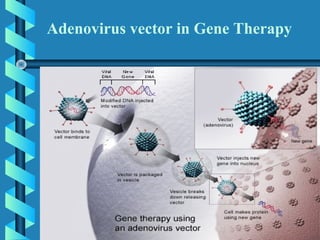
Adenovirus vector in Gene Therapy
Adenoviruses AdvantagesAdenoviruses Advantages
* Non-oncogenic.* Non-oncogenic.
* Relatively easy to culture.* Relatively easy to culture.
* Proteins functions are known.* Proteins functions are known.
* Complete DNA sequence is* Complete DNA sequence is
available.available.
Adenoviruses Disadvantages
Transient expression leads to
multiple
* RNA Viruses.* RNA Viruses.
* Incorporating Viruses.* Incorporating Viruses.
* Infect dividing cells.* Infect dividing cells.
Retroviruses
* Infect* Infect ONLYONLY dividing cellsdividing cells
* Integration israndom, causing* Integration israndom, causing
““ Insertio nalMutgenesisInsertio nalMutgenesis”.”.
Retroviruses
Disadvantages
* Their ability to integratein host DNA.
Advantages
Non-viral delivery in
gene therapy
Particle bombardment
Receptor-mediated uptake
Liposomes
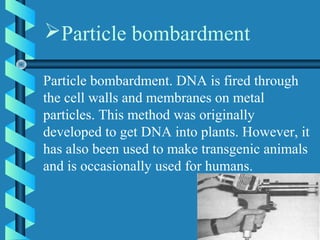
Particle bombardment. DNA is fired through
the cell walls and membranes on metal
particles. This method was originally
developed to get DNA into plants. However, it
has also been used to make transgenic animals
and is occasionally used for humans.
Particle bombardment
Receptor-mediated uptake. DNA
is attached to a protein that is
recognized by a cell surface
receptor. When the protein enters
the cell, the DNA is taken in with
it.
Receptor-mediated uptake
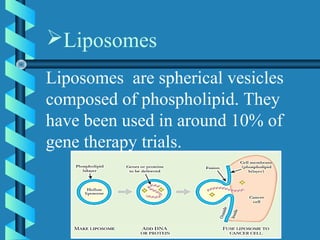
Liposomes are spherical vesicles
composed of phospholipid. They
have been used in around 10% of
gene therapy trials.
Liposomes
Definition of Gene Therapy
Aim of Gene Therapy
DNA delivery in Gene Therapy; How & With What
General Principles of Gene Therapy
Gene Therapy Approach
Gene Therapy Problems
Inherited Diseases Treated by Gene Therapy; Trails
Types of Gene Therapy
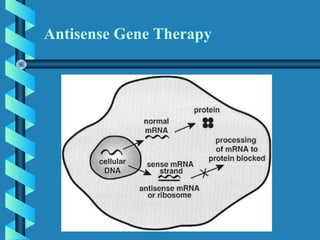
Antisense Gene Therapy
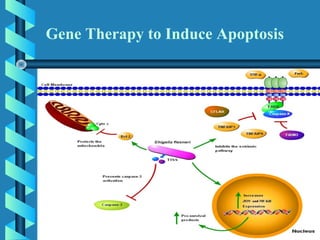
Gene Therapy to Induce Apoptosis
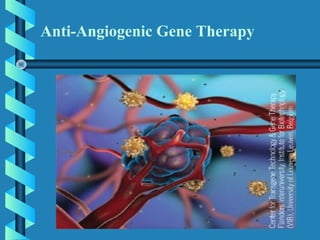
Anti-Angiogenic Gene Therapy
Definition of Gene Therapy
Aim of Gene Therapy
DNA delivery in Gene Therapy; How & With What
General Principles of Gene Therapy
Gene Therapy Approach
Gene Therapy Problems
Inherited Diseases Treated by Gene Therapy; Trails
Types of Gene Therapy
1.1. Short LivedShort Lived
2. Immune Response2. Immune Response
3. Viral Vectors3. Viral Vectors
– may cause disease once insidemay cause disease once inside
Problems with GeneProblems with Gene
TherapyTherapy
4. Multigene Disorders4. Multigene Disorders
– Heart disease, high blood pressure,Heart disease, high blood pressure,
Alzheimer’s, arthritis and diabetesAlzheimer’s, arthritis and diabetes
are hard to treat because you need toare hard to treat because you need to
introduce more than one geneintroduce more than one gene
5. May induce a tumor if integrated in5. May induce a tumor if integrated in
a tumor suppressor gene becausea tumor suppressor gene because
insertional mutagenesisinsertional mutagenesis
Problems with GeneProblems with Gene
TherapyTherapy
Definition of Gene Therapy
Aim of Gene Therapy
DNA delivery in Gene Therapy; How & With What
General Principles of Gene Therapy
Gene Therapy Approach
Gene Therapy Problems
Inherited Diseases Treated by Gene Therapy; Trails
Types of Gene Therapy
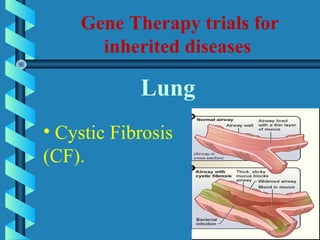
Gene Therapy trials for
inherited diseases
Lung
• Cystic Fibrosis
(CF).
Diseases Treated by Gene
Therapy
Bone Marrow Adenosene
DeaminaseDeficency(ADA)
Brain (Alzheimer’sdisease)
Liver(Factor VIII deficiency.)
Questions?Questions?

Gene therapy

  • 2.
  • 3.
    Definition of GeneTherapy Aim of Gene Therapy DNA delivery in Gene Therapy; How & With What General Principles of Gene Therapy Gene Therapy Approach Gene Therapy Problems Inherited Diseases Treated by Gene Therapy; Trails Types of Gene Therapy
  • 4.
    Definition of GeneTherapy Aim of Gene Therapy DNA delivery in Gene Therapy; How & With What General Principles of Gene Therapy Gene Therapy Approach Gene Therapy Problems Inherited Diseases Treated by Gene Therapy; Trails Types of Gene Therapy
  • 5.
    Gene Therapy: isthe insertion, alteration, or removal of genes within an individual's cells and biological tissues to treat disease. It is a technique for correcting defective genes. Definition of Gene Therapy
  • 6.
    Definition of GeneTherapy Aim of Gene Therapy DNA delivery in Gene Therapy; How & With What General Principles of Gene Therapy Gene Therapy Approach Gene Therapy Problems Inherited Diseases Treated by Gene Therapy; Trails Types of Gene Therapy
  • 7.
    Aim of GeneTherapy The most common form of gene therapy involves the insertion of functional genes into an unspecified genomic location in order to replace a mutated gene, but other forms involve directly correcting the mutation or modifying normal gene that enables a viral infection.
  • 8.
    Definition of GeneTherapy Aim of Gene Therapy DNA delivery in Gene Therapy; How & With What General Principles of Gene Therapy Gene Therapy Approach Gene Therapy Problems Inherited Diseases Treated by Gene Therapy; Trails Types of Gene Therapy
  • 9.
     Somatic genetherapy  In Utero gene therapy  Germ line gene therapy Types of gene therapy
  • 10.
    In the caseof somatic gene therapy, the therapeutic genes are transferred into the somatic cells of a patient. Any modifications and effects will be restricted to the individual patient only, and will not be inherited by the patient's offspring or later generations. Somatic gene therapy
  • 11.
    InIn UteroUtero genetherapygene therapy It involves gene therapy of fetuses whilst in the womb. There is some concern that the germline will be affected.
  • 12.
    In this case;Germ cells (Ex. sperm or eggs) are modified by the introduction of functional genes, which are integrated into their genomes. Therefore, the change due to therapy would be heritable and would be passed on to later generations. Germ line gene therapy
  • 13.
    Definition of GeneTherapy Aim of Gene Therapy DNA delivery in Gene Therapy; How & With What General Principles of Gene Therapy Gene Therapy Approach Gene Therapy Problems Inherited Diseases Treated by Gene Therapy; Trails Types of Gene Therapy
  • 14.
    General principles ofGene therapy Identification and characterization of gene Cloning of gene Choice of vector Method of delivery Expression of gene
  • 15.
     Non-pathogeneic.  Capableof integrating DNA into host genome at a single site.  Able to carry large amounts of DNA.  Unable to cause immune response.  Target cells specifically. Characteristics of the ideal vector
  • 16.
    Definition of GeneTherapy Aim of Gene Therapy DNA delivery in Gene Therapy; How & With What General Principles of Gene Therapy Gene Therapy Approach Gene Therapy Problems Inherited Diseases Treated by Gene Therapy; Trails Types of Gene Therapy
  • 17.
     Viral vectors. Non-viral delivery. DNA delivery is mainly accomplished by either:
  • 18.
    Vectors Adeno virusesAdeno viruses AdenoAsso ciated virusesAdeno Asso ciated viruses Reto virusesReto viruses Herpes Simplex virusesHerpes Simplex viruses
  • 19.
    * dsDNA Viruses.*dsDNA Viruses. * Non-integrating viruses.* Non-integrating viruses. * Infect dividing & non-dividing* Infect dividing & non-dividing cells.cells. AdenovirusesAdenoviruses
  • 20.
  • 21.
    Adenoviruses AdvantagesAdenoviruses Advantages *Non-oncogenic.* Non-oncogenic. * Relatively easy to culture.* Relatively easy to culture. * Proteins functions are known.* Proteins functions are known. * Complete DNA sequence is* Complete DNA sequence is available.available. Adenoviruses Disadvantages Transient expression leads to multiple
  • 22.
    * RNA Viruses.*RNA Viruses. * Incorporating Viruses.* Incorporating Viruses. * Infect dividing cells.* Infect dividing cells. Retroviruses
  • 23.
    * Infect* InfectONLYONLY dividing cellsdividing cells * Integration israndom, causing* Integration israndom, causing ““ Insertio nalMutgenesisInsertio nalMutgenesis”.”. Retroviruses Disadvantages * Their ability to integratein host DNA. Advantages
  • 24.
    Non-viral delivery in genetherapy Particle bombardment Receptor-mediated uptake Liposomes
  • 25.
    Particle bombardment. DNAis fired through the cell walls and membranes on metal particles. This method was originally developed to get DNA into plants. However, it has also been used to make transgenic animals and is occasionally used for humans. Particle bombardment
  • 26.
    Receptor-mediated uptake. DNA isattached to a protein that is recognized by a cell surface receptor. When the protein enters the cell, the DNA is taken in with it. Receptor-mediated uptake
  • 27.
    Liposomes are sphericalvesicles composed of phospholipid. They have been used in around 10% of gene therapy trials. Liposomes
  • 28.
    Definition of GeneTherapy Aim of Gene Therapy DNA delivery in Gene Therapy; How & With What General Principles of Gene Therapy Gene Therapy Approach Gene Therapy Problems Inherited Diseases Treated by Gene Therapy; Trails Types of Gene Therapy
  • 29.
  • 30.
    Gene Therapy toInduce Apoptosis
  • 31.
  • 32.
    Definition of GeneTherapy Aim of Gene Therapy DNA delivery in Gene Therapy; How & With What General Principles of Gene Therapy Gene Therapy Approach Gene Therapy Problems Inherited Diseases Treated by Gene Therapy; Trails Types of Gene Therapy
  • 33.
    1.1. Short LivedShortLived 2. Immune Response2. Immune Response 3. Viral Vectors3. Viral Vectors – may cause disease once insidemay cause disease once inside Problems with GeneProblems with Gene TherapyTherapy
  • 34.
    4. Multigene Disorders4.Multigene Disorders – Heart disease, high blood pressure,Heart disease, high blood pressure, Alzheimer’s, arthritis and diabetesAlzheimer’s, arthritis and diabetes are hard to treat because you need toare hard to treat because you need to introduce more than one geneintroduce more than one gene 5. May induce a tumor if integrated in5. May induce a tumor if integrated in a tumor suppressor gene becausea tumor suppressor gene because insertional mutagenesisinsertional mutagenesis Problems with GeneProblems with Gene TherapyTherapy
  • 35.
    Definition of GeneTherapy Aim of Gene Therapy DNA delivery in Gene Therapy; How & With What General Principles of Gene Therapy Gene Therapy Approach Gene Therapy Problems Inherited Diseases Treated by Gene Therapy; Trails Types of Gene Therapy
  • 36.
    Gene Therapy trialsfor inherited diseases Lung • Cystic Fibrosis (CF).
  • 37.
    Diseases Treated byGene Therapy Bone Marrow Adenosene DeaminaseDeficency(ADA) Brain (Alzheimer’sdisease) Liver(Factor VIII deficiency.)
  • 38.