
Diacylglycerol pathway
Presented By;
Sohil shah
M Pharm 1st year
pharmacology
School of Pharmacy,
Swami Ramanand Teerth Marathwada University, Nanded.
01
CONTENTS
 Introduction
 Pathway for Activation of protein kinase C
 Pathway for Regulation of insulin secretion
 Function
 References
02
INTRODUCTION
 Diacylglycerol (DAG) is a lipid signal messenger which is an essential secondary
messenger in mammalian cells
 The level of DAG is regulated by diacylglycerol kinase (D GK) , diacylglycerol lipase
(DGL), or diacylglycerol acyltransferase (DGAT).
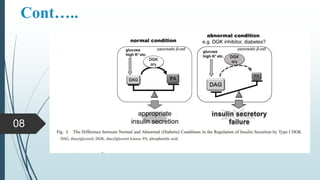
 Among this DGK which phosphorylates DAG to phosphatidic acid which is the dominant
enzyme responsible for DAG metabolism
 Some recent studies shows that alpha and gamma DGK acts as a positive regulators of
insulin secretion.
03
Activation of protein kinase c
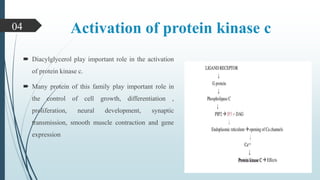
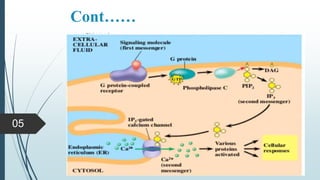
 Diacylglycerol play important role in the activation
of protein kinase c.
 Many protein of this family play important role in
the control of cell growth, differentiation ,
proliferation, neural development, synaptic
transmission, smooth muscle contraction and gene
expression
04
Cont……
05
Regulation of insulin secretion
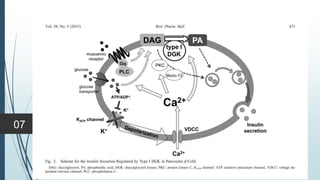
 alpha and gamma DGK are mainly responsible for the insulin secretion
 It increase the concentration of calcium ion in pancreatic beta cell for the release of
insulin
 It also stimulate the muscarinic receptor and increase the concentration of glucose in
the cell which is necessary for the secretion of insulin.
06
Pre-anesthetic agents
07
Cont…..
08
Function of DAG
 A source for PG
 Regulation of insulin
 Activation of protein kinase c
 DAG also have some role in the secretion of TRH and oxytocin
09
REFERENCES
 1) Baldanzi G. Inhibition of diacylglycerol kinases as a physiologi- cal way to promote
diacylglycerol signaling. Adv. Biol. Regul., 55, 39–49 (2014)
 2) Peter-Riesch B, Fathi M, Schlegel W, Wollheim CB. Glucose and carbachol generate
1,2-diacylglycerols by different mechanisms in pancreatic islets. J. Clin. Invest., 81, 1154–
1161 (1988).
 3) internet.
10
THANK YOU
11

Diacylglycerol pathway

  • 1.
    Diacylglycerol pathway Presented By; Sohilshah M Pharm 1st year pharmacology School of Pharmacy, Swami Ramanand Teerth Marathwada University, Nanded. 01
  • 2.
    CONTENTS  Introduction  Pathwayfor Activation of protein kinase C  Pathway for Regulation of insulin secretion  Function  References 02
  • 3.
    INTRODUCTION  Diacylglycerol (DAG)is a lipid signal messenger which is an essential secondary messenger in mammalian cells  The level of DAG is regulated by diacylglycerol kinase (D GK) , diacylglycerol lipase (DGL), or diacylglycerol acyltransferase (DGAT).  Among this DGK which phosphorylates DAG to phosphatidic acid which is the dominant enzyme responsible for DAG metabolism  Some recent studies shows that alpha and gamma DGK acts as a positive regulators of insulin secretion. 03
  • 4.
    Activation of proteinkinase c  Diacylglycerol play important role in the activation of protein kinase c.  Many protein of this family play important role in the control of cell growth, differentiation , proliferation, neural development, synaptic transmission, smooth muscle contraction and gene expression 04
  • 5.
  • 6.
    Regulation of insulinsecretion  alpha and gamma DGK are mainly responsible for the insulin secretion  It increase the concentration of calcium ion in pancreatic beta cell for the release of insulin  It also stimulate the muscarinic receptor and increase the concentration of glucose in the cell which is necessary for the secretion of insulin. 06
  • 7.
  • 8.
  • 9.
    Function of DAG A source for PG  Regulation of insulin  Activation of protein kinase c  DAG also have some role in the secretion of TRH and oxytocin 09
  • 10.
    REFERENCES  1) BaldanziG. Inhibition of diacylglycerol kinases as a physiologi- cal way to promote diacylglycerol signaling. Adv. Biol. Regul., 55, 39–49 (2014)  2) Peter-Riesch B, Fathi M, Schlegel W, Wollheim CB. Glucose and carbachol generate 1,2-diacylglycerols by different mechanisms in pancreatic islets. J. Clin. Invest., 81, 1154– 1161 (1988).  3) internet. 10
  • 11.