Download to read offline
![EAS statistics in knee region
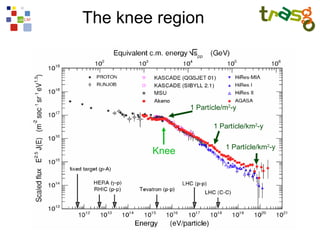
Mass of the primary cosmic ray vs energy measured in different experiments
[CCOU02]
The scatter plot of the average logarithm of the nuclear
mass number of the primary cosmic rays versus energy
clearly shows the need for more input from accelerators.](https://image.slidesharecdn.com/gkornakoveasmultivariateanalysis-100213135549-phpapp01/85/G-Kornakov-Ea-Smultivariate-Analysis-4-320.jpg)
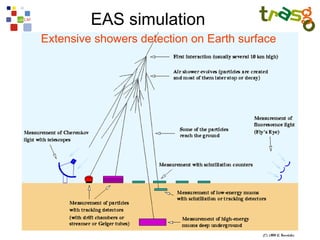
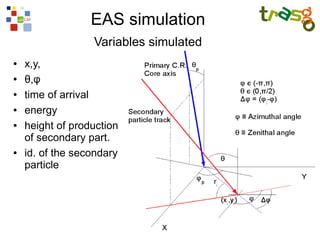
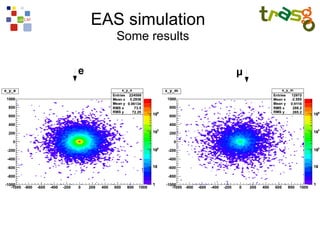
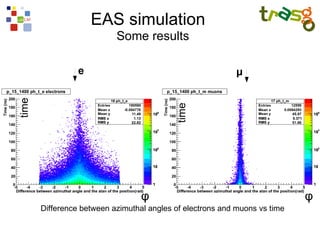
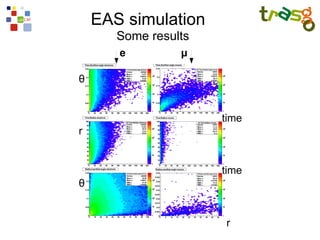
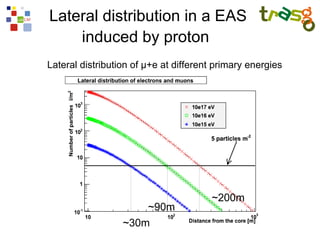
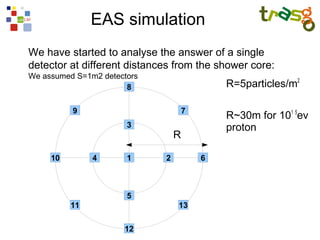
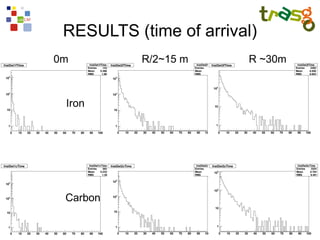
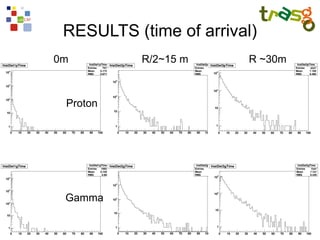
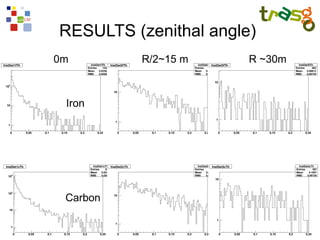
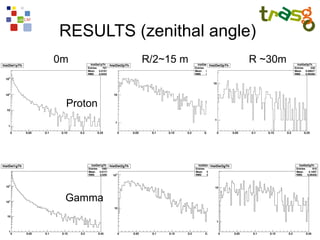
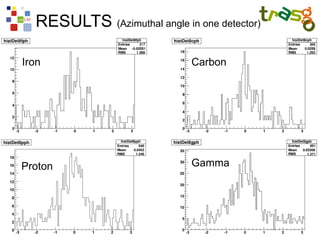

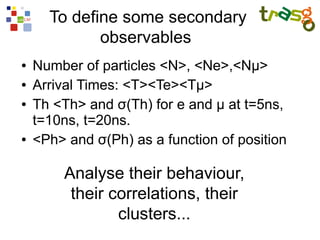
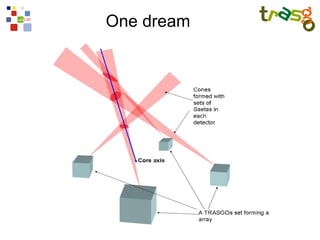
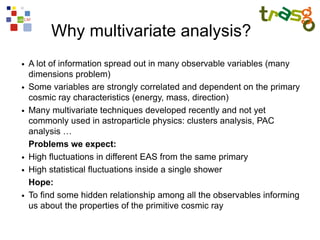



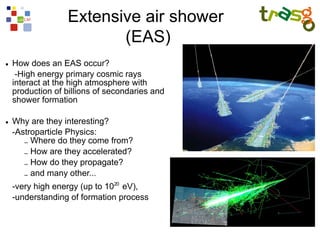
The document summarizes a simulation of extensive air showers (EAS) using the AIRES code. Key results include: 1) Simulations of EAS were conducted for primaries of protons, carbon, iron, and gamma rays with energies of 1015 eV in the "knee" region. 2) Observables like particle type, arrival time, zenith angle, and azimuthal angle were recorded for electrons and muons at varying distances from the shower core. 3) Preliminary analysis of arrival times and angular distributions shows differences between primaries that could help identify the primary particle. 4) Further multivariate analysis of correlations between observables may provide hidden insights into the primary cosmic ray


![[L'angolo del PhD] Alessandro Palma - XXII Ciclo - 2009](https://cdn.slidesharecdn.com/ss_thumbnails/palmasem2009-110224030932-phpapp01-thumbnail.jpg?width=640&height=640&fit=bounds)


