Detecting EAS with TRASGOs
        -a simulation-


               G. Kornakov
      February, 2010, Santiago de Compostela
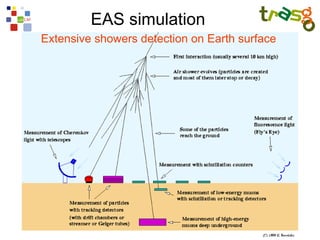
Extensive air shower
                         (EAS)
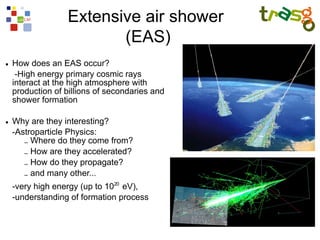
●   How does an EAS occur?
     -High energy primary cosmic rays
    interact at the high atmosphere with
    production of billions of secondaries and
    shower formation

●   Why are they interesting?
    -Astroparticle Physics:
       – Where do they come from?
       – How are they accelerated?
       – How do they propagate?
       – and many other...
    -very high energy (up to 1020 eV),
    -understanding of formation process
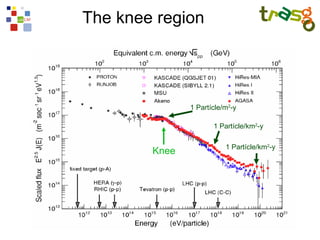
The knee region


               1 Partícle/m2-y

                      1 Partícle/km2-y

                          1 Partícle/km2-y
        Knee
EAS statistics in knee region
Mass of the primary cosmic ray vs energy measured in different experiments


            [CCOU02]


          The scatter plot of the average logarithm of the nuclear
         mass number of the primary cosmic rays versus energy
         clearly shows the need for more input from accelerators.
EAS simulation
  Extensive showers detection on Earth surface


                   Code: AIRES

            Simulations characteristics:

-energy: 1015 eV (Knee region)
-primary particles: P,C,Fe,Gammas
-depth of first interaction:30g/cm2
-number of simulations: 100 for each case.
-height of measurement plane: 1400 m
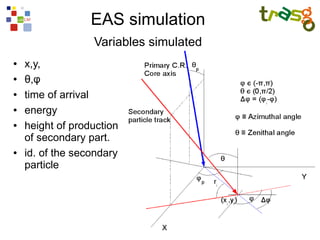
EAS simulation
                  Variables simulated
●   x,y,
●   θ,φ
●   time of arrival
●   energy
●   height of production
    of secondary part.
●   id. of the secondary
    particle
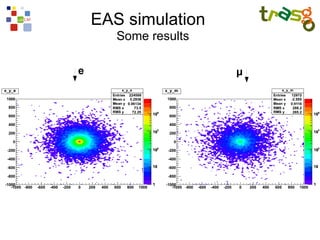
EAS simulation
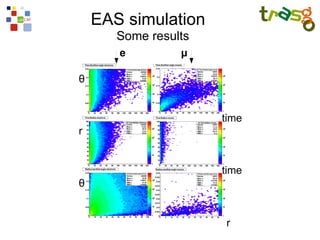
       Some results

e                     μ
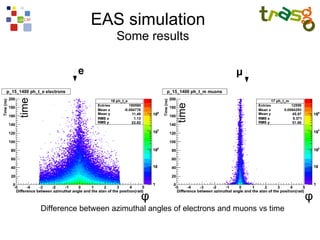
EAS simulation
                           Some results

                 e                                         μ
time


                                           time
                                  φ                                         φ
       Difference between azimuthal angles of electrons and muons vs time
EAS simulation
       Some results
       e         μ

θ


                      time
r


                      time
θ


                      r
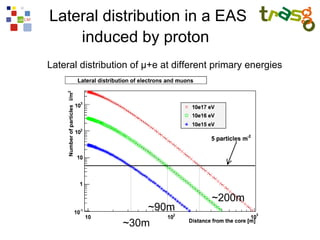
Lateral distribution in a EAS
    induced by proton
Lateral distribution of μ+e at different primary energies


                                       ~200m
                      ~90m
                  ~30m
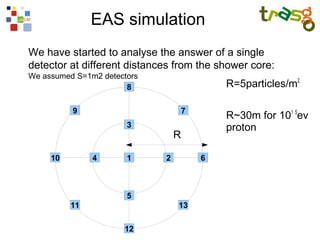
EAS simulation
We have started to analyse the answer of a single
detector at different distances from the shower core:
We assumed S=1m2 detectors
                       8                     R=5particles/m2

          9                          7
                                             R~30m for 101 5ev
                       3                     proton
                                 R

     10        4       1     2           6


                       5
          11                     13

                      12
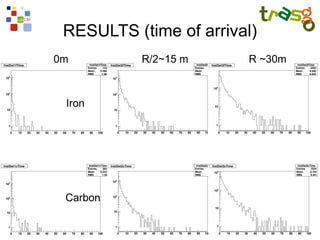
RESULTS (time of arrival)
0m         R/2~15 m     R ~30m


 Iron


 Carbon
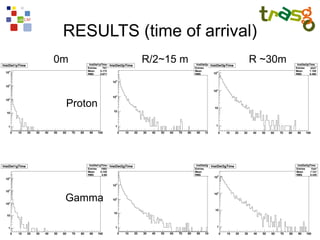
RESULTS (time of arrival)
0m         R/2~15 m     R ~30m


 Proton


 Gamma
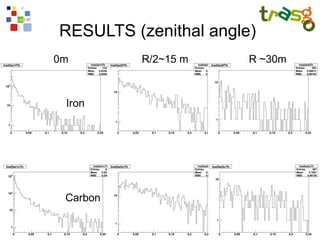
RESULTS (zenithal angle)
0m        R/2~15 m     R ~30m


 Iron


 Carbon
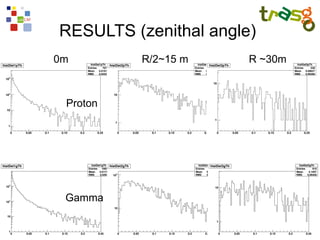
RESULTS (zenithal angle)
0m        R/2~15 m     R ~30m


 Proton


 Gamma
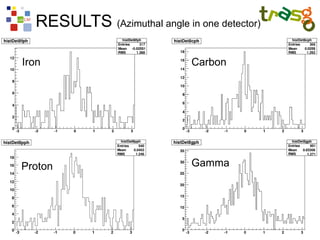
RESULTS (Azimuthal angle in one detector)

Iron                          Carbon


Proton                        Gamma
NEXT STEPS
To define some secondary
             observables
●   Number of particles <N>, <Ne>,<Nμ>
●   Arrival Times: <T><Te><Tμ>
●   Th <Th> and σ(Th) for e and μ at t=5ns,
    t=10ns, t=20ns.
●   <Ph> and σ(Ph) as a function of position

        Analyse their behaviour,
         their correlations, their
                clusters...
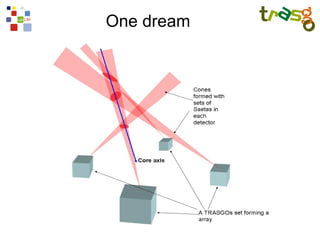
One dream
Why multivariate analysis?
●   A lot of information spread out in many observable variables (many
    dimensions problem)
●   Some variables are strongly correlated and dependent on the primary
    cosmic ray characteristics (energy, mass, direction)
●   Many multivariate techniques developed recently and not yet
    commonly used in astroparticle physics: clusters analysis, PAC
    analysis …
    Problems we expect:
●   High fluctuations in different EAS from the same primary
●   High statistical fluctuations inside a single shower
    Hope:
●   To find some hidden relationship among all the observables informing
    us about the properties of the primitive cosmic ray
Still a lot of work
Acknowledgments

especially want to thank R.Vázquez for his
help with the simulations

G Kornakov E A Smultivariate Analysis

  • 1.
    Detecting EAS withTRASGOs -a simulation- G. Kornakov February, 2010, Santiago de Compostela
  • 2.
    Extensive air shower (EAS) ● How does an EAS occur? -High energy primary cosmic rays interact at the high atmosphere with production of billions of secondaries and shower formation ● Why are they interesting? -Astroparticle Physics: – Where do they come from? – How are they accelerated? – How do they propagate? – and many other... -very high energy (up to 1020 eV), -understanding of formation process
  • 3.
    The knee region 1 Partícle/m2-y 1 Partícle/km2-y 1 Partícle/km2-y Knee
  • 4.
    EAS statistics inknee region Mass of the primary cosmic ray vs energy measured in different experiments [CCOU02] The scatter plot of the average logarithm of the nuclear mass number of the primary cosmic rays versus energy clearly shows the need for more input from accelerators.
  • 5.
    EAS simulation Extensive showers detection on Earth surface Code: AIRES Simulations characteristics: -energy: 1015 eV (Knee region) -primary particles: P,C,Fe,Gammas -depth of first interaction:30g/cm2 -number of simulations: 100 for each case. -height of measurement plane: 1400 m
  • 6.
    EAS simulation Variables simulated ● x,y, ● θ,φ ● time of arrival ● energy ● height of production of secondary part. ● id. of the secondary particle
  • 7.
    EAS simulation Some results e μ
  • 8.
    EAS simulation Some results e μ time time φ φ Difference between azimuthal angles of electrons and muons vs time
  • 9.
    EAS simulation Some results e μ θ time r time θ r
  • 10.
    Lateral distribution ina EAS induced by proton Lateral distribution of μ+e at different primary energies ~200m ~90m ~30m
  • 11.
    EAS simulation We havestarted to analyse the answer of a single detector at different distances from the shower core: We assumed S=1m2 detectors 8 R=5particles/m2 9 7 R~30m for 101 5ev 3 proton R 10 4 1 2 6 5 11 13 12
  • 12.
    RESULTS (time ofarrival) 0m R/2~15 m R ~30m Iron Carbon
  • 13.
    RESULTS (time ofarrival) 0m R/2~15 m R ~30m Proton Gamma
  • 14.
    RESULTS (zenithal angle) 0m R/2~15 m R ~30m Iron Carbon
  • 15.
    RESULTS (zenithal angle) 0m R/2~15 m R ~30m Proton Gamma
  • 16.
    RESULTS (Azimuthal anglein one detector) Iron Carbon Proton Gamma
  • 17.
  • 18.
    To define somesecondary observables ● Number of particles <N>, <Ne>,<Nμ> ● Arrival Times: <T><Te><Tμ> ● Th <Th> and σ(Th) for e and μ at t=5ns, t=10ns, t=20ns. ● <Ph> and σ(Ph) as a function of position Analyse their behaviour, their correlations, their clusters...
  • 19.
  • 20.
    Why multivariate analysis? ● A lot of information spread out in many observable variables (many dimensions problem) ● Some variables are strongly correlated and dependent on the primary cosmic ray characteristics (energy, mass, direction) ● Many multivariate techniques developed recently and not yet commonly used in astroparticle physics: clusters analysis, PAC analysis … Problems we expect: ● High fluctuations in different EAS from the same primary ● High statistical fluctuations inside a single shower Hope: ● To find some hidden relationship among all the observables informing us about the properties of the primitive cosmic ray
  • 21.
    Still a lotof work
  • 22.
    Acknowledgments especially want tothank R.Vázquez for his help with the simulations