Reduction of saetas W.González-Manteiga and C. Sánchez-Sellero Department of Statistics and Operations Research University of Santiago de Compostela
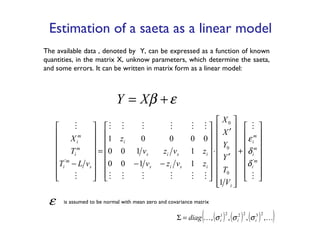
Estimation of a saeta as a linear model The available data , denoted by  Y, can be expressed as a function of known quantities, in the matrix X, unknow parameters, which determine the saeta, and some errors. It can be written in matrix form as a linear model: is assumed to be normal with mean zero and covariance matrix
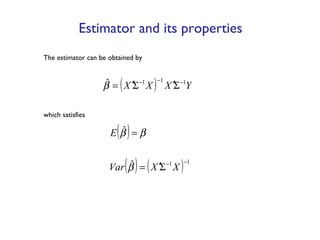
Estimator and its properties The estimator can be obtained by which satisfies
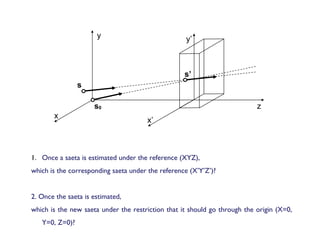
Once a saeta is estimated under the reference (XYZ), which is the corresponding saeta under the reference (X’Y’Z’)? 2. Once the saeta is estimated, which is the new saeta under the restriction that it should go through the origin (X=0, Y=0, Z=0)? s s’ s 0 y x z x’ y’
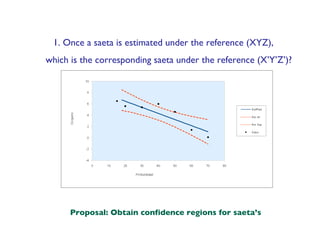
1. Once a saeta is estimated under the reference (XYZ), which is the corresponding saeta under the reference (X’Y’Z’)? Proposal: Obtain confidence regions for saeta’s
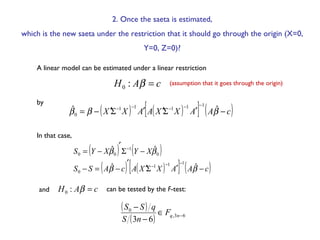
2. Once the saeta is estimated, which is the new saeta under the restriction that it should go through the origin (X=0, Y=0, Z=0)? A linear model can be estimated under a linear restriction by In that case,  and (assumption that it goes through the origin) can be tested by the  F -test:
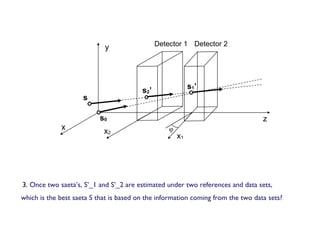
3.  Once two saeta’s, S’_1 and S’_2 are estimated under two references and data sets, which is the best saeta S that is based on the information coming from the two data sets? s s 1 ’ s 0 y x z φ s 2 ’ Detector 1 Detector 2 x 1 x 2
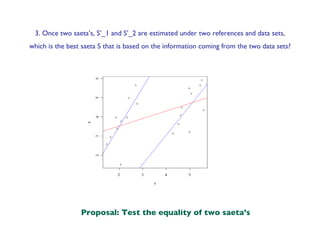
3. Once two saeta’s, S’_1 and S’_2 are estimated under two references and data sets, which is the best saeta S that is based on the information coming from the two data sets? Proposal: Test the equality of two saeta’s
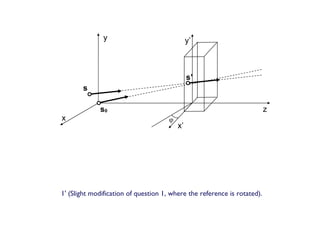
1' (Slight modification of question 1, where the reference is rotated). s’ s s 0 y x z φ x’ y’

C Sanchez Reduction Saetas

  • 1.
    Reduction of saetasW.González-Manteiga and C. Sánchez-Sellero Department of Statistics and Operations Research University of Santiago de Compostela
  • 2.
    Estimation of asaeta as a linear model The available data , denoted by Y, can be expressed as a function of known quantities, in the matrix X, unknow parameters, which determine the saeta, and some errors. It can be written in matrix form as a linear model: is assumed to be normal with mean zero and covariance matrix
  • 3.
    Estimator and itsproperties The estimator can be obtained by which satisfies
  • 4.
    Once a saetais estimated under the reference (XYZ), which is the corresponding saeta under the reference (X’Y’Z’)? 2. Once the saeta is estimated, which is the new saeta under the restriction that it should go through the origin (X=0, Y=0, Z=0)? s s’ s 0 y x z x’ y’
  • 5.
    1. Once asaeta is estimated under the reference (XYZ), which is the corresponding saeta under the reference (X’Y’Z’)? Proposal: Obtain confidence regions for saeta’s
  • 6.
    2. Once thesaeta is estimated, which is the new saeta under the restriction that it should go through the origin (X=0, Y=0, Z=0)? A linear model can be estimated under a linear restriction by In that case, and (assumption that it goes through the origin) can be tested by the F -test:
  • 7.
    3. Oncetwo saeta’s, S’_1 and S’_2 are estimated under two references and data sets, which is the best saeta S that is based on the information coming from the two data sets? s s 1 ’ s 0 y x z φ s 2 ’ Detector 1 Detector 2 x 1 x 2
  • 8.
    3. Once twosaeta’s, S’_1 and S’_2 are estimated under two references and data sets, which is the best saeta S that is based on the information coming from the two data sets? Proposal: Test the equality of two saeta’s
  • 9.
    1' (Slight modificationof question 1, where the reference is rotated). s’ s s 0 y x z φ x’ y’