MIDAS: Identifying particle masses with TRASGOS

               Teresa Kurtukian-Nieto
              CEN Bordeaux-Gradignan


      Santiago de Compostela, February 5th 2010
Outline


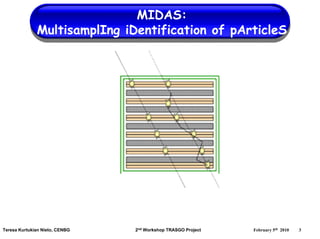
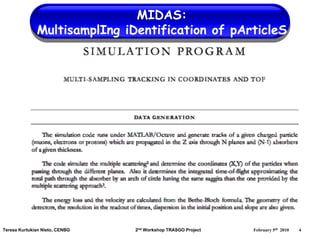
                 MIDAS: MultisamplIng iDentification of pArticleS

                 Matlab simulation: first results

                 Geant4 simulation:
                       SETA: Simulation Environment for TrAsgo


                 Summary and outlook


Teresa Kurtukian Nieto, CENBG           2nd Workshop TRASGO Project   February 5th 2010   2
MIDAS:
              MultisamplIng iDentification of pArticleS


Teresa Kurtukian Nieto, CENBG   2nd Workshop TRASGO Project   February 5th 2010   3
MIDAS:
              MultisamplIng iDentification of pArticleS


Teresa Kurtukian Nieto, CENBG   2nd Workshop TRASGO Project   February 5th 2010   4
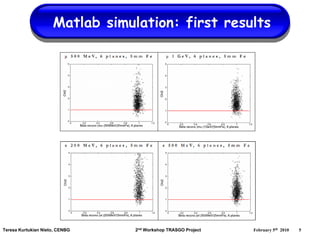
Matlab simulation: first results


Teresa Kurtukian Nieto, CENBG    2nd Workshop TRASGO Project   February 5th 2010   5
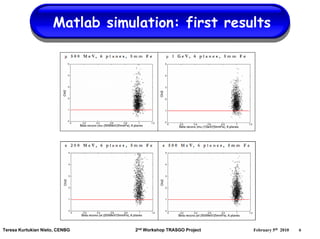
Matlab simulation: first results


Teresa Kurtukian Nieto, CENBG    2nd Workshop TRASGO Project   February 5th 2010   6
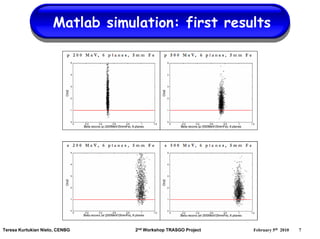
Matlab simulation: first results


Teresa Kurtukian Nieto, CENBG    2nd Workshop TRASGO Project   February 5th 2010   7
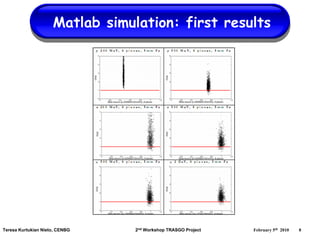
Matlab simulation: first results


Teresa Kurtukian Nieto, CENBG    2nd Workshop TRASGO Project   February 5th 2010   8
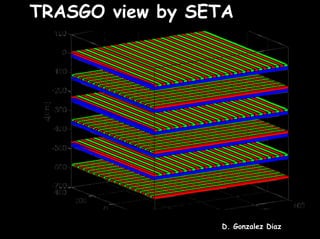
TRASGO view by SETA


Teresa Kurtukian Nieto, CENBG   2nd Workshop TRASGO Project
                                                              D. Gonzalez Diaz2010
                                                                      February 5th   9
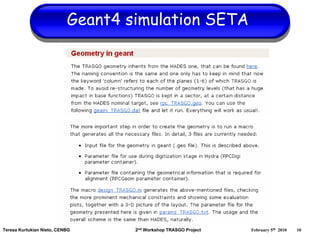
Geant4 simulation SETA


Teresa Kurtukian Nieto, CENBG      2nd Workshop TRASGO Project   February 5th 2010   10
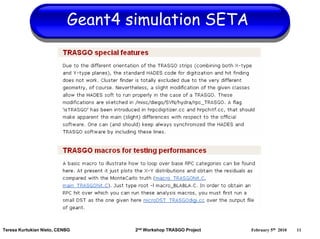
Geant4 simulation SETA


Teresa Kurtukian Nieto, CENBG      2nd Workshop TRASGO Project   February 5th 2010   11
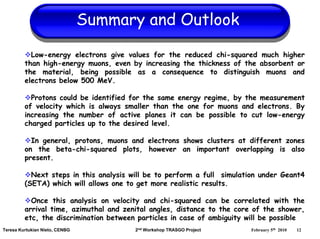
Summary and Outlook

           Low-energy electrons give values for the reduced chi-squared much higher
         than high-energy muons, even by increasing the thickness of the absorbent or
         the material, being possible as a consequence to distinguish muons and
         electrons below 500 MeV.

           Protons could be identified for the same energy regime, by the measurement
         of velocity which is always smaller than the one for muons and electrons. By
         increasing the number of active planes it can be possible to cut low-energy
         charged particles up to the desired level.

           In general, protons, muons and electrons shows clusters at different zones
         on the beta-chi-squared plots, however an important overlapping is also
         present.

           Next steps in this analysis will be to perform a full simulation under Geant4
         (SETA) which will allows one to get more realistic results.

           Once this analysis on velocity and chi-squared can be correlated with the
         arrival time, azimuthal and zenital angles, distance to the core of the shower,
         etc, the discrimination between particles in case of ambiguity will be possible
Teresa Kurtukian Nieto, CENBG           2nd Workshop TRASGO Project     February 5th 2010   12
Thank you


Teresa Kurtukian Nieto, CENBG     2nd Workshop TRASGO Project   February 5th 2010   13

T Kurtukian Midas

  • 1.
    MIDAS: Identifying particlemasses with TRASGOS Teresa Kurtukian-Nieto CEN Bordeaux-Gradignan Santiago de Compostela, February 5th 2010
  • 2.
    Outline MIDAS: MultisamplIng iDentification of pArticleS Matlab simulation: first results Geant4 simulation: SETA: Simulation Environment for TrAsgo Summary and outlook Teresa Kurtukian Nieto, CENBG 2nd Workshop TRASGO Project February 5th 2010 2
  • 3.
    MIDAS: MultisamplIng iDentification of pArticleS Teresa Kurtukian Nieto, CENBG 2nd Workshop TRASGO Project February 5th 2010 3
  • 4.
    MIDAS: MultisamplIng iDentification of pArticleS Teresa Kurtukian Nieto, CENBG 2nd Workshop TRASGO Project February 5th 2010 4
  • 5.
    Matlab simulation: firstresults Teresa Kurtukian Nieto, CENBG 2nd Workshop TRASGO Project February 5th 2010 5
  • 6.
    Matlab simulation: firstresults Teresa Kurtukian Nieto, CENBG 2nd Workshop TRASGO Project February 5th 2010 6
  • 7.
    Matlab simulation: firstresults Teresa Kurtukian Nieto, CENBG 2nd Workshop TRASGO Project February 5th 2010 7
  • 8.
    Matlab simulation: firstresults Teresa Kurtukian Nieto, CENBG 2nd Workshop TRASGO Project February 5th 2010 8
  • 9.
    TRASGO view bySETA Teresa Kurtukian Nieto, CENBG 2nd Workshop TRASGO Project D. Gonzalez Diaz2010 February 5th 9
  • 10.
    Geant4 simulation SETA TeresaKurtukian Nieto, CENBG 2nd Workshop TRASGO Project February 5th 2010 10
  • 11.
    Geant4 simulation SETA TeresaKurtukian Nieto, CENBG 2nd Workshop TRASGO Project February 5th 2010 11
  • 12.
    Summary and Outlook Low-energy electrons give values for the reduced chi-squared much higher than high-energy muons, even by increasing the thickness of the absorbent or the material, being possible as a consequence to distinguish muons and electrons below 500 MeV. Protons could be identified for the same energy regime, by the measurement of velocity which is always smaller than the one for muons and electrons. By increasing the number of active planes it can be possible to cut low-energy charged particles up to the desired level. In general, protons, muons and electrons shows clusters at different zones on the beta-chi-squared plots, however an important overlapping is also present. Next steps in this analysis will be to perform a full simulation under Geant4 (SETA) which will allows one to get more realistic results. Once this analysis on velocity and chi-squared can be correlated with the arrival time, azimuthal and zenital angles, distance to the core of the shower, etc, the discrimination between particles in case of ambiguity will be possible Teresa Kurtukian Nieto, CENBG 2nd Workshop TRASGO Project February 5th 2010 12
  • 13.
    Thank you Teresa KurtukianNieto, CENBG 2nd Workshop TRASGO Project February 5th 2010 13