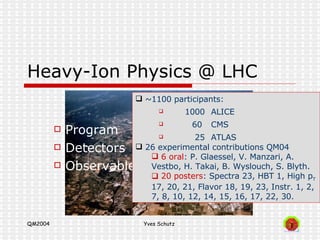
Heavy-Ion Physics @ LHC Program Detectors Observables  ~1100 participants: 26 experimental contributions QM04 6 oral : P. Glaessel, V. Manzari, A. Vestbo, H. Takai, B. Wyslouch, S. Blyth. 20 posters : Spectra 23, HBT 1, High p T  17, 20, 21, Flavor 18, 19, 23, Instr. 1, 2, 7, 8, 10, 12, 14, 15, 16, 17, 22, 30. ATLAS 25 CMS 60  ALICE 1000
The LHC facility Running conditions:  + other collision systems:  pA, lighter ions  (Sn, Kr, Ar, O)  & energies  (pp @ 5.5 TeV) . April 2007   End 2007 Early 2008 *L max (ALICE) =  10 31 ** L int (ALICE) ~  0.7 nb -1 /year Collision system PbPb pp <L>/L 0 (%) 10 7 Run time (s/year)  geom (b) L 0 (cm -2 s -1 ) √ s NN (TeV) 0.07 10 34 * 14.0 70-50 10 6  * * 7.7 10 27 5.5
Novel aspects :  Probe initial partonic state in a novel Bjorken-x range ( 10 -3 -10 -5 ): nuclear shadowing, high-density saturated gluon distribution. Larger saturation scale  ( Q S =0.2A 1/6 √s  = 2.7 GeV ) : particle production dominated by the staturation region. Qualitatively new regime ALICE PPR CERN/LHCC 2003-049 J/ ψ 10 -6  10 -4  10 -2   10 0 x 10 8 10 6 10 4 10 2 10 0 M 2  (GeV 2 ) 10 GeV
Novel aspects :  Hard processes contribute significantly to the total AA cross-section ( σ hard / σ tot  = 98% ):   Bulk properties dominated by hard processes; Very hard probes are abundantly produced. Weakly interacting probes become accessible (  , Z 0 , W ± ). Qualitatively new regime LHC RHIC SPS (h + +h - )/2  0 17 GeV 200  GeV 5500 GeV = √ s LO p+p y=0
3 experiments  JURA ALPES
Which particle multiplicity to expect at LHC ? ALICE optimized for  dN ch /dY  =  4000 ,   checked up to  8000  (reality factor 2). CMS & ATLAS (checked up to  7000 ) will provide good performances over the expected range. HI experiments dN ch /d    ~ 1500 dN ch /d    ~ 2500 hep-ph0104010 5 √ s (GeV) 10 10 2 10 3 10 2 10 3 10 4 1.0 5.0 10.0 15.0 N ch /(0.5N part ) dN ch /d  |  <1 2 5 10 3
ALICE:  the dedicated HI experiment Central tracking system: ITS  TPC TRD TOF MUON Spectrometer: absorbers tracking stations trigger chambers dipole Specialized detectors: HMPID PHOS Forward detectors: PMD FMD, T0, V0, ZDC Cosmic rays trigger Solenoid magnet 0.5 T
US EMCaL  (under discussion) Pb/Sci EMCal    x    = 1.4 x 2  /3 TPC TRD TOF PHOS RICH ITS
ALICE:  the dedicated HI experiment Measure flavor content and phase-space distribution event-by-event: Most  (2   * 1.8 units   )  of the hadrons  (dE/dx + ToF) , leptons  (dE/dx, transition radiation, magnetic analysis)  and photons  (high resolution EM calorimetry) ;   Track and identify from very low  (< 100 MeV/c; soft processes)  up to very high p t   (~100 GeV/c; hard processes) ; Identify short lived particles  (hyperons, D/B meson)  through secondary vertex detection; Jet identification;
ALICE PID performances ALICE PPR CERN/LHCC 2003-049
ALICE tracking efficiency  p/p < 1% 100% p t  (GeV/c) 1 3 5 0 0.4 0.8 1.2  ALICE PPR CERN/LHCC 2003-049 TPC only
ALICE track resolution at high p t 10 100 p t  (GeV/c) 50  p/p (%) 10 30 50  ALICE PPR CERN/LHCC 2003-049
ALICE construction status
ALICE TPC
ALICE  Space Frame
ALICE  Dipole coil
ALICE pixel 40K channels 200+150   m
CMS Central tracker High resolution EM calorimeter Hadronic calorimeter Superconducting solenoid magnet 4T Muon spectrometer Very forward calorimeters ZDC CASTOR TOTEM
ATLAS Inner detector Solenoid 2T EM calorimeter H calorimeter    detectors
CMS & ATLAS Experiments designed for high p t  physics in pp collisions: Precise tracking systems in a large solenoid magnetic field; Hermetic calorimeters (EM+Hadronic) systems with fine grain segmentation; Large acceptance muon spectrometers; Accurate measurement of high energy leptons, photons and hadronic jets. Provide adequate performances for selected high p t   (> 1 GeV/c)  probes for HI physics.
3  Experiments Bulk properties Hard processes Modified by the medium ALICE CMS&ATLAS PID T=  QCD Q s 0 1 2 10 100 p t  (GeV/c)
QGP probes: hard processes modified by the medium Q »   QCD , T, Q s       ,   r ~ 1/Q Jet quenching: Energy degradation of leading hadrons, p t  dependence; Modification of genuine jet observables; Mass dependence of energy loss (light and heavy quarks).  Dissolution of c’onium & b’onium bound states.
Leading hadron  quenching Nuclear modification factor pattern very different at LHC: Final state interactions  (radiative & collisional energy loss)  dominate over nuclear effects  (shadowing+Cronin) . Measurement of suppression pattern of leading partons remains  experimentally the most straightforward observable for jet-tomography analysis.  0 20 40 60 80 100 p t  (GeV) 0.05 0.1 0.5 1 R AA A+A √s NN  = 200, 5500 GeV Vitev&Gyulassy QM02
Jets reconstruction Jets are produced copiously. Jets are distinguishable from the HI underlying event. p t  (GeV) 2 20 100 200 100/event 1/event 100K/year 100 GeV jet + HI event
Performance by ATLAS Cone algorithm R=0.4 E t  > 30 GeV 50 150 250 350 0 40 80 % Efficiency Fake jets E t 50 150 250 350 E t 0 20 10 Energy resolution PbPb pp  E/E (%)
Performance by CMS Cone algorithm R=0.5 E t  > 30 GeV Energy resolution E t 50 150 250 350 0 40 80 % E t 0 20 10  E/E (%) 200 300 0 100 0
Jet quenching Excellent jet reconstruction… but challenging to measure medium modification of its shape…  E t =100 GeV  (reduced average jet energy fraction inside R) : Radiated energy ~20%  R=0.3   E/E=3% E t UE  ~ 100 GeV  Medium induced redistribution of jet energy occurs inside cone. C.A. Salgado, U.A. Wiedemann hep-ph/0310079 R vacuum medium E t  = 50 GeV E t  = 100 GeV 0.2 0 0 0.4 0.6 0.8 1 0.2 R=√(  2 +  2 ) 0.4 0.6 0.8 1 0 0.2 0.4 0.6 0.8 1  (R)
Exclusive jets:   Redistribution of jet energy Jet shape: distance  R  to leading particle; p T  of particles for  R  <  R max ; Multiplicity of particles for  R  <  R max  ; Heating :  k T  = p    sin(  (particle, jet axis)) ; Forward backward correlation  (particle, jet axis); Fragmentation function: F(z)=1/N j  dN ch /dz z=p t / p jet . Requires high quality tracking down to low p t  .
Fragmentation functions z=p t / p jet p jet 0 0.5 1 z 10 -4 10 -2 1 vacuum medium 0 0.5 1 z 1/N jets dN c /dz 10 -1 10 10 3 reconstructed input p jet z k t
Exclusive jets:   Tagging Direct measurement of jet energy:   ,   *, Z 0 40 500 Z 0  (  μ +  μ - )-jet 50 10 4  *(  μ +  μ - )- jet 50 10 6  -jet p t (GeV) Statistics (evts/month) Channel 50 600 100 6  10 3
Exclusive jets:   Tagging Direct measure of jet energy:   ,   *, Z 0 Low  (< 10%)  background as compared to   /  0
Heavy flavor quenching observables Inclusive: Suppression of dilepton invariant mass spectrum (DD  l + l - , BB   l + l -  , B   D +   l + )l -  Suppression of lepton spectra Exclusive jet tagging: High- p T  lepton ( B->Dl  )   &   displaced vertex Hadronic decay (ex.  D 0    K -  + )  &   displaced vertex
D quenching  ( D 0    K -  + )   Reduced Ratio D/hadrons (or D/  0 ) enhanced and sensitive to medium properties. nucl-ex/0311004
c/b Quarkonia 1 month statistics of PbPb √s NN =5.5 TeV;  |  | < 2.4 2.5   <   < 4 Events/100 MeV 10 3 J/  Y 5 10 15 10 2 dN/d  =8000 M  +  -   (GeV) Events/25 MeV 10 4 J/  Y 2 3 4 9 10 11 0 10 5 10 4 dN/d  =5000
Looking forward For a timely completion of LHC and experiments construction in April 2007; Accelerators and experiments are today in the production phase. For an exciting decade of novel HI physics in continuation of the SPS and complementary to RHIC;  Detailed physics program, complementary between 1+2 experiments, takes shape (see PPRs, Yellow reports…). The 2004 challenge: demonstrate world-wide distributed Monte-Carlo production and data analysis.
Backup
The LHC facility
The LHC facility:  average  L Time (h) 1 2 3 Experiments  * = 2 - 0.5 m I O   = 10 8  ions/bunch 70% 55% 50% Tuning time 0.2 0.4 0.6 0.8 1 < L >/ L 0 0 5 10 15 20 0 ALICE PPR CERN/LHCC 2003-049
Novel aspects :  Quantitatively new regime few 10 4 20-30 2-4 5 1.9 0.2 850 200 RHIC few 10 3 V f (fm 3 ) ~10  f  (fm/c) ≤ 2  QGP  (fm/c) 3    (GeV/fm 3 ) 1.1 T/T c 1  0 QGP  (fm/c) 500 dN ch /dy 17 √ s NN  (GeV) LHC SPS few 10 5 bigger 5500 X 28 1500-8000 ? 0.1 faster 3.0-4.2 hotter 15-60 denser 30-40 ≥ 10 longer
Novel aspects :  Thermodynamics of the QGP phase    Thermodynamics of massless 3-flavor QCD. Parton dynamics (  QGP /  0 >50-100 ) dominate the fireball expansion and the collective features of the hadronic final state. Qualitatively new regime m u = m d  = m s m u  = m d m u  = m d  ; m s     m u,d HQ suppressed exp(-m c,b,t /T)  s (T)=4  /(18log(5T/Tc))
Scientific objectives  of HI physics Study the QCD phase transition and the physics of the QGP state: How to apply and extend the SM to a complex and dynamically evolving system of finite size;  Understand how collective phenomena and macroscopic properties emerge from the microscopic laws of elementary particle physics;  Answer these questions in the sector of strong interaction by studying matter under conditions of extreme temperature and density.  RHIC + CBM LHC
Heavy-ion running scenario Year 1   pp:  detector commissioning & physics data  PbPb  physics pilot run: global event-properties, observables with large cross-section Year 2   (in addition to pp @ 14 TeV, L< 5.10 30   cm -2 s -1  ) PbPb @ L~ 10 27   cm -2 s -1 :  rare observables Year 3 p(d,   )Pb @ L~ 10 29   cm -2 s -1  :  Nuclear modification of structure function Year 4  (as year 2) :  L int  = 0.5-0.7 nb -1 /year Year 5 ArAr @ L~ 10 27  -10 29   cm -2 s -1  :  energy density dependencies Options for later pp @ 5.5 TeV, pA (A scan to map A dependence), AA (A scan to map energy-density dependence), PbPb (energy-excitation function down towards RHIC), ….
Combined PID Probability to be a pion Probability to be a kaon Probability to be a proton
Inclusive jets by ALICE Original spectrum Measured spectrum   E/E = 25% Original spectrum for measured energy 90 <  E T  < 110 GeV R=0.3 p t  > 2 GeV
Exclusive jets:   Tagged jets p t  (GeV) R AA PbPb + 40 GeV   -jet 1 0 10 20 30 40 0 2 3 4 Tagging 0 10 20 30 40 No Tagging
Heavy quarks jets  A. Dainese QM04 Initially produced Qs experience the full collision history: Short time scale for production:   1/m Q Production suppressed at larger times: m Q »T Long time scale for decay   decay »  QGP The large masses of c and b quarks make them qualitatively different probes (   massless partons)  Radiative energy loss suppressed as compared to q, g: (1+  0 2 /  2 ) -2 ;   0 =m Q /E Q
D 0    K -  +  reconstruction in ALICE
 
 
ALICE TPC E E 510 cm E E 88  s Central electrode
 
D 0    K -  +  reconstruction in ALICE A. Dainese QM04 Invariant-mass analysis of fully-reconstructed topologies originating from displaced secondary vertices
Cone angle (°) 0 20 40 0 0.1 0.2 C.A. Salgado, U.A. Wiedemann  E/E

YSchutz_PPTWin

  • 1.
    Heavy-Ion Physics @LHC Program Detectors Observables ~1100 participants: 26 experimental contributions QM04 6 oral : P. Glaessel, V. Manzari, A. Vestbo, H. Takai, B. Wyslouch, S. Blyth. 20 posters : Spectra 23, HBT 1, High p T 17, 20, 21, Flavor 18, 19, 23, Instr. 1, 2, 7, 8, 10, 12, 14, 15, 16, 17, 22, 30. ATLAS 25 CMS 60 ALICE 1000
  • 2.
    The LHC facilityRunning conditions: + other collision systems: pA, lighter ions (Sn, Kr, Ar, O) & energies (pp @ 5.5 TeV) . April 2007 End 2007 Early 2008 *L max (ALICE) = 10 31 ** L int (ALICE) ~ 0.7 nb -1 /year Collision system PbPb pp <L>/L 0 (%) 10 7 Run time (s/year)  geom (b) L 0 (cm -2 s -1 ) √ s NN (TeV) 0.07 10 34 * 14.0 70-50 10 6 * * 7.7 10 27 5.5
  • 3.
    Novel aspects : Probe initial partonic state in a novel Bjorken-x range ( 10 -3 -10 -5 ): nuclear shadowing, high-density saturated gluon distribution. Larger saturation scale ( Q S =0.2A 1/6 √s  = 2.7 GeV ) : particle production dominated by the staturation region. Qualitatively new regime ALICE PPR CERN/LHCC 2003-049 J/ ψ 10 -6 10 -4 10 -2 10 0 x 10 8 10 6 10 4 10 2 10 0 M 2 (GeV 2 ) 10 GeV
  • 4.
    Novel aspects : Hard processes contribute significantly to the total AA cross-section ( σ hard / σ tot = 98% ): Bulk properties dominated by hard processes; Very hard probes are abundantly produced. Weakly interacting probes become accessible (  , Z 0 , W ± ). Qualitatively new regime LHC RHIC SPS (h + +h - )/2  0 17 GeV 200 GeV 5500 GeV = √ s LO p+p y=0
  • 5.
    3 experiments JURA ALPES
  • 6.
    Which particle multiplicityto expect at LHC ? ALICE optimized for dN ch /dY = 4000 , checked up to 8000 (reality factor 2). CMS & ATLAS (checked up to 7000 ) will provide good performances over the expected range. HI experiments dN ch /d  ~ 1500 dN ch /d  ~ 2500 hep-ph0104010 5 √ s (GeV) 10 10 2 10 3 10 2 10 3 10 4 1.0 5.0 10.0 15.0 N ch /(0.5N part ) dN ch /d  |  <1 2 5 10 3
  • 7.
    ALICE: thededicated HI experiment Central tracking system: ITS TPC TRD TOF MUON Spectrometer: absorbers tracking stations trigger chambers dipole Specialized detectors: HMPID PHOS Forward detectors: PMD FMD, T0, V0, ZDC Cosmic rays trigger Solenoid magnet 0.5 T
  • 8.
    US EMCaL (under discussion) Pb/Sci EMCal  x  = 1.4 x 2  /3 TPC TRD TOF PHOS RICH ITS
  • 9.
    ALICE: thededicated HI experiment Measure flavor content and phase-space distribution event-by-event: Most (2  * 1.8 units  ) of the hadrons (dE/dx + ToF) , leptons (dE/dx, transition radiation, magnetic analysis) and photons (high resolution EM calorimetry) ; Track and identify from very low (< 100 MeV/c; soft processes) up to very high p t (~100 GeV/c; hard processes) ; Identify short lived particles (hyperons, D/B meson) through secondary vertex detection; Jet identification;
  • 10.
    ALICE PID performancesALICE PPR CERN/LHCC 2003-049
  • 11.
    ALICE tracking efficiency p/p < 1% 100% p t (GeV/c) 1 3 5 0 0.4 0.8 1.2  ALICE PPR CERN/LHCC 2003-049 TPC only
  • 12.
    ALICE track resolutionat high p t 10 100 p t (GeV/c) 50  p/p (%) 10 30 50  ALICE PPR CERN/LHCC 2003-049
  • 13.
  • 14.
  • 15.
  • 16.
  • 17.
    ALICE pixel 40Kchannels 200+150  m
  • 18.
    CMS Central trackerHigh resolution EM calorimeter Hadronic calorimeter Superconducting solenoid magnet 4T Muon spectrometer Very forward calorimeters ZDC CASTOR TOTEM
  • 19.
    ATLAS Inner detectorSolenoid 2T EM calorimeter H calorimeter  detectors
  • 20.
    CMS & ATLASExperiments designed for high p t physics in pp collisions: Precise tracking systems in a large solenoid magnetic field; Hermetic calorimeters (EM+Hadronic) systems with fine grain segmentation; Large acceptance muon spectrometers; Accurate measurement of high energy leptons, photons and hadronic jets. Provide adequate performances for selected high p t (> 1 GeV/c) probes for HI physics.
  • 21.
    3 ExperimentsBulk properties Hard processes Modified by the medium ALICE CMS&ATLAS PID T=  QCD Q s 0 1 2 10 100 p t (GeV/c)
  • 22.
    QGP probes: hardprocesses modified by the medium Q »  QCD , T, Q s   ,  r ~ 1/Q Jet quenching: Energy degradation of leading hadrons, p t dependence; Modification of genuine jet observables; Mass dependence of energy loss (light and heavy quarks). Dissolution of c’onium & b’onium bound states.
  • 23.
    Leading hadron quenching Nuclear modification factor pattern very different at LHC: Final state interactions (radiative & collisional energy loss) dominate over nuclear effects (shadowing+Cronin) . Measurement of suppression pattern of leading partons remains experimentally the most straightforward observable for jet-tomography analysis. 0 20 40 60 80 100 p t (GeV) 0.05 0.1 0.5 1 R AA A+A √s NN = 200, 5500 GeV Vitev&Gyulassy QM02
  • 24.
    Jets reconstruction Jetsare produced copiously. Jets are distinguishable from the HI underlying event. p t (GeV) 2 20 100 200 100/event 1/event 100K/year 100 GeV jet + HI event
  • 25.
    Performance by ATLASCone algorithm R=0.4 E t > 30 GeV 50 150 250 350 0 40 80 % Efficiency Fake jets E t 50 150 250 350 E t 0 20 10 Energy resolution PbPb pp  E/E (%)
  • 26.
    Performance by CMSCone algorithm R=0.5 E t > 30 GeV Energy resolution E t 50 150 250 350 0 40 80 % E t 0 20 10  E/E (%) 200 300 0 100 0
  • 27.
    Jet quenching Excellentjet reconstruction… but challenging to measure medium modification of its shape… E t =100 GeV (reduced average jet energy fraction inside R) : Radiated energy ~20% R=0.3  E/E=3% E t UE ~ 100 GeV Medium induced redistribution of jet energy occurs inside cone. C.A. Salgado, U.A. Wiedemann hep-ph/0310079 R vacuum medium E t = 50 GeV E t = 100 GeV 0.2 0 0 0.4 0.6 0.8 1 0.2 R=√(  2 +  2 ) 0.4 0.6 0.8 1 0 0.2 0.4 0.6 0.8 1  (R)
  • 28.
    Exclusive jets: Redistribution of jet energy Jet shape: distance R to leading particle; p T of particles for R < R max ; Multiplicity of particles for R < R max ; Heating : k T = p  sin(  (particle, jet axis)) ; Forward backward correlation  (particle, jet axis); Fragmentation function: F(z)=1/N j  dN ch /dz z=p t / p jet . Requires high quality tracking down to low p t .
  • 29.
    Fragmentation functions z=pt / p jet p jet 0 0.5 1 z 10 -4 10 -2 1 vacuum medium 0 0.5 1 z 1/N jets dN c /dz 10 -1 10 10 3 reconstructed input p jet z k t
  • 30.
    Exclusive jets: Tagging Direct measurement of jet energy:  ,  *, Z 0 40 500 Z 0 (  μ + μ - )-jet 50 10 4  *(  μ + μ - )- jet 50 10 6  -jet p t (GeV) Statistics (evts/month) Channel 50 600 100 6  10 3
  • 31.
    Exclusive jets: Tagging Direct measure of jet energy:  ,  *, Z 0 Low (< 10%) background as compared to  /  0
  • 32.
    Heavy flavor quenchingobservables Inclusive: Suppression of dilepton invariant mass spectrum (DD  l + l - , BB  l + l - , B  D +  l + )l - Suppression of lepton spectra Exclusive jet tagging: High- p T lepton ( B->Dl  ) & displaced vertex Hadronic decay (ex. D 0  K -  + ) & displaced vertex
  • 33.
    D quenching ( D 0  K -  + ) Reduced Ratio D/hadrons (or D/  0 ) enhanced and sensitive to medium properties. nucl-ex/0311004
  • 34.
    c/b Quarkonia 1month statistics of PbPb √s NN =5.5 TeV; |  | < 2.4 2.5 <  < 4 Events/100 MeV 10 3 J/  Y 5 10 15 10 2 dN/d  =8000 M  +  - (GeV) Events/25 MeV 10 4 J/  Y 2 3 4 9 10 11 0 10 5 10 4 dN/d  =5000
  • 35.
    Looking forward Fora timely completion of LHC and experiments construction in April 2007; Accelerators and experiments are today in the production phase. For an exciting decade of novel HI physics in continuation of the SPS and complementary to RHIC; Detailed physics program, complementary between 1+2 experiments, takes shape (see PPRs, Yellow reports…). The 2004 challenge: demonstrate world-wide distributed Monte-Carlo production and data analysis.
  • 36.
  • 37.
  • 38.
    The LHC facility: average L Time (h) 1 2 3 Experiments  * = 2 - 0.5 m I O = 10 8 ions/bunch 70% 55% 50% Tuning time 0.2 0.4 0.6 0.8 1 < L >/ L 0 0 5 10 15 20 0 ALICE PPR CERN/LHCC 2003-049
  • 39.
    Novel aspects : Quantitatively new regime few 10 4 20-30 2-4 5 1.9 0.2 850 200 RHIC few 10 3 V f (fm 3 ) ~10  f (fm/c) ≤ 2  QGP (fm/c) 3  (GeV/fm 3 ) 1.1 T/T c 1  0 QGP (fm/c) 500 dN ch /dy 17 √ s NN (GeV) LHC SPS few 10 5 bigger 5500 X 28 1500-8000 ? 0.1 faster 3.0-4.2 hotter 15-60 denser 30-40 ≥ 10 longer
  • 40.
    Novel aspects : Thermodynamics of the QGP phase  Thermodynamics of massless 3-flavor QCD. Parton dynamics (  QGP /  0 >50-100 ) dominate the fireball expansion and the collective features of the hadronic final state. Qualitatively new regime m u = m d = m s m u = m d m u = m d ; m s  m u,d HQ suppressed exp(-m c,b,t /T)  s (T)=4  /(18log(5T/Tc))
  • 41.
    Scientific objectives of HI physics Study the QCD phase transition and the physics of the QGP state: How to apply and extend the SM to a complex and dynamically evolving system of finite size; Understand how collective phenomena and macroscopic properties emerge from the microscopic laws of elementary particle physics; Answer these questions in the sector of strong interaction by studying matter under conditions of extreme temperature and density. RHIC + CBM LHC
  • 42.
    Heavy-ion running scenarioYear 1 pp: detector commissioning & physics data PbPb physics pilot run: global event-properties, observables with large cross-section Year 2 (in addition to pp @ 14 TeV, L< 5.10 30 cm -2 s -1 ) PbPb @ L~ 10 27 cm -2 s -1 : rare observables Year 3 p(d,  )Pb @ L~ 10 29 cm -2 s -1 : Nuclear modification of structure function Year 4 (as year 2) : L int = 0.5-0.7 nb -1 /year Year 5 ArAr @ L~ 10 27 -10 29 cm -2 s -1 : energy density dependencies Options for later pp @ 5.5 TeV, pA (A scan to map A dependence), AA (A scan to map energy-density dependence), PbPb (energy-excitation function down towards RHIC), ….
  • 43.
    Combined PID Probabilityto be a pion Probability to be a kaon Probability to be a proton
  • 44.
    Inclusive jets byALICE Original spectrum Measured spectrum  E/E = 25% Original spectrum for measured energy 90 < E T < 110 GeV R=0.3 p t > 2 GeV
  • 45.
    Exclusive jets: Tagged jets p t (GeV) R AA PbPb + 40 GeV  -jet 1 0 10 20 30 40 0 2 3 4 Tagging 0 10 20 30 40 No Tagging
  • 46.
    Heavy quarks jets A. Dainese QM04 Initially produced Qs experience the full collision history: Short time scale for production:  1/m Q Production suppressed at larger times: m Q »T Long time scale for decay  decay »  QGP The large masses of c and b quarks make them qualitatively different probes (  massless partons) Radiative energy loss suppressed as compared to q, g: (1+  0 2 /  2 ) -2 ;  0 =m Q /E Q
  • 47.
    D 0  K -  + reconstruction in ALICE
  • 48.
  • 49.
  • 50.
    ALICE TPC EE 510 cm E E 88  s Central electrode
  • 51.
  • 52.
    D 0  K -  + reconstruction in ALICE A. Dainese QM04 Invariant-mass analysis of fully-reconstructed topologies originating from displaced secondary vertices
  • 53.
    Cone angle (°)0 20 40 0 0.1 0.2 C.A. Salgado, U.A. Wiedemann  E/E