RESOLUTION METHOD IN
AI
Assistant proof. Dr. Emad I Abdul Kareem
RESOLUTION METHOD IN AI
Resolution method is an inference rule which is used in both
Propositional as well as First-order Predicate Logic in different ways. This
method is basically used for proving the satisfiability of a sentence. In
resolution method, we use Proof by Refutation technique to prove the given
statement.
The key idea for the resolution method is to use the knowledge base
and negated goal to obtain null clause (which indicates contradiction).
Resolution method is also called Proof by Refutation. Since the knowledge
base itself is consistent, the contradiction must be introduced by a negated
goal. As a result, we have to conclude that the original goal is true.
RESOLUTION METHOD IN
PROPOSITIONAL LOGIC
In propositional logic, resolution method is the only inference rule
which gives a new clause when two or more clauses are coupled together.
Using propositional resolution, it becomes easy to make a theorem prover
sound and complete for all. The process followed to convert the propositional
logic into resolution method contains the below steps:
• Convert the given statements into clausal form,
• Apply and proof the given goal using negation rule.
• Use those literals which are needed to prove.
• Solve the clauses together and achieve the goal.
But, before solving problems using Resolution method, let’s understand
two normal forms
CONVERT THE GIVEN STATEMENTS INTO
CLAUSAL FORM ( CONJUNCTIVE
NORMAL FORM(CNF))
∀x [B(x) → (∃y [Q(x, y) ∧ ⌐ P(y)]
∧ ⌐ ∃y [Q(x, y) ∧ Q(y, x)]
∧ ∀y [⌐ B(y) → ⌐ E(x, y)])]
1- Eliminate the implication (→)
E1 → E2 = ⌐ E1 ∨ E2
∀x [⌐ B(x) ∨ ( ∃y [ Q(x ,y) ∧ ⌐ P(y) ]
∧ ⌐ ∃y [ Q(x ,y) ∧ Q(y ,x) ]
∧ ∀y [⌐(⌐ B(y)) ∨ ⌐ E(x ,y)] ) ]
∀x [B(x) → (∃y [Q(x, y) ∧ ⌐ P(y)]
∧ ∀y [⌐ B(y) → ⌐ E(x, y)])]
2- Move the negation down to the atomic formulas (by using the following rules)
• ⌐ (P∧Q) ≡ ⌐ P ∨ ⌐ Q
• ⌐ (P∨Q) ≡ ⌐ P ∧ ⌐ Q
• ⌐ (⌐ (P)) ≡ P
• ⌐ ∀x (P (x)) ≡ ∃x (⌐ P (x))
• ⌐ ∃x (P (x)) ≡ ∀x (⌐ P (x))
∀x[⌐ B(x) ∨ ( ∃y [ Q(x,y) ∧ ⌐ P(y) ]
∧ ∀y [ ⌐ Q(x,y) ∨ ⌐ Q(y,x) ]
∧ ∀y [ B(y) ∨ ⌐ E(x,y)] ) ]
3- Purge existential quantifiers
The function that is eliminate the existential are called “Skolem function”
∀x[⌐ B(x) ∨ ( [ Q(x , f (x)) ∧ ⌐ P(f (x)) ]
∧ ∀y [ ⌐ Q(x,y) ∨ ⌐ Q(y,x) ]
∧ ∀y [ B(y) ∨ ⌐ E(x,y)] ) ]
∧ ⌐ ∃y [ Q(x ,y) ∧ Q(y ,x) ]
∧ ∀y [⌐(⌐ B(y)) ∨ ⌐ E(x ,y)] ) ]
∀x[⌐ B(x) ∨ ( ∃y [ Q(x,y) ∧ ⌐ P(y) ]
4- Rename variables, as necessary, so that no two variables are the same.
∀x[⌐ B(x) ∨ ( [ Q(x , f (x)) ∧ ⌐ P(f (x)) ]
∧ ∀y [ ⌐ Q(x,y) ∨ ⌐ Q(y,x) ]
∧ ∀z [ B(z) ∨ ⌐ E(x,z)] ) ]
5- Move the Universal quantifiers to the left of the statement.
∀x ∀y ∀z [⌐ B(x) ∨ ( [ Q(x , f (x)) ∧ ⌐ P(f (x)) ]
∧ [ ⌐ Q(x,y) ∨ ⌐ Q(y,x) ]
∧ [ B(z) ∨ ⌐ E(x,z)] ) ]
∧ ∀y [ B(y) ∨ ⌐ E(x,y)] ) ]
∀x[⌐ B(x) ∨ ( [ Q(x , f (x)) ∧ ⌐ P(f (x)) ]
∧ ∀y [ ⌐ Q(x,y) ∨ ⌐ Q(y,x) ]
∧ ∀z [ B(z) ∨ ⌐ E(x,z)] ) ]
6- Move the disjunction down to the literals, using distributive laws
E1 ∨ (E2 ∧ E3 ∧ E4 ∧…) ≡ (E1 ∨ E2) ∧ (E1∨E3) ∧ ….
E1 ∧ (E2 ∨ E3 ∨ E4∨…) ≡ (E1 ∧ E2) ∨ (E1∧E3) ∨ ….
∀x ∀y ∀z [ ( ⌐ B(x) ∨ ( Q(x , f (x))
∧ ( ⌐ B(x) ∨ ⌐ P(f (x) ) )
∧ ( ⌐ B(x) ∨ ⌐ Q(x,y) ∨ ⌐ Q(y,x) )
∧ (⌐ B(x) ∨ B(z) ∨ ⌐ E(x,z) ) ]
7- Eliminate the conjunctions
∀x [ ⌐ B(x) ∨ ( Q(x , f (x) ]
∀x [⌐ B(x) ∨ ⌐ P(f (x) ) ]
∀x ∀y [ ⌐ B(x) ∨ ⌐ Q(x,y) ∨ ⌐ Q(y,x) ]
∀x ∀z [⌐ B(x) ∨ B(z) ∨ ⌐ E(x,z) ]
∀x ∀y ∀z [⌐ B(x) ∨ ( [ Q(x , f (x)) ∧ ⌐ P(f (x)) ]
∧ [ ⌐ Q(x,y) ∨ ⌐ Q(y,x) ]
∧ [ B(z) ∨ ⌐ E(x,z)] ) ]
∀x ∀y ∀z [ ( ⌐ B(x) ∨ ( Q(x , f (x))
∧ ( ⌐ B(x) ∨ ⌐ P(f (x) ) )
∧ ( ⌐ B(x) ∨ ⌐ Q(x,y) ∨ ⌐ Q(y,x) )
∧ (⌐ B(x) ∨ B(z) ∨ ⌐ E(x,z) ) ]
8- Rename all the variables, as necessary, so that no two variables are the same.
∀x [ ⌐ B(x) ∨ ( Q(x , f (x) ]
∀w [⌐ B(w) ∨ ⌐ P(f (w) ) ]
∀u ∀y [⌐ B(u) ∨ ⌐ Q(u,y) ∨ ⌐ Q(y,u) ]
∀a ∀z [⌐ B(a) ∨ B(z) ∨ ⌐ E(a,z) ]
9- Purge the universal quantifiers.
⌐ B(x) ∨ ( Q(x , f (x))
⌐ B(w) ∨ ⌐ P(f (w) )
⌐ B(u) ∨ ⌐ Q(u,y) ∨ ⌐ Q(y,u)
⌐ B(a) ∨ B(z) ∨ ⌐ E(a,z) )
∀x [ ⌐ B(x) ∨ ( Q(x , f (x) ]
∀x [⌐ B(x) ∨ ⌐ P(f (x) ) ]
∀x ∀y [ ⌐ B(x) ∨ ⌐ Q(x,y) ∨ ⌐ Q(y,x) ]
∀x ∀z [⌐ B(x) ∨ B(z) ∨ ⌐ E(x,z) ]
∀x [ ⌐ B(x) ∨ ( Q(x , f (x) ]
∀x [⌐ B(x) ∨ ⌐ P(f (x) ) ]
∀x ∀y [ ⌐ B(x) ∨ ⌐ Q(x,y) ∨ ⌐ Q(y,x) ]
∀x ∀z [⌐ B(x) ∨ B(z) ∨ ⌐ E(x,z) ]
EXAMPLE
Consider the following Knowledge Base:
The humidity is high or the sky is cloudy. ‫غائمة‬ ‫السماء‬ ‫أو‬ ‫عالية‬ ‫الرطوبة‬
.
If the sky is cloudy, then it will rain. ‫تمطر‬ ‫فسوف‬ ، ‫غائمة‬ ‫السماء‬ ‫كانت‬ ‫إذا‬
.
If the humidity is high, then it is hot. ‫حارا‬ ‫الطقس‬ ‫يكون‬ ‫ثم‬ ،‫عالية‬ ‫الرطوبة‬ ‫كانت‬ ‫إذا‬
.
It is not hot. ‫ليس‬ ‫الطقس‬
‫حارا‬
.
Goal: It will rain.
Use propositional logic and apply resolution method to prove that the goal is
derivable from the given knowledge base.
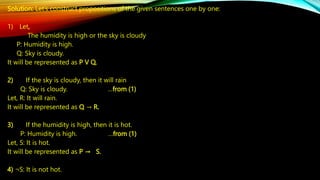
Solution: Let’s construct propositions of the given sentences one by one:
1) Let,
The humidity is high or the sky is cloudy
P: Humidity is high.
Q: Sky is cloudy.
It will be represented as P V Q.
2) If the sky is cloudy, then it will rain
Q: Sky is cloudy. …from (1)
Let, R: It will rain.
It will be represented as Q → R.
3) If the humidity is high, then it is hot.
P: Humidity is high. …from (1)
Let, S: It is hot.
It will be represented as P → S.
4) ¬S: It is not hot.
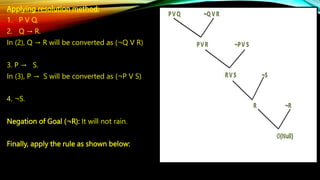
Applying resolution method:
1. P V Q.
2. Q → R.
In (2), Q → R will be converted as (¬Q V R)
3. P → S.
In (3), P → S will be converted as (¬P V S)
4. ¬S.
Negation of Goal (¬R): It will not rain.
Finally, apply the rule as shown below:
The End

Resolution method in AI.pptx

  • 1.
    RESOLUTION METHOD IN AI Assistantproof. Dr. Emad I Abdul Kareem
  • 2.
    RESOLUTION METHOD INAI Resolution method is an inference rule which is used in both Propositional as well as First-order Predicate Logic in different ways. This method is basically used for proving the satisfiability of a sentence. In resolution method, we use Proof by Refutation technique to prove the given statement. The key idea for the resolution method is to use the knowledge base and negated goal to obtain null clause (which indicates contradiction). Resolution method is also called Proof by Refutation. Since the knowledge base itself is consistent, the contradiction must be introduced by a negated goal. As a result, we have to conclude that the original goal is true.
  • 3.
    RESOLUTION METHOD IN PROPOSITIONALLOGIC In propositional logic, resolution method is the only inference rule which gives a new clause when two or more clauses are coupled together. Using propositional resolution, it becomes easy to make a theorem prover sound and complete for all. The process followed to convert the propositional logic into resolution method contains the below steps: • Convert the given statements into clausal form, • Apply and proof the given goal using negation rule. • Use those literals which are needed to prove. • Solve the clauses together and achieve the goal. But, before solving problems using Resolution method, let’s understand two normal forms
  • 4.
    CONVERT THE GIVENSTATEMENTS INTO CLAUSAL FORM ( CONJUNCTIVE NORMAL FORM(CNF)) ∀x [B(x) → (∃y [Q(x, y) ∧ ⌐ P(y)] ∧ ⌐ ∃y [Q(x, y) ∧ Q(y, x)] ∧ ∀y [⌐ B(y) → ⌐ E(x, y)])] 1- Eliminate the implication (→) E1 → E2 = ⌐ E1 ∨ E2 ∀x [⌐ B(x) ∨ ( ∃y [ Q(x ,y) ∧ ⌐ P(y) ] ∧ ⌐ ∃y [ Q(x ,y) ∧ Q(y ,x) ] ∧ ∀y [⌐(⌐ B(y)) ∨ ⌐ E(x ,y)] ) ] ∀x [B(x) → (∃y [Q(x, y) ∧ ⌐ P(y)] ∧ ∀y [⌐ B(y) → ⌐ E(x, y)])]
  • 5.
    2- Move thenegation down to the atomic formulas (by using the following rules) • ⌐ (P∧Q) ≡ ⌐ P ∨ ⌐ Q • ⌐ (P∨Q) ≡ ⌐ P ∧ ⌐ Q • ⌐ (⌐ (P)) ≡ P • ⌐ ∀x (P (x)) ≡ ∃x (⌐ P (x)) • ⌐ ∃x (P (x)) ≡ ∀x (⌐ P (x)) ∀x[⌐ B(x) ∨ ( ∃y [ Q(x,y) ∧ ⌐ P(y) ] ∧ ∀y [ ⌐ Q(x,y) ∨ ⌐ Q(y,x) ] ∧ ∀y [ B(y) ∨ ⌐ E(x,y)] ) ] 3- Purge existential quantifiers The function that is eliminate the existential are called “Skolem function” ∀x[⌐ B(x) ∨ ( [ Q(x , f (x)) ∧ ⌐ P(f (x)) ] ∧ ∀y [ ⌐ Q(x,y) ∨ ⌐ Q(y,x) ] ∧ ∀y [ B(y) ∨ ⌐ E(x,y)] ) ] ∧ ⌐ ∃y [ Q(x ,y) ∧ Q(y ,x) ] ∧ ∀y [⌐(⌐ B(y)) ∨ ⌐ E(x ,y)] ) ] ∀x[⌐ B(x) ∨ ( ∃y [ Q(x,y) ∧ ⌐ P(y) ]
  • 6.
    4- Rename variables,as necessary, so that no two variables are the same. ∀x[⌐ B(x) ∨ ( [ Q(x , f (x)) ∧ ⌐ P(f (x)) ] ∧ ∀y [ ⌐ Q(x,y) ∨ ⌐ Q(y,x) ] ∧ ∀z [ B(z) ∨ ⌐ E(x,z)] ) ] 5- Move the Universal quantifiers to the left of the statement. ∀x ∀y ∀z [⌐ B(x) ∨ ( [ Q(x , f (x)) ∧ ⌐ P(f (x)) ] ∧ [ ⌐ Q(x,y) ∨ ⌐ Q(y,x) ] ∧ [ B(z) ∨ ⌐ E(x,z)] ) ] ∧ ∀y [ B(y) ∨ ⌐ E(x,y)] ) ] ∀x[⌐ B(x) ∨ ( [ Q(x , f (x)) ∧ ⌐ P(f (x)) ] ∧ ∀y [ ⌐ Q(x,y) ∨ ⌐ Q(y,x) ] ∧ ∀z [ B(z) ∨ ⌐ E(x,z)] ) ]
  • 7.
    6- Move thedisjunction down to the literals, using distributive laws E1 ∨ (E2 ∧ E3 ∧ E4 ∧…) ≡ (E1 ∨ E2) ∧ (E1∨E3) ∧ …. E1 ∧ (E2 ∨ E3 ∨ E4∨…) ≡ (E1 ∧ E2) ∨ (E1∧E3) ∨ …. ∀x ∀y ∀z [ ( ⌐ B(x) ∨ ( Q(x , f (x)) ∧ ( ⌐ B(x) ∨ ⌐ P(f (x) ) ) ∧ ( ⌐ B(x) ∨ ⌐ Q(x,y) ∨ ⌐ Q(y,x) ) ∧ (⌐ B(x) ∨ B(z) ∨ ⌐ E(x,z) ) ] 7- Eliminate the conjunctions ∀x [ ⌐ B(x) ∨ ( Q(x , f (x) ] ∀x [⌐ B(x) ∨ ⌐ P(f (x) ) ] ∀x ∀y [ ⌐ B(x) ∨ ⌐ Q(x,y) ∨ ⌐ Q(y,x) ] ∀x ∀z [⌐ B(x) ∨ B(z) ∨ ⌐ E(x,z) ] ∀x ∀y ∀z [⌐ B(x) ∨ ( [ Q(x , f (x)) ∧ ⌐ P(f (x)) ] ∧ [ ⌐ Q(x,y) ∨ ⌐ Q(y,x) ] ∧ [ B(z) ∨ ⌐ E(x,z)] ) ] ∀x ∀y ∀z [ ( ⌐ B(x) ∨ ( Q(x , f (x)) ∧ ( ⌐ B(x) ∨ ⌐ P(f (x) ) ) ∧ ( ⌐ B(x) ∨ ⌐ Q(x,y) ∨ ⌐ Q(y,x) ) ∧ (⌐ B(x) ∨ B(z) ∨ ⌐ E(x,z) ) ]
  • 8.
    8- Rename allthe variables, as necessary, so that no two variables are the same. ∀x [ ⌐ B(x) ∨ ( Q(x , f (x) ] ∀w [⌐ B(w) ∨ ⌐ P(f (w) ) ] ∀u ∀y [⌐ B(u) ∨ ⌐ Q(u,y) ∨ ⌐ Q(y,u) ] ∀a ∀z [⌐ B(a) ∨ B(z) ∨ ⌐ E(a,z) ] 9- Purge the universal quantifiers. ⌐ B(x) ∨ ( Q(x , f (x)) ⌐ B(w) ∨ ⌐ P(f (w) ) ⌐ B(u) ∨ ⌐ Q(u,y) ∨ ⌐ Q(y,u) ⌐ B(a) ∨ B(z) ∨ ⌐ E(a,z) ) ∀x [ ⌐ B(x) ∨ ( Q(x , f (x) ] ∀x [⌐ B(x) ∨ ⌐ P(f (x) ) ] ∀x ∀y [ ⌐ B(x) ∨ ⌐ Q(x,y) ∨ ⌐ Q(y,x) ] ∀x ∀z [⌐ B(x) ∨ B(z) ∨ ⌐ E(x,z) ] ∀x [ ⌐ B(x) ∨ ( Q(x , f (x) ] ∀x [⌐ B(x) ∨ ⌐ P(f (x) ) ] ∀x ∀y [ ⌐ B(x) ∨ ⌐ Q(x,y) ∨ ⌐ Q(y,x) ] ∀x ∀z [⌐ B(x) ∨ B(z) ∨ ⌐ E(x,z) ]
  • 9.
    EXAMPLE Consider the followingKnowledge Base: The humidity is high or the sky is cloudy. ‫غائمة‬ ‫السماء‬ ‫أو‬ ‫عالية‬ ‫الرطوبة‬ . If the sky is cloudy, then it will rain. ‫تمطر‬ ‫فسوف‬ ، ‫غائمة‬ ‫السماء‬ ‫كانت‬ ‫إذا‬ . If the humidity is high, then it is hot. ‫حارا‬ ‫الطقس‬ ‫يكون‬ ‫ثم‬ ،‫عالية‬ ‫الرطوبة‬ ‫كانت‬ ‫إذا‬ . It is not hot. ‫ليس‬ ‫الطقس‬ ‫حارا‬ . Goal: It will rain. Use propositional logic and apply resolution method to prove that the goal is derivable from the given knowledge base.
  • 10.
    Solution: Let’s constructpropositions of the given sentences one by one: 1) Let, The humidity is high or the sky is cloudy P: Humidity is high. Q: Sky is cloudy. It will be represented as P V Q. 2) If the sky is cloudy, then it will rain Q: Sky is cloudy. …from (1) Let, R: It will rain. It will be represented as Q → R. 3) If the humidity is high, then it is hot. P: Humidity is high. …from (1) Let, S: It is hot. It will be represented as P → S. 4) ¬S: It is not hot.
  • 11.
    Applying resolution method: 1.P V Q. 2. Q → R. In (2), Q → R will be converted as (¬Q V R) 3. P → S. In (3), P → S will be converted as (¬P V S) 4. ¬S. Negation of Goal (¬R): It will not rain. Finally, apply the rule as shown below:
  • 12.