Mr. Vipul H. Kondekar
(vhkondekar@witsolapur.org)
Assistant Professor,
Electronics & Telecommunication Engineering
Walchand Institute of Technology, Solapur
(www.witsolapur.org)
Artificial Intelligence :
Properties of task environments
Walchand Institute of Technology, Solapur 1
At the end of this session, students will be able to
1) Differentiate task environments based on different properties.
2) Identify properties of task environments.
Walchand Institute of Technology, Solapur 2
Learning Outcomes
Walchand Institute of Technology, Solapur 3
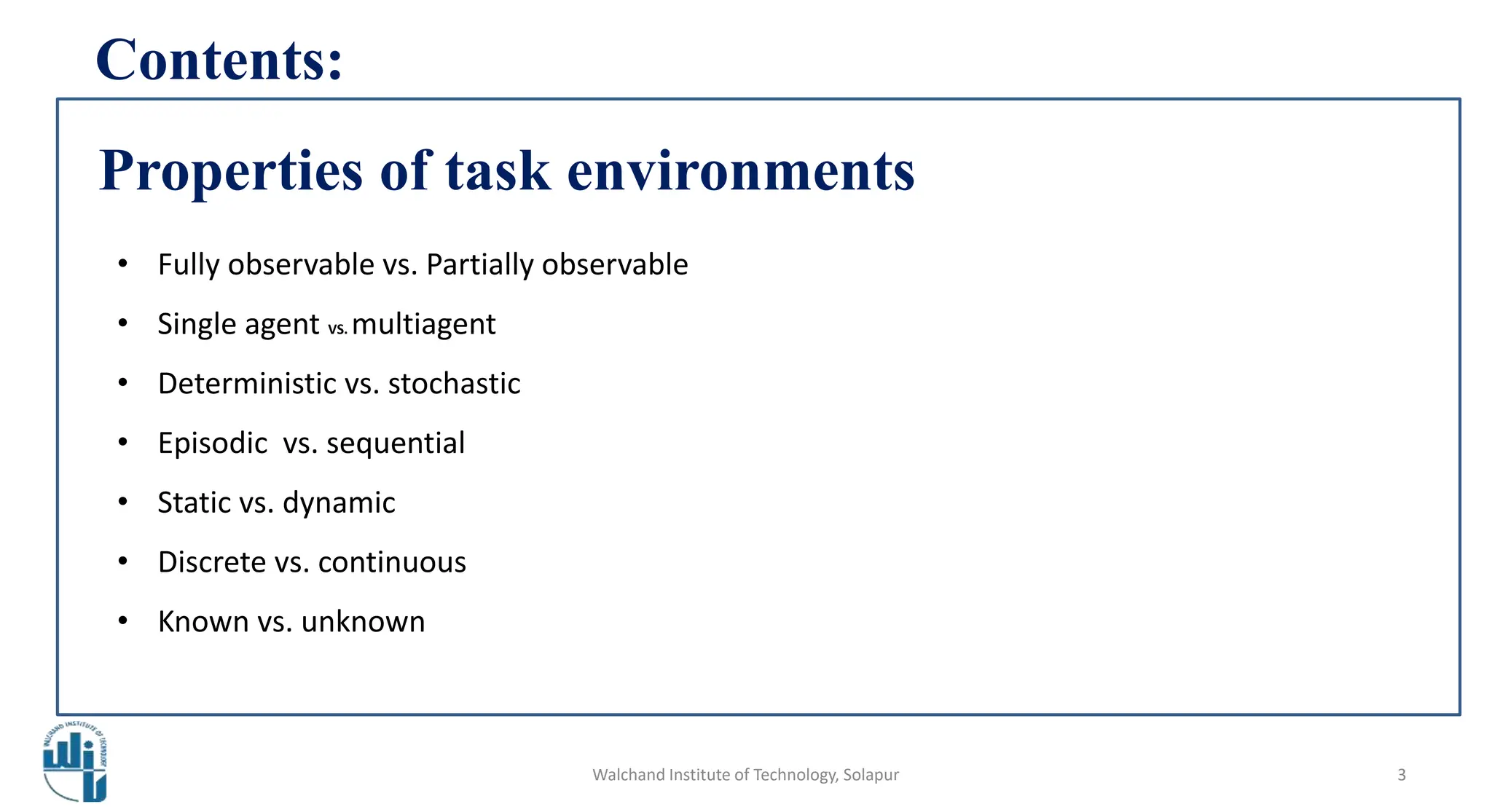
Contents:
• Fully observable vs. Partially observable
• Single agent VS. multiagent
• Deterministic vs. stochastic
• Episodic vs. sequential
• Static vs. dynamic
• Discrete vs. continuous
• Known vs. unknown
Properties of task environments
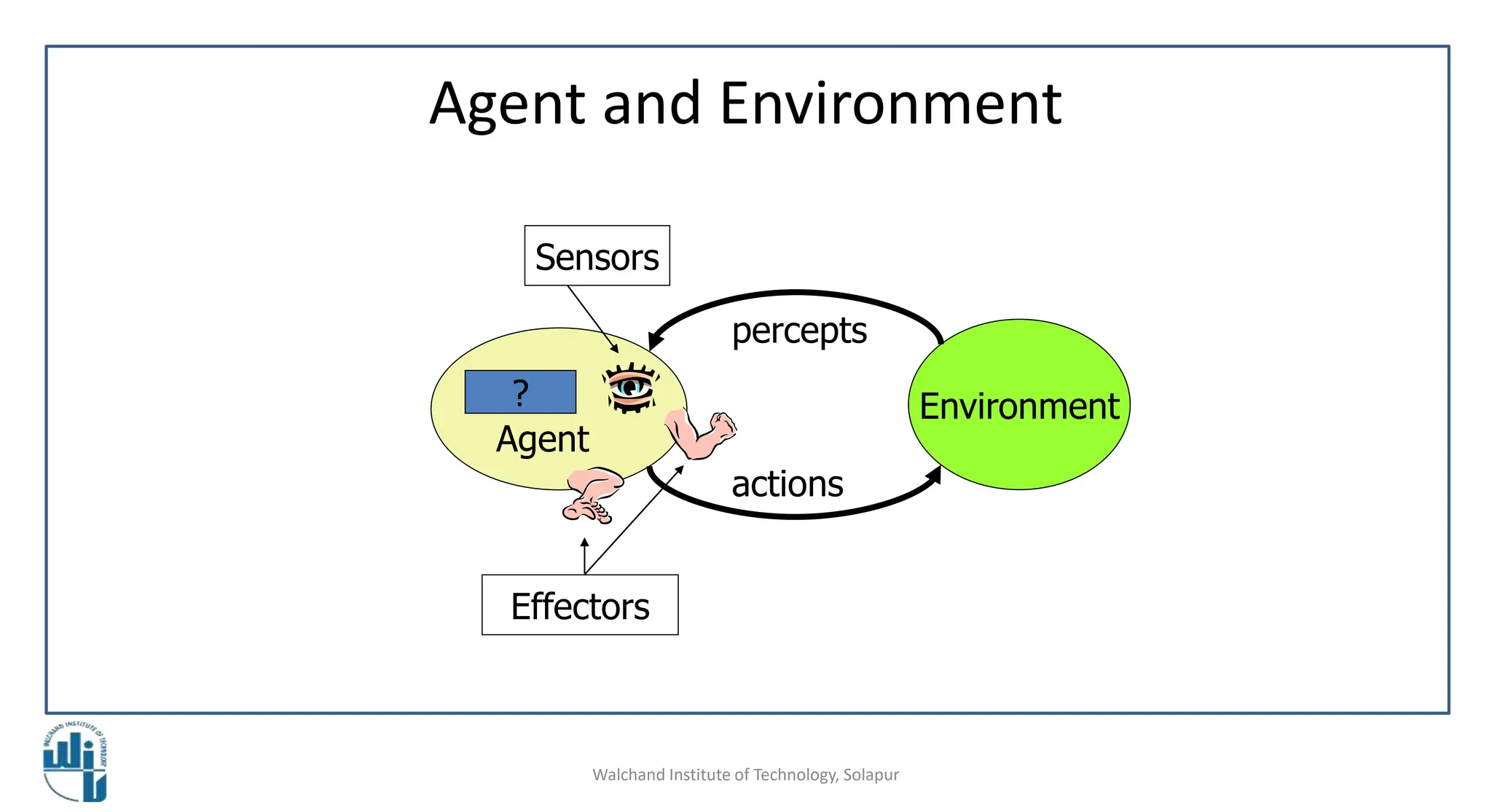
Agent and Environment
Environment
Agent
percepts
actions
?
Sensors
Effectors
Walchand Institute of Technology, Solapur
Walchand Institute of Technology, Solapur 5
Task environments
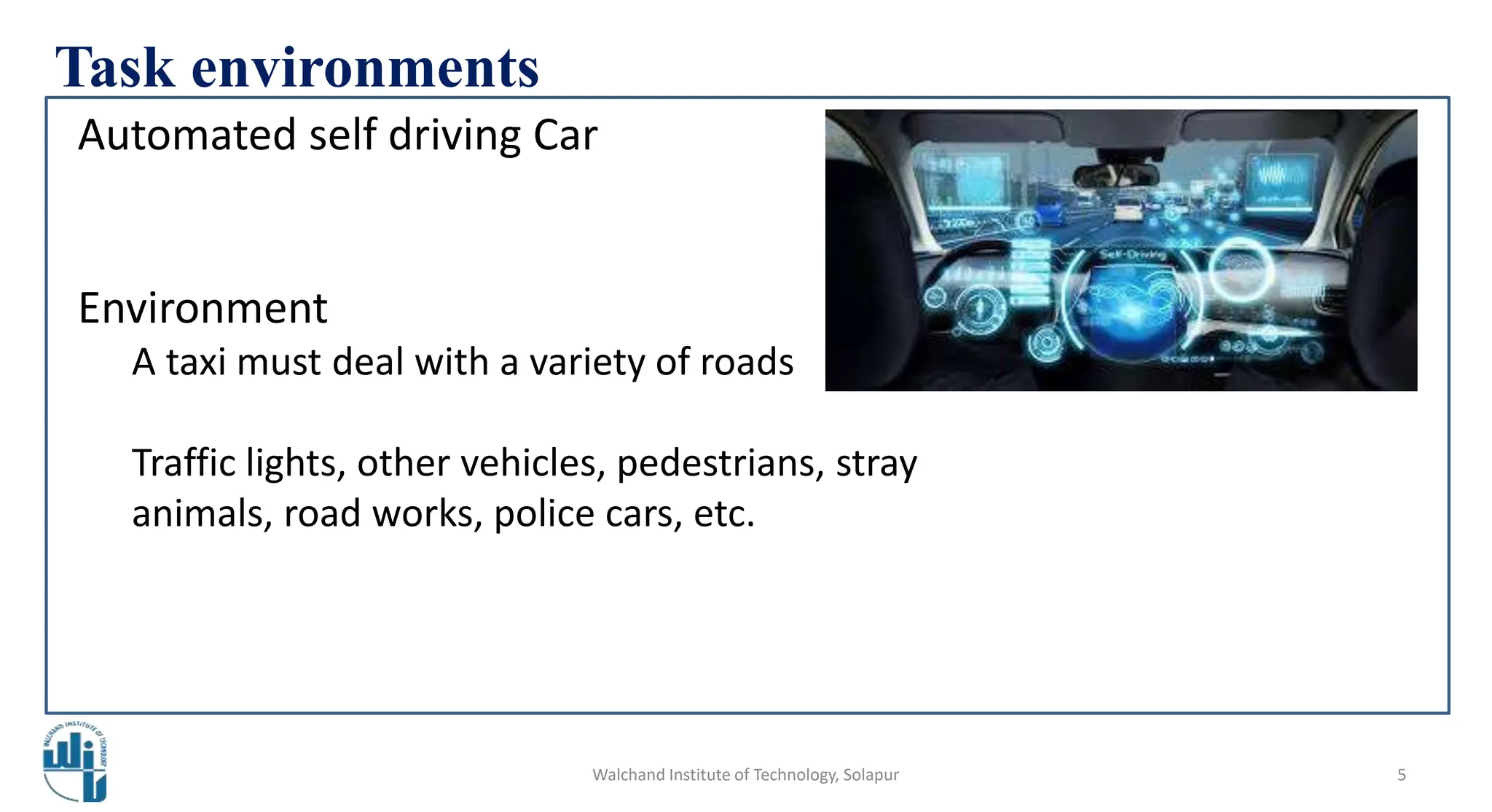
Automated self driving Car
Environment
A taxi must deal with a variety of roads
Traffic lights, other vehicles, pedestrians, stray
animals, road works, police cars, etc.
Walchand Institute of Technology, Solapur 6
Properties of task environments
• Fully observable vs. Partially observable
• If an agent’s sensors give it access to the complete state of the environment at
each point in time then the environment is fully observable
• An environment might be Partially observable because of noisy and inaccurate
sensors or because parts of the state are simply missing from the sensor data.
• Fully observable environments are convinient because the agent need not manitain any internal
state to keep track of the world.
Walchand Institute of Technology, Solapur 7
Properties of task environments
• Single agent VS. multiagent
– Playing a crossword puzzle – single agent
– Chess playing – two agents
– Competitive multiagent environment
• Chess playing
– Cooperative multiagent environment
• Automated taxi driver
• Avoiding collision
Walchand Institute of Technology, Solapur 8
Properties of task environments
• Deterministic vs. stochastic
– Next state of the environment Completely determined by the current state and the
actions executed by the agent, then the environment is deterministic, otherwise, it
is Stochastic.
– Environment is uncertain if it is not fully observable or not deterministic
– Outcomes are quantified in terms of probability
-taxi driver is Stochastic
- Vacuum cleaner may be deterministic or stochastic
Walchand Institute of Technology, Solapur 9
Properties of task environments
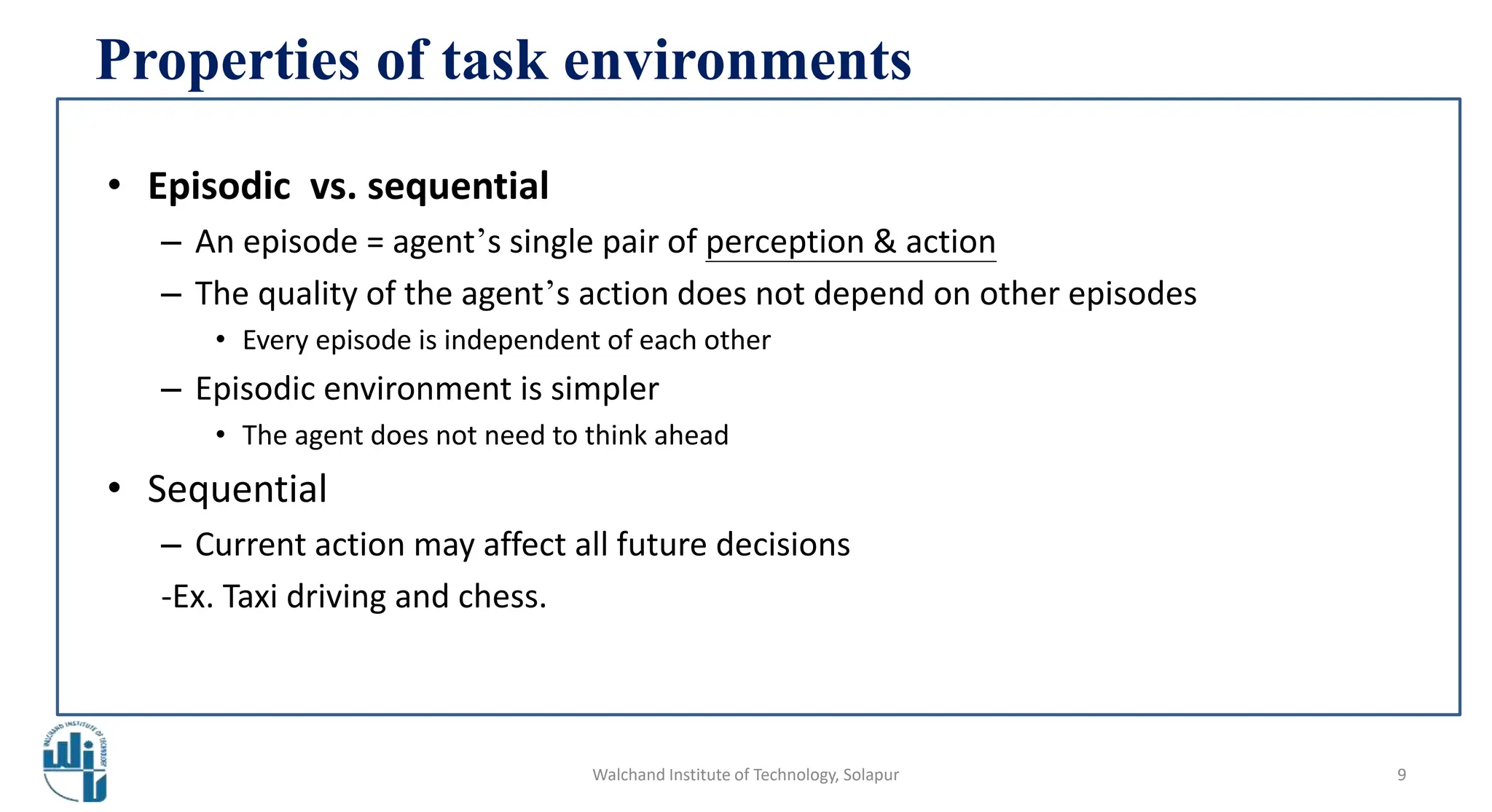
• Episodic vs. sequential
– An episode = agent’s single pair of perception & action
– The quality of the agent’s action does not depend on other episodes
• Every episode is independent of each other
– Episodic environment is simpler
• The agent does not need to think ahead
• Sequential
– Current action may affect all future decisions
-Ex. Taxi driving and chess.
Walchand Institute of Technology, Solapur 10
Properties of task environments
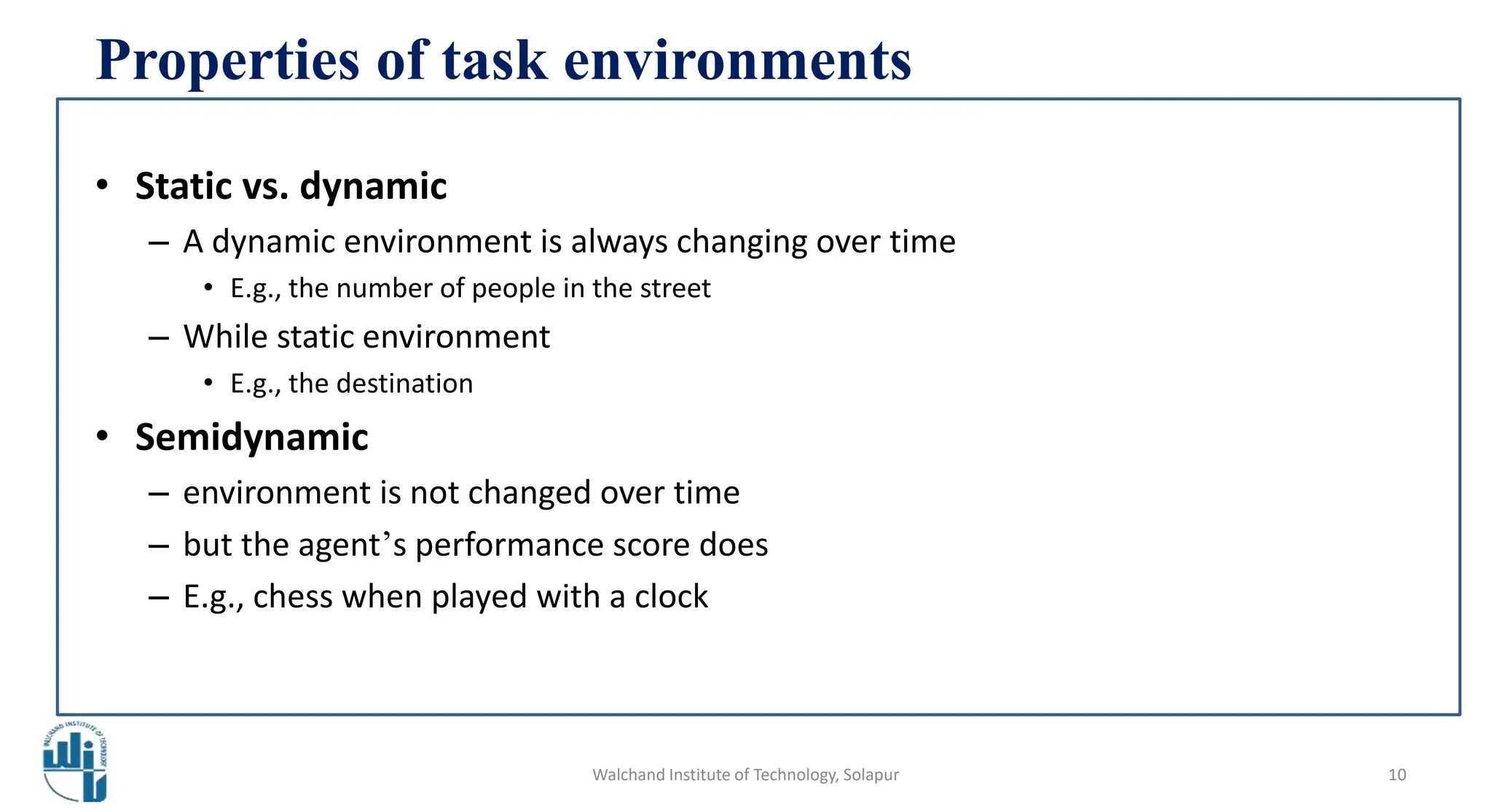
• Static vs. dynamic
– A dynamic environment is always changing over time
• E.g., the number of people in the street
– While static environment
• E.g., the destination
• Semidynamic
– environment is not changed over time
– but the agent’s performance score does
– E.g., chess when played with a clock
Walchand Institute of Technology, Solapur 11
Properties of task environments
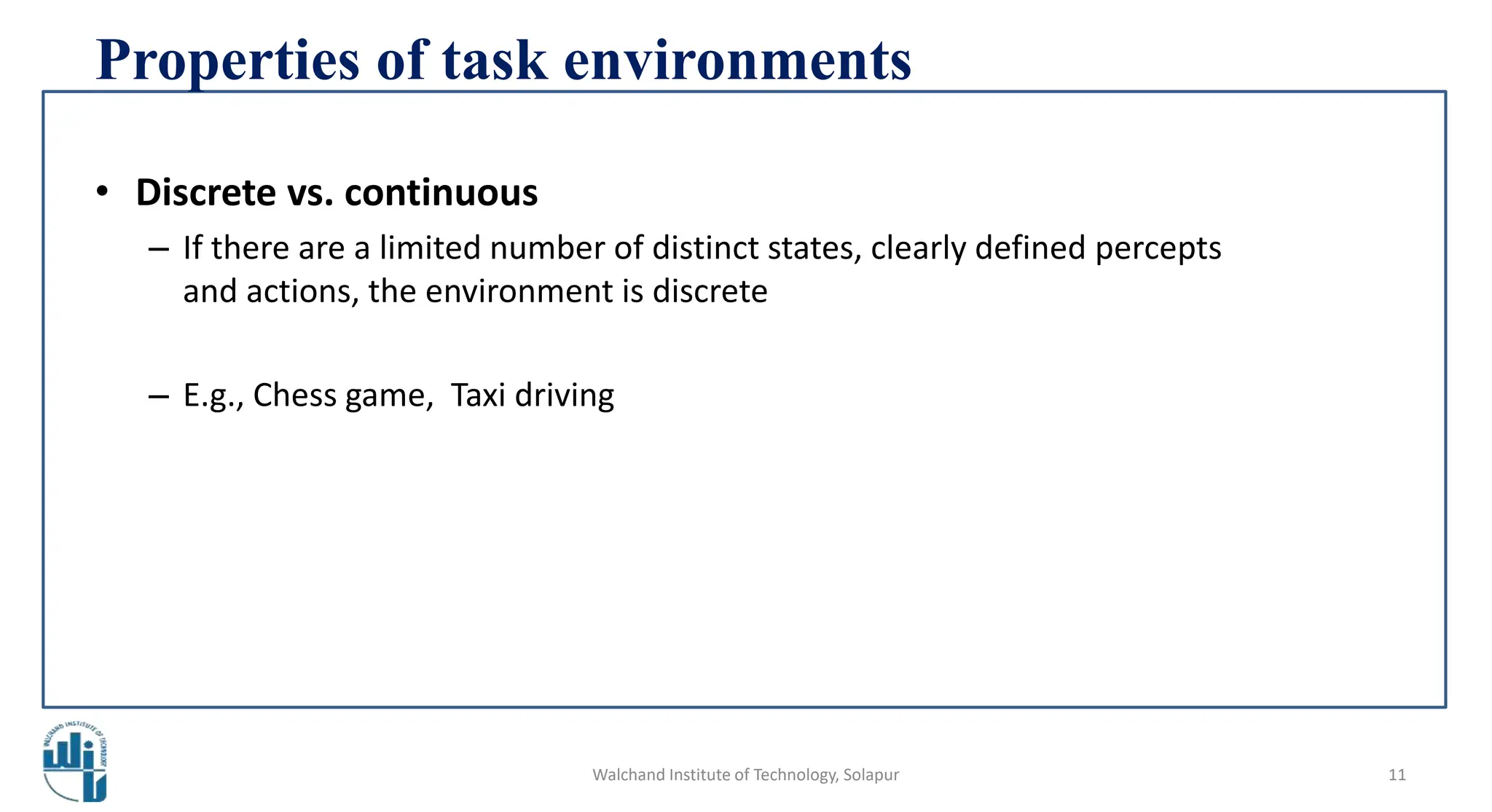
• Discrete vs. continuous
– If there are a limited number of distinct states, clearly defined percepts
and actions, the environment is discrete
– E.g., Chess game, Taxi driving
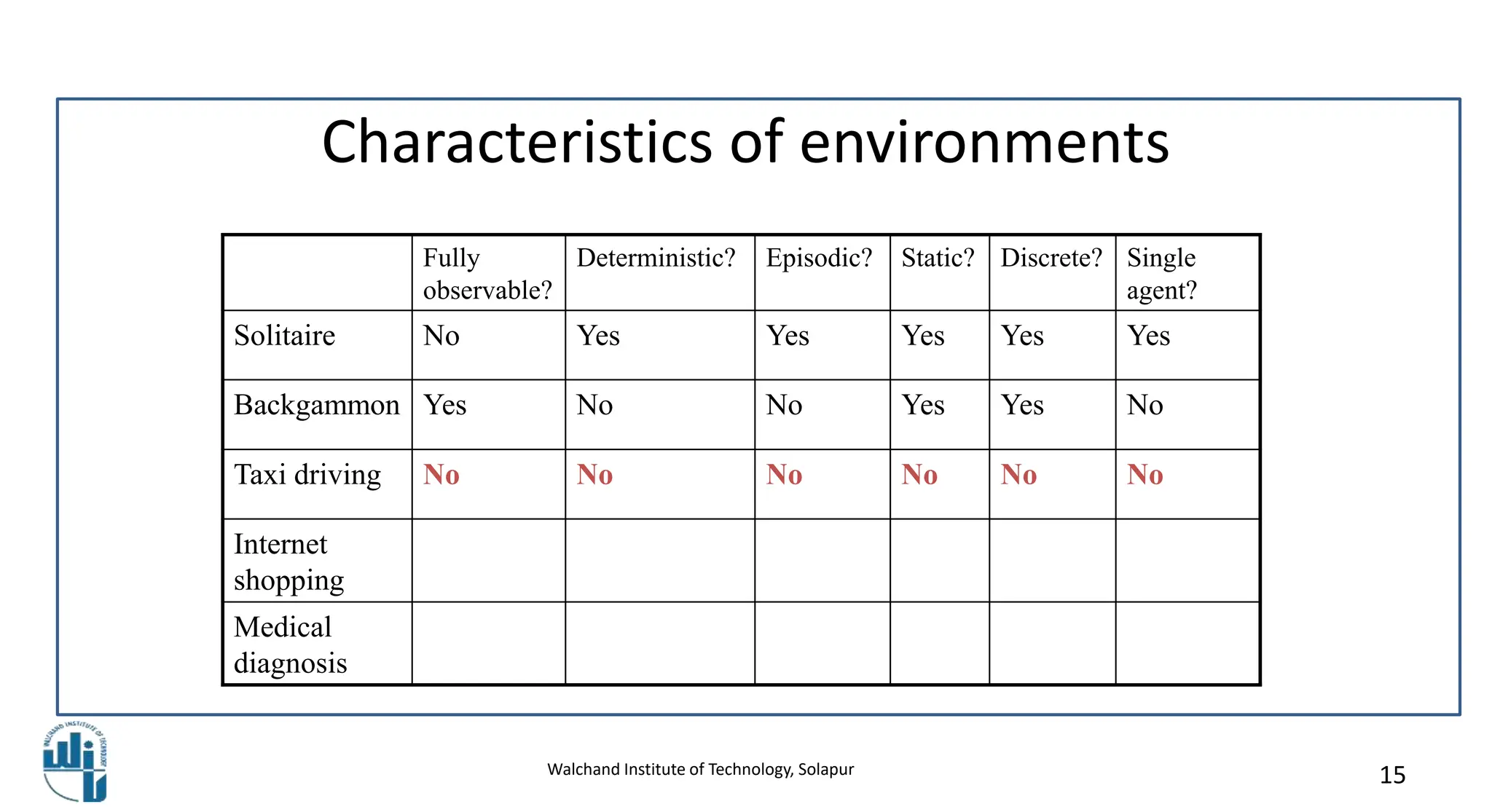
Characteristics of environments
Fully
observable?
Deterministic? Episodic? Static? Discrete? Single
agent?
Solitaire
Backgammon
Taxi driving
Internet
shopping
Medical
diagnosis
Walchand Institute of Technology, Solapur 12
Think ?
Characteristics of environments
Fully
observable?
Deterministic Episodic Static Discrete? Single
agent?
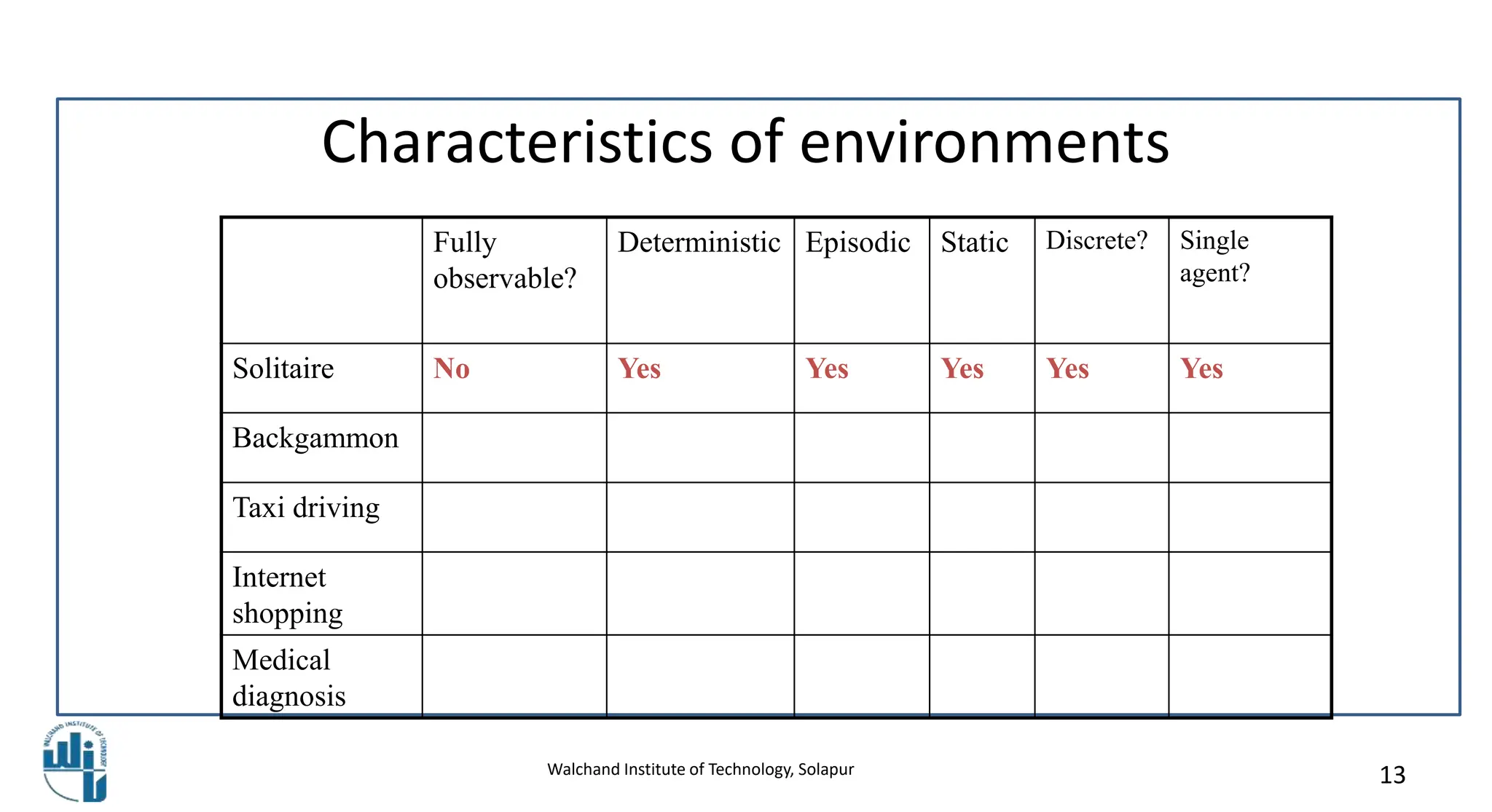
Solitaire No Yes Yes Yes Yes Yes
Backgammon
Taxi driving
Internet
shopping
Medical
diagnosis
Walchand Institute of Technology, Solapur 13
Characteristics of environments
Fully
observable?
Deterministic? Episodic? Static? Discrete? Single
agent?
Solitaire No Yes Yes Yes Yes Yes
Backgammon Yes No No Yes Yes No
Taxi driving
Internet
shopping
Medical
diagnosis
Walchand Institute of Technology, Solapur 14
Characteristics of environments
Fully
observable?
Deterministic? Episodic? Static? Discrete? Single
agent?
Solitaire No Yes Yes Yes Yes Yes
Backgammon Yes No No Yes Yes No
Taxi driving No No No No No No
Internet
shopping
Medical
diagnosis
Walchand Institute of Technology, Solapur 15
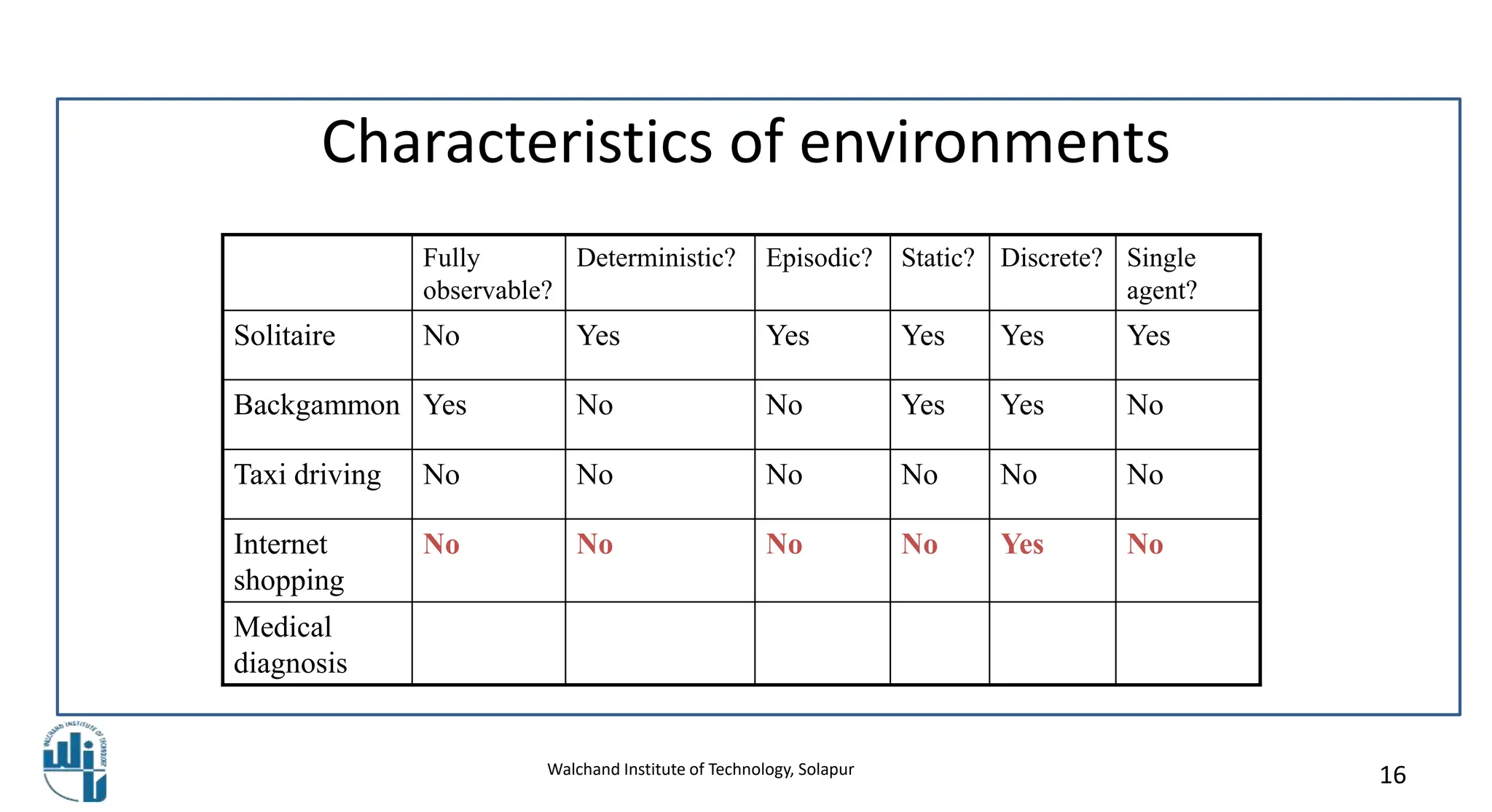
Characteristics of environments
Fully
observable?
Deterministic? Episodic? Static? Discrete? Single
agent?
Solitaire No Yes Yes Yes Yes Yes
Backgammon Yes No No Yes Yes No
Taxi driving No No No No No No
Internet
shopping
No No No No Yes No
Medical
diagnosis
Walchand Institute of Technology, Solapur 16
Walchand Institute of Technology, Solapur 17
Characteristics of environments
Fully
observable?
Deterministic? Episodic? Static? Discrete? Single
agent?
Solitaire No Yes Yes Yes Yes Yes
Backgammon Yes No No Yes Yes No
Taxi driving No No No No No No
Internet
shopping
No No No No Yes No
Medical
diagnosis
No No No No No Yes
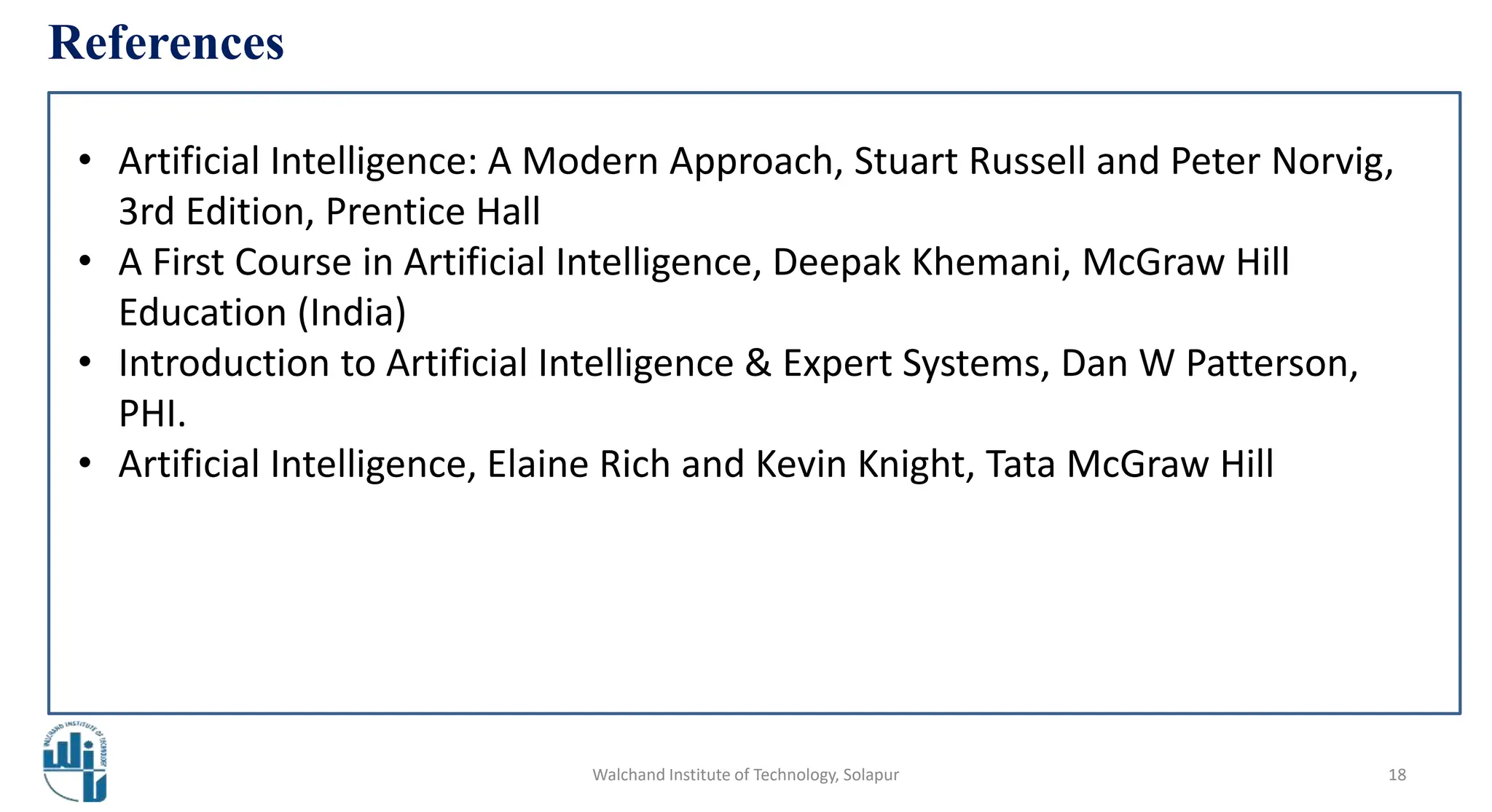
References
Walchand Institute of Technology, Solapur 18
• Artificial Intelligence: A Modern Approach, Stuart Russell and Peter Norvig,
3rd Edition, Prentice Hall
• A First Course in Artificial Intelligence, Deepak Khemani, McGraw Hill
Education (India)
• Introduction to Artificial Intelligence & Expert Systems, Dan W Patterson,
PHI.
• Artificial Intelligence, Elaine Rich and Kevin Knight, Tata McGraw Hill
Walchand Institute of Technology, Solapur 19
Thanks!!

properties of the task environment in artificial intelligence system

  • 1.
    Mr. Vipul H.Kondekar (vhkondekar@witsolapur.org) Assistant Professor, Electronics & Telecommunication Engineering Walchand Institute of Technology, Solapur (www.witsolapur.org) Artificial Intelligence : Properties of task environments Walchand Institute of Technology, Solapur 1
  • 2.
    At the endof this session, students will be able to 1) Differentiate task environments based on different properties. 2) Identify properties of task environments. Walchand Institute of Technology, Solapur 2 Learning Outcomes
  • 3.
    Walchand Institute ofTechnology, Solapur 3 Contents: • Fully observable vs. Partially observable • Single agent VS. multiagent • Deterministic vs. stochastic • Episodic vs. sequential • Static vs. dynamic • Discrete vs. continuous • Known vs. unknown Properties of task environments
  • 4.
  • 5.
    Walchand Institute ofTechnology, Solapur 5 Task environments Automated self driving Car Environment A taxi must deal with a variety of roads Traffic lights, other vehicles, pedestrians, stray animals, road works, police cars, etc.
  • 6.
    Walchand Institute ofTechnology, Solapur 6 Properties of task environments • Fully observable vs. Partially observable • If an agent’s sensors give it access to the complete state of the environment at each point in time then the environment is fully observable • An environment might be Partially observable because of noisy and inaccurate sensors or because parts of the state are simply missing from the sensor data. • Fully observable environments are convinient because the agent need not manitain any internal state to keep track of the world.
  • 7.
    Walchand Institute ofTechnology, Solapur 7 Properties of task environments • Single agent VS. multiagent – Playing a crossword puzzle – single agent – Chess playing – two agents – Competitive multiagent environment • Chess playing – Cooperative multiagent environment • Automated taxi driver • Avoiding collision
  • 8.
    Walchand Institute ofTechnology, Solapur 8 Properties of task environments • Deterministic vs. stochastic – Next state of the environment Completely determined by the current state and the actions executed by the agent, then the environment is deterministic, otherwise, it is Stochastic. – Environment is uncertain if it is not fully observable or not deterministic – Outcomes are quantified in terms of probability -taxi driver is Stochastic - Vacuum cleaner may be deterministic or stochastic
  • 9.
    Walchand Institute ofTechnology, Solapur 9 Properties of task environments • Episodic vs. sequential – An episode = agent’s single pair of perception & action – The quality of the agent’s action does not depend on other episodes • Every episode is independent of each other – Episodic environment is simpler • The agent does not need to think ahead • Sequential – Current action may affect all future decisions -Ex. Taxi driving and chess.
  • 10.
    Walchand Institute ofTechnology, Solapur 10 Properties of task environments • Static vs. dynamic – A dynamic environment is always changing over time • E.g., the number of people in the street – While static environment • E.g., the destination • Semidynamic – environment is not changed over time – but the agent’s performance score does – E.g., chess when played with a clock
  • 11.
    Walchand Institute ofTechnology, Solapur 11 Properties of task environments • Discrete vs. continuous – If there are a limited number of distinct states, clearly defined percepts and actions, the environment is discrete – E.g., Chess game, Taxi driving
  • 12.
    Characteristics of environments Fully observable? Deterministic?Episodic? Static? Discrete? Single agent? Solitaire Backgammon Taxi driving Internet shopping Medical diagnosis Walchand Institute of Technology, Solapur 12 Think ?
  • 13.
    Characteristics of environments Fully observable? DeterministicEpisodic Static Discrete? Single agent? Solitaire No Yes Yes Yes Yes Yes Backgammon Taxi driving Internet shopping Medical diagnosis Walchand Institute of Technology, Solapur 13
  • 14.
    Characteristics of environments Fully observable? Deterministic?Episodic? Static? Discrete? Single agent? Solitaire No Yes Yes Yes Yes Yes Backgammon Yes No No Yes Yes No Taxi driving Internet shopping Medical diagnosis Walchand Institute of Technology, Solapur 14
  • 15.
    Characteristics of environments Fully observable? Deterministic?Episodic? Static? Discrete? Single agent? Solitaire No Yes Yes Yes Yes Yes Backgammon Yes No No Yes Yes No Taxi driving No No No No No No Internet shopping Medical diagnosis Walchand Institute of Technology, Solapur 15
  • 16.
    Characteristics of environments Fully observable? Deterministic?Episodic? Static? Discrete? Single agent? Solitaire No Yes Yes Yes Yes Yes Backgammon Yes No No Yes Yes No Taxi driving No No No No No No Internet shopping No No No No Yes No Medical diagnosis Walchand Institute of Technology, Solapur 16
  • 17.
    Walchand Institute ofTechnology, Solapur 17 Characteristics of environments Fully observable? Deterministic? Episodic? Static? Discrete? Single agent? Solitaire No Yes Yes Yes Yes Yes Backgammon Yes No No Yes Yes No Taxi driving No No No No No No Internet shopping No No No No Yes No Medical diagnosis No No No No No Yes
  • 18.
    References Walchand Institute ofTechnology, Solapur 18 • Artificial Intelligence: A Modern Approach, Stuart Russell and Peter Norvig, 3rd Edition, Prentice Hall • A First Course in Artificial Intelligence, Deepak Khemani, McGraw Hill Education (India) • Introduction to Artificial Intelligence & Expert Systems, Dan W Patterson, PHI. • Artificial Intelligence, Elaine Rich and Kevin Knight, Tata McGraw Hill
  • 19.
    Walchand Institute ofTechnology, Solapur 19 Thanks!!