1 | P a g e
15BSP430
Global Financial Markets and the Financial Crisis
΄
Assignment question: Show how transactions in derivative
instruments can be used to either hedge risks or to open speculative
positions.
Word Count: 2,749
Name: Panagiotis Charalampopoulos
Student ID: B511616
Due Date: 04/05/2016
2 | P a g e
Table of Contents
1 Introduction ...............................................................................................................3
2 Price risk management derivatives ..........................................................................3
2.1 Futures and Forwards ........................................................................................4
2.2 Options .................................................................................................................5
2.3 Swaps....................................................................................................................6
3 Credit Derivatives......................................................................................................7
3.1 CDS and CDO’s...................................................................................................7
4 Conclusion ..................................................................................................................8
5 References...................................................................................................................9
3 | P a g e
1 Introduction
Derivatives have increasingly gained popularity amongst financial practitioners and investors,
in an effort to adapt with the increasing volatility and complexity of financial markets. These
instruments enable investors to handle the risks arising from securities trading and speculate on
expected movements in securities prices, without direct trade in the assets themselves.
“Derivatives are financial contracts whose value is derived from some underlying asset”
(Acharya and Richardson, 2009, p.233). The length of the contract is fixed and at maturity each
party may face one of the following outcomes: a) obligation or option to buy/sell the underlying
asset, b) claim the gains/ pay the losses of a fluctuation in the underlying asset to the
counterparty (through margin accounts), c) exchange the nature of cash flows (fixed, floating)
between the two parties.
This essay aims to examine the hedging and speculative strategies that can be achieved using
various derivative instruments. Firstly, a distinction is made between derivatives for the
management of price risks and those for the shifting of credit risk (Llewellyn, 2009). In both
categories, the main instruments are reviewed and their role for hedging or speculating is
examined using imaginative and real industry examples. Finally, the conclusion provides a
recommendation towards a more effective and transparent use of derivatives.
2 Price risk management derivatives
Instruments in this group come in many forms and combinations inter-alia futures, forwards,
options and swaps. Nevertheless, they can be further categorized on the primary intention of
their use; hedging versus speculation, or in other words using derivatives to offset price
exposure versus taking-on positions based on your best forecast about the future (Turbeville,
2013). This is an area that has been intensively researched by academics.
Most studies focus on non-financial firms and although it seems to be a general consensus that
companies use derivatives to hedge, evidence for speculative use, vary. Allayannis and Ofek
(2001) examine the degree to which foreign exchange exposure affects firms’ decisions to use
derivatives, finding a positive association between hedging and forex exposure, but no intention
to speculate. Likewise, Hentschel and Kothari (2001) find no material effects of derivative
contracts on overall firm volatility. Conversely, Brown, Crabb and Haushalter (2003) find that
managers may add speculative components in a firm’s risk management strategy, while Adam
and Fernando (2003, p.25) expound that the original intention of derivative usage is not always
easy to distinguish if “hedging and speculation are no longer mutually exclusive activities”.
This implies that firms may disguise speculative activities as hedging transactions. Finally,
Chernenko and Faulkender (2011), contend that firms appear to use interest rate swaps to
speculate as much as they use them to handle risks.
This disagreement between researchers, partly stems from the fact that most of the data used
come from exchange-traded records rather than over-the-counter, thus not taking into
consideration the large private bilateral agreements. Derivative exchanges like the Chicago
Mercantile Exchange (CME) operate for many decades, although the fixed nature of contracts
offered is often not suitable for corporations’ tailored needs. Thus, in recent years trading
activity has shifted to OTC markets, which as estimated before 2007, accounted for over $596
4 | P a g e
trillion in derivative contracts outstanding (Chance and Brooks, 2010). Prior to the crisis, OTC
markets were largely unregulated carrying a huge amount of systemic risk (Hull, 2014). After
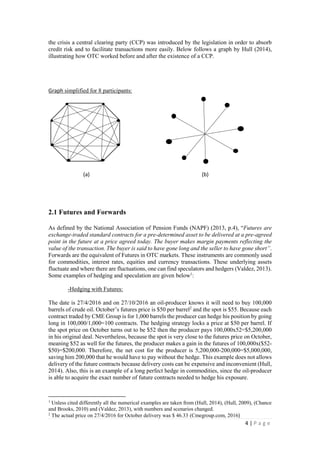
the crisis a central clearing party (CCP) was introduced by the legislation in order to absorb
credit risk and to facilitate transactions more easily. Below follows a graph by Hull (2014),
illustrating how OTC worked before and after the existence of a CCP.
Graph simplified for 8 participants:
(a) (b)
2.1 Futures and Forwards
As defined by the National Association of Pension Funds (NAPF) (2013, p.4), “Futures are
exchange-traded standard contracts for a pre-determined asset to be delivered at a pre-agreed
point in the future at a price agreed today. The buyer makes margin payments reflecting the
value of the transaction. The buyer is said to have gone long and the seller to have gone short”.
Forwards are the equivalent of Futures in OTC markets. These instruments are commonly used
for commodities, interest rates, equities and currency transactions. These underlying assets
fluctuate and where there are fluctuations, one can find speculators and hedgers (Valdez, 2013).
Some examples of hedging and speculation are given below1
:
-Hedging with Futures:
The date is 27/4/2016 and on 27/10/2016 an oil-producer knows it will need to buy 100,000
barrels of crude oil. October’s futures price is $50 per barrel2
and the spot is $55. Because each
contract traded by CME Group is for 1,000 barrels the producer can hedge his position by going
long in 100,000/1,000=100 contracts. The hedging strategy locks a price at $50 per barrel. If
the spot price on October turns out to be $52 then the producer pays 100,000x52=$5,200,000
in his original deal. Nevertheless, because the spot is very close to the futures price on October,
meaning $52 as well for the futures, the producer makes a gain in the futures of
100,000x($52$50)=$200,000. Therefore, the net cost for the producer is 5,200,000-
200,000=$5,000,000, saving him 200,000 that he would have to pay without the hedge. This
example does not allows delivery of the future contracts because delivery costs can be
expensive and inconvenient (Hull, 2014). Also, this is an example of a long perfect hedge in
commodities, since the oil-producer is able to acquire the exact number of future contracts
needed to hedge his exposure.
1
Unless cited differently all the numerical examples are taken from (Hull, 2014), (Hull, 2009), (Chance
and Brooks, 2010) and (Valdez, 2013), with numbers and scenarios changed.
2
The actual price on 27/4/2016 for October delivery was $ 46.33 (Cmegroup.com, 2016)
5 | P a g e
A high-profile industry example of unsuccessful hedging is that of Metallgesellschaft. The
German company introduced a marketing programme which enabled its clients to lock fixed
prices on petroleum products. Metallgesellschaft entered into long short-term futures and
forwards contracts that were supposed to match the long exposure it had with clients if they
were rolled over continuously (Chance and Brooks, 2010). Although, as Culp and Miller (1995,
p.64) contend in their relative paper “borrowing short and lending long is an oft-cited recipe
for financial disaster”. The result was that the oil price fell and the company received huge
margin calls in its exchange-traded position that could not fund from its operational activities
hereby, experiencing large liquidity problems. Eventually, the management liquidated the
hedge position with Metallgesellschaft making a loss of $1.33 billion (Hull, 2014).
-Speculating with Futures:
Speculating with futures can be similar to the hedging example. Although, here the oil producer
enters the future contract because he believes that the futures price per barrel is going to increase
from $50 in April to $60 in October. This is a projection; a best guess about the future based on
analysing past trends or news from the press. Assuming the October price actually moves to
$57 per barrel, then the producer has spent 100,000x$50=$5,000,000 on April and in October
he can close his position with an opposite contract, selling his future exposure at $57, resulting
in a gain of (100,000x$57)-$5,000,000=$700,000.
2.2 Options
Options are traded on exchange and give one party the right, but not the obligation to buy or
sell an asset at a predetermined date for a certain price. They are named calls, when the buyer
has the option and puts, when the seller has the option to exercise the contract (NAPF, 2013).
This flexibility offered to the option-holder, does not come for free. The investor must pay an
up-front fee called option premium, which is the main characteristic that distinguishes options
from futures (Hull, 2014).
-Hedging with Options:
As Chance and Brooks (2010) recognize, there are four types of option transactions. a) Buy a
call, b) Write a call, c) Buy a put and d) Write a put. A simplified option hedging strategy can
be achieved only if you take position a) or c). In the latter case assume you own 100 shares of
a stock with a price of S=$100. Your total position is therefore 100x$100=$10,000. You are
confident that the price of the stock will rise, nevertheless you don’t want to leave your position
unprotected. You decide that you want to hedge that position by buying a put option to sell 100
shares at $100 at a specific date in the future. This agreed future price is the strike price of the
option. The price of an option to sell one share is $5 (option premium), resulting in a total initial
investment of $500. The agreed date arrives3
and the share price of the stock falls at $80. Your
normal loss at the stock market without the option would be $10,000-(100x$80)=$2,000.
However, since the market price is lower than the strike price you exercise your option, selling
at $100 despite the price having fell at $80. If there were no upfront fees you would make no
loss, since gains in the options and losses in the stock market would balance. However you paid
an up-front fee of $500. Therefore, after this price fluctuation you end up making a loss of only
+2,000–2,000–500=-$500. This is a basic hedging strategy example with a stock put option.
More advanced strategies include straddle, butterfly, bull spreads etc.
3
In both examples of hedging and speculation, the option contract is assumed to be a European option,
meaning that is possible to exercise it only at expiration date (Call-options.com, 2016).
6 | P a g e
-Speculating with Options:
Speculating with options involves taking one of the four positions mentioned above or having
already an open position in stocks and gearing that position further with an option contract of
the same ‘direction’ (Valdez, 2013). For example, suppose that the current price of a stock is
$100. You estimate that the price will rise, therefore you buy a call option for 100 shares locking
a price at $100. The option premium is $1 per share so $100 in total, up-front costs. The price
of the stock eventually moves to $120 at expiration date, so you can exercise your call option.
You buy at $100 and sell at $120 in the spot market making a profit of 100x($120$100)=$2,000.
Your net profit equals $2,000-$100(initial investment)=$1,900. It should be noted however that
speculating with options may be quite expensive. For example if your initial costs for the
options were $1,000 instead of $100 and at expiration the stock price has moved to $105 instead
of $120, you would still exercise your option. However, in this case you make a loss. This is
because you gain 100x($105–$100)=$500 from the movement, but you pay a large initial fee
of $1,000, ending with +$500-$1,000=-$500. This means that if option premium is very high,
you need a larger favourable movement to realize a profit (Hull, 2014).
2.3 Swaps
Swaps are OTC contracts between two parties, to exchange a series of cash flows in the future
(NAPF, 2013). Interest rate swaps make more than half of the total amount of OTC market,
while other types may include forex or equity swaps (Chance and Brooks, 2010). The popularity
of these contracts comes mainly from the comparative advantage theory, pioneered by Ricardo
in 1817 and his Ricardian model and further improved later by the work of Samuelson on
international trade and finance (Rogoff et al, 2006). An example of comparative advantage
using an interest rate swap is illustrated bellow:
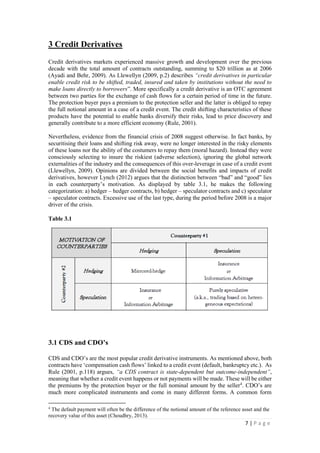
Table 2.3.1
In table 2.3.1, company A appears to have a clear advantage in both fixed and floating rates.
Nevertheless, the theory proves that if company A exploits its comparative advantage only at
fixed rate (which is the largest), then both companies will benefit. The benefit for each company
assuming no intermediation would be:
(Difference in fixed market–difference in the floating market)/2=(1.4%-0.5%)/2=0.45% for
each company.
The comparative advantage theory is a key concept in determining how companies enter into
Swap contracts to hedge risks.
7 | P a g e
3 Credit Derivatives
Credit derivatives markets experienced massive growth and development over the previous
decade with the total amount of contracts outstanding, summing to $20 trillion as at 2006
(Ayadi and Behr, 2009). As Llewellyn (2009, p.2) describes “credit derivatives in particular
enable credit risk to be shifted, traded, insured and taken by institutions without the need to
make loans directly to borrowers”. More specifically a credit derivative is an OTC agreement
between two parties for the exchange of cash flows for a certain period of time in the future.
The protection buyer pays a premium to the protection seller and the latter is obliged to repay
the full notional amount in a case of a credit event. The credit shifting characteristics of these
products have the potential to enable banks diversify their risks, lead to price discovery and
generally contribute to a more efficient economy (Rule, 2001).
Nevertheless, evidence from the financial crisis of 2008 suggest otherwise. In fact banks, by
securitising their loans and shifting risk away, were no longer interested in the risky elements
of these loans nor the ability of the costumers to repay them (moral hazard). Instead they were
consciously selecting to insure the riskiest (adverse selection), ignoring the global network
externalities of the industry and the consequences of this over-leverage in case of a credit event
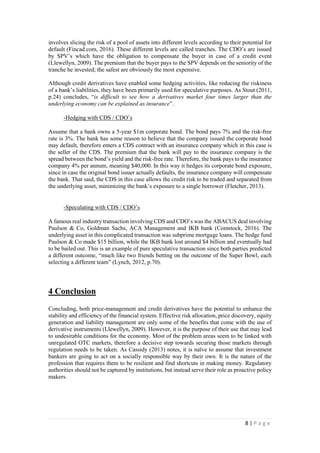
(Llewellyn, 2009). Opinions are divided between the social benefits and impacts of credit
derivatives, however Lynch (2012) argues that the distinction between “bad” and “good” lies
in each counterparty’s motivation. As displayed by table 3.1, he makes the following
categorization: a) hedger – hedger contracts, b) hedger – speculator contracts and c) speculator
– speculator contracts. Excessive use of the last type, during the period before 2008 is a major
driver of the crisis.
Table 3.1
3.1 CDS and CDO’s
CDS and CDO’s are the most popular credit derivative instruments. As mentioned above, both
contracts have ‘compensation cash flows’ linked to a credit event (default, bankruptcy etc.). As
Rule (2001, p.118) argues, “a CDS contract is state-dependent but outcome-independent”,
meaning that whether a credit event happens or not payments will be made. These will be either
the premiums by the protection buyer or the full nominal amount by the seller4
. CDO’s are
much more complicated instruments and come in many different forms. A common form
4
The default payment will often be the difference of the notional amount of the reference asset and the
recovery value of this asset (Choudhry, 2013).
8 | P a g e
involves slicing the risk of a pool of assets into different levels according to their potential for
default (Fincad.com, 2016). These different levels are called tranches. The CDO’s are issued
by SPV’s which have the obligation to compensate the buyer in case of a credit event
(Llewellyn, 2009). The premium that the buyer pays to the SPV depends on the seniority of the
tranche he invested; the safest are obviously the most expensive.
Although credit derivatives have enabled some hedging activities, like reducing the riskiness of
a bank’s liabilities, they have been primarily used for speculative purposes. As Stout (2011,
p.24) concludes, “is difficult to see how a derivatives market four times larger than the
underlying economy can be explained as insurance”.
-Hedging with CDS / CDO’s
Assume that a bank owns a 5-year $1m corporate bond. The bond pays 7% and the risk-free
rate is 3%. The bank has some reason to believe that the company issued the corporate bond
may default, therefore enters a CDS contract with an insurance company which in this case is
the seller of the CDS. The premium that the bank will pay to the insurance company is the
spread between the bond’s yield and the risk-free rate. Therefore, the bank pays to the insurance
company 4% per annum, meaning $40,000. In this way it hedges its corporate bond exposure,
since in case the original bond issuer actually defaults, the insurance company will compensate
the bank. That said, the CDS in this case allows the credit risk to be traded and separated from
the underlying asset, minimizing the bank’s exposure to a single borrower (Fletcher, 2013).
-Speculating with CDS / CDO’s
A famous real industry transaction involving CDS and CDO’s was the ABACUS deal involving
Paulson & Co, Goldman Sachs, ACA Management and IKB bank (Comstock, 2016). The
underlying asset in this complicated transaction was subprime mortgage loans. The hedge fund
Paulson & Co made $15 billion, while the IKB bank lost around $4 billion and eventually had
to be bailed out. This is an example of pure speculative transaction since both parties predicted
a different outcome, “much like two friends betting on the outcome of the Super Bowl, each
selecting a different team” (Lynch, 2012, p.70).
4 Conclusion
Concluding, both price-management and credit derivatives have the potential to enhance the
stability and efficiency of the financial system. Effective risk allocation, price discovery, equity
generation and liability management are only some of the benefits that come with the use of
derivative instruments (Llewellyn, 2009). However, it is the purpose of their use that may lead
to undesirable conditions for the economy. Most of the problem areas seem to be linked with
unregulated OTC markets, therefore a decisive step towards securing those markets through
regulation needs to be taken. As Cassidy (2013) notes, it is naïve to assume that investment
bankers are going to act on a socially responsible way by their own. It is the nature of the
profession that requires them to be resilient and find shortcuts in making money. Regulatory
authorities should not be captured by institutions, but instead serve their role as proactive policy
makers.
9 | P a g e
5 References
Acharya, V. and Richardson, M. (2009). Restoring financial stability. Hoboken, N.J.: John
Wiley & Sons.
Adam, T. and Fernando, C. (2003). Are there speculative components in corporate hedging
and do they add value?. [online] Repository.ust.hk. Available at: http://repository.ust.hk
/ir/Record/1783.1-217 [Accessed 26 Apr. 2016].
Allayannis, G. and Ofek, E. (2001). Exchange rate exposure, hedging, and the use of foreign
currency derivatives. Journal of International Money and Finance, 20(2), pp.273-296.
Ayadi, R. and Behr, P. (2009). On the necessity to regulate credit derivatives markets. J Bank
Regul, 10(3), pp.179-201.
Brown, G., Crabb, P. and Haushalter, D. (2003). Are Firms Successful at 'Selective' Hedging?.
SSRN Electronic Journal.
Call-options.com. (2016). European Call Option, European Put Options. [online] Available at:
http://www.call-options.com/european-call-option.html [Accessed 29 Apr. 2016].
Cassidy, J. (2013). Why Do Banks Go Rogue: Bad Culture or Lax Regulation? - The New
Yorker. [online] The New Yorker. Available at:
http://www.newyorker.com/news/johncassidy/why-do-banks-go-rogue-bad-culture-or-lax-
regulation [Accessed 2 May 2016].
Chance, D. and Brooks, R. (2010). An introduction to derivatives and risk management.
Mason, OH: Thomson/South-Western.
Chernenko, S. and Faulkender, M. (2011). The Two Sides of Derivatives Usage: Hedging and
Speculating with Interest Rate Swaps. Journal of Financial and Quantitative Analysis, 46(06),
pp.1727-1754.
Choudhry, M. (2013). An introduction to credit derivatives. Oxford, UK: Elsevier Butterworth-
Heinemann.
Cmegroup.com. (2016). Crude Oil Futures - CME Group. [online] Available at:
10 | P a g e
http://www.cmegroup.com/trading/energy/crude-oil/light-sweet-crude.html [Accessed 27 Apr.
2016].
Comstock, C. (2016). The Complete Story Of What Really Happened Between Goldman,
Paulson, ACA, IKB, And ABN. [online] Business Insider. Available at:
http://www.businessinsider.com/a-timeline-of-goldmans-abacus-trade-with-paulson-aca-
ikband-2010-4?op=1&IR=T [Accessed 2 May 2016].
Fincad.com. (2016). Types of Credit Derivatives | Derivatives Risk Management Software &
Pricing Analytics | FINCAD. [online] Available at:
http://www.fincad.com/resources/resource-library/wiki/types-credit-derivatives [Accessed 30
Apr. 2016].
Fletcher, G. (2013). Hazardous Hedging: The (Unacknowledged) Risks of Hedging with Credit
Default Swaps. SSRN Electronic Journal.
Hentschel, L. and Kothari, S. (2001). Are Corporations Reducing or Taking Risks with
Derivatives?. The Journal of Financial and Quantitative Analysis, 36(1), p.93.
Hull, J. (2009). Solutions manual [to accompany] Options, futures, and other derivatives.
Upper Saddle River, N.J.: Pearson Prentice Hall.
Hull, J. (2014). Fundamentals of Futures and Option Markets. 8th ed. Upper Saddle River, N.J.:
Pearson/Prentice Hall.
Llewellyn, D. (2009). Financial Innovation and the economics of banking and the financial
system, financial innovation in retail and corporate banking. Cheltenham, UK: Edward Elgar.
Lynch, T. (2012). Gambling by Another Name? The Challenge of Purely Speculative
Derivatives. SSRN Electronic Journal.
NAPF, (2013). Derivatives and risk management made simple. Cheapside House 138
Cheapside London EC2V 6AE: The National Association of Pension Funds Limited 2013.
Ricardo, D. (2001). On the principles of political economy and taxation. London: Electric
Book Co.
11 | P a g e
Rogoff, Kenneth, Aron Gottesman, Lall Ramrattan, and Michael Szenberg. 2006. “Paul
Samuelson's Contributions to Economics.” Samuelsonian Economics and the Twenty-First
Century. Oxford University Press.
Rule D. (2001) “Credit Derivatives Market: Its Development and Possible Implications for
Financial Stability”, Bank of England, Financial Stability Review, June, 2001
Stout, Lynn A., Derivatives and the Legal Origin of the 2008 Credit Crisis (June, 29 2011).
Harvard Business Law Review, Vol. 1, pp. 1-38, 2011; UCLA School of Law, Law-Econ
Research Paper No. 11-11. Available at SSRN: http://ssrn.com/abstract=1874806
Turbeville, W. (2013). Derivatives: Innovation In The Era of Financial Deregulation | Demos.
[online] Demos.org. Available at: http://www.demos.org/publication/derivatives-
innovationera-financial-deregulation [Accessed 26 Apr. 2016].
Valdez, S. (2013). An introduction to global financial markets. New York, NY: Palgrave
Macmillan.

Msc Project - Hedging vs Speculating with derivative instruments

  • 1.
    1 | Pa g e 15BSP430 Global Financial Markets and the Financial Crisis ΄ Assignment question: Show how transactions in derivative instruments can be used to either hedge risks or to open speculative positions. Word Count: 2,749 Name: Panagiotis Charalampopoulos Student ID: B511616 Due Date: 04/05/2016
  • 2.
    2 | Pa g e Table of Contents 1 Introduction ...............................................................................................................3 2 Price risk management derivatives ..........................................................................3 2.1 Futures and Forwards ........................................................................................4 2.2 Options .................................................................................................................5 2.3 Swaps....................................................................................................................6 3 Credit Derivatives......................................................................................................7 3.1 CDS and CDO’s...................................................................................................7 4 Conclusion ..................................................................................................................8 5 References...................................................................................................................9
  • 3.
    3 | Pa g e 1 Introduction Derivatives have increasingly gained popularity amongst financial practitioners and investors, in an effort to adapt with the increasing volatility and complexity of financial markets. These instruments enable investors to handle the risks arising from securities trading and speculate on expected movements in securities prices, without direct trade in the assets themselves. “Derivatives are financial contracts whose value is derived from some underlying asset” (Acharya and Richardson, 2009, p.233). The length of the contract is fixed and at maturity each party may face one of the following outcomes: a) obligation or option to buy/sell the underlying asset, b) claim the gains/ pay the losses of a fluctuation in the underlying asset to the counterparty (through margin accounts), c) exchange the nature of cash flows (fixed, floating) between the two parties. This essay aims to examine the hedging and speculative strategies that can be achieved using various derivative instruments. Firstly, a distinction is made between derivatives for the management of price risks and those for the shifting of credit risk (Llewellyn, 2009). In both categories, the main instruments are reviewed and their role for hedging or speculating is examined using imaginative and real industry examples. Finally, the conclusion provides a recommendation towards a more effective and transparent use of derivatives. 2 Price risk management derivatives Instruments in this group come in many forms and combinations inter-alia futures, forwards, options and swaps. Nevertheless, they can be further categorized on the primary intention of their use; hedging versus speculation, or in other words using derivatives to offset price exposure versus taking-on positions based on your best forecast about the future (Turbeville, 2013). This is an area that has been intensively researched by academics. Most studies focus on non-financial firms and although it seems to be a general consensus that companies use derivatives to hedge, evidence for speculative use, vary. Allayannis and Ofek (2001) examine the degree to which foreign exchange exposure affects firms’ decisions to use derivatives, finding a positive association between hedging and forex exposure, but no intention to speculate. Likewise, Hentschel and Kothari (2001) find no material effects of derivative contracts on overall firm volatility. Conversely, Brown, Crabb and Haushalter (2003) find that managers may add speculative components in a firm’s risk management strategy, while Adam and Fernando (2003, p.25) expound that the original intention of derivative usage is not always easy to distinguish if “hedging and speculation are no longer mutually exclusive activities”. This implies that firms may disguise speculative activities as hedging transactions. Finally, Chernenko and Faulkender (2011), contend that firms appear to use interest rate swaps to speculate as much as they use them to handle risks. This disagreement between researchers, partly stems from the fact that most of the data used come from exchange-traded records rather than over-the-counter, thus not taking into consideration the large private bilateral agreements. Derivative exchanges like the Chicago Mercantile Exchange (CME) operate for many decades, although the fixed nature of contracts offered is often not suitable for corporations’ tailored needs. Thus, in recent years trading activity has shifted to OTC markets, which as estimated before 2007, accounted for over $596
  • 4.
    4 | Pa g e trillion in derivative contracts outstanding (Chance and Brooks, 2010). Prior to the crisis, OTC markets were largely unregulated carrying a huge amount of systemic risk (Hull, 2014). After the crisis a central clearing party (CCP) was introduced by the legislation in order to absorb credit risk and to facilitate transactions more easily. Below follows a graph by Hull (2014), illustrating how OTC worked before and after the existence of a CCP. Graph simplified for 8 participants: (a) (b) 2.1 Futures and Forwards As defined by the National Association of Pension Funds (NAPF) (2013, p.4), “Futures are exchange-traded standard contracts for a pre-determined asset to be delivered at a pre-agreed point in the future at a price agreed today. The buyer makes margin payments reflecting the value of the transaction. The buyer is said to have gone long and the seller to have gone short”. Forwards are the equivalent of Futures in OTC markets. These instruments are commonly used for commodities, interest rates, equities and currency transactions. These underlying assets fluctuate and where there are fluctuations, one can find speculators and hedgers (Valdez, 2013). Some examples of hedging and speculation are given below1 : -Hedging with Futures: The date is 27/4/2016 and on 27/10/2016 an oil-producer knows it will need to buy 100,000 barrels of crude oil. October’s futures price is $50 per barrel2 and the spot is $55. Because each contract traded by CME Group is for 1,000 barrels the producer can hedge his position by going long in 100,000/1,000=100 contracts. The hedging strategy locks a price at $50 per barrel. If the spot price on October turns out to be $52 then the producer pays 100,000x52=$5,200,000 in his original deal. Nevertheless, because the spot is very close to the futures price on October, meaning $52 as well for the futures, the producer makes a gain in the futures of 100,000x($52$50)=$200,000. Therefore, the net cost for the producer is 5,200,000- 200,000=$5,000,000, saving him 200,000 that he would have to pay without the hedge. This example does not allows delivery of the future contracts because delivery costs can be expensive and inconvenient (Hull, 2014). Also, this is an example of a long perfect hedge in commodities, since the oil-producer is able to acquire the exact number of future contracts needed to hedge his exposure. 1 Unless cited differently all the numerical examples are taken from (Hull, 2014), (Hull, 2009), (Chance and Brooks, 2010) and (Valdez, 2013), with numbers and scenarios changed. 2 The actual price on 27/4/2016 for October delivery was $ 46.33 (Cmegroup.com, 2016)
  • 5.
    5 | Pa g e A high-profile industry example of unsuccessful hedging is that of Metallgesellschaft. The German company introduced a marketing programme which enabled its clients to lock fixed prices on petroleum products. Metallgesellschaft entered into long short-term futures and forwards contracts that were supposed to match the long exposure it had with clients if they were rolled over continuously (Chance and Brooks, 2010). Although, as Culp and Miller (1995, p.64) contend in their relative paper “borrowing short and lending long is an oft-cited recipe for financial disaster”. The result was that the oil price fell and the company received huge margin calls in its exchange-traded position that could not fund from its operational activities hereby, experiencing large liquidity problems. Eventually, the management liquidated the hedge position with Metallgesellschaft making a loss of $1.33 billion (Hull, 2014). -Speculating with Futures: Speculating with futures can be similar to the hedging example. Although, here the oil producer enters the future contract because he believes that the futures price per barrel is going to increase from $50 in April to $60 in October. This is a projection; a best guess about the future based on analysing past trends or news from the press. Assuming the October price actually moves to $57 per barrel, then the producer has spent 100,000x$50=$5,000,000 on April and in October he can close his position with an opposite contract, selling his future exposure at $57, resulting in a gain of (100,000x$57)-$5,000,000=$700,000. 2.2 Options Options are traded on exchange and give one party the right, but not the obligation to buy or sell an asset at a predetermined date for a certain price. They are named calls, when the buyer has the option and puts, when the seller has the option to exercise the contract (NAPF, 2013). This flexibility offered to the option-holder, does not come for free. The investor must pay an up-front fee called option premium, which is the main characteristic that distinguishes options from futures (Hull, 2014). -Hedging with Options: As Chance and Brooks (2010) recognize, there are four types of option transactions. a) Buy a call, b) Write a call, c) Buy a put and d) Write a put. A simplified option hedging strategy can be achieved only if you take position a) or c). In the latter case assume you own 100 shares of a stock with a price of S=$100. Your total position is therefore 100x$100=$10,000. You are confident that the price of the stock will rise, nevertheless you don’t want to leave your position unprotected. You decide that you want to hedge that position by buying a put option to sell 100 shares at $100 at a specific date in the future. This agreed future price is the strike price of the option. The price of an option to sell one share is $5 (option premium), resulting in a total initial investment of $500. The agreed date arrives3 and the share price of the stock falls at $80. Your normal loss at the stock market without the option would be $10,000-(100x$80)=$2,000. However, since the market price is lower than the strike price you exercise your option, selling at $100 despite the price having fell at $80. If there were no upfront fees you would make no loss, since gains in the options and losses in the stock market would balance. However you paid an up-front fee of $500. Therefore, after this price fluctuation you end up making a loss of only +2,000–2,000–500=-$500. This is a basic hedging strategy example with a stock put option. More advanced strategies include straddle, butterfly, bull spreads etc. 3 In both examples of hedging and speculation, the option contract is assumed to be a European option, meaning that is possible to exercise it only at expiration date (Call-options.com, 2016).
  • 6.
    6 | Pa g e -Speculating with Options: Speculating with options involves taking one of the four positions mentioned above or having already an open position in stocks and gearing that position further with an option contract of the same ‘direction’ (Valdez, 2013). For example, suppose that the current price of a stock is $100. You estimate that the price will rise, therefore you buy a call option for 100 shares locking a price at $100. The option premium is $1 per share so $100 in total, up-front costs. The price of the stock eventually moves to $120 at expiration date, so you can exercise your call option. You buy at $100 and sell at $120 in the spot market making a profit of 100x($120$100)=$2,000. Your net profit equals $2,000-$100(initial investment)=$1,900. It should be noted however that speculating with options may be quite expensive. For example if your initial costs for the options were $1,000 instead of $100 and at expiration the stock price has moved to $105 instead of $120, you would still exercise your option. However, in this case you make a loss. This is because you gain 100x($105–$100)=$500 from the movement, but you pay a large initial fee of $1,000, ending with +$500-$1,000=-$500. This means that if option premium is very high, you need a larger favourable movement to realize a profit (Hull, 2014). 2.3 Swaps Swaps are OTC contracts between two parties, to exchange a series of cash flows in the future (NAPF, 2013). Interest rate swaps make more than half of the total amount of OTC market, while other types may include forex or equity swaps (Chance and Brooks, 2010). The popularity of these contracts comes mainly from the comparative advantage theory, pioneered by Ricardo in 1817 and his Ricardian model and further improved later by the work of Samuelson on international trade and finance (Rogoff et al, 2006). An example of comparative advantage using an interest rate swap is illustrated bellow: Table 2.3.1 In table 2.3.1, company A appears to have a clear advantage in both fixed and floating rates. Nevertheless, the theory proves that if company A exploits its comparative advantage only at fixed rate (which is the largest), then both companies will benefit. The benefit for each company assuming no intermediation would be: (Difference in fixed market–difference in the floating market)/2=(1.4%-0.5%)/2=0.45% for each company. The comparative advantage theory is a key concept in determining how companies enter into Swap contracts to hedge risks.
  • 7.
    7 | Pa g e 3 Credit Derivatives Credit derivatives markets experienced massive growth and development over the previous decade with the total amount of contracts outstanding, summing to $20 trillion as at 2006 (Ayadi and Behr, 2009). As Llewellyn (2009, p.2) describes “credit derivatives in particular enable credit risk to be shifted, traded, insured and taken by institutions without the need to make loans directly to borrowers”. More specifically a credit derivative is an OTC agreement between two parties for the exchange of cash flows for a certain period of time in the future. The protection buyer pays a premium to the protection seller and the latter is obliged to repay the full notional amount in a case of a credit event. The credit shifting characteristics of these products have the potential to enable banks diversify their risks, lead to price discovery and generally contribute to a more efficient economy (Rule, 2001). Nevertheless, evidence from the financial crisis of 2008 suggest otherwise. In fact banks, by securitising their loans and shifting risk away, were no longer interested in the risky elements of these loans nor the ability of the costumers to repay them (moral hazard). Instead they were consciously selecting to insure the riskiest (adverse selection), ignoring the global network externalities of the industry and the consequences of this over-leverage in case of a credit event (Llewellyn, 2009). Opinions are divided between the social benefits and impacts of credit derivatives, however Lynch (2012) argues that the distinction between “bad” and “good” lies in each counterparty’s motivation. As displayed by table 3.1, he makes the following categorization: a) hedger – hedger contracts, b) hedger – speculator contracts and c) speculator – speculator contracts. Excessive use of the last type, during the period before 2008 is a major driver of the crisis. Table 3.1 3.1 CDS and CDO’s CDS and CDO’s are the most popular credit derivative instruments. As mentioned above, both contracts have ‘compensation cash flows’ linked to a credit event (default, bankruptcy etc.). As Rule (2001, p.118) argues, “a CDS contract is state-dependent but outcome-independent”, meaning that whether a credit event happens or not payments will be made. These will be either the premiums by the protection buyer or the full nominal amount by the seller4 . CDO’s are much more complicated instruments and come in many different forms. A common form 4 The default payment will often be the difference of the notional amount of the reference asset and the recovery value of this asset (Choudhry, 2013).
  • 8.
    8 | Pa g e involves slicing the risk of a pool of assets into different levels according to their potential for default (Fincad.com, 2016). These different levels are called tranches. The CDO’s are issued by SPV’s which have the obligation to compensate the buyer in case of a credit event (Llewellyn, 2009). The premium that the buyer pays to the SPV depends on the seniority of the tranche he invested; the safest are obviously the most expensive. Although credit derivatives have enabled some hedging activities, like reducing the riskiness of a bank’s liabilities, they have been primarily used for speculative purposes. As Stout (2011, p.24) concludes, “is difficult to see how a derivatives market four times larger than the underlying economy can be explained as insurance”. -Hedging with CDS / CDO’s Assume that a bank owns a 5-year $1m corporate bond. The bond pays 7% and the risk-free rate is 3%. The bank has some reason to believe that the company issued the corporate bond may default, therefore enters a CDS contract with an insurance company which in this case is the seller of the CDS. The premium that the bank will pay to the insurance company is the spread between the bond’s yield and the risk-free rate. Therefore, the bank pays to the insurance company 4% per annum, meaning $40,000. In this way it hedges its corporate bond exposure, since in case the original bond issuer actually defaults, the insurance company will compensate the bank. That said, the CDS in this case allows the credit risk to be traded and separated from the underlying asset, minimizing the bank’s exposure to a single borrower (Fletcher, 2013). -Speculating with CDS / CDO’s A famous real industry transaction involving CDS and CDO’s was the ABACUS deal involving Paulson & Co, Goldman Sachs, ACA Management and IKB bank (Comstock, 2016). The underlying asset in this complicated transaction was subprime mortgage loans. The hedge fund Paulson & Co made $15 billion, while the IKB bank lost around $4 billion and eventually had to be bailed out. This is an example of pure speculative transaction since both parties predicted a different outcome, “much like two friends betting on the outcome of the Super Bowl, each selecting a different team” (Lynch, 2012, p.70). 4 Conclusion Concluding, both price-management and credit derivatives have the potential to enhance the stability and efficiency of the financial system. Effective risk allocation, price discovery, equity generation and liability management are only some of the benefits that come with the use of derivative instruments (Llewellyn, 2009). However, it is the purpose of their use that may lead to undesirable conditions for the economy. Most of the problem areas seem to be linked with unregulated OTC markets, therefore a decisive step towards securing those markets through regulation needs to be taken. As Cassidy (2013) notes, it is naïve to assume that investment bankers are going to act on a socially responsible way by their own. It is the nature of the profession that requires them to be resilient and find shortcuts in making money. Regulatory authorities should not be captured by institutions, but instead serve their role as proactive policy makers.
  • 9.
    9 | Pa g e 5 References Acharya, V. and Richardson, M. (2009). Restoring financial stability. Hoboken, N.J.: John Wiley & Sons. Adam, T. and Fernando, C. (2003). Are there speculative components in corporate hedging and do they add value?. [online] Repository.ust.hk. Available at: http://repository.ust.hk /ir/Record/1783.1-217 [Accessed 26 Apr. 2016]. Allayannis, G. and Ofek, E. (2001). Exchange rate exposure, hedging, and the use of foreign currency derivatives. Journal of International Money and Finance, 20(2), pp.273-296. Ayadi, R. and Behr, P. (2009). On the necessity to regulate credit derivatives markets. J Bank Regul, 10(3), pp.179-201. Brown, G., Crabb, P. and Haushalter, D. (2003). Are Firms Successful at 'Selective' Hedging?. SSRN Electronic Journal. Call-options.com. (2016). European Call Option, European Put Options. [online] Available at: http://www.call-options.com/european-call-option.html [Accessed 29 Apr. 2016]. Cassidy, J. (2013). Why Do Banks Go Rogue: Bad Culture or Lax Regulation? - The New Yorker. [online] The New Yorker. Available at: http://www.newyorker.com/news/johncassidy/why-do-banks-go-rogue-bad-culture-or-lax- regulation [Accessed 2 May 2016]. Chance, D. and Brooks, R. (2010). An introduction to derivatives and risk management. Mason, OH: Thomson/South-Western. Chernenko, S. and Faulkender, M. (2011). The Two Sides of Derivatives Usage: Hedging and Speculating with Interest Rate Swaps. Journal of Financial and Quantitative Analysis, 46(06), pp.1727-1754. Choudhry, M. (2013). An introduction to credit derivatives. Oxford, UK: Elsevier Butterworth- Heinemann. Cmegroup.com. (2016). Crude Oil Futures - CME Group. [online] Available at:
  • 10.
    10 | Pa g e http://www.cmegroup.com/trading/energy/crude-oil/light-sweet-crude.html [Accessed 27 Apr. 2016]. Comstock, C. (2016). The Complete Story Of What Really Happened Between Goldman, Paulson, ACA, IKB, And ABN. [online] Business Insider. Available at: http://www.businessinsider.com/a-timeline-of-goldmans-abacus-trade-with-paulson-aca- ikband-2010-4?op=1&IR=T [Accessed 2 May 2016]. Fincad.com. (2016). Types of Credit Derivatives | Derivatives Risk Management Software & Pricing Analytics | FINCAD. [online] Available at: http://www.fincad.com/resources/resource-library/wiki/types-credit-derivatives [Accessed 30 Apr. 2016]. Fletcher, G. (2013). Hazardous Hedging: The (Unacknowledged) Risks of Hedging with Credit Default Swaps. SSRN Electronic Journal. Hentschel, L. and Kothari, S. (2001). Are Corporations Reducing or Taking Risks with Derivatives?. The Journal of Financial and Quantitative Analysis, 36(1), p.93. Hull, J. (2009). Solutions manual [to accompany] Options, futures, and other derivatives. Upper Saddle River, N.J.: Pearson Prentice Hall. Hull, J. (2014). Fundamentals of Futures and Option Markets. 8th ed. Upper Saddle River, N.J.: Pearson/Prentice Hall. Llewellyn, D. (2009). Financial Innovation and the economics of banking and the financial system, financial innovation in retail and corporate banking. Cheltenham, UK: Edward Elgar. Lynch, T. (2012). Gambling by Another Name? The Challenge of Purely Speculative Derivatives. SSRN Electronic Journal. NAPF, (2013). Derivatives and risk management made simple. Cheapside House 138 Cheapside London EC2V 6AE: The National Association of Pension Funds Limited 2013. Ricardo, D. (2001). On the principles of political economy and taxation. London: Electric Book Co.
  • 11.
    11 | Pa g e Rogoff, Kenneth, Aron Gottesman, Lall Ramrattan, and Michael Szenberg. 2006. “Paul Samuelson's Contributions to Economics.” Samuelsonian Economics and the Twenty-First Century. Oxford University Press. Rule D. (2001) “Credit Derivatives Market: Its Development and Possible Implications for Financial Stability”, Bank of England, Financial Stability Review, June, 2001 Stout, Lynn A., Derivatives and the Legal Origin of the 2008 Credit Crisis (June, 29 2011). Harvard Business Law Review, Vol. 1, pp. 1-38, 2011; UCLA School of Law, Law-Econ Research Paper No. 11-11. Available at SSRN: http://ssrn.com/abstract=1874806 Turbeville, W. (2013). Derivatives: Innovation In The Era of Financial Deregulation | Demos. [online] Demos.org. Available at: http://www.demos.org/publication/derivatives- innovationera-financial-deregulation [Accessed 26 Apr. 2016]. Valdez, S. (2013). An introduction to global financial markets. New York, NY: Palgrave Macmillan.