How to Manage Your Commodity Risk ?? An Eyeopener.
TYPES OF CORPORATE  RISKS FACED Business risks: Commodity Risk : Price risk: price fluctuations. Quantitative: natural calamity, weather, etc. Concentration Risk: International operations Risk: Financial Risks: Credit Risk: For-ex Risk: Operational Risks:
COMMODITY RISK Reasons: Change in inventory value. Inflation leading to : Increase in production-infrastructure cost. Increase in production-Raw material cost. Change in Selling price-Price Fluctuations.
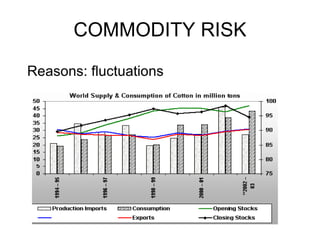
COMMODITY RISK Reasons: fluctuations
COMMODITY RISK Countering the risk:-Hedging Commodity futures (selling price) OTC Local exchanges International exchanges Inventory hedging (Cost price) Options Swaps Borrowing linked to commodity prices.
COMMODITY RISK Hedging: By Futures contracts in India Definition: Making an investment to reduce the risk of adverse price movements in an asset. Normally, a hedge consists of taking an offsetting position in a related security, such as a futures contract. Investors use this strategy when they are unsure of what the market will do. A perfect hedge reduces your risk to nothing (except for the cost of the hedge).
EXAMPLE OF A HEDGE: Prediction:  A Farmer predicts Price will go down from Rs 62/kg (spot price-Oct) to Rs 55/kg (spot price-Dec).  Hence, the Farmer Sells a December 20th Futures contract at Rs 62/kg.   COMMODITY RISK Spot 1 st  Dec
HEDGE RATIO Definition: A ratio comparing the value of a position protected via a hedge with the size of the entire position itself. A ratio comparing the value of futures contracts purchased or sold to the value of the cash commodity being hedged.  Example: Say a textile manufacturer is to receive delivery of 425 quintals of Raw cotton after three months. If he buys three, 3 months futures contract covering 255 quintals of cotton, then his hedge ratio is 3:5. he is protected 60 % of his exposure. The hedge ratio is important for investors in futures contracts, as it will help to identify and minimize basis risk.
TYPES OF HEDGES Long Hedge This requires taking a long position in the futures contract Appropriate when a certain asset or commodity would be purchased in the future and one is interested in locking in the price now Textile Company would use a long hedge Short Hedge This involves a short position in the futures contract Applicable when a hedger already owns an asset and expects to sell it in the future The Aluminum producer would use a short hedge
TYPES OF HEDGES (cont..) Cross Hedge Cross Hedge is used to hedge price risk of different but economically related commodities 􀁺Correlation analysis is used Hedging and cross hedging should only be attempted if the price movements are similar and basis risk is acceptable to the hedger Example: Aviation turbine fuel- crude oil.
TYPES OF HEDGES (cont..) Unbalanced hedge Description : The future contract standardized size units do not match the cash position quantity Solution : A combination of regular size futures and mini contracts can be used to reach a futures position as close as possible to the cash position. Variations Over hedge: occurs when futures quantity exceeds the cash quantity. Under hedge: occurs when the cash position exceeds the future quantity.
TYPES OF HEDGES (cont..) Inter-commodity spread Price movements between related underlying instruments tend to correlate fairly well and such gains in one derivatives position may offset losses in a related instrument 􀁺 Companies can hedge their input and output price risk 􀁺 Soya oil manufacturers--Soybean and Soya oil 􀁺 Refiners—Crude and gasoline 􀁺 Crack Spread 􀁺 Exchanges offer an inter-commodity spread discount on initial margin
TYPES OF HEDGES (cont..) Intra commodity spread: Bull: long near end contract; short far end contract. Bear: short near end contract; long far end contract.
Fundamentals Difference between spot and future price depends (fundamentally) upon: Storage characteristics of the commodity Supplies of the commodity Production and consumption cycle for the commodity Ease of short selling the commodity  Transaction costs (Good storability) +(Prod>consumption)= price moves according to cash and carry model.
Commodities that can be Hedged Two examples: Cotton. Copper.
COTTON Why Hedge? STATS speak for themselves. 2008-09: Global predictions: Production: 158.172 Mn Bales (up 3%) Use: 161.7 Mn Bales (up 1%) India:  07-08: 31 Mn Bales (up 11%) China: Production expected to increase + decreased import duties= increased demand, hence market share of China down. US: Area under cultivation expected to decrease= market share of the US down. Imports up Cotton prices have been defying fundamental measures of supply and use.
COTTON Stages for Hedging: Raw Cotton: Hedge against increase in Price Farmer Yarn producer Textile producer Cotton Yarn:  Buyer: Hedge against Price rise. Seller: Hedge against Price fall. Textile: Buyer (Garment manufacturer): Price Rise. Seller : Domestic seller: Price Fall. Exporter: Price Fall and For-Ex Risk.
COTTON Steps: Identity Risk. Quantify Risk. Calculate Possible and optimum Hedge Ratio. Hedge: options available Simple hedge:  Long- short. Short- long intra commodity calendar Hedge: spread (safer) Cross Hedge: If contract not available for the type. Inter commodity spread. Inter Exchange spread.
COTTON Tax Benefit and provisions: Refer to: http://www.taxmann.com/DitTaxmann/IncomeTaxActs/2006ITAct/casesec43(5).htm Hedging profits/income if any treated as business income, different from speculative income. Hedging loss is treated as business loss and not speculative loss. Hedging contracts can be both for  purchase  and  sale ; In order to be a genuine and valid hedging contract of sale, the  total of such transactions  should  not exceed  the  total stock of the raw material  or merchandise in hand.
COTTON Tax Benefit and provisions (continued): In order to be genuine and valid hedging contract of purchase, there should be an existing  forward contract  of sale by actual delivery. The hedging contracts need not necessarily be in the same variety of the commodity; they can be in connected commodities,  e.g.,  one type of cotton against another type of cotton. Forwards allowed when: commodity not traded on exchange. No traded commodity correlated to intended commodity
COTTON Margin: causes leverage. Caution: Leverage: Because of Margin deposit. Tick Size:  Price limits during last month:
SMC global: Your helper; your Guide!! Member of NCDEX and MCX. ISO 9001:2000 certified DP for commodities. Proactive and timely world class research based advice and guidance. Investor meet/seminars across India. Brokerage: Negotiable based on turnover. Service: offline/online/software based (real time screen)
MCX- your options You can hedge in: Cotton L staple. Cotton M staple. Cotton S staple. Cotton yarn. Kapas.
NCDEX: your options. You can hedge in: Indian 28.5 mm cotton. Indian 30 mm cotton. Shankar kapas.
COPPER INDUSRY Global Production:18.29 mn tonnes Consumption: 18 mn tonnes Major players in India - Hindalco Industries Ltd - Sterlite Industries Ltd - Hindustan Copper Ltd Other than these co.’s around 1000 secondary producers exist in the market.
INDIAN CONTEXT Contribution to world Production is low around 3.5 – 4%.Annual Production around 650000 MT Major Consumers: Telecommunication, Power Cables,Wires,Construction,Transportation,Consumer Durable,Defense.
HEDGING - Reasons Price fluctuations in International metal exchanges Disturbances in Production copper mines or Refineries Changes in consumption/demand pattern (China,America).
HEDGING-Reasons(Cont.) Changes in market demand - Optical Fibers - Change from fixed line to wireless Disadvantages of secondary producers. - Treatment and refining charges
Porter’s Model-Copper Industry
THANK YOU

Corporate Risk Mngmnt-commodity Hedging

  • 1.
    How to ManageYour Commodity Risk ?? An Eyeopener.
  • 2.
    TYPES OF CORPORATE RISKS FACED Business risks: Commodity Risk : Price risk: price fluctuations. Quantitative: natural calamity, weather, etc. Concentration Risk: International operations Risk: Financial Risks: Credit Risk: For-ex Risk: Operational Risks:
  • 3.
    COMMODITY RISK Reasons:Change in inventory value. Inflation leading to : Increase in production-infrastructure cost. Increase in production-Raw material cost. Change in Selling price-Price Fluctuations.
  • 4.
  • 5.
    COMMODITY RISK Counteringthe risk:-Hedging Commodity futures (selling price) OTC Local exchanges International exchanges Inventory hedging (Cost price) Options Swaps Borrowing linked to commodity prices.
  • 6.
    COMMODITY RISK Hedging:By Futures contracts in India Definition: Making an investment to reduce the risk of adverse price movements in an asset. Normally, a hedge consists of taking an offsetting position in a related security, such as a futures contract. Investors use this strategy when they are unsure of what the market will do. A perfect hedge reduces your risk to nothing (except for the cost of the hedge).
  • 7.
    EXAMPLE OF AHEDGE: Prediction: A Farmer predicts Price will go down from Rs 62/kg (spot price-Oct) to Rs 55/kg (spot price-Dec). Hence, the Farmer Sells a December 20th Futures contract at Rs 62/kg. COMMODITY RISK Spot 1 st Dec
  • 8.
    HEDGE RATIO Definition:A ratio comparing the value of a position protected via a hedge with the size of the entire position itself. A ratio comparing the value of futures contracts purchased or sold to the value of the cash commodity being hedged. Example: Say a textile manufacturer is to receive delivery of 425 quintals of Raw cotton after three months. If he buys three, 3 months futures contract covering 255 quintals of cotton, then his hedge ratio is 3:5. he is protected 60 % of his exposure. The hedge ratio is important for investors in futures contracts, as it will help to identify and minimize basis risk.
  • 9.
    TYPES OF HEDGESLong Hedge This requires taking a long position in the futures contract Appropriate when a certain asset or commodity would be purchased in the future and one is interested in locking in the price now Textile Company would use a long hedge Short Hedge This involves a short position in the futures contract Applicable when a hedger already owns an asset and expects to sell it in the future The Aluminum producer would use a short hedge
  • 10.
    TYPES OF HEDGES(cont..) Cross Hedge Cross Hedge is used to hedge price risk of different but economically related commodities 􀁺Correlation analysis is used Hedging and cross hedging should only be attempted if the price movements are similar and basis risk is acceptable to the hedger Example: Aviation turbine fuel- crude oil.
  • 11.
    TYPES OF HEDGES(cont..) Unbalanced hedge Description : The future contract standardized size units do not match the cash position quantity Solution : A combination of regular size futures and mini contracts can be used to reach a futures position as close as possible to the cash position. Variations Over hedge: occurs when futures quantity exceeds the cash quantity. Under hedge: occurs when the cash position exceeds the future quantity.
  • 12.
    TYPES OF HEDGES(cont..) Inter-commodity spread Price movements between related underlying instruments tend to correlate fairly well and such gains in one derivatives position may offset losses in a related instrument 􀁺 Companies can hedge their input and output price risk 􀁺 Soya oil manufacturers--Soybean and Soya oil 􀁺 Refiners—Crude and gasoline 􀁺 Crack Spread 􀁺 Exchanges offer an inter-commodity spread discount on initial margin
  • 13.
    TYPES OF HEDGES(cont..) Intra commodity spread: Bull: long near end contract; short far end contract. Bear: short near end contract; long far end contract.
  • 14.
    Fundamentals Difference betweenspot and future price depends (fundamentally) upon: Storage characteristics of the commodity Supplies of the commodity Production and consumption cycle for the commodity Ease of short selling the commodity Transaction costs (Good storability) +(Prod>consumption)= price moves according to cash and carry model.
  • 15.
    Commodities that canbe Hedged Two examples: Cotton. Copper.
  • 16.
    COTTON Why Hedge?STATS speak for themselves. 2008-09: Global predictions: Production: 158.172 Mn Bales (up 3%) Use: 161.7 Mn Bales (up 1%) India: 07-08: 31 Mn Bales (up 11%) China: Production expected to increase + decreased import duties= increased demand, hence market share of China down. US: Area under cultivation expected to decrease= market share of the US down. Imports up Cotton prices have been defying fundamental measures of supply and use.
  • 17.
    COTTON Stages forHedging: Raw Cotton: Hedge against increase in Price Farmer Yarn producer Textile producer Cotton Yarn: Buyer: Hedge against Price rise. Seller: Hedge against Price fall. Textile: Buyer (Garment manufacturer): Price Rise. Seller : Domestic seller: Price Fall. Exporter: Price Fall and For-Ex Risk.
  • 18.
    COTTON Steps: IdentityRisk. Quantify Risk. Calculate Possible and optimum Hedge Ratio. Hedge: options available Simple hedge: Long- short. Short- long intra commodity calendar Hedge: spread (safer) Cross Hedge: If contract not available for the type. Inter commodity spread. Inter Exchange spread.
  • 19.
    COTTON Tax Benefitand provisions: Refer to: http://www.taxmann.com/DitTaxmann/IncomeTaxActs/2006ITAct/casesec43(5).htm Hedging profits/income if any treated as business income, different from speculative income. Hedging loss is treated as business loss and not speculative loss. Hedging contracts can be both for purchase and sale ; In order to be a genuine and valid hedging contract of sale, the total of such transactions should not exceed the total stock of the raw material or merchandise in hand.
  • 20.
    COTTON Tax Benefitand provisions (continued): In order to be genuine and valid hedging contract of purchase, there should be an existing forward contract of sale by actual delivery. The hedging contracts need not necessarily be in the same variety of the commodity; they can be in connected commodities, e.g., one type of cotton against another type of cotton. Forwards allowed when: commodity not traded on exchange. No traded commodity correlated to intended commodity
  • 21.
    COTTON Margin: causesleverage. Caution: Leverage: Because of Margin deposit. Tick Size: Price limits during last month:
  • 22.
    SMC global: Yourhelper; your Guide!! Member of NCDEX and MCX. ISO 9001:2000 certified DP for commodities. Proactive and timely world class research based advice and guidance. Investor meet/seminars across India. Brokerage: Negotiable based on turnover. Service: offline/online/software based (real time screen)
  • 23.
    MCX- your optionsYou can hedge in: Cotton L staple. Cotton M staple. Cotton S staple. Cotton yarn. Kapas.
  • 24.
    NCDEX: your options.You can hedge in: Indian 28.5 mm cotton. Indian 30 mm cotton. Shankar kapas.
  • 25.
    COPPER INDUSRY GlobalProduction:18.29 mn tonnes Consumption: 18 mn tonnes Major players in India - Hindalco Industries Ltd - Sterlite Industries Ltd - Hindustan Copper Ltd Other than these co.’s around 1000 secondary producers exist in the market.
  • 26.
    INDIAN CONTEXT Contributionto world Production is low around 3.5 – 4%.Annual Production around 650000 MT Major Consumers: Telecommunication, Power Cables,Wires,Construction,Transportation,Consumer Durable,Defense.
  • 27.
    HEDGING - ReasonsPrice fluctuations in International metal exchanges Disturbances in Production copper mines or Refineries Changes in consumption/demand pattern (China,America).
  • 28.
    HEDGING-Reasons(Cont.) Changes inmarket demand - Optical Fibers - Change from fixed line to wireless Disadvantages of secondary producers. - Treatment and refining charges
  • 29.
  • 30.