Towards a BETTER and PROSPEROUS City
Team :
1. Rahul Singh Keram (Team Coordinator) , III sem(E&TC),NIT Raipur.
2. Nikhil Yede, III sem(E&TC),NIT Raipur.
3. D Vivek, III sem(Meta.),NIT Raipur.
4. Arunabh Singh, IIIsem(CSE), BITS Pilani, Goa.
5. Yugantar Mishra,III sem(Mech.),Rungta College of Engg. &Tech, Raipur.
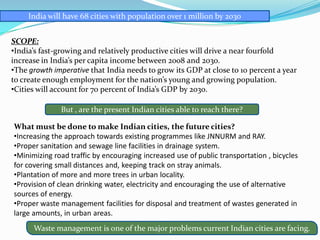
India will have 68 cities with population over 1 million by 2030
SCOPE:
•India’s fast-growing and relatively productive cities will drive a near fourfold
increase in India’s per capita income between 2008 and 2030.
•The growth imperative that India needs to grow its GDP at close to 10 percent a year
to create enough employment for the nation’s young and growing population.
•Cities will account for 70 percent of India’s GDP by 2030.
But , are the present Indian cities able to reach there?
What must be done to make Indian cities, the future cities?
•Increasing the approach towards existing programmes like JNNURM and RAY.
•Proper sanitation and sewage line facilities in drainage system.
•Minimizing road traffic by encouraging increased use of public transportation , bicycles
for covering small distances and, keeping track on stray animals.
•Plantation of more and more trees in urban locality.
•Provision of clean drinking water, electricity and encouraging the use of alternative
sources of energy.
•Proper waste management facilities for disposal and treatment of wastes generated in
large amounts, in urban areas.
Waste management is one of the major problems current Indian cities are facing.
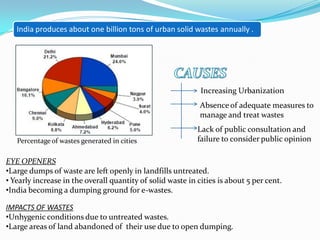
Increasing Urbanization
Absence of adequate measures to
manage and treat wastes
Lack of public consultation and
failure to consider public opinion
EYE OPENERS
•Large dumps of waste are left openly in landfills untreated.
• Yearly increase in the overall quantity of solid waste in cities is about 5 per cent.
•India becoming a dumping ground for e-wastes.
Percentageof wastes generated in cities
IMPACTS OF WASTES
•Unhygenic conditions due to untreated wastes.
•Large areas of land abandoned of their use due to open dumping.
India produces about one billion tons of urban solid wastes annually .
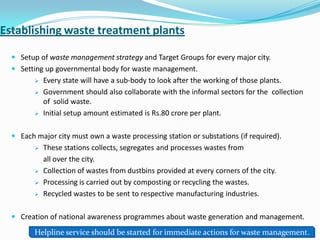
Establishing waste treatment plants
 Setup of waste management strategy and Target Groups for every major city.
 Setting up governmental body for waste management.
 Every state will have a sub-body to look after the working of those plants.
 Government should also collaborate with the informal sectors for the collection
of solid waste.
 Initial setup amount estimated is Rs.80 crore per plant.
 Each major city must own a waste processing station or substations (if required).
 These stations collects, segregates and processes wastes from
all over the city.
 Collection of wastes from dustbins provided at every corners of the city.
 Processing is carried out by composting or recycling the wastes.
 Recycled wastes to be sent to respective manufacturing industries.
 Creation of national awareness programmes about waste generation and management.
Helpline service should be started for immediate actions for waste management.
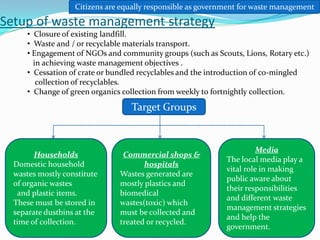
Setup of waste management strategy
• Closure of existing landfill.
• Waste and / or recyclable materials transport.
• Engagement of NGOs and community groups (such as Scouts, Lions, Rotary etc.)
in achieving waste management objectives .
• Cessation of crate or bundled recyclables and the introduction of co-mingled
collection of recyclables.
• Change of green organics collection from weekly to fortnightly collection.
Target Groups
Households
Domestic household
wastes mostly constitute
of organic wastes
and plastic items.
These must be stored in
separate dustbins at the
time of collection.
Commercial shops &
hospitals
Wastes generated are
mostly plastics and
biomedical
wastes(toxic) which
must be collected and
treated or recycled.
Media
The local media play a
vital role in making
public aware about
their responsibilities
and different waste
management strategies
and help the
government.
Citizens are equally responsible as government for waste management
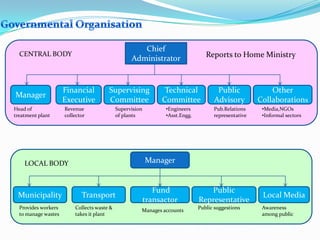
Chief
Administrator
Financial
Executive
Supervising
Committee
Technical
Committee
Public
Advisory
Other
Collaborations
Manager
•Engineers
•Asst.Engg.
Pub.Relations
representative
•Media,NGOs
•Informal sectors
Supervision
of plants
Revenue
collector
Head of
treatment plant
Manager
Reports to Home MinistryCENTRAL BODY
LOCAL BODY
Municipality Transport
Fund
transactor
Public
Representative
Local Media
Collects waste &
takes it plant
Manages accounts
Public suggestions Awareness
among public
Provides workers
to manage wastes
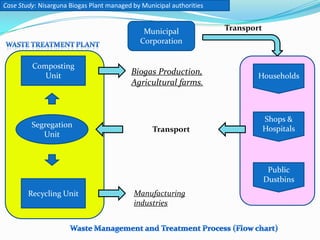
Composting
Unit
Recycling Unit
Segregation
Unit
Municipal
Corporation
Transport
Households
Shops &
Hospitals
Public
Dustbins
Transport
Manufacturing
industries
Biogas Production,
Agricultural farms.
Case Study: Nisarguna Biogas Plant managed by Municipal authorities
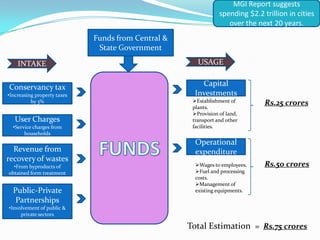
Funds from Central &
State Government
Conservancy tax
•Increasing property taxes
by 3%
User Charges
•Service charges from
households
Public-Private
Partnerships
•Involvement of public &
private sectors
Revenue from
recovery of wastes
•From byproducts of
obtained form treatment
Capital
Investments
Operational
expenditure
Establishment of
plants.
Provision of land,
transport and other
facilities.
Wages to employees.
Fuel and processing
costs.
Management of
existing equipments.
INTAKE USAGE
Rs.25 crores
Rs.50 crores
Total Estimation = Rs.75 crores
MGI Report suggests
spending $2.2 trillion in cities
over the next 20 years.
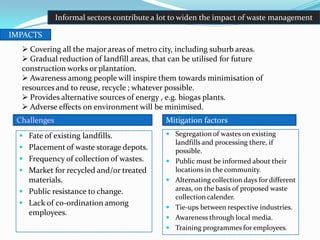
 Fate of existing landfills.
 Placement of waste storage depots.
 Frequency of collection of wastes.
 Market for recycled and/or treated
materials.
 Public resistance to change.
 Lack of co-ordination among
employees.
 Segregation of wastes on existing
landfills and processing there, if
possible.
 Public must be informed about their
locations in the community.
 Alternating collection days for different
areas, on the basis of proposed waste
collection calender.
 Tie-ups between respective industries.
 Awareness through local media.
 Training programmes for employees.
IMPACTS
 Covering all the major areas of metro city, including suburb areas.
 Gradual reduction of landfill areas, that can be utilised for future
construction works or plantation.
 Awareness among people will inspire them towards minimisation of
resources and to reuse, recycle ; whatever possible.
 Provides alternative sources of energy , e.g. biogas plants.
 Adverse effects on environment will be minimised.
Informal sectors contribute a lot to widen the impact of waste management
Challenges Mitigation factors
References:
India’s urban awakening: Building inclusive cities sustaining economic
growth, MGI Reports 2010.
Report on Civic Amenities in Urban Areas, Planning Commission 2002.
Report on Solid Wastes Management, India Infrastructure Report
2006,P.U.Asnani, IIT-K.

Future2020Glasses

  • 1.
    Towards a BETTERand PROSPEROUS City Team : 1. Rahul Singh Keram (Team Coordinator) , III sem(E&TC),NIT Raipur. 2. Nikhil Yede, III sem(E&TC),NIT Raipur. 3. D Vivek, III sem(Meta.),NIT Raipur. 4. Arunabh Singh, IIIsem(CSE), BITS Pilani, Goa. 5. Yugantar Mishra,III sem(Mech.),Rungta College of Engg. &Tech, Raipur.
  • 2.
    India will have68 cities with population over 1 million by 2030 SCOPE: •India’s fast-growing and relatively productive cities will drive a near fourfold increase in India’s per capita income between 2008 and 2030. •The growth imperative that India needs to grow its GDP at close to 10 percent a year to create enough employment for the nation’s young and growing population. •Cities will account for 70 percent of India’s GDP by 2030. But , are the present Indian cities able to reach there? What must be done to make Indian cities, the future cities? •Increasing the approach towards existing programmes like JNNURM and RAY. •Proper sanitation and sewage line facilities in drainage system. •Minimizing road traffic by encouraging increased use of public transportation , bicycles for covering small distances and, keeping track on stray animals. •Plantation of more and more trees in urban locality. •Provision of clean drinking water, electricity and encouraging the use of alternative sources of energy. •Proper waste management facilities for disposal and treatment of wastes generated in large amounts, in urban areas. Waste management is one of the major problems current Indian cities are facing.
  • 3.
    Increasing Urbanization Absence ofadequate measures to manage and treat wastes Lack of public consultation and failure to consider public opinion EYE OPENERS •Large dumps of waste are left openly in landfills untreated. • Yearly increase in the overall quantity of solid waste in cities is about 5 per cent. •India becoming a dumping ground for e-wastes. Percentageof wastes generated in cities IMPACTS OF WASTES •Unhygenic conditions due to untreated wastes. •Large areas of land abandoned of their use due to open dumping. India produces about one billion tons of urban solid wastes annually .
  • 4.
    Establishing waste treatmentplants  Setup of waste management strategy and Target Groups for every major city.  Setting up governmental body for waste management.  Every state will have a sub-body to look after the working of those plants.  Government should also collaborate with the informal sectors for the collection of solid waste.  Initial setup amount estimated is Rs.80 crore per plant.  Each major city must own a waste processing station or substations (if required).  These stations collects, segregates and processes wastes from all over the city.  Collection of wastes from dustbins provided at every corners of the city.  Processing is carried out by composting or recycling the wastes.  Recycled wastes to be sent to respective manufacturing industries.  Creation of national awareness programmes about waste generation and management. Helpline service should be started for immediate actions for waste management.
  • 5.
    Setup of wastemanagement strategy • Closure of existing landfill. • Waste and / or recyclable materials transport. • Engagement of NGOs and community groups (such as Scouts, Lions, Rotary etc.) in achieving waste management objectives . • Cessation of crate or bundled recyclables and the introduction of co-mingled collection of recyclables. • Change of green organics collection from weekly to fortnightly collection. Target Groups Households Domestic household wastes mostly constitute of organic wastes and plastic items. These must be stored in separate dustbins at the time of collection. Commercial shops & hospitals Wastes generated are mostly plastics and biomedical wastes(toxic) which must be collected and treated or recycled. Media The local media play a vital role in making public aware about their responsibilities and different waste management strategies and help the government. Citizens are equally responsible as government for waste management
  • 6.
    Chief Administrator Financial Executive Supervising Committee Technical Committee Public Advisory Other Collaborations Manager •Engineers •Asst.Engg. Pub.Relations representative •Media,NGOs •Informal sectors Supervision of plants Revenue collector Headof treatment plant Manager Reports to Home MinistryCENTRAL BODY LOCAL BODY Municipality Transport Fund transactor Public Representative Local Media Collects waste & takes it plant Manages accounts Public suggestions Awareness among public Provides workers to manage wastes
  • 7.
  • 8.
    Funds from Central& State Government Conservancy tax •Increasing property taxes by 3% User Charges •Service charges from households Public-Private Partnerships •Involvement of public & private sectors Revenue from recovery of wastes •From byproducts of obtained form treatment Capital Investments Operational expenditure Establishment of plants. Provision of land, transport and other facilities. Wages to employees. Fuel and processing costs. Management of existing equipments. INTAKE USAGE Rs.25 crores Rs.50 crores Total Estimation = Rs.75 crores MGI Report suggests spending $2.2 trillion in cities over the next 20 years.
  • 9.
     Fate ofexisting landfills.  Placement of waste storage depots.  Frequency of collection of wastes.  Market for recycled and/or treated materials.  Public resistance to change.  Lack of co-ordination among employees.  Segregation of wastes on existing landfills and processing there, if possible.  Public must be informed about their locations in the community.  Alternating collection days for different areas, on the basis of proposed waste collection calender.  Tie-ups between respective industries.  Awareness through local media.  Training programmes for employees. IMPACTS  Covering all the major areas of metro city, including suburb areas.  Gradual reduction of landfill areas, that can be utilised for future construction works or plantation.  Awareness among people will inspire them towards minimisation of resources and to reuse, recycle ; whatever possible.  Provides alternative sources of energy , e.g. biogas plants.  Adverse effects on environment will be minimised. Informal sectors contribute a lot to widen the impact of waste management Challenges Mitigation factors
  • 10.
    References: India’s urban awakening:Building inclusive cities sustaining economic growth, MGI Reports 2010. Report on Civic Amenities in Urban Areas, Planning Commission 2002. Report on Solid Wastes Management, India Infrastructure Report 2006,P.U.Asnani, IIT-K.