PLANNING FOR A CLEAN CITY: CASE
STUDY OF VADODARA
SUBMITTED BY : - DISHA PACHHIGAR
JANKI SHAH
MAHESHVAR THAKOR
SHARAD ZALAVADIYA
MURP-1, MSU
INTRODUCTION
• Vadodara , which used to be known as Baroda, the Cultural Capital of Gujarat, is the
third largest city in the Western Indian State of Gujarat.
• The city bounced to the 13th rank in the Swachh Survekshan rankings.
• The city post some marks in door-to-door collection, sweeping, collection and
transportation as well as processing and disposal of waste.
• There are many aspect for the planning of clean city which are discussed in this
presentation.
• Also we provided some proposals, policies and awareness programmes to promote
cleanliness.
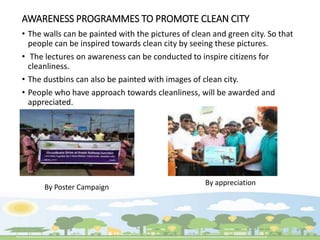
AWARENESS PROGRAMMES TO PROMOTE CLEAN CITY
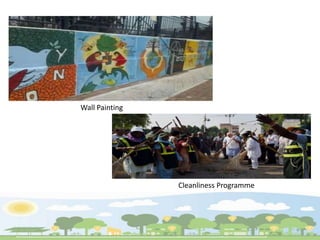
• The walls can be painted with the pictures of clean and green city. So that
people can be inspired towards clean city by seeing these pictures.
• The lectures on awareness can be conducted to inspire citizens for
cleanliness.
• The dustbins can also be painted with images of clean city.
• People who have approach towards cleanliness, will be awarded and
appreciated.
By Poster Campaign
By appreciation
Wall Painting
Cleanliness Programme
Whether Any Profitable Company spending small
proportion of profit for cleanliness
• New Delhi: Keen to accelerate Swachh Bharat Abhiyan, the Centre is
considering a proposal to ask private companies and PSUs to spend around
30% of CSR funds on the cleanliness programme.
• In CSR, The New Companies Act, 2013 makes a mandatory provision of
making a contribution of 2% of profits towards corporate social responsibility
to address social issues, cleanliness and bring about a positive impact on the
life of the poor and disadvantaged groups including bringing about inclusive
development and help these sections leave a productive dignified life.
Proposals
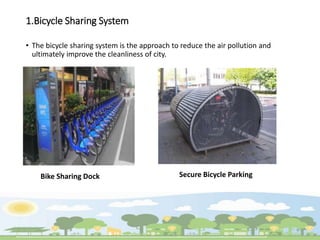
1.Bicycle Sharing System
• The bicycle sharing system is the approach to reduce the air pollution and
ultimately improve the cleanliness of city.
Bike Sharing Dock Secure Bicycle Parking
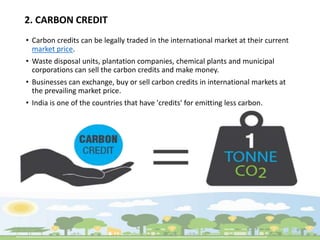
2. CARBON CREDIT
• Carbon credits can be legally traded in the international market at their current
market price.
• Waste disposal units, plantation companies, chemical plants and municipal
corporations can sell the carbon credits and make money.
• Businesses can exchange, buy or sell carbon credits in international markets at
the prevailing market price.
• India is one of the countries that have 'credits' for emitting less carbon.
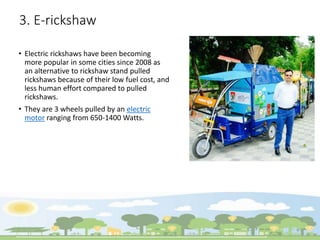
3. E-rickshaw
• Electric rickshaws have been becoming
more popular in some cities since 2008 as
an alternative to rickshaw stand pulled
rickshaws because of their low fuel cost, and
less human effort compared to pulled
rickshaws.
• They are 3 wheels pulled by an electric
motor ranging from 650-1400 Watts.
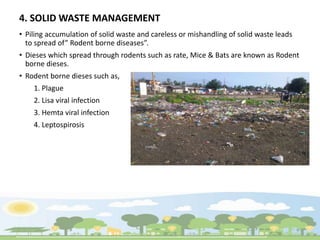
4. SOLID WASTE MANAGEMENT
• Piling accumulation of solid waste and careless or mishandling of solid waste leads
to spread of” Rodent borne diseases”.
• Dieses which spread through rodents such as rate, Mice & Bats are known as Rodent
borne dieses.
• Rodent borne dieses such as,
1. Plague
2. Lisa viral infection
3. Hemta viral infection
4. Leptospirosis
4. SOLID WASTE DISPOSAL METHODS:
LAND FILLING – The Landfill is the most popularly used method of waste disposal
used today. This process of waste disposal focuses attention on burying the waste in
the land. Landfills are found in all areas. There is a process used that eliminates the
odours and dangers of waste before it is placed into the ground. While it is true this is
the most popular form of waste disposal it is certainly far from the only procedure and
one that may also bring with it an assortment of space.
INCINERATION–Incineration is a type disposal method in which municipal solid wastes
are burned at high temperatures so as to convert them into residue and gaseous
products. The biggest advantage of this type of method is that it can reduce the
volume of solid waste to 20 to 30 percent of the original volume, decreases the space
they take up and reduce the stress on landfills. This process is also known as thermal
treatment where solid waste materials are converted by Incinerators into heat, gas,
steam and ash. Incineration is something that is very in countries where landfill space
is no longer available, which includes Japan.
SOLID WASTE SOLUTIONS:
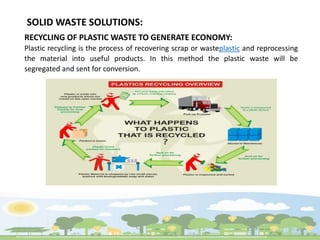
RECYCLING OF PLASTIC WASTE TO GENERATE ECONOMY:
Plastic recycling is the process of recovering scrap or wasteplastic and reprocessing
the material into useful products. In this method the plastic waste will be
segregated and sent for conversion.
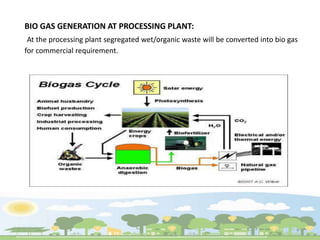
BIO GAS GENERATION AT PROCESSING PLANT:
At the processing plant segregated wet/organic waste will be converted into bio gas
for commercial requirement.
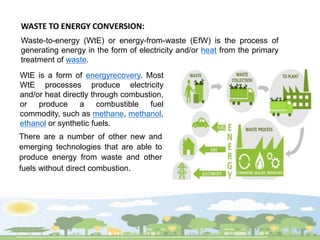
WASTE TO ENERGY CONVERSION:
Waste-to-energy (WtE) or energy-from-waste (EfW) is the process of
generating energy in the form of electricity and/or heat from the primary
treatment of waste.
There are a number of other new and
emerging technologies that are able to
produce energy from waste and other
fuels without direct combustion.
WtE is a form of energyrecovery. Most
WtE processes produce electricity
and/or heat directly through combustion,
or produce a combustible fuel
commodity, such as methane, methanol,
ethanol or synthetic fuels.
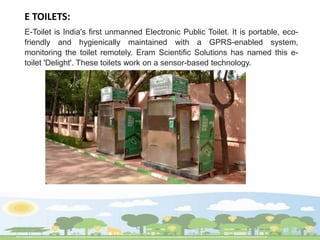
E TOILETS:
E-Toilet is India's first unmanned Electronic Public Toilet. It is portable, eco-
friendly and hygienically maintained with a GPRS-enabled system,
monitoring the toilet remotely. Eram Scientific Solutions has named this e-
toilet 'Delight'. These toilets work on a sensor-based technology.
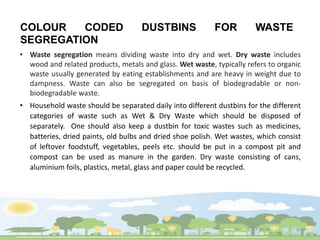
COLOUR CODED DUSTBINS FOR WASTE
SEGREGATION
• Waste segregation means dividing waste into dry and wet. Dry waste includes
wood and related products, metals and glass. Wet waste, typically refers to organic
waste usually generated by eating establishments and are heavy in weight due to
dampness. Waste can also be segregated on basis of biodegradable or non-
biodegradable waste.
• Household waste should be separated daily into different dustbins for the different
categories of waste such as Wet & Dry Waste which should be disposed of
separately. One should also keep a dustbin for toxic wastes such as medicines,
batteries, dried paints, old bulbs and dried shoe polish. Wet wastes, which consist
of leftover foodstuff, vegetables, peels etc. should be put in a compost pit and
compost can be used as manure in the garden. Dry waste consisting of cans,
aluminium foils, plastics, metal, glass and paper could be recycled.
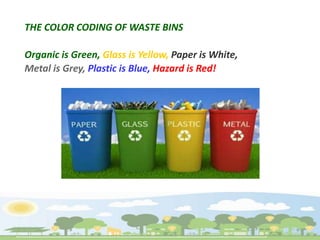
THE COLOR CODING OF WASTE BINS
Organic is Green, Glass is Yellow, Paper is White,
Metal is Grey, Plastic is Blue, Hazard is Red!
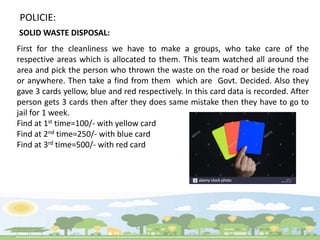
First for the cleanliness we have to make a groups, who take care of the
respective areas which is allocated to them. This team watched all around the
area and pick the person who thrown the waste on the road or beside the road
or anywhere. Then take a find from them which are Govt. Decided. Also they
gave 3 cards yellow, blue and red respectively. In this card data is recorded. After
person gets 3 cards then after they does same mistake then they have to go to
jail for 1 week.
Find at 1st time=100/- with yellow card
Find at 2nd time=250/- with blue card
Find at 3rd time=500/- with red card
POLICIE:
SOLID WASTE DISPOSAL:
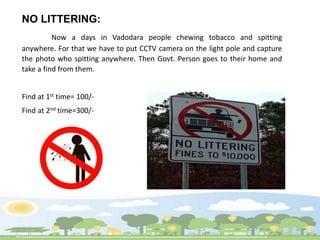
NO LITTERING:
Now a days in Vadodara people chewing tobacco and spitting
anywhere. For that we have to put CCTV camera on the light pole and capture
the photo who spitting anywhere. Then Govt. Person goes to their home and
take a find from them.
Find at 1st time= 100/-
Find at 2nd time=300/-
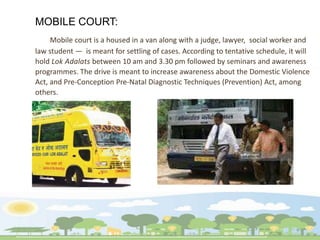
MOBILE COURT:
Mobile court is a housed in a van along with a judge, lawyer, social worker and
law student — is meant for settling of cases. According to tentative schedule, it will
hold Lok Adalats between 10 am and 3.30 pm followed by seminars and awareness
programmes. The drive is meant to increase awareness about the Domestic Violence
Act, and Pre-Conception Pre-Natal Diagnostic Techniques (Prevention) Act, among
others.
CONCLUSION:
After all this proposals and existing issues we conclude that the vision of
Vadodara is, Towards a sustainable and clean city, with an efficient,
sophisticated, skilled and people-centric administration providing the best
quality of services to its citizens. Also the mission is to achieve high standard
of: potable water, efficient drainage system and hassle free urban
transportation and Scientifically cleaning, disposal of waste, to make pollution
free city and provide excellent health service. Also after including some policies
we want to create a awareness about cleanliness in public so that economy
generate. After all this proposals Vadodara is become a clean city.

Clean city

  • 1.
    PLANNING FOR ACLEAN CITY: CASE STUDY OF VADODARA SUBMITTED BY : - DISHA PACHHIGAR JANKI SHAH MAHESHVAR THAKOR SHARAD ZALAVADIYA MURP-1, MSU
  • 2.
    INTRODUCTION • Vadodara ,which used to be known as Baroda, the Cultural Capital of Gujarat, is the third largest city in the Western Indian State of Gujarat. • The city bounced to the 13th rank in the Swachh Survekshan rankings. • The city post some marks in door-to-door collection, sweeping, collection and transportation as well as processing and disposal of waste. • There are many aspect for the planning of clean city which are discussed in this presentation. • Also we provided some proposals, policies and awareness programmes to promote cleanliness.
  • 3.
    AWARENESS PROGRAMMES TOPROMOTE CLEAN CITY • The walls can be painted with the pictures of clean and green city. So that people can be inspired towards clean city by seeing these pictures. • The lectures on awareness can be conducted to inspire citizens for cleanliness. • The dustbins can also be painted with images of clean city. • People who have approach towards cleanliness, will be awarded and appreciated. By Poster Campaign By appreciation
  • 4.
  • 5.
    Whether Any ProfitableCompany spending small proportion of profit for cleanliness • New Delhi: Keen to accelerate Swachh Bharat Abhiyan, the Centre is considering a proposal to ask private companies and PSUs to spend around 30% of CSR funds on the cleanliness programme. • In CSR, The New Companies Act, 2013 makes a mandatory provision of making a contribution of 2% of profits towards corporate social responsibility to address social issues, cleanliness and bring about a positive impact on the life of the poor and disadvantaged groups including bringing about inclusive development and help these sections leave a productive dignified life.
  • 6.
  • 7.
    1.Bicycle Sharing System •The bicycle sharing system is the approach to reduce the air pollution and ultimately improve the cleanliness of city. Bike Sharing Dock Secure Bicycle Parking
  • 8.
    2. CARBON CREDIT •Carbon credits can be legally traded in the international market at their current market price. • Waste disposal units, plantation companies, chemical plants and municipal corporations can sell the carbon credits and make money. • Businesses can exchange, buy or sell carbon credits in international markets at the prevailing market price. • India is one of the countries that have 'credits' for emitting less carbon.
  • 9.
    3. E-rickshaw • Electricrickshaws have been becoming more popular in some cities since 2008 as an alternative to rickshaw stand pulled rickshaws because of their low fuel cost, and less human effort compared to pulled rickshaws. • They are 3 wheels pulled by an electric motor ranging from 650-1400 Watts.
  • 10.
    4. SOLID WASTEMANAGEMENT • Piling accumulation of solid waste and careless or mishandling of solid waste leads to spread of” Rodent borne diseases”. • Dieses which spread through rodents such as rate, Mice & Bats are known as Rodent borne dieses. • Rodent borne dieses such as, 1. Plague 2. Lisa viral infection 3. Hemta viral infection 4. Leptospirosis
  • 11.
    4. SOLID WASTEDISPOSAL METHODS: LAND FILLING – The Landfill is the most popularly used method of waste disposal used today. This process of waste disposal focuses attention on burying the waste in the land. Landfills are found in all areas. There is a process used that eliminates the odours and dangers of waste before it is placed into the ground. While it is true this is the most popular form of waste disposal it is certainly far from the only procedure and one that may also bring with it an assortment of space. INCINERATION–Incineration is a type disposal method in which municipal solid wastes are burned at high temperatures so as to convert them into residue and gaseous products. The biggest advantage of this type of method is that it can reduce the volume of solid waste to 20 to 30 percent of the original volume, decreases the space they take up and reduce the stress on landfills. This process is also known as thermal treatment where solid waste materials are converted by Incinerators into heat, gas, steam and ash. Incineration is something that is very in countries where landfill space is no longer available, which includes Japan.
  • 12.
    SOLID WASTE SOLUTIONS: RECYCLINGOF PLASTIC WASTE TO GENERATE ECONOMY: Plastic recycling is the process of recovering scrap or wasteplastic and reprocessing the material into useful products. In this method the plastic waste will be segregated and sent for conversion.
  • 13.
    BIO GAS GENERATIONAT PROCESSING PLANT: At the processing plant segregated wet/organic waste will be converted into bio gas for commercial requirement.
  • 14.
    WASTE TO ENERGYCONVERSION: Waste-to-energy (WtE) or energy-from-waste (EfW) is the process of generating energy in the form of electricity and/or heat from the primary treatment of waste. There are a number of other new and emerging technologies that are able to produce energy from waste and other fuels without direct combustion. WtE is a form of energyrecovery. Most WtE processes produce electricity and/or heat directly through combustion, or produce a combustible fuel commodity, such as methane, methanol, ethanol or synthetic fuels.
  • 15.
    E TOILETS: E-Toilet isIndia's first unmanned Electronic Public Toilet. It is portable, eco- friendly and hygienically maintained with a GPRS-enabled system, monitoring the toilet remotely. Eram Scientific Solutions has named this e- toilet 'Delight'. These toilets work on a sensor-based technology.
  • 16.
    COLOUR CODED DUSTBINSFOR WASTE SEGREGATION • Waste segregation means dividing waste into dry and wet. Dry waste includes wood and related products, metals and glass. Wet waste, typically refers to organic waste usually generated by eating establishments and are heavy in weight due to dampness. Waste can also be segregated on basis of biodegradable or non- biodegradable waste. • Household waste should be separated daily into different dustbins for the different categories of waste such as Wet & Dry Waste which should be disposed of separately. One should also keep a dustbin for toxic wastes such as medicines, batteries, dried paints, old bulbs and dried shoe polish. Wet wastes, which consist of leftover foodstuff, vegetables, peels etc. should be put in a compost pit and compost can be used as manure in the garden. Dry waste consisting of cans, aluminium foils, plastics, metal, glass and paper could be recycled.
  • 17.
    THE COLOR CODINGOF WASTE BINS Organic is Green, Glass is Yellow, Paper is White, Metal is Grey, Plastic is Blue, Hazard is Red!
  • 18.
    First for thecleanliness we have to make a groups, who take care of the respective areas which is allocated to them. This team watched all around the area and pick the person who thrown the waste on the road or beside the road or anywhere. Then take a find from them which are Govt. Decided. Also they gave 3 cards yellow, blue and red respectively. In this card data is recorded. After person gets 3 cards then after they does same mistake then they have to go to jail for 1 week. Find at 1st time=100/- with yellow card Find at 2nd time=250/- with blue card Find at 3rd time=500/- with red card POLICIE: SOLID WASTE DISPOSAL:
  • 19.
    NO LITTERING: Now adays in Vadodara people chewing tobacco and spitting anywhere. For that we have to put CCTV camera on the light pole and capture the photo who spitting anywhere. Then Govt. Person goes to their home and take a find from them. Find at 1st time= 100/- Find at 2nd time=300/-
  • 20.
    MOBILE COURT: Mobile courtis a housed in a van along with a judge, lawyer, social worker and law student — is meant for settling of cases. According to tentative schedule, it will hold Lok Adalats between 10 am and 3.30 pm followed by seminars and awareness programmes. The drive is meant to increase awareness about the Domestic Violence Act, and Pre-Conception Pre-Natal Diagnostic Techniques (Prevention) Act, among others.
  • 21.
    CONCLUSION: After all thisproposals and existing issues we conclude that the vision of Vadodara is, Towards a sustainable and clean city, with an efficient, sophisticated, skilled and people-centric administration providing the best quality of services to its citizens. Also the mission is to achieve high standard of: potable water, efficient drainage system and hassle free urban transportation and Scientifically cleaning, disposal of waste, to make pollution free city and provide excellent health service. Also after including some policies we want to create a awareness about cleanliness in public so that economy generate. After all this proposals Vadodara is become a clean city.