1
Topic:- Identifying waste Preparation and collection
Made by:- MANAV PREET
Follow on:-
2
Introduction:-
Municipal solid waste (MSW) is the abridgment of the waste generated from
domestic, commercial, and construction activities by natural persons that is
collected and treated by municipalities. Rapid industrialization and
population explosion in India has led to the migration of people from villages
to cities, which generate thousands of tons of municipal solid waste (MSW)
daily. The MSW amount is expected to increase significantly in the near
future as the country strives to attain an industrialized nation status. Poor
collection and inadequate transportation are responsible for the
accumulation of MSW at every nook and corner. The management of MSW is
going through a critical phase, due to the unavailability of suitable facilities to
treat and dispose of the larger amount of MSW generated daily in
metropolitan cities. Unscientific disposal causes an adverse impact on all
components of the environment and human health. Generally, MSW is
disposed of in low-lying areas without taking any precautions or operational
controls. Therefore, MSWM is one of the major environmental problems of
Indian megacities. It involves activities associated with generation, storage,
collection, transfer and transport, processing and disposal of solid wastes.
But, in most cities, the MSWM system comprises only four activities, i.e.,
waste generation, collection, transportation, and disposal. The management
of MSW requires proper infrastructure, maintenance and upgrade for all
activities. This becomes increasingly expensive and complex due to the
continuous and unplanned growth of urban centers. The difficulties in
providing the desired level of public service in the urban centers are often
attributed to the poor financial status of the managing municipal
corporations.
Statistically, urban India produced around 62 Mt of solid waste
(450g/capita/day) in 2015. Approximately 82% of MSW was collected and the
remaining 18% was litter. The waste treated was only 28% of the collected
waste, and the remaining 72% was openly dumped. Waste collection
efficiency ranges between 70% and 95% in major metropolitan cities,
3
whereas in several smaller cities it is below 50%. Most urban local bodies
(ULBs) are unable to manage such a large amount of solid waste due to
financial debilities and inadequate infrastructure. Source segregation of
waste, doorstep collection, options for recycling and reuse, technologies for
treatment, land availability, and disposal competence are a few of the prime
challenges.
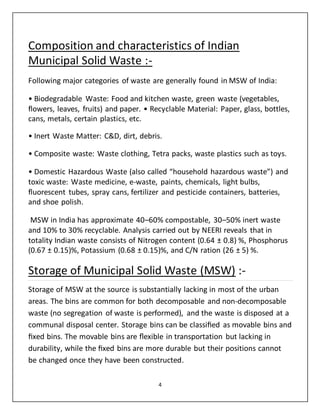
Sources of Municipal Solid Waste:-
4
Composition and characteristics of Indian
Municipal Solid Waste :-
Following major categories of waste are generally found in MSW of India:
• Biodegradable Waste: Food and kitchen waste, green waste (vegetables,
flowers, leaves, fruits) and paper. • Recyclable Material: Paper, glass, bottles,
cans, metals, certain plastics, etc.
• Inert Waste Matter: C&D, dirt, debris.
• Composite waste: Waste clothing, Tetra packs, waste plastics such as toys.
• Domestic Hazardous Waste (also called “household hazardous waste”) and
toxic waste: Waste medicine, e-waste, paints, chemicals, light bulbs,
fluorescent tubes, spray cans, fertilizer and pesticide containers, batteries,
and shoe polish.
MSW in India has approximate 40–60% compostable, 30–50% inert waste
and 10% to 30% recyclable. Analysis carried out by NEERI reveals that in
totality Indian waste consists of Nitrogen content (0.64 ± 0.8) %, Phosphorus
(0.67 ± 0.15)%, Potassium (0.68 ± 0.15)%, and C/N ration (26 ± 5) %.
Storage of Municipal Solid Waste (MSW) :-
Storage of MSW at the source is substantially lacking in most of the urban
areas. The bins are common for both decomposable and non-decomposable
waste (no segregation of waste is performed), and the waste is disposed at a
communal disposal center. Storage bins can be classified as movable bins and
fixed bins. The movable bins are flexible in transportation but lacking in
durability, while the fixed bins are more durable but their positions cannot
be changed once they have been constructed.
5
Municipal authorities shall establish and maintain storage facilities in such a
manner, as they do not create unhygienic and unsanitary conditions around
it. Following criteria shall be taken into account while establishing and
maintaining storage facilities:-
 Storage facilities shall be created and established by taking into account
quantities of waste generation in a given area and the population
densities. A storage facility shall be so placed that it is accessible to
users.
 Storage facilities to be set up by municipal authorities or any other
agency shall be so designed that wastes stored are not exposed to open
atmosphere and shall be aesthetically acceptable and user-friendly.
 Storage facilities or ‘bins’ shall have ‘easy to operate’ design for
handling, transfer and transportation of waste. Bins for storage of bio-
degradable wastes shall be painted green, those for storage of
recyclable wastes shall be painted white and those for storage of other
wastes shall be painted black.
 Manual handling of waste shall be prohibited. If unavoidable due to
constraints, manual handling shall be carried out under proper
precaution with due care for safety of workers.
Collection of Municipal Solid Waste :-
The collection of MSW is the responsibility of corporations /municipalities.
The predominant system of collection in most of the cities is through
communal bins placed at various points along the roads, and sometimes this
leads to the creation of unauthorized open collection points. Efforts to
organize house-to-house collection are just starting in many megacities such
as Delhi, Mumbai, Bangalore, Madras and Hyderabad with the help of NGOs.
It has been observed that many municipalities have employed private
6
contractors for secondary transportation from the communal bins or
collection points to the disposal sites.
Others have employed NGOs and citizen’s committees to supervise
segregation and collection from the generation source to collection points
located at intermediate points between sources and dumpsites. In addition,
the welfare associations on specified monthly payment arrange collection in
some urban areas. A sweeper who sweeps the roads manually is allotted a
specific area. The sweepers put the road wastes into a wheelbarrow, and
then transfer the waste to dustbins or collection points. In most cities, a
fraction of MSW generated remains uncollected on streets, and what is
collected is transported to processing or disposal sites. The collection
efficiency is the quantity of MSW collected and transported from streets to
disposal sites divided by the total quantity of MSW generated during the
same period.
Littering of municipal solid waste shall be prohibited in cities, towns and in
urban areas notified by the State Governments. To prohibit littering and
facilitate compliance, the following steps shall be taken by the municipal
authority:-
 Organizing house-to-house collection of municipal solid wastes through
any of the methods, like community bin collection (central bin), house-
to-house collection, and collection on regular pre-informed timings and
scheduling by using musical bell of the vehicle.
 Devising collection of waste from slums and squatter areas or localities
including hotels, restaurants, office complexes and commercial areas.
 Wastes from slaughter houses, meat and fish markets, fruits and
vegetable markets, which are biodegradable in nature, shall be
managed to make use of such wastes.
7
 Bio-medical wastes and industrial wastes shall not be mixed with
municipal solid wastes and such wastes shall follow the rules separately
specified for the purpose.
 Construction or demolition wastes shall be separately collected and
disposed off following proper norms. Similarly, wastes generated at
dairies shall be regulated in accordance with the State laws.
 Waste (garbage, dry leaves) shall not be burnt.
 Stray animals shall not be allowed to move around waste storage
facilities or at any other place in the city or town.
Reuse/Recycle:-
This entails activities like collecting those materials from the waste, which
could be gainfully retrieved and utilized for making new products. Since
unsegregated waste is dumped at community bins, its optimal recycling is
not possible. However, rag-pickers usually sorted out and took and sell
recyclable material like plastics, glass, etc.
Transportation:-
Modes of transportation for MSWM practised in India are: bullock carts,
hand rickshaws, compactors, trucks, tractor, trailers, and dumpers. In
smaller towns trucks having 5–9 ton capacity are used without adequate
cover system. Stationary compactors, mobile compactors/closed tempos,
and tarpaulin-covered vehicles are used in the transportation of MSW and
about 65, 15, and 20% of waste is transported through these compacters,
respectively. The maintenance of vehicles used in for transportation of
waste is usually done in workshop run by ULBs but most of these
workshops can do minor repairs only. No wonder, in the event of
breakdown of these vehicles, the overall collection, transportation, and
disposal efficiency reduces drastically. Only few transfer stations can be
found in some metropolitan e.g. Mumbai.
8
Hauled Container System:-
Collection systems in which the containers used for the storage of wastes are
hauled to the processing, transfer or disposal site, emptied and returned to
either their original location or some other location are defined as hauled
container systems. There are two main types of hauled container systems:
1) Tilt frame container,
2) Trash-trailer.
The collector is responsible for driving the vehicle, loading full containers and
unloading empty containers and emptying the contents of the container at
the disposal site. In some cases, for safety reasons, both a driver and helper
are used. Systems that use tilt frame loaded vehicles and large containers,
often called drop boxes are ideally suited for the collection of all types of
solid waste and rubbish from locations where the generation rate warrants
the use of large containers.The application of trash-trailers is similar to that
of frame container systems. Trash trailers are better for the collection of
especially heavy rubbish and often are used for the collection of demolition
wastes at construction sites.
Stationary Container System:-
Container systems in which the containers used for the storage of wastes
remain at the point of waste generation, except when moved for collection
are defined as stationary container system. Labour requirements for
mechanically loaded stationary container systems are essentially the same as
for hauled container system. There are two main types of stationary
container systems:
i) Those in which self loading compactors are used.
ii) Those in which manually loaded vehicles are used.
9
Container size and utilization are not as critical in stationary container
systems using self loading collection vehicles equipped with a compaction
mechanism as they are in hauled container system. Trips to the disposal site,
transfer station or processing station are made after the contents of number
of containers have been collected and compacted and the collection vehicle
is full. This system is used for the collection of all types of wastes.

Identifying waste Preparation and collection

  • 1.
    1 Topic:- Identifying wastePreparation and collection Made by:- MANAV PREET Follow on:-
  • 2.
    2 Introduction:- Municipal solid waste(MSW) is the abridgment of the waste generated from domestic, commercial, and construction activities by natural persons that is collected and treated by municipalities. Rapid industrialization and population explosion in India has led to the migration of people from villages to cities, which generate thousands of tons of municipal solid waste (MSW) daily. The MSW amount is expected to increase significantly in the near future as the country strives to attain an industrialized nation status. Poor collection and inadequate transportation are responsible for the accumulation of MSW at every nook and corner. The management of MSW is going through a critical phase, due to the unavailability of suitable facilities to treat and dispose of the larger amount of MSW generated daily in metropolitan cities. Unscientific disposal causes an adverse impact on all components of the environment and human health. Generally, MSW is disposed of in low-lying areas without taking any precautions or operational controls. Therefore, MSWM is one of the major environmental problems of Indian megacities. It involves activities associated with generation, storage, collection, transfer and transport, processing and disposal of solid wastes. But, in most cities, the MSWM system comprises only four activities, i.e., waste generation, collection, transportation, and disposal. The management of MSW requires proper infrastructure, maintenance and upgrade for all activities. This becomes increasingly expensive and complex due to the continuous and unplanned growth of urban centers. The difficulties in providing the desired level of public service in the urban centers are often attributed to the poor financial status of the managing municipal corporations. Statistically, urban India produced around 62 Mt of solid waste (450g/capita/day) in 2015. Approximately 82% of MSW was collected and the remaining 18% was litter. The waste treated was only 28% of the collected waste, and the remaining 72% was openly dumped. Waste collection efficiency ranges between 70% and 95% in major metropolitan cities,
  • 3.
    3 whereas in severalsmaller cities it is below 50%. Most urban local bodies (ULBs) are unable to manage such a large amount of solid waste due to financial debilities and inadequate infrastructure. Source segregation of waste, doorstep collection, options for recycling and reuse, technologies for treatment, land availability, and disposal competence are a few of the prime challenges. Sources of Municipal Solid Waste:-
  • 4.
    4 Composition and characteristicsof Indian Municipal Solid Waste :- Following major categories of waste are generally found in MSW of India: • Biodegradable Waste: Food and kitchen waste, green waste (vegetables, flowers, leaves, fruits) and paper. • Recyclable Material: Paper, glass, bottles, cans, metals, certain plastics, etc. • Inert Waste Matter: C&D, dirt, debris. • Composite waste: Waste clothing, Tetra packs, waste plastics such as toys. • Domestic Hazardous Waste (also called “household hazardous waste”) and toxic waste: Waste medicine, e-waste, paints, chemicals, light bulbs, fluorescent tubes, spray cans, fertilizer and pesticide containers, batteries, and shoe polish. MSW in India has approximate 40–60% compostable, 30–50% inert waste and 10% to 30% recyclable. Analysis carried out by NEERI reveals that in totality Indian waste consists of Nitrogen content (0.64 ± 0.8) %, Phosphorus (0.67 ± 0.15)%, Potassium (0.68 ± 0.15)%, and C/N ration (26 ± 5) %. Storage of Municipal Solid Waste (MSW) :- Storage of MSW at the source is substantially lacking in most of the urban areas. The bins are common for both decomposable and non-decomposable waste (no segregation of waste is performed), and the waste is disposed at a communal disposal center. Storage bins can be classified as movable bins and fixed bins. The movable bins are flexible in transportation but lacking in durability, while the fixed bins are more durable but their positions cannot be changed once they have been constructed.
  • 5.
    5 Municipal authorities shallestablish and maintain storage facilities in such a manner, as they do not create unhygienic and unsanitary conditions around it. Following criteria shall be taken into account while establishing and maintaining storage facilities:-  Storage facilities shall be created and established by taking into account quantities of waste generation in a given area and the population densities. A storage facility shall be so placed that it is accessible to users.  Storage facilities to be set up by municipal authorities or any other agency shall be so designed that wastes stored are not exposed to open atmosphere and shall be aesthetically acceptable and user-friendly.  Storage facilities or ‘bins’ shall have ‘easy to operate’ design for handling, transfer and transportation of waste. Bins for storage of bio- degradable wastes shall be painted green, those for storage of recyclable wastes shall be painted white and those for storage of other wastes shall be painted black.  Manual handling of waste shall be prohibited. If unavoidable due to constraints, manual handling shall be carried out under proper precaution with due care for safety of workers. Collection of Municipal Solid Waste :- The collection of MSW is the responsibility of corporations /municipalities. The predominant system of collection in most of the cities is through communal bins placed at various points along the roads, and sometimes this leads to the creation of unauthorized open collection points. Efforts to organize house-to-house collection are just starting in many megacities such as Delhi, Mumbai, Bangalore, Madras and Hyderabad with the help of NGOs. It has been observed that many municipalities have employed private
  • 6.
    6 contractors for secondarytransportation from the communal bins or collection points to the disposal sites. Others have employed NGOs and citizen’s committees to supervise segregation and collection from the generation source to collection points located at intermediate points between sources and dumpsites. In addition, the welfare associations on specified monthly payment arrange collection in some urban areas. A sweeper who sweeps the roads manually is allotted a specific area. The sweepers put the road wastes into a wheelbarrow, and then transfer the waste to dustbins or collection points. In most cities, a fraction of MSW generated remains uncollected on streets, and what is collected is transported to processing or disposal sites. The collection efficiency is the quantity of MSW collected and transported from streets to disposal sites divided by the total quantity of MSW generated during the same period. Littering of municipal solid waste shall be prohibited in cities, towns and in urban areas notified by the State Governments. To prohibit littering and facilitate compliance, the following steps shall be taken by the municipal authority:-  Organizing house-to-house collection of municipal solid wastes through any of the methods, like community bin collection (central bin), house- to-house collection, and collection on regular pre-informed timings and scheduling by using musical bell of the vehicle.  Devising collection of waste from slums and squatter areas or localities including hotels, restaurants, office complexes and commercial areas.  Wastes from slaughter houses, meat and fish markets, fruits and vegetable markets, which are biodegradable in nature, shall be managed to make use of such wastes.
  • 7.
    7  Bio-medical wastesand industrial wastes shall not be mixed with municipal solid wastes and such wastes shall follow the rules separately specified for the purpose.  Construction or demolition wastes shall be separately collected and disposed off following proper norms. Similarly, wastes generated at dairies shall be regulated in accordance with the State laws.  Waste (garbage, dry leaves) shall not be burnt.  Stray animals shall not be allowed to move around waste storage facilities or at any other place in the city or town. Reuse/Recycle:- This entails activities like collecting those materials from the waste, which could be gainfully retrieved and utilized for making new products. Since unsegregated waste is dumped at community bins, its optimal recycling is not possible. However, rag-pickers usually sorted out and took and sell recyclable material like plastics, glass, etc. Transportation:- Modes of transportation for MSWM practised in India are: bullock carts, hand rickshaws, compactors, trucks, tractor, trailers, and dumpers. In smaller towns trucks having 5–9 ton capacity are used without adequate cover system. Stationary compactors, mobile compactors/closed tempos, and tarpaulin-covered vehicles are used in the transportation of MSW and about 65, 15, and 20% of waste is transported through these compacters, respectively. The maintenance of vehicles used in for transportation of waste is usually done in workshop run by ULBs but most of these workshops can do minor repairs only. No wonder, in the event of breakdown of these vehicles, the overall collection, transportation, and disposal efficiency reduces drastically. Only few transfer stations can be found in some metropolitan e.g. Mumbai.
  • 8.
    8 Hauled Container System:- Collectionsystems in which the containers used for the storage of wastes are hauled to the processing, transfer or disposal site, emptied and returned to either their original location or some other location are defined as hauled container systems. There are two main types of hauled container systems: 1) Tilt frame container, 2) Trash-trailer. The collector is responsible for driving the vehicle, loading full containers and unloading empty containers and emptying the contents of the container at the disposal site. In some cases, for safety reasons, both a driver and helper are used. Systems that use tilt frame loaded vehicles and large containers, often called drop boxes are ideally suited for the collection of all types of solid waste and rubbish from locations where the generation rate warrants the use of large containers.The application of trash-trailers is similar to that of frame container systems. Trash trailers are better for the collection of especially heavy rubbish and often are used for the collection of demolition wastes at construction sites. Stationary Container System:- Container systems in which the containers used for the storage of wastes remain at the point of waste generation, except when moved for collection are defined as stationary container system. Labour requirements for mechanically loaded stationary container systems are essentially the same as for hauled container system. There are two main types of stationary container systems: i) Those in which self loading compactors are used. ii) Those in which manually loaded vehicles are used.
  • 9.
    9 Container size andutilization are not as critical in stationary container systems using self loading collection vehicles equipped with a compaction mechanism as they are in hauled container system. Trips to the disposal site, transfer station or processing station are made after the contents of number of containers have been collected and compacted and the collection vehicle is full. This system is used for the collection of all types of wastes.