MANTHAN TOPIC: ENSURING WORLD CLASS CIVIC
AMENITIES IN URBAN INDIA
WORKING TOWARDS A NEW AGE:
WASTE MANAGEMENT SYSTEM
TEAM MEMBERS:
Kshitija Naik (NUJS, Kolkata)
Ashwin Kirtane (DA-IICT, Gandhinagar)
Rahul Saranjame (DA-IICT, Gandhinagar)
Sahil Jain (DA-IICT, Gandhinagar)
S. Chaitanya Prasad (DA-IICT, Gandhinagar)
The waste Management system determines the economic status of a country and
the lifestyle of its population.
It is the shared responsibility of the citizens and the government to promote and
implement sustainable development.
CERTAIN FACTS REGARDING WASTE
GENERATION IN INDIA
 India produces 5.6 metric
tons of waste annually.
 Delhi generates the
maximum at 689.5 metric
tons every day.
 Metros and big cities in India
collect about 60-70% of their
MSW (Municipal Solid
Waste).
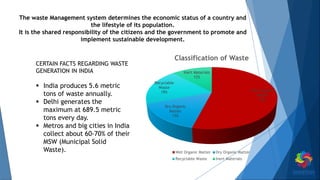
Wet Organic
Matter
54%
Dry Organic
Matter
15%
Recyclable
Waste
19%
Inert Materials
12%
Classification of Waste
Wet Organic Matter Dry Organic Matter
Recyclable Waste Inert Materials
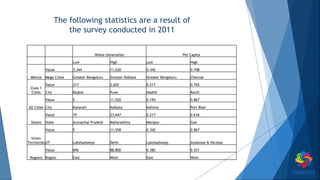
Waste Generation Per Capita
Low High Low High
Metros
Value 3,344 11,520 0.445 0.708
Mega Cities Greater Bengaluru Greater Kolkata Greater Bengaluru Chennai
Class 1
Cities
Value 317 2,602 0.217 0.765
City Rajkot Pune Nashik Kochi
All Cities
Value 5 11,520 0.194 0.867
City Kavarati Kolkata Kohima Port Blair
States
Value 19 23,647 0.217 0.616
State Arunachal Pradesh Maharashtra Manipur Goa
Union
Territories
Value 5 11,558 0.342 0.867
UT Lakshadweep Delhi Lakshadweep Andaman & Nicobar
Regions
Value 696 88,800 0.382 0.531
Region East West East West
The following statistics are a result of
the survey conducted in 2011
Turning visions and dreams into reality with
optimum planning.
• Develop financial sources from public and
private sector to sustain the project.
• Building a network of volunteers in
collaboration with the media team to
create awareness.
• Ensure an eco friendly approach to dealing
with waste materials in all aspects.
• Encouraging the growth of research and
innovation regarding waste management in
India.
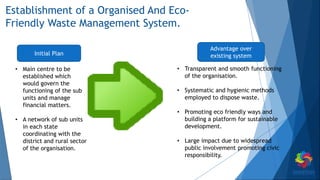
Establishment of a Organised And Eco-
Friendly Waste Management System.
• Main centre to be
established which
would govern the
functioning of the sub
units and manage
financial matters.
• A network of sub units
in each state
coordinating with the
district and rural sector
of the organisation.
• Transparent and smooth functioning
of the organisation.
• Systematic and hygienic methods
employed to dispose waste.
• Promoting eco friendly ways and
building a platform for sustainable
development.
• Large impact due to widespread
public involvement promoting civic
responsibility.
Initial Plan
Advantage over
existing system
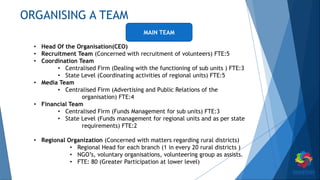
ORGANISING A TEAM
• Head Of the Organisation(CEO)
• Recruitment Team (Concerned with recruitment of volunteers) FTE:5
• Coordination Team
• Centralised Firm (Dealing with the functioning of sub units ) FTE:3
• State Level (Coordinating activities of regional units) FTE:5
• Media Team
• Centralised Firm (Advertising and Public Relations of the
organisation) FTE:4
• Financial Team
• Centralised Firm (Funds Management for sub units) FTE:3
• State Level (Funds management for regional units and as per state
requirements) FTE:2
• Regional Organization (Concerned with matters regarding rural districts)
• Regional Head for each branch (1 in every 20 rural districts )
• NGO’s, voluntary organisations, volunteering group as assists.
• FTE: 80 (Greater Participation at lower level)
MAIN TEAM
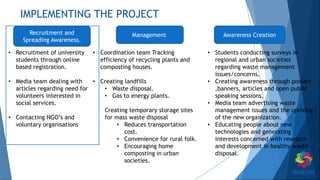
IMPLEMENTING THE PROJECT
• Recruitment of university
students through online
based registration.
• Media team dealing with
articles regarding need for
volunteers interested in
social services.
• Contacting NGO’s and
voluntary organisations
• Coordination team Tracking
efficiency of recycling plants and
composting houses.
• Creating landfills
• Waste disposal.
• Gas to energy plants.
Creating temporary storage sites
for mass waste disposal
• Reduces transportation
cost.
• Convenience for rural folk.
• Encouraging home
composting in urban
societies.
• Students conducting surveys in
regional and urban societies
regarding waste management
issues/concerns.
• Creating awareness through posters
,banners, articles and open public
speaking sessions.
• Media team advertising waste
management issues and the uprising
of the new organization.
• Educating people about new
technologies and generating
interests concerned with research
and development in healthy waste
disposal.
Recruitment and
Spreading Awareness.
Management Awareness Creation
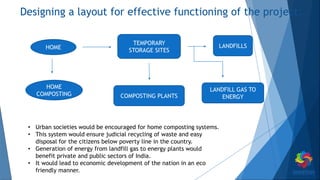
Designing a layout for effective functioning of the project.
HOME
HOME
COMPOSTING
TEMPORARY
STORAGE SITES
COMPOSTING PLANTS
LANDFILLS
LANDFILL GAS TO
ENERGY
• Urban societies would be encouraged for home composting systems.
• This system would ensure judicial recycling of waste and easy
disposal for the citizens below poverty line in the country.
• Generation of energy from landfill gas to energy plants would
benefit private and public sectors of India.
• It would lead to economic development of the nation in an eco
friendly manner.
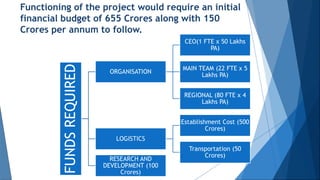
Functioning of the project would require an initial
financial budget of 655 Crores along with 150
Crores per annum to follow.
FUNDSREQUIRED ORGANISATION
CEO(1 FTE x 50 Lakhs
PA)
MAIN TEAM (22 FTE x 5
Lakhs PA)
REGIONAL (80 FTE x 4
Lakhs PA)
LOGISTICS
Establishment Cost (500
Crores)
Transportation (50
Crores)
RESEARCH AND
DEVELOPMENT (100
Crores)
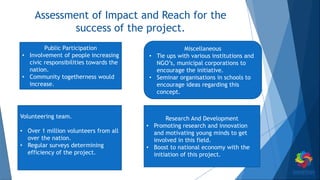
Assessment of Impact and Reach for the
success of the project.
Volunteering team.
• Over 1 million volunteers from all
over the nation.
• Regular surveys determining
efficiency of the project.
Public Participation
• Involvement of people increasing
civic responsibilities towards the
nation.
• Community togetherness would
increase.
Research And Development
• Promoting research and innovation
and motivating young minds to get
involved in this field.
• Boost to national economy with the
initiation of this project.
Miscellaneous
• Tie ups with various institutions and
NGO’s, municipal corporations to
encourage the initiative.
• Seminar organisations in schools to
encourage ideas regarding this
concept.
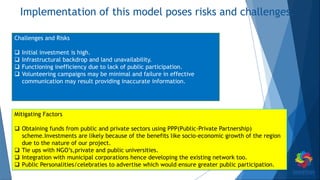
Implementation of this model poses risks and challenges.
Challenges and Risks
 Initial investment is high.
 Infrastructural backdrop and land unavailability.
 Functioning inefficiency due to lack of public participation.
 Volunteering campaigns may be minimal and failure in effective
communication may result providing inaccurate information.
Mitigating Factors
 Obtaining funds from public and private sectors using PPP(Public-Private Partnership)
scheme.Investments are likely because of the benefits like socio-economic growth of the region
due to the nature of our project.
 Tie ups with NGO’s,private and public universities.
 Integration with municipal corporations hence developing the existing network too.
 Public Personalities/celebraties to advertise which would ensure greater public participation.
Appendix
 Waste Disposal System in Japan, Malaysia and Dubai.
 Project Reports on Waste Management System.
 Waste Management issues in Jakarta, Indonesia : A case
study
 Challenges regarding waste Management in India : Google
 Statistics of Waste management in India for the year 2011.
 Towards an eco friendly society, Renesas Electronics
Europe.
 Waste Management World : The potential for waste to
energy initiatives.
REFERENCES

ManthanRulers

  • 1.
    MANTHAN TOPIC: ENSURINGWORLD CLASS CIVIC AMENITIES IN URBAN INDIA WORKING TOWARDS A NEW AGE: WASTE MANAGEMENT SYSTEM TEAM MEMBERS: Kshitija Naik (NUJS, Kolkata) Ashwin Kirtane (DA-IICT, Gandhinagar) Rahul Saranjame (DA-IICT, Gandhinagar) Sahil Jain (DA-IICT, Gandhinagar) S. Chaitanya Prasad (DA-IICT, Gandhinagar)
  • 2.
    The waste Managementsystem determines the economic status of a country and the lifestyle of its population. It is the shared responsibility of the citizens and the government to promote and implement sustainable development. CERTAIN FACTS REGARDING WASTE GENERATION IN INDIA  India produces 5.6 metric tons of waste annually.  Delhi generates the maximum at 689.5 metric tons every day.  Metros and big cities in India collect about 60-70% of their MSW (Municipal Solid Waste). Wet Organic Matter 54% Dry Organic Matter 15% Recyclable Waste 19% Inert Materials 12% Classification of Waste Wet Organic Matter Dry Organic Matter Recyclable Waste Inert Materials
  • 3.
    Waste Generation PerCapita Low High Low High Metros Value 3,344 11,520 0.445 0.708 Mega Cities Greater Bengaluru Greater Kolkata Greater Bengaluru Chennai Class 1 Cities Value 317 2,602 0.217 0.765 City Rajkot Pune Nashik Kochi All Cities Value 5 11,520 0.194 0.867 City Kavarati Kolkata Kohima Port Blair States Value 19 23,647 0.217 0.616 State Arunachal Pradesh Maharashtra Manipur Goa Union Territories Value 5 11,558 0.342 0.867 UT Lakshadweep Delhi Lakshadweep Andaman & Nicobar Regions Value 696 88,800 0.382 0.531 Region East West East West The following statistics are a result of the survey conducted in 2011
  • 4.
    Turning visions anddreams into reality with optimum planning. • Develop financial sources from public and private sector to sustain the project. • Building a network of volunteers in collaboration with the media team to create awareness. • Ensure an eco friendly approach to dealing with waste materials in all aspects. • Encouraging the growth of research and innovation regarding waste management in India.
  • 5.
    Establishment of aOrganised And Eco- Friendly Waste Management System. • Main centre to be established which would govern the functioning of the sub units and manage financial matters. • A network of sub units in each state coordinating with the district and rural sector of the organisation. • Transparent and smooth functioning of the organisation. • Systematic and hygienic methods employed to dispose waste. • Promoting eco friendly ways and building a platform for sustainable development. • Large impact due to widespread public involvement promoting civic responsibility. Initial Plan Advantage over existing system
  • 6.
    ORGANISING A TEAM •Head Of the Organisation(CEO) • Recruitment Team (Concerned with recruitment of volunteers) FTE:5 • Coordination Team • Centralised Firm (Dealing with the functioning of sub units ) FTE:3 • State Level (Coordinating activities of regional units) FTE:5 • Media Team • Centralised Firm (Advertising and Public Relations of the organisation) FTE:4 • Financial Team • Centralised Firm (Funds Management for sub units) FTE:3 • State Level (Funds management for regional units and as per state requirements) FTE:2 • Regional Organization (Concerned with matters regarding rural districts) • Regional Head for each branch (1 in every 20 rural districts ) • NGO’s, voluntary organisations, volunteering group as assists. • FTE: 80 (Greater Participation at lower level) MAIN TEAM
  • 7.
    IMPLEMENTING THE PROJECT •Recruitment of university students through online based registration. • Media team dealing with articles regarding need for volunteers interested in social services. • Contacting NGO’s and voluntary organisations • Coordination team Tracking efficiency of recycling plants and composting houses. • Creating landfills • Waste disposal. • Gas to energy plants. Creating temporary storage sites for mass waste disposal • Reduces transportation cost. • Convenience for rural folk. • Encouraging home composting in urban societies. • Students conducting surveys in regional and urban societies regarding waste management issues/concerns. • Creating awareness through posters ,banners, articles and open public speaking sessions. • Media team advertising waste management issues and the uprising of the new organization. • Educating people about new technologies and generating interests concerned with research and development in healthy waste disposal. Recruitment and Spreading Awareness. Management Awareness Creation
  • 8.
    Designing a layoutfor effective functioning of the project. HOME HOME COMPOSTING TEMPORARY STORAGE SITES COMPOSTING PLANTS LANDFILLS LANDFILL GAS TO ENERGY • Urban societies would be encouraged for home composting systems. • This system would ensure judicial recycling of waste and easy disposal for the citizens below poverty line in the country. • Generation of energy from landfill gas to energy plants would benefit private and public sectors of India. • It would lead to economic development of the nation in an eco friendly manner.
  • 9.
    Functioning of theproject would require an initial financial budget of 655 Crores along with 150 Crores per annum to follow. FUNDSREQUIRED ORGANISATION CEO(1 FTE x 50 Lakhs PA) MAIN TEAM (22 FTE x 5 Lakhs PA) REGIONAL (80 FTE x 4 Lakhs PA) LOGISTICS Establishment Cost (500 Crores) Transportation (50 Crores) RESEARCH AND DEVELOPMENT (100 Crores)
  • 10.
    Assessment of Impactand Reach for the success of the project. Volunteering team. • Over 1 million volunteers from all over the nation. • Regular surveys determining efficiency of the project. Public Participation • Involvement of people increasing civic responsibilities towards the nation. • Community togetherness would increase. Research And Development • Promoting research and innovation and motivating young minds to get involved in this field. • Boost to national economy with the initiation of this project. Miscellaneous • Tie ups with various institutions and NGO’s, municipal corporations to encourage the initiative. • Seminar organisations in schools to encourage ideas regarding this concept.
  • 11.
    Implementation of thismodel poses risks and challenges. Challenges and Risks  Initial investment is high.  Infrastructural backdrop and land unavailability.  Functioning inefficiency due to lack of public participation.  Volunteering campaigns may be minimal and failure in effective communication may result providing inaccurate information. Mitigating Factors  Obtaining funds from public and private sectors using PPP(Public-Private Partnership) scheme.Investments are likely because of the benefits like socio-economic growth of the region due to the nature of our project.  Tie ups with NGO’s,private and public universities.  Integration with municipal corporations hence developing the existing network too.  Public Personalities/celebraties to advertise which would ensure greater public participation.
  • 12.
    Appendix  Waste DisposalSystem in Japan, Malaysia and Dubai.  Project Reports on Waste Management System.  Waste Management issues in Jakarta, Indonesia : A case study  Challenges regarding waste Management in India : Google  Statistics of Waste management in India for the year 2011.  Towards an eco friendly society, Renesas Electronics Europe.  Waste Management World : The potential for waste to energy initiatives. REFERENCES