Physical Planning Forum
Vision
policy, strategy; regional context.
Kamil Khan Mumtaz
July 2014
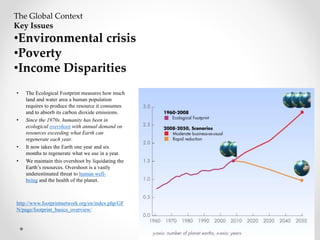
• The Ecological Footprint measures how much
land and water area a human population
requires to produce the resource it consumes
and to absorb its carbon dioxide emissions.
• Since the 1970s, humanity has been in
ecological overshoot with annual demand on
resources exceeding what Earth can
regenerate each year.
• It now takes the Earth one year and six
months to regenerate what we use in a year.
• We maintain this overshoot by liquidating the
Earth’s resources. Overshoot is a vastly
underestimated threat to human well-
being and the health of the planet.
http://www.footprintnetwork.org/en/index.php/GF
N/page/footprint_basics_overview/
The Global Context
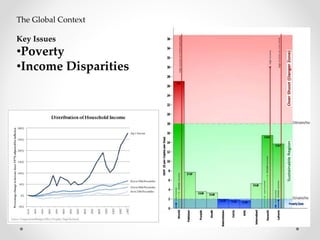
Key Issues
•Environmental crisis
•Poverty
•Income Disparities
Ecological ‘income’
(bio-capacity) and
‘expenditure’ (eco-
footprint)
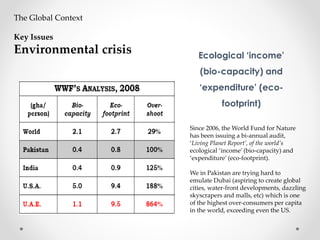
Since 2006, the World Fund for Nature
has been issuing a bi-annual audit,
‘Living Planet Report’, of the world’s
ecological ‘income’ (bio-capacity) and
‘expenditure’ (eco-footprint).
We in Pakistan are trying hard to
emulate Dubai (aspiring to create global
cities, water-front developments, dazzling
skyscrapers and malls, etc) which is one
of the highest over-consumers per capita
in the world, exceeding even the US.
The Global Context
Key Issues
Environmental crisis
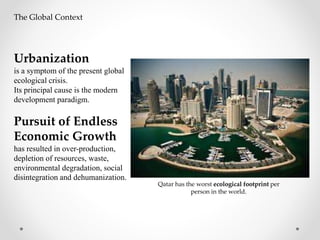
Qatar has the worst ecological footprint per
person in the world.
The Global Context
Urbanization
is a symptom of the present global
ecological crisis.
Its principal cause is the modern
development paradigm.
Pursuit of Endless
Economic Growth
has resulted in over-production,
depletion of resources, waste,
environmental degradation, social
disintegration and dehumanization.
The Global Context
Key Issues
•Poverty
•Income Disparities
Vision, Policies & Strategies
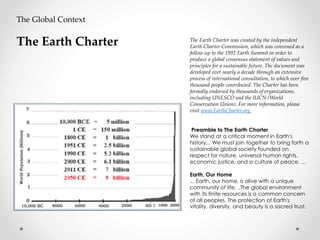
The Earth Charter was created by the independent
Earth Charter Commission, which was convened as a
follow-up to the 1992 Earth Summit in order to
produce a global consensus statement of values and
principles for a sustainable future. The document was
developed over nearly a decade through an extensive
process of international consultation, to which over five
thousand people contributed. The Charter has been
formally endorsed by thousands of organizations,
including UNESCO and the IUCN (World
Conservation Union). For more information, please
visit www.EarthCharter.org.
Preamble to The Earth Charter
We stand at a critical moment in Earth's
history... We must join together to bring forth a
sustainable global society founded on
respect for nature, universal human rights,
economic justice, and a culture of peace. …
Earth, Our Home
... Earth, our home, is alive with a unique
community of life. ..The global environment
with its finite resources is a common concern
of all peoples. The protection of Earth's
vitality, diversity, and beauty is a sacred trust.
The Global Context
The Earth Charter
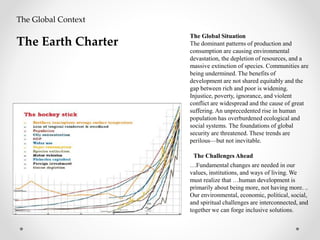
The Global Situation
The dominant patterns of production and
consumption are causing environmental
devastation, the depletion of resources, and a
massive extinction of species. Communities are
being undermined. The benefits of
development are not shared equitably and the
gap between rich and poor is widening.
Injustice, poverty, ignorance, and violent
conflict are widespread and the cause of great
suffering. An unprecedented rise in human
population has overburdened ecological and
social systems. The foundations of global
security are threatened. These trends are
perilous—but not inevitable.
The Challenges Ahead
…Fundamental changes are needed in our
values, institutions, and ways of living. We
must realize that …human development is
primarily about being more, not having more. ..
Our environmental, economic, political, social,
and spiritual challenges are interconnected, and
together we can forge inclusive solutions.
The Global Context
The Earth Charter
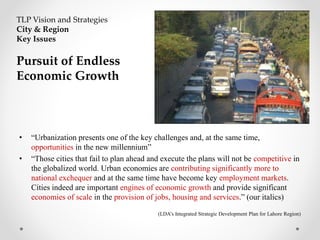
• “Urbanization presents one of the key challenges and, at the same time,
opportunities in the new millennium”
• “Those cities that fail to plan ahead and execute the plans will not be competitive in
the globalized world. Urban economies are contributing significantly more to
national exchequer and at the same time have become key employment markets.
Cities indeed are important engines of economic growth and provide significant
economies of scale in the provision of jobs, housing and services.” (our italics)
(LDA’s Integrated Strategic Development Plan for Lahore Region)
TLP Vision and Strategies
City & Region
Key Issues
Pursuit of Endless
Economic Growth
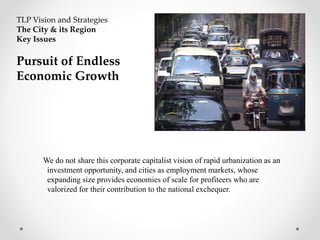
We do not share this corporate capitalist vision of rapid urbanization as an
investment opportunity, and cities as employment markets, whose
expanding size provides economies of scale for profiteers who are
valorized for their contribution to the national exchequer.
TLP Vision and Strategies
The City & its Region
Key Issues
Pursuit of Endless
Economic Growth
The City & its Region
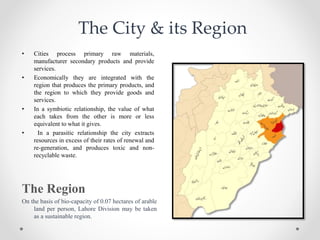
• Cities process primary raw materials,
manufacturer secondary products and provide
services.
• Economically they are integrated with the
region that produces the primary products, and
the region to which they provide goods and
services.
• In a symbiotic relationship, the value of what
each takes from the other is more or less
equivalent to what it gives.
• In a parasitic relationship the city extracts
resources in excess of their rates of renewal and
re-generation, and produces toxic and non-
recyclable waste.
The Region
On the basis of bio-capacity of 0.07 hectares of arable
land per person, Lahore Division may be taken
as a sustainable region.
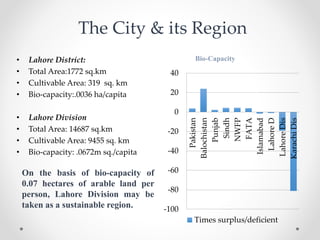
Bio-Capacity
-100
-80
-60
-40
-20
0
20
40
Pakistan
Balochistan
Punjab
Sindh
NWFP
FATA
Islamabad
LahoreD
LahoreDis
KarachiDis
Times surplus/deficient
The City & its Region
• Lahore District:
• Total Area:1772 sq.km
• Cultivable Area: 319 sq. km
• Bio-capacity:.0036 ha/capita
• Lahore Division
• Total Area: 14687 sq.km
• Cultivable Area: 9455 sq. km
• Bio-capacity: .0672m sq./capita
On the basis of bio-capacity of
0.07 hectares of arable land per
person, Lahore Division may be
taken as a sustainable region.
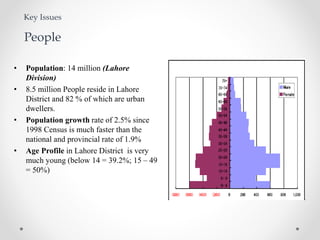
• Population: 14 million (Lahore
Division)
• 8.5 million People reside in Lahore
District and 82 % of which are urban
dwellers.
• Population growth rate of 2.5% since
1998 Census is much faster than the
national and provincial rate of 1.9%
• Age Profile in Lahore District is very
much young (below 14 = 39.2%; 15 – 49
= 50%)
Key Issues
People
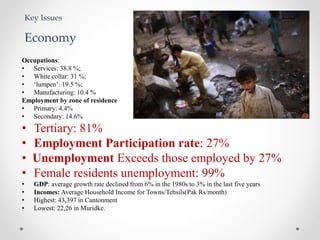
Occupations:
• Services: 38.8 %;
• White collar: 31 %;
• ‘lumpen’: 19.5 %;
• Manufacturing: 10.4 %
Employment by zone of residence
• Primary: 4.4%
• Secondary: 14.6%
• Tertiary: 81%
• Employment Participation rate: 27%
• Unemployment Exceeds those employed by 27%
• Female residents unemployment: 99%
• GDP: average growth rate declined from 6% in the 1980s to 3% in the last five years
• Incomes: Average Household Income for Towns/Tehsils(Pak Rs/month)
• Highest: 43,397 in Cantonment
• Lowest: 22,26 in Muridke.
Key Issues
Economy
Vision and Strategies
Key Issues
Urbanization
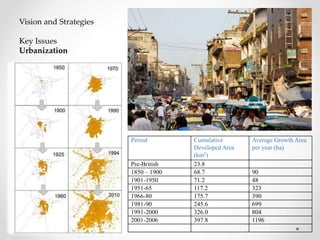
Period Cumulative
Developed Area
(km2)
Average Growth Area
per year (ha)
Pre-British 23.8
1850 – 1900 68.7 90
1901-1950 71.2 48
1951-65 117.2 323
1966-80 175.7 390
1981-90 245.6 699
1991-2000 326.0 804
2001-2006 397.8 1196
Vision and Strategies
Key Issues
Urbanization
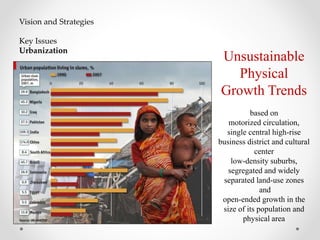
Unsustainable
Physical
Growth Trends
based on
motorized circulation,
single central high-rise
business district and cultural
center
low-density suburbs,
segregated and widely
separated land-use zones
and
open-ended growth in the
size of its population and
physical area
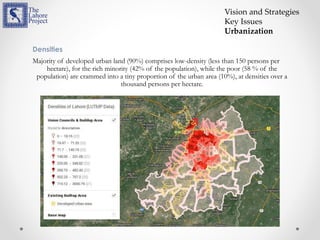
Densities
Majority of developed urban land (90%) comprises low-density (less than 150 persons per
hectare), for the rich minority (42% of the population), while the poor (58 % of the
population) are crammed into a tiny proportion of the urban area (10%), at densities over a
thousand persons per hectare.
Vision and Strategies
Key Issues
Urbanization
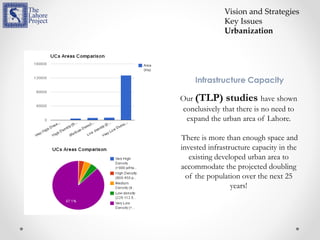
Our (TLP) studies have shown
conclusively that there is no need to
expand the urban area of Lahore.
There is more than enough space and
invested infrastructure capacity in the
existing developed urban area to
accommodate the projected doubling
of the population over the next 25
years!
Infrastructure Capacity
Vision and Strategies
Key Issues
Urbanization
•Sustainable economy based on need rather than greed;
•Extraction from resources should not exceed their rates of renewal and
re-generation;
•All that is consumed should be fully recycled;
•Toxic and non-recyclable waste should be eliminated;
•Equitable distribution of wealth
Progressive taxation on incomes, movable and immovable property, and
conspicuous consumption ;
Full employment opportunities for working population;
Place of work located within walking distance of place of residence;
•Integrate housing for all income and occupational groups;
•Integrate land uses, particularly housing, employment and social
infrastructure;
•Balance location of urban services and facilities in relation to
population for each neighborhood;
Principles & Policies
•Integrate urban economy with economy of host region
•Organic farming in host region and artisanal manufacture of commodities
at village, town and city levels based on natural raw materials and
renewable energy will:
reduce unemployment;
improve balance of payments;
produce healthier food;
reduce of environmental degradation;
result in 100% recycling; and
zero waste
•Tertiary Services: markets, trading and services at village, town and
city levels
•Taxation of non-essential consumption and investment of revenues in
social infrastructure will:
reduce income disparities;
provide better quality of life; and
reduce unemployment;
Economic Strategy
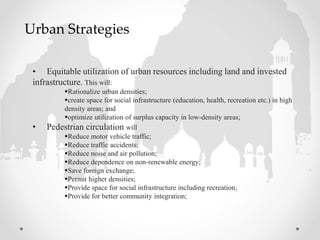
• Equitable utilization of urban resources including land and invested
infrastructure. This will:
Rationalize urban densities;
create space for social infrastructure (education, health, recreation etc.) in high
density areas; and
optimize utilization of surplus capacity in low-density areas;
• Pedestrian circulation will
Reduce motor vehicle traffic;
Reduce traffic accidents;
Reduce noise and air pollution;
Reduce dependence on non-renewable energy;
Save foreign exchange;
Permit higher densities;
Provide space for social infrastructure including recreation;
Provide for better community integration;
Urban Strategies
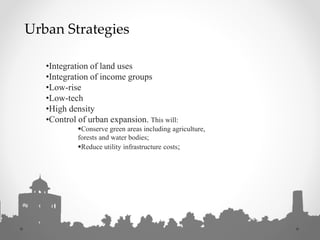
•Integration of land uses
•Integration of income groups
•Low-rise
•Low-tech
•High density
•Control of urban expansion. This will:
Conserve green areas including agriculture,
forests and water bodies;
Reduce utility infrastructure costs;
Urban Strategies
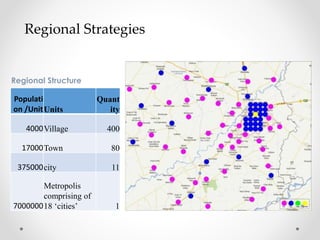
Regional Structure
Populati
on /UnitUnits
Quant
ity
4000Village 400
17000Town 80
375000city 11
7000000
Metropolis
comprising of
18 ‘cities’ 1
Regional Strategies
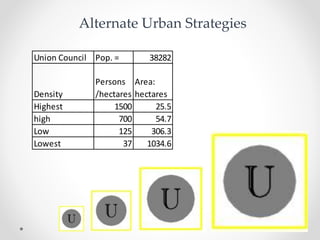
Union Council Pop. = 38282
Density
Persons
/hectares
Area:
hectares
Highest 1500 25.5
high 700 54.7
Low 125 306.3
Lowest 37 1034.6
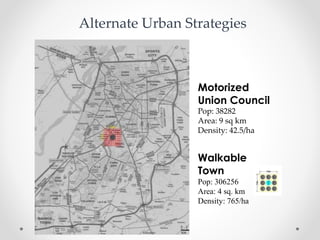
Alternate Urban Strategies
Walkable
Town
Pop: 306256
Area: 4 sq. km
Density: 765/ha
Motorized
Union Council
Pop: 38282
Area: 9 sq km
Density: 42.5/ha
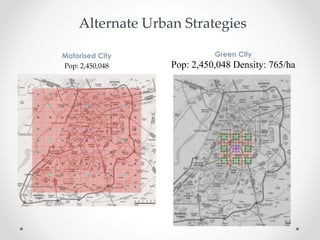
Alternate Urban Strategies
Motorised City
Pop: 2,450,048
Green City
Pop: 2,450,048 Density: 765/ha
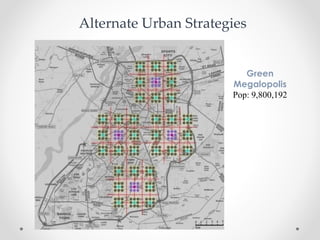
Alternate Urban Strategies
Green
Megalopolis
Pop: 9,800,192
Alternate Urban Strategies
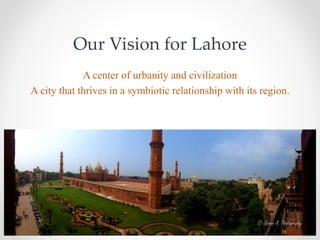
Our Vision for Lahore
A center of urbanity and civilization
A city that thrives in a symbiotic relationship with its region.
Our Goals
• Realization of our highest human potential.
• the greatest challenges of the new millennium is the conservation
of our humanity and our environment
• Our humanity is defined by the universal set of qualities and
values that define what it means to be “human” – qualities such as
Love, Compassion, Justice and Beauty – not by quantities such as
gross national product, monetary wealth and material possessions
For the Conservation of our Humanity & our Environment
www.thelahoreproject.com

A vision for Physical Planning

  • 1.
    Physical Planning Forum Vision policy,strategy; regional context. Kamil Khan Mumtaz July 2014
  • 2.
    • The EcologicalFootprint measures how much land and water area a human population requires to produce the resource it consumes and to absorb its carbon dioxide emissions. • Since the 1970s, humanity has been in ecological overshoot with annual demand on resources exceeding what Earth can regenerate each year. • It now takes the Earth one year and six months to regenerate what we use in a year. • We maintain this overshoot by liquidating the Earth’s resources. Overshoot is a vastly underestimated threat to human well- being and the health of the planet. http://www.footprintnetwork.org/en/index.php/GF N/page/footprint_basics_overview/ The Global Context Key Issues •Environmental crisis •Poverty •Income Disparities
  • 3.
    Ecological ‘income’ (bio-capacity) and ‘expenditure’(eco- footprint) Since 2006, the World Fund for Nature has been issuing a bi-annual audit, ‘Living Planet Report’, of the world’s ecological ‘income’ (bio-capacity) and ‘expenditure’ (eco-footprint). We in Pakistan are trying hard to emulate Dubai (aspiring to create global cities, water-front developments, dazzling skyscrapers and malls, etc) which is one of the highest over-consumers per capita in the world, exceeding even the US. The Global Context Key Issues Environmental crisis
  • 4.
    Qatar has theworst ecological footprint per person in the world. The Global Context Urbanization is a symptom of the present global ecological crisis. Its principal cause is the modern development paradigm. Pursuit of Endless Economic Growth has resulted in over-production, depletion of resources, waste, environmental degradation, social disintegration and dehumanization.
  • 5.
    The Global Context KeyIssues •Poverty •Income Disparities
  • 6.
  • 7.
    The Earth Charterwas created by the independent Earth Charter Commission, which was convened as a follow-up to the 1992 Earth Summit in order to produce a global consensus statement of values and principles for a sustainable future. The document was developed over nearly a decade through an extensive process of international consultation, to which over five thousand people contributed. The Charter has been formally endorsed by thousands of organizations, including UNESCO and the IUCN (World Conservation Union). For more information, please visit www.EarthCharter.org. Preamble to The Earth Charter We stand at a critical moment in Earth's history... We must join together to bring forth a sustainable global society founded on respect for nature, universal human rights, economic justice, and a culture of peace. … Earth, Our Home ... Earth, our home, is alive with a unique community of life. ..The global environment with its finite resources is a common concern of all peoples. The protection of Earth's vitality, diversity, and beauty is a sacred trust. The Global Context The Earth Charter
  • 8.
    The Global Situation Thedominant patterns of production and consumption are causing environmental devastation, the depletion of resources, and a massive extinction of species. Communities are being undermined. The benefits of development are not shared equitably and the gap between rich and poor is widening. Injustice, poverty, ignorance, and violent conflict are widespread and the cause of great suffering. An unprecedented rise in human population has overburdened ecological and social systems. The foundations of global security are threatened. These trends are perilous—but not inevitable. The Challenges Ahead …Fundamental changes are needed in our values, institutions, and ways of living. We must realize that …human development is primarily about being more, not having more. .. Our environmental, economic, political, social, and spiritual challenges are interconnected, and together we can forge inclusive solutions. The Global Context The Earth Charter
  • 9.
    • “Urbanization presentsone of the key challenges and, at the same time, opportunities in the new millennium” • “Those cities that fail to plan ahead and execute the plans will not be competitive in the globalized world. Urban economies are contributing significantly more to national exchequer and at the same time have become key employment markets. Cities indeed are important engines of economic growth and provide significant economies of scale in the provision of jobs, housing and services.” (our italics) (LDA’s Integrated Strategic Development Plan for Lahore Region) TLP Vision and Strategies City & Region Key Issues Pursuit of Endless Economic Growth
  • 10.
    We do notshare this corporate capitalist vision of rapid urbanization as an investment opportunity, and cities as employment markets, whose expanding size provides economies of scale for profiteers who are valorized for their contribution to the national exchequer. TLP Vision and Strategies The City & its Region Key Issues Pursuit of Endless Economic Growth
  • 11.
    The City &its Region • Cities process primary raw materials, manufacturer secondary products and provide services. • Economically they are integrated with the region that produces the primary products, and the region to which they provide goods and services. • In a symbiotic relationship, the value of what each takes from the other is more or less equivalent to what it gives. • In a parasitic relationship the city extracts resources in excess of their rates of renewal and re-generation, and produces toxic and non- recyclable waste. The Region On the basis of bio-capacity of 0.07 hectares of arable land per person, Lahore Division may be taken as a sustainable region.
  • 12.
    Bio-Capacity -100 -80 -60 -40 -20 0 20 40 Pakistan Balochistan Punjab Sindh NWFP FATA Islamabad LahoreD LahoreDis KarachiDis Times surplus/deficient The City& its Region • Lahore District: • Total Area:1772 sq.km • Cultivable Area: 319 sq. km • Bio-capacity:.0036 ha/capita • Lahore Division • Total Area: 14687 sq.km • Cultivable Area: 9455 sq. km • Bio-capacity: .0672m sq./capita On the basis of bio-capacity of 0.07 hectares of arable land per person, Lahore Division may be taken as a sustainable region.
  • 13.
    • Population: 14million (Lahore Division) • 8.5 million People reside in Lahore District and 82 % of which are urban dwellers. • Population growth rate of 2.5% since 1998 Census is much faster than the national and provincial rate of 1.9% • Age Profile in Lahore District is very much young (below 14 = 39.2%; 15 – 49 = 50%) Key Issues People
  • 14.
    Occupations: • Services: 38.8%; • White collar: 31 %; • ‘lumpen’: 19.5 %; • Manufacturing: 10.4 % Employment by zone of residence • Primary: 4.4% • Secondary: 14.6% • Tertiary: 81% • Employment Participation rate: 27% • Unemployment Exceeds those employed by 27% • Female residents unemployment: 99% • GDP: average growth rate declined from 6% in the 1980s to 3% in the last five years • Incomes: Average Household Income for Towns/Tehsils(Pak Rs/month) • Highest: 43,397 in Cantonment • Lowest: 22,26 in Muridke. Key Issues Economy
  • 15.
    Vision and Strategies KeyIssues Urbanization Period Cumulative Developed Area (km2) Average Growth Area per year (ha) Pre-British 23.8 1850 – 1900 68.7 90 1901-1950 71.2 48 1951-65 117.2 323 1966-80 175.7 390 1981-90 245.6 699 1991-2000 326.0 804 2001-2006 397.8 1196
  • 16.
    Vision and Strategies KeyIssues Urbanization Unsustainable Physical Growth Trends based on motorized circulation, single central high-rise business district and cultural center low-density suburbs, segregated and widely separated land-use zones and open-ended growth in the size of its population and physical area
  • 17.
    Densities Majority of developedurban land (90%) comprises low-density (less than 150 persons per hectare), for the rich minority (42% of the population), while the poor (58 % of the population) are crammed into a tiny proportion of the urban area (10%), at densities over a thousand persons per hectare. Vision and Strategies Key Issues Urbanization
  • 18.
    Our (TLP) studieshave shown conclusively that there is no need to expand the urban area of Lahore. There is more than enough space and invested infrastructure capacity in the existing developed urban area to accommodate the projected doubling of the population over the next 25 years! Infrastructure Capacity Vision and Strategies Key Issues Urbanization
  • 19.
    •Sustainable economy basedon need rather than greed; •Extraction from resources should not exceed their rates of renewal and re-generation; •All that is consumed should be fully recycled; •Toxic and non-recyclable waste should be eliminated; •Equitable distribution of wealth Progressive taxation on incomes, movable and immovable property, and conspicuous consumption ; Full employment opportunities for working population; Place of work located within walking distance of place of residence; •Integrate housing for all income and occupational groups; •Integrate land uses, particularly housing, employment and social infrastructure; •Balance location of urban services and facilities in relation to population for each neighborhood; Principles & Policies
  • 20.
    •Integrate urban economywith economy of host region •Organic farming in host region and artisanal manufacture of commodities at village, town and city levels based on natural raw materials and renewable energy will: reduce unemployment; improve balance of payments; produce healthier food; reduce of environmental degradation; result in 100% recycling; and zero waste •Tertiary Services: markets, trading and services at village, town and city levels •Taxation of non-essential consumption and investment of revenues in social infrastructure will: reduce income disparities; provide better quality of life; and reduce unemployment; Economic Strategy
  • 21.
    • Equitable utilizationof urban resources including land and invested infrastructure. This will: Rationalize urban densities; create space for social infrastructure (education, health, recreation etc.) in high density areas; and optimize utilization of surplus capacity in low-density areas; • Pedestrian circulation will Reduce motor vehicle traffic; Reduce traffic accidents; Reduce noise and air pollution; Reduce dependence on non-renewable energy; Save foreign exchange; Permit higher densities; Provide space for social infrastructure including recreation; Provide for better community integration; Urban Strategies
  • 22.
    •Integration of landuses •Integration of income groups •Low-rise •Low-tech •High density •Control of urban expansion. This will: Conserve green areas including agriculture, forests and water bodies; Reduce utility infrastructure costs; Urban Strategies
  • 23.
    Regional Structure Populati on /UnitUnits Quant ity 4000Village400 17000Town 80 375000city 11 7000000 Metropolis comprising of 18 ‘cities’ 1 Regional Strategies
  • 24.
    Union Council Pop.= 38282 Density Persons /hectares Area: hectares Highest 1500 25.5 high 700 54.7 Low 125 306.3 Lowest 37 1034.6 Alternate Urban Strategies
  • 25.
    Walkable Town Pop: 306256 Area: 4sq. km Density: 765/ha Motorized Union Council Pop: 38282 Area: 9 sq km Density: 42.5/ha Alternate Urban Strategies
  • 26.
    Motorised City Pop: 2,450,048 GreenCity Pop: 2,450,048 Density: 765/ha Alternate Urban Strategies
  • 27.
  • 28.
    Our Vision forLahore A center of urbanity and civilization A city that thrives in a symbiotic relationship with its region.
  • 29.
    Our Goals • Realizationof our highest human potential. • the greatest challenges of the new millennium is the conservation of our humanity and our environment • Our humanity is defined by the universal set of qualities and values that define what it means to be “human” – qualities such as Love, Compassion, Justice and Beauty – not by quantities such as gross national product, monetary wealth and material possessions
  • 30.
    For the Conservationof our Humanity & our Environment www.thelahoreproject.com