What is Furcation?
Thefurcation is the area located between individual root
cones and it refers to the anatomic area of a multirooted
tooth where the roots divide or diverge from the common
root trunk.
3.
What is Furcationinvolvement?
The term Furcation involvement refers to the
invasion of the bifurcation and trifurcation of multi-
rooted teeth by periodontal disease.
Glossary of periodontal terms defines Furcation as
"the area of a multi-rooted tooth where the roots
diverge".
It defines a furcation invasion as the "pathologic
resorption of bone within a Furcation”.
4.
Terminology
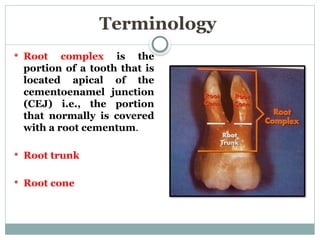
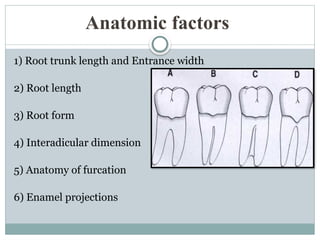
Root complexis the
portion of a tooth that is
located apical of the
cementoenamel junction
(CEJ) i.e., the portion
that normally is covered
with a root cementum.
Root trunk
Root cone
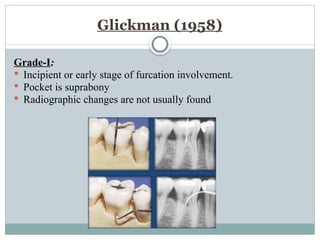
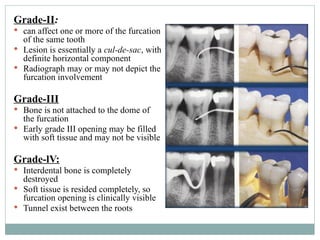
Grade-II:
can affectone or more of the furcation
of the same tooth
Lesion is essentially a cul-de-sac, with
definite horizontal component
Radiograph may or may not depict the
furcation involvement
Grade-III
Bone is not attached to the dome of
the furcation
Early grade III opening may be filled
with soft tissue and may not be visible
Grade-lV:
Interdental bone is completely
destroyed
Soft tissue is resided completely, so
furcation opening is clinically visible
Tunnel exist between the roots
The selection oftherapeutic mode
varies with
A- The class of furcation involvement,
B- The extent and configuration of bone loss,
C- Other anatomic factors
16.
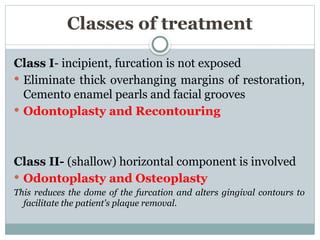
Classes of treatment
ClassI- incipient, furcation is not exposed
Eliminate thick overhanging margins of restoration,
Cemento enamel pearls and facial grooves
Odontoplasty and Recontouring
Class II- (shallow) horizontal component is involved
Odontoplasty and Osteoplasty
This reduces the dome of the furcation and alters gingival contours to
facilitate the patient's plaque removal.
17.
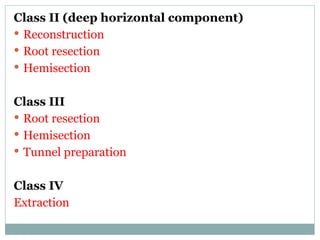
Class II (deephorizontal component)
Reconstruction
Root resection
Hemisection
Class III
Root resection
Hemisection
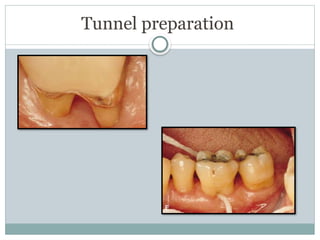
Tunnel preparation
Class IV
Extraction
Root resection
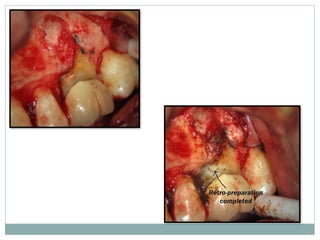
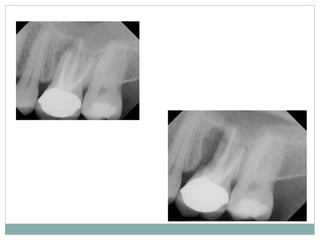
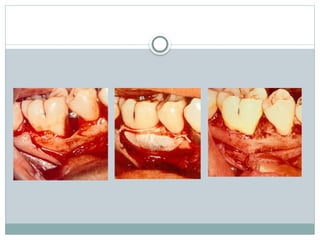
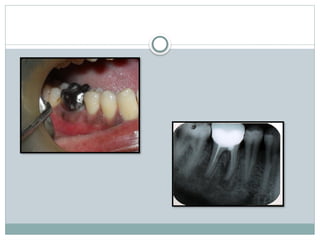
A rootresection or amputation is done when
one of a tooth's damaged roots is removed while
keeping the healthy root or roots in place.
Indicated in :-
multirooted teeth with grade II to IV furcation
involvements
20.
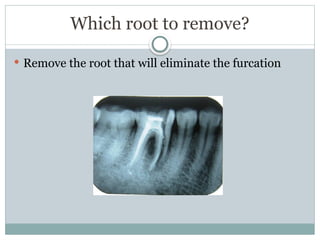
Which root toremove?
Remove the root that will eliminate the furcation
21.
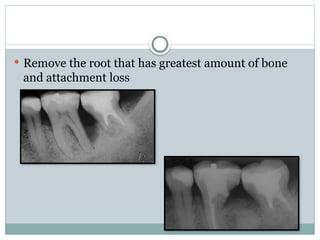
Remove theroot that has greatest amount of bone
and attachment loss
25.
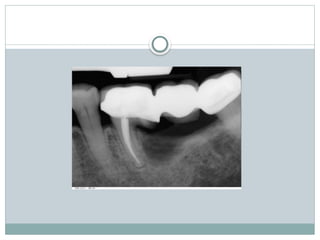
Remove theroot with greatest number of anatomic
problems
27.
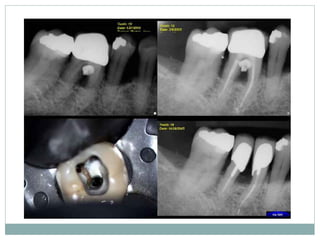
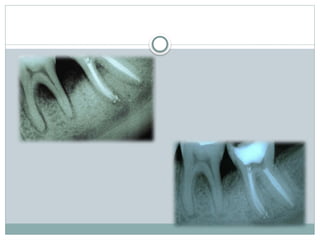
Hemisection
It issplitting of a two-rooted tooth into two separate
portions
This process has been called bicuspidization or
separation as it changes the molar into two
separate roots.
It is most likely to be performed on mandibular
molars with buccal and lingual class II or III
furcation involvements
Regeneration
Furcation defectswith deep two-walled or significant
three-walled components may however be candidates
for regeneration procedures.
These vertical bony deformities respond favorably to
a variety of other surgical procedures such as
debridement with or without membranes and bone
grafts.






![CTEV [ clubfoot] DR ARUN LAL ,DR MOHAMED ASHRAF travancore medical college k...](https://cdn.slidesharecdn.com/ss_thumbnails/ctevclubfootdrarunlaldrmohamedashraftravancoremedicalcollegekollamkeralaindia-260208063247-18fc466c-thumbnail.jpg?width=640&height=640&fit=bounds)
