Presented by
Dr. Sharashchandra, MDS
Prof and HOD
ETIOLOGY
-- Bacterial plaque
-- Root trunk length
-- Root morphology
-- Cervical enamel projections
Local factors affect the rate of plaque deposition
or complicate the performance of oral hygiene
procedures and contributing to the development
of periodontitis and attachment loss
DIAGNOSIS
-- Careful probing
-- Transgingival probing
factors that contribute :
Morphology of the affected tooth
Position of tooth relative to adjacent teeth
Local anatomy of the alveolar bone
Configuration of any bony defects
Caries and pulpal necrosis
CLASSIFICATION
GLICKMAN
FOUR CLASSES
GRADE I
Incipient or early stage
Supra bony pocket
Early bone loss
Radiographic changes are not found
GRADE II
Cul-de- sac
Vertical bone loss
Radiograph may not show the involvement
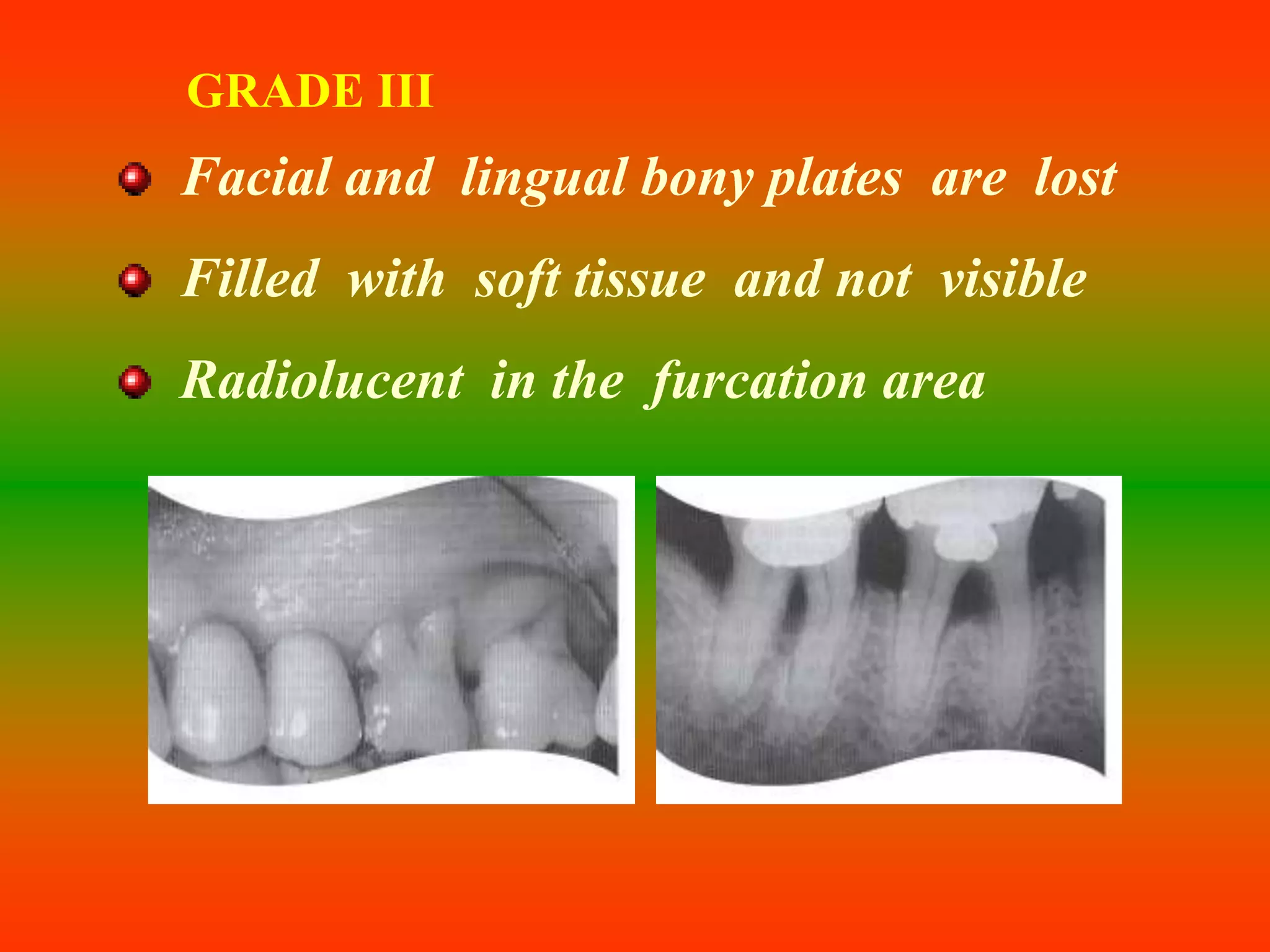
GRADE III
Facial and lingual bony plates are lost
Filled with soft tissue and not visible
Radiolucent in the furcation area
GRADE IV
Inter dental bone is destroyed
Soft tissue have receded apically
Furcation opening is clinically visible
Tunnel therefore exists between the roots
FACTORS AFFECTING TREATMENT
ROOT TRUNK LENGTH
ROOT LENGTH
ROOT FORM
INTER RADICULAR DIMENSION
ANATOMY OF FURCATION
CERVICAL ENAMEL PROJECTIONS
ROOT TRUNK LENGTH
Shorter the root trunk length – more accessible
to facilitate surgical procedures than the long
root trunks or fused roots
ROOT LENGTH
Teeth with long roots are more readily treated, as
sufficient attachment remains,to meet functional demands
ROOT FORM
Curvature – complicates
INTER RADICULAR DIMENSION
Teeth with widely separated roots present
adequate instrumentation during scaling,
root planning, and surgery than closely
approximated or fused
roots
ANATOMY OF THE FURCATION
Bifurcation ridges
Concavity in the dome
Accessory canals
Complicates scaling, root planing and
surgical therapy and maintenance
CERVICAL ENAMEL PROJECTIONS
Prevalence is highest for mandibular and
maxillary second molars
AFFECT : plaque removal
COMPLICATE : scaling and root planning
They are removed to facilitate maintenance
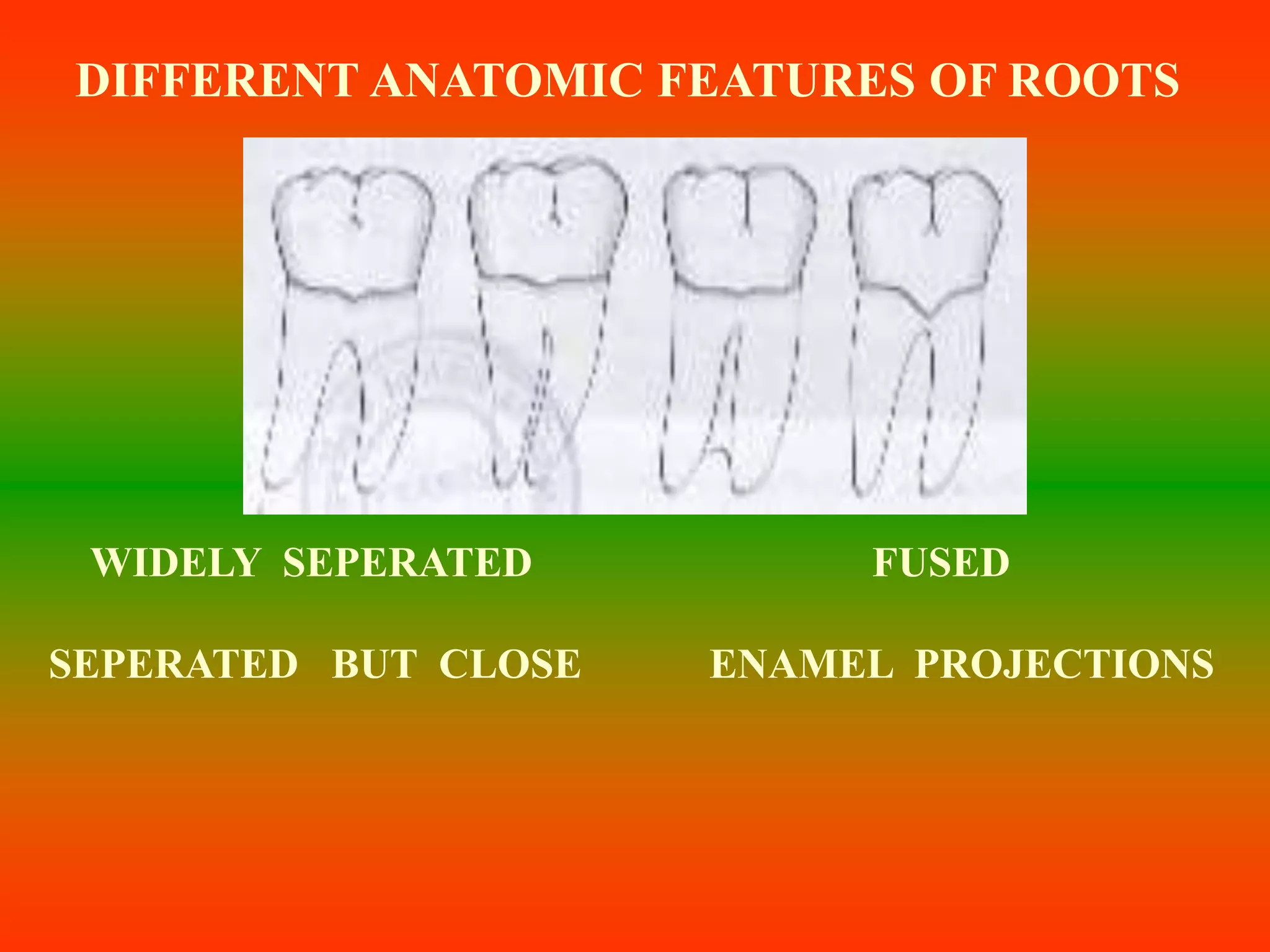
DIFFERENT ANATOMIC FEATURES OF ROOTS
WIDELY SEPERATED FUSED
SEPERATED BUT CLOSE ENAMEL PROJECTIONS
THE ANATOMY OF BONY LESIONS
PATTERN OF ATTACHMENT LOSS
Horizontal bone loss can expose the
furcation as thin facial/lingual plates of bone
The pattern of bone loss on other surfaces
of the affected tooth and adjacent teeth must
be considered during treatment planning
Molars with advanced attachment loss on only
one root may be treated by resective procedures
OTHER DENTAL FINDINGS
The combination of furcation involvement and
root approximation with an adjacent tooth may
dictate the removal of the most severely
affected tooth or the removal of a root
TREATMENT
OBJECTIVES
Facilitate maintenance
Prevent attachment loss
Obliterate the furcation defects
CLASS I
Odontoplasty
Re-contouring
CLASS II
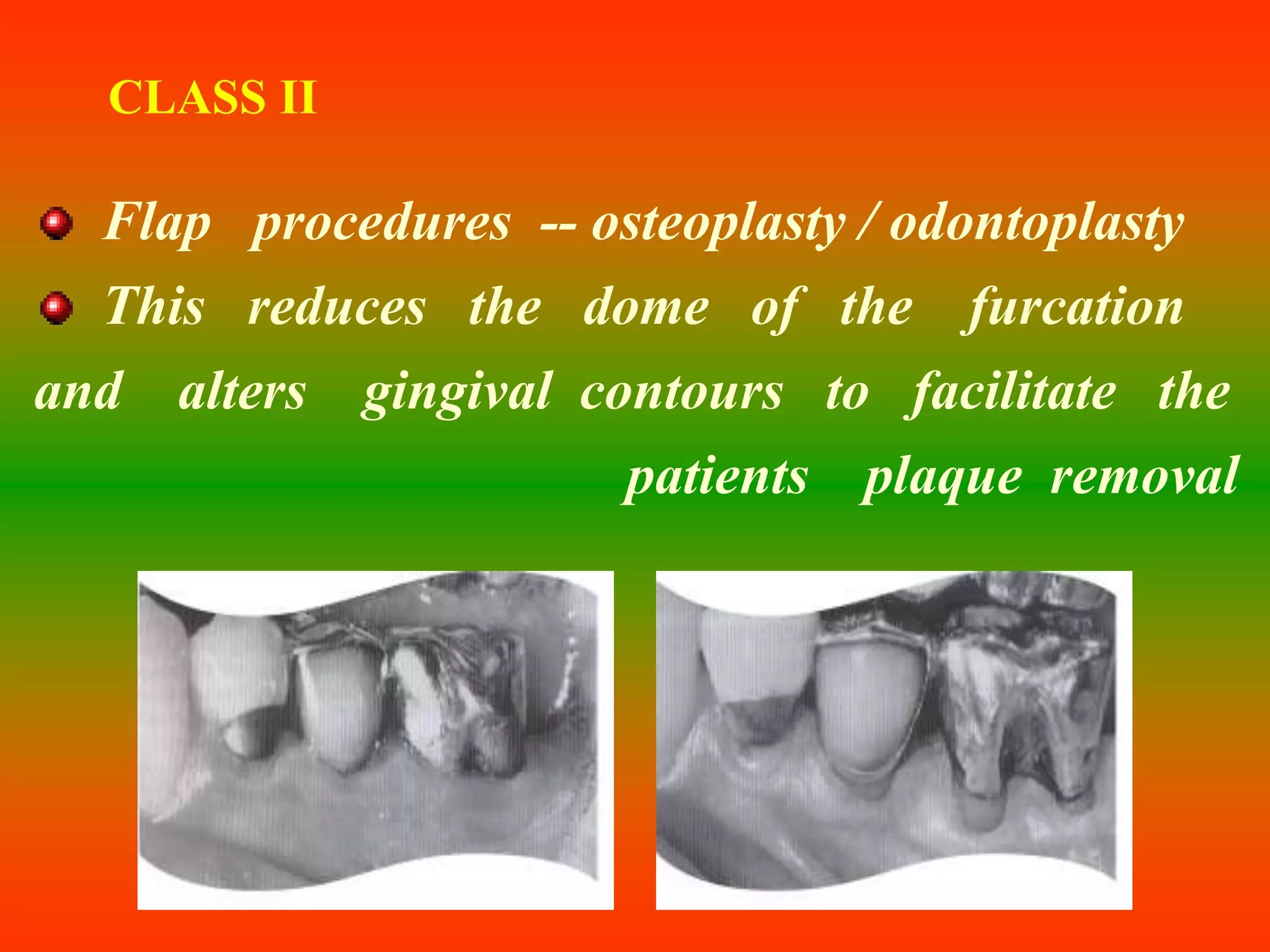
Flap procedures -- osteoplasty / odontoplasty
This reduces the dome of the furcation
and alters gingival contours to facilitate the
patients plaque removal
CLASS III / IV
Periodontal surgery
Endodontics
Replacement of tooth
ROOT RESECTION – MANDIBULAR II MOLAR
SURGICAL THERAPY
ROOT RESECTION
INDICATED
Multi rooted teeth with grade II to IV furcation
Teeth serving as abutments of fixed or
removable restorations
Teeth that have sufficient attachment
remaining for function
Teeth with furcation defects that have been
treated successfully with endodontics but now
present with a vertical root fracture
Patients with good oral hygiene and low
activity for caries
CONTRA INDICATIONS
Patients unable or willing to perform
good oral hygiene and preventive measures
are not suitable candidates
WHICH ROOT TO REMOVE AND WHY ?
Remove the roots that will eliminate the
furcation and allow the production of a
maintainable architecture on the remaining roots
Remove the root with the greatest amount of
bone and attachment loss
Remove the root that best contributes to the
elimination of periodontal problems on
adjacent teeth
Remove the root with the greatest number
of anatomic problems such as severe curvature,
developmental grooves or accessory root canals
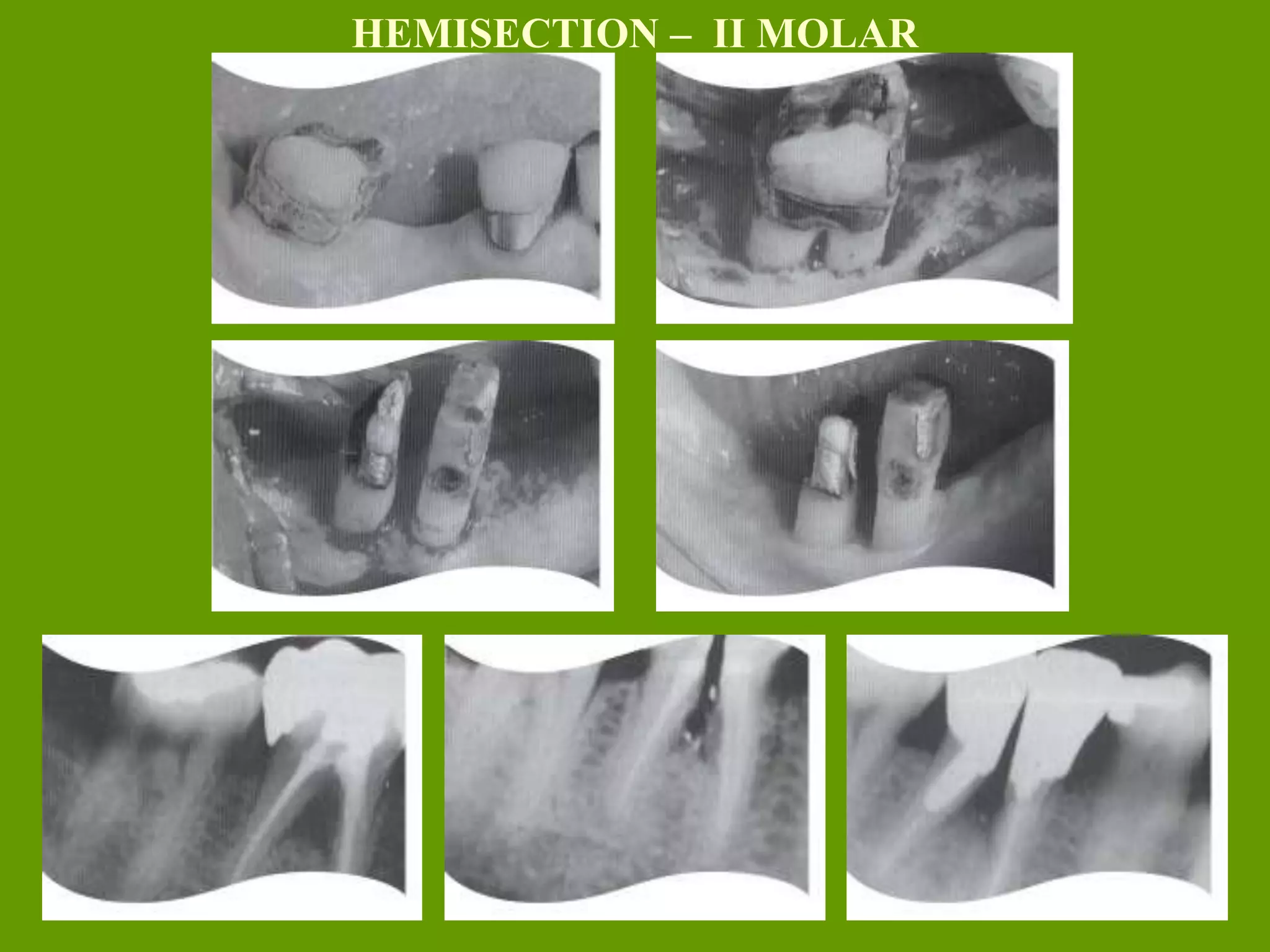
HEMISECTION
Splitting of two-rooted into two separate
portions
Also called as bicuspidization
INDICATED
Mandibular molars with buccal and lingual
class II or III furcations
CONTRAINDICATED
Molars with advanced bone loss in the
inter proximal and inter radicular zones
RESECTION / HEMISECTION PROCEDURE
Most commonly – disto-buccal root of the
maxillary first molar
Local anesthesia given
Full thickness flap is raised
Both facial and lingual / palatal flap raised
to provide better visibility and instrumentation
Debridement
A cut is then directed from just apical to
the contact point of the tooth through the
tooth to the facial and distal orifices of
the furcation
A high speed surgical length fissure or
cross-cut fissure carbine bur is used
For hemisection a vertically oriented cut is
made facio-lingually through the buccal and
lingual developmental grooves of the tooth
through the pulp chamber and through the
furcation
After sectioning the root is elevated from its
socket
Care should be taken not to traumatize bone
on the remaining roots or to damage an
adjacent tooth
Odontoplasty is performed to remove portions
of the developmental ridges and prepare a
furcation that is free of any deformity
Flaps are then approximated to cover any
grafted tissues or to slightly cover the bony
margins around the tooth
Sutures are then placed to maintain the
position of the flaps
The removal of a root alters the distribution
of occlusal forces on the remaining roots
Adjust the occlusion
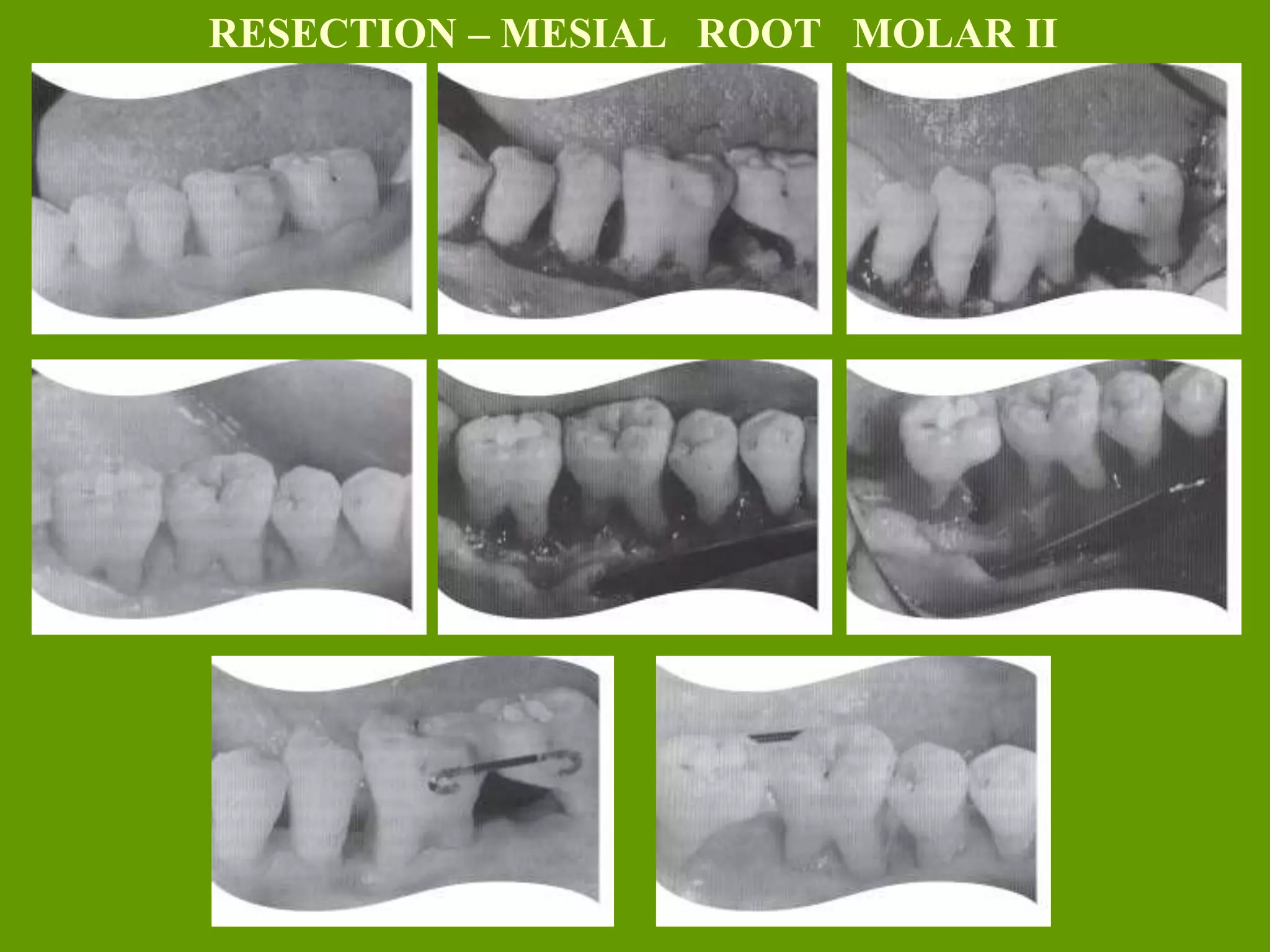
RESECTION – MESIAL ROOT MOLAR II
HEMISECTION – II MOLAR
HEMISECTION – I MOLAR
REGENERATION
INDICATION
Furcation with deep two-walled defects
EXTRACTION
Extraction of teeth with through and through
furcation defects [class III and IV ] and advanced
attachment loss is most appropriate therapy
for some patients
PROGNOSIS
The keys of long-term success :
Thorough and careful diagnosis
Selection of patient with good oral hygiene
Careful surgical and restorative management

FURCATION MANAGEMENT.ppt

  • 1.
  • 2.
    ETIOLOGY -- Bacterial plaque --Root trunk length -- Root morphology -- Cervical enamel projections Local factors affect the rate of plaque deposition or complicate the performance of oral hygiene procedures and contributing to the development of periodontitis and attachment loss
  • 3.
    DIAGNOSIS -- Careful probing --Transgingival probing factors that contribute : Morphology of the affected tooth Position of tooth relative to adjacent teeth Local anatomy of the alveolar bone Configuration of any bony defects Caries and pulpal necrosis
  • 4.
  • 5.
    GRADE I Incipient orearly stage Supra bony pocket Early bone loss Radiographic changes are not found
  • 6.
    GRADE II Cul-de- sac Verticalbone loss Radiograph may not show the involvement
  • 7.
    GRADE III Facial andlingual bony plates are lost Filled with soft tissue and not visible Radiolucent in the furcation area
  • 8.
    GRADE IV Inter dentalbone is destroyed Soft tissue have receded apically Furcation opening is clinically visible Tunnel therefore exists between the roots
  • 9.
    FACTORS AFFECTING TREATMENT ROOTTRUNK LENGTH ROOT LENGTH ROOT FORM INTER RADICULAR DIMENSION ANATOMY OF FURCATION CERVICAL ENAMEL PROJECTIONS
  • 10.
    ROOT TRUNK LENGTH Shorterthe root trunk length – more accessible to facilitate surgical procedures than the long root trunks or fused roots
  • 11.
    ROOT LENGTH Teeth withlong roots are more readily treated, as sufficient attachment remains,to meet functional demands
  • 12.
  • 13.
    INTER RADICULAR DIMENSION Teethwith widely separated roots present adequate instrumentation during scaling, root planning, and surgery than closely approximated or fused roots
  • 14.
    ANATOMY OF THEFURCATION Bifurcation ridges Concavity in the dome Accessory canals Complicates scaling, root planing and surgical therapy and maintenance
  • 15.
    CERVICAL ENAMEL PROJECTIONS Prevalenceis highest for mandibular and maxillary second molars AFFECT : plaque removal COMPLICATE : scaling and root planning They are removed to facilitate maintenance
  • 16.
    DIFFERENT ANATOMIC FEATURESOF ROOTS WIDELY SEPERATED FUSED SEPERATED BUT CLOSE ENAMEL PROJECTIONS
  • 17.
    THE ANATOMY OFBONY LESIONS PATTERN OF ATTACHMENT LOSS Horizontal bone loss can expose the furcation as thin facial/lingual plates of bone The pattern of bone loss on other surfaces of the affected tooth and adjacent teeth must be considered during treatment planning Molars with advanced attachment loss on only one root may be treated by resective procedures
  • 18.
    OTHER DENTAL FINDINGS Thecombination of furcation involvement and root approximation with an adjacent tooth may dictate the removal of the most severely affected tooth or the removal of a root
  • 19.
  • 20.
  • 21.
    CLASS II Flap procedures-- osteoplasty / odontoplasty This reduces the dome of the furcation and alters gingival contours to facilitate the patients plaque removal
  • 22.
    CLASS III /IV Periodontal surgery Endodontics Replacement of tooth
  • 23.
    ROOT RESECTION –MANDIBULAR II MOLAR
  • 24.
    SURGICAL THERAPY ROOT RESECTION INDICATED Multirooted teeth with grade II to IV furcation Teeth serving as abutments of fixed or removable restorations Teeth that have sufficient attachment remaining for function
  • 25.
    Teeth with furcationdefects that have been treated successfully with endodontics but now present with a vertical root fracture Patients with good oral hygiene and low activity for caries
  • 26.
    CONTRA INDICATIONS Patients unableor willing to perform good oral hygiene and preventive measures are not suitable candidates
  • 27.
    WHICH ROOT TOREMOVE AND WHY ? Remove the roots that will eliminate the furcation and allow the production of a maintainable architecture on the remaining roots Remove the root with the greatest amount of bone and attachment loss
  • 28.
    Remove the rootthat best contributes to the elimination of periodontal problems on adjacent teeth Remove the root with the greatest number of anatomic problems such as severe curvature, developmental grooves or accessory root canals
  • 29.
    HEMISECTION Splitting of two-rootedinto two separate portions Also called as bicuspidization INDICATED Mandibular molars with buccal and lingual class II or III furcations CONTRAINDICATED Molars with advanced bone loss in the inter proximal and inter radicular zones
  • 30.
    RESECTION / HEMISECTIONPROCEDURE Most commonly – disto-buccal root of the maxillary first molar Local anesthesia given Full thickness flap is raised Both facial and lingual / palatal flap raised to provide better visibility and instrumentation
  • 31.
    Debridement A cut isthen directed from just apical to the contact point of the tooth through the tooth to the facial and distal orifices of the furcation A high speed surgical length fissure or cross-cut fissure carbine bur is used
  • 32.
    For hemisection avertically oriented cut is made facio-lingually through the buccal and lingual developmental grooves of the tooth through the pulp chamber and through the furcation After sectioning the root is elevated from its socket Care should be taken not to traumatize bone on the remaining roots or to damage an adjacent tooth
  • 33.
    Odontoplasty is performedto remove portions of the developmental ridges and prepare a furcation that is free of any deformity Flaps are then approximated to cover any grafted tissues or to slightly cover the bony margins around the tooth Sutures are then placed to maintain the position of the flaps The removal of a root alters the distribution of occlusal forces on the remaining roots Adjust the occlusion
  • 34.
    RESECTION – MESIALROOT MOLAR II
  • 35.
  • 36.
  • 37.
  • 38.
    EXTRACTION Extraction of teethwith through and through furcation defects [class III and IV ] and advanced attachment loss is most appropriate therapy for some patients
  • 39.
    PROGNOSIS The keys oflong-term success : Thorough and careful diagnosis Selection of patient with good oral hygiene Careful surgical and restorative management