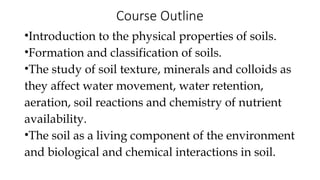
Course Outline
•Introduction tothe physical properties of soils.
•Formation and classification of soils.
•The study of soil texture, minerals and colloids as
they affect water movement, water retention,
aeration, soil reactions and chemistry of nutrient
availability.
•The soil as a living component of the environment
and biological and chemical interactions in soil.
3.
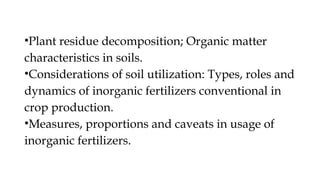
•Plant residue decomposition;Organic matter
characteristics in soils.
•Considerations of soil utilization: Types, roles and
dynamics of inorganic fertilizers conventional in
crop production.
•Measures, proportions and caveats in usage of
inorganic fertilizers.
4.
•Reading list
1. Brady,NC & Weil, RR. 1996. The Nature and properties of Soil.
12th Edition. Prentice Hall, Upper Saddle River, NJ 07458,
USA.
2. Urio, AP; Mong, HO; Chowdhury, MS & Singh BR & Semoka,
JMR 1979. Introductory Soil Science. Tanzania Publishing
House, Dar es Salaam.
• Rowell D.L Soil Science; Methods and Application,
5.
SOIL
• Soil isthe mixture of organic matter, minerals, gasses, liquids,
and organisms that together support the life of plants and
soil organisms
• Soil, the biologically active, porous medium that has
developed in the uppermost layer of Earth’s crust.
• This is one of the principal substrata of life on Earth, serving
as a reservoir of water and nutrients, as a medium for the
filtration and breakdown of injurious wastes, and as a
participant in the cycling of carbon and other elements
through the global ecosystem.
• Soil is a mixture of organic and inorganic substances which
provide nutrients, and structure to plant growth.
6.
Views on Soil(Science)
• The term SOIL was derived from the Latin Word “SOLUM”
Means FLOOR
For a Layman soil is dirt or debris
For an Agriculturist soil is a habitat for plant growth (to
grow crops)
For a Mining Engineer soil is a debris covering the Rocks
For a Civil Engineer soil is a material on which road bed or
house bed is formed
For a Home Owner soil is a mellow or loamy or hard
material
7.
Definitions according todifferent scientists in defining soil
• Generally soil refers to the loose surface of the earth as
identified from the original rocks and minerals from which it
is derived through weathering process.
• Whitney (1892): “Soil is a nutrient bin which supplies all the
nutrients required for plant growth”
• Hilgard (1892): “Soil is more or less a loose and friable
material in which plants, by means of their roots, find a
foothold for nourishment as well as for other conditions of
growth”
• Dokuchaiev (1900): Russian scientist - Father of soil science –
“Soil is a natural body composed of mineral and organic
constituents, having a definite genesis and a distinct nature
of its own”.
8.
• Joffe (1936):“Soil is a natural body of mineral and organic
constituents differentiated into horizons - usually
unconsolidated - of variable depth which differs among
themselves as well as from the underlying parent material
in morphology, physical makeup, chemical properties and
composition and biological characteristics”.
• Jenny (1941): “Soil is a naturally occurring body that has
been formed due to combined influence of climate and
living organisms acting on parent material as conditioned
by relief over a period of time”.
9.
• Ruffin andSimonson (1968): “Soil is a mixture of Earth’s
uppermost mantle of weathered rock and organic matter”
• Buckman and Brady (1969 ): “Soil is a dynamic natural body
on the surface of the earth in which plants grow, composed
of mineral and organic materials and living forms”
10.
Approaches of SoilStudy
Two Concepts:
• 1. Pedology: From Greek word pedon, means soil or earth).
The concept treats soil as a natural body, weathered and
synthesized product in nature
Pedology is the study of soil as a natural body and does
not focus on the soil’s immediate practical use.
A pedologist studies, examines and classifies soil as they
occur in their natural environment.
Pedological Approach: The origin of the soil, its
classification and its description are examined in Pedology.
11.
• 2. Edaphology:(From Greek word edaphos, means soil or
ground)
This concept treats soil as a medium for plant growth
Edaphological Approach: Edophology is the study of soil
from the stand point of higher plants.
Edaphologists consider the various properties of soil in
relation to plant production.
They are practical and have the production of food and fibre
as their ultimate goal.
They must determine the reasons for variation in the
productivity of soils and find means for improvement.
12.
SOIL SCIENCE
• Soilscience is the study of soil as a natural resource on the
surface of the earth including soil formation, classification
and mapping; physical, chemical, biological, and fertility
properties of soils; and these properties in relation to the use
and management of soils.
• Engineers, Agronomists, Chemists, Geologists, Physical
geographers, Ecologists, Biologists, Microbiologists,
Sylviculturists, Sanitarians, Archaeologists, and Specialists in
regional planning, all contribute to further knowledge of soils
and the advancement of the soil sciences
13.
BRANCHES OF SOILSCIENCE
1. Soil Physics
• Soil physics examines the physical properties of soil,
including texture, structure, density, and water retention.
• It also investigates into the movement of water and air
through soil pores.
• Soil physicists use mathematical models to predict how soil
properties impact plant growth and water availability.
• Example: In accuracy agriculture, soil physics plays a key role
in determining optimal irrigation practices, ensuring water is
distributed evenly across a field.
14.
2. Soil Chemistry
•Soil chemistry focuses on the chemical composition and
reactions that occur within soils.
• It explores nutrient availability, pH levels, ion exchange, and
the interactions between soil minerals and organic matter.
• Soil chemists study elements like nitrogen, phosphorus, and
potassium and their influence on plant growth.
• Example: Understanding the pH levels of soil is crucial for
selecting suitable crops.
• For instance, blueberries thrive in acidic soils with a pH range
of 4.5 to 5.5.
15.
3.Soil Microbiology
• Soilmicrobiology examines the diverse community of
microorganisms living within soil.
• This branch studies bacteria, fungi, algae, and other
microbes and their roles in nutrient cycling, decomposition,
and disease suppression.
• Understanding soil microbiology is crucial for sustainable
agriculture and environmental management.
• Example: Mycorrhizal fungi form mutualistic relationships
with plant roots, aiding in nutrient uptake and enhancing
plant growth.
16.
4. Soil Biology
•It refers to the soil inhabiting organisms and their biology,
functions and activities.
• For examples, insects and nematodes
5. Soil mineralogy
• This branch deals with the primary and secondary soil minerals
and their contribution to the chemistry, physics, fertility and
biology of the soils and their relation to soil genesis.
17.
6. Soil genesisand classification (pedology)
• Soil genesis deals with the weathering of rocks and minerals
and factors and processes of soil formation whereas, soil
classification is the systematic rearrangements of soils into
groups or categories on the basis of their characteristics.
18.
7.Soil fertility
• Itconcerns the ability of a soil to supply the essential plant
nutrients for plant growth.
8. Soil Salinity
• It concerns with the excess soluble salts present in the soil
their reclamation and soil management for saline agriculture.
19.
9. Soil Survey
•The systematic examination of the soils in the field and lab,
their description, classification, mapping and interpretation
according to their suitability for different management
systems is dealt with in soil surveys.
20.
10. Soil Conservation
•It deals with the protection of soil from the physical loss by
erosion (by wind and water) or chemical deterioration.
• Thus, soil conservation is concerned with a combination of
all management and land use method that safeguard the soil
against deterioration by natural or human induced factors.
21.
11. Soil Morphology
•Soil morphology is the study of the formation and
description of soil types within various soil horizons.
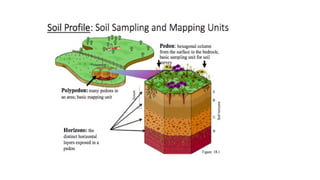
• The observations are typically made on a soil profile in order
to analyze the different soil horizons.
• A profile is a vertical section, in two dimensions, in the
ground and delimits one side of a pedon.
• A pedon is the smallest unit containing all the horizons of the
soil. Pedons typically measure 1 square meter above and
capture the lateral range of variability from soil to bedrock.
23.
12. Edaphology
• Edaphologyis concerned with the influence of soils on living
beings, in particular plants.
• In fact, edaphology includes the study of how soil influences
humankind’s land use for plant growth as well as the overall
land use by people.
• The general subfields of edaphology are agricultural soil
science (known as agronomy in some areas) and
environmental soil science.






![[Scholar.geology physical geography-botany] fundamentals of soil science (hen...](https://cdn.slidesharecdn.com/ss_thumbnails/scholar-geology-physicalgeography-botanyfundamentalsofsoilsciencehenryfoth-1990-8ed-380pp-ebook-121119041700-phpapp01-thumbnail.jpg?width=640&height=640&fit=bounds)


