Project Management
The Basics of Determining the
Basics
Learning Objectives
Introduction & Concept Development
Evaluate System Development Lifecycle
(SDLC)
Evaluate Project Management Methods
Introduction & Concept
Development
Project Management 0
1
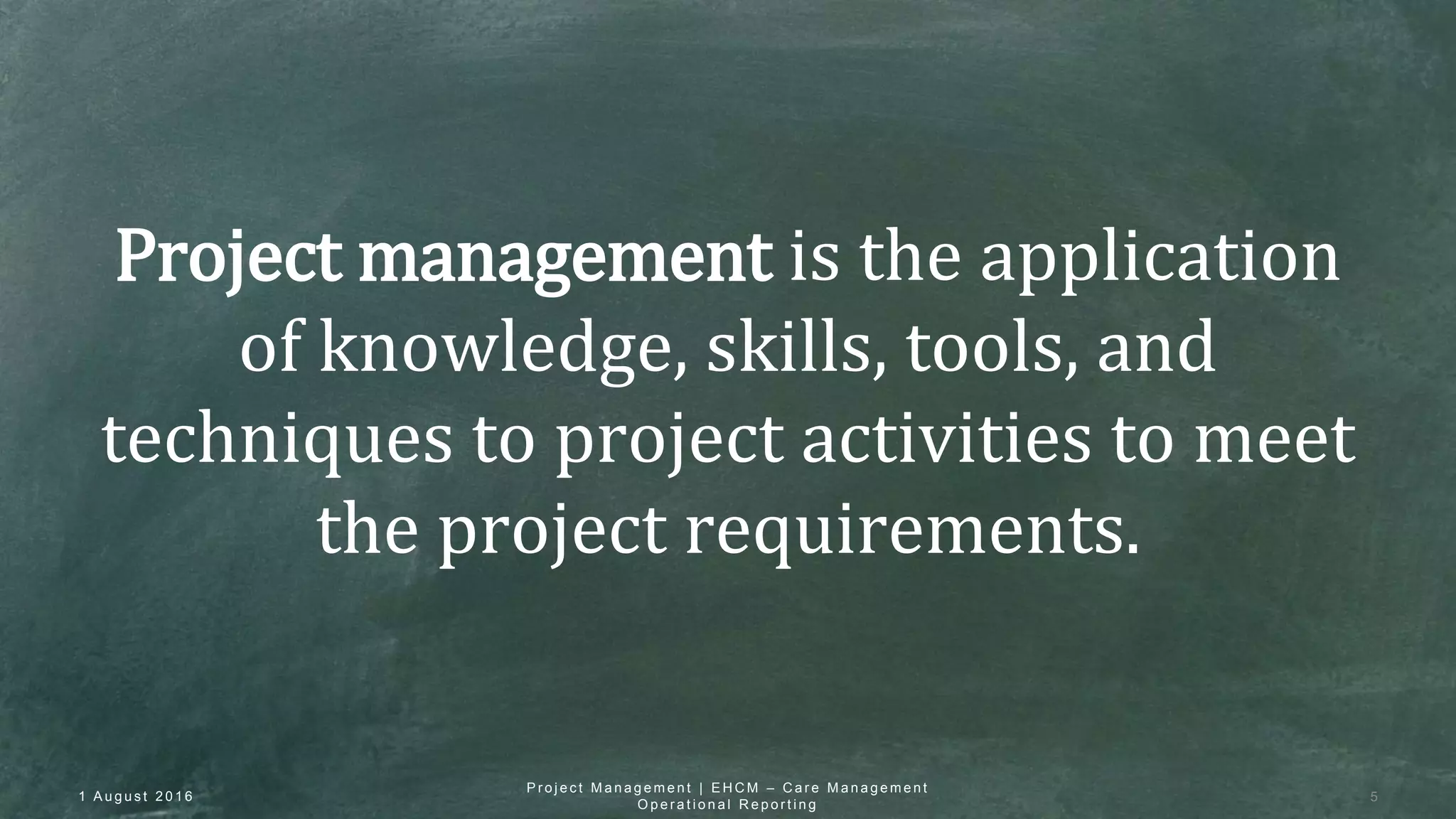
Project management is the application
of knowledge, skills, tools, and
techniques to project activities to meet
the project requirements.
1 A u g u s t 2 0 1 6 5
P r o j e c t M a n a g e m e n t | E H C M – C a r e M a n a g e m e n t
O p e r a t i o n a l R e p o r t i n g
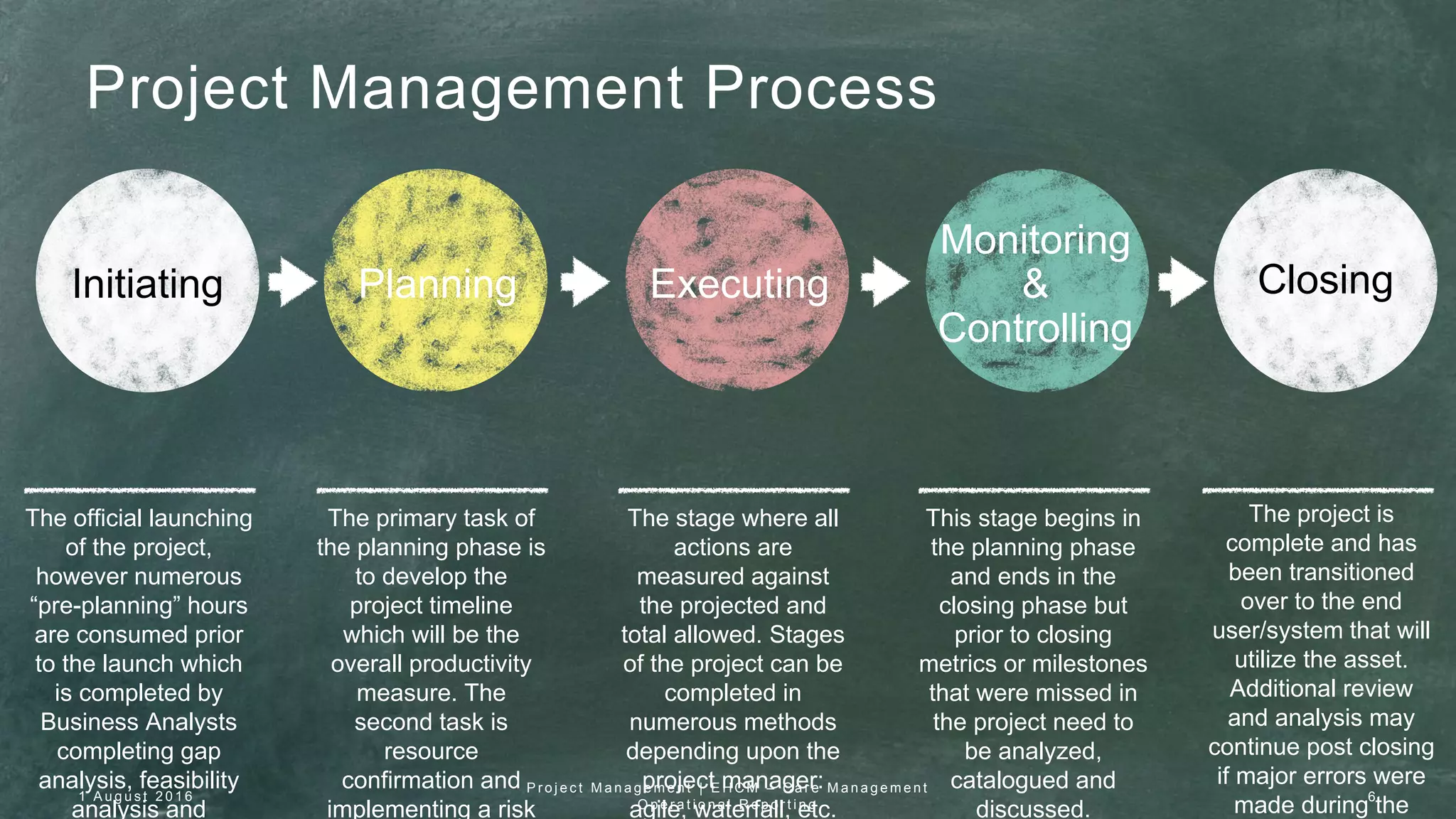
Project Management Process
The official launching
of the project,
however numerous
“pre-planning” hours
are consumed prior
to the launch which
is completed by
Business Analysts
completing gap
analysis, feasibility
analysis and
The primary task of
the planning phase is
to develop the
project timeline
which will be the
overall productivity
measure. The
second task is
resource
confirmation and
implementing a risk
The stage where all
actions are
measured against
the projected and
total allowed. Stages
of the project can be
completed in
numerous methods
depending upon the
project manager:
agile, waterfall, etc.
This stage begins in
the planning phase
and ends in the
closing phase but
prior to closing
metrics or milestones
that were missed in
the project need to
be analyzed,
catalogued and
discussed.
Initiating Planning
Monitoring
&
Controlling
Executing
1 A u g u s t 2 0 1 6
P r o j e c t M a n a g e m e n t | E H C M – C a r e M a n a g e m e n t
O p e r a t i o n a l R e p o r t i n g
6
The project is
complete and has
been transitioned
over to the end
user/system that will
utilize the asset.
Additional review
and analysis may
continue post closing
if major errors were
made during the
Closing
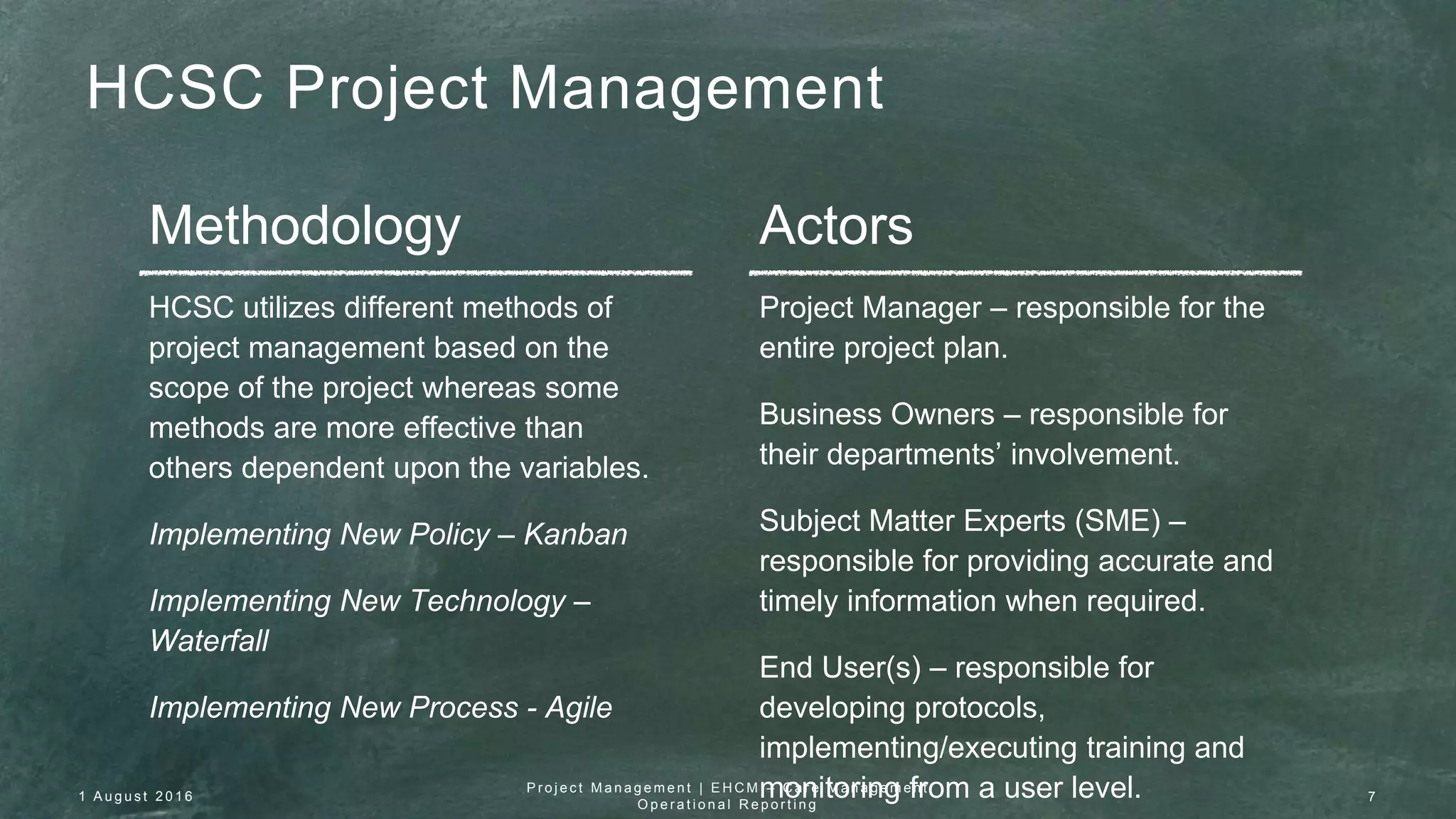
HCSC Project Management
Methodology Actors
HCSC utilizes different methods of
project management based on the
scope of the project whereas some
methods are more effective than
others dependent upon the variables.
Implementing New Policy – Kanban
Implementing New Technology –
Waterfall
Implementing New Process - Agile
Project Manager – responsible for the
entire project plan.
Business Owners – responsible for
their departments’ involvement.
Subject Matter Experts (SME) –
responsible for providing accurate and
timely information when required.
End User(s) – responsible for
developing protocols,
implementing/executing training and
monitoring from a user level.1 A u g u s t 2 0 1 6
P r o j e c t M a n a g e m e n t | E H C M – C a r e M a n a g e m e n t
O p e r a t i o n a l R e p o r t i n g
7
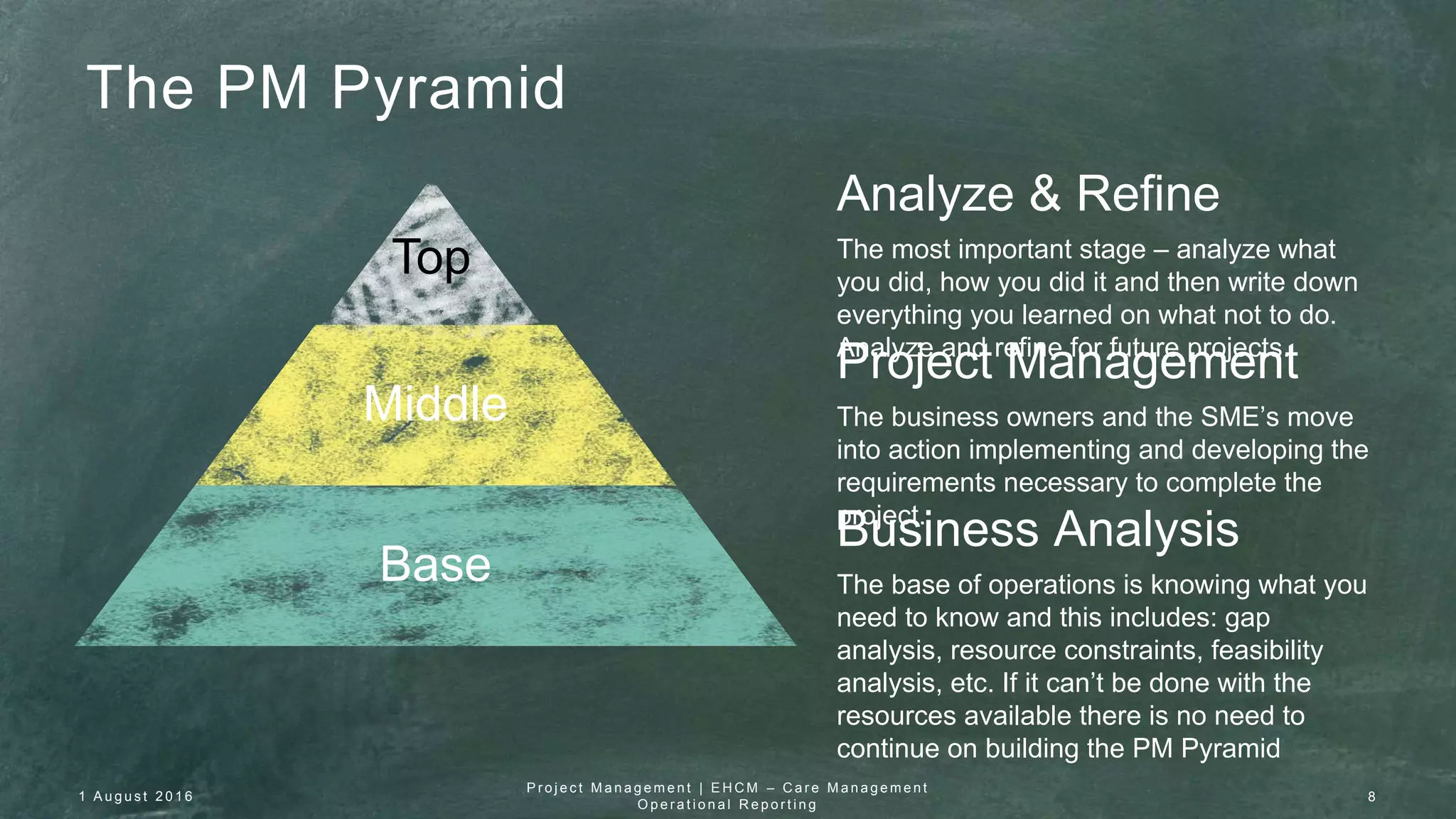
Top
Middle
Base
The PM Pyramid
The most important stage – analyze what
you did, how you did it and then write down
everything you learned on what not to do.
Analyze and refine for future projects.
Analyze & Refine
The business owners and the SME’s move
into action implementing and developing the
requirements necessary to complete the
project.
Project Management
The base of operations is knowing what you
need to know and this includes: gap
analysis, resource constraints, feasibility
analysis, etc. If it can’t be done with the
resources available there is no need to
continue on building the PM Pyramid
Business Analysis
1 A u g u s t 2 0 1 6
P r o j e c t M a n a g e m e n t | E H C M – C a r e M a n a g e m e n t
O p e r a t i o n a l R e p o r t i n g
8
System Development
Life Cycle
Project Management 02
The software development life cycle
(SDLC) is a framework defining tasks
performed at each step in the software
development process.
1 A u g u s t 2 0 1 6 10
P r o j e c t M a n a g e m e n t | E H C M – C a r e M a n a g e m e n t
O p e r a t i o n a l R e p o r t i n g
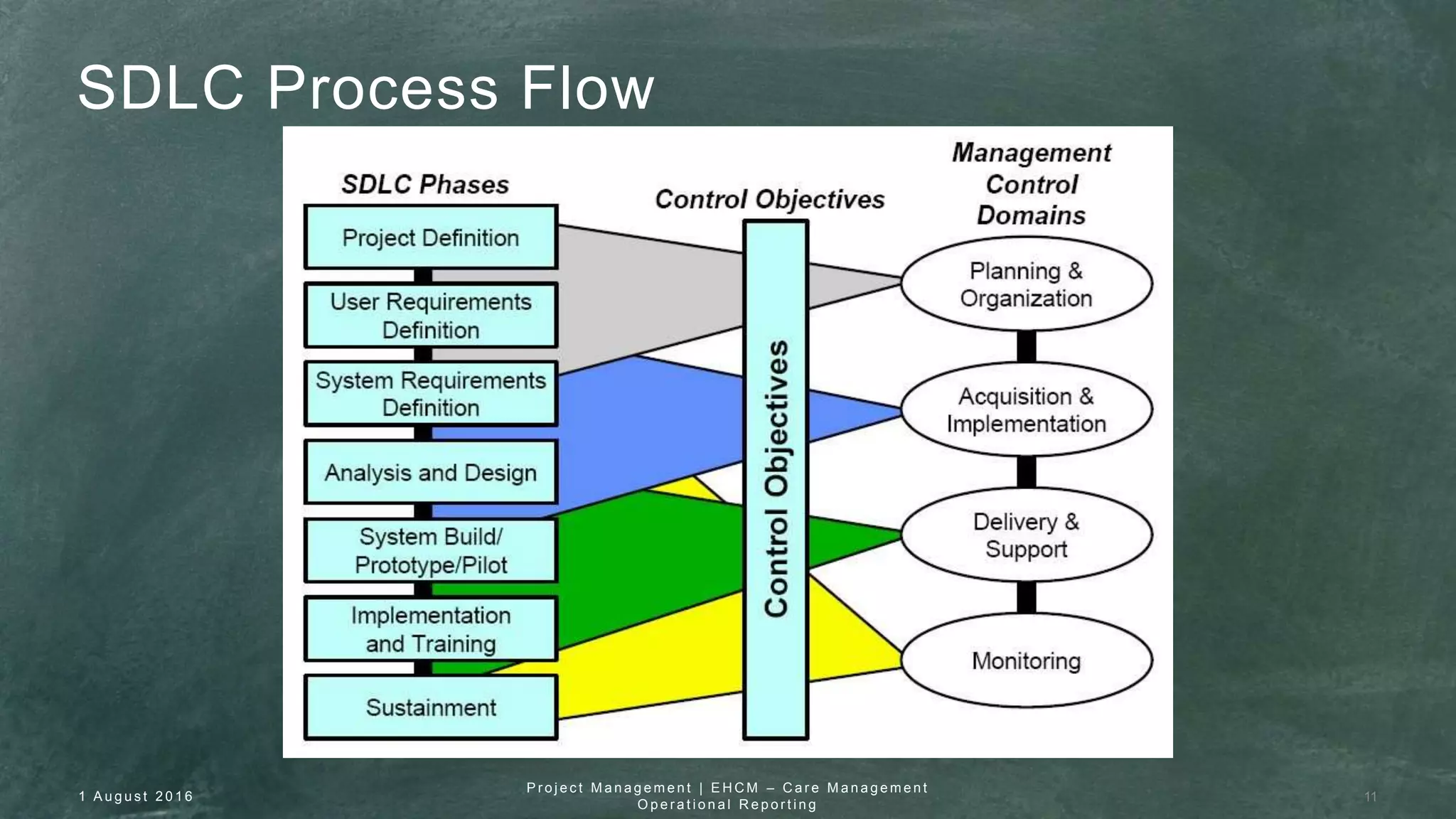
SDLC Process Flow
1 A u g u s t 2 0 1 6
P r o j e c t M a n a g e m e n t | E H C M – C a r e M a n a g e m e n t
O p e r a t i o n a l R e p o r t i n g
11
SDLC vs PMSoftware
Development
Lifecycle Project Management
SDLC is a process for developing new
technology and monitoring it’s
progression.
SDLC is not a stand alone process and
must fit into a greater overall plan.
SDLC is a tool used to measure and
provide accountability based on
standard industry guidelines.
Project Management is a process for
implementing, developing and/or
initiating change.
Project Management frequently
includes an SDLC sub-process when
dealing with technology.
The project management plan
develops timelines based on
resources, constraints and
expectations that provide the standard
for which all comparison is made. The
“industry standards” for project1 A u g u s t 2 0 1 6
P r o j e c t M a n a g e m e n t | E H C M – C a r e M a n a g e m e n t
O p e r a t i o n a l R e p o r t i n g
1 2
Project Management
Methodologies
Project Management 03
Waterfall Method
Concept
Strengths &
Weakness
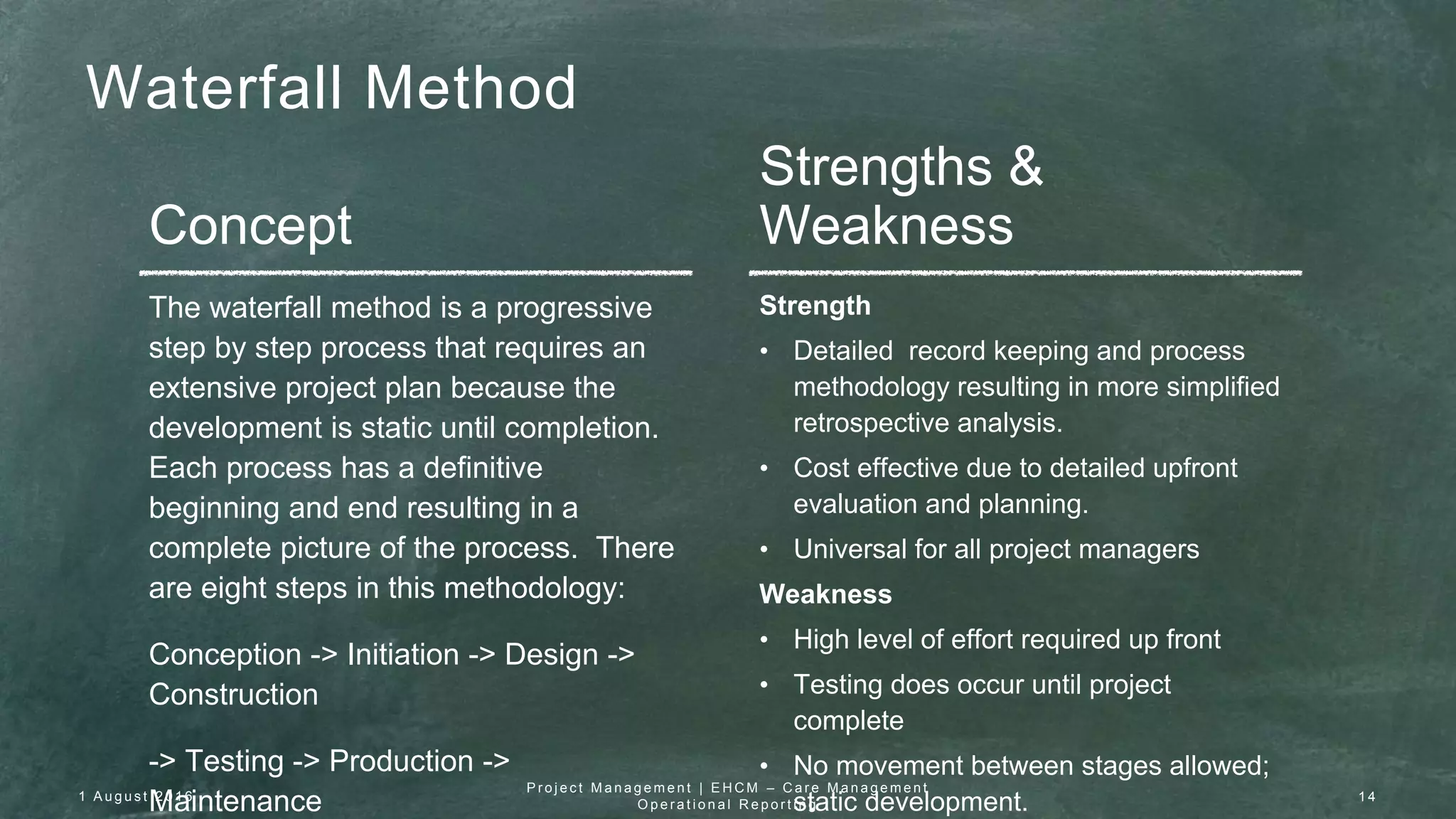
The waterfall method is a progressive
step by step process that requires an
extensive project plan because the
development is static until completion.
Each process has a definitive
beginning and end resulting in a
complete picture of the process. There
are eight steps in this methodology:
Conception -> Initiation -> Design ->
Construction
-> Testing -> Production ->
Maintenance
Strength
• Detailed record keeping and process
methodology resulting in more simplified
retrospective analysis.
• Cost effective due to detailed upfront
evaluation and planning.
• Universal for all project managers
Weakness
• High level of effort required up front
• Testing does occur until project
complete
• No movement between stages allowed;
static development.1 A u g u s t 2 0 1 6
P r o j e c t M a n a g e m e n t | E H C M – C a r e M a n a g e m e n t
O p e r a t i o n a l R e p o r t i n g
1 4
Agile Method
Concept
Strength &
Weakness
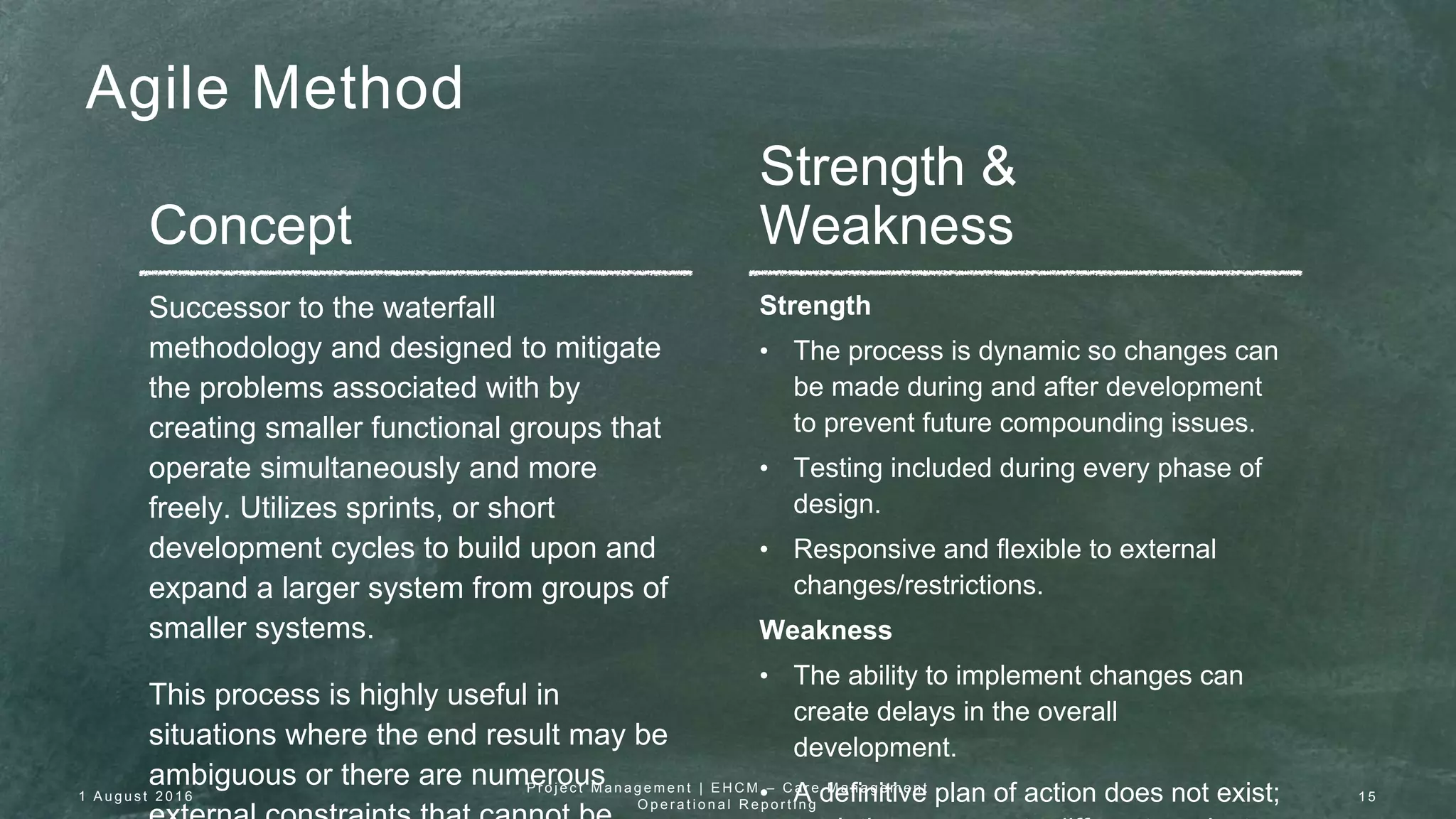
Successor to the waterfall
methodology and designed to mitigate
the problems associated with by
creating smaller functional groups that
operate simultaneously and more
freely. Utilizes sprints, or short
development cycles to build upon and
expand a larger system from groups of
smaller systems.
This process is highly useful in
situations where the end result may be
ambiguous or there are numerous
Strength
• The process is dynamic so changes can
be made during and after development
to prevent future compounding issues.
• Testing included during every phase of
design.
• Responsive and flexible to external
changes/restrictions.
Weakness
• The ability to implement changes can
create delays in the overall
development.
• A definitive plan of action does not exist;1 A u g u s t 2 0 1 6
P r o j e c t M a n a g e m e n t | E H C M – C a r e M a n a g e m e n t
O p e r a t i o n a l R e p o r t i n g
1 5
Kanban Method
Concept
Strength &
Weakness
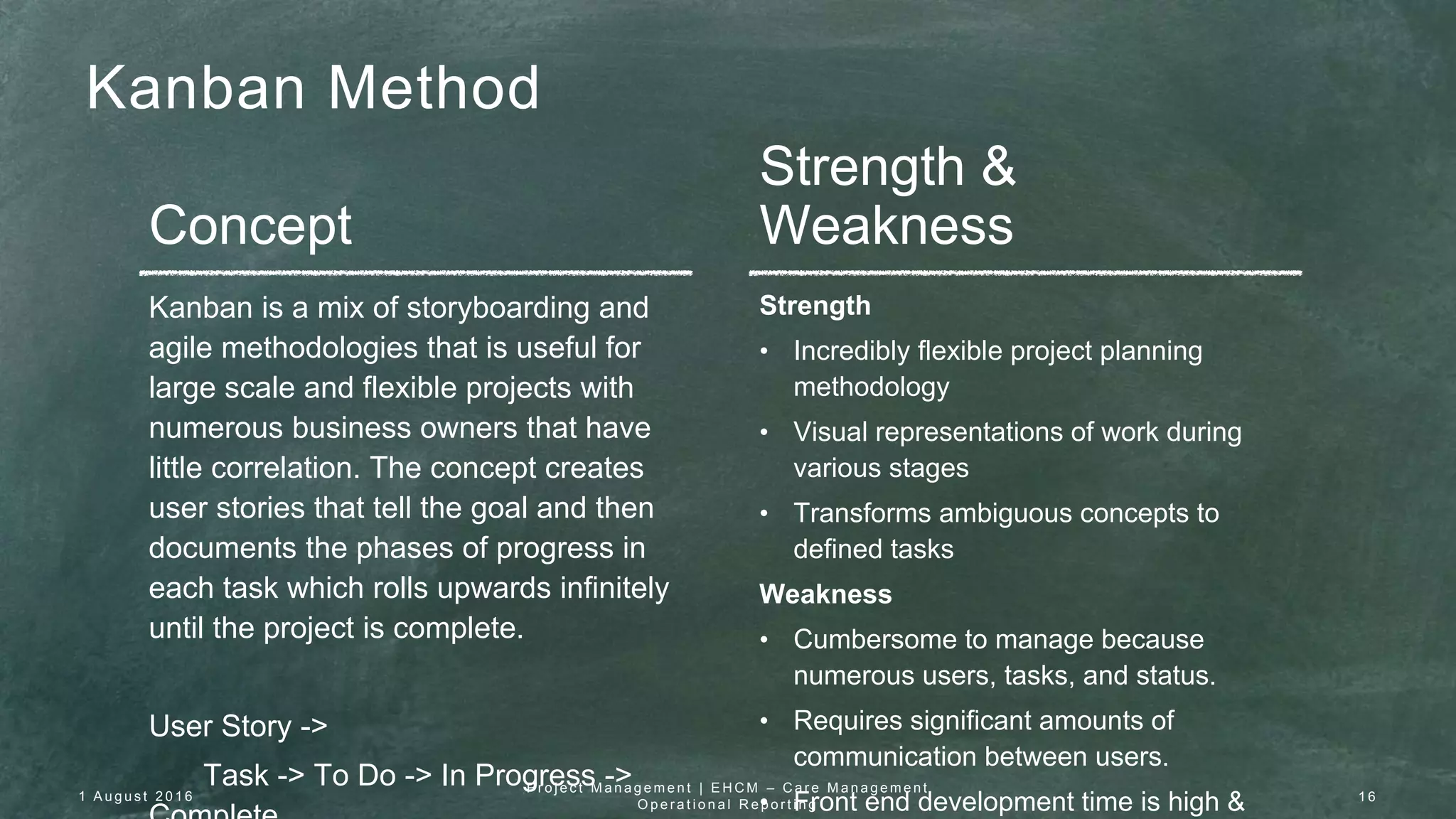
Kanban is a mix of storyboarding and
agile methodologies that is useful for
large scale and flexible projects with
numerous business owners that have
little correlation. The concept creates
user stories that tell the goal and then
documents the phases of progress in
each task which rolls upwards infinitely
until the project is complete.
User Story ->
Task -> To Do -> In Progress ->
Strength
• Incredibly flexible project planning
methodology
• Visual representations of work during
various stages
• Transforms ambiguous concepts to
defined tasks
Weakness
• Cumbersome to manage because
numerous users, tasks, and status.
• Requires significant amounts of
communication between users.
• Front end development time is high &1 A u g u s t 2 0 1 6
P r o j e c t M a n a g e m e n t | E H C M – C a r e M a n a g e m e n t
O p e r a t i o n a l R e p o r t i n g
1 6
Six Sigma Method
Concept
Strength &
Weakness
Six Sigma is a data driven, model
centric project management technique
that focuses on identifying defects. The
goal of six sigma is to correctly identify
and mitigate any risk(s) that might
create a defect or customer [end-user]
dissatisfaction there by becoming
100% efficient and effective.
This project management methodology
would be best used for a
program/process that would strive to
increase revenue or decrease
Strength
• Focuses on key concepts: Who, What,
When, Where, Why and How.
• Utilizes data to create models, to make
predictions and to monitor progress.
• Reveals the interconnectedness of each
functional unit.
Weakness
• Large amounts of data are required to
monitor
• High preparatory time required before
implementation.
1 A u g u s t 2 0 1 6
P r o j e c t M a n a g e m e n t | E H C M – C a r e M a n a g e m e n t
O p e r a t i o n a l R e p o r t i n g
1 7
Questions & Discussion
Project Management 04

Fundamentals of Project Management

  • 1.
    Project Management The Basicsof Determining the Basics
  • 2.
    Learning Objectives Introduction &Concept Development Evaluate System Development Lifecycle (SDLC) Evaluate Project Management Methods
  • 3.
  • 4.
    Project management isthe application of knowledge, skills, tools, and techniques to project activities to meet the project requirements. 1 A u g u s t 2 0 1 6 5 P r o j e c t M a n a g e m e n t | E H C M – C a r e M a n a g e m e n t O p e r a t i o n a l R e p o r t i n g
  • 5.
    Project Management Process Theofficial launching of the project, however numerous “pre-planning” hours are consumed prior to the launch which is completed by Business Analysts completing gap analysis, feasibility analysis and The primary task of the planning phase is to develop the project timeline which will be the overall productivity measure. The second task is resource confirmation and implementing a risk The stage where all actions are measured against the projected and total allowed. Stages of the project can be completed in numerous methods depending upon the project manager: agile, waterfall, etc. This stage begins in the planning phase and ends in the closing phase but prior to closing metrics or milestones that were missed in the project need to be analyzed, catalogued and discussed. Initiating Planning Monitoring & Controlling Executing 1 A u g u s t 2 0 1 6 P r o j e c t M a n a g e m e n t | E H C M – C a r e M a n a g e m e n t O p e r a t i o n a l R e p o r t i n g 6 The project is complete and has been transitioned over to the end user/system that will utilize the asset. Additional review and analysis may continue post closing if major errors were made during the Closing
  • 6.
    HCSC Project Management MethodologyActors HCSC utilizes different methods of project management based on the scope of the project whereas some methods are more effective than others dependent upon the variables. Implementing New Policy – Kanban Implementing New Technology – Waterfall Implementing New Process - Agile Project Manager – responsible for the entire project plan. Business Owners – responsible for their departments’ involvement. Subject Matter Experts (SME) – responsible for providing accurate and timely information when required. End User(s) – responsible for developing protocols, implementing/executing training and monitoring from a user level.1 A u g u s t 2 0 1 6 P r o j e c t M a n a g e m e n t | E H C M – C a r e M a n a g e m e n t O p e r a t i o n a l R e p o r t i n g 7
  • 7.
    Top Middle Base The PM Pyramid Themost important stage – analyze what you did, how you did it and then write down everything you learned on what not to do. Analyze and refine for future projects. Analyze & Refine The business owners and the SME’s move into action implementing and developing the requirements necessary to complete the project. Project Management The base of operations is knowing what you need to know and this includes: gap analysis, resource constraints, feasibility analysis, etc. If it can’t be done with the resources available there is no need to continue on building the PM Pyramid Business Analysis 1 A u g u s t 2 0 1 6 P r o j e c t M a n a g e m e n t | E H C M – C a r e M a n a g e m e n t O p e r a t i o n a l R e p o r t i n g 8
  • 8.
  • 9.
    The software developmentlife cycle (SDLC) is a framework defining tasks performed at each step in the software development process. 1 A u g u s t 2 0 1 6 10 P r o j e c t M a n a g e m e n t | E H C M – C a r e M a n a g e m e n t O p e r a t i o n a l R e p o r t i n g
  • 10.
    SDLC Process Flow 1A u g u s t 2 0 1 6 P r o j e c t M a n a g e m e n t | E H C M – C a r e M a n a g e m e n t O p e r a t i o n a l R e p o r t i n g 11
  • 11.
    SDLC vs PMSoftware Development LifecycleProject Management SDLC is a process for developing new technology and monitoring it’s progression. SDLC is not a stand alone process and must fit into a greater overall plan. SDLC is a tool used to measure and provide accountability based on standard industry guidelines. Project Management is a process for implementing, developing and/or initiating change. Project Management frequently includes an SDLC sub-process when dealing with technology. The project management plan develops timelines based on resources, constraints and expectations that provide the standard for which all comparison is made. The “industry standards” for project1 A u g u s t 2 0 1 6 P r o j e c t M a n a g e m e n t | E H C M – C a r e M a n a g e m e n t O p e r a t i o n a l R e p o r t i n g 1 2
  • 12.
  • 13.
    Waterfall Method Concept Strengths & Weakness Thewaterfall method is a progressive step by step process that requires an extensive project plan because the development is static until completion. Each process has a definitive beginning and end resulting in a complete picture of the process. There are eight steps in this methodology: Conception -> Initiation -> Design -> Construction -> Testing -> Production -> Maintenance Strength • Detailed record keeping and process methodology resulting in more simplified retrospective analysis. • Cost effective due to detailed upfront evaluation and planning. • Universal for all project managers Weakness • High level of effort required up front • Testing does occur until project complete • No movement between stages allowed; static development.1 A u g u s t 2 0 1 6 P r o j e c t M a n a g e m e n t | E H C M – C a r e M a n a g e m e n t O p e r a t i o n a l R e p o r t i n g 1 4
  • 14.
    Agile Method Concept Strength & Weakness Successorto the waterfall methodology and designed to mitigate the problems associated with by creating smaller functional groups that operate simultaneously and more freely. Utilizes sprints, or short development cycles to build upon and expand a larger system from groups of smaller systems. This process is highly useful in situations where the end result may be ambiguous or there are numerous Strength • The process is dynamic so changes can be made during and after development to prevent future compounding issues. • Testing included during every phase of design. • Responsive and flexible to external changes/restrictions. Weakness • The ability to implement changes can create delays in the overall development. • A definitive plan of action does not exist;1 A u g u s t 2 0 1 6 P r o j e c t M a n a g e m e n t | E H C M – C a r e M a n a g e m e n t O p e r a t i o n a l R e p o r t i n g 1 5
  • 15.
    Kanban Method Concept Strength & Weakness Kanbanis a mix of storyboarding and agile methodologies that is useful for large scale and flexible projects with numerous business owners that have little correlation. The concept creates user stories that tell the goal and then documents the phases of progress in each task which rolls upwards infinitely until the project is complete. User Story -> Task -> To Do -> In Progress -> Strength • Incredibly flexible project planning methodology • Visual representations of work during various stages • Transforms ambiguous concepts to defined tasks Weakness • Cumbersome to manage because numerous users, tasks, and status. • Requires significant amounts of communication between users. • Front end development time is high &1 A u g u s t 2 0 1 6 P r o j e c t M a n a g e m e n t | E H C M – C a r e M a n a g e m e n t O p e r a t i o n a l R e p o r t i n g 1 6
  • 16.
    Six Sigma Method Concept Strength& Weakness Six Sigma is a data driven, model centric project management technique that focuses on identifying defects. The goal of six sigma is to correctly identify and mitigate any risk(s) that might create a defect or customer [end-user] dissatisfaction there by becoming 100% efficient and effective. This project management methodology would be best used for a program/process that would strive to increase revenue or decrease Strength • Focuses on key concepts: Who, What, When, Where, Why and How. • Utilizes data to create models, to make predictions and to monitor progress. • Reveals the interconnectedness of each functional unit. Weakness • Large amounts of data are required to monitor • High preparatory time required before implementation. 1 A u g u s t 2 0 1 6 P r o j e c t M a n a g e m e n t | E H C M – C a r e M a n a g e m e n t O p e r a t i o n a l R e p o r t i n g 1 7
  • 17.