Common Sense Project Management Methodology
Methodologies – Quick Overview Waterfall Agile
Methodologies – Pros and Cons Pure Waterfall Works well when the requirements/specifications are well defined and stable In theory, more deterministic in nature Detailed planning helps map out all dependencies ahead of time – especially important when team is distributed and matrixed Works well when team management is highly structured and process oriented Not well suited to handle changes along the way Testing in the very end is risky Pure Agile Works well when requirements are not ‘ALL’ firmed up, but team can start on some  Not very deterministic on what gets delivered on <x> date or when <y> feature gets delivered Assumes very high collaboration (co-location) between the different teams (product, design, tech, qa) Equipped to handle changes with minimal disruption to overall flow Assumes a more experienced self-managing team Focus on QA from early on – good for quality
My Context - Typical Software Development Context Most of the projects start with some product idea and a somewhat firm launch date for marketing/PR reasons or a product idea that gets tied to a date very quickly  In order to commit to a date, we will need to do some upfront scoping, estimating and planning to inform the team size, dependencies, budget, etc –  So, pure Agile doesn’t work. One of the trio (scope, time, budget) needs to be fully negotiable for Agile.  Too often, we have to start a phase before the previous one ends (start development before design completes) – means need to be able to absorb changes and additions to scope –  So, pure Waterfall doesn’t work. Lot of conflicting priorities pop up – not always structured and need to be able to handle some chaos/changes along the way Team is not always experienced at the same level - so, need to account for ramp-up and varied degrees of team management
Methodology in my context - Hybrid Need to do waterfall like  upfront scoping, estimation and planning Need to be  agile enough  to absorb “some” changes along the way  Need to focus on Quality early for better quality Need to be able to tailor the methodology to a project’s context (as needed)
Hybrid - Common Sense Methodology This is the Hybrid methodology that works in this context. I am sure many others use this or some version of this – It is just  Common Sense
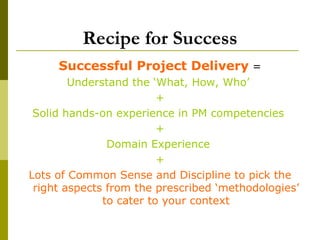
Recipe for Success Successful Project Delivery  = Understand the ‘What, How, Who’  + Solid hands-on experience in PM competencies  + Domain Experience  + Lots of Common Sense and Discipline to pick the right aspects from the prescribed ‘methodologies’ to cater to your context
Feedback Welcome Are there things I can do differently in my context and be even more successful?

Common Sense Project Management Methodology

  • 1.
    Common Sense ProjectManagement Methodology
  • 2.
    Methodologies – QuickOverview Waterfall Agile
  • 3.
    Methodologies – Prosand Cons Pure Waterfall Works well when the requirements/specifications are well defined and stable In theory, more deterministic in nature Detailed planning helps map out all dependencies ahead of time – especially important when team is distributed and matrixed Works well when team management is highly structured and process oriented Not well suited to handle changes along the way Testing in the very end is risky Pure Agile Works well when requirements are not ‘ALL’ firmed up, but team can start on some Not very deterministic on what gets delivered on <x> date or when <y> feature gets delivered Assumes very high collaboration (co-location) between the different teams (product, design, tech, qa) Equipped to handle changes with minimal disruption to overall flow Assumes a more experienced self-managing team Focus on QA from early on – good for quality
  • 4.
    My Context -Typical Software Development Context Most of the projects start with some product idea and a somewhat firm launch date for marketing/PR reasons or a product idea that gets tied to a date very quickly In order to commit to a date, we will need to do some upfront scoping, estimating and planning to inform the team size, dependencies, budget, etc – So, pure Agile doesn’t work. One of the trio (scope, time, budget) needs to be fully negotiable for Agile. Too often, we have to start a phase before the previous one ends (start development before design completes) – means need to be able to absorb changes and additions to scope – So, pure Waterfall doesn’t work. Lot of conflicting priorities pop up – not always structured and need to be able to handle some chaos/changes along the way Team is not always experienced at the same level - so, need to account for ramp-up and varied degrees of team management
  • 5.
    Methodology in mycontext - Hybrid Need to do waterfall like upfront scoping, estimation and planning Need to be agile enough to absorb “some” changes along the way Need to focus on Quality early for better quality Need to be able to tailor the methodology to a project’s context (as needed)
  • 6.
    Hybrid - CommonSense Methodology This is the Hybrid methodology that works in this context. I am sure many others use this or some version of this – It is just Common Sense
  • 7.
    Recipe for SuccessSuccessful Project Delivery = Understand the ‘What, How, Who’ + Solid hands-on experience in PM competencies + Domain Experience + Lots of Common Sense and Discipline to pick the right aspects from the prescribed ‘methodologies’ to cater to your context
  • 8.
    Feedback Welcome Arethere things I can do differently in my context and be even more successful?