1
Always AheadAlways Ahead
QualityQuality
CompetenceCompetence
FlexibilityFlexibility
OVERVIEW
Medium Speed Diesel Engine Lubrication
Used Oil Analysis
2TRIBOLOGY & LUBRICATION by
SANJIV WAZIR
LUBRICATION OF
MEDIUM SPEED DIESEL ENGINES
03
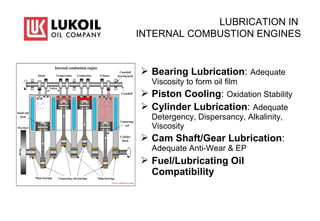
LUBRICATION IN
INTERNAL COMBUSTION ENGINES
 Bearing Lubrication: Adequate
Viscosity to form oil film
 Piston Cooling: Oxidation Stability
 Cylinder Lubrication: Adequate
Detergency, Dispersancy, Alkalinity,
Viscosity
 Cam Shaft/Gear Lubrication:
Adequate Anti-Wear & EP
 Fuel/Lubricating Oil
Compatibility
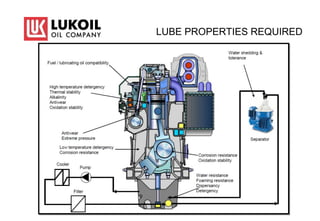
LUBE PROPERTIES REQUIRED
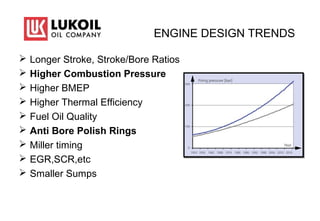
ENGINE DESIGN TRENDS
 Longer Stroke, Stroke/Bore Ratios
 Higher Combustion Pressure
 Higher BMEP
 Higher Thermal Efficiency
 Fuel Oil Quality
 Anti Bore Polish Rings
 Miller timing
 EGR,SCR,etc
 Smaller Sumps
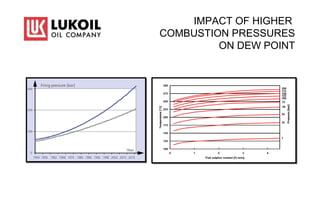
IMPACT OF HIGHER
COMBUSTION PRESSURES
ON DEW POINT
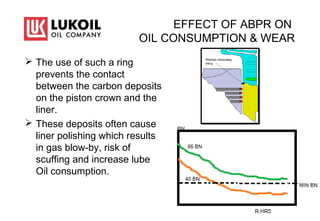
EFFECT OF ABPR ON
OIL CONSUMPTION & WEAR
 The use of such a ring
prevents the contact
between the carbon deposits
on the piston crown and the
liner.
 These deposits often cause
liner polishing which results
in gas blow-by, risk of
scuffing and increase lube
Oil consumption.
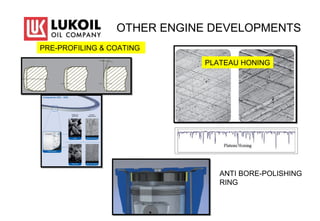
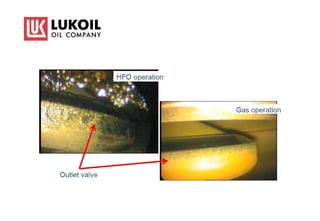
OTHER ENGINE DEVELOPMENTS
PRE-PROFILING & COATING
PLATEAU HONING
ANTI BORE-POLISHING
RING
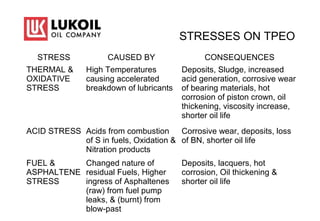
STRESSES ON TPEO
STRESS CAUSED BY CONSEQUENCES
THERMAL &
OXIDATIVE
STRESS
High Temperatures
causing accelerated
breakdown of lubricants
Deposits, Sludge, increased
acid generation, corrosive wear
of bearing materials, hot
corrosion of piston crown, oil
thickening, viscosity increase,
shorter oil life
ACID STRESS Acids from combustion
of S in fuels, Oxidation &
Nitration products
Corrosive wear, deposits, loss
of BN, shorter oil life
FUEL &
ASPHALTENE
STRESS
Changed nature of
residual Fuels, Higher
ingress of Asphaltenes
(raw) from fuel pump
leaks, & (burnt) from
blow-past
Deposits, lacquers, hot
corrosion, Oil thickening &
shorter oil life
ENG COMPONENT STRESS -
LO/ADDITIVE PROPERTY REQUIRED
CREATING
& MAINTAINING AN OIL FILM
Viscosity is the a
key property
SAE 30 & 40 are
mainly used
SANJIV WAZIR 13
MAINTAIN CLEANLINESS OF
CRANKCASE,CYLINDER LINER
& PISTON RING PACK
Detergents
Dispersants
are the key
properties
Fuel Quality Deteriorating
Fuel ingress Increasing pressures
Combustion conditions more severe
Blowby of combustion gases
Centrifuge & Fiteration
Lubricant Condition
It is estimated that a 0.4mm thick
deposit layer in Piston Underside can
cause a 100 C rise in Piston crown
temperature
SANJIV WAZIR 14
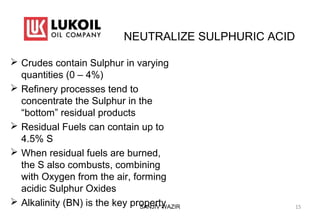
NEUTRALIZE SULPHURIC ACID
 Crudes contain Sulphur in varying
quantities (0 – 4%)
 Refinery processes tend to
concentrate the Sulphur in the
“bottom” residual products
 Residual Fuels can contain up to
4.5% S
 When residual fuels are burned,
the S also combusts, combining
with Oxygen from the air, forming
acidic Sulphur Oxides
 Alkalinity (BN) is the key propertySANJIV WAZIR 15
THE OIL IN USE
 The engine hardly ever, apart from the first start up, enjoys
unused, fresh oil
 The engine requirements are met by a combination of oil
performance reserve and the efficiency of the oil maintenance
system
 If the engine requirements are not met, undesirable
consequences can occur, such as increased LO consumption,
more frequent/unplanned oil changes, increase in fouling,
wear & tear of components, more frequent maintenance, even
engine damage & failure
OIL CIRCULATION &
REPLENISHMENT SPEED CONDITION
LUBRICATING OIL
SOURCES OF CONTAMINATION
MAINTAINING THE OIL CONDITION
 Maintaining the oil within acceptable limits is a function of:
1. Lube oil’s additive package reserve
2. Degree of contamination from products of combustion & other
sources
3. Excessive LO consumption due to leakage or poor engine
maintenance
4. Degree of LO cleaning by filtration & separation (centrifuging)
5. Frequency & amount of top-ups
 Extended lubricating oil life or running hours can be obtained
by optimising all these influences.
LUBRICATING OIL
TREATMENT SYSTEM
………..TO SUMMARISE
 Larger number of product types needed to suit the wide range of
applications.
 Matching the product to the application results in the lowest overall cost.
 Improved cleanliness is essential for modern engines operating on poor
quality residual fuel.
 OEMs now prefer Higher Viscosity products
 Higher BN products are becoming more common.
USED OILO ANALYSIS
023
TRIBOLOGY & LUBRICATION by
SANJIV WAZIR
24
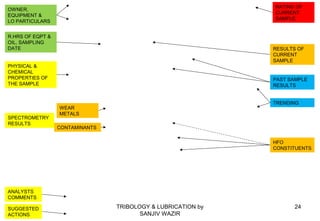
OWNER,
EQUIPMENT &
LO PARTICULARS
R.HRS OF EQPT &
OIL, SAMPLING
DATE
PHYSICAL &
CHEMICAL
PROPERTIES OF
THE SAMPLE
SPECTROMETRY
RESULTS
WEAR
METALS
CONTAMINANTS
RATING OF
CURRENT
SAMPLE
ANALYSTS
COMMENTS
SUGGESTED
ACTIONS
RESULTS OF
CURRENT
SAMPLE
PAST SAMPLE
RESULTS
TRENDING
HFO
CONSTITUENTS
DP ENGINE #1
HFO
CONSTITUENTS
RISING
DROPPING
DP PLANT
DISCUSSION
 Rise in KV and Drop in BN correlate well with the rise in
Vanadium+ Nickel (and Na), hence ingress of Bunt/Unburnt
Fuel components and Combustion by-products is likely to be
the cause.
 Soot/Insolubles levels are also up, supporting above
hypothesis
 Wear metal levels are satisfactory
 High KV could affect bearing cooling and result in temperature
rise
 Degradation of additives and ingress of combustion could
lead to increased air entrainment
TRIBOLOGY & LUBRICATION by
SANJIV WAZIR
26
DP PLANT
SUGGESTIONS
 Source of ingress needs to be identified and rectified to
minimise oil degradation.
 Some likely source could be:
Raw Fuel: Leakage from plunger/barrel, poor injector spray
Combustion By-products: Blow-past, Mixing of Combustion
gases in T/Charger Lubrication
 Maintain the OEM recommended SLOC by regular top-up and
sweetening (if required)
 Maintain operating parameters such as Oil, Water, Air,
Exhaust temperatures and pressures within specified limits
TRIBOLOGY & LUBRICATION by
SANJIV WAZIR
27
28

Power Oil And Lubes PPT

  • 1.
  • 2.
    OVERVIEW Medium Speed DieselEngine Lubrication Used Oil Analysis 2TRIBOLOGY & LUBRICATION by SANJIV WAZIR
  • 3.
    LUBRICATION OF MEDIUM SPEEDDIESEL ENGINES 03
  • 4.
    LUBRICATION IN INTERNAL COMBUSTIONENGINES  Bearing Lubrication: Adequate Viscosity to form oil film  Piston Cooling: Oxidation Stability  Cylinder Lubrication: Adequate Detergency, Dispersancy, Alkalinity, Viscosity  Cam Shaft/Gear Lubrication: Adequate Anti-Wear & EP  Fuel/Lubricating Oil Compatibility
  • 5.
  • 6.
    ENGINE DESIGN TRENDS Longer Stroke, Stroke/Bore Ratios  Higher Combustion Pressure  Higher BMEP  Higher Thermal Efficiency  Fuel Oil Quality  Anti Bore Polish Rings  Miller timing  EGR,SCR,etc  Smaller Sumps
  • 7.
    IMPACT OF HIGHER COMBUSTIONPRESSURES ON DEW POINT
  • 8.
    EFFECT OF ABPRON OIL CONSUMPTION & WEAR  The use of such a ring prevents the contact between the carbon deposits on the piston crown and the liner.  These deposits often cause liner polishing which results in gas blow-by, risk of scuffing and increase lube Oil consumption.
  • 9.
    OTHER ENGINE DEVELOPMENTS PRE-PROFILING& COATING PLATEAU HONING ANTI BORE-POLISHING RING
  • 11.
    STRESSES ON TPEO STRESSCAUSED BY CONSEQUENCES THERMAL & OXIDATIVE STRESS High Temperatures causing accelerated breakdown of lubricants Deposits, Sludge, increased acid generation, corrosive wear of bearing materials, hot corrosion of piston crown, oil thickening, viscosity increase, shorter oil life ACID STRESS Acids from combustion of S in fuels, Oxidation & Nitration products Corrosive wear, deposits, loss of BN, shorter oil life FUEL & ASPHALTENE STRESS Changed nature of residual Fuels, Higher ingress of Asphaltenes (raw) from fuel pump leaks, & (burnt) from blow-past Deposits, lacquers, hot corrosion, Oil thickening & shorter oil life
  • 12.
    ENG COMPONENT STRESS- LO/ADDITIVE PROPERTY REQUIRED
  • 13.
    CREATING & MAINTAINING ANOIL FILM Viscosity is the a key property SAE 30 & 40 are mainly used SANJIV WAZIR 13
  • 14.
    MAINTAIN CLEANLINESS OF CRANKCASE,CYLINDERLINER & PISTON RING PACK Detergents Dispersants are the key properties Fuel Quality Deteriorating Fuel ingress Increasing pressures Combustion conditions more severe Blowby of combustion gases Centrifuge & Fiteration Lubricant Condition It is estimated that a 0.4mm thick deposit layer in Piston Underside can cause a 100 C rise in Piston crown temperature SANJIV WAZIR 14
  • 15.
    NEUTRALIZE SULPHURIC ACID Crudes contain Sulphur in varying quantities (0 – 4%)  Refinery processes tend to concentrate the Sulphur in the “bottom” residual products  Residual Fuels can contain up to 4.5% S  When residual fuels are burned, the S also combusts, combining with Oxygen from the air, forming acidic Sulphur Oxides  Alkalinity (BN) is the key propertySANJIV WAZIR 15
  • 16.
    THE OIL INUSE  The engine hardly ever, apart from the first start up, enjoys unused, fresh oil  The engine requirements are met by a combination of oil performance reserve and the efficiency of the oil maintenance system  If the engine requirements are not met, undesirable consequences can occur, such as increased LO consumption, more frequent/unplanned oil changes, increase in fouling, wear & tear of components, more frequent maintenance, even engine damage & failure
  • 17.
  • 18.
  • 19.
    MAINTAINING THE OILCONDITION  Maintaining the oil within acceptable limits is a function of: 1. Lube oil’s additive package reserve 2. Degree of contamination from products of combustion & other sources 3. Excessive LO consumption due to leakage or poor engine maintenance 4. Degree of LO cleaning by filtration & separation (centrifuging) 5. Frequency & amount of top-ups  Extended lubricating oil life or running hours can be obtained by optimising all these influences.
  • 20.
  • 21.
    ………..TO SUMMARISE  Largernumber of product types needed to suit the wide range of applications.  Matching the product to the application results in the lowest overall cost.  Improved cleanliness is essential for modern engines operating on poor quality residual fuel.  OEMs now prefer Higher Viscosity products  Higher BN products are becoming more common.
  • 23.
  • 24.
    TRIBOLOGY & LUBRICATIONby SANJIV WAZIR 24 OWNER, EQUIPMENT & LO PARTICULARS R.HRS OF EQPT & OIL, SAMPLING DATE PHYSICAL & CHEMICAL PROPERTIES OF THE SAMPLE SPECTROMETRY RESULTS WEAR METALS CONTAMINANTS RATING OF CURRENT SAMPLE ANALYSTS COMMENTS SUGGESTED ACTIONS RESULTS OF CURRENT SAMPLE PAST SAMPLE RESULTS TRENDING HFO CONSTITUENTS
  • 25.
  • 26.
    DP PLANT DISCUSSION  Risein KV and Drop in BN correlate well with the rise in Vanadium+ Nickel (and Na), hence ingress of Bunt/Unburnt Fuel components and Combustion by-products is likely to be the cause.  Soot/Insolubles levels are also up, supporting above hypothesis  Wear metal levels are satisfactory  High KV could affect bearing cooling and result in temperature rise  Degradation of additives and ingress of combustion could lead to increased air entrainment TRIBOLOGY & LUBRICATION by SANJIV WAZIR 26
  • 27.
    DP PLANT SUGGESTIONS  Sourceof ingress needs to be identified and rectified to minimise oil degradation.  Some likely source could be: Raw Fuel: Leakage from plunger/barrel, poor injector spray Combustion By-products: Blow-past, Mixing of Combustion gases in T/Charger Lubrication  Maintain the OEM recommended SLOC by regular top-up and sweetening (if required)  Maintain operating parameters such as Oil, Water, Air, Exhaust temperatures and pressures within specified limits TRIBOLOGY & LUBRICATION by SANJIV WAZIR 27
  • 28.

Editor's Notes

  • #4 Of the $134BN in reported revenue, approx 65% ($85BN) was derived outside Russia. Approx $8BN was generated from Lukoil’s activities within the US.
  • #24 Of the $134BN in reported revenue, approx 65% ($85BN) was derived outside Russia. Approx $8BN was generated from Lukoil’s activities within the US.
  • #29 Of the $134BN in reported revenue, approx 65% ($85BN) was derived outside Russia. Approx $8BN was generated from Lukoil’s activities within the US.