Functions
Section 2.3 of Rosen
Spring 2020
CSCE 235H Introduction to Discrete Structures (Honors)
Course web-page: cse.unl.edu/~cse235h
Questions: Piazza
Functions
CSCE 235 2
Outline
• Definitions & terminology
– function, domain, co-domain, image, preimage (antecedent), range, image of a set, strictly
increasing, strictly decreasing, monotonic
• Properties
– One-to-one (injective)
– Onto (surjective)
– One-to-one correspondence (bijective)
– Exercices (5)
• Inverse functions (examples)
• Operators
– Composition, Equality
• Important functions
– identity, absolute value, floor, ceiling, factorial
Functions
CSCE 235 3
Introduction
• You have already encountered function
– f(x,y) = x+y
– f(x) = x
– f(x) = sin(x)
• Here we will study functions defined on discrete
domains and ranges
• We may not always be able to write function in a
‘neat way’ as above
Functions
CSCE 235 4
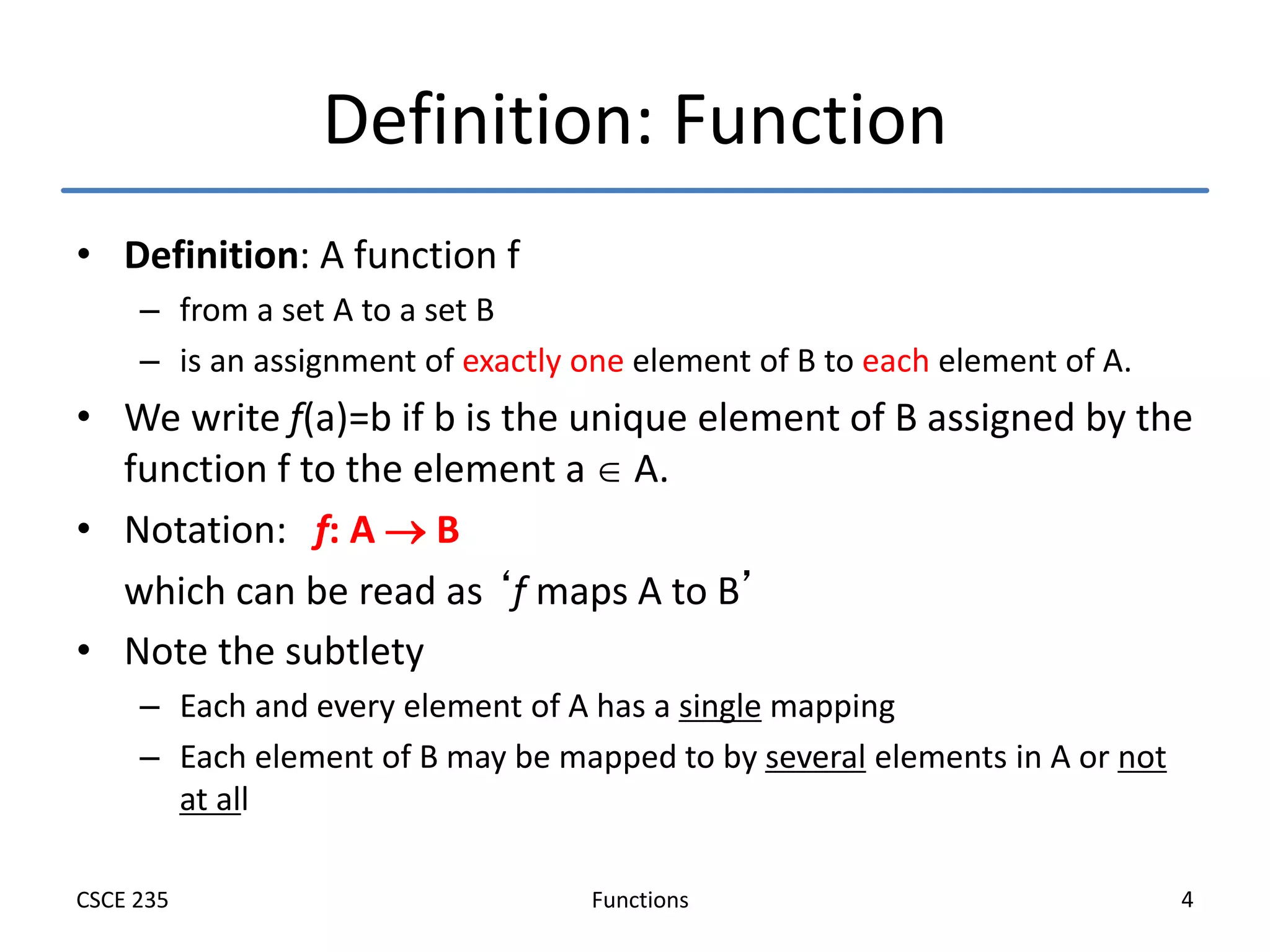
Definition: Function
• Definition: A function f
– from a set A to a set B
– is an assignment of exactly one element of B to each element of A.
• We write f(a)=b if b is the unique element of B assigned by the
function f to the element a  A.
• Notation: f: A  B
which can be read as ‘f maps A to B’
• Note the subtlety
– Each and every element of A has a single mapping
– Each element of B may be mapped to by several elements in A or not
at all
Functions
CSCE 235 5
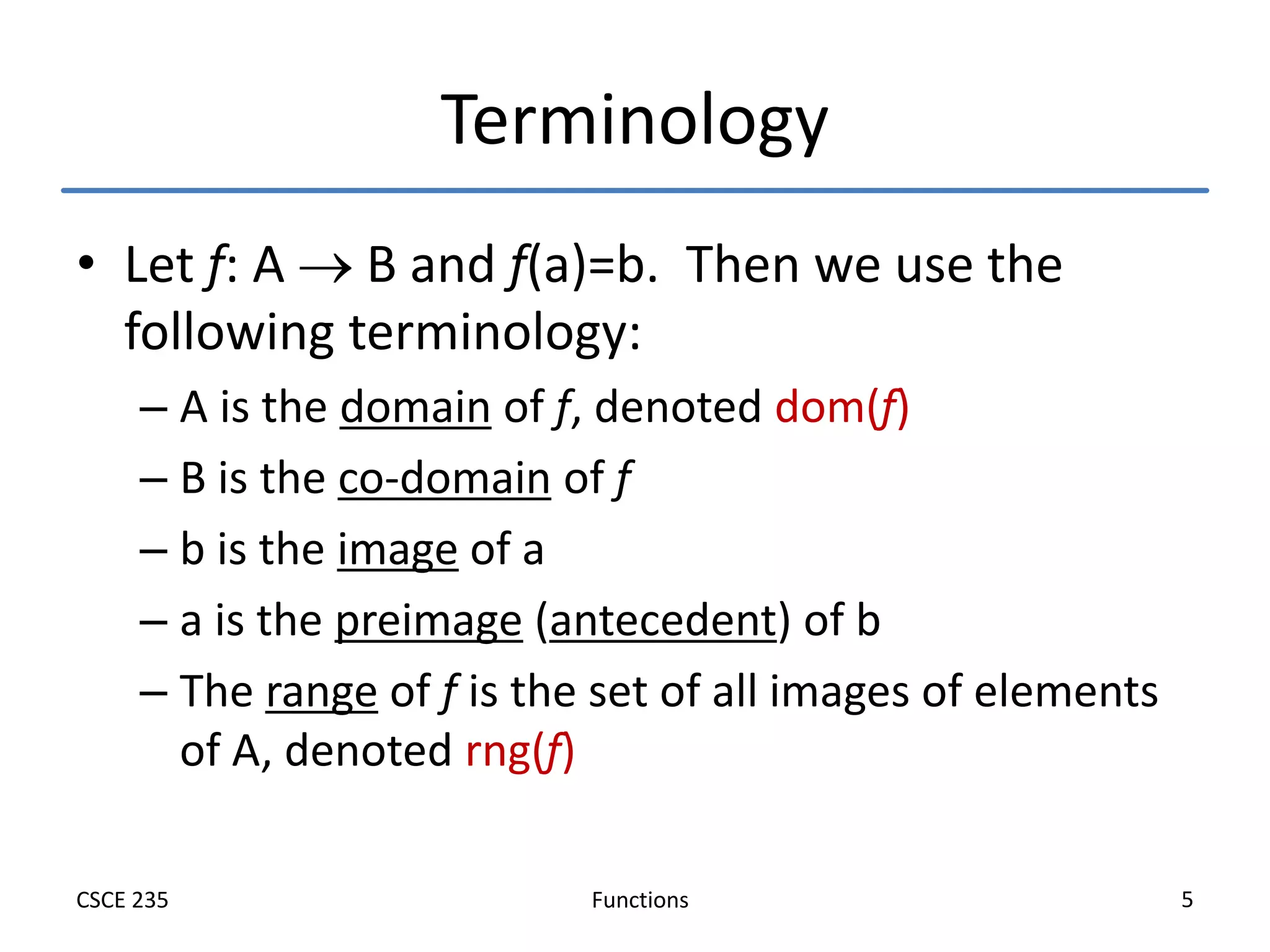
Terminology
• Let f: A  B and f(a)=b. Then we use the
following terminology:
– A is the domain of f, denoted dom(f)
– B is the co-domain of f
– b is the image of a
– a is the preimage (antecedent) of b
– The range of f is the set of all images of elements
of A, denoted rng(f)
Functions
CSCE 235 6
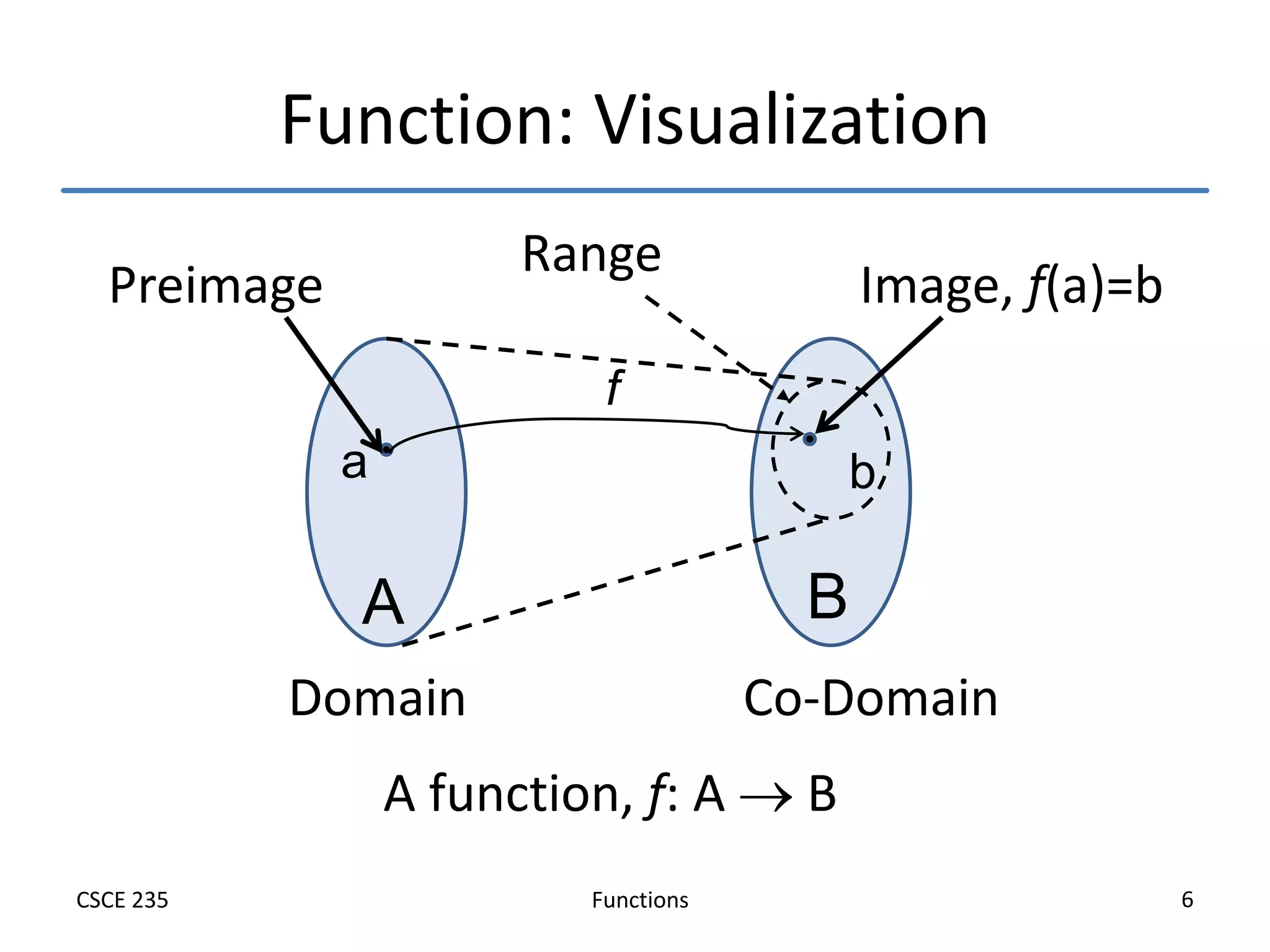
Function: Visualization
A function, f: A  B
A B
a b
f
Domain Co-Domain
Preimage Image, f(a)=b
Range
Functions
CSCE 235 7
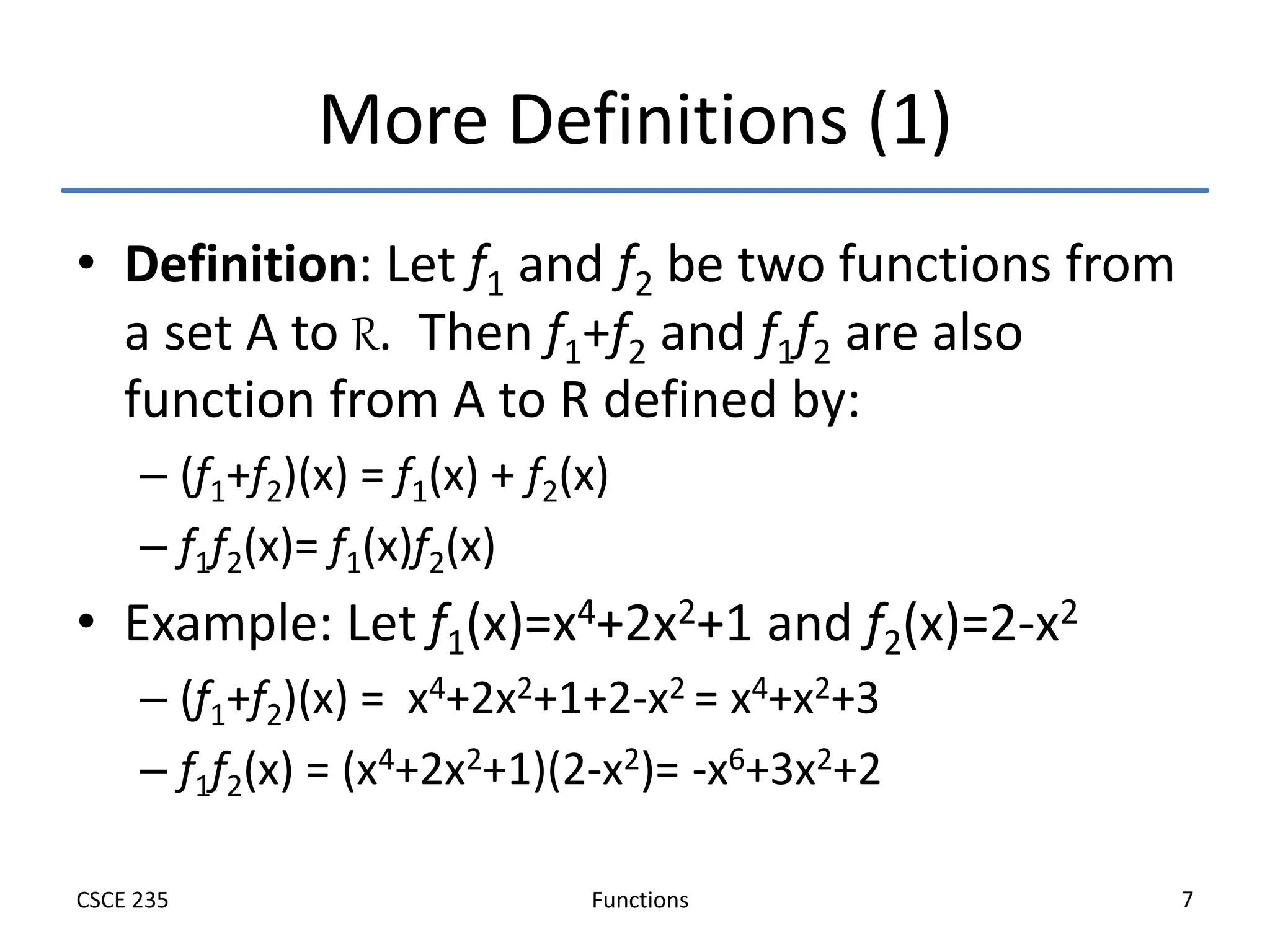
More Definitions (1)
• Definition: Let f1 and f2 be two functions from
a set A to R. Then f1+f2 and f1f2 are also
function from A to R defined by:
– (f1+f2)(x) = f1(x) + f2(x)
– f1f2(x)= f1(x)f2(x)
• Example: Let f1(x)=x4+2x2+1 and f2(x)=2-x2
– (f1+f2)(x) = x4+2x2+1+2-x2 = x4+x2+3
– f1f2(x) = (x4+2x2+1)(2-x2)= -x6+3x2+2
Functions
CSCE 235 8
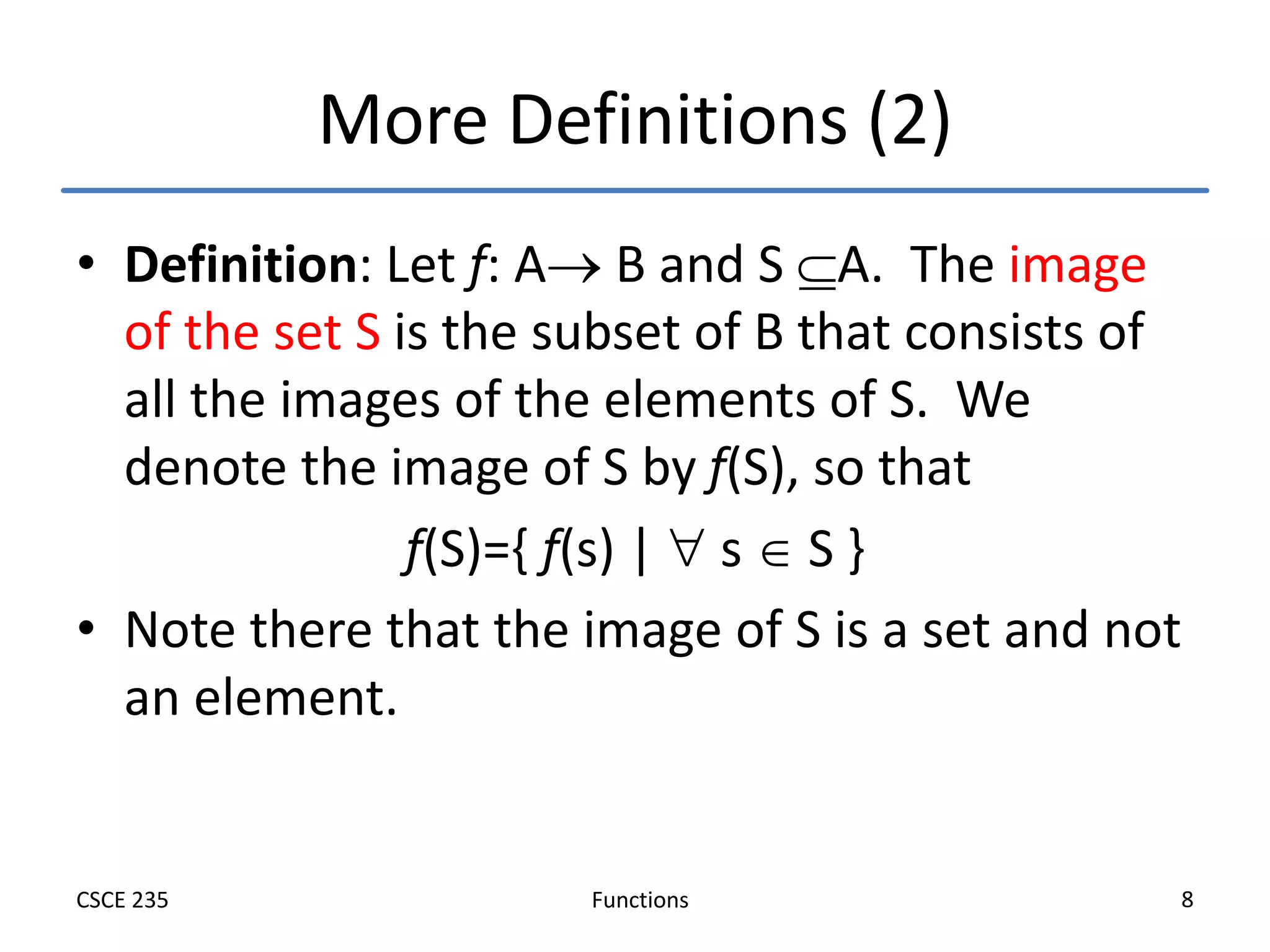
More Definitions (2)
• Definition: Let f: A B and S A. The image
of the set S is the subset of B that consists of
all the images of the elements of S. We
denote the image of S by f(S), so that
f(S)={ f(s) |  s  S }
• Note there that the image of S is a set and not
an element.
Functions
CSCE 235 9
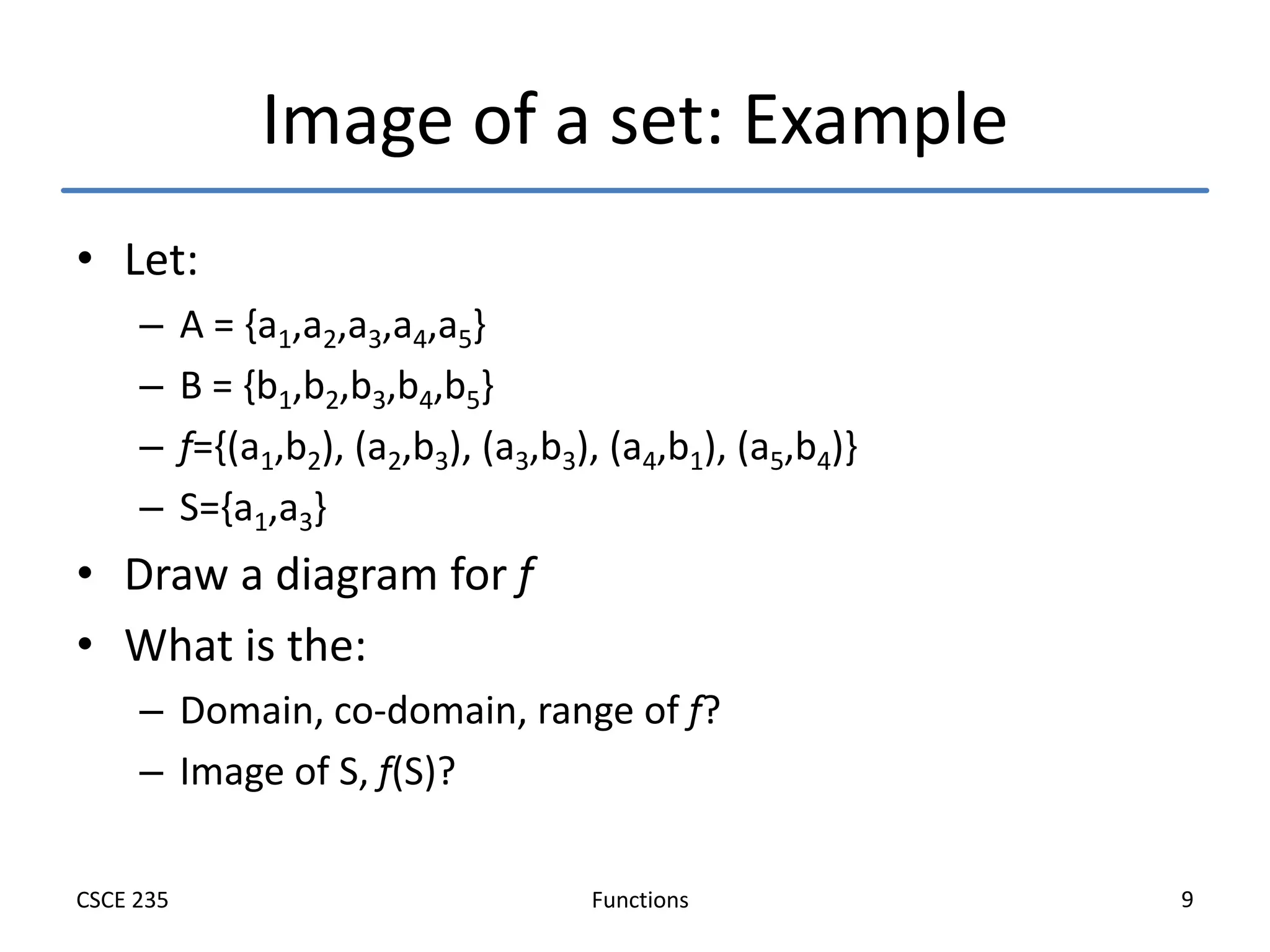
Image of a set: Example
• Let:
– A = {a1,a2,a3,a4,a5}
– B = {b1,b2,b3,b4,b5}
– f={(a1,b2), (a2,b3), (a3,b3), (a4,b1), (a5,b4)}
– S={a1,a3}
• Draw a diagram for f
• What is the:
– Domain, co-domain, range of f?
– Image of S, f(S)?
Functions
CSCE 235 10
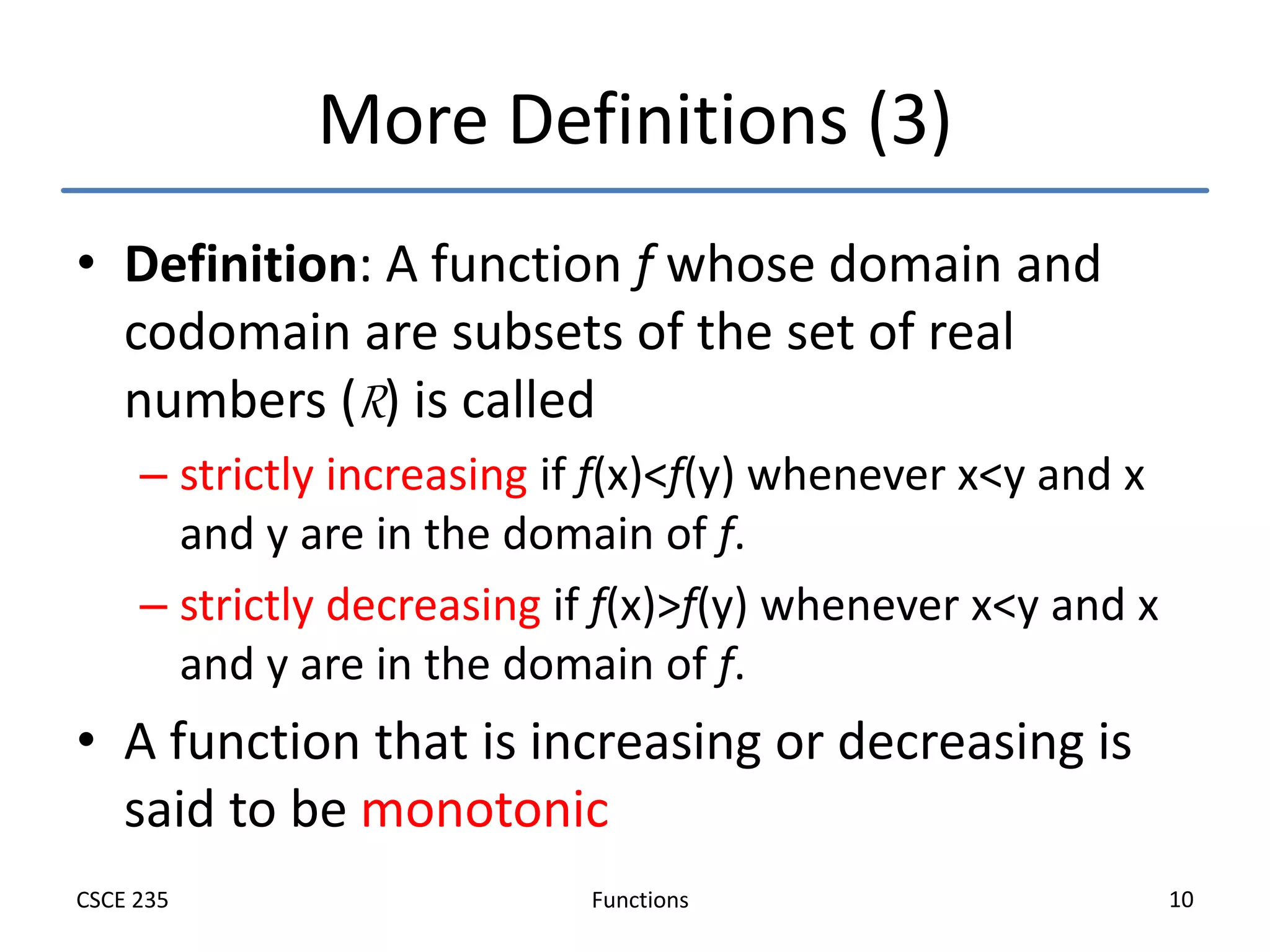
More Definitions (3)
• Definition: A function f whose domain and
codomain are subsets of the set of real
numbers (R) is called
– strictly increasing if f(x)<f(y) whenever x<y and x
and y are in the domain of f.
– strictly decreasing if f(x)>f(y) whenever x<y and x
and y are in the domain of f.
• A function that is increasing or decreasing is
said to be monotonic
Functions
CSCE 235 11
Outline
• Definitions & terminology
• Properties
– One-to-one (injective)
– Onto (surjective)
– One-to-one correspondence (bijective)
– Exercices (5)
• Inverse functions (examples)
• Operators
• Important functions
Functions
CSCE 235 12
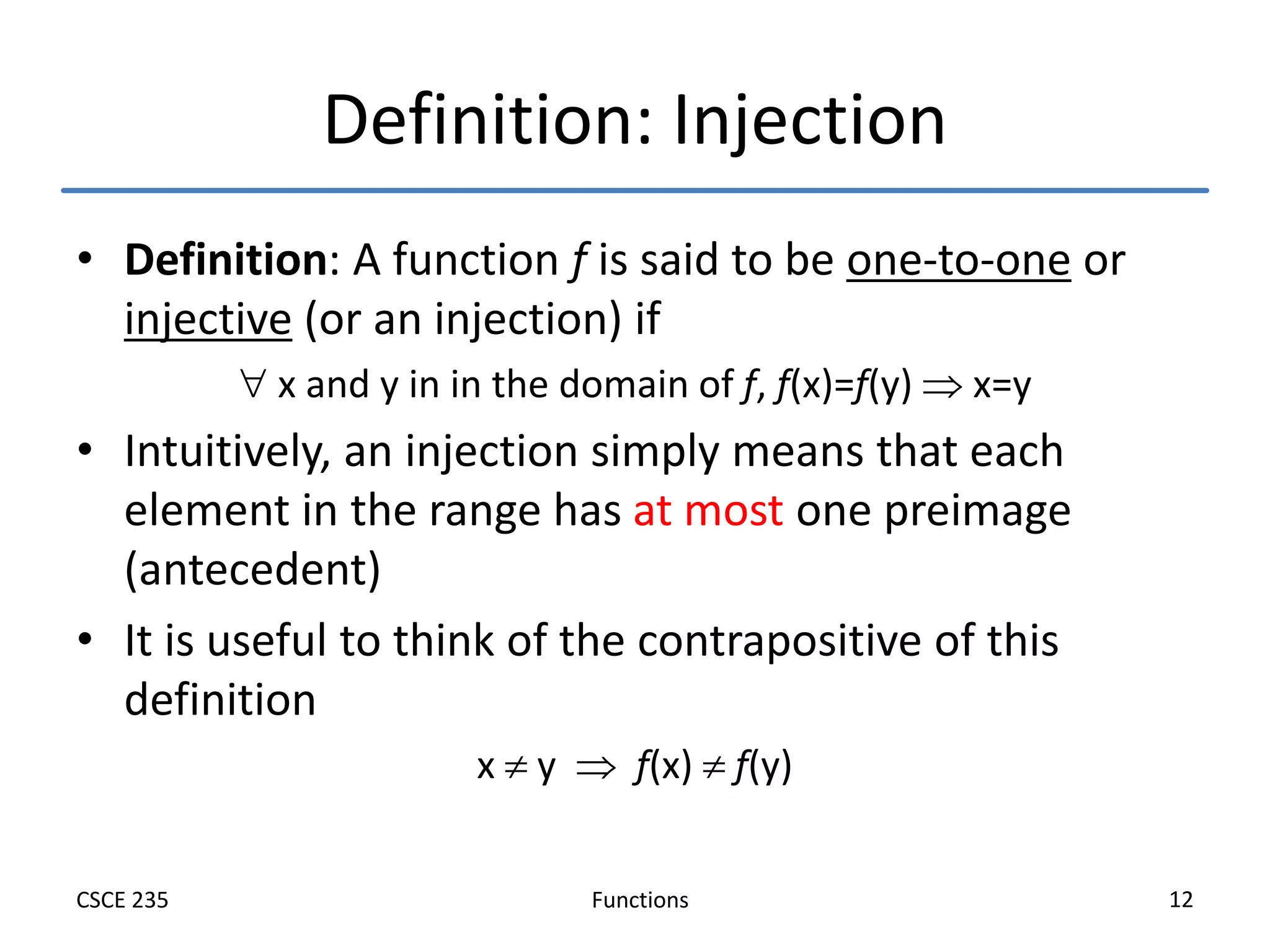
Definition: Injection
• Definition: A function f is said to be one-to-one or
injective (or an injection) if
 x and y in in the domain of f, f(x)=f(y)  x=y
• Intuitively, an injection simply means that each
element in the range has at most one preimage
(antecedent)
• It is useful to think of the contrapositive of this
definition
x  y  f(x)  f(y)
Functions
CSCE 235 13
Definition: Surjection
• Definition: A function f: AB is called onto or
surjective (or an surjection) if
bB,  aA with f(a)=b
• Intuitively, a surjection means that every
element in the codomain is mapped into (i.e.,
it is an image, has an antecedent)
• Thus, the range is the same as the codomain
Functions
CSCE 235 14
Definition: Bijection
• Definition: A function f is a one-to-one
correspondence (or a bijection), if it is both
– one-to-one (injective) and
– onto (surjective)
• One-to-one correspondences are important because
they endow a function with an inverse.
• They also allow us to have a concept cardinality for
infinite sets
• Let’s look at a few examples to develop a feel for
these definitions…
Functions
CSCE 235 15
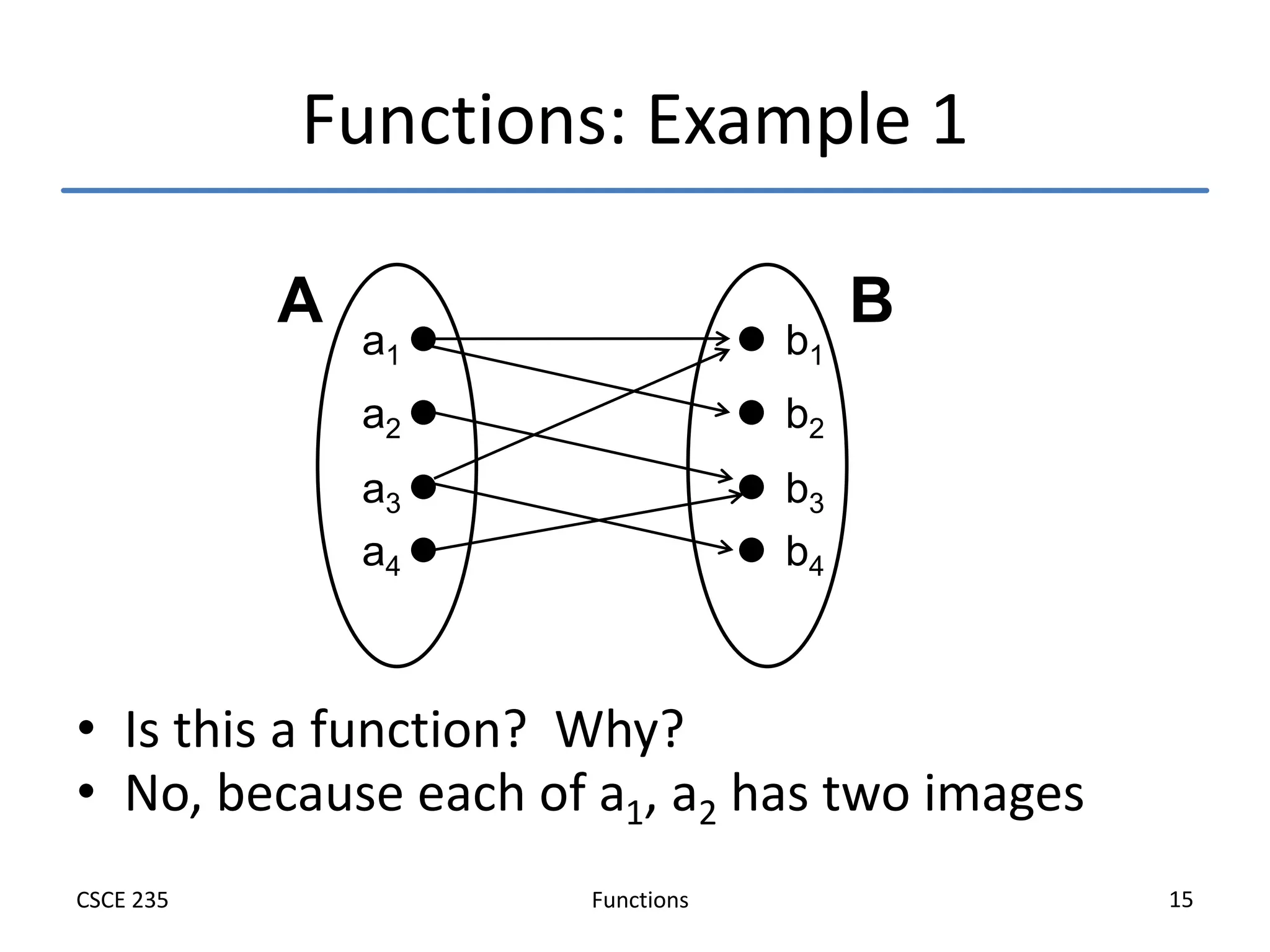
Functions: Example 1
• Is this a function? Why?
a1
a2
a3
a4
b1
b2
b3
b4
A B
• No, because each of a1, a2 has two images
Functions
CSCE 235 16
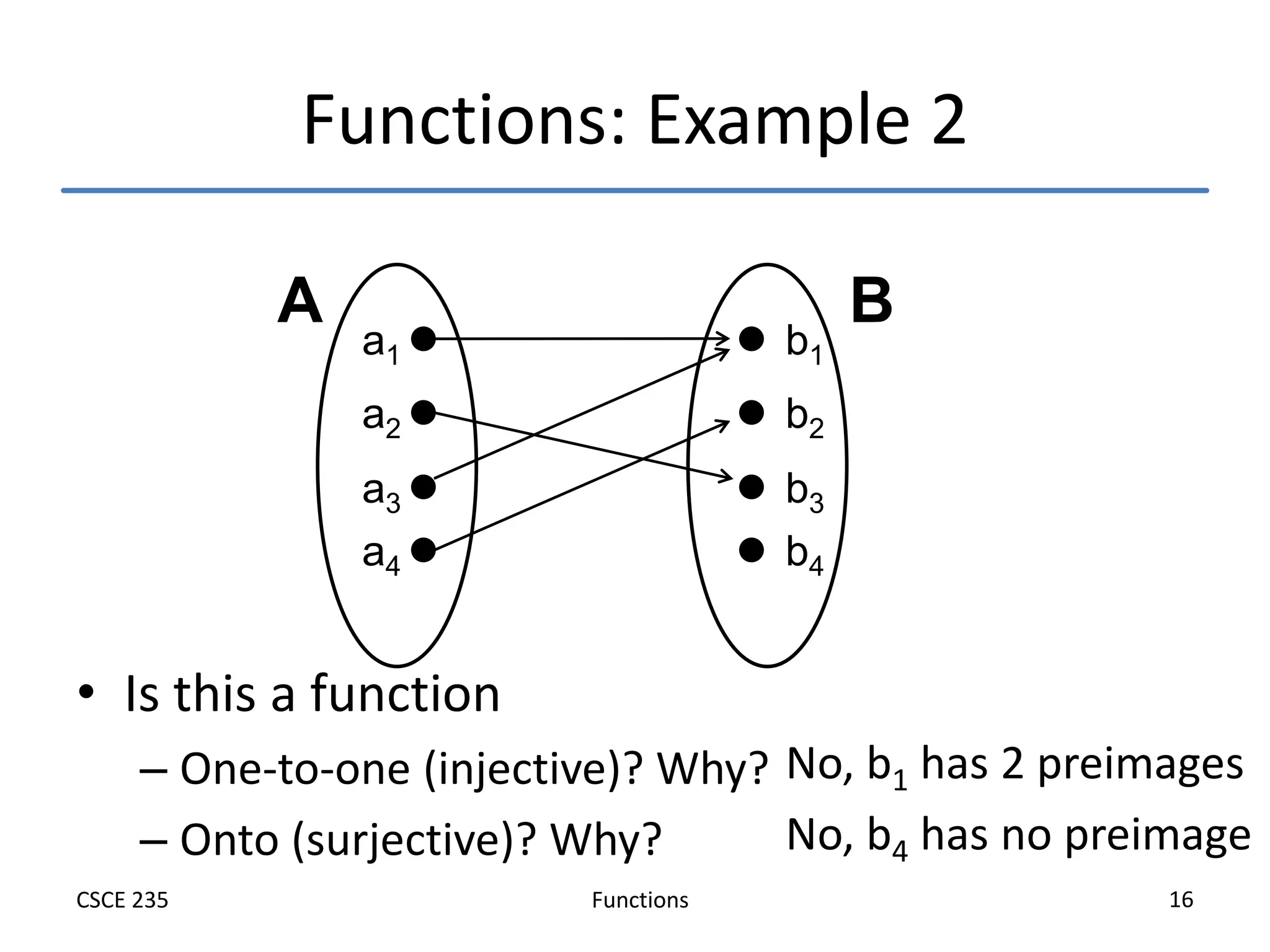
Functions: Example 2
• Is this a function
– One-to-one (injective)? Why?
– Onto (surjective)? Why?
a1
a2
a3
a4
b1
b2
b3
b4
A B
No, b1 has 2 preimages
No, b4 has no preimage
Functions
CSCE 235 17
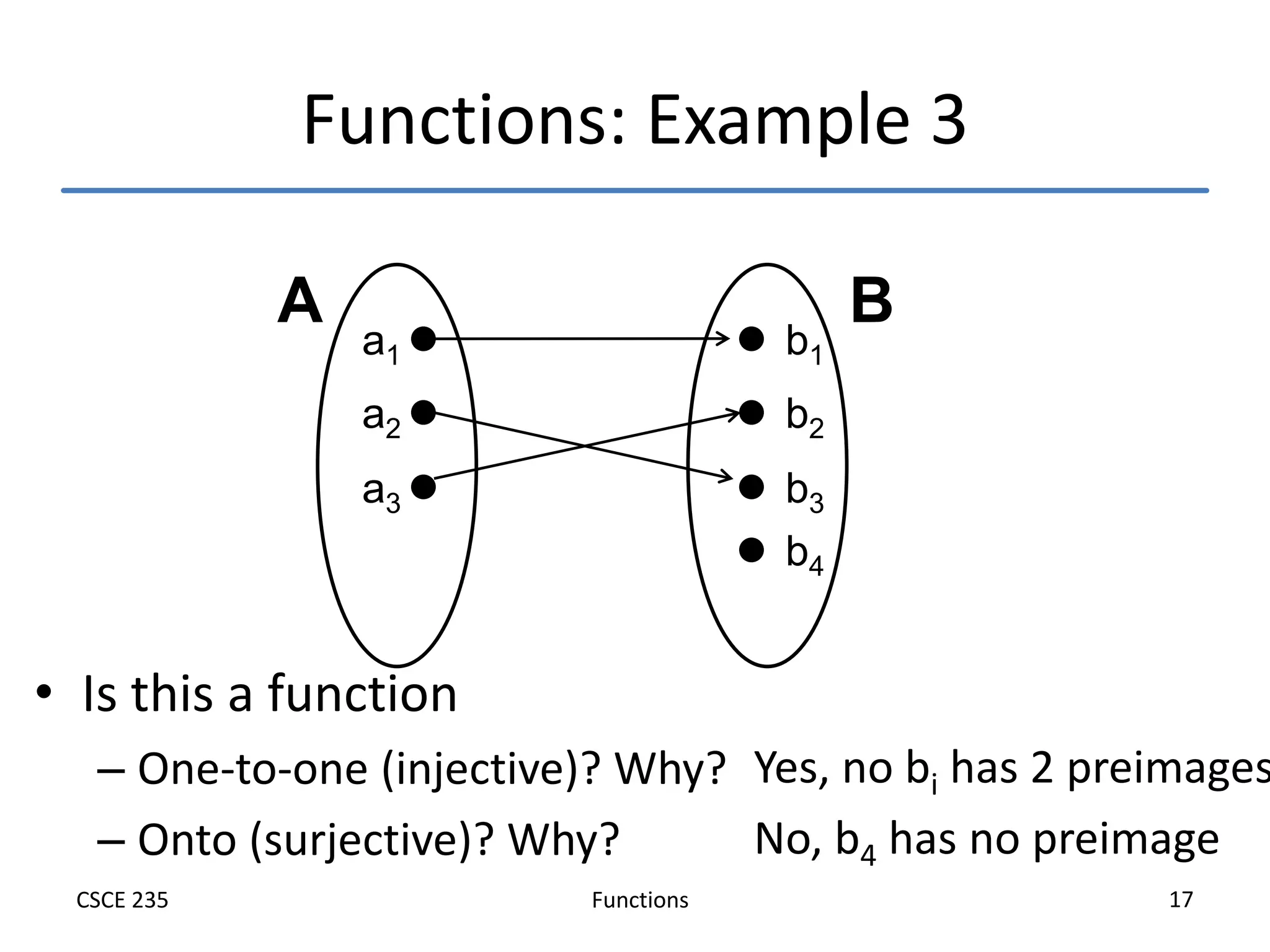
Functions: Example 3
• Is this a function
– One-to-one (injective)? Why?
– Onto (surjective)? Why?
a1
a2
a3
b1
b2
b3
b4
A B
Yes, no bi has 2 preimages
No, b4 has no preimage
Functions
CSCE 235 18
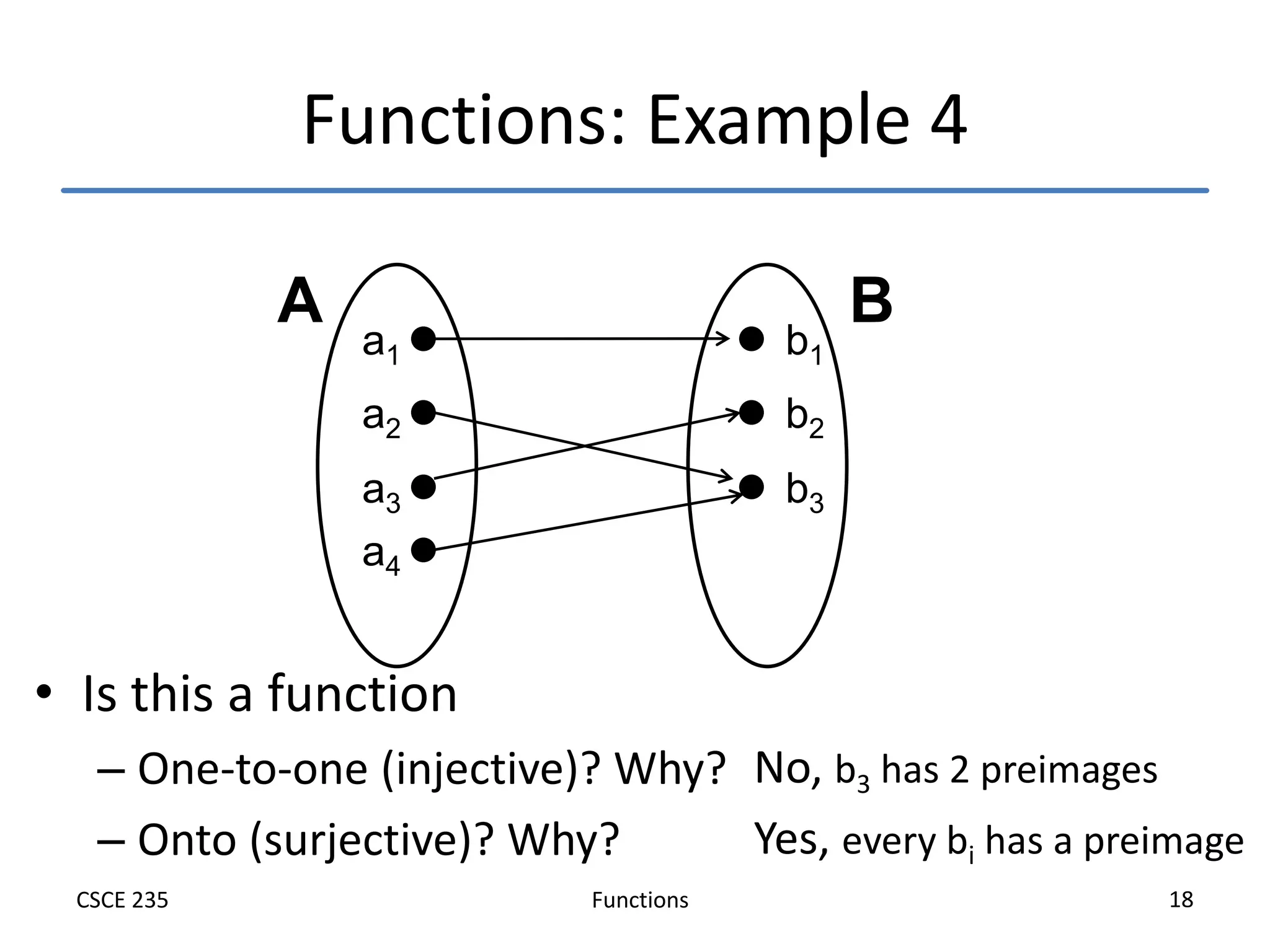
Functions: Example 4
a1
a2
a3
a4
b1
b2
b3
A B
• Is this a function
– One-to-one (injective)? Why?
– Onto (surjective)? Why?
No, b3 has 2 preimages
Yes, every bi has a preimage
Functions
CSCE 235 19
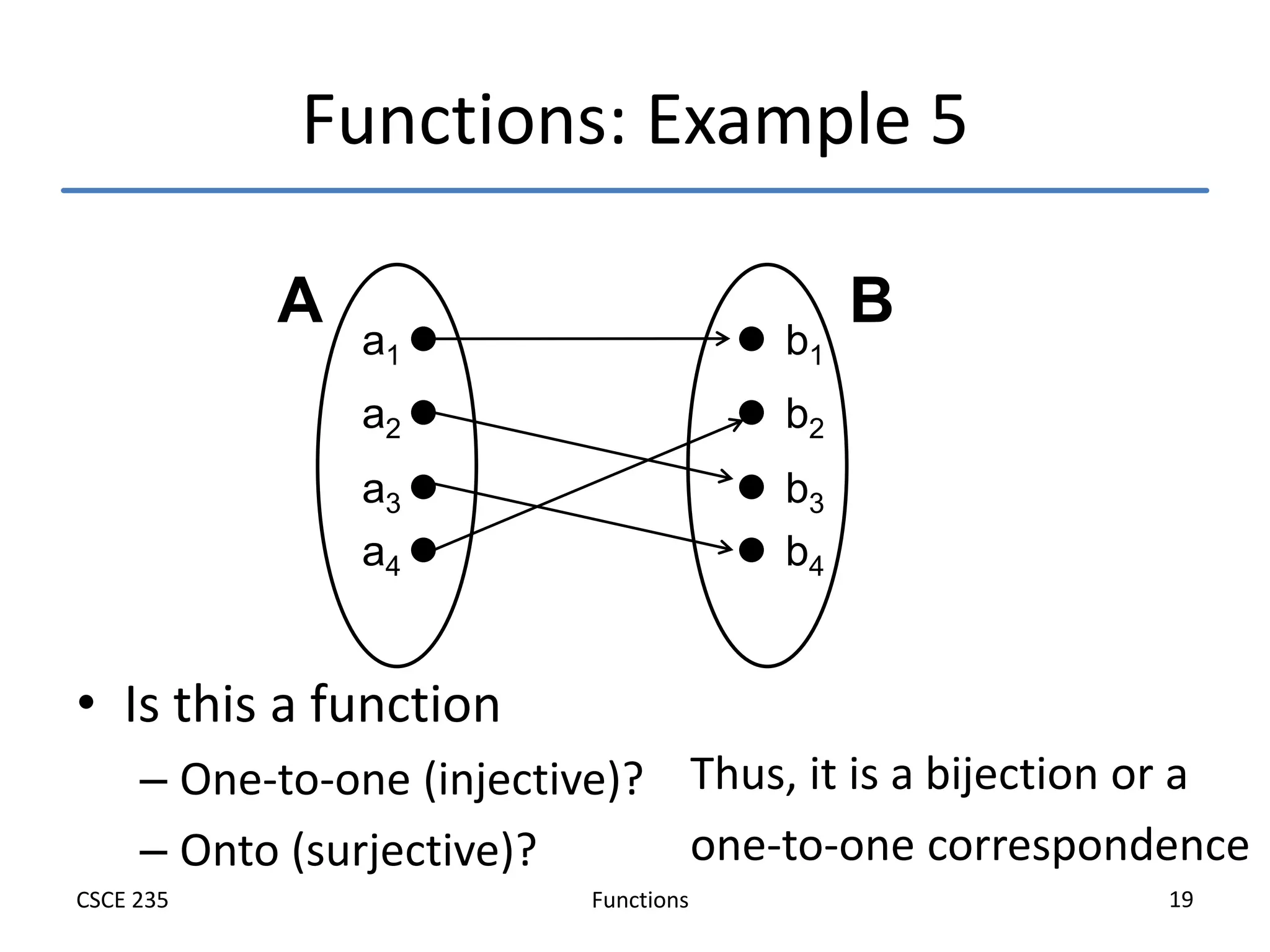
Functions: Example 5
a1
a2
a3
a4
b1
b2
b3
b4
A B
• Is this a function
– One-to-one (injective)?
– Onto (surjective)?
Thus, it is a bijection or a
one-to-one correspondence
Functions
CSCE 235 20
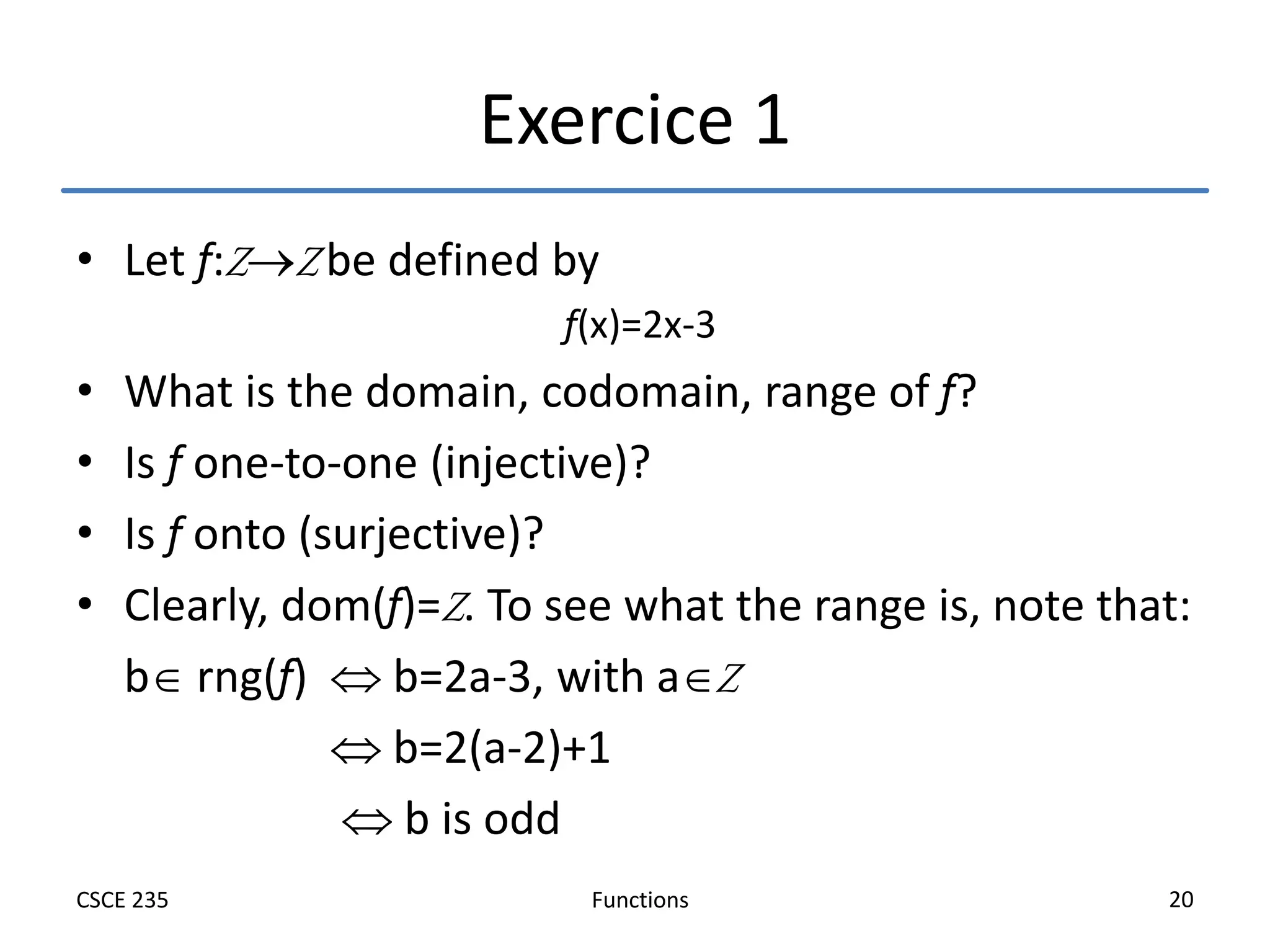
Exercice 1
• Let f:ZZ be defined by
f(x)=2x-3
• What is the domain, codomain, range of f?
• Is f one-to-one (injective)?
• Is f onto (surjective)?
• Clearly, dom(f)=Z. To see what the range is, note that:
b rng(f)  b=2a-3, with aZ
 b=2(a-2)+1
 b is odd
Functions
CSCE 235 21
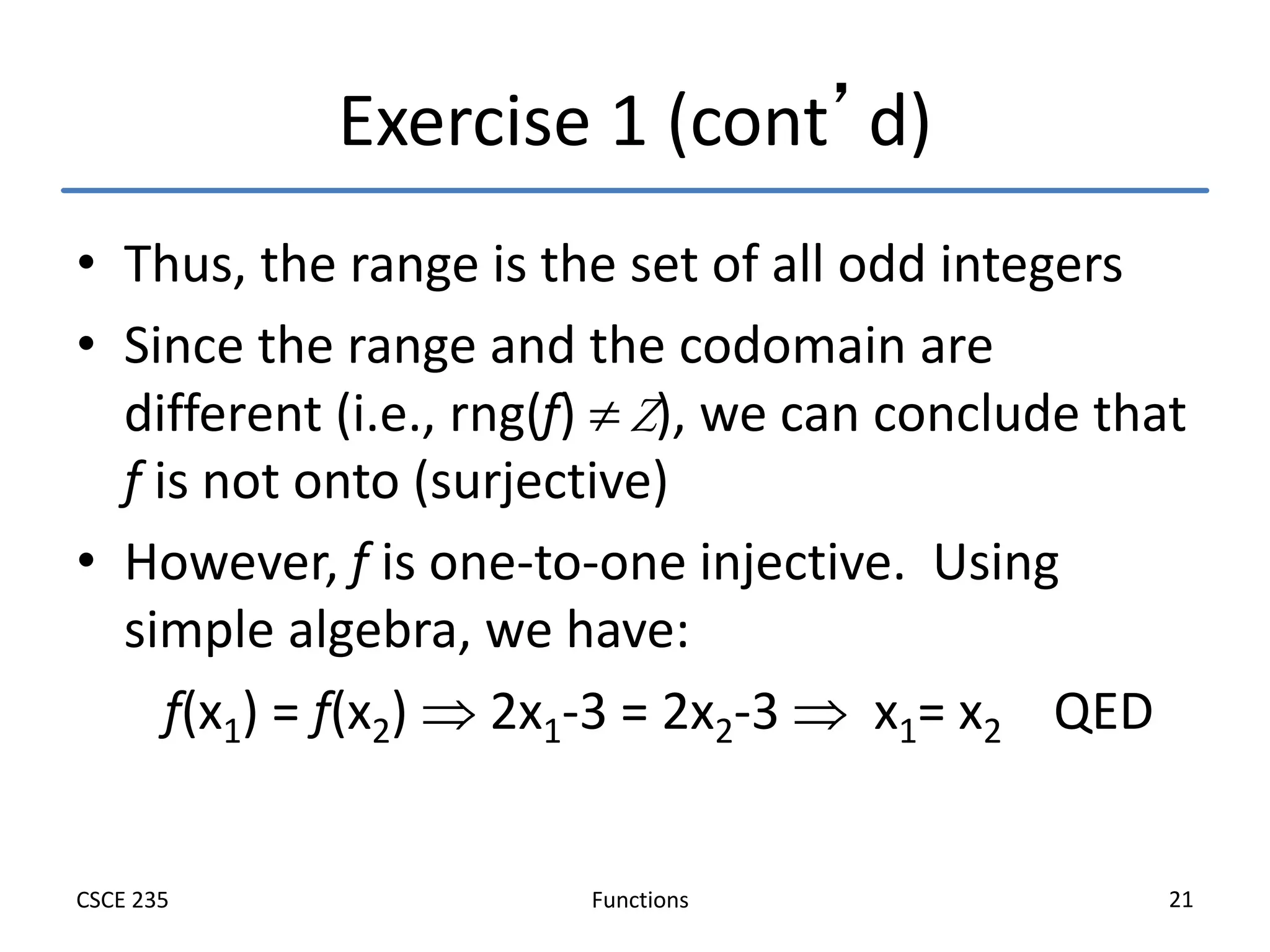
Exercise 1 (cont’d)
• Thus, the range is the set of all odd integers
• Since the range and the codomain are
different (i.e., rng(f)  Z), we can conclude that
f is not onto (surjective)
• However, f is one-to-one injective. Using
simple algebra, we have:
f(x1) = f(x2)  2x1-3 = 2x2-3  x1= x2 QED
Functions
CSCE 235 22
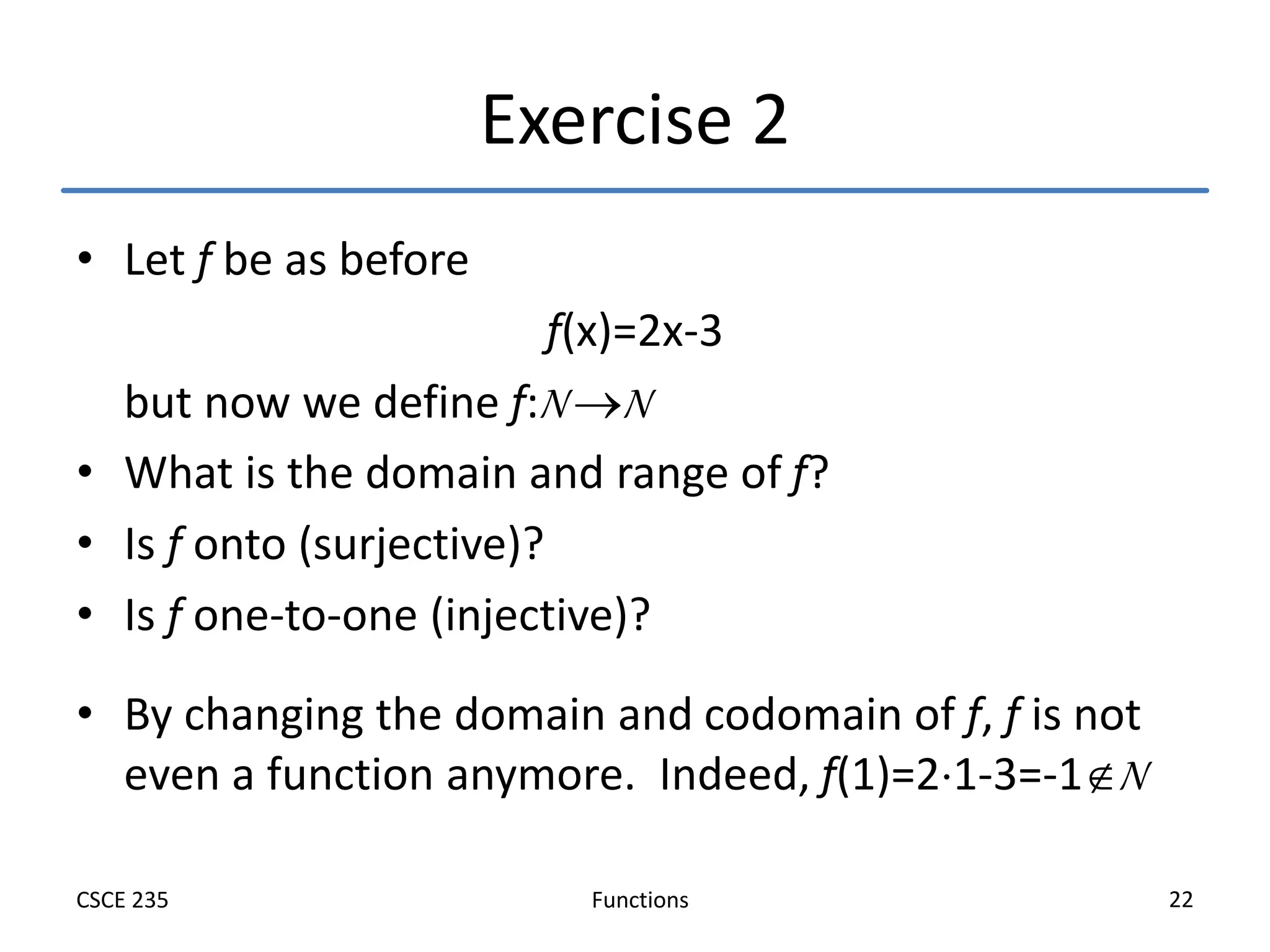
Exercise 2
• Let f be as before
f(x)=2x-3
but now we define f:N N
• What is the domain and range of f?
• Is f onto (surjective)?
• Is f one-to-one (injective)?
• By changing the domain and codomain of f, f is not
even a function anymore. Indeed, f(1)=21-3=-1N
Functions
CSCE 235 23
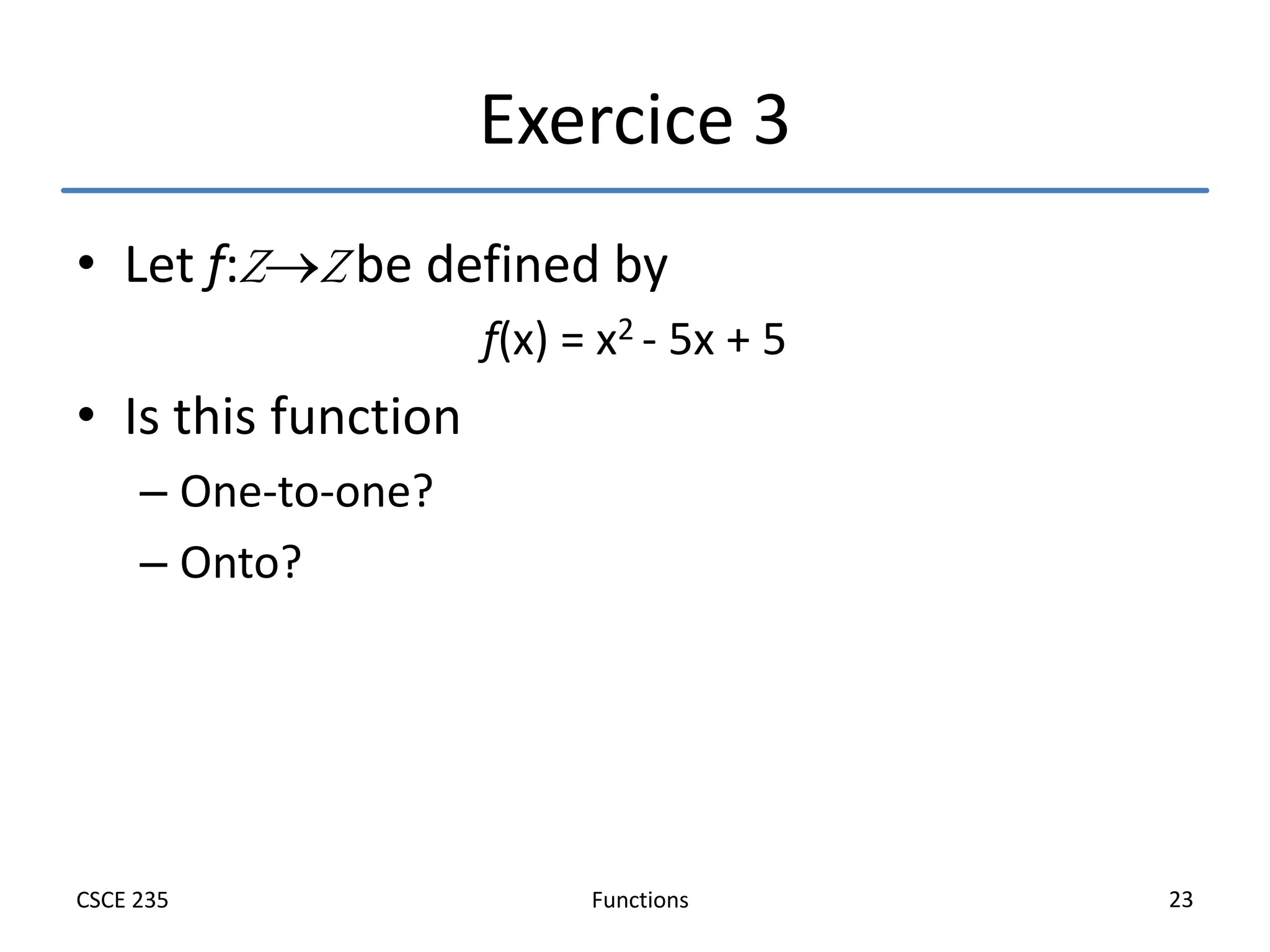
Exercice 3
• Let f:ZZ be defined by
f(x) = x2 - 5x + 5
• Is this function
– One-to-one?
– Onto?
Functions
CSCE 235 24
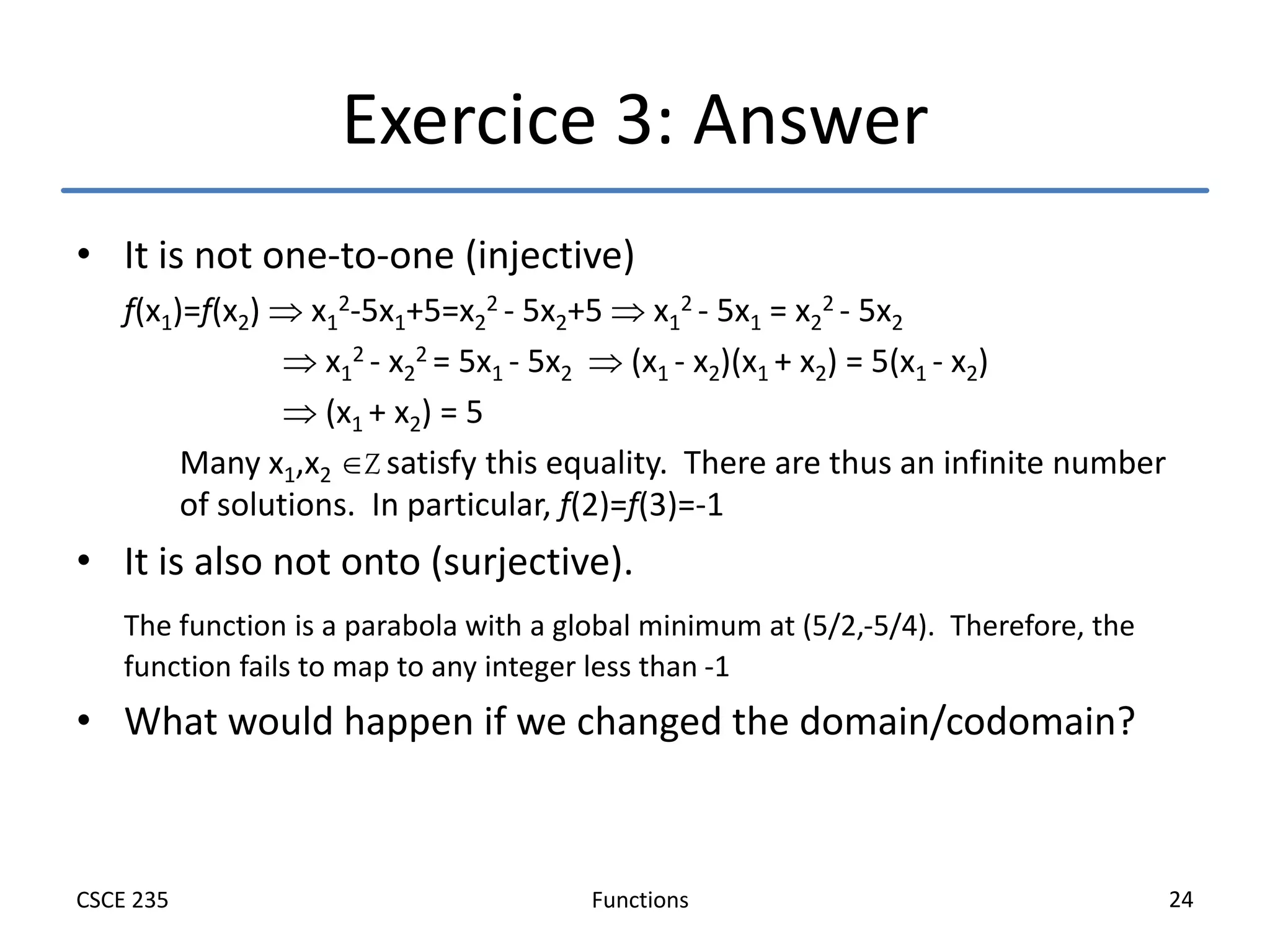
Exercice 3: Answer
• It is not one-to-one (injective)
f(x1)=f(x2)  x1
2-5x1+5=x2
2 - 5x2+5  x1
2 - 5x1 = x2
2 - 5x2
 x1
2 - x2
2 = 5x1 - 5x2  (x1 - x2)(x1 + x2) = 5(x1 - x2)
 (x1 + x2) = 5
Many x1,x2 Z satisfy this equality. There are thus an infinite number
of solutions. In particular, f(2)=f(3)=-1
• It is also not onto (surjective).
The function is a parabola with a global minimum at (5/2,-5/4). Therefore, the
function fails to map to any integer less than -1
• What would happen if we changed the domain/codomain?
Functions
CSCE 235 25
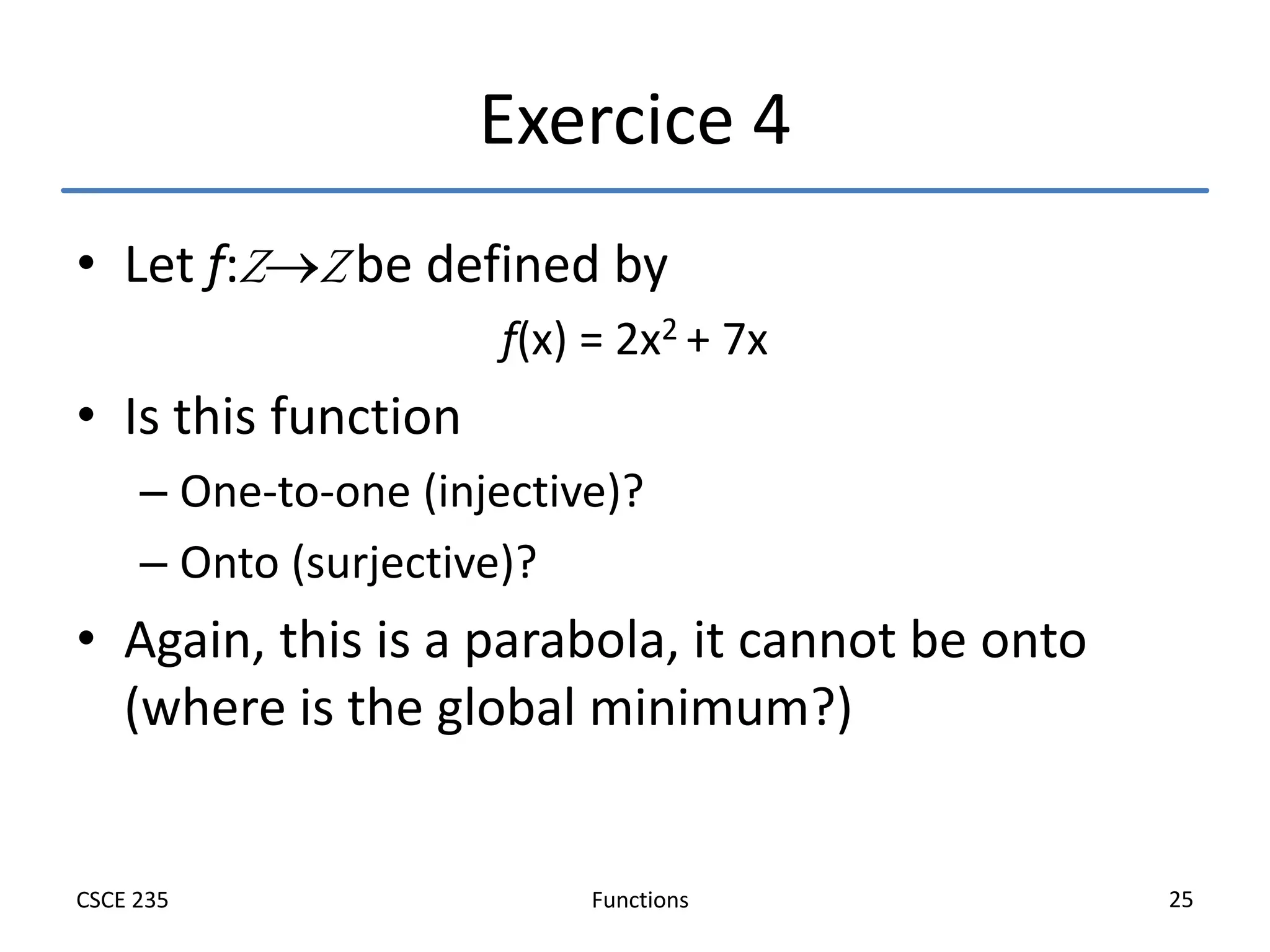
Exercice 4
• Let f:ZZ be defined by
f(x) = 2x2 + 7x
• Is this function
– One-to-one (injective)?
– Onto (surjective)?
• Again, this is a parabola, it cannot be onto
(where is the global minimum?)
Functions
CSCE 235 26
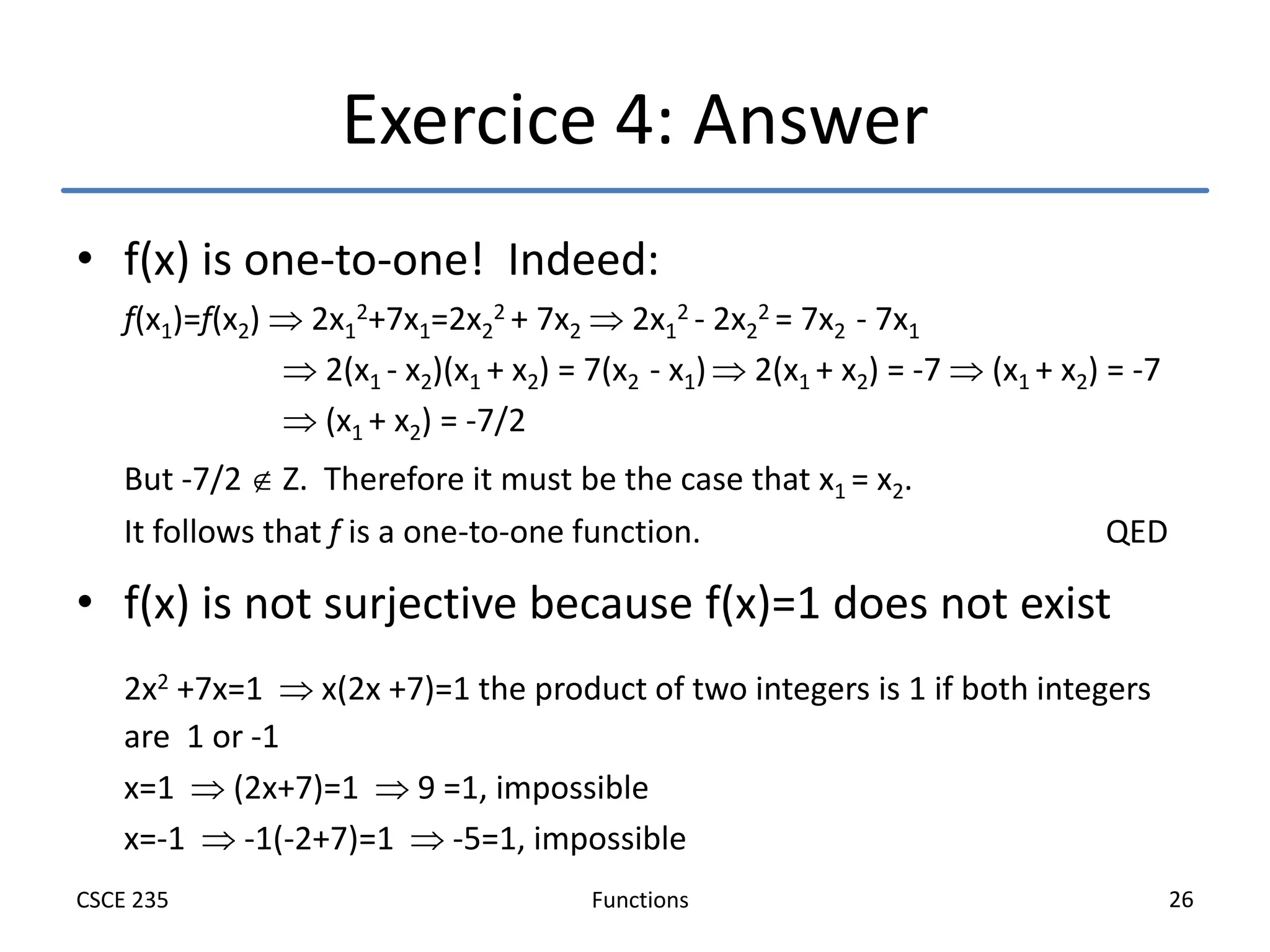
Exercice 4: Answer
• f(x) is one-to-one! Indeed:
f(x1)=f(x2)  2x1
2+7x1=2x2
2 + 7x2  2x1
2 - 2x2
2 = 7x2 - 7x1
 2(x1 - x2)(x1 + x2) = 7(x2 - x1)  2(x1 + x2) = -7  (x1 + x2) = -7
 (x1 + x2) = -7/2
But -7/2  Z. Therefore it must be the case that x1 = x2.
It follows that f is a one-to-one function. QED
• f(x) is not surjective because f(x)=1 does not exist
2x2 +7x=1  x(2x +7)=1 the product of two integers is 1 if both integers
are 1 or -1
x=1  (2x+7)=1  9 =1, impossible
x=-1  -1(-2+7)=1  -5=1, impossible
Functions
CSCE 235 27
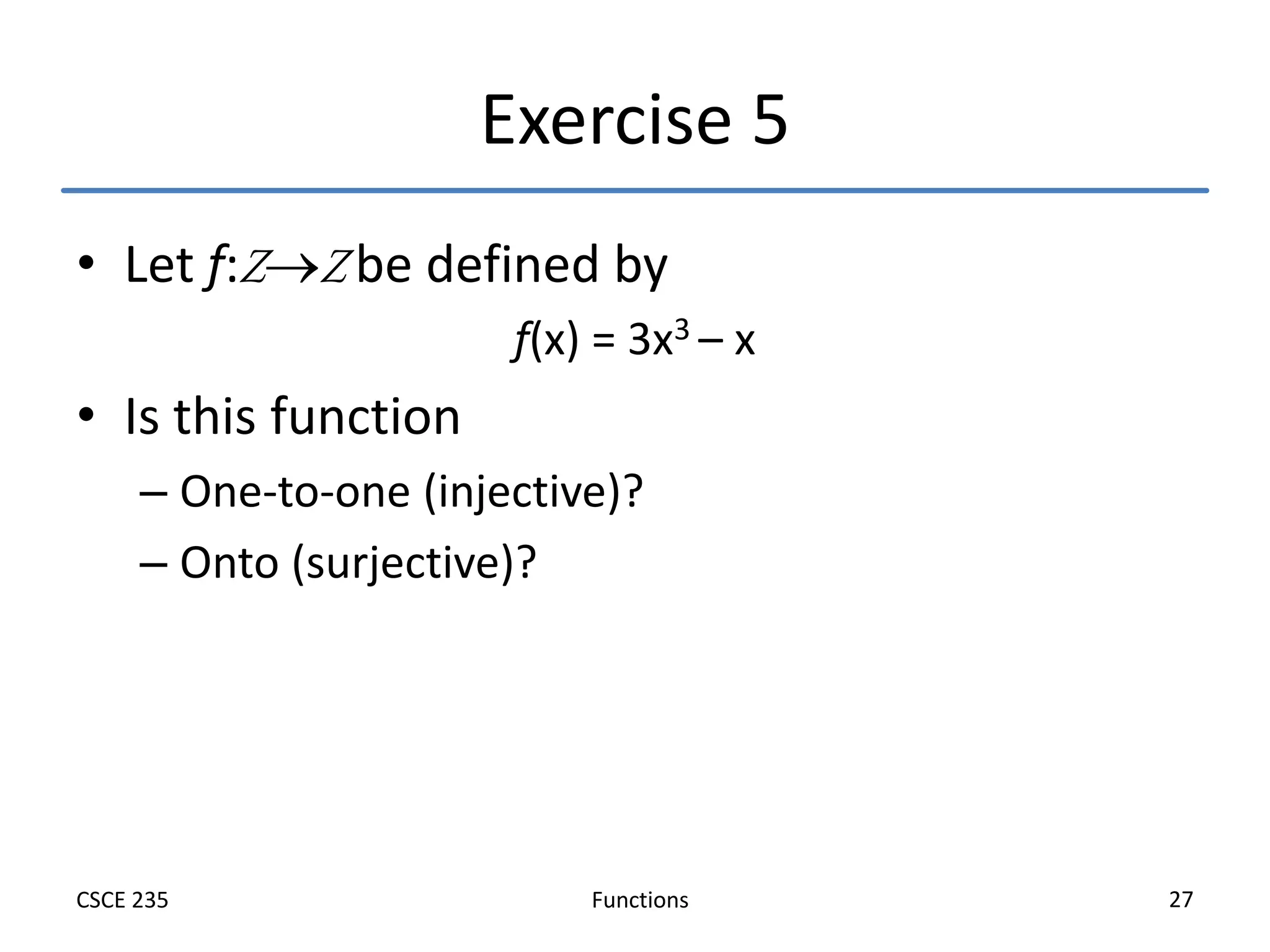
Exercise 5
• Let f:ZZ be defined by
f(x) = 3x3 – x
• Is this function
– One-to-one (injective)?
– Onto (surjective)?
Functions
CSCE 235 28
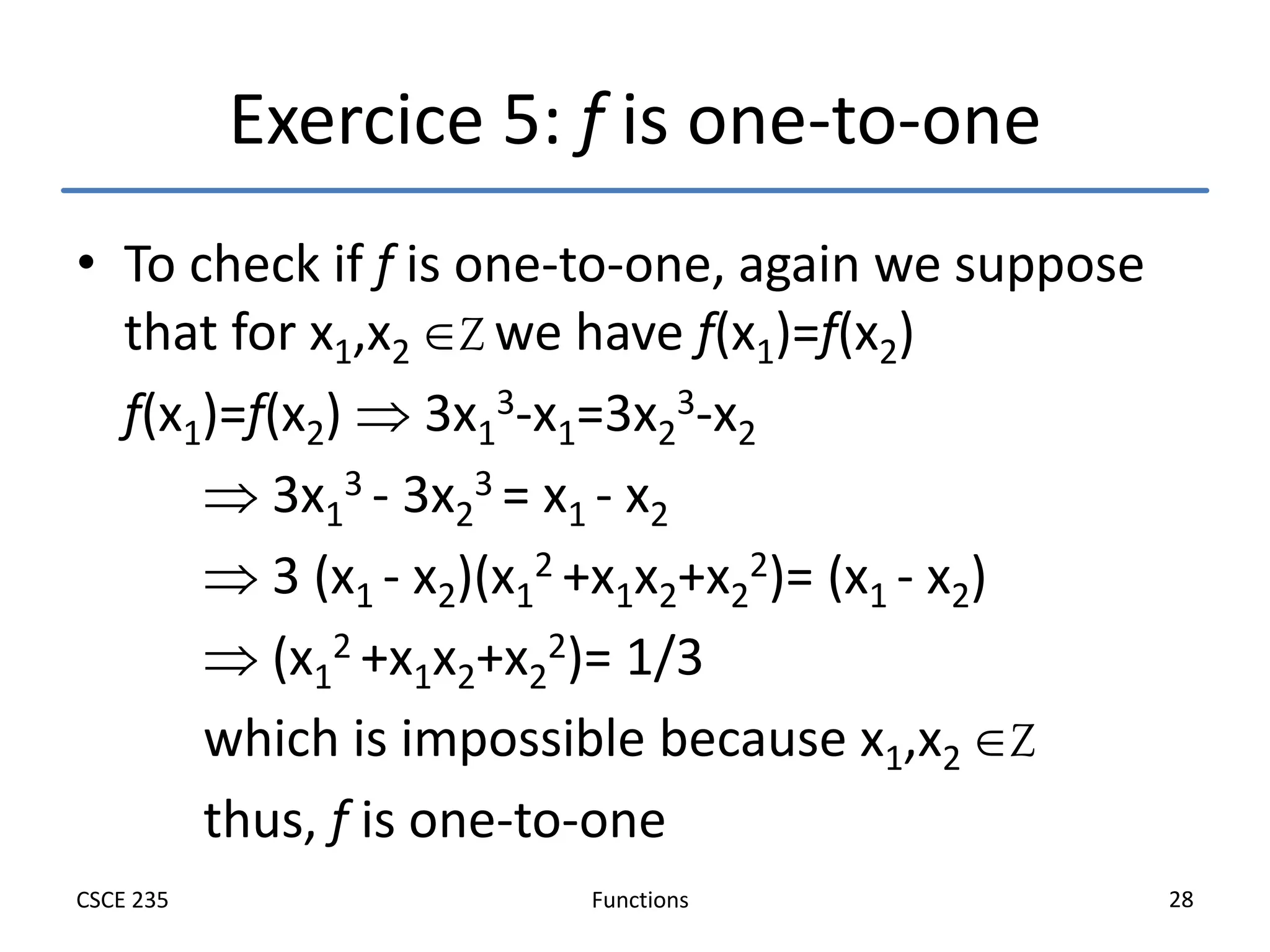
Exercice 5: f is one-to-one
• To check if f is one-to-one, again we suppose
that for x1,x2 Z we have f(x1)=f(x2)
f(x1)=f(x2)  3x1
3-x1=3x2
3-x2
 3x1
3 - 3x2
3 = x1 - x2
 3 (x1 - x2)(x1
2 +x1x2+x2
2)= (x1 - x2)
 (x1
2 +x1x2+x2
2)= 1/3
which is impossible because x1,x2 Z
thus, f is one-to-one
Functions
CSCE 235 29
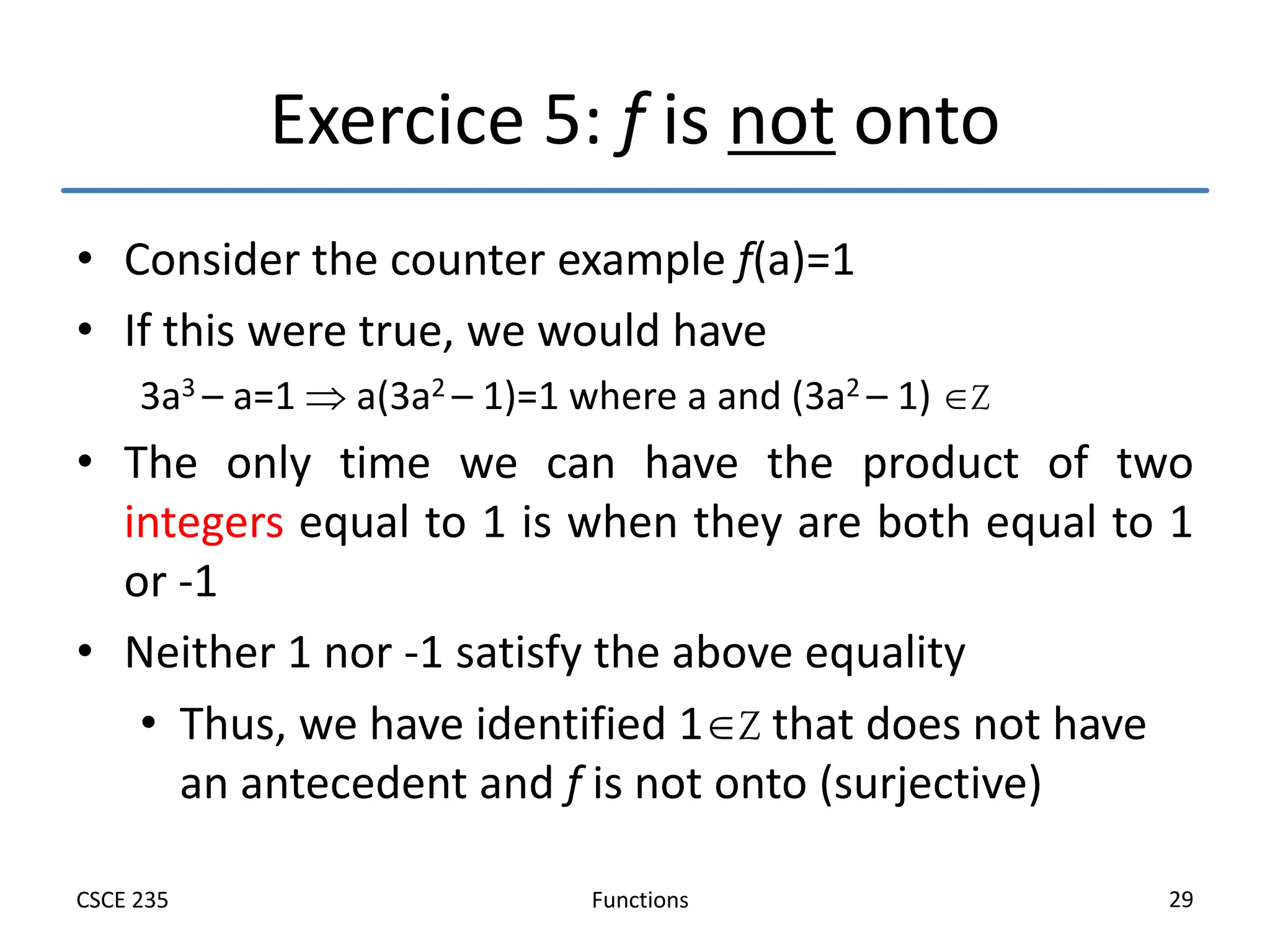
Exercice 5: f is not onto
• Consider the counter example f(a)=1
• If this were true, we would have
3a3 – a=1  a(3a2 – 1)=1 where a and (3a2 – 1) Z
• The only time we can have the product of two
integers equal to 1 is when they are both equal to 1
or -1
• Neither 1 nor -1 satisfy the above equality
• Thus, we have identified 1Z that does not have
an antecedent and f is not onto (surjective)
Functions
CSCE 235 30
Outline
• Definitions & terminology
– function, domain, co-domain, image, preimage (antecedent), range,
image of a set, strictly increasing, strictly decreasing, monotonic
• Properties
– One-to-one (injective), onto (surjective), one-to-one correspondence
(bijective)
– Exercices (5)
• Inverse functions (examples)
• Operators
– Composition, Equality
• Important functions
– identity, absolute value, floor, ceiling, factorial
Functions
CSCE 235 31
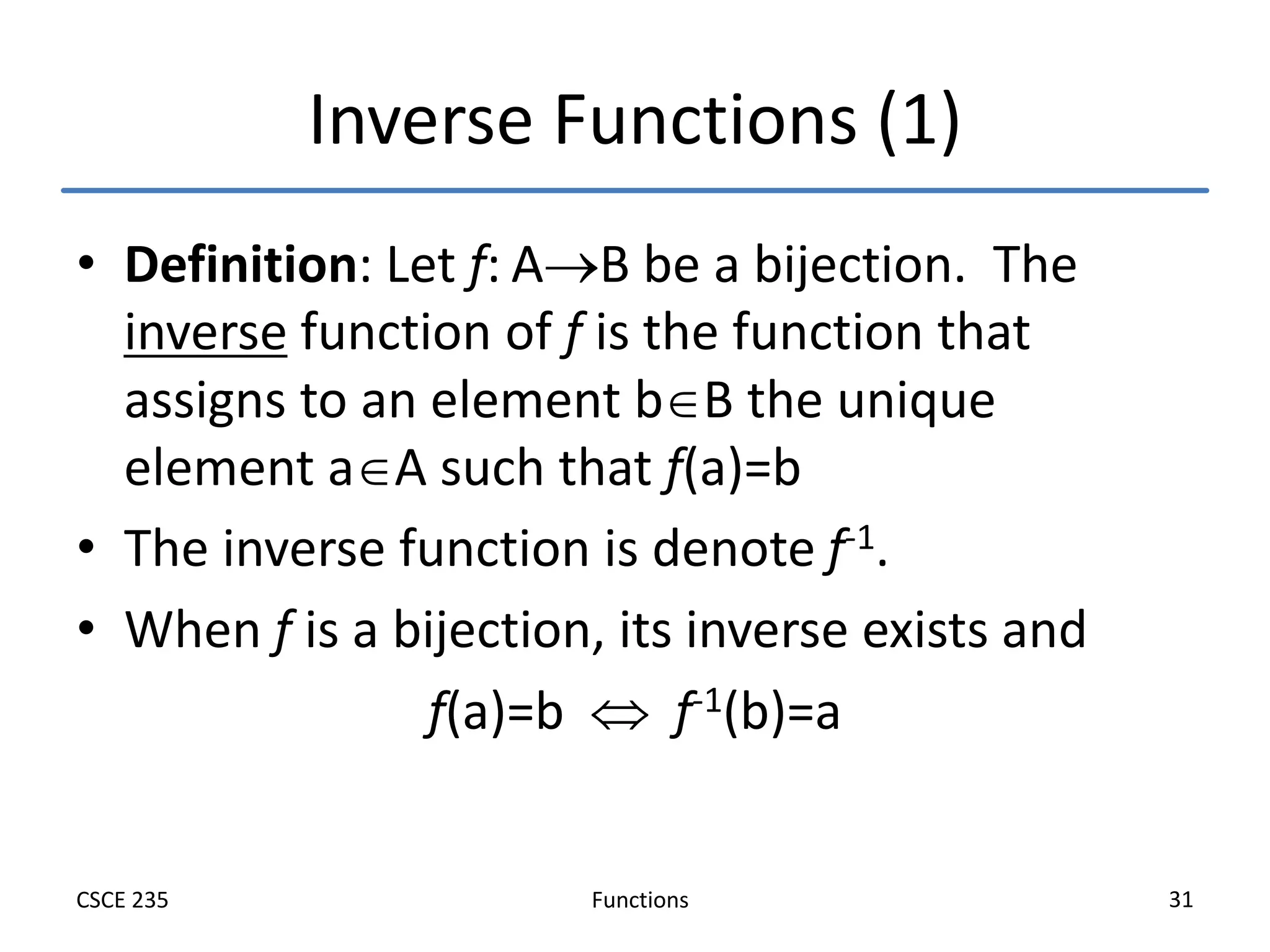
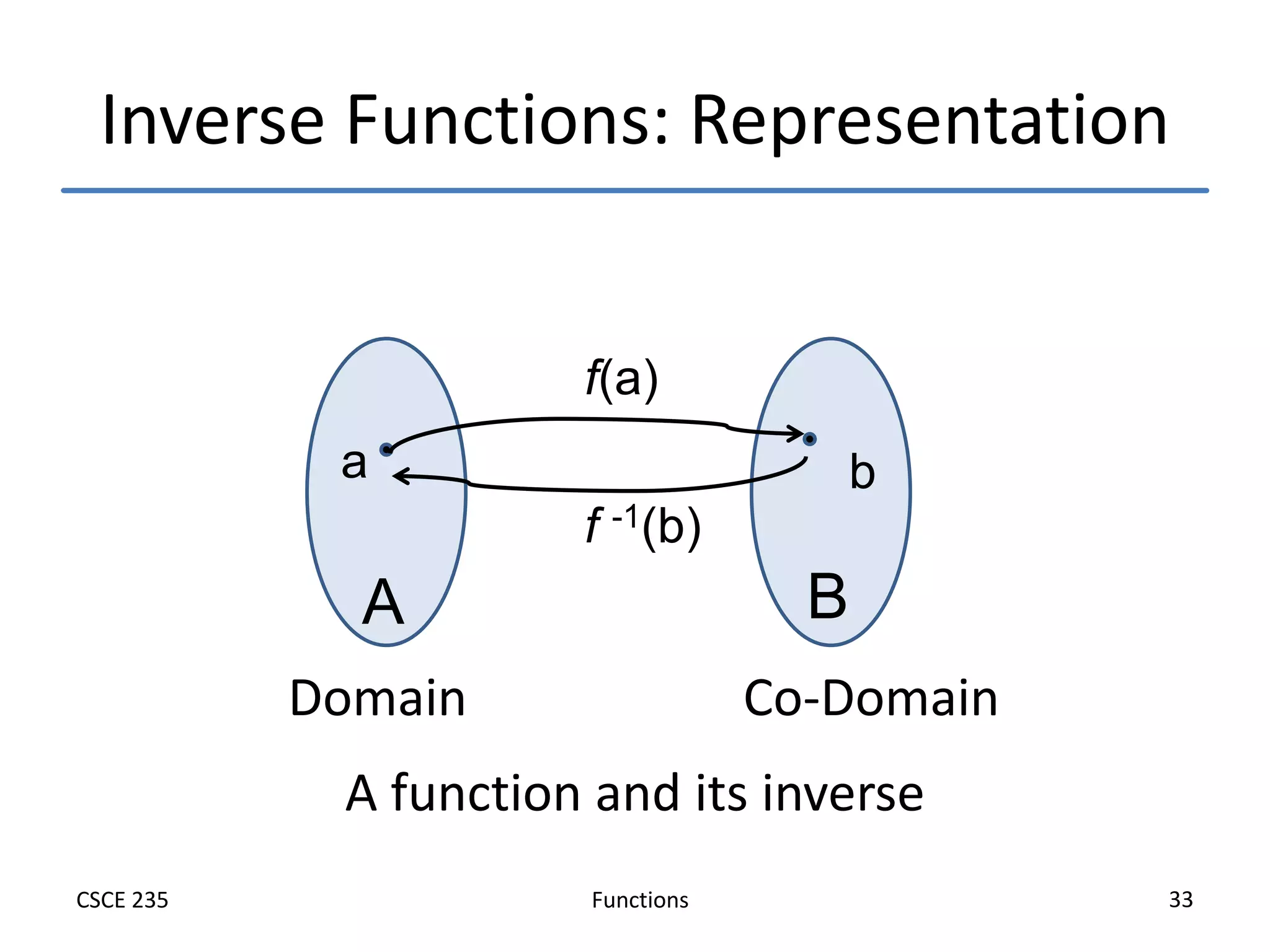
Inverse Functions (1)
• Definition: Let f: AB be a bijection. The
inverse function of f is the function that
assigns to an element bB the unique
element aA such that f(a)=b
• The inverse function is denote f-1.
• When f is a bijection, its inverse exists and
f(a)=b  f-1(b)=a
Functions
CSCE 235 32
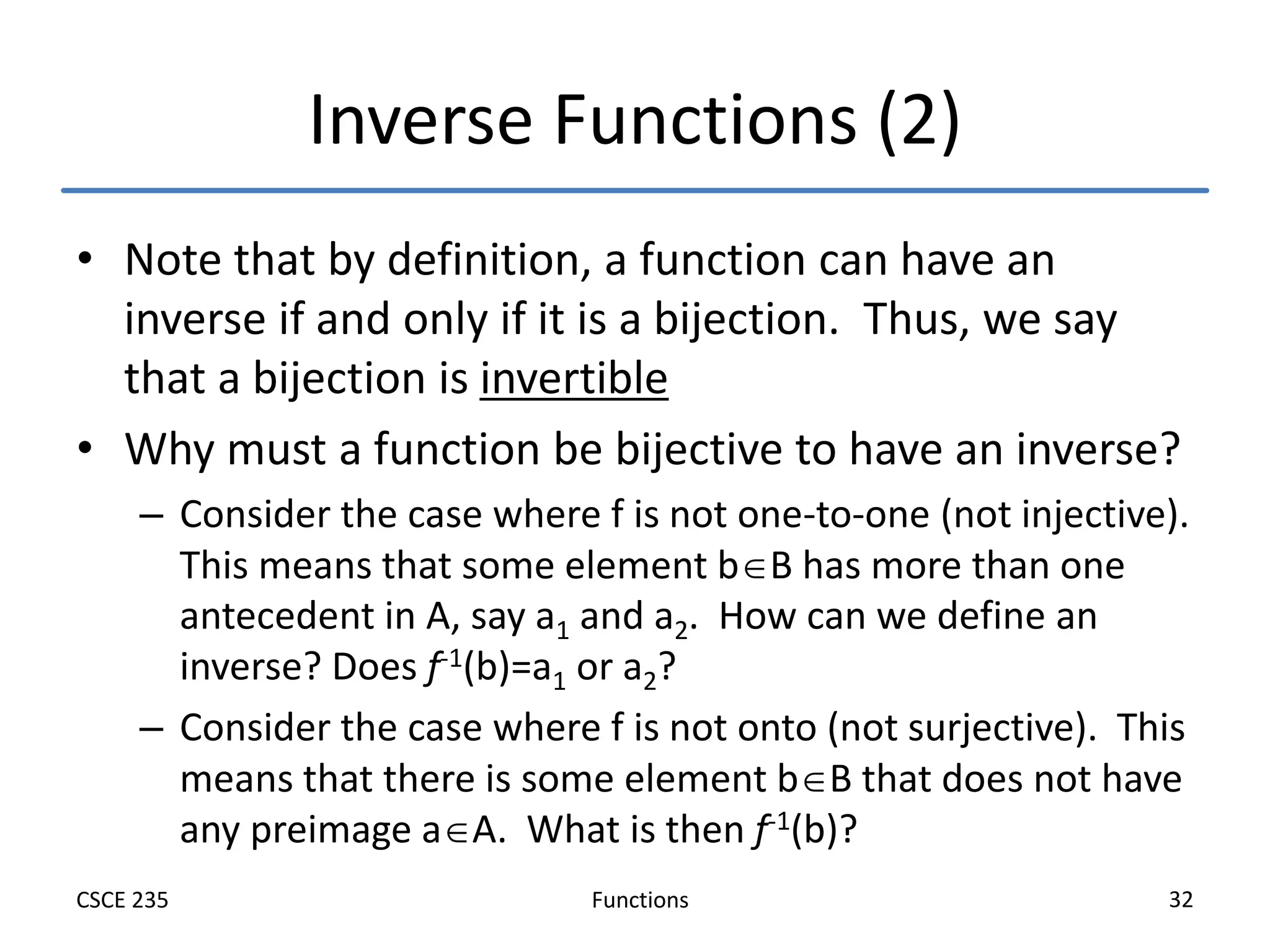
Inverse Functions (2)
• Note that by definition, a function can have an
inverse if and only if it is a bijection. Thus, we say
that a bijection is invertible
• Why must a function be bijective to have an inverse?
– Consider the case where f is not one-to-one (not injective).
This means that some element bB has more than one
antecedent in A, say a1 and a2. How can we define an
inverse? Does f-1(b)=a1 or a2?
– Consider the case where f is not onto (not surjective). This
means that there is some element bB that does not have
any preimage aA. What is then f-1(b)?
Functions
CSCE 235 33
Inverse Functions: Representation
A function and its inverse
A B
a b
f(a)
Domain Co-Domain
f -1(b)
Functions
CSCE 235 34
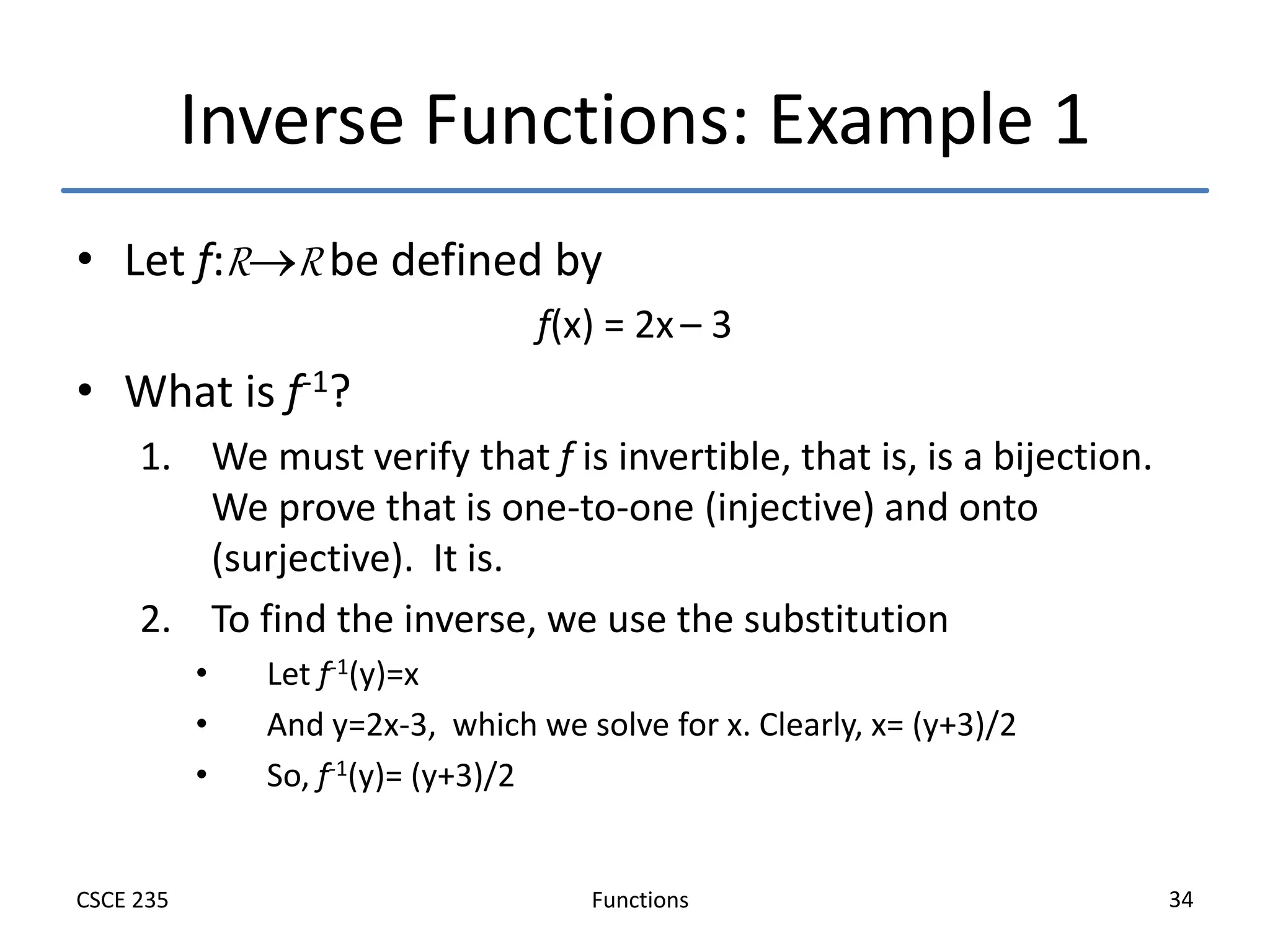
Inverse Functions: Example 1
• Let f:RR be defined by
f(x) = 2x – 3
• What is f-1?
1. We must verify that f is invertible, that is, is a bijection.
We prove that is one-to-one (injective) and onto
(surjective). It is.
2. To find the inverse, we use the substitution
• Let f-1(y)=x
• And y=2x-3, which we solve for x. Clearly, x= (y+3)/2
• So, f-1(y)= (y+3)/2
Functions
CSCE 235 35
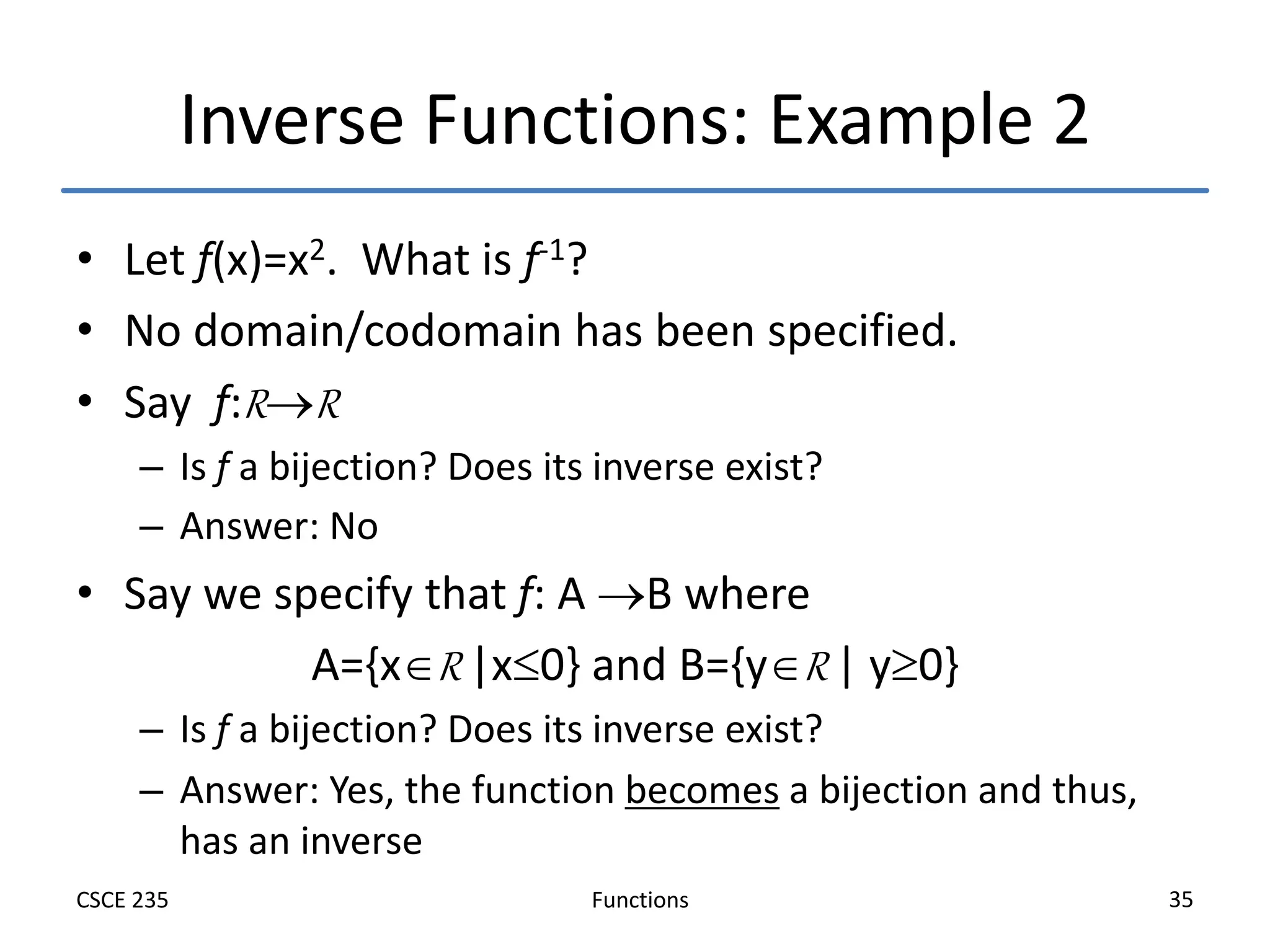
Inverse Functions: Example 2
• Let f(x)=x2. What is f-1?
• No domain/codomain has been specified.
• Say f:RR
– Is f a bijection? Does its inverse exist?
– Answer: No
• Say we specify that f: A B where
A={xR |x0} and B={yR | y0}
– Is f a bijection? Does its inverse exist?
– Answer: Yes, the function becomes a bijection and thus,
has an inverse
Functions
CSCE 235 36
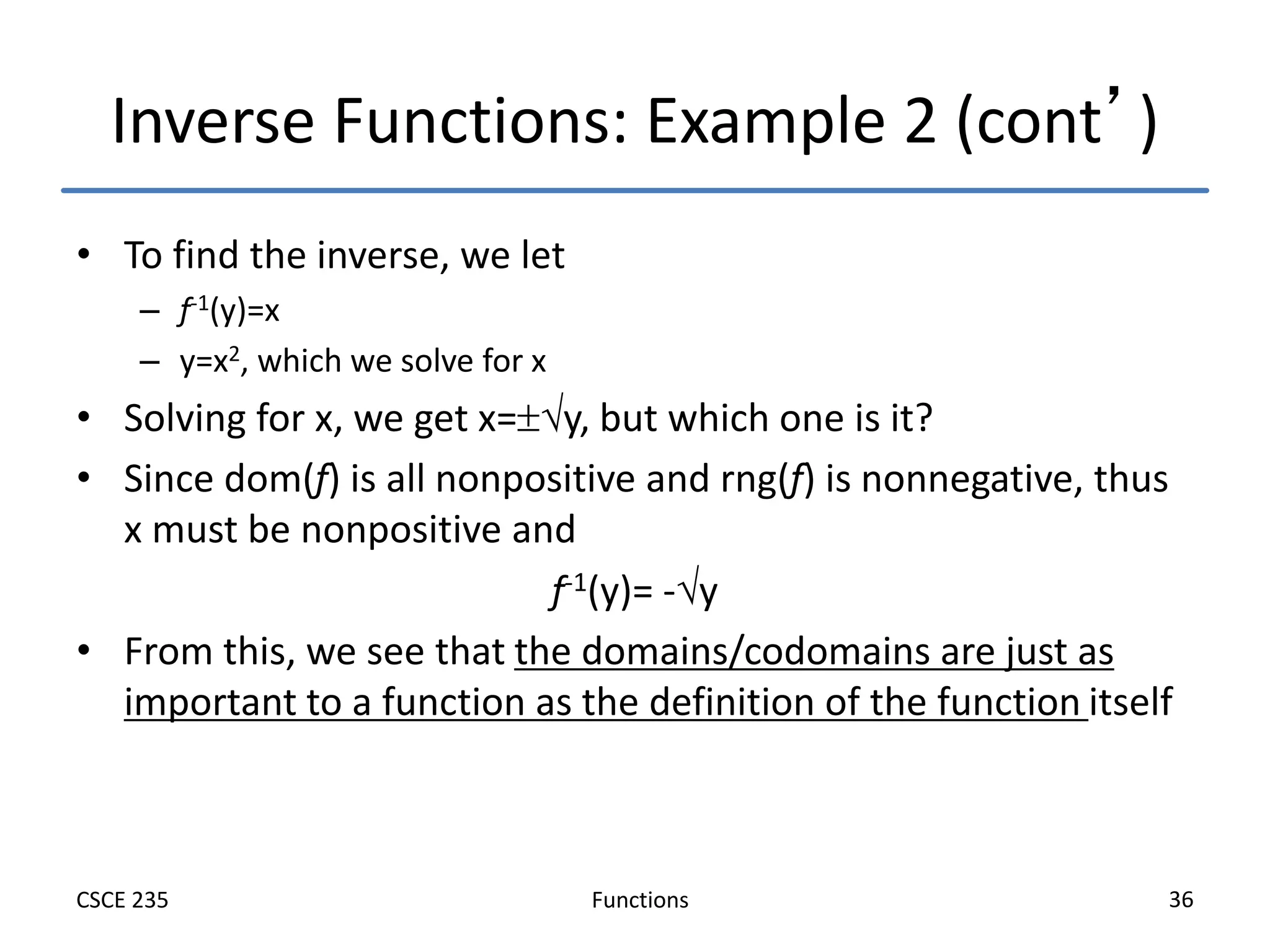
Inverse Functions: Example 2 (cont’)
• To find the inverse, we let
– f-1(y)=x
– y=x2, which we solve for x
• Solving for x, we get x=y, but which one is it?
• Since dom(f) is all nonpositive and rng(f) is nonnegative, thus
x must be nonpositive and
f-1(y)= -y
• From this, we see that the domains/codomains are just as
important to a function as the definition of the function itself
Functions
CSCE 235 37
Inverse Functions: Example 3
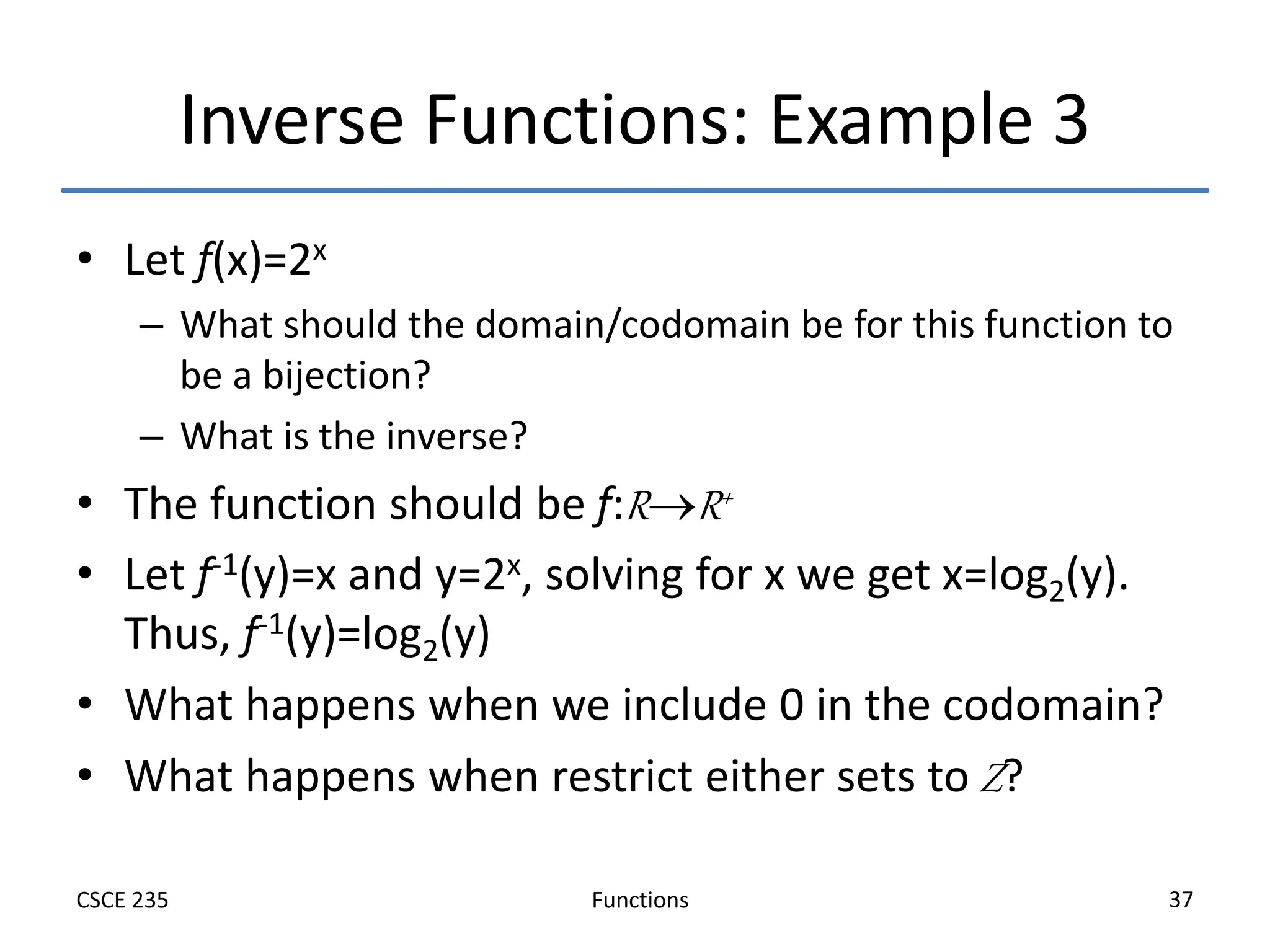
• Let f(x)=2x
– What should the domain/codomain be for this function to
be a bijection?
– What is the inverse?
• The function should be f:RR+
• Let f-1(y)=x and y=2x, solving for x we get x=log2(y).
Thus, f-1(y)=log2(y)
• What happens when we include 0 in the codomain?
• What happens when restrict either sets to Z?
Functions
CSCE 235 38
Function Composition (1)
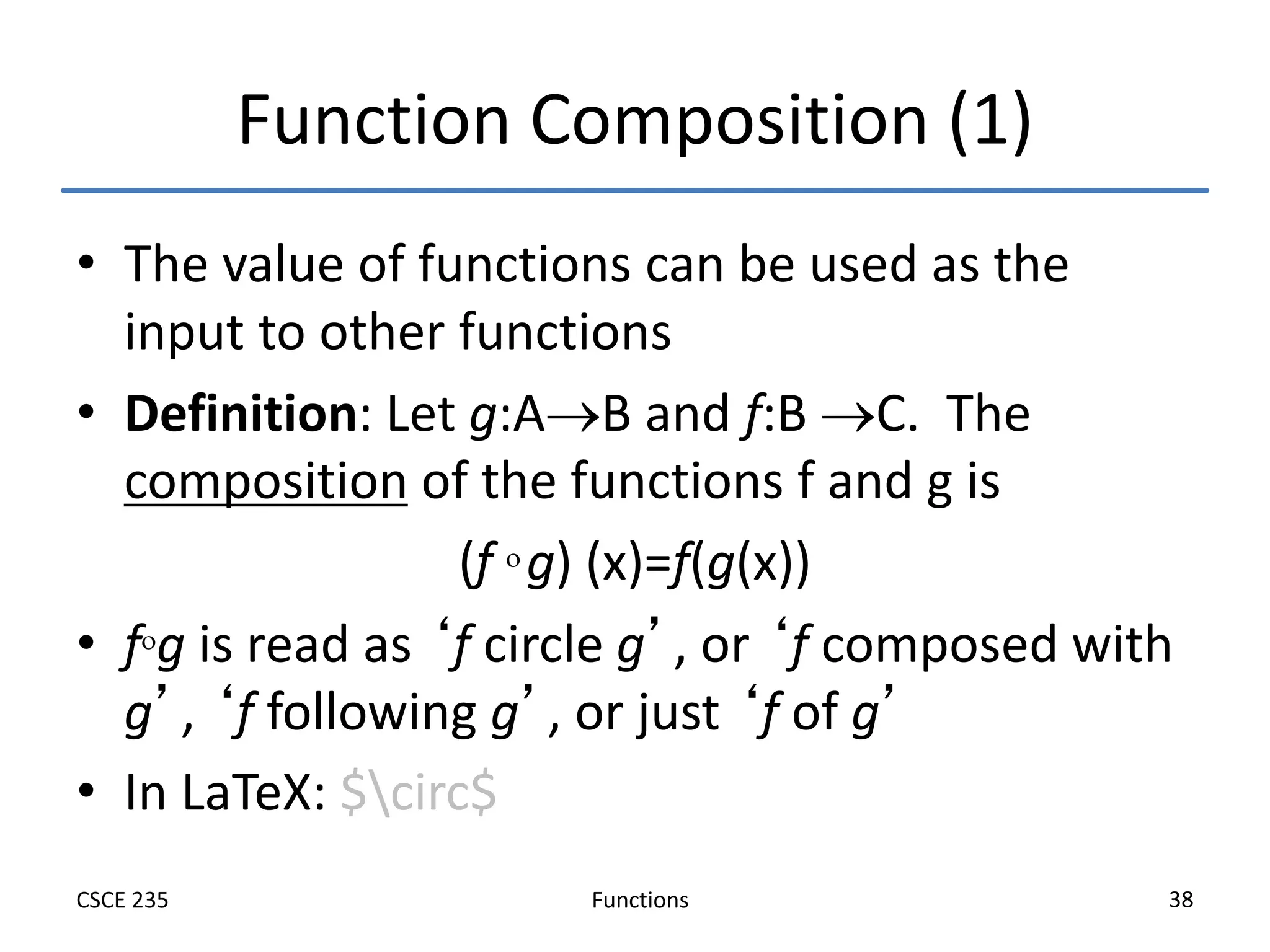
• The value of functions can be used as the
input to other functions
• Definition: Let g:AB and f:B C. The
composition of the functions f and g is
(f  g) (x)=f(g(x))
• fg is read as ‘f circle g’, or ‘f composed with
g’, ‘f following g’, or just ‘f of g’
• In LaTeX: $circ$
Functions
CSCE 235 39
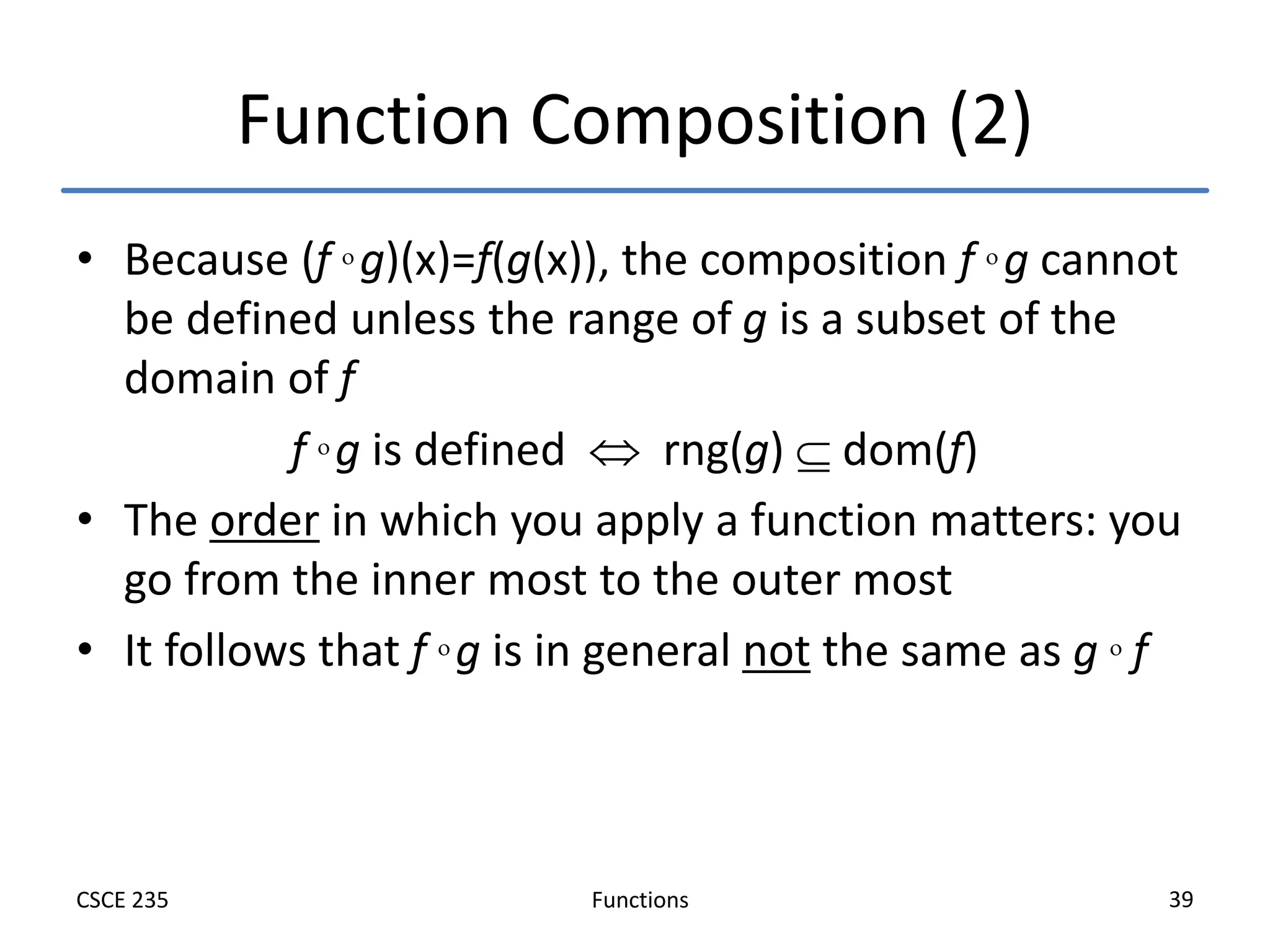
Function Composition (2)
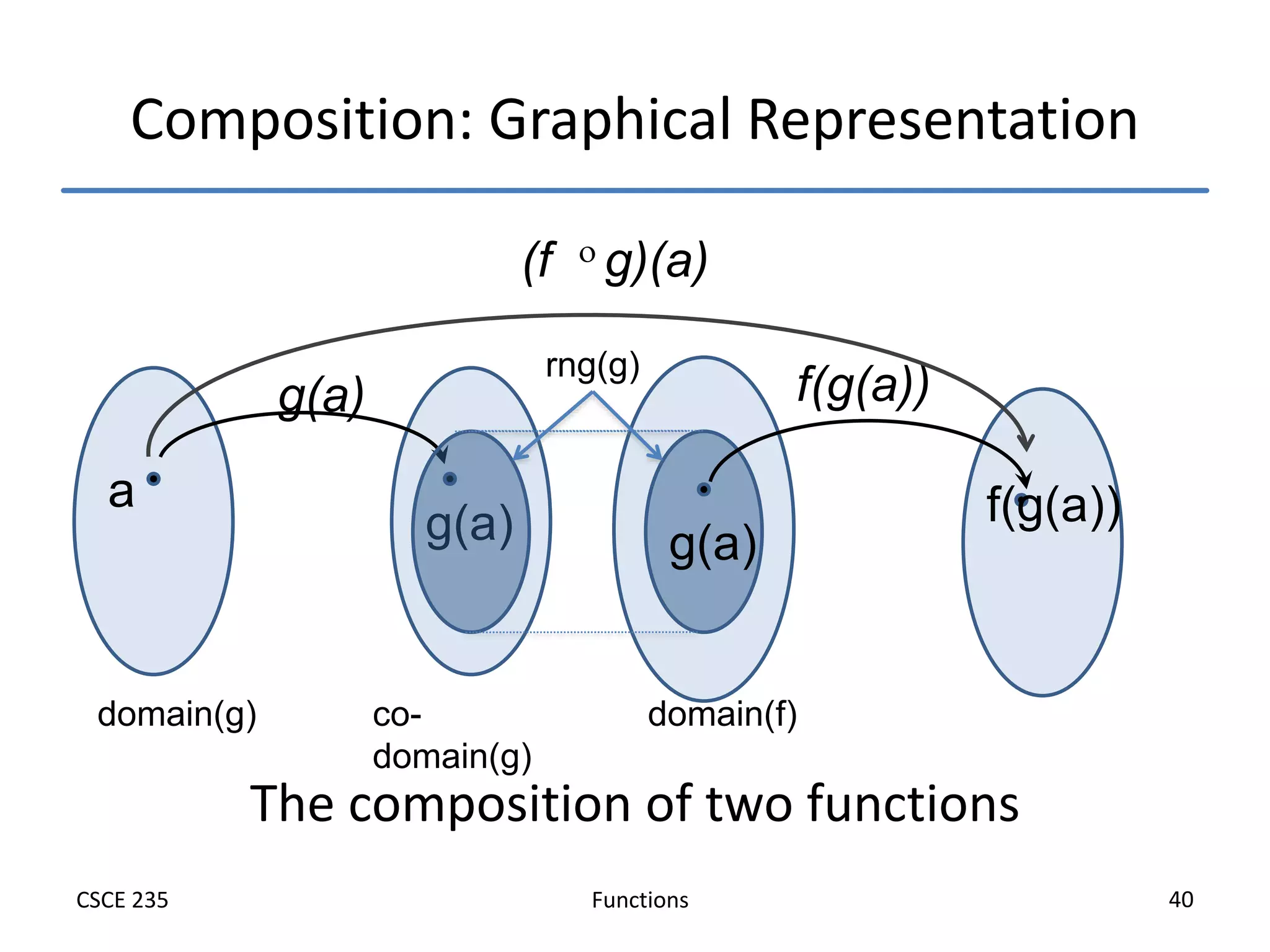
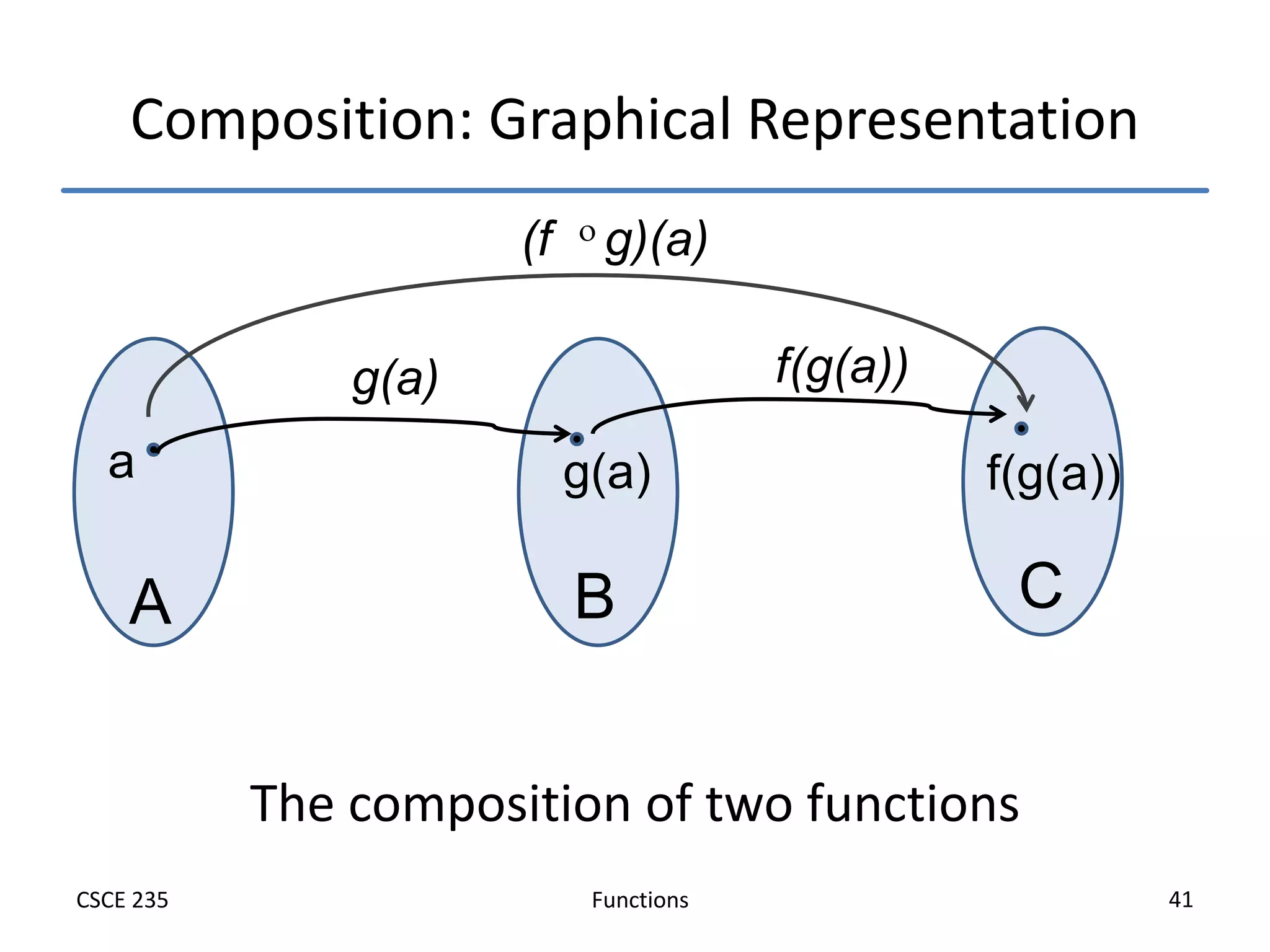
• Because (f  g)(x)=f(g(x)), the composition f  g cannot
be defined unless the range of g is a subset of the
domain of f
f  g is defined  rng(g)  dom(f)
• The order in which you apply a function matters: you
go from the inner most to the outer most
• It follows that f  g is in general not the same as g  f
Functions
CSCE 235 40
Composition: Graphical Representation
The composition of two functions
co-
domain(g)
a
g(a)
g(a)
f(g(a))
f(g(a))
(f  g)(a)
domain(f)
domain(g)
g(a)
rng(g)
Functions
CSCE 235 41
Composition: Graphical Representation
The composition of two functions
A B
a g(a)
g(a)
C
f(g(a))
f(g(a))
(f  g)(a)
Functions
CSCE 235 42
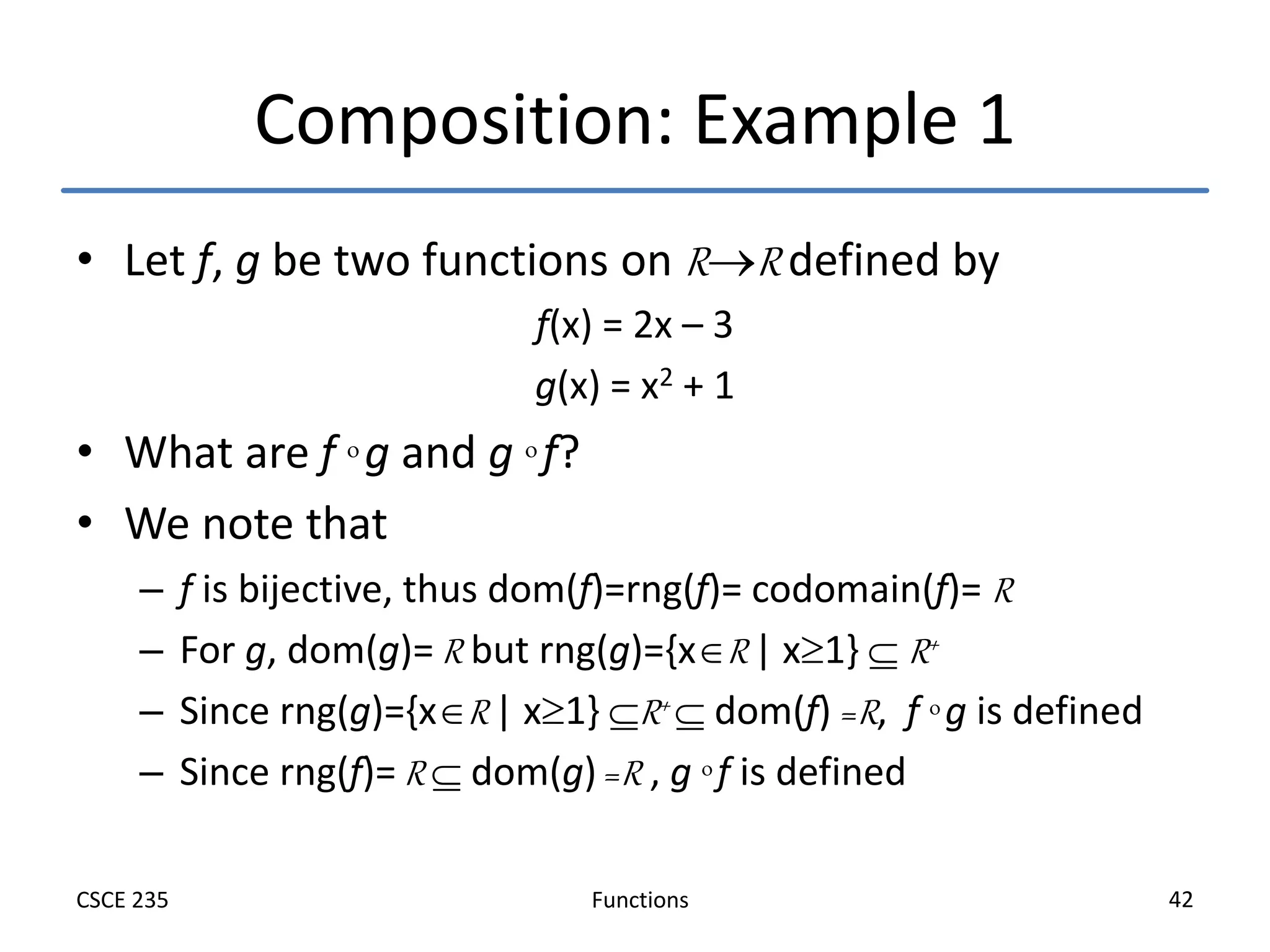
Composition: Example 1
• Let f, g be two functions on RR defined by
f(x) = 2x – 3
g(x) = x2 + 1
• What are f  g and g  f?
• We note that
– f is bijective, thus dom(f)=rng(f)= codomain(f)= R
– For g, dom(g)= R but rng(g)={xR | x1}  R+
– Since rng(g)={xR | x1} R+  dom(f) =R, f  g is defined
– Since rng(f)= R  dom(g) =R , g  f is defined
Functions
CSCE 235 43
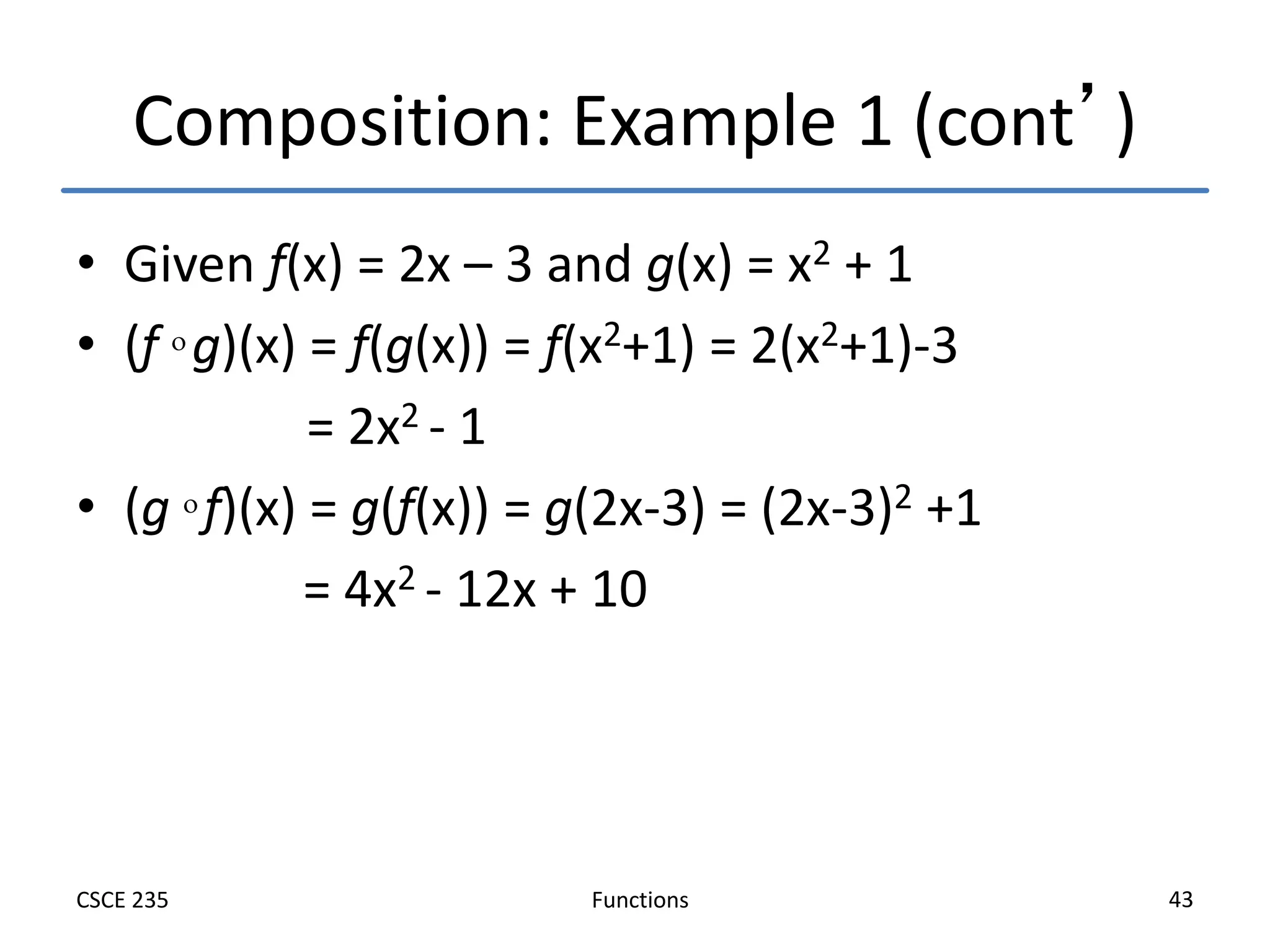
Composition: Example 1 (cont’)
• Given f(x) = 2x – 3 and g(x) = x2 + 1
• (f  g)(x) = f(g(x)) = f(x2+1) = 2(x2+1)-3
= 2x2 - 1
• (g  f)(x) = g(f(x)) = g(2x-3) = (2x-3)2 +1
= 4x2 - 12x + 10
Functions
CSCE 235 44
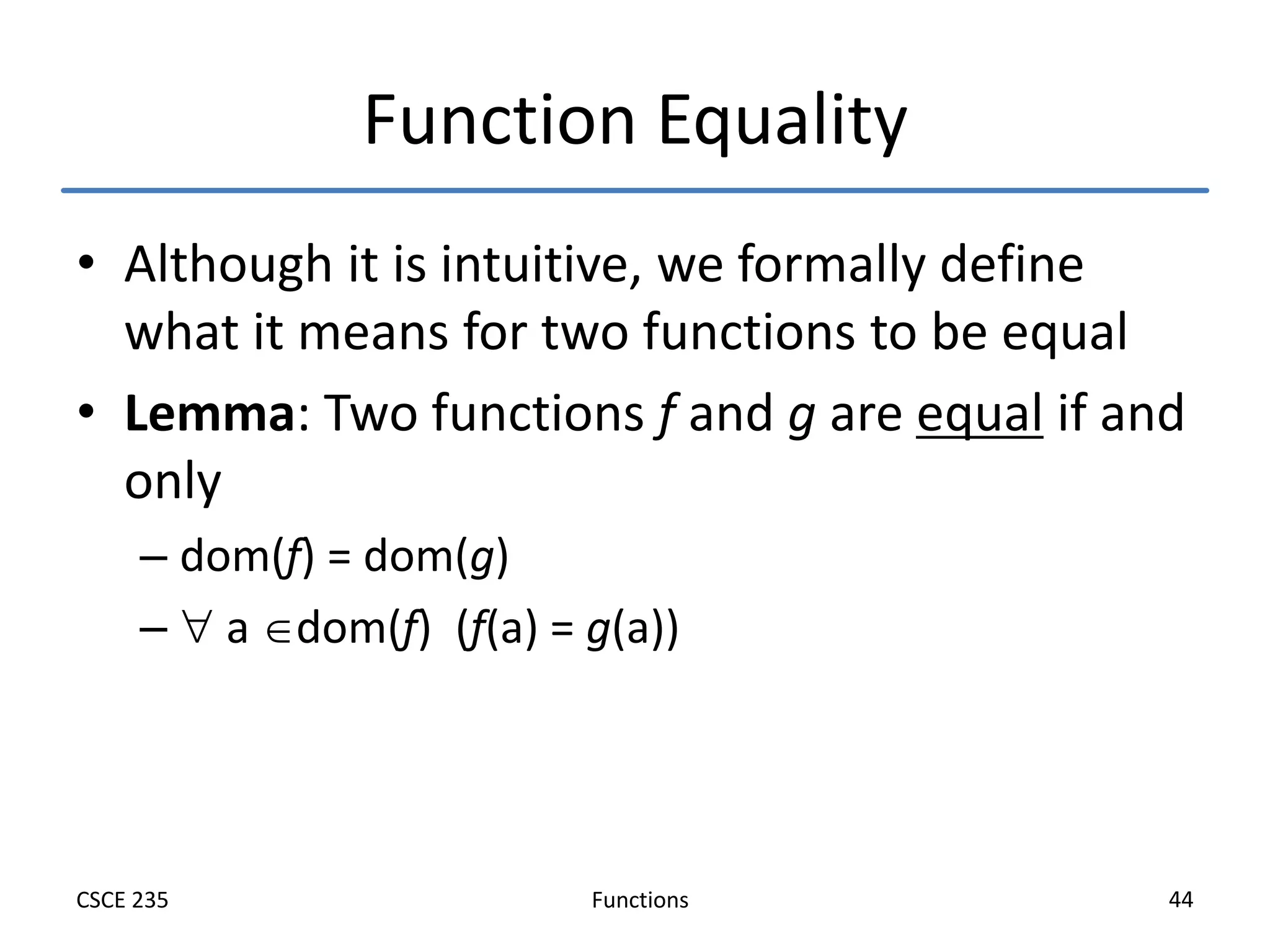
Function Equality
• Although it is intuitive, we formally define
what it means for two functions to be equal
• Lemma: Two functions f and g are equal if and
only
– dom(f) = dom(g)
–  a dom(f) (f(a) = g(a))
Functions
CSCE 235 45
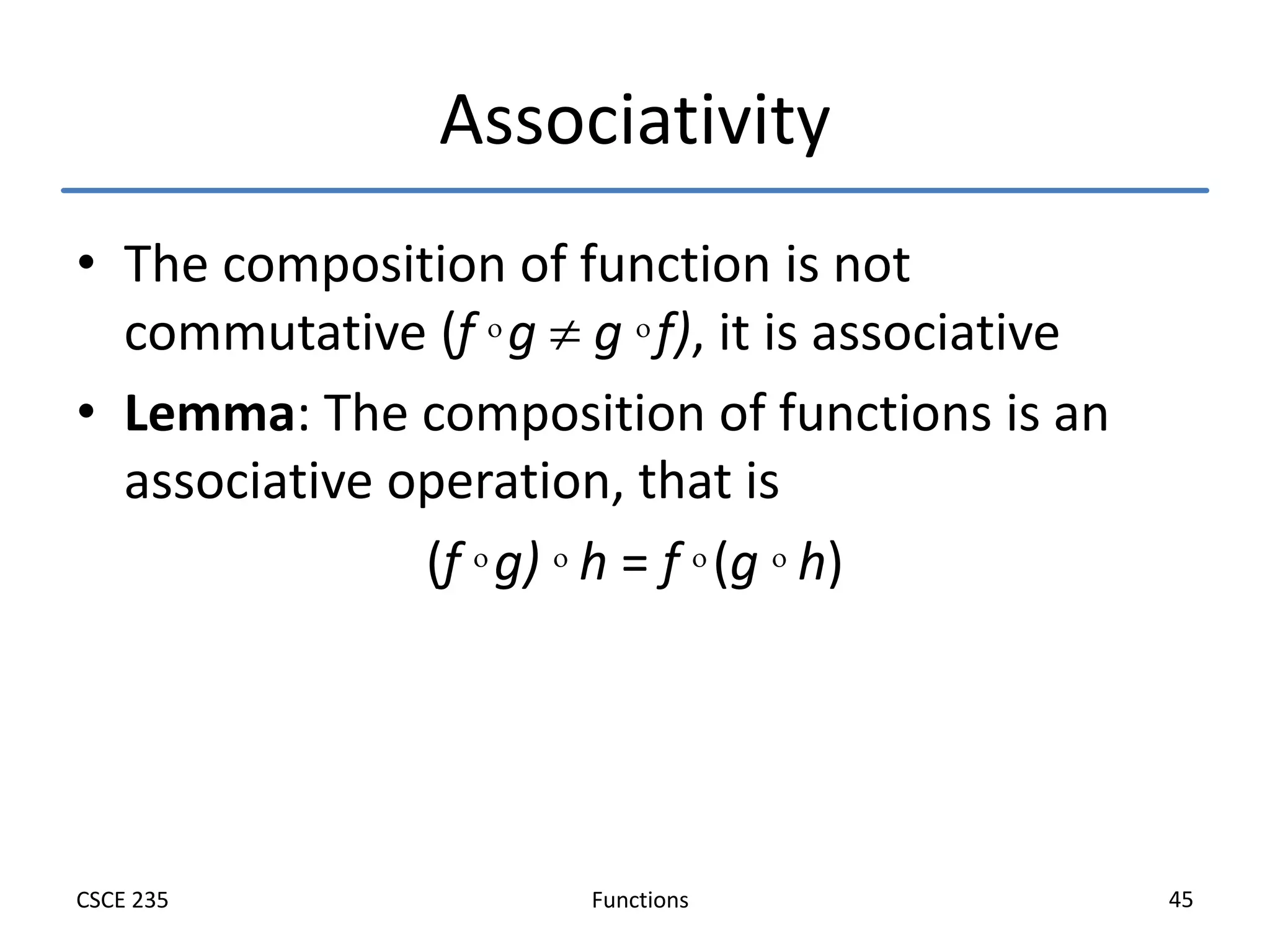
Associativity
• The composition of function is not
commutative (f  g  g  f), it is associative
• Lemma: The composition of functions is an
associative operation, that is
(f  g)  h = f  (g  h)
Functions
CSCE 235 46
Outline
• Definitions & terminology
– function, domain, co-domain, image, preimage (antecedent), range, image of a
set, strictly increasing, strictly decreasing, monotonic
• Properties
– One-to-one (injective), onto (surjective), one-to-one correspondence
(bijective)
– Exercices (5)
• Inverse functions (examples)
• Operators
– Composition, Equality
• Important functions
– identity, absolute value, floor, ceiling, factorial
Functions
CSCE 235 47
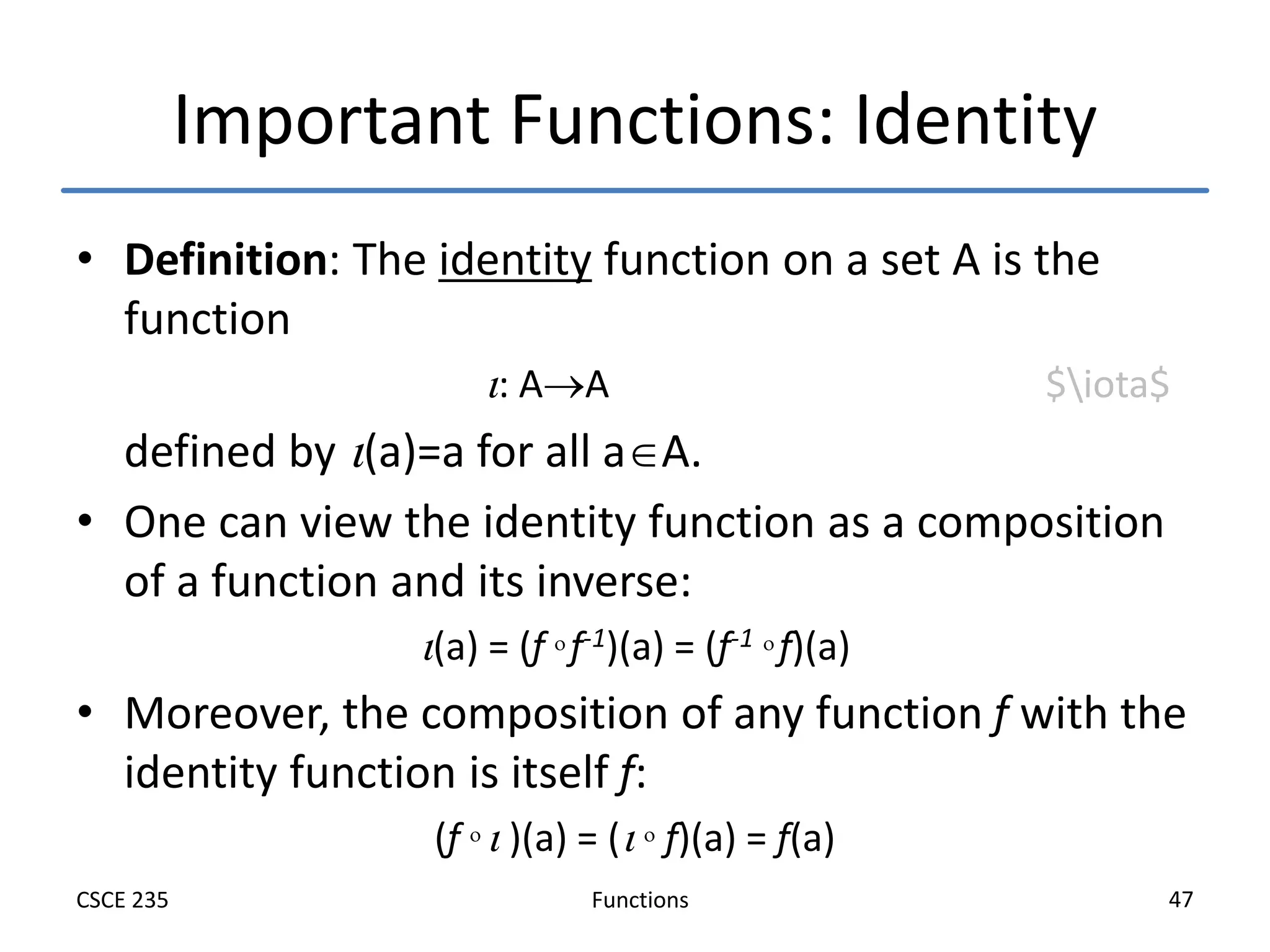
Important Functions: Identity
• Definition: The identity function on a set A is the
function
: AA $iota$
defined by (a)=a for all aA.
• One can view the identity function as a composition
of a function and its inverse:
(a) = (f  f-1)(a) = (f-1  f)(a)
• Moreover, the composition of any function f with the
identity function is itself f:
(f   )(a) = (  f)(a) = f(a)
Functions
CSCE 235 48
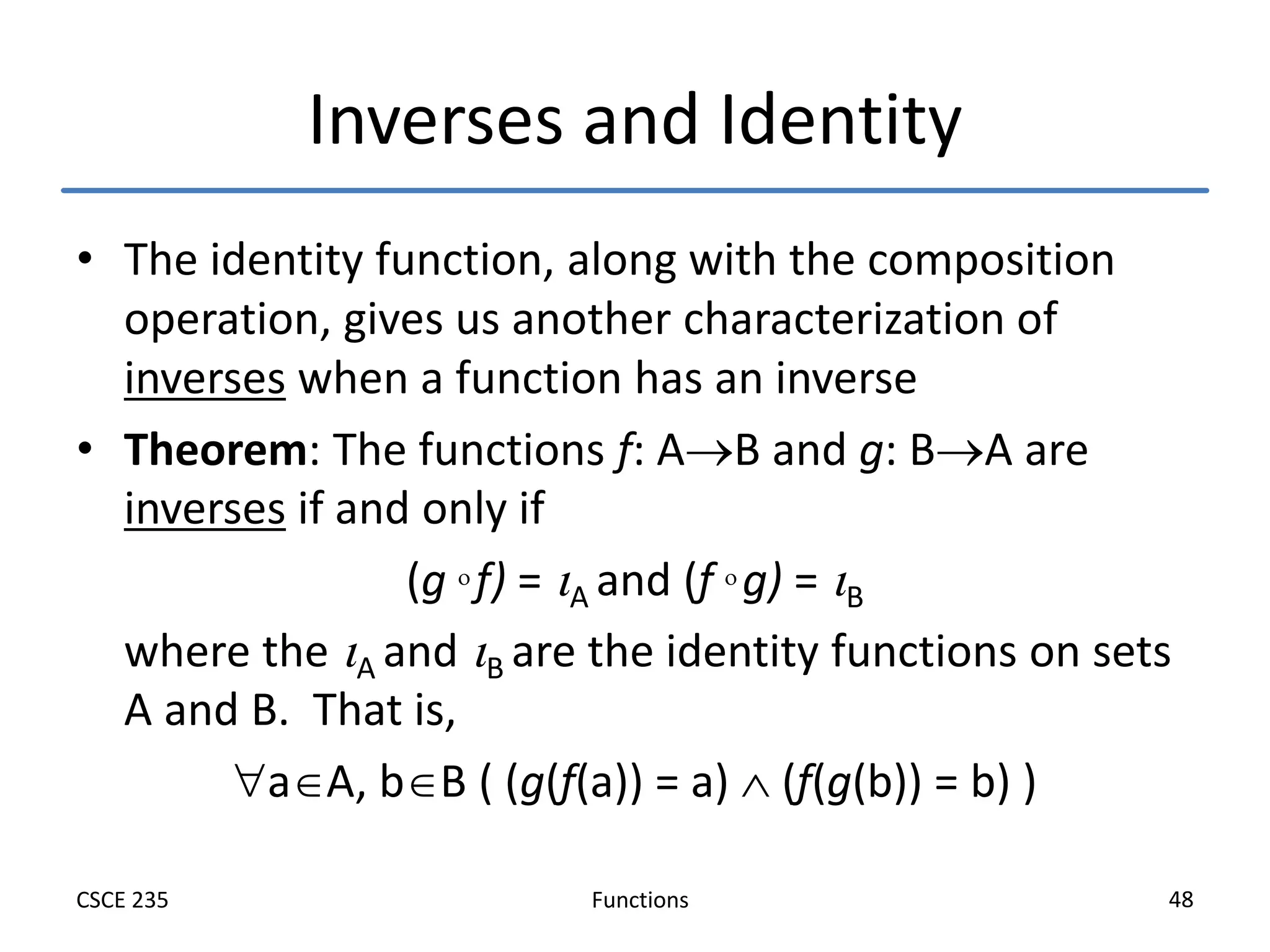
Inverses and Identity
• The identity function, along with the composition
operation, gives us another characterization of
inverses when a function has an inverse
• Theorem: The functions f: AB and g: BA are
inverses if and only if
(g  f) = A and (f  g) = B
where the A and B are the identity functions on sets
A and B. That is,
aA, bB ( (g(f(a)) = a)  (f(g(b)) = b) )
Functions
CSCE 235 49
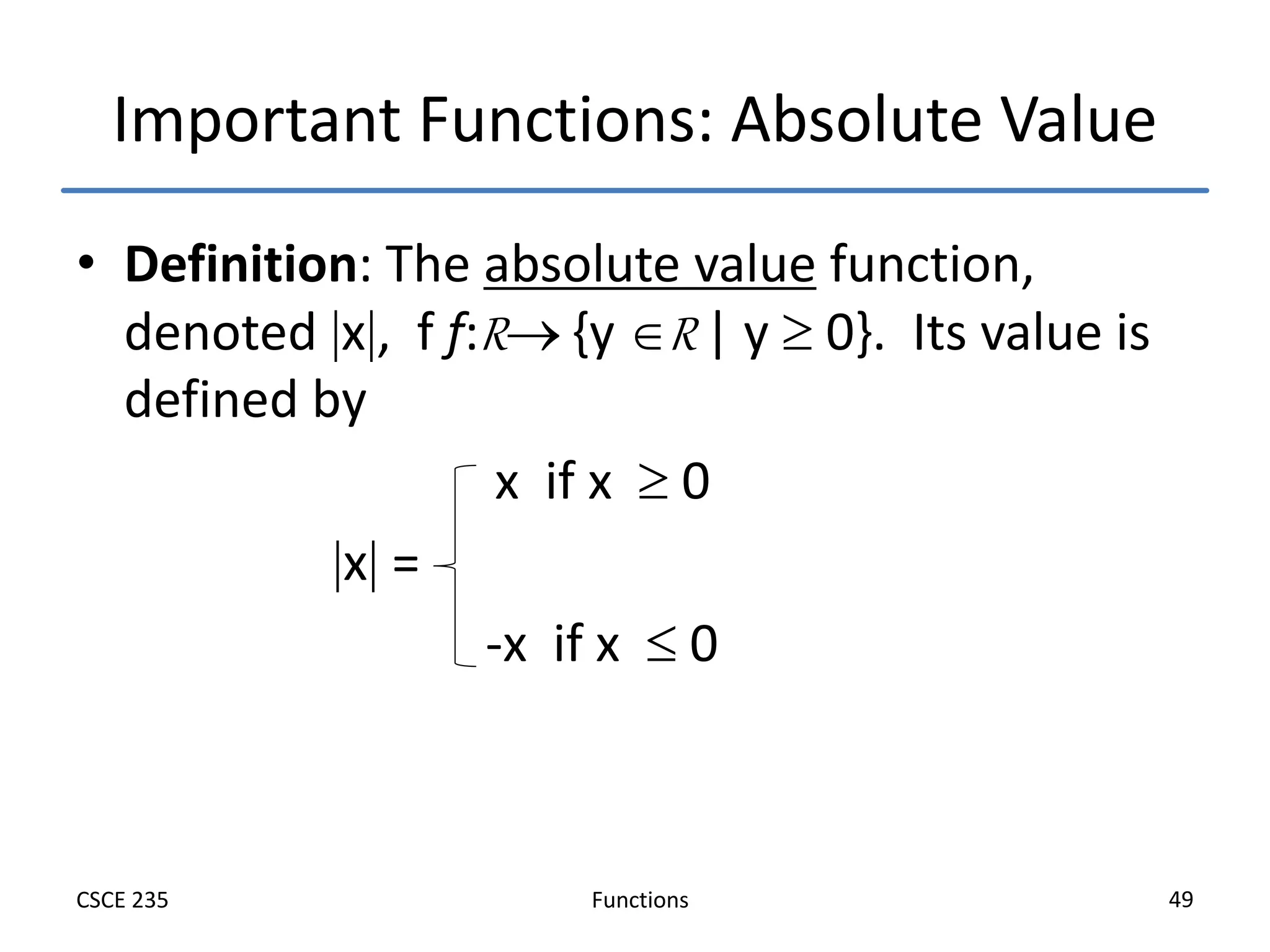
Important Functions: Absolute Value
• Definition: The absolute value function,
denoted x, f f:R {y R | y  0}. Its value is
defined by
x if x  0
x =
-x if x  0
Functions
CSCE 235 50
Important Functions: Floor & Ceiling
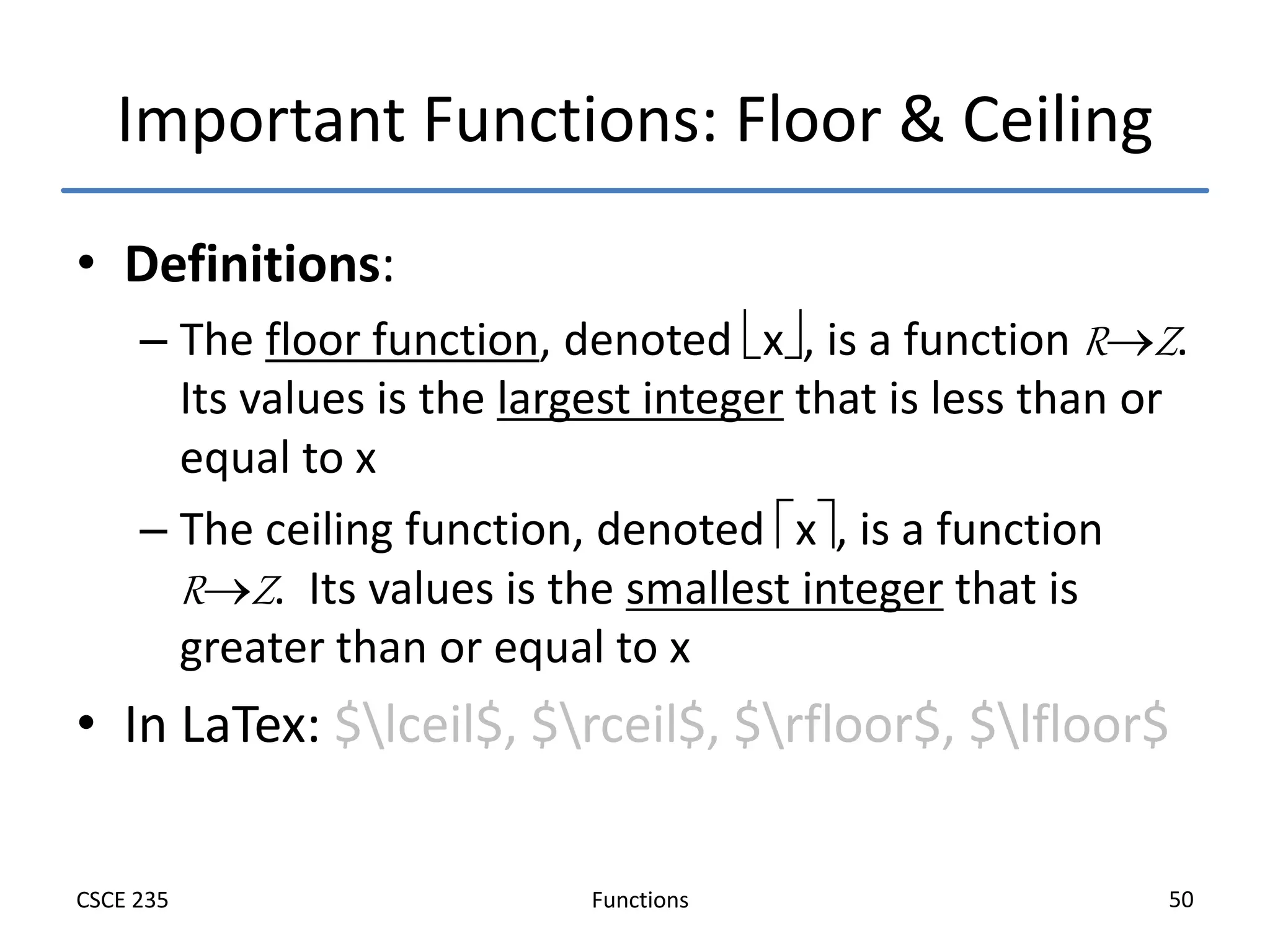
• Definitions:
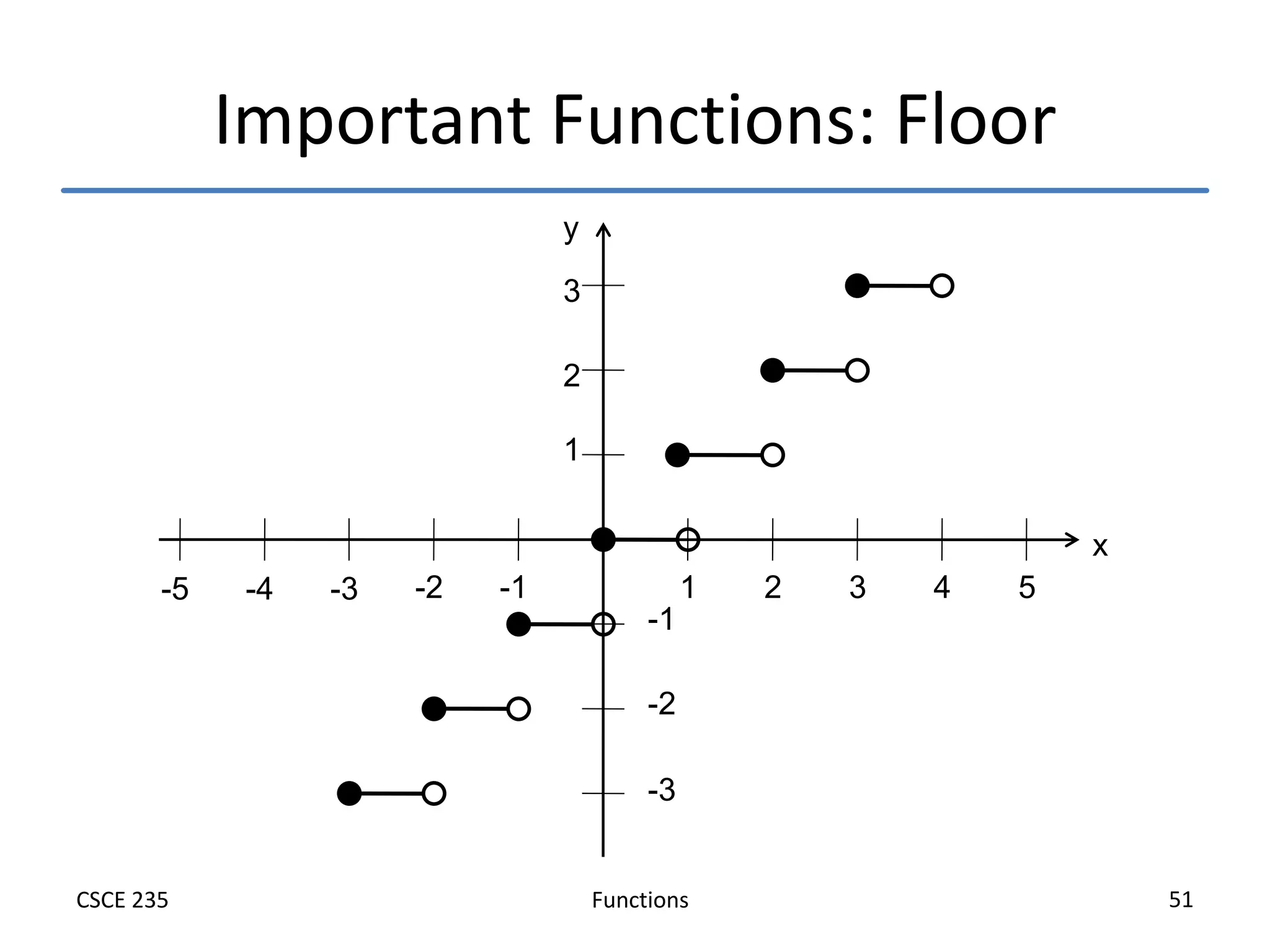
– The floor function, denoted x, is a function RZ.
Its values is the largest integer that is less than or
equal to x
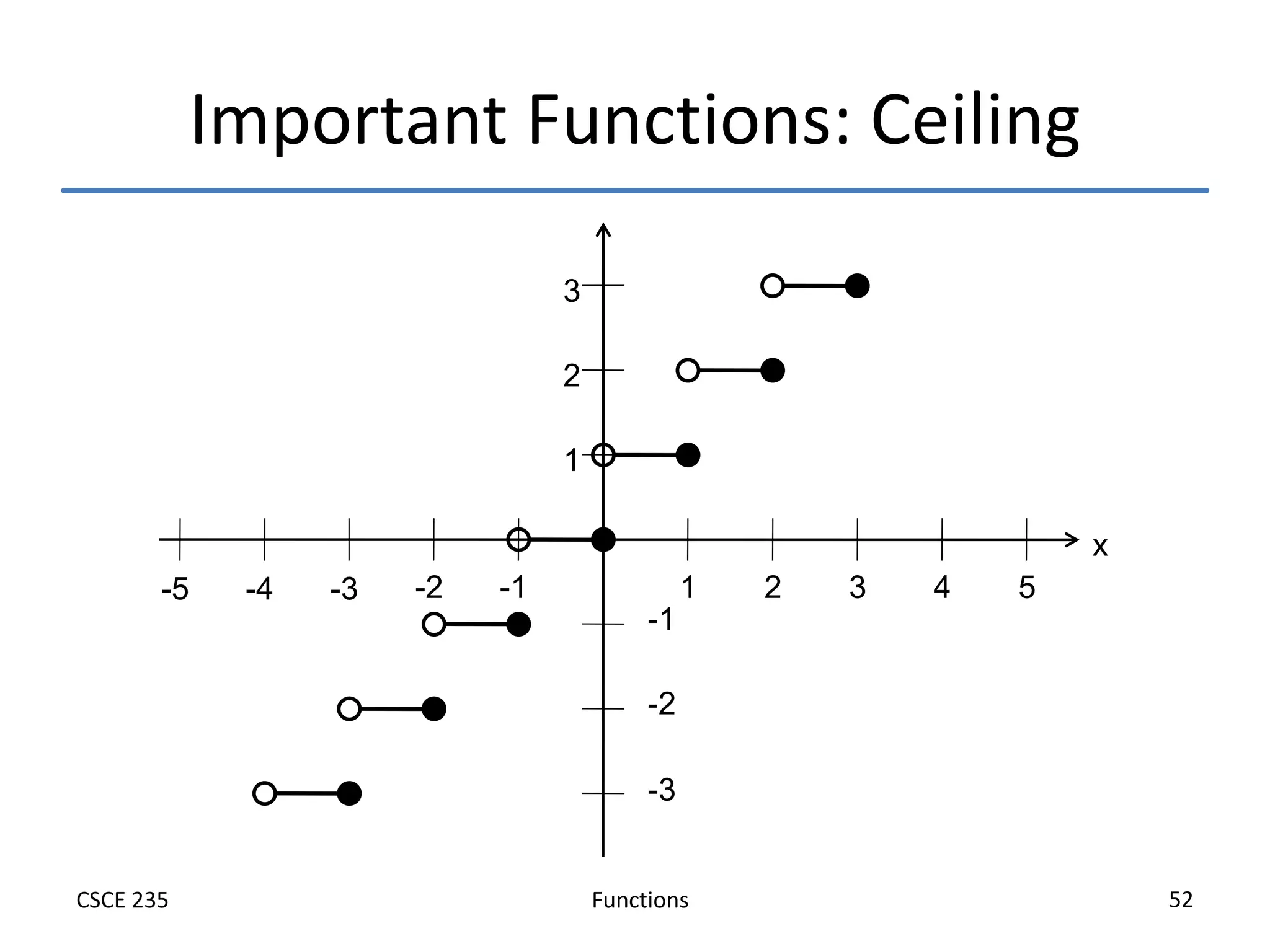
– The ceiling function, denoted x, is a function
RZ. Its values is the smallest integer that is
greater than or equal to x
• In LaTex: $lceil$, $rceil$, $rfloor$, $lfloor$
Functions
CSCE 235 51
Important Functions: Floor
1 2 3 4 5
-1
-2
-3
-4
-5
1
2
3
-1
-2
-3
x
y
Functions
CSCE 235 52
Important Functions: Ceiling
1 2 3 4 5
-1
-2
-3
-4
-5
1
2
3
-1
-2
-3
x
Functions
CSCE 235 53
Important Function: Factorial
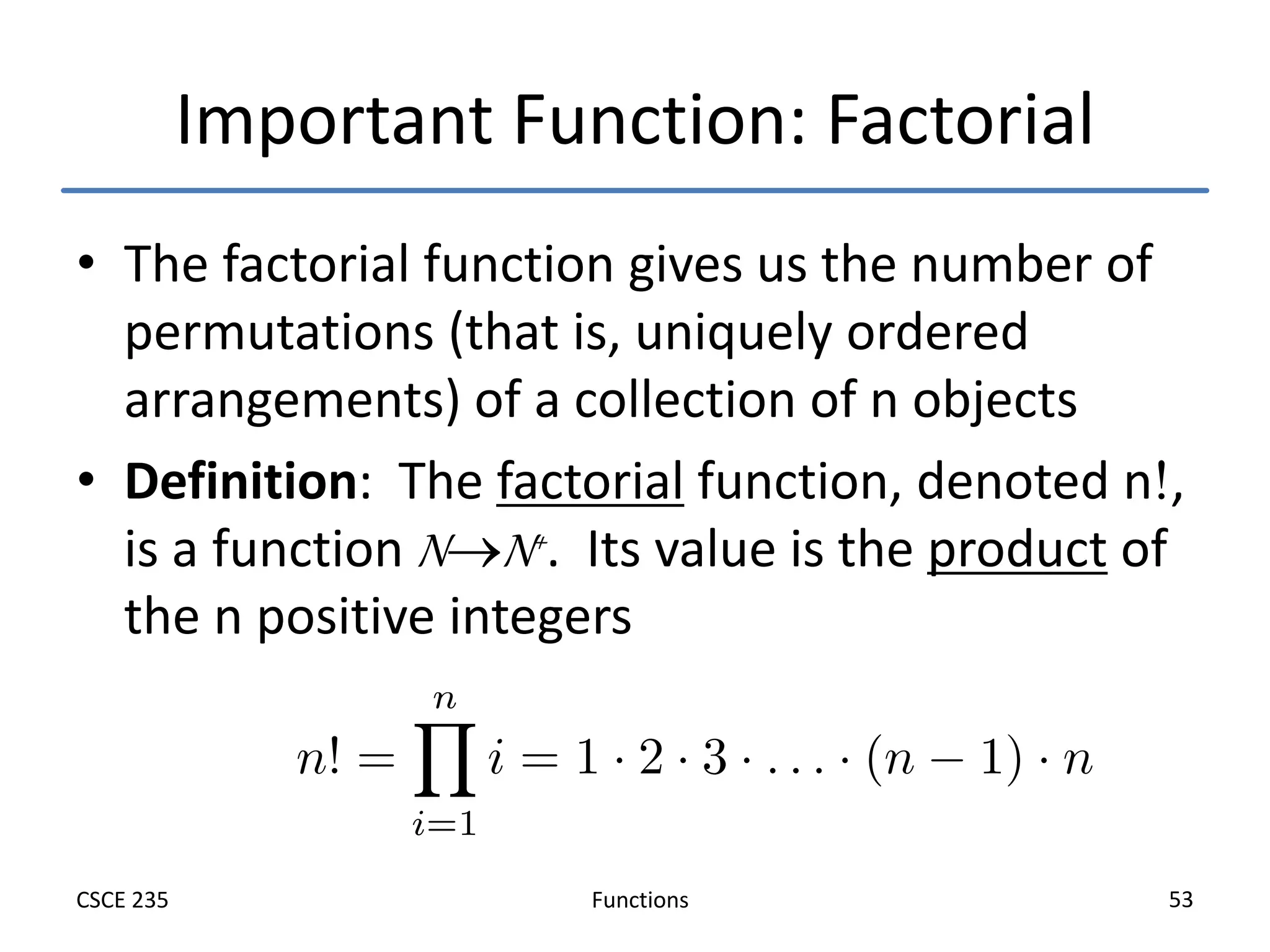
• The factorial function gives us the number of
permutations (that is, uniquely ordered
arrangements) of a collection of n objects
• Definition: The factorial function, denoted n,
is a function NN+. Its value is the product of
the n positive integers
Functions
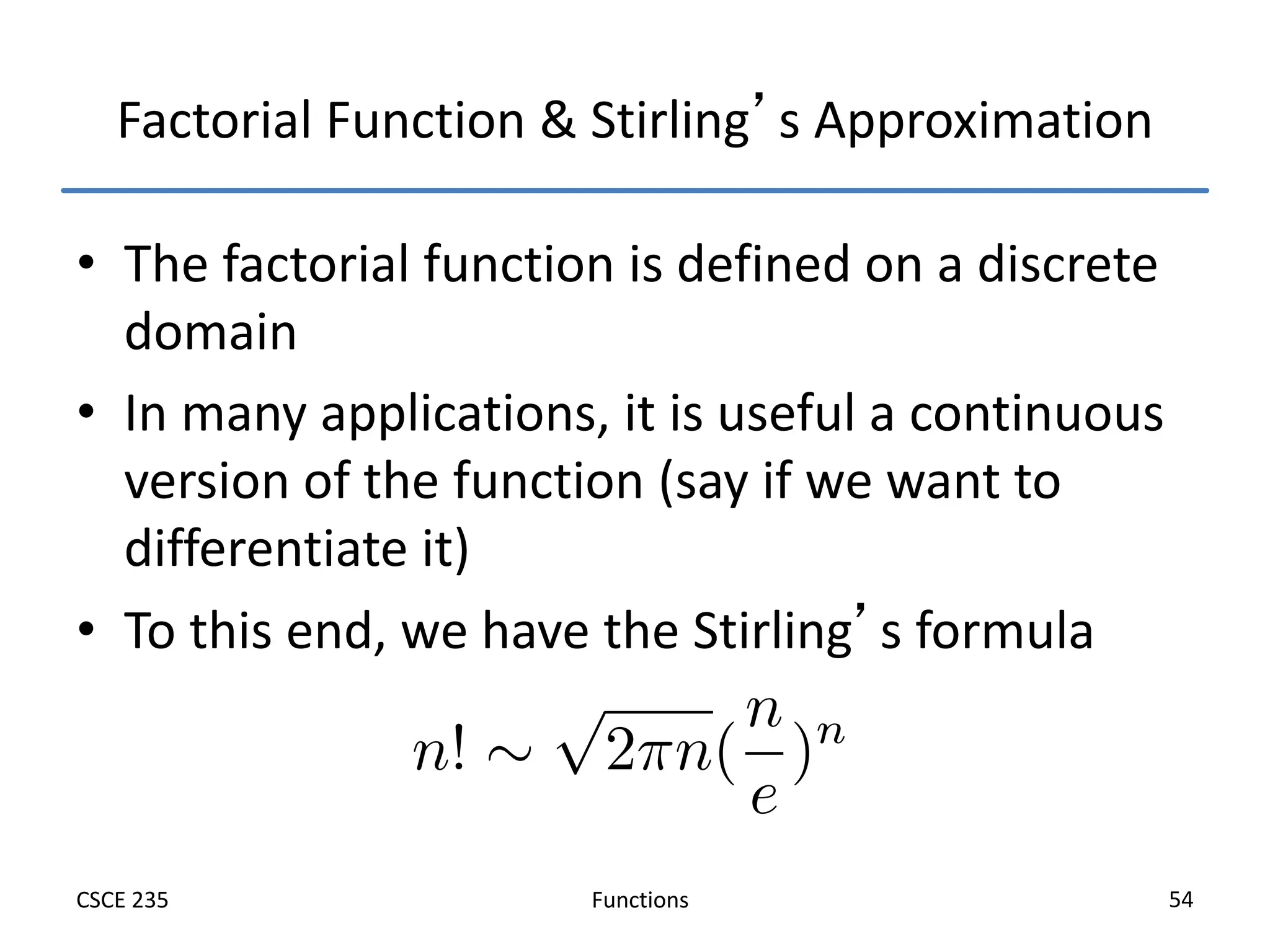
CSCE 235 54
Factorial Function & Stirling’s Approximation
• The factorial function is defined on a discrete
domain
• In many applications, it is useful a continuous
version of the function (say if we want to
differentiate it)
• To this end, we have the Stirling’s formula
Functions
CSCE 235 55
Summary
• Definitions & terminology
– function, domain, co-domain, image, preimage (antecedent), range,
image of a set, strictly increasing, strictly decreasing, monotonic
• Properties
– One-to-one (injective), onto (surjective), one-to-one correspondence
(bijective)
– Exercices (5)
• Inverse functions (examples)
• Operators
– Composition, Equality
• Important functions
– identity, absolute value, floor, ceiling, factorial

Functions.pptx

  • 1.
    Functions Section 2.3 ofRosen Spring 2020 CSCE 235H Introduction to Discrete Structures (Honors) Course web-page: cse.unl.edu/~cse235h Questions: Piazza
  • 2.
    Functions CSCE 235 2 Outline •Definitions & terminology – function, domain, co-domain, image, preimage (antecedent), range, image of a set, strictly increasing, strictly decreasing, monotonic • Properties – One-to-one (injective) – Onto (surjective) – One-to-one correspondence (bijective) – Exercices (5) • Inverse functions (examples) • Operators – Composition, Equality • Important functions – identity, absolute value, floor, ceiling, factorial
  • 3.
    Functions CSCE 235 3 Introduction •You have already encountered function – f(x,y) = x+y – f(x) = x – f(x) = sin(x) • Here we will study functions defined on discrete domains and ranges • We may not always be able to write function in a ‘neat way’ as above
  • 4.
    Functions CSCE 235 4 Definition:Function • Definition: A function f – from a set A to a set B – is an assignment of exactly one element of B to each element of A. • We write f(a)=b if b is the unique element of B assigned by the function f to the element a  A. • Notation: f: A  B which can be read as ‘f maps A to B’ • Note the subtlety – Each and every element of A has a single mapping – Each element of B may be mapped to by several elements in A or not at all
  • 5.
    Functions CSCE 235 5 Terminology •Let f: A  B and f(a)=b. Then we use the following terminology: – A is the domain of f, denoted dom(f) – B is the co-domain of f – b is the image of a – a is the preimage (antecedent) of b – The range of f is the set of all images of elements of A, denoted rng(f)
  • 6.
    Functions CSCE 235 6 Function:Visualization A function, f: A  B A B a b f Domain Co-Domain Preimage Image, f(a)=b Range
  • 7.
    Functions CSCE 235 7 MoreDefinitions (1) • Definition: Let f1 and f2 be two functions from a set A to R. Then f1+f2 and f1f2 are also function from A to R defined by: – (f1+f2)(x) = f1(x) + f2(x) – f1f2(x)= f1(x)f2(x) • Example: Let f1(x)=x4+2x2+1 and f2(x)=2-x2 – (f1+f2)(x) = x4+2x2+1+2-x2 = x4+x2+3 – f1f2(x) = (x4+2x2+1)(2-x2)= -x6+3x2+2
  • 8.
    Functions CSCE 235 8 MoreDefinitions (2) • Definition: Let f: A B and S A. The image of the set S is the subset of B that consists of all the images of the elements of S. We denote the image of S by f(S), so that f(S)={ f(s) |  s  S } • Note there that the image of S is a set and not an element.
  • 9.
    Functions CSCE 235 9 Imageof a set: Example • Let: – A = {a1,a2,a3,a4,a5} – B = {b1,b2,b3,b4,b5} – f={(a1,b2), (a2,b3), (a3,b3), (a4,b1), (a5,b4)} – S={a1,a3} • Draw a diagram for f • What is the: – Domain, co-domain, range of f? – Image of S, f(S)?
  • 10.
    Functions CSCE 235 10 MoreDefinitions (3) • Definition: A function f whose domain and codomain are subsets of the set of real numbers (R) is called – strictly increasing if f(x)<f(y) whenever x<y and x and y are in the domain of f. – strictly decreasing if f(x)>f(y) whenever x<y and x and y are in the domain of f. • A function that is increasing or decreasing is said to be monotonic
  • 11.
    Functions CSCE 235 11 Outline •Definitions & terminology • Properties – One-to-one (injective) – Onto (surjective) – One-to-one correspondence (bijective) – Exercices (5) • Inverse functions (examples) • Operators • Important functions
  • 12.
    Functions CSCE 235 12 Definition:Injection • Definition: A function f is said to be one-to-one or injective (or an injection) if  x and y in in the domain of f, f(x)=f(y)  x=y • Intuitively, an injection simply means that each element in the range has at most one preimage (antecedent) • It is useful to think of the contrapositive of this definition x  y  f(x)  f(y)
  • 13.
    Functions CSCE 235 13 Definition:Surjection • Definition: A function f: AB is called onto or surjective (or an surjection) if bB,  aA with f(a)=b • Intuitively, a surjection means that every element in the codomain is mapped into (i.e., it is an image, has an antecedent) • Thus, the range is the same as the codomain
  • 14.
    Functions CSCE 235 14 Definition:Bijection • Definition: A function f is a one-to-one correspondence (or a bijection), if it is both – one-to-one (injective) and – onto (surjective) • One-to-one correspondences are important because they endow a function with an inverse. • They also allow us to have a concept cardinality for infinite sets • Let’s look at a few examples to develop a feel for these definitions…
  • 15.
    Functions CSCE 235 15 Functions:Example 1 • Is this a function? Why? a1 a2 a3 a4 b1 b2 b3 b4 A B • No, because each of a1, a2 has two images
  • 16.
    Functions CSCE 235 16 Functions:Example 2 • Is this a function – One-to-one (injective)? Why? – Onto (surjective)? Why? a1 a2 a3 a4 b1 b2 b3 b4 A B No, b1 has 2 preimages No, b4 has no preimage
  • 17.
    Functions CSCE 235 17 Functions:Example 3 • Is this a function – One-to-one (injective)? Why? – Onto (surjective)? Why? a1 a2 a3 b1 b2 b3 b4 A B Yes, no bi has 2 preimages No, b4 has no preimage
  • 18.
    Functions CSCE 235 18 Functions:Example 4 a1 a2 a3 a4 b1 b2 b3 A B • Is this a function – One-to-one (injective)? Why? – Onto (surjective)? Why? No, b3 has 2 preimages Yes, every bi has a preimage
  • 19.
    Functions CSCE 235 19 Functions:Example 5 a1 a2 a3 a4 b1 b2 b3 b4 A B • Is this a function – One-to-one (injective)? – Onto (surjective)? Thus, it is a bijection or a one-to-one correspondence
  • 20.
    Functions CSCE 235 20 Exercice1 • Let f:ZZ be defined by f(x)=2x-3 • What is the domain, codomain, range of f? • Is f one-to-one (injective)? • Is f onto (surjective)? • Clearly, dom(f)=Z. To see what the range is, note that: b rng(f)  b=2a-3, with aZ  b=2(a-2)+1  b is odd
  • 21.
    Functions CSCE 235 21 Exercise1 (cont’d) • Thus, the range is the set of all odd integers • Since the range and the codomain are different (i.e., rng(f)  Z), we can conclude that f is not onto (surjective) • However, f is one-to-one injective. Using simple algebra, we have: f(x1) = f(x2)  2x1-3 = 2x2-3  x1= x2 QED
  • 22.
    Functions CSCE 235 22 Exercise2 • Let f be as before f(x)=2x-3 but now we define f:N N • What is the domain and range of f? • Is f onto (surjective)? • Is f one-to-one (injective)? • By changing the domain and codomain of f, f is not even a function anymore. Indeed, f(1)=21-3=-1N
  • 23.
    Functions CSCE 235 23 Exercice3 • Let f:ZZ be defined by f(x) = x2 - 5x + 5 • Is this function – One-to-one? – Onto?
  • 24.
    Functions CSCE 235 24 Exercice3: Answer • It is not one-to-one (injective) f(x1)=f(x2)  x1 2-5x1+5=x2 2 - 5x2+5  x1 2 - 5x1 = x2 2 - 5x2  x1 2 - x2 2 = 5x1 - 5x2  (x1 - x2)(x1 + x2) = 5(x1 - x2)  (x1 + x2) = 5 Many x1,x2 Z satisfy this equality. There are thus an infinite number of solutions. In particular, f(2)=f(3)=-1 • It is also not onto (surjective). The function is a parabola with a global minimum at (5/2,-5/4). Therefore, the function fails to map to any integer less than -1 • What would happen if we changed the domain/codomain?
  • 25.
    Functions CSCE 235 25 Exercice4 • Let f:ZZ be defined by f(x) = 2x2 + 7x • Is this function – One-to-one (injective)? – Onto (surjective)? • Again, this is a parabola, it cannot be onto (where is the global minimum?)
  • 26.
    Functions CSCE 235 26 Exercice4: Answer • f(x) is one-to-one! Indeed: f(x1)=f(x2)  2x1 2+7x1=2x2 2 + 7x2  2x1 2 - 2x2 2 = 7x2 - 7x1  2(x1 - x2)(x1 + x2) = 7(x2 - x1)  2(x1 + x2) = -7  (x1 + x2) = -7  (x1 + x2) = -7/2 But -7/2  Z. Therefore it must be the case that x1 = x2. It follows that f is a one-to-one function. QED • f(x) is not surjective because f(x)=1 does not exist 2x2 +7x=1  x(2x +7)=1 the product of two integers is 1 if both integers are 1 or -1 x=1  (2x+7)=1  9 =1, impossible x=-1  -1(-2+7)=1  -5=1, impossible
  • 27.
    Functions CSCE 235 27 Exercise5 • Let f:ZZ be defined by f(x) = 3x3 – x • Is this function – One-to-one (injective)? – Onto (surjective)?
  • 28.
    Functions CSCE 235 28 Exercice5: f is one-to-one • To check if f is one-to-one, again we suppose that for x1,x2 Z we have f(x1)=f(x2) f(x1)=f(x2)  3x1 3-x1=3x2 3-x2  3x1 3 - 3x2 3 = x1 - x2  3 (x1 - x2)(x1 2 +x1x2+x2 2)= (x1 - x2)  (x1 2 +x1x2+x2 2)= 1/3 which is impossible because x1,x2 Z thus, f is one-to-one
  • 29.
    Functions CSCE 235 29 Exercice5: f is not onto • Consider the counter example f(a)=1 • If this were true, we would have 3a3 – a=1  a(3a2 – 1)=1 where a and (3a2 – 1) Z • The only time we can have the product of two integers equal to 1 is when they are both equal to 1 or -1 • Neither 1 nor -1 satisfy the above equality • Thus, we have identified 1Z that does not have an antecedent and f is not onto (surjective)
  • 30.
    Functions CSCE 235 30 Outline •Definitions & terminology – function, domain, co-domain, image, preimage (antecedent), range, image of a set, strictly increasing, strictly decreasing, monotonic • Properties – One-to-one (injective), onto (surjective), one-to-one correspondence (bijective) – Exercices (5) • Inverse functions (examples) • Operators – Composition, Equality • Important functions – identity, absolute value, floor, ceiling, factorial
  • 31.
    Functions CSCE 235 31 InverseFunctions (1) • Definition: Let f: AB be a bijection. The inverse function of f is the function that assigns to an element bB the unique element aA such that f(a)=b • The inverse function is denote f-1. • When f is a bijection, its inverse exists and f(a)=b  f-1(b)=a
  • 32.
    Functions CSCE 235 32 InverseFunctions (2) • Note that by definition, a function can have an inverse if and only if it is a bijection. Thus, we say that a bijection is invertible • Why must a function be bijective to have an inverse? – Consider the case where f is not one-to-one (not injective). This means that some element bB has more than one antecedent in A, say a1 and a2. How can we define an inverse? Does f-1(b)=a1 or a2? – Consider the case where f is not onto (not surjective). This means that there is some element bB that does not have any preimage aA. What is then f-1(b)?
  • 33.
    Functions CSCE 235 33 InverseFunctions: Representation A function and its inverse A B a b f(a) Domain Co-Domain f -1(b)
  • 34.
    Functions CSCE 235 34 InverseFunctions: Example 1 • Let f:RR be defined by f(x) = 2x – 3 • What is f-1? 1. We must verify that f is invertible, that is, is a bijection. We prove that is one-to-one (injective) and onto (surjective). It is. 2. To find the inverse, we use the substitution • Let f-1(y)=x • And y=2x-3, which we solve for x. Clearly, x= (y+3)/2 • So, f-1(y)= (y+3)/2
  • 35.
    Functions CSCE 235 35 InverseFunctions: Example 2 • Let f(x)=x2. What is f-1? • No domain/codomain has been specified. • Say f:RR – Is f a bijection? Does its inverse exist? – Answer: No • Say we specify that f: A B where A={xR |x0} and B={yR | y0} – Is f a bijection? Does its inverse exist? – Answer: Yes, the function becomes a bijection and thus, has an inverse
  • 36.
    Functions CSCE 235 36 InverseFunctions: Example 2 (cont’) • To find the inverse, we let – f-1(y)=x – y=x2, which we solve for x • Solving for x, we get x=y, but which one is it? • Since dom(f) is all nonpositive and rng(f) is nonnegative, thus x must be nonpositive and f-1(y)= -y • From this, we see that the domains/codomains are just as important to a function as the definition of the function itself
  • 37.
    Functions CSCE 235 37 InverseFunctions: Example 3 • Let f(x)=2x – What should the domain/codomain be for this function to be a bijection? – What is the inverse? • The function should be f:RR+ • Let f-1(y)=x and y=2x, solving for x we get x=log2(y). Thus, f-1(y)=log2(y) • What happens when we include 0 in the codomain? • What happens when restrict either sets to Z?
  • 38.
    Functions CSCE 235 38 FunctionComposition (1) • The value of functions can be used as the input to other functions • Definition: Let g:AB and f:B C. The composition of the functions f and g is (f  g) (x)=f(g(x)) • fg is read as ‘f circle g’, or ‘f composed with g’, ‘f following g’, or just ‘f of g’ • In LaTeX: $circ$
  • 39.
    Functions CSCE 235 39 FunctionComposition (2) • Because (f  g)(x)=f(g(x)), the composition f  g cannot be defined unless the range of g is a subset of the domain of f f  g is defined  rng(g)  dom(f) • The order in which you apply a function matters: you go from the inner most to the outer most • It follows that f  g is in general not the same as g  f
  • 40.
    Functions CSCE 235 40 Composition:Graphical Representation The composition of two functions co- domain(g) a g(a) g(a) f(g(a)) f(g(a)) (f  g)(a) domain(f) domain(g) g(a) rng(g)
  • 41.
    Functions CSCE 235 41 Composition:Graphical Representation The composition of two functions A B a g(a) g(a) C f(g(a)) f(g(a)) (f  g)(a)
  • 42.
    Functions CSCE 235 42 Composition:Example 1 • Let f, g be two functions on RR defined by f(x) = 2x – 3 g(x) = x2 + 1 • What are f  g and g  f? • We note that – f is bijective, thus dom(f)=rng(f)= codomain(f)= R – For g, dom(g)= R but rng(g)={xR | x1}  R+ – Since rng(g)={xR | x1} R+  dom(f) =R, f  g is defined – Since rng(f)= R  dom(g) =R , g  f is defined
  • 43.
    Functions CSCE 235 43 Composition:Example 1 (cont’) • Given f(x) = 2x – 3 and g(x) = x2 + 1 • (f  g)(x) = f(g(x)) = f(x2+1) = 2(x2+1)-3 = 2x2 - 1 • (g  f)(x) = g(f(x)) = g(2x-3) = (2x-3)2 +1 = 4x2 - 12x + 10
  • 44.
    Functions CSCE 235 44 FunctionEquality • Although it is intuitive, we formally define what it means for two functions to be equal • Lemma: Two functions f and g are equal if and only – dom(f) = dom(g) –  a dom(f) (f(a) = g(a))
  • 45.
    Functions CSCE 235 45 Associativity •The composition of function is not commutative (f  g  g  f), it is associative • Lemma: The composition of functions is an associative operation, that is (f  g)  h = f  (g  h)
  • 46.
    Functions CSCE 235 46 Outline •Definitions & terminology – function, domain, co-domain, image, preimage (antecedent), range, image of a set, strictly increasing, strictly decreasing, monotonic • Properties – One-to-one (injective), onto (surjective), one-to-one correspondence (bijective) – Exercices (5) • Inverse functions (examples) • Operators – Composition, Equality • Important functions – identity, absolute value, floor, ceiling, factorial
  • 47.
    Functions CSCE 235 47 ImportantFunctions: Identity • Definition: The identity function on a set A is the function : AA $iota$ defined by (a)=a for all aA. • One can view the identity function as a composition of a function and its inverse: (a) = (f  f-1)(a) = (f-1  f)(a) • Moreover, the composition of any function f with the identity function is itself f: (f   )(a) = (  f)(a) = f(a)
  • 48.
    Functions CSCE 235 48 Inversesand Identity • The identity function, along with the composition operation, gives us another characterization of inverses when a function has an inverse • Theorem: The functions f: AB and g: BA are inverses if and only if (g  f) = A and (f  g) = B where the A and B are the identity functions on sets A and B. That is, aA, bB ( (g(f(a)) = a)  (f(g(b)) = b) )
  • 49.
    Functions CSCE 235 49 ImportantFunctions: Absolute Value • Definition: The absolute value function, denoted x, f f:R {y R | y  0}. Its value is defined by x if x  0 x = -x if x  0
  • 50.
    Functions CSCE 235 50 ImportantFunctions: Floor & Ceiling • Definitions: – The floor function, denoted x, is a function RZ. Its values is the largest integer that is less than or equal to x – The ceiling function, denoted x, is a function RZ. Its values is the smallest integer that is greater than or equal to x • In LaTex: $lceil$, $rceil$, $rfloor$, $lfloor$
  • 51.
    Functions CSCE 235 51 ImportantFunctions: Floor 1 2 3 4 5 -1 -2 -3 -4 -5 1 2 3 -1 -2 -3 x y
  • 52.
    Functions CSCE 235 52 ImportantFunctions: Ceiling 1 2 3 4 5 -1 -2 -3 -4 -5 1 2 3 -1 -2 -3 x
  • 53.
    Functions CSCE 235 53 ImportantFunction: Factorial • The factorial function gives us the number of permutations (that is, uniquely ordered arrangements) of a collection of n objects • Definition: The factorial function, denoted n, is a function NN+. Its value is the product of the n positive integers
  • 54.
    Functions CSCE 235 54 FactorialFunction & Stirling’s Approximation • The factorial function is defined on a discrete domain • In many applications, it is useful a continuous version of the function (say if we want to differentiate it) • To this end, we have the Stirling’s formula
  • 55.
    Functions CSCE 235 55 Summary •Definitions & terminology – function, domain, co-domain, image, preimage (antecedent), range, image of a set, strictly increasing, strictly decreasing, monotonic • Properties – One-to-one (injective), onto (surjective), one-to-one correspondence (bijective) – Exercices (5) • Inverse functions (examples) • Operators – Composition, Equality • Important functions – identity, absolute value, floor, ceiling, factorial