Presented by:
Abhijith Rajendra
Archanala Sawthi
Akash B.N.
Akshay Shetty
Akshay P.G.
 Frederick Irving Herzberg: April 18th 1923 - January 19th
2000 in Massachusetts.

 He was an American psychologist.
 One of the most influential names in business management
for introducing:
 Job enrichment
 The Motivator-Hygiene theory.
 Graduation-City College in 1946.

 Post-graduation-University of Pittsburgh .
 Professor of psychology-Case Western Reserve University in
Cleveland.

 Professor of management-University of Utah
(College of business).
 "One More Time, How Do You Motivate Employees?" -1.2
million reprints by 1987.
 The most requested article from the Harvard Business
Review.

 Herzberg attended City College of New York, but left part
way-to enlist in the army.

 As a patrol sergeant, he was a firsthand witness of the
Dachau concentration camp.
Two Factor Theory states that there are
certain factors in the workplace that causes in
job satisfaction, while a separate set of factors
cause dissatisfaction.
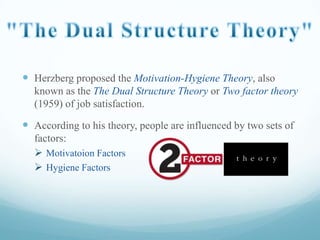
 Herzberg proposed the Motivation-Hygiene Theory, also
known as the The Dual Structure Theory or Two factor theory
(1959) of job satisfaction.

 According to his theory, people are influenced by two sets of
factors:
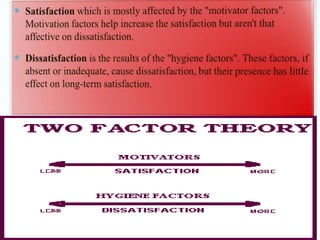
 Motivatoion Factors
 Hygiene Factors
 The theory was based around interviews with 203 American
accountants & engineers in Pittsburgh, chosen because of
their professions' growing importance in the business world
by Herzberg.

 The subjects were asked to relate times when they felt
exceptionally good or bad about their present job or any
previous job, and to provide reasons, and a description of the
sequence of events giving rise to that positive or negative
feeling.
 Individuals are not content with the satisfaction of lower-order
needs at work, for example, those associated with minimum
salary levels or safe and pleasant working conditions.

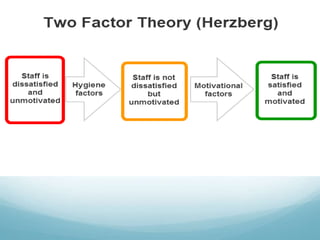
 Satisfaction and dissatisfaction are not on a continuum with
one increasing as the other diminishes, but are independent
phenomena.

 This theory suggests that to improve job attitudes and
productivity, administrators must recognize and attend to both
sets of characteristics and not assume that an increase in
satisfaction leads to an decrease in unpleasurable
dissatisfaction.
BASIS
OF
THEORY
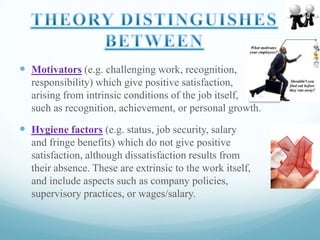
 Motivators (e.g. challenging work, recognition,
responsibility) which give positive satisfaction,
arising from intrinsic conditions of the job itself,
such as recognition, achievement, or personal growth.

 Hygiene factors (e.g. status, job security, salary
and fringe benefits) which do not give positive
satisfaction, although dissatisfaction results from
their absence. These are extrinsic to the work itself,
and include aspects such as company policies,
supervisory practices, or wages/salary.
 What might the evidence of de-motivated employees be in a business?
 Low productivity
 Poor production or service quality
 Strikes / industrial disputes / breakdowns in employee
communication and relationships
 Complaints about pay and working conditions

 According to Herzberg, management should focus on rearranging work
so that motivator factors can take effect. He suggested three ways in
which this could be done:
 Job enlargement
 Job rotation
 Job enrichment
TWO FACTOR THEORY , HERZBERG
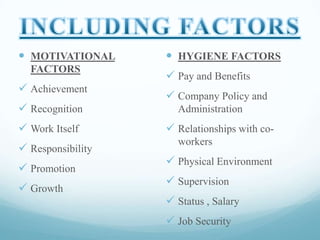
 MOTIVATIONAL
FACTORS

 Achievement
 Recognition
 Work Itself
 Responsibility
 Promotion
 Growth

 HYGIENE FACTORS
 Pay and Benefits

 Company Policy and
Administration

 Relationships with coworkers

 Physical Environment
 Supervision
 Status , Salary
 Job Security
The purpose of this study was to determine the relative importance of motivation
factors for general job satisfaction and assess the applicability of Herzberg’s TwoFactor theory of Motivation to job satisfaction of logistics officers and soldiers in
the Korean Army’s foodservice operations. This study, therefore, was designed to
investigate job satisfaction and two different motivation factors for both
respondent groups.
For the first and second research questions, significant differences were found
between the respondents’ group (rank) and job satisfaction. The higher the rank,
the higher job satisfaction. For the third research question, the two respondent
groups had the opposite results. The foodservice soldiers regarded hygiene factors
as more powerful predictors of their job satisfaction than motivators. In contrast to
foodservice soldiers, motivators were considered as the more significant predictors
of the logistics officers’ job satisfaction. For the fourth research question, human
supervision was the most powerful predictor of job satisfaction for foodservice
soldiers and achievement for logistics officers. However, not all hygiene factors
were more important than motivators for the foodservice soldiers. Likewise, not all
motivators appeared to be more important factors than hygiene factors for logistics
officers.

Two theory factor

  • 1.
    Presented by: Abhijith Rajendra ArchanalaSawthi Akash B.N. Akshay Shetty Akshay P.G.
  • 2.
     Frederick IrvingHerzberg: April 18th 1923 - January 19th 2000 in Massachusetts.  He was an American psychologist.  One of the most influential names in business management for introducing:  Job enrichment  The Motivator-Hygiene theory.
  • 3.
     Graduation-City Collegein 1946.  Post-graduation-University of Pittsburgh .  Professor of psychology-Case Western Reserve University in Cleveland.  Professor of management-University of Utah (College of business).
  • 4.
     "One MoreTime, How Do You Motivate Employees?" -1.2 million reprints by 1987.  The most requested article from the Harvard Business Review.  Herzberg attended City College of New York, but left part way-to enlist in the army.  As a patrol sergeant, he was a firsthand witness of the Dachau concentration camp.
  • 5.
    Two Factor Theorystates that there are certain factors in the workplace that causes in job satisfaction, while a separate set of factors cause dissatisfaction.
  • 6.
     Herzberg proposedthe Motivation-Hygiene Theory, also known as the The Dual Structure Theory or Two factor theory (1959) of job satisfaction.  According to his theory, people are influenced by two sets of factors:  Motivatoion Factors  Hygiene Factors
  • 8.
     The theorywas based around interviews with 203 American accountants & engineers in Pittsburgh, chosen because of their professions' growing importance in the business world by Herzberg.  The subjects were asked to relate times when they felt exceptionally good or bad about their present job or any previous job, and to provide reasons, and a description of the sequence of events giving rise to that positive or negative feeling.
  • 9.
     Individuals arenot content with the satisfaction of lower-order needs at work, for example, those associated with minimum salary levels or safe and pleasant working conditions.  Satisfaction and dissatisfaction are not on a continuum with one increasing as the other diminishes, but are independent phenomena.  This theory suggests that to improve job attitudes and productivity, administrators must recognize and attend to both sets of characteristics and not assume that an increase in satisfaction leads to an decrease in unpleasurable dissatisfaction.
  • 10.
  • 12.
     Motivators (e.g.challenging work, recognition, responsibility) which give positive satisfaction, arising from intrinsic conditions of the job itself, such as recognition, achievement, or personal growth.  Hygiene factors (e.g. status, job security, salary and fringe benefits) which do not give positive satisfaction, although dissatisfaction results from their absence. These are extrinsic to the work itself, and include aspects such as company policies, supervisory practices, or wages/salary.
  • 13.
     What mightthe evidence of de-motivated employees be in a business?  Low productivity  Poor production or service quality  Strikes / industrial disputes / breakdowns in employee communication and relationships  Complaints about pay and working conditions  According to Herzberg, management should focus on rearranging work so that motivator factors can take effect. He suggested three ways in which this could be done:  Job enlargement  Job rotation  Job enrichment
  • 14.
  • 15.
     MOTIVATIONAL FACTORS  Achievement Recognition  Work Itself  Responsibility  Promotion  Growth  HYGIENE FACTORS  Pay and Benefits  Company Policy and Administration  Relationships with coworkers  Physical Environment  Supervision  Status , Salary  Job Security
  • 16.
    The purpose ofthis study was to determine the relative importance of motivation factors for general job satisfaction and assess the applicability of Herzberg’s TwoFactor theory of Motivation to job satisfaction of logistics officers and soldiers in the Korean Army’s foodservice operations. This study, therefore, was designed to investigate job satisfaction and two different motivation factors for both respondent groups. For the first and second research questions, significant differences were found between the respondents’ group (rank) and job satisfaction. The higher the rank, the higher job satisfaction. For the third research question, the two respondent groups had the opposite results. The foodservice soldiers regarded hygiene factors as more powerful predictors of their job satisfaction than motivators. In contrast to foodservice soldiers, motivators were considered as the more significant predictors of the logistics officers’ job satisfaction. For the fourth research question, human supervision was the most powerful predictor of job satisfaction for foodservice soldiers and achievement for logistics officers. However, not all hygiene factors were more important than motivators for the foodservice soldiers. Likewise, not all motivators appeared to be more important factors than hygiene factors for logistics officers.

Editor's Notes

  • #7 Motivatoion Factors : Linked to employee motivation in the work place.Hygiene Factors : Cause dissatisfaction in the work place