

Management
Managers and Managing
Management   -  Italian  word  maneggiare  (to handle especially a horse), derives from the  Latin   manus  (hand). -  The process of  Planning, Organizing, Leading, and Controlling  to achieve   organizational goals
Managers -  are the people responsible for supervising/ managing the organization’s resources to meet its goals. They are responsible for the works of people directly working to them
Administration Middle English  word  administracioun , which is in turn derived from the  French   administration , itself derived from the  Latin   administratio  - a  ad  ("to") and  ministratio  ("give service") is the management of any institution, public or private.  Interpretation of the policy set by an organization’s board of directors, and its translation into executive action .
Supervision To inspect, to guide, evaluate. And improve work performance pf employees through a criteria against which the quality and quantity of work production and utilization of time and resources are made The act of looking over or directing and inspecting the performance of workers or work
The Difference between a  MANAGER LEADER SUPERVISOR
Management is a career. Leadership is a calling.  A supervisor looks over or directs and inspects the performance of the workers or the work
" A leader knows what's best to do; a manager knows merely how best to do it."  -  Ken Adelman
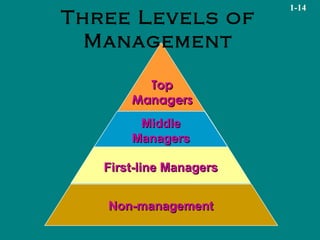
Management Levels O rganizations often have 3 levels of managers: First-line Managers:   responsible for day-to-day operation. They supervise the people performing the activities required to make the good or service.   Middle Managers:   Supervise first-line managers. They are also responsible to find the best way to use departmental resources to achieve goals Top Managers:   Responsible for the performance of  all  departments and have cross-departmental responsibility. They establish organizational goals and monitor middle managers. 1-13
Top Managers Middle Managers First-line Managers Non-management Three Levels of Management 1-14
Roles of Managers (Mintzberg) Interpersonal role Informational role Decisional role
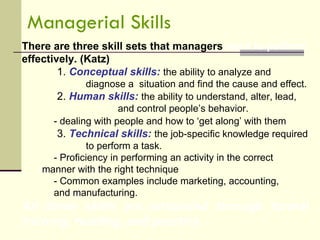
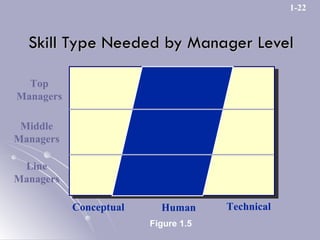
Managerial Skills There are three skill sets that managers  need to perform  effectively. (Katz) 1.  Conceptual skills:   the ability to analyze and  diagnose a  situation and find the cause and effect. 2.  Human skills:   the ability to understand, alter, lead,  and control people’s behavior. - dealing with people and how to ‘get along’ with them   3.  Technical skills:   the job-specific knowledge required  to perform a task.  - Proficiency in performing an activity in the correct  manner with the right technique  - Common examples include marketing, accounting,  and manufacturing. All three skills are enhanced through formal training, reading, and practice .
Skill Type Needed by Manager Level Top Managers Middle Managers Line Managers Conceptual Human Technical Figure 1.5 1-22
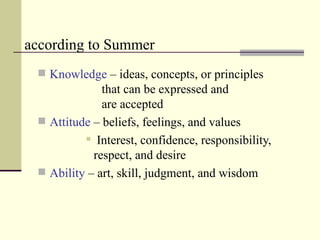
according to Summer Knowledge  – ideas, concepts, or principles  that can be expressed and  are accepted Attitude  – beliefs, feelings, and values Interest, confidence, responsibility, respect, and desire Ability  – art, skill, judgment, and wisdom
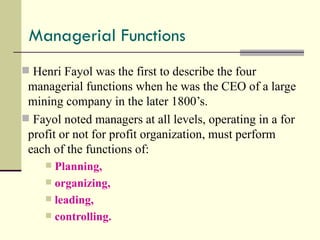
Managerial Functions Henri Fayol was the first to describe the four managerial functions when he was the CEO of a large mining company in the later 1800’s.  Fayol noted managers at all levels, operating in a for profit or not for profit organization, must perform each of the functions of: Planning,  organizing,  leading,  controlling.
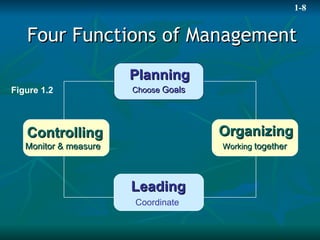
4 functions of Management Planning Organizing Leading Controlling
Planning Planning  is the process used by managers to identify and select appropriate goals and courses of action for an organization.   3 steps to good planning : 1. Which goals should be pursued? 2. How should the goal be attained? 3. How should resources be allocated? The planning function determines how effective and efficient the organization is and determines the strategy of the organization. 1-9
Organizing Organizing  is the process of assigning tasks, allocating resources, and coordinating work activities Success begins with organizing In organizing, managers create the structure of working relationships between organizational members that best allows them to work together and achieve goals. Managers will group people into departments according to the tasks performed. They also lay out lines of authority and responsibility for members. An  organizational structure  is the outcome of organizing. This structure coordinates and motivates employees so that they work together to achieve goals . 1-10
Leading Leading  is the process of arousing people’s enthusiasm to work hard and inspiring their efforts to fulfill plans and accomplish objectives -  In leading, managers determine direction, state a clear  vision for employees to follow, and help employees  understand the role they play in attaining goals. Leadership involves a manager using power, influence, vision, persuasion, and communication skills. The outcome of the leading function is a high level of motivation and commitment from employees to the organization. 1-11
Controlling Controlling  is the process of measuring performance and taking action to ensure desired results. In controlling, managers evaluate how well the organization is achieving its goals and takes corrective action to improve performance. Managers will monitor individuals, departments, and the organization to determine if desired performance has been reached. Managers will also take action to increase performance as required. The outcome of the controlling function is the accurate measurement of performance and regulation of efficiency and effectiveness. 1-12
Four Functions of Management Figure 1.2 Planning Choose  Goals Organizing Working  together Leading Coordinate Controlling Monitor & measure 1-8
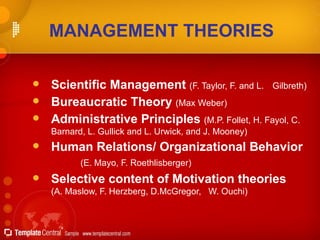
MANAGEMENT THEORIES Scientific Management  (F. Taylor, F. and L.  Gilbreth) Bureaucratic Theory   (Max Weber) Administrative Principles   (M.P. Follet, H. Fayol, C.  Barnard, L. Gullick and L. Urwick, and J. Mooney) Human Relations/ Organizational Behavior   (E. Mayo, F. Roethlisberger) Selective content of Motivation theories   (A. Maslow, F. Herzberg, D.McGregor,  W. Ouchi)
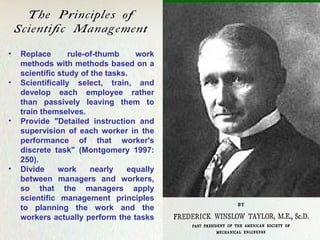
Replace rule-of-thumb work methods with methods based on a scientific study of the tasks. Scientifically select, train, and develop each employee rather than passively leaving them to train themselves.  Provide "Detailed instruction and supervision of each worker in the performance of that worker's discrete task" (Montgomery 1997: 250).  Divide work nearly equally between managers and workers, so that the managers apply scientific management principles to planning the work and the workers actually perform the tasks
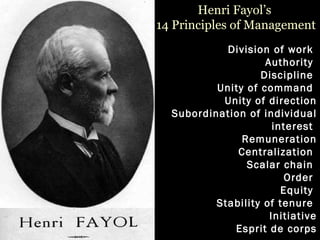
Henri Fayol’s  14 Principles of Management     Division of work        Authority        Discipline        Unity of command        Unity of direction       Subordination of individual interest        Remuneration       Centralization        Scalar chain        Order        Equity        Stability of tenure        Initiative       Esprit de corps
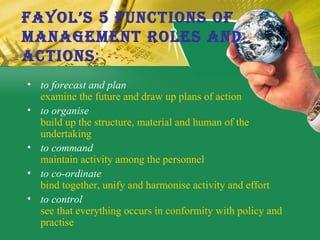
Fayol’s 5 Functions of  Management Roles and  Actions : to forecast and plan   examine the future and draw up plans of action  to organise build up the structure, material and human of the undertaking  to command maintain activity among the personnel  to co-ordinate bind together, unify and harmonise activity and effort  to control see that everything occurs in conformity with policy and practise
END

Management

  • 1.
  • 2.
  • 3.
    Management - Italian word maneggiare (to handle especially a horse), derives from the Latin manus (hand). - The process of Planning, Organizing, Leading, and Controlling to achieve organizational goals
  • 4.
    Managers - are the people responsible for supervising/ managing the organization’s resources to meet its goals. They are responsible for the works of people directly working to them
  • 5.
    Administration Middle English word administracioun , which is in turn derived from the French administration , itself derived from the Latin administratio - a ad ("to") and ministratio ("give service") is the management of any institution, public or private. Interpretation of the policy set by an organization’s board of directors, and its translation into executive action .
  • 6.
    Supervision To inspect,to guide, evaluate. And improve work performance pf employees through a criteria against which the quality and quantity of work production and utilization of time and resources are made The act of looking over or directing and inspecting the performance of workers or work
  • 7.
    The Difference betweena MANAGER LEADER SUPERVISOR
  • 8.
    Management is acareer. Leadership is a calling. A supervisor looks over or directs and inspects the performance of the workers or the work
  • 9.
    " A leaderknows what's best to do; a manager knows merely how best to do it." - Ken Adelman
  • 10.
    Management Levels Organizations often have 3 levels of managers: First-line Managers: responsible for day-to-day operation. They supervise the people performing the activities required to make the good or service. Middle Managers: Supervise first-line managers. They are also responsible to find the best way to use departmental resources to achieve goals Top Managers: Responsible for the performance of all departments and have cross-departmental responsibility. They establish organizational goals and monitor middle managers. 1-13
  • 11.
    Top Managers MiddleManagers First-line Managers Non-management Three Levels of Management 1-14
  • 12.
    Roles of Managers(Mintzberg) Interpersonal role Informational role Decisional role
  • 13.
    Managerial Skills Thereare three skill sets that managers need to perform effectively. (Katz) 1. Conceptual skills: the ability to analyze and diagnose a situation and find the cause and effect. 2. Human skills: the ability to understand, alter, lead, and control people’s behavior. - dealing with people and how to ‘get along’ with them 3. Technical skills: the job-specific knowledge required to perform a task. - Proficiency in performing an activity in the correct manner with the right technique - Common examples include marketing, accounting, and manufacturing. All three skills are enhanced through formal training, reading, and practice .
  • 14.
    Skill Type Neededby Manager Level Top Managers Middle Managers Line Managers Conceptual Human Technical Figure 1.5 1-22
  • 15.
    according to SummerKnowledge – ideas, concepts, or principles that can be expressed and are accepted Attitude – beliefs, feelings, and values Interest, confidence, responsibility, respect, and desire Ability – art, skill, judgment, and wisdom
  • 16.
    Managerial Functions HenriFayol was the first to describe the four managerial functions when he was the CEO of a large mining company in the later 1800’s. Fayol noted managers at all levels, operating in a for profit or not for profit organization, must perform each of the functions of: Planning, organizing, leading, controlling.
  • 17.
    4 functions ofManagement Planning Organizing Leading Controlling
  • 18.
    Planning Planning is the process used by managers to identify and select appropriate goals and courses of action for an organization. 3 steps to good planning : 1. Which goals should be pursued? 2. How should the goal be attained? 3. How should resources be allocated? The planning function determines how effective and efficient the organization is and determines the strategy of the organization. 1-9
  • 19.
    Organizing Organizing is the process of assigning tasks, allocating resources, and coordinating work activities Success begins with organizing In organizing, managers create the structure of working relationships between organizational members that best allows them to work together and achieve goals. Managers will group people into departments according to the tasks performed. They also lay out lines of authority and responsibility for members. An organizational structure is the outcome of organizing. This structure coordinates and motivates employees so that they work together to achieve goals . 1-10
  • 20.
    Leading Leading is the process of arousing people’s enthusiasm to work hard and inspiring their efforts to fulfill plans and accomplish objectives - In leading, managers determine direction, state a clear vision for employees to follow, and help employees understand the role they play in attaining goals. Leadership involves a manager using power, influence, vision, persuasion, and communication skills. The outcome of the leading function is a high level of motivation and commitment from employees to the organization. 1-11
  • 21.
    Controlling Controlling is the process of measuring performance and taking action to ensure desired results. In controlling, managers evaluate how well the organization is achieving its goals and takes corrective action to improve performance. Managers will monitor individuals, departments, and the organization to determine if desired performance has been reached. Managers will also take action to increase performance as required. The outcome of the controlling function is the accurate measurement of performance and regulation of efficiency and effectiveness. 1-12
  • 22.
    Four Functions ofManagement Figure 1.2 Planning Choose Goals Organizing Working together Leading Coordinate Controlling Monitor & measure 1-8
  • 23.
    MANAGEMENT THEORIES ScientificManagement (F. Taylor, F. and L. Gilbreth) Bureaucratic Theory (Max Weber) Administrative Principles (M.P. Follet, H. Fayol, C. Barnard, L. Gullick and L. Urwick, and J. Mooney) Human Relations/ Organizational Behavior (E. Mayo, F. Roethlisberger) Selective content of Motivation theories (A. Maslow, F. Herzberg, D.McGregor, W. Ouchi)
  • 24.
    Replace rule-of-thumb workmethods with methods based on a scientific study of the tasks. Scientifically select, train, and develop each employee rather than passively leaving them to train themselves. Provide "Detailed instruction and supervision of each worker in the performance of that worker's discrete task" (Montgomery 1997: 250). Divide work nearly equally between managers and workers, so that the managers apply scientific management principles to planning the work and the workers actually perform the tasks
  • 25.
    Henri Fayol’s 14 Principles of Management    Division of work    Authority    Discipline    Unity of command    Unity of direction    Subordination of individual interest    Remuneration    Centralization    Scalar chain    Order    Equity    Stability of tenure    Initiative    Esprit de corps
  • 26.
    Fayol’s 5 Functionsof Management Roles and Actions : to forecast and plan examine the future and draw up plans of action to organise build up the structure, material and human of the undertaking to command maintain activity among the personnel to co-ordinate bind together, unify and harmonise activity and effort to control see that everything occurs in conformity with policy and practise
  • 27.