Prepared by
Ms. Nisha S. Mhaske
M.Pharm (Q.A.T)
Lecturer, PRES’s COPD, Chincholi.
Email : nisha.mhaske@pravara.in
CONTENTS
 Digestion phases
 Function of digestive system
 Main divisions of digestive system
 Buccal cavity
 Alimentary canal
 Esophagus
 Stomach
 Small intestine
 Pancreas
 Liver
 Gall bladder
 Large intestine
 Rectum
 BMR
 Definitions
DIGESTION PHASES
 Phases Include
1. Ingestion
2. Movement
3. Mechanical and Chemical Digestion
4. Absorption
5. Elimination
FUNCTION OF DIGESTIVE SYSTEM
 The cell requires essential materials for Growth, for
carrying out other structural activities & as a source of
energy for these activities.
 The food material serves these purposes.
 Hence, human organism needs a regular supply of food.
 The food that we eat contains complex substances.
 Digestion helps to convert complex food into simple food
so that they easily get absorb into blood.
DIGESTION
 Definition:-“The conversion of complex food into
simple form so that it is easily absorbed in the
blood is called as digestion.”
 The digestive system includes the Alimentary
canal and some accessory organs.
MAIN DIVISIONS OF THE DIGESTIVE SYSTEM
Alimentary Canal
 The alimentary tract is a long tube through which food
passes.
 It begins at the mouth and terminates at the anus.
 Digests and absorbs food particles
 Contains the following organs:
Mouth
Pharynx
Esophagus
Stomach
Small Intestine
Large Intestine
Rectum.
ACCESSORY DIGESTIVE ORGANS
 Contains the following organs
Teeth
Tongue
Gallbladder
Three pairs of salivary Glands
Liver
Pancreas.
TONGUE
 Taste is detected by
taste buds present on
tongue.
 It is fleshy muscular
organ attached to
floor of buccal
cavity.
 It is free at the front
& moves in all
direction.
TEETH & MASTICATION
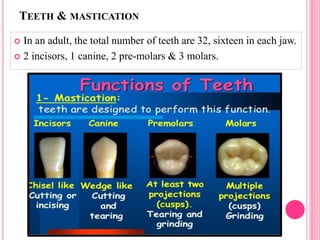
 In an adult, the total number of teeth are 32, sixteen in each jaw.
 2 incisors, 1 canine, 2 pre-molars & 3 molars.
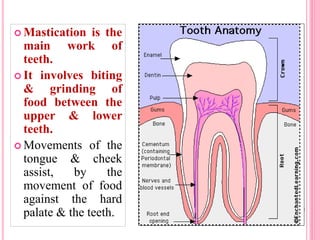
 Mastication is the
main work of
teeth.
 It involves biting
& grinding of
food between the
upper & lower
teeth.
 Movements of the
tongue & cheek
assist, by the
movement of food
against the hard
palate & the teeth.
 Teeth mechanically
break down food into
small pieces. Tongue
mixes food with saliva
(contains amylase,
which helps break
down starch).
 Epiglottis is a flap-like
structure at the back of
the throat that closes
over the trachea
preventing food from
entering it. It is located
in the Pharynx.
SALIVARY GLAND
Three pairs of salivary
glands
Submandibular
Glands
 Found underneath the
mandible
Sublingual Glands
 Found underneath the
tongue
Parotid Glands
 Found anterior to the
ear between masseter
and skin
 Largest gland
COMPOSITION OF SALIVA
 97-99.5% water
 pH 6.75-7.0
 Sodium, potassium, chloride, phosphate, and
bicarbonate
 Mucin
 Salivary amylase
 Enzyme Ptyalin acts on cooked starches in
alkaline medium & converts them to soluble form
called maltose.
 The action of the enzyme continues till the food is
rendered acidic by the action of gastric fluid.
FUNCTION OF SALIVARY GLAND
 Secretion of saliva which is stimulated by the sight, smell &
presence of food in the mouth.
 Saliva moistens the mouth
 Cleanses the tongue
 Makes speech easier
 Begins the chemical breakdown of food
Mouth
Digestive juices &
enzymes
Carbohydrates Proteins Fats
Saliva
Salivary Amylase Cooked Starches Maltose No action No action
ALIMENTARY CANAL
 The walls of alimentary canal are made up of the following 4
layers of tissue.
1. Outer covering consisting of peritoneum in the abdomen.
2. Muscle layer of both circular & longitudinal muscles
3. Submucous layer of loose connective tissue
4. Mucous membrane lining consisting of epithelial cells.
Peritoneum
Peritoneum is the serous membrane lining the abdominopelvic cavity.
• Visceral peritoneum covers the external surfaces of most digestive
organs and is continuous with the parietal peritoneum that lines the
body wall.
• Between the two peritoneums is the peritoneal cavity.
HISTOLOGY OF GI TRACT
 Mesentery is a double layer peritoneum; provides routes for
BV, lymphatics, nerves.
(BV-Blood Vessels)
DEGLUTITION AND THE PHARYNX
 Deglutition = swallowing
 Oropharynx and Laryngopharynx are common passage ways for
food and air
 Pharynx contains stratified squamous epithelium
OESOPHAGUS
 Swallowed food passes through epiglottis present behind the
tongue direct the food into oesophagus & prevent the
larynx.
 Approximately 20 cm long.
 Esophageal glands – produce mucus to lubricate bolus
 Esophageal sphincter – prevents backflow into oral cavity
 Cardiac sphincter- prevents backflow into esophagus
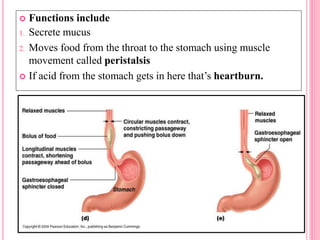
 Functions include
1. Secrete mucus
2. Moves food from the throat to the stomach using muscle
movement called peristalsis
 If acid from the stomach gets in here that’s heartburn.
DIGESTIVE PROCESSES IN THE MOUTH, PHARYNX, &
ESOPHAGUS
 Mouth processes
 Ingestion
 Mechanical digestion (e.g. salivary amylase)
 Initiation of Propulsion
 Mastication: chewing
 Pharyngeal processes
 Deglutition = swallowing
Voluntary Buccal phase
Involuntary Pharyngeal-Esophageal Phase
 Esophageal processes
 Peristalsis (rhythmic contractions, involuntary)
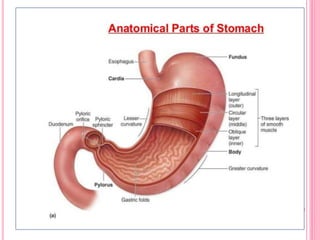
 J-shaped muscular bag that
stores the food you eat,
breaks it down into tiny
pieces.
 Mixes food with Digestive
Juices that contain enzymes
to break down Proteins
and Lipids.
 Acid (HCl) in the stomach
Kills Bacteria.
 Food found in the stomach
is called Chyme.
MICROSCOPIC ANATOMY OF THE STOMACH
 Simple columnar epithelium – contains gastric
pits that secrete gastric juices
 Goblet cells – secrete mucus that coats stomach
and prevents it from being digested itself
 Parietal cells – secrete hydrochloric acid
(converts pepsinogen into pepsin) and intrinsic
factor (necessary for absorption of vitamin B12)
 Chief cells – secrete pepsinogen which is
converted to pepsin to aid in protein digestion
 Enteroendocrine cells – release hormones such as:
 Histamine, Serotonin, Gastrin, Endorphins, and
Somatostatin
 Histamine
- activates parietal cells to release HCl
 Serotonin
- contraction of stomach muscle
 Gastrin
- gastric glands to increase secretion
 Endorphins
- natural opiates
 Somatostatin
- sympathetic n.s.
- inhibits gastric secretion
- inhibits gastric emptying
GASTRIC MOTILITY AND EMPTYING
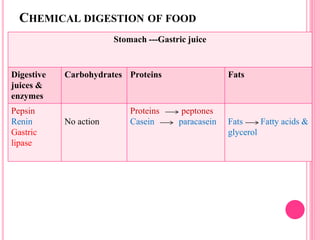
CHEMICAL DIGESTION OF FOOD
Stomach ---Gastric juice
Digestive
juices &
enzymes
Carbohydrates Proteins Fats
Pepsin
Renin
Gastric
lipase
No action
Proteins peptones
Casein paracasein Fats Fatty acids &
glycerol
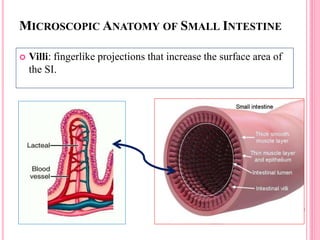
 Small intestines are roughly 7 meters long
 Lining of intestine walls has finger-like projections called villi,
to increase surface area.
 The villi are covered in microvilli which further increases
surface area for absorption.
 Nutrients from the food pass into the bloodstream through the
small intestine walls.
 Absorbs
 80% ingested water
 Vitamins
 Minerals
 Carbohydrates
 Proteins
 Lipids
 Secretes digestive enzymes
MICROSCOPIC ANATOMY OF SMALL INTESTINE
 Villi: fingerlike projections that increase the surface area of
the SI.
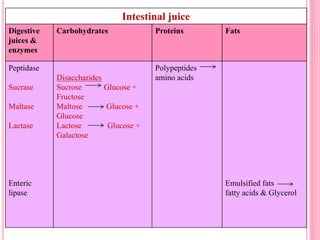
Intestinal juice
Digestive
juices &
enzymes
Carbohydrates Proteins Fats
Peptidase
Sucrase
Maltase
Lactase
Enteric
lipase
Disaccharides
Sucrose Glucose +
Fructose
Maltose Glucose +
Glucose
Lactose Glucose +
Galactose
Polypeptides
amino acids
Emulsified fats
fatty acids & Glycerol
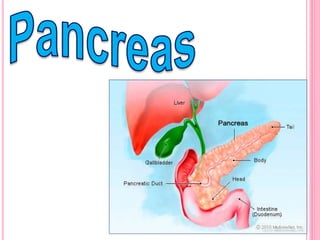
 It is leaf shaped & located just
below the stomach.
 It secrets pancreatic juices.
Pancreatic juice
Digestive
juices &
enzymes
Carbohydrates Proteins Fats
Trypsin &
Chymotrypsin
Pancreatic
amylase
Pancreatic
Lipase
Starch
Disaccharides
Peptones Poly-
peptides
Fats fatty acids &
glycerol
•Produces digestive enzymes to digest fats, carbohydrates
&Proteins
•Regulates blood sugar by producing insulin
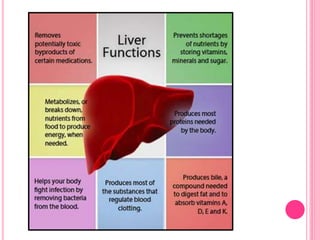
 Largest gland in human body
 It is reddish brown in color
 It secrets bile which breakdown fats.
 Bile is stored on gall bladder.
 filters out toxins and waste including drugs and alcohol and
poisons.
Functions of Liver
•Secretion of bile
•Glycogenic functions
•Formation of urea
•Desaturation of fats
•Functions related to blood
•Maintainace of body temperature
•Excretion of toxic substances
 Stores bile from the liver, releases it into the small intestine.
 Fatty diets can cause gallstones
Gall bladder
Digestive
juices &
enzymes
Carbohydrates Proteins Fats
Bile
Bile salts
(No enzyme)
Umemulsified fats
Emulsified fats
 The undigested & unabsorbed food enters into large
intestine.
 It is wider than small intestine, about 1.5 cm in length.
 Appendix: small structure containing lymphoid tissue;
small immune function
 Once the undigested food enters into large intestine, it
absorbs water & some salts from it & passed the
remaining waste into the rectum.
 Functions of Large intestine
 Reabsorption of remaining water and
electrolytes
 Production and absorption of Vitamins
B and K
 Elimination of feces
 Semisolid faecal matter remove from the anus.
BASAL METABOLIC RATE-BMR
 “The minimum energy requirement per day is called
as the Basal Metabolic Rate(BMR)”.
 This is the rate at which the sum of the metabolic
processes takes place, when an individual is at rest &
has eaten no food for 12 hrs.
 The normal BMR values are,
 Men ---170kJ/m2/hr
 Women ---155 kJ/m2/hr.
Digestive juices
Gastric Juice Intestinal Pancreatic Bile
Volume 1.5 to 2.5 lit/day 2 to 3 lit/day 600 to 800 ml/day 800 to 1000
ml/day
pH 1.6 to 3.2 7.5 to 8 4.5 to 7.0 6.8 to 7.7
Composition of juices
Gastric juices Intestinal juices Pancreatic juices Bile juice
Water
Mineral Salts
Hydrochloric
acids
Pepsinogen
Renin
Water
Mineral Salts
Entero Kinase
Amylase
Peptidase
Lipase
Sucrase
Maltase
Lactase
Water
Mineral Salts
Trypsinogen
Chymotrypsinogen
Amylase
Lipase
Water
Mineral Salts
Sodium Taruocholate
Sodium Glycocholate
Biliverdin
Bilirubin
cholesterol
IMP. DEFINITIONS
 Ingestion:- The process of taking food into the body by
swallowing or absorbing it.
 Assimilation:- absorbed food is used by various cell
components.
 Egestion:- Removal of undigested and unabsorbed food
from the GI tract through the anus.
Digestive system

Digestive system

  • 1.
    Prepared by Ms. NishaS. Mhaske M.Pharm (Q.A.T) Lecturer, PRES’s COPD, Chincholi. Email : nisha.mhaske@pravara.in
  • 2.
    CONTENTS  Digestion phases Function of digestive system  Main divisions of digestive system  Buccal cavity  Alimentary canal  Esophagus  Stomach  Small intestine  Pancreas  Liver  Gall bladder  Large intestine  Rectum  BMR  Definitions
  • 4.
    DIGESTION PHASES  PhasesInclude 1. Ingestion 2. Movement 3. Mechanical and Chemical Digestion 4. Absorption 5. Elimination
  • 5.
    FUNCTION OF DIGESTIVESYSTEM  The cell requires essential materials for Growth, for carrying out other structural activities & as a source of energy for these activities.  The food material serves these purposes.  Hence, human organism needs a regular supply of food.  The food that we eat contains complex substances.  Digestion helps to convert complex food into simple food so that they easily get absorb into blood.
  • 6.
    DIGESTION  Definition:-“The conversionof complex food into simple form so that it is easily absorbed in the blood is called as digestion.”  The digestive system includes the Alimentary canal and some accessory organs.
  • 7.
    MAIN DIVISIONS OFTHE DIGESTIVE SYSTEM Alimentary Canal  The alimentary tract is a long tube through which food passes.  It begins at the mouth and terminates at the anus.  Digests and absorbs food particles  Contains the following organs: Mouth Pharynx Esophagus Stomach Small Intestine Large Intestine Rectum.
  • 8.
    ACCESSORY DIGESTIVE ORGANS Contains the following organs Teeth Tongue Gallbladder Three pairs of salivary Glands Liver Pancreas.
  • 11.
    TONGUE  Taste isdetected by taste buds present on tongue.  It is fleshy muscular organ attached to floor of buccal cavity.  It is free at the front & moves in all direction.
  • 12.
    TEETH & MASTICATION In an adult, the total number of teeth are 32, sixteen in each jaw.  2 incisors, 1 canine, 2 pre-molars & 3 molars.
  • 13.
     Mastication isthe main work of teeth.  It involves biting & grinding of food between the upper & lower teeth.  Movements of the tongue & cheek assist, by the movement of food against the hard palate & the teeth.
  • 14.
     Teeth mechanically breakdown food into small pieces. Tongue mixes food with saliva (contains amylase, which helps break down starch).  Epiglottis is a flap-like structure at the back of the throat that closes over the trachea preventing food from entering it. It is located in the Pharynx.
  • 15.
    SALIVARY GLAND Three pairsof salivary glands Submandibular Glands  Found underneath the mandible Sublingual Glands  Found underneath the tongue Parotid Glands  Found anterior to the ear between masseter and skin  Largest gland
  • 16.
    COMPOSITION OF SALIVA 97-99.5% water  pH 6.75-7.0  Sodium, potassium, chloride, phosphate, and bicarbonate  Mucin  Salivary amylase  Enzyme Ptyalin acts on cooked starches in alkaline medium & converts them to soluble form called maltose.  The action of the enzyme continues till the food is rendered acidic by the action of gastric fluid.
  • 17.
    FUNCTION OF SALIVARYGLAND  Secretion of saliva which is stimulated by the sight, smell & presence of food in the mouth.  Saliva moistens the mouth  Cleanses the tongue  Makes speech easier  Begins the chemical breakdown of food Mouth Digestive juices & enzymes Carbohydrates Proteins Fats Saliva Salivary Amylase Cooked Starches Maltose No action No action
  • 19.
    ALIMENTARY CANAL  Thewalls of alimentary canal are made up of the following 4 layers of tissue. 1. Outer covering consisting of peritoneum in the abdomen. 2. Muscle layer of both circular & longitudinal muscles 3. Submucous layer of loose connective tissue 4. Mucous membrane lining consisting of epithelial cells.
  • 20.
    Peritoneum Peritoneum is theserous membrane lining the abdominopelvic cavity. • Visceral peritoneum covers the external surfaces of most digestive organs and is continuous with the parietal peritoneum that lines the body wall. • Between the two peritoneums is the peritoneal cavity.
  • 21.
    HISTOLOGY OF GITRACT  Mesentery is a double layer peritoneum; provides routes for BV, lymphatics, nerves. (BV-Blood Vessels)
  • 22.
    DEGLUTITION AND THEPHARYNX  Deglutition = swallowing  Oropharynx and Laryngopharynx are common passage ways for food and air  Pharynx contains stratified squamous epithelium
  • 24.
    OESOPHAGUS  Swallowed foodpasses through epiglottis present behind the tongue direct the food into oesophagus & prevent the larynx.  Approximately 20 cm long.  Esophageal glands – produce mucus to lubricate bolus  Esophageal sphincter – prevents backflow into oral cavity  Cardiac sphincter- prevents backflow into esophagus
  • 25.
     Functions include 1.Secrete mucus 2. Moves food from the throat to the stomach using muscle movement called peristalsis  If acid from the stomach gets in here that’s heartburn.
  • 26.
    DIGESTIVE PROCESSES INTHE MOUTH, PHARYNX, & ESOPHAGUS  Mouth processes  Ingestion  Mechanical digestion (e.g. salivary amylase)  Initiation of Propulsion  Mastication: chewing  Pharyngeal processes  Deglutition = swallowing Voluntary Buccal phase Involuntary Pharyngeal-Esophageal Phase  Esophageal processes  Peristalsis (rhythmic contractions, involuntary)
  • 29.
     J-shaped muscularbag that stores the food you eat, breaks it down into tiny pieces.  Mixes food with Digestive Juices that contain enzymes to break down Proteins and Lipids.  Acid (HCl) in the stomach Kills Bacteria.  Food found in the stomach is called Chyme.
  • 31.
    MICROSCOPIC ANATOMY OFTHE STOMACH  Simple columnar epithelium – contains gastric pits that secrete gastric juices  Goblet cells – secrete mucus that coats stomach and prevents it from being digested itself  Parietal cells – secrete hydrochloric acid (converts pepsinogen into pepsin) and intrinsic factor (necessary for absorption of vitamin B12)  Chief cells – secrete pepsinogen which is converted to pepsin to aid in protein digestion
  • 32.
     Enteroendocrine cells– release hormones such as:  Histamine, Serotonin, Gastrin, Endorphins, and Somatostatin  Histamine - activates parietal cells to release HCl  Serotonin - contraction of stomach muscle  Gastrin - gastric glands to increase secretion  Endorphins - natural opiates  Somatostatin - sympathetic n.s. - inhibits gastric secretion - inhibits gastric emptying
  • 33.
  • 34.
    CHEMICAL DIGESTION OFFOOD Stomach ---Gastric juice Digestive juices & enzymes Carbohydrates Proteins Fats Pepsin Renin Gastric lipase No action Proteins peptones Casein paracasein Fats Fatty acids & glycerol
  • 36.
     Small intestinesare roughly 7 meters long  Lining of intestine walls has finger-like projections called villi, to increase surface area.  The villi are covered in microvilli which further increases surface area for absorption.  Nutrients from the food pass into the bloodstream through the small intestine walls.  Absorbs  80% ingested water  Vitamins  Minerals  Carbohydrates  Proteins  Lipids  Secretes digestive enzymes
  • 38.
    MICROSCOPIC ANATOMY OFSMALL INTESTINE  Villi: fingerlike projections that increase the surface area of the SI.
  • 39.
    Intestinal juice Digestive juices & enzymes CarbohydratesProteins Fats Peptidase Sucrase Maltase Lactase Enteric lipase Disaccharides Sucrose Glucose + Fructose Maltose Glucose + Glucose Lactose Glucose + Galactose Polypeptides amino acids Emulsified fats fatty acids & Glycerol
  • 41.
     It isleaf shaped & located just below the stomach.  It secrets pancreatic juices. Pancreatic juice Digestive juices & enzymes Carbohydrates Proteins Fats Trypsin & Chymotrypsin Pancreatic amylase Pancreatic Lipase Starch Disaccharides Peptones Poly- peptides Fats fatty acids & glycerol
  • 43.
    •Produces digestive enzymesto digest fats, carbohydrates &Proteins •Regulates blood sugar by producing insulin
  • 46.
     Largest glandin human body  It is reddish brown in color  It secrets bile which breakdown fats.  Bile is stored on gall bladder.  filters out toxins and waste including drugs and alcohol and poisons. Functions of Liver •Secretion of bile •Glycogenic functions •Formation of urea •Desaturation of fats •Functions related to blood •Maintainace of body temperature •Excretion of toxic substances
  • 49.
     Stores bilefrom the liver, releases it into the small intestine.  Fatty diets can cause gallstones Gall bladder Digestive juices & enzymes Carbohydrates Proteins Fats Bile Bile salts (No enzyme) Umemulsified fats Emulsified fats
  • 51.
     The undigested& unabsorbed food enters into large intestine.  It is wider than small intestine, about 1.5 cm in length.  Appendix: small structure containing lymphoid tissue; small immune function  Once the undigested food enters into large intestine, it absorbs water & some salts from it & passed the remaining waste into the rectum.
  • 53.
     Functions ofLarge intestine  Reabsorption of remaining water and electrolytes  Production and absorption of Vitamins B and K  Elimination of feces
  • 54.
     Semisolid faecalmatter remove from the anus.
  • 55.
    BASAL METABOLIC RATE-BMR “The minimum energy requirement per day is called as the Basal Metabolic Rate(BMR)”.  This is the rate at which the sum of the metabolic processes takes place, when an individual is at rest & has eaten no food for 12 hrs.  The normal BMR values are,  Men ---170kJ/m2/hr  Women ---155 kJ/m2/hr.
  • 58.
    Digestive juices Gastric JuiceIntestinal Pancreatic Bile Volume 1.5 to 2.5 lit/day 2 to 3 lit/day 600 to 800 ml/day 800 to 1000 ml/day pH 1.6 to 3.2 7.5 to 8 4.5 to 7.0 6.8 to 7.7 Composition of juices Gastric juices Intestinal juices Pancreatic juices Bile juice Water Mineral Salts Hydrochloric acids Pepsinogen Renin Water Mineral Salts Entero Kinase Amylase Peptidase Lipase Sucrase Maltase Lactase Water Mineral Salts Trypsinogen Chymotrypsinogen Amylase Lipase Water Mineral Salts Sodium Taruocholate Sodium Glycocholate Biliverdin Bilirubin cholesterol
  • 59.
    IMP. DEFINITIONS  Ingestion:-The process of taking food into the body by swallowing or absorbing it.  Assimilation:- absorbed food is used by various cell components.  Egestion:- Removal of undigested and unabsorbed food from the GI tract through the anus.