SubmittedTo=MS.ABHIKRATI SHUKLA
BY :Harshit Patni
Husain Shabir Gopalpurwala
FUNCTIONS OF COMMERCIAL
BANKS
OBJECTIVES
 DEFINITION OF A
BANK.
TYPES OF
COMMERCIAL
BANKS.
FUNCTIONS OF
COMMERCIAL
BANKS.
CONCLUSION.
A bank is like a pool into which the flow of
savings, the idle surplus money of
households and from which loans are given
on interest to individuals and others who
need them for investment or productive
uses.
DEFINITION OF A BANK
The Banking Companies Act of India
defines a bank as “A Bank is a financial
institution which accepts money from the
public for the purpose of lending or
investment repayable on demand or
otherwise withdrawable by cheques, drafts
or order or otherwise.”
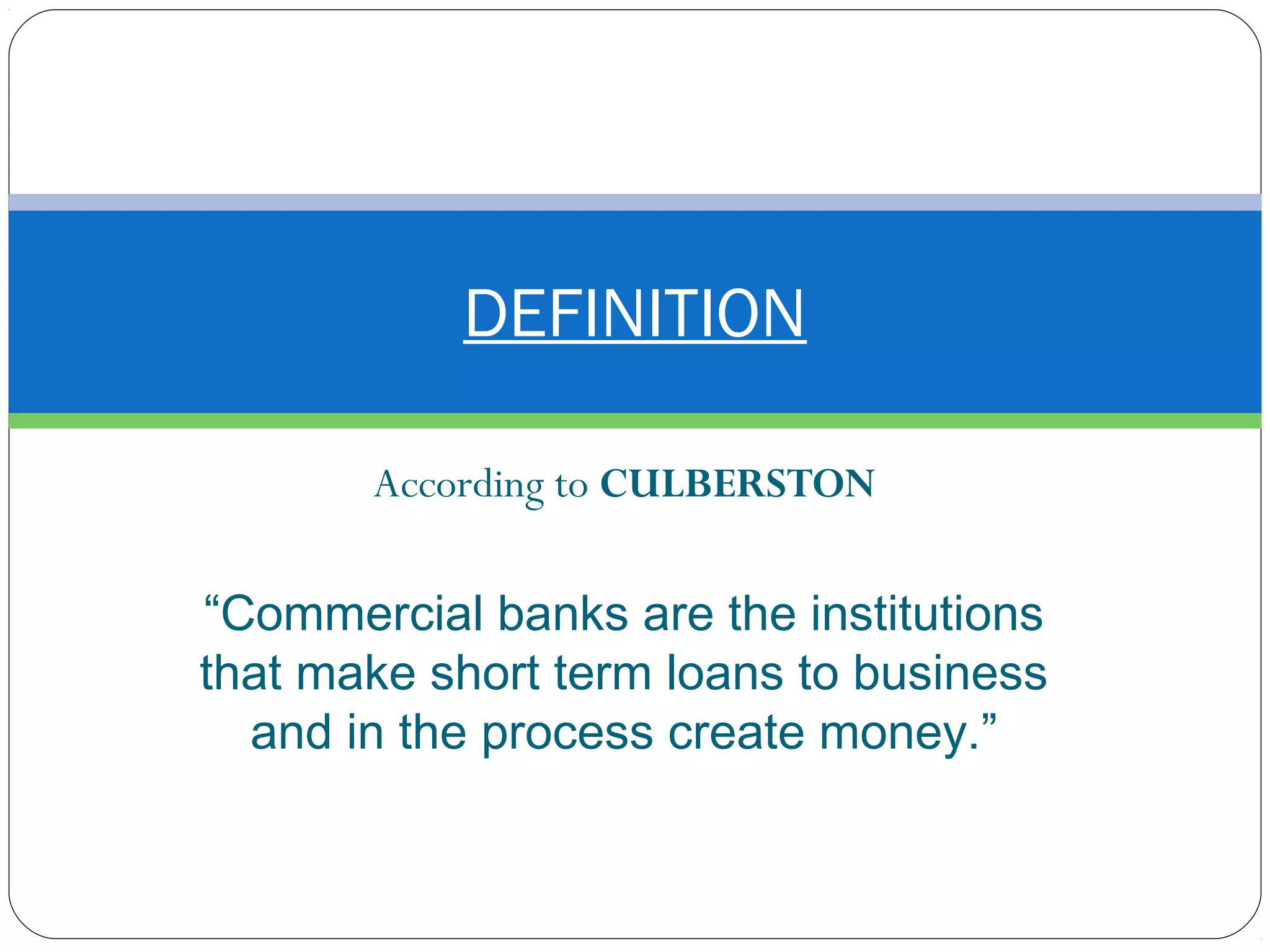
According to CULBERSTON
“Commercial banks are the institutions
that make short term loans to business
and in the process create money.”
DEFINITION
TYPES OF COMMERCIAL
BANKS
DEPOSIT BANKS
INDUSTRIAL BANKS
SAVINGS BANKS
EXCHANGE BANKS
AGRICULTURAL BANKS
MISCELLANEOUS BANKS
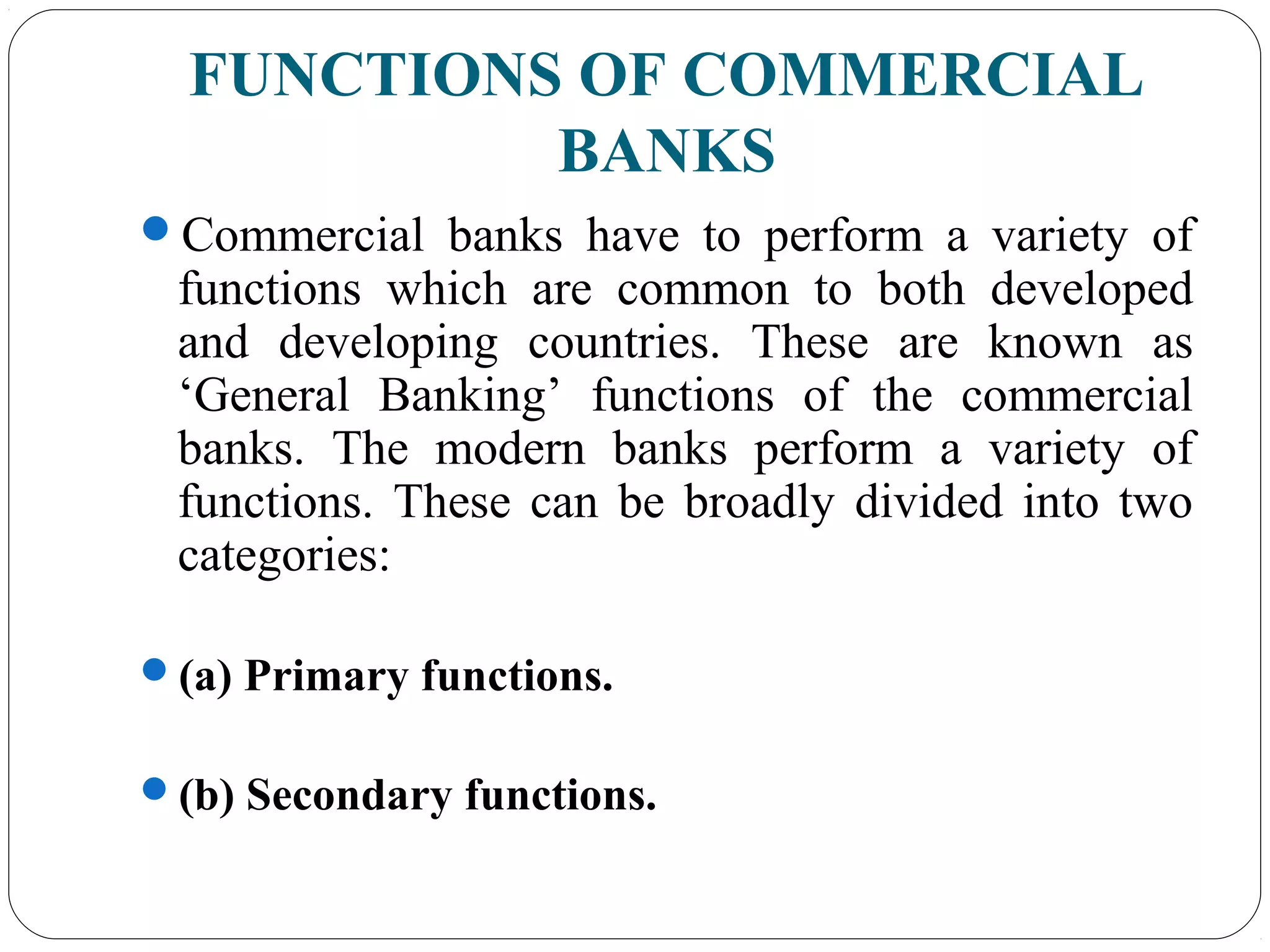
FUNCTIONS OF COMMERCIAL
BANKS
Commercial banks have to perform a variety of
functions which are common to both developed
and developing countries. These are known as
‘General Banking’ functions of the commercial
banks. The modern banks perform a variety of
functions. These can be broadly divided into two
categories:
(a) Primary functions.
(b) Secondary functions.
PRIMARY FUNCTIONS
1. Acceptance of
deposits.
2. Advancing loans.
3. Creation of
credit.
4. Clearing of
cheques.
5. Financing foreign
trade.
6. Remittance of
funds.
1. Acceptance of deposits
It is the most important function of commercial
banks.
They accept deposits in several forms according
to requirements of different sections of the
society.
The main kinds of deposits are:
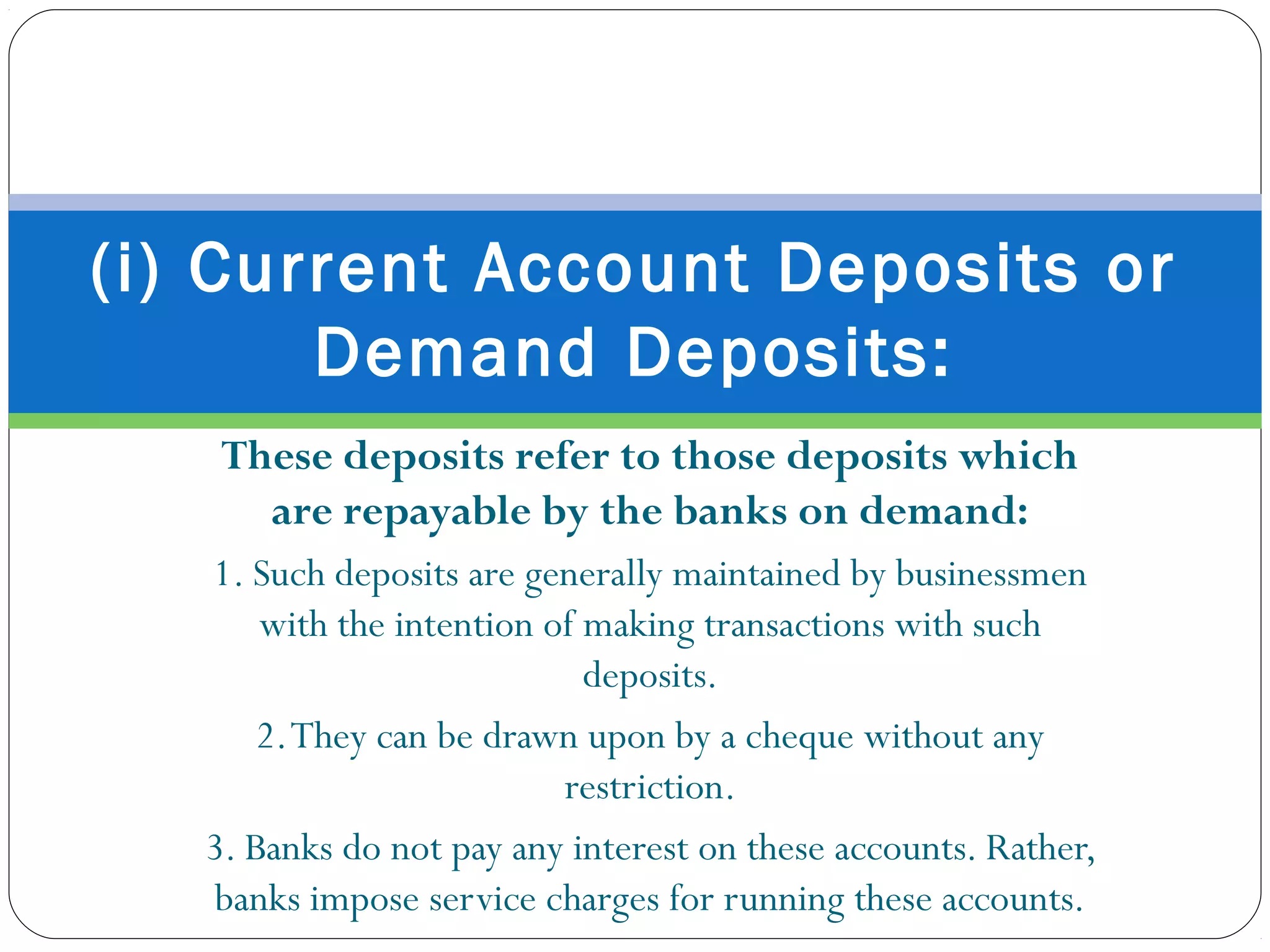
These deposits refer to those deposits which
are repayable by the banks on demand:
1. Such deposits are generally maintained by businessmen
with the intention of making transactions with such
deposits.
2.They can be drawn upon by a cheque without any
restriction.
3. Banks do not pay any interest on these accounts. Rather,
banks impose service charges for running these accounts.
(i) Current Account Deposits or
Demand Deposits:
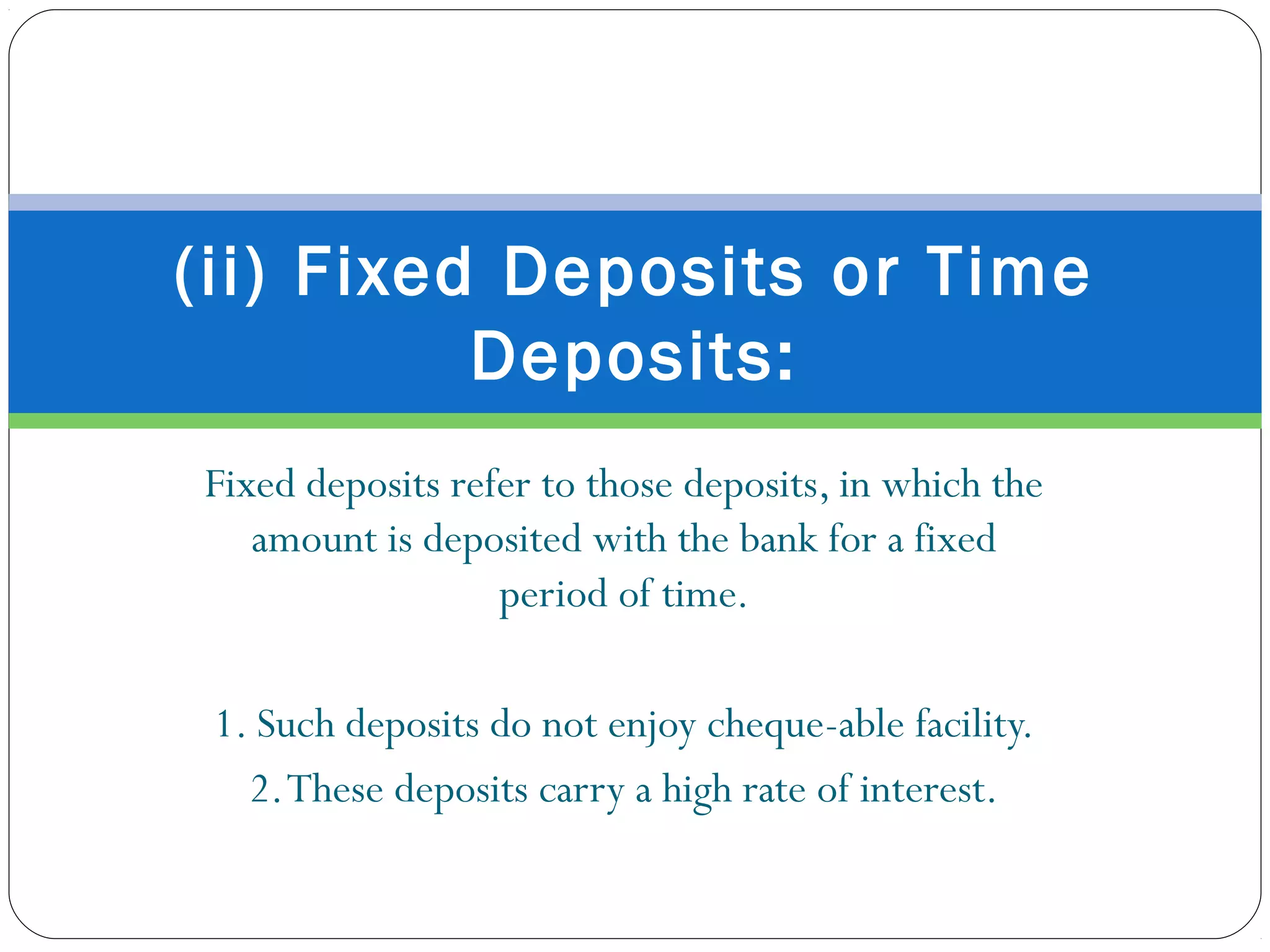
Fixed deposits refer to those deposits, in which the
amount is deposited with the bank for a fixed
period of time.
1. Such deposits do not enjoy cheque-able facility.
2.These deposits carry a high rate of interest.
(ii) Fixed Deposits or Time
Deposits:
Basis Demand Deposits Fixed Deposits
Cheque facility They are chequeable deposits. They are non-chequeable
deposits.
Interest payments They do not carry any interest. They carry interest which
varies directly with the period
of time.
Number of transactions The depositor can make any
number of transactions for
deposit or with drawl of
money.
Depositor generally makes
only two transactions: (i)
Deposit of Money in the
beginning;
(ii) Withdrawal of money on
maturity.
These deposits combine features of both
current account deposits and fixed
deposits:
1.The depositors are given cheque facility to
withdraw money from their account. But, some
restrictions are imposed on number and amount of
withdrawals, in order to discourage frequent use of
saving deposits.
(iii) Saving Deposits:
2.They carry a rate of interest which is less than
interest rate on fixed deposits. It must be noted
that CurrentAccount deposits and saving
deposits are chequable deposits, whereas, fixed
deposit is a non-chequable deposit.
The deposits received by banks are not allowed to
remain idle. So, after keeping certain cash reserves,
the balance is given to needy borrowers and interest
is charged from them, which is the main source of
income for these banks.
2. Advancing of Loans:
Different types of loans and
advances made by Commercial
banks are:
Cash credit refers to a loan given to the borrower
against his current assets like shares, stocks, bonds,
etc.A credit limit is sanctioned and the amount is
credited in his account.The borrower may
withdraw any amount within his credit limit and
interest is charged on the amount actually
withdrawn
(i) Cash Credit:
Demand loans refer to those loans
which can be recalled on demand by
the bank at any time.The entire sum
of demand loan is credited to the
account and interest is payable on the
entire sum.
(ii) Demand Loans:
They are given as personal loans against
some collateral security.The money is
credited to the account of borrower and
the borrower can withdraw money from
his account and interest is payable on the
entire sum of loan granted. 
(iii) Short-term Loans:
Credit creation is most significant function of
commercial banks.While sanctioning a loan to a
customer, they do not provide cash to the borrower.
Instead, they open a deposit account from which the
borrower can withdraw. In other words, while
sanctioning a loan, they automatically create
deposits, known as a credit creation from
commercial banks.
3. Creation of credit
It is the process of moving a cheque from the bank
in which it was deposited to the bank on which it
was drawn, and the movement of the money in the
opposite direction.This process is called the
clearing cycle and normally results in a credit to the
account at the bank of deposit, and an equivalent
debit to the account at the bank on which it was
drawn
4. Clearing of cheques.
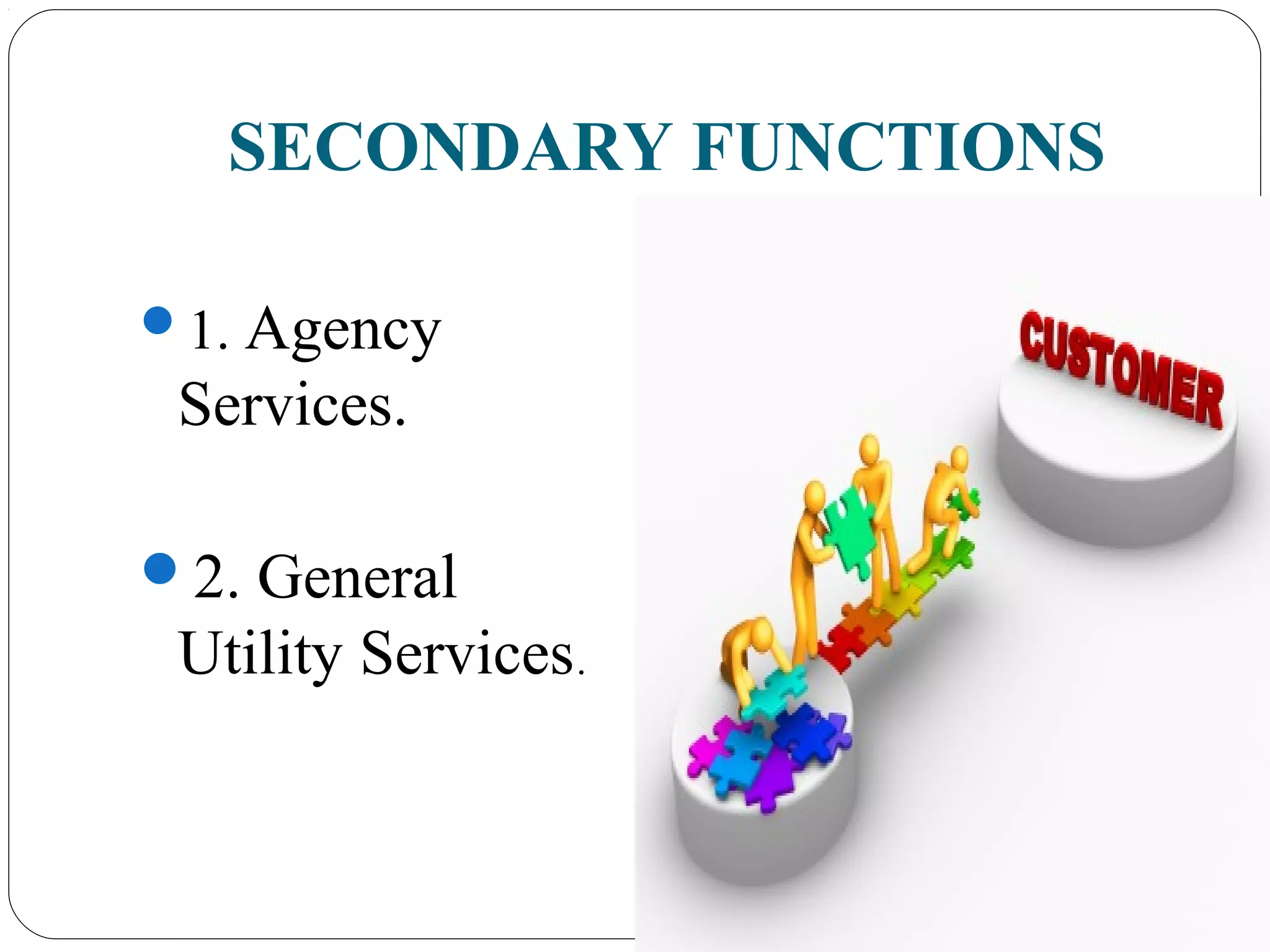
SECONDARY FUNCTIONS
1. Agency
Services.
2. General
Utility Services.
Banks act as agents to their customers in different ways:
(i)Collection and Payment ofVarious Items:
Banks collect cheques, rent, interest etc. on behalf of their
customers and also make payment of taxes, insurance premia etc.
on their behalf.
1. Agency Services:
Banks normally are more knowledgeable
with regard to stock and share business.
As such they buy, sell and keep in safe
custody the securities on behalf of their
customers.
(ii) Purchase and Sale of
Securities:
Banks also act as trustees and executors of the property of their customers
on their advice.
(iv) Remitting of Money:
Banks also remit money from one place to the other through bank drafts.
(iii) Trustee and Executor:
Banks buy and sell foreign exchange and thus promote international trade.
This function is mainly discharged by Foreign Exchange Banks.
(vi) Letter of References:
Banks also give information about economic position of their customers to
domestic and foreign traders and likewise provide information about
economic position of domestic and foreign traders to their customers.
(v) Purchase and Sale of
Foreign Exchange:
.
Commercial banks also provide certain services of general utility to the
society:
(i)Locker Facilities:
Banks provide locker facilities to their customers. People can keep their
gold or silver jewellery or other important documents in these lockers.
Their annual rent is very nominal.
2. General Utility Services:
Banks issue traveller’s cheque and letters of credit to their customers so
that they may be spared from the risk of carrying cash during their journey.
(iii) Business Information and Statistics:
Being familiar with the economic situation of the country, the banks give
advice to their customers on financial matters on the basis of business
information and statistical data collected by them.
(ii) Traveller’s Cheque and
Letters of Credit:
TOP RANKING COMMERCIAL
BANKS IN INDIA
1. STATE BANK OF INDIA
2. ICICI Bank Limited
3. Punjab National Bank
4. Canara Bank
5. Bank of Baroda
6. Bank of India
7. Union Bank of India
8. Industrial Development Bank of India Limited
9. Central Bank of India
10. HDFC Bank Limited
11. UCO Bank
12. Syndicate Bank
13. Indian Overseas Bank
14. Oriental Bank of Commerce
15. Allahabad Bank
CONCLUSION
Have been called upon to
help achieve certain socio-
economic objectives laid
down by the state.
Used to sub-serve the
national policy objectives of
reducing inequalities of
income and wealth, removal
of poverty and elimination
of unemployment in the
country.
In the modern world, banks
are to be considered not
merely as dealers in money
but also the leaders in
economic development.
Functions of commercial banks

Functions of commercial banks

  • 1.
    SubmittedTo=MS.ABHIKRATI SHUKLA BY :HarshitPatni Husain Shabir Gopalpurwala FUNCTIONS OF COMMERCIAL BANKS
  • 2.
    OBJECTIVES  DEFINITION OFA BANK. TYPES OF COMMERCIAL BANKS. FUNCTIONS OF COMMERCIAL BANKS. CONCLUSION.
  • 3.
    A bank islike a pool into which the flow of savings, the idle surplus money of households and from which loans are given on interest to individuals and others who need them for investment or productive uses.
  • 4.
    DEFINITION OF ABANK The Banking Companies Act of India defines a bank as “A Bank is a financial institution which accepts money from the public for the purpose of lending or investment repayable on demand or otherwise withdrawable by cheques, drafts or order or otherwise.”
  • 5.
    According to CULBERSTON “Commercialbanks are the institutions that make short term loans to business and in the process create money.” DEFINITION
  • 6.
    TYPES OF COMMERCIAL BANKS DEPOSITBANKS INDUSTRIAL BANKS SAVINGS BANKS EXCHANGE BANKS AGRICULTURAL BANKS MISCELLANEOUS BANKS
  • 7.
    FUNCTIONS OF COMMERCIAL BANKS Commercialbanks have to perform a variety of functions which are common to both developed and developing countries. These are known as ‘General Banking’ functions of the commercial banks. The modern banks perform a variety of functions. These can be broadly divided into two categories: (a) Primary functions. (b) Secondary functions.
  • 8.
    PRIMARY FUNCTIONS 1. Acceptanceof deposits. 2. Advancing loans. 3. Creation of credit. 4. Clearing of cheques. 5. Financing foreign trade. 6. Remittance of funds.
  • 9.
    1. Acceptance ofdeposits It is the most important function of commercial banks. They accept deposits in several forms according to requirements of different sections of the society. The main kinds of deposits are:
  • 10.
    These deposits referto those deposits which are repayable by the banks on demand: 1. Such deposits are generally maintained by businessmen with the intention of making transactions with such deposits. 2.They can be drawn upon by a cheque without any restriction. 3. Banks do not pay any interest on these accounts. Rather, banks impose service charges for running these accounts. (i) Current Account Deposits or Demand Deposits:
  • 11.
    Fixed deposits referto those deposits, in which the amount is deposited with the bank for a fixed period of time. 1. Such deposits do not enjoy cheque-able facility. 2.These deposits carry a high rate of interest. (ii) Fixed Deposits or Time Deposits:
  • 12.
    Basis Demand DepositsFixed Deposits Cheque facility They are chequeable deposits. They are non-chequeable deposits. Interest payments They do not carry any interest. They carry interest which varies directly with the period of time. Number of transactions The depositor can make any number of transactions for deposit or with drawl of money. Depositor generally makes only two transactions: (i) Deposit of Money in the beginning; (ii) Withdrawal of money on maturity.
  • 13.
    These deposits combinefeatures of both current account deposits and fixed deposits: 1.The depositors are given cheque facility to withdraw money from their account. But, some restrictions are imposed on number and amount of withdrawals, in order to discourage frequent use of saving deposits. (iii) Saving Deposits:
  • 14.
    2.They carry arate of interest which is less than interest rate on fixed deposits. It must be noted that CurrentAccount deposits and saving deposits are chequable deposits, whereas, fixed deposit is a non-chequable deposit.
  • 15.
    The deposits receivedby banks are not allowed to remain idle. So, after keeping certain cash reserves, the balance is given to needy borrowers and interest is charged from them, which is the main source of income for these banks. 2. Advancing of Loans:
  • 16.
    Different types ofloans and advances made by Commercial banks are:
  • 17.
    Cash credit refersto a loan given to the borrower against his current assets like shares, stocks, bonds, etc.A credit limit is sanctioned and the amount is credited in his account.The borrower may withdraw any amount within his credit limit and interest is charged on the amount actually withdrawn (i) Cash Credit:
  • 18.
    Demand loans referto those loans which can be recalled on demand by the bank at any time.The entire sum of demand loan is credited to the account and interest is payable on the entire sum. (ii) Demand Loans:
  • 19.
    They are givenas personal loans against some collateral security.The money is credited to the account of borrower and the borrower can withdraw money from his account and interest is payable on the entire sum of loan granted.  (iii) Short-term Loans:
  • 20.
    Credit creation ismost significant function of commercial banks.While sanctioning a loan to a customer, they do not provide cash to the borrower. Instead, they open a deposit account from which the borrower can withdraw. In other words, while sanctioning a loan, they automatically create deposits, known as a credit creation from commercial banks. 3. Creation of credit
  • 21.
    It is theprocess of moving a cheque from the bank in which it was deposited to the bank on which it was drawn, and the movement of the money in the opposite direction.This process is called the clearing cycle and normally results in a credit to the account at the bank of deposit, and an equivalent debit to the account at the bank on which it was drawn 4. Clearing of cheques.
  • 22.
  • 23.
    Banks act asagents to their customers in different ways: (i)Collection and Payment ofVarious Items: Banks collect cheques, rent, interest etc. on behalf of their customers and also make payment of taxes, insurance premia etc. on their behalf. 1. Agency Services:
  • 24.
    Banks normally aremore knowledgeable with regard to stock and share business. As such they buy, sell and keep in safe custody the securities on behalf of their customers. (ii) Purchase and Sale of Securities:
  • 25.
    Banks also actas trustees and executors of the property of their customers on their advice. (iv) Remitting of Money: Banks also remit money from one place to the other through bank drafts. (iii) Trustee and Executor:
  • 26.
    Banks buy andsell foreign exchange and thus promote international trade. This function is mainly discharged by Foreign Exchange Banks. (vi) Letter of References: Banks also give information about economic position of their customers to domestic and foreign traders and likewise provide information about economic position of domestic and foreign traders to their customers. (v) Purchase and Sale of Foreign Exchange: .
  • 27.
    Commercial banks alsoprovide certain services of general utility to the society: (i)Locker Facilities: Banks provide locker facilities to their customers. People can keep their gold or silver jewellery or other important documents in these lockers. Their annual rent is very nominal. 2. General Utility Services:
  • 28.
    Banks issue traveller’scheque and letters of credit to their customers so that they may be spared from the risk of carrying cash during their journey. (iii) Business Information and Statistics: Being familiar with the economic situation of the country, the banks give advice to their customers on financial matters on the basis of business information and statistical data collected by them. (ii) Traveller’s Cheque and Letters of Credit:
  • 29.
    TOP RANKING COMMERCIAL BANKSIN INDIA 1. STATE BANK OF INDIA 2. ICICI Bank Limited 3. Punjab National Bank 4. Canara Bank 5. Bank of Baroda 6. Bank of India 7. Union Bank of India 8. Industrial Development Bank of India Limited 9. Central Bank of India 10. HDFC Bank Limited 11. UCO Bank 12. Syndicate Bank 13. Indian Overseas Bank 14. Oriental Bank of Commerce 15. Allahabad Bank
  • 30.
    CONCLUSION Have been calledupon to help achieve certain socio- economic objectives laid down by the state. Used to sub-serve the national policy objectives of reducing inequalities of income and wealth, removal of poverty and elimination of unemployment in the country. In the modern world, banks are to be considered not merely as dealers in money but also the leaders in economic development.