•Schedule
commercial
bank
Presented by ,
Shrikanth.T.Mulimani
Jr.Msc agri in agmaco
contents
•
•
•
•
•

Introduction
Functions
Agency functions
General Utility Functions
Difference between scheduled commercial
bank and commercial bank
• Reference
INTRODUCTION
Banks in India can be categorized into two parts:
a) Scheduled Commercial banks and
b) Unscheduled Commercial Banks.
Those banks which fulfil the conditions laid down by the
Second Schedule of Reserve Bank of India Act 1934, vide
section 42 (6), are called Scheduled Commercial Banks
and other banks are known as Unscheduled Commercial
Banks.
(a non scheduled bank is a bank which does not come
under RBI act 1949 )
• The banks included in this schedule list should
fulfil two conditions.
1. The paid capital and collected funds of bank
should not be less than Rs. 5 lack.
2.Any activity of the bank will not adversely affect
the interests of depositors.
Every Scheduled bank enjoys the following facilities.
1. Such bank becomes eligible for debts/loans on
bank rate from the RBI
2. Such bank automatically acquire the membership
of clearing house.
Scheduled Banks of India can be further
categorized into
– Public Sector Banks
– Private Sector Banks
– Foreign Banks
– Regional rural bank
• Public Sector Banks are widely known as
Nationalized banks of India.
Public Sector Banks :- are those banks in which majority of stake is
held by the government. Eg-

•
•
•
•
•
•
•
•
•
•
•
•
•

Allahabad Bank
Andhra Bank
Bank of Baroda
Bank of India
Bank of Maharashtra
Canara Bank
Central Bank of India
Corporation Bank
Dena Bank
IDBI Bank (Industrial Development Bank of India)
Indian Bank
Indian Overseas Bank
Oriental Bank of Commerce
•
•
•
•
•
•
•
•
•
•
•
•
•
•

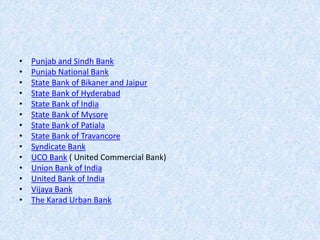
Punjab and Sindh Bank
Punjab National Bank
State Bank of Bikaner and Jaipur
State Bank of Hyderabad
State Bank of India
State Bank of Mysore
State Bank of Patiala
State Bank of Travancore
Syndicate Bank
UCO Bank ( United Commercial Bank)
Union Bank of India
United Bank of India
Vijaya Bank
The Karad Urban Bank
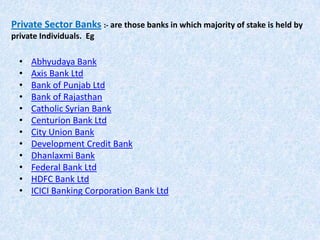
Private Sector Banks :- are those banks in which majority of stake is held by
private Individuals. Eg

•
•
•
•
•
•
•
•
•
•
•
•

Abhyudaya Bank
Axis Bank Ltd
Bank of Punjab Ltd
Bank of Rajasthan
Catholic Syrian Bank
Centurion Bank Ltd
City Union Bank
Development Credit Bank
Dhanlaxmi Bank
Federal Bank Ltd
HDFC Bank Ltd
ICICI Banking Corporation Bank Ltd
•
•
•
•
•
•
•
•
•
•
•
•

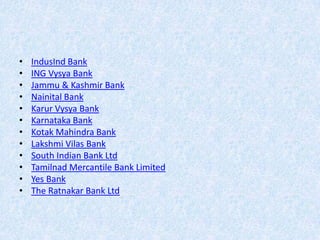
IndusInd Bank
ING Vysya Bank
Jammu & Kashmir Bank
Nainital Bank
Karur Vysya Bank
Karnataka Bank
Kotak Mahindra Bank
Lakshmi Vilas Bank
South Indian Bank Ltd
Tamilnad Mercantile Bank Limited
Yes Bank
The Ratnakar Bank Ltd
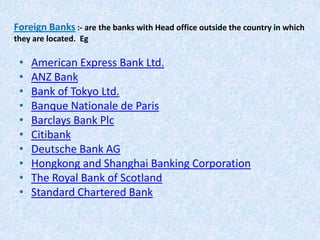
Foreign Banks :- are the banks with Head office outside the country in which
they are located. Eg

•
•
•
•
•
•
•
•
•
•

American Express Bank Ltd.
ANZ Bank
Bank of Tokyo Ltd.
Banque Nationale de Paris
Barclays Bank Plc
Citibank
Deutsche Bank AG
Hongkong and Shanghai Banking Corporation
The Royal Bank of Scotland
Standard Chartered Bank
Regional Rural Banks - are the banking organizations
being operated in different states of India. They have
been created to serve the rural areas with banking
and financial services. Eg

•
•
•
•
•
•
•
•

Karnataka Vikas Grameena Bank
Narmada Malwa Grameena Bank
Pragathi Grameena Bank
Cauvery Kalpatharu Grameena Bank
Saptagiri Grameena Bank
Shri Venkateswara Grameena Bank
Kisan Grameena Bank
Chaitanya Grameena Bank ..etc
Functions
1. Accepting Deposits : accepts various types of
deposits from public especially from its clients. It
includes saving account deposits, recurring account
deposits, fixed deposits, etc.

2. Making Advances : The commercial banks provide
loans and advances of various forms. It includes an
over draft facility, cash credit, bill discounting, etc.
They also give term loans to all types of clients
against proper security.
• 3.Credit creation : While sanctioning a loan to a
customer, a bank does not provide cash to the
borrower Instead it opens a deposit account from
where the borrower can withdraw. In other words
while sanctioning a loan a bank automatically
creates deposits. This is known as a credit creation.
Agency Functions : Various agency functions of
Scheduled commercial banks are
1.To collect and clear cheque, dividends and interest
warrant.
2. To make payment of rent, insurance premium, etc.
3 .To deal in foreign exchange transactions.
4 .To purchase and sell securities.
5.To accept tax proceeds and tax returns.
General Utility Functions : The general utility
functions of the scheduled commercial banks
include
1. To provide safety locker facility to customers.
2. To provide money transfer facility.
3. To issue traveler's cheque.
4. To act as referees.
5. To accept various bills for payment e.g. phone
bills, gas bills, water bills, etc.
6. To provide merchant banking facility.
7. To provide various cards such as credit cards, debit
cards, Smart cards, etc.
Difference between scheduled commercial
bank and commercial bank
• While commercial banks exist around the
world, scheduled banks constitute a unique feature
of the Indian banking system.
• Within this banking structure, commercial banks
take on a specific definition in relation to the other
types of banks in the Indian system, which include
schedule banks, non-scheduled banks and
cooperative banks.
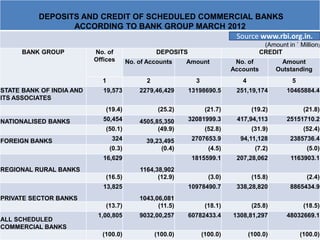
DEPOSITS AND CREDIT OF SCHEDULED COMMERCIAL BANKS
ACCORDING TO BANK GROUP MARCH 2012
Source www.rbi.org.in.
BANK GROUP

(Amount in ` Million)
CREDIT

No. of Accounts

Amount

No. of
Accounts

Amount
Outstanding

1
STATE BANK OF INDIA AND
ITS ASSOCIATES

No. of
Offices

DEPOSITS

2

3

4

5

2279,46,429

13198690.5

251,19,174

10465884.4

(19.4)

(25.2)

(21.7)

(19.2)

(21.8)

50,454

4505,85,350
(49.9)

32081999.3

417,94,113

25151710.2

(52.8)

(31.9)

(52.4)

39,23,495
(0.4)

2707653.9

94,11,128

2385736.4

(4.5)

(7.2)

(5.0)

1815599.1

207,28,062

1163903.1

(3.0)

(15.8)

(2.4)

10978490.7

338,28,820

8865434.9

(13.7)

NATIONALISED BANKS

19,573

1043,06,081
(11.5)

(18.1)

(25.8)

(18.5)

1,00,805

9032,00,257

60782433.4

1308,81,297

48032669.1

(100.0)

(100.0)

(100.0)

(100.0)

(100.0)

(50.1)
FOREIGN BANKS

324
(0.3)
16,629

REGIONAL RURAL BANKS
(16.5)

1164,38,902
(12.9)

13,825
PRIVATE SECTOR BANKS
ALL SCHEDULED
COMMERCIAL BANKS
Reference
•
•
•
•
•

http://www.rbi.org.in.
http://en.wikipedia.org
http://wiki.answers.com
http://www.ehow.com
http://www.scribd.com/doc
Schedule commercial bank ppt

Schedule commercial bank ppt

  • 2.
  • 3.
    contents • • • • • Introduction Functions Agency functions General UtilityFunctions Difference between scheduled commercial bank and commercial bank • Reference
  • 4.
    INTRODUCTION Banks in Indiacan be categorized into two parts: a) Scheduled Commercial banks and b) Unscheduled Commercial Banks. Those banks which fulfil the conditions laid down by the Second Schedule of Reserve Bank of India Act 1934, vide section 42 (6), are called Scheduled Commercial Banks and other banks are known as Unscheduled Commercial Banks. (a non scheduled bank is a bank which does not come under RBI act 1949 )
  • 5.
    • The banksincluded in this schedule list should fulfil two conditions. 1. The paid capital and collected funds of bank should not be less than Rs. 5 lack. 2.Any activity of the bank will not adversely affect the interests of depositors. Every Scheduled bank enjoys the following facilities. 1. Such bank becomes eligible for debts/loans on bank rate from the RBI 2. Such bank automatically acquire the membership of clearing house.
  • 6.
    Scheduled Banks ofIndia can be further categorized into – Public Sector Banks – Private Sector Banks – Foreign Banks – Regional rural bank • Public Sector Banks are widely known as Nationalized banks of India.
  • 7.
    Public Sector Banks:- are those banks in which majority of stake is held by the government. Eg- • • • • • • • • • • • • • Allahabad Bank Andhra Bank Bank of Baroda Bank of India Bank of Maharashtra Canara Bank Central Bank of India Corporation Bank Dena Bank IDBI Bank (Industrial Development Bank of India) Indian Bank Indian Overseas Bank Oriental Bank of Commerce
  • 8.
    • • • • • • • • • • • • • • Punjab and SindhBank Punjab National Bank State Bank of Bikaner and Jaipur State Bank of Hyderabad State Bank of India State Bank of Mysore State Bank of Patiala State Bank of Travancore Syndicate Bank UCO Bank ( United Commercial Bank) Union Bank of India United Bank of India Vijaya Bank The Karad Urban Bank
  • 9.
    Private Sector Banks:- are those banks in which majority of stake is held by private Individuals. Eg • • • • • • • • • • • • Abhyudaya Bank Axis Bank Ltd Bank of Punjab Ltd Bank of Rajasthan Catholic Syrian Bank Centurion Bank Ltd City Union Bank Development Credit Bank Dhanlaxmi Bank Federal Bank Ltd HDFC Bank Ltd ICICI Banking Corporation Bank Ltd
  • 10.
    • • • • • • • • • • • • IndusInd Bank ING VysyaBank Jammu & Kashmir Bank Nainital Bank Karur Vysya Bank Karnataka Bank Kotak Mahindra Bank Lakshmi Vilas Bank South Indian Bank Ltd Tamilnad Mercantile Bank Limited Yes Bank The Ratnakar Bank Ltd
  • 11.
    Foreign Banks :-are the banks with Head office outside the country in which they are located. Eg • • • • • • • • • • American Express Bank Ltd. ANZ Bank Bank of Tokyo Ltd. Banque Nationale de Paris Barclays Bank Plc Citibank Deutsche Bank AG Hongkong and Shanghai Banking Corporation The Royal Bank of Scotland Standard Chartered Bank
  • 12.
    Regional Rural Banks- are the banking organizations being operated in different states of India. They have been created to serve the rural areas with banking and financial services. Eg • • • • • • • • Karnataka Vikas Grameena Bank Narmada Malwa Grameena Bank Pragathi Grameena Bank Cauvery Kalpatharu Grameena Bank Saptagiri Grameena Bank Shri Venkateswara Grameena Bank Kisan Grameena Bank Chaitanya Grameena Bank ..etc
  • 13.
    Functions 1. Accepting Deposits: accepts various types of deposits from public especially from its clients. It includes saving account deposits, recurring account deposits, fixed deposits, etc. 2. Making Advances : The commercial banks provide loans and advances of various forms. It includes an over draft facility, cash credit, bill discounting, etc. They also give term loans to all types of clients against proper security.
  • 14.
    • 3.Credit creation: While sanctioning a loan to a customer, a bank does not provide cash to the borrower Instead it opens a deposit account from where the borrower can withdraw. In other words while sanctioning a loan a bank automatically creates deposits. This is known as a credit creation.
  • 15.
    Agency Functions :Various agency functions of Scheduled commercial banks are 1.To collect and clear cheque, dividends and interest warrant. 2. To make payment of rent, insurance premium, etc. 3 .To deal in foreign exchange transactions. 4 .To purchase and sell securities. 5.To accept tax proceeds and tax returns.
  • 16.
    General Utility Functions: The general utility functions of the scheduled commercial banks include 1. To provide safety locker facility to customers. 2. To provide money transfer facility. 3. To issue traveler's cheque. 4. To act as referees. 5. To accept various bills for payment e.g. phone bills, gas bills, water bills, etc. 6. To provide merchant banking facility. 7. To provide various cards such as credit cards, debit cards, Smart cards, etc.
  • 17.
    Difference between scheduledcommercial bank and commercial bank • While commercial banks exist around the world, scheduled banks constitute a unique feature of the Indian banking system. • Within this banking structure, commercial banks take on a specific definition in relation to the other types of banks in the Indian system, which include schedule banks, non-scheduled banks and cooperative banks.
  • 18.
    DEPOSITS AND CREDITOF SCHEDULED COMMERCIAL BANKS ACCORDING TO BANK GROUP MARCH 2012 Source www.rbi.org.in. BANK GROUP (Amount in ` Million) CREDIT No. of Accounts Amount No. of Accounts Amount Outstanding 1 STATE BANK OF INDIA AND ITS ASSOCIATES No. of Offices DEPOSITS 2 3 4 5 2279,46,429 13198690.5 251,19,174 10465884.4 (19.4) (25.2) (21.7) (19.2) (21.8) 50,454 4505,85,350 (49.9) 32081999.3 417,94,113 25151710.2 (52.8) (31.9) (52.4) 39,23,495 (0.4) 2707653.9 94,11,128 2385736.4 (4.5) (7.2) (5.0) 1815599.1 207,28,062 1163903.1 (3.0) (15.8) (2.4) 10978490.7 338,28,820 8865434.9 (13.7) NATIONALISED BANKS 19,573 1043,06,081 (11.5) (18.1) (25.8) (18.5) 1,00,805 9032,00,257 60782433.4 1308,81,297 48032669.1 (100.0) (100.0) (100.0) (100.0) (100.0) (50.1) FOREIGN BANKS 324 (0.3) 16,629 REGIONAL RURAL BANKS (16.5) 1164,38,902 (12.9) 13,825 PRIVATE SECTOR BANKS ALL SCHEDULED COMMERCIAL BANKS
  • 19.