COMMERCIAL BANKS &
ITS FUNCTIONS
GUIDED BY :- PRESENTED BY :-
SHREE VAISHNAV INSTITUTE OF
MANAGEMENT
 Commercial Bank is an institution which performs the functions of
accepting deposits, granting loans and making investments with the
aim of earning profits.
 They are also called ‘DEPOSIT BANKS’ .
 The amount of money earned by a commercial bank is determined
by the SPREAD which is the difference of the interest it pays on
deposits and the interest it earns on loans.
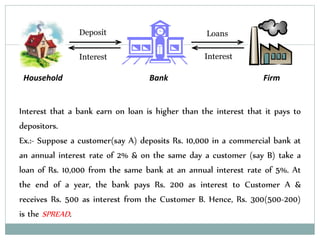
Household Bank Firm
Deposit Loans
Interest Interest
Interest that a bank earn on loan is higher than the interest that it pays to
depositors.
Ex.:- Suppose a customer(say A) deposits Rs. 10,000 in a commercial bank at
an annual interest rate of 2% & on the same day a customer (say B) take a
loan of Rs. 10,000 from the same bank at an annual interest rate of 5%. At
the end of a year, the bank pays Rs. 200 as interest to Customer A &
receives Rs. 500 as interest from the Customer B. Hence, Rs. 300(500-200)
is the SPREAD.
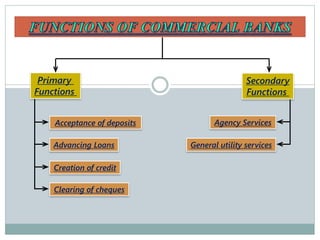
Primary
Functions
Secondary
Functions
Acceptance of deposits
Advancing Loans
Creation of credit
Clearing of cheques
Agency Services
General utility services
Primary
Functions
Acceptance of Deposits
Commercial banks receive deposits from the people
who have surplus money and willing to deposit with
banks for the purpose of safety and interests etc.
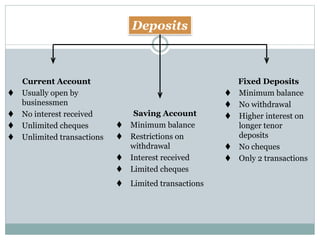
The main types of deposits are:-
 Current Deposits
 Savings Deposits
 Fixed Deposits
Current Account
 Usually open by
businessmen
 No interest received
 Unlimited cheques
 Unlimited transactions
Deposits
Saving Account
 Minimum balance
 Restrictions on
withdrawal
 Interest received
 Limited cheques
 Limited transactions
Fixed Deposits
 Minimum balance
 No withdrawal
 Higher interest on
longer tenor
deposits
 No cheques
 Only 2 transactions
The deposits received by banks are not allowed to
remain idle. So, after keeping certain cash reserves, the
balance is given to needy borrowers and interest is
charged from them, which is the main source of
income for commercial banks.
Bank advances loans to all types of persons,
businessmen and investors, against personal security,
gold, silver, stock of goods & other assets.
Advancing Loans
a) Overdraft Facilities: In this case, the depositor in a current account is
allowed to draw over and above his account up to a previously agreed
limit. The bank allows the customer to overdraw his account through
cheques. The bank, however, charges interest only on the amount
overdrawn from the account.
b) Term Loans: Banks give term loans to traders, industrialists and now
to agriculturists also against some collateral securities. Term loans are
so-called because their maturity period varies between 1 to 10 years.
Sometimes, two or more banks may jointly provide large term loans to
the borrower against a common security. Such loans are called
participation loans or consortium finance.
c) Money at Call: Bank also grant loans for a very short period, generally
not exceeding 7 days to the borrowers, usually dealers or brokers in stock
exchange markets against collateral securities like stock or equity shares,
debentures, etc., offered by them. Such advances are repayable
immediately at short notice hence, they are described as money at call or
call money.
d) Consumer Credit: Banks also grant credit to households in a limited
amount to buy some durable consumer goods such as television sets,
refrigerators, etc., or to meet some personal needs like payment of
hospital bills etc. Such consumer credit is made in a lump sum and is
repayable in instalments in a short time.
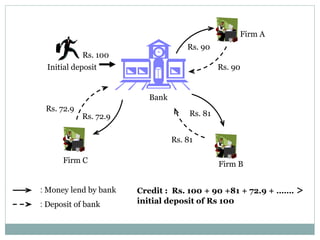
Credit creation is most significant function of
commercial banks. While sanctioning a loan to a
customer, they do not provide cash to the borrower.
Instead, they open a deposit account from which the
borrower can withdraw. In other words, while
sanctioning a loan, they automatically create deposits,
known as a credit creation from commercial banks.
Creation of credit
: Money lend by bank
: Deposit of bank
Bank
Firm A
Firm B
Firm C
Rs. 90
Rs. 90
Rs. 81
Rs. 81
Rs. 72.9
Rs. 72.9
Rs. 100
Initial deposit
Credit : Rs. 100 + 90 +81 + 72.9 + ……. >
initial deposit of Rs 100
It is the process of moving a cheque from the bank in
which it was deposited to the bank on which it was
drawn, and the movement of the money in the opposite
direction. This process is called the clearing cycle and
normally results in a credit to the account of bank of
deposit, and an equivalent debit to the account at the
bank on which it was drawn.
Clearing of cheques
Secondary
Functions
Banks act as agents to their customers in different ways:
a) It collect cheques, rent, interest etc & pay insurance
premium, mutual funds, rent, water taxes, electricity bills
etc of their customers.
b) Collection of dividend on shares purchased by customers.
c) Buy and sell shares, securities on behalf of their
customers.
d) Purchase & sale of foreign exchange.
Agency services
Banks act as agents to their customers in different ways:
e) Acts as Correspondent: Sometimes banks act as
representative and correspondents of their customers.
They get passports, traveller’s tickets etc for their
customers.
f) Acts as Trustee and Executor: Banks preserve the ‘Wills’
of their customers and execute them after their death.
g) Income-tax Consultancy: Banks may also employ income
tax experts to prepare income tax returns for their
customers and to help them to get refund of income tax.
Agency services
Commercial banks also provide certain services of general
utility to the society:
a) Locker facilities: The customers can keep their valuables,
such as gold and silver ornaments, important documents.
b) Banks issue traveller’s cheque or credit cards to their
customers so that they may be spared from the risk of
carrying cash during the journey.
c) Business information & statistics.
d) Banks underwrite the shares and debentures issued by
the Government, public or private companies.
General utility services
Commercial banks also provide certain services of general
utility to the society:
d) Acting Referee: Banks may act as referees with respect to
the financial standing, business reputation and
respectability of customers.
e) Merchant Banking: Some commercial banks have opened
merchant banking divisions to provide merchant banking
services.
f) Gift Cheques: Some banks issue cheques of various
denominations to be used on auspicious occasions.
General utility services
Commercial banks & its functions

Commercial banks & its functions

  • 1.
    COMMERCIAL BANKS & ITSFUNCTIONS GUIDED BY :- PRESENTED BY :- SHREE VAISHNAV INSTITUTE OF MANAGEMENT
  • 2.
     Commercial Bankis an institution which performs the functions of accepting deposits, granting loans and making investments with the aim of earning profits.  They are also called ‘DEPOSIT BANKS’ .  The amount of money earned by a commercial bank is determined by the SPREAD which is the difference of the interest it pays on deposits and the interest it earns on loans.
  • 3.
    Household Bank Firm DepositLoans Interest Interest Interest that a bank earn on loan is higher than the interest that it pays to depositors. Ex.:- Suppose a customer(say A) deposits Rs. 10,000 in a commercial bank at an annual interest rate of 2% & on the same day a customer (say B) take a loan of Rs. 10,000 from the same bank at an annual interest rate of 5%. At the end of a year, the bank pays Rs. 200 as interest to Customer A & receives Rs. 500 as interest from the Customer B. Hence, Rs. 300(500-200) is the SPREAD.
  • 7.
    Primary Functions Secondary Functions Acceptance of deposits AdvancingLoans Creation of credit Clearing of cheques Agency Services General utility services
  • 8.
  • 9.
    Acceptance of Deposits Commercialbanks receive deposits from the people who have surplus money and willing to deposit with banks for the purpose of safety and interests etc. The main types of deposits are:-  Current Deposits  Savings Deposits  Fixed Deposits
  • 10.
    Current Account  Usuallyopen by businessmen  No interest received  Unlimited cheques  Unlimited transactions Deposits Saving Account  Minimum balance  Restrictions on withdrawal  Interest received  Limited cheques  Limited transactions Fixed Deposits  Minimum balance  No withdrawal  Higher interest on longer tenor deposits  No cheques  Only 2 transactions
  • 11.
    The deposits receivedby banks are not allowed to remain idle. So, after keeping certain cash reserves, the balance is given to needy borrowers and interest is charged from them, which is the main source of income for commercial banks. Bank advances loans to all types of persons, businessmen and investors, against personal security, gold, silver, stock of goods & other assets. Advancing Loans
  • 12.
    a) Overdraft Facilities:In this case, the depositor in a current account is allowed to draw over and above his account up to a previously agreed limit. The bank allows the customer to overdraw his account through cheques. The bank, however, charges interest only on the amount overdrawn from the account. b) Term Loans: Banks give term loans to traders, industrialists and now to agriculturists also against some collateral securities. Term loans are so-called because their maturity period varies between 1 to 10 years. Sometimes, two or more banks may jointly provide large term loans to the borrower against a common security. Such loans are called participation loans or consortium finance.
  • 13.
    c) Money atCall: Bank also grant loans for a very short period, generally not exceeding 7 days to the borrowers, usually dealers or brokers in stock exchange markets against collateral securities like stock or equity shares, debentures, etc., offered by them. Such advances are repayable immediately at short notice hence, they are described as money at call or call money. d) Consumer Credit: Banks also grant credit to households in a limited amount to buy some durable consumer goods such as television sets, refrigerators, etc., or to meet some personal needs like payment of hospital bills etc. Such consumer credit is made in a lump sum and is repayable in instalments in a short time.
  • 14.
    Credit creation ismost significant function of commercial banks. While sanctioning a loan to a customer, they do not provide cash to the borrower. Instead, they open a deposit account from which the borrower can withdraw. In other words, while sanctioning a loan, they automatically create deposits, known as a credit creation from commercial banks. Creation of credit
  • 15.
    : Money lendby bank : Deposit of bank Bank Firm A Firm B Firm C Rs. 90 Rs. 90 Rs. 81 Rs. 81 Rs. 72.9 Rs. 72.9 Rs. 100 Initial deposit Credit : Rs. 100 + 90 +81 + 72.9 + ……. > initial deposit of Rs 100
  • 16.
    It is theprocess of moving a cheque from the bank in which it was deposited to the bank on which it was drawn, and the movement of the money in the opposite direction. This process is called the clearing cycle and normally results in a credit to the account of bank of deposit, and an equivalent debit to the account at the bank on which it was drawn. Clearing of cheques
  • 17.
  • 18.
    Banks act asagents to their customers in different ways: a) It collect cheques, rent, interest etc & pay insurance premium, mutual funds, rent, water taxes, electricity bills etc of their customers. b) Collection of dividend on shares purchased by customers. c) Buy and sell shares, securities on behalf of their customers. d) Purchase & sale of foreign exchange. Agency services
  • 19.
    Banks act asagents to their customers in different ways: e) Acts as Correspondent: Sometimes banks act as representative and correspondents of their customers. They get passports, traveller’s tickets etc for their customers. f) Acts as Trustee and Executor: Banks preserve the ‘Wills’ of their customers and execute them after their death. g) Income-tax Consultancy: Banks may also employ income tax experts to prepare income tax returns for their customers and to help them to get refund of income tax. Agency services
  • 20.
    Commercial banks alsoprovide certain services of general utility to the society: a) Locker facilities: The customers can keep their valuables, such as gold and silver ornaments, important documents. b) Banks issue traveller’s cheque or credit cards to their customers so that they may be spared from the risk of carrying cash during the journey. c) Business information & statistics. d) Banks underwrite the shares and debentures issued by the Government, public or private companies. General utility services
  • 21.
    Commercial banks alsoprovide certain services of general utility to the society: d) Acting Referee: Banks may act as referees with respect to the financial standing, business reputation and respectability of customers. e) Merchant Banking: Some commercial banks have opened merchant banking divisions to provide merchant banking services. f) Gift Cheques: Some banks issue cheques of various denominations to be used on auspicious occasions. General utility services