Fitness-For-Duty Evaluations: A Tool For Financial and Safety Risk Management Steven E. Rothke, Ph.D., ABPP
Definitions  Neuropsychology Rehabilitation Psychology
(ADA) A limitation in physical, cognitive (thinking), sensory, or emotional functioning which significantly affects a person’s ability to work, to learn, to manage personal or family responsibilities, to maintain relationships, or to participate in recreational activities. Definitions  Disability
“ A specialized formal medical-legal examination of an employee … with a central purpose being the determination of whether the employee is able to safely perform a defined job.” Anthony V. Stone (2000)  Fitness For Duty: Principles, Methods and Legal Issues.  Boca Raton, FL: CRC Press Definitions  Fitness-For-Duty Evaluation
Basic Standards Of Work  To remember locations and work-like procedures To understand, remember and execute very short and simple  instructions To maintain attention for extended periods To persist in the performance of simple tasks
Basic Standards Of Work  To perform activities within a schedule To maintain regular attendance and to be punctual within  customary tolerances To sustain an ordinary routine without special supervision To make simple work-related decisions
Basic Standards Of Work  To work in coordination or in the presence of others without being  distracted by them To complete a normal workday and work week without interruption from mental  symptoms and to perform at a consistent pace without an unreasonable number of  rest periods
Basic Standards Of Work  To ask questions of request assistance To accept instructions and respond appropriately to criticism from    supervisors To maintain socially appropriate behavior and to adhere to basic  standards of neatness and cleanliness  To respond appropriately to changes in the work setting
Job Description Essential functions Non-essential functions (accommodations) Ask about availability of other sites, other assignments, can you speak with managers and/or coworkers
FFDE: Informed Consent Issues Discussed at the outset Who made the referral; who is paying for the exam What will the results be used for Confidentiality: Who will see the report Will the subject (employee) be given feedback and from whom
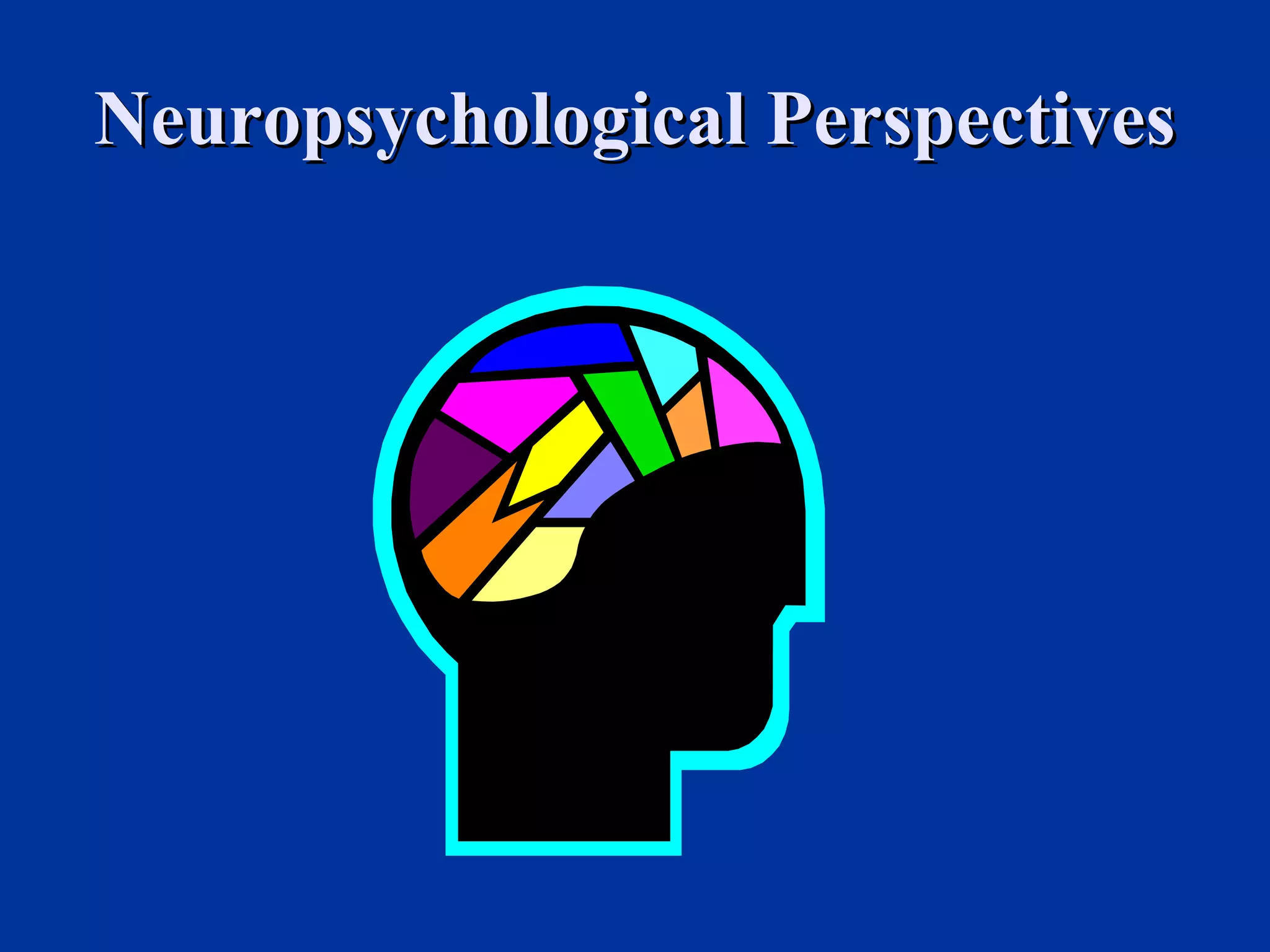
Neuropsychological Perspectives
Major Neuropsychological Evaluation Procedures Clinical Interview Wechsler Adult Intelligence Scale, 4 th  Edition (WAIS-IV) Wechsler Memory Scale, 4 th  Edition (WMS-IV) Halstead-Reitan Neuropsychological Test Battery Wisconsin Card Sorting Test Rey or California Verbal Learning Tests Grooved Pegboard Test Symptom validity tests Minnesota Multiphasic Personality Inventory (MMPI-2)
The Clinical Interview Appearance Behavior Speech Affect Thinking Perception Insight Judgment
Major Neuropsychological Evaluation Procedures Clinical Interview Wechsler Adult Intelligence Scale, 4 th  Edition (WAIS-IV) Wechsler Memory Scale, 4 th  Edition (WMS-IV) Halstead-Reitan Neuropsychological Test Battery Wisconsin Card Sorting Test Rey or California Verbal Learning Tests Grooved Pegboard Test Symptom validity tests Minnesota Multiphasic Personality Inventory (MMPI-2)
What does a Neuropsychological  Evaluation tell you about a patient or claimant?   Orientation Attention / Concentration Focus Selective Sustaining Shifting Speech / Language  Naming Word finding
What does a Neuropsychological  Evaluation tell you about a patient or claimant?   Memory Immediate, short-term and long-term Verbal and nonverbal Visuospatial Reasoning Complex Motor Abstract Reasoning Emotional / Psychological Executive Abilities
Executive Abilities Insight Judgment Forethought/ Anticipation of consequences Planning/Sequencing
Executive Abilities Self-monitoring capacity (error awareness and correction) Awareness of impact on others Strategy Shifting (flexibility) Inhibition of impulses/ delay of gratification
Issues in Test Interpretation Age Educational background Occupational background Premorbid psychiatric and medical conditions ETOH and recreational drug abuse Effects of medications
Issues in Test Interpretation Time Since Onset Effects of retesting Effects of rehabilitation efforts Incentives to perform poorly Going beyond the bounds of the data Being overly localizationsitic
Risk Factors To Assess Evaluate: Factors That Limit Inhibition Intervene: To Enhance Inhibition
History of Previous Violence Employee’s account of event Emotional experience during event Signs of remorse vs. blaming others
Psychiatric History Sexual/physical abuse Hospitalizations Episodes of depression, PTSD Suicide attempts Emotional traumas, losses
Emotional Status The Affects of Violence Fear Anger
Personality Characteristics Signs of Psychopathy and  Antisocial Personality Disorder Manipulativeness Lack of remorse for actions Refusal to accept responsibility Lack of empathy Pathological lying
Personality Characteristics Signs of Psychopathy and  Antisocial Personality Disorder Sense of grandiosity Impulsivity Poor behavioral controls Disregard for the welfare of others Criminal history
Thought Disorder Psychotic Features Delusions (paranoid) Hallucinations (command)
Thought Disorder Threat Control/Override Features  Belief that your mind is dominated by forces outside your control Thought insertion Belief that people wish to harm you
Substance Abuse Stimulants (cocaine): Paranoia Grandiosity Disinhibition Alcohol  Disinhibition
Combination of Substance Abuse and Mental Disorder  Mental Disorder in the US (19%) Substance Abuse Disorder (6%) Combination (3%) U.S. Surgeon General (1999). Mental Health: A Report of the Surgeon General.  www.surgeongeneral.gov/sgoffice.htm  (Reports)
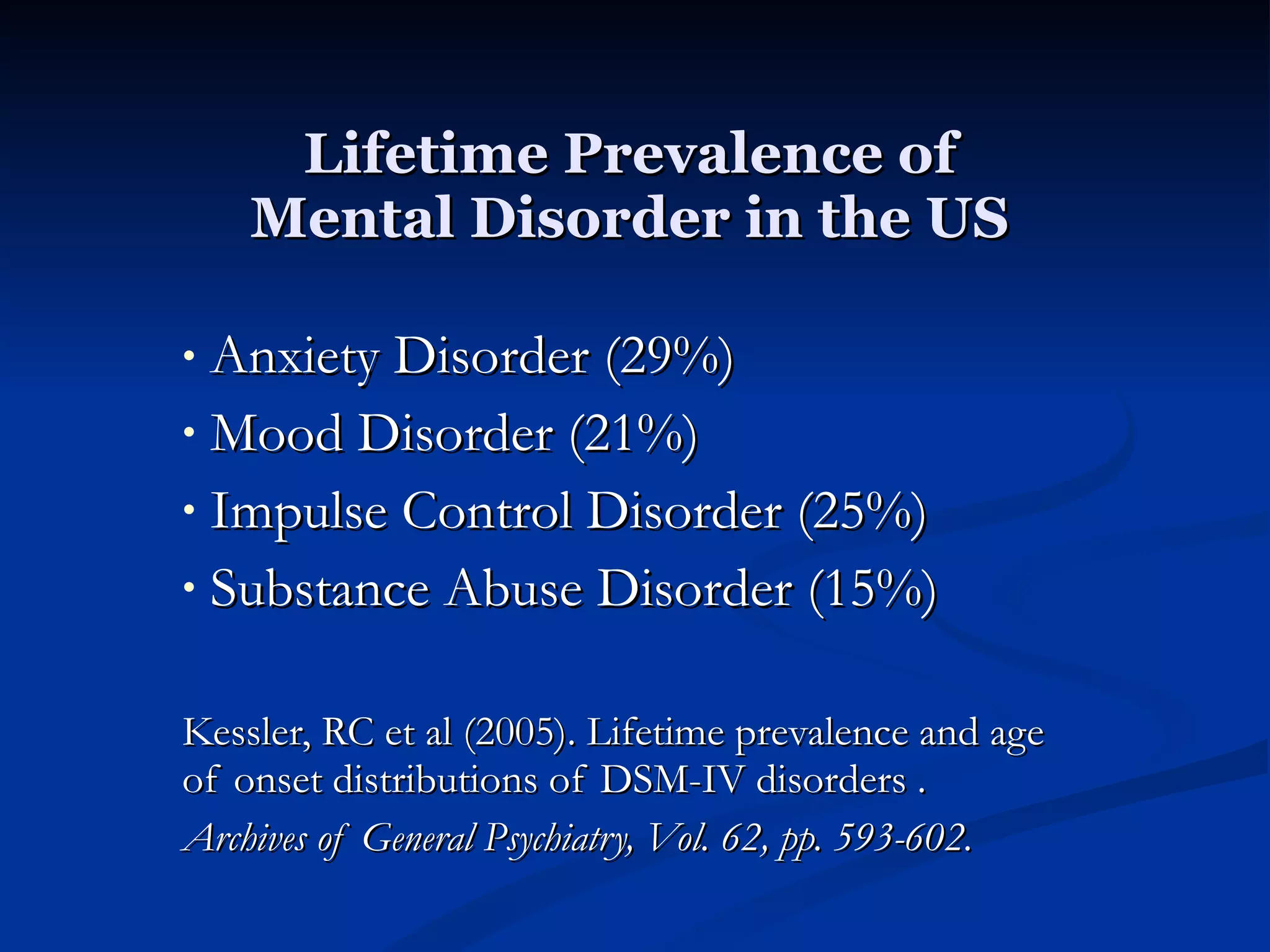
Lifetime Prevalence of  Mental Disorder in the US Anxiety Disorder (29%) Mood Disorder (21%) Impulse Control Disorder (25%) Substance Abuse Disorder (15%) Kessler, RC et al (2005). Lifetime prevalence and age of onset distributions of DSM-IV disorders . Archives of General Psychiatry, Vol. 62, pp. 593-602.
Medical/Neurological History Traumatic Brain Injury high incidence in prison population increased risk of affective/impulsive violence (Episodic Explosive Disorder) reduced executive function, reduced prefrontal activation, decreased serotonergic function treatment with anticonvulsants or SSRIs  Terminal illness
Plan/Intent 1) Wish to harm self and/or others 2) Frequency of thoughts or statements 3) Sequence thought through 4) Availability of weapons 5) Experience with firearms 6) Consequences considered
Malignant Signs Feeling of “nothing to lose” Belief that an injustice (humiliation) has been done to you (workplace violence)
Coping Skills 1) Self-Esteem 2) Stress management strategies 3) How has the person dealt with prior losses/trauma (is this the first bad thing that has happened to them)
Other Stressors/Supports Ongoing legal difficulties (divorce, bankruptcy, criminal) Financial struggles Marital/relationship strains v. good family support Social isolation Prior job difficulties/fears of loss of job
Assessment Tools RAGE-V (Risk Assessment Guideline for Violence) www.atapworldwide.org Hit tab for Education, then scroll down to RAGE-V to download form.  See other useful articles as well.
“ Tarasoff Warnings:  What is the Law in Illinois? Mental Health & Developmental Disabilities Confidentiality Act  (740 ILCS 110) Available at:  www.ilga.gov/legislation/ilcs/ilcs.asp
“ Records and communications may be disclosed … when, and to the extent, a therapist, in his or her sole discretion, determines that such a disclosure is necessary to continue civil commitment proceedings or to otherwise protect the recipient [patient, examinee] or other person against a clear, imminent risk of serious physical or mental injury or disease or death being inflicted upon the recipient, or by the recipient on himself or another.” Section 110/11 ii
“ Records and communications may be disclosed … when, and to the extent, in the therapist’s sole discretion, disclosure is necessary to warn or protect a specific individual against whom a recipient has made a specific threat of violence where there exists a therapist-recipient relationship or a special recipient-individual relationship.” Section 110/11 vii
“ Tarasoff Warnings:  What is the Law in Illinois? Mental Health & Developmental Disabilities Code (405 ILCS 5) Available at:  www.ilga.gov/legislation/ilcs/ilcs.asp
“ There shall be no liability on the part of, and no cause of action shall rise against, any person who is a physician, clinical psychologist, or qualified examiner based on that person’s failure to warn of and protect from a recipient’s threatened or actual violent behavior  except  where the recipient has communicated to the person a serious threat of physical violence against a reasonably identifiable victim or victims.” Section 110/11 vii
Common Mental Diagnoses of Workers Referred for FFD Exams Post-Concussion Syndrome (PCS) Traumatic Brain Injury (TBI) Depression Posttraumatic Stress Disorder (PTSD) Anxiety/Panic Disorder Dementia Substance Abuse Disorder
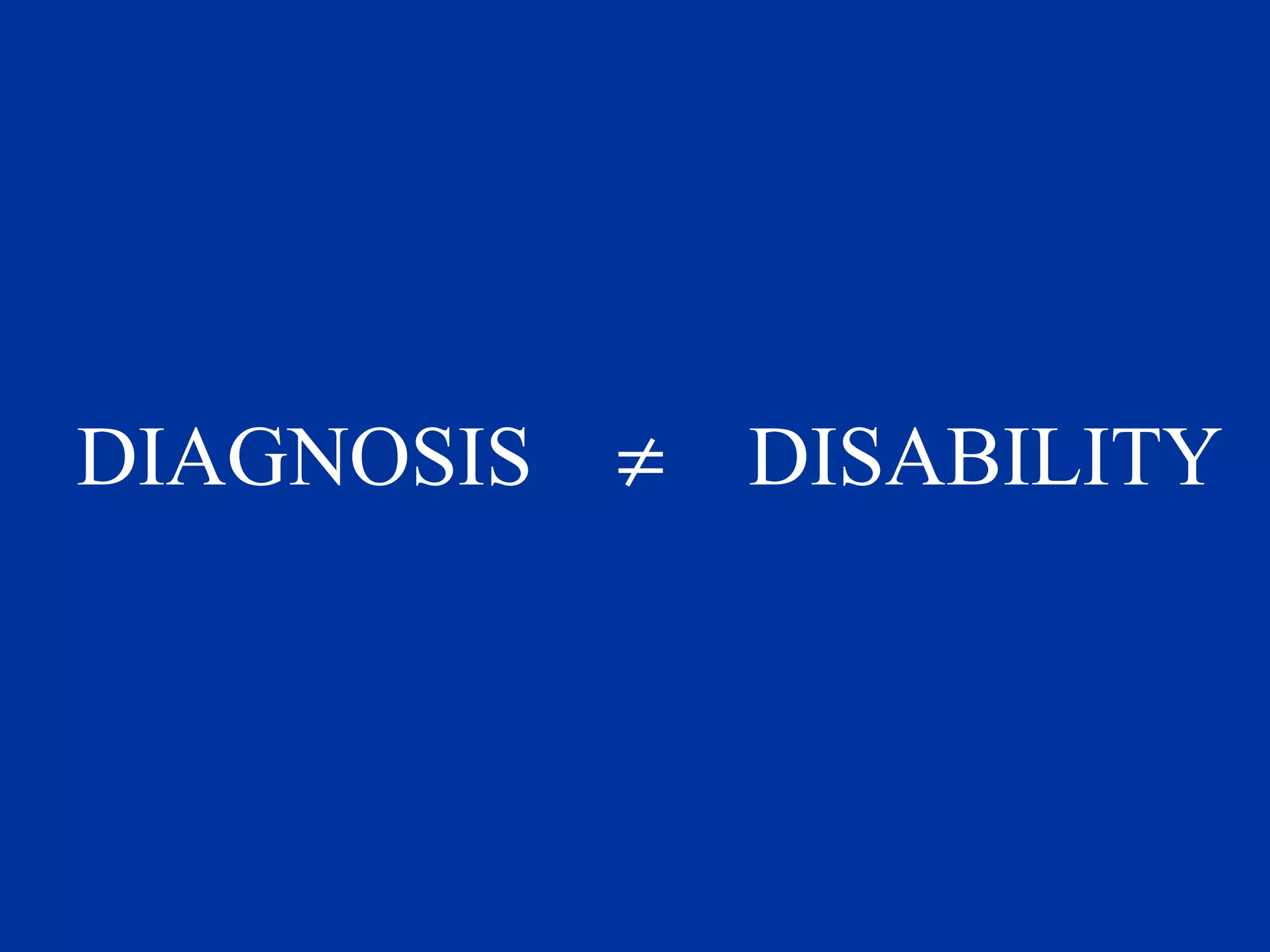
DIAGNOSIS     DISABILITY
Accommodating Disabilities: Getting People Back to Work Concentration deficits, distractibility  - enhance signal stimuli through use of headphones, bold print or colors; reduce distractions by modifying lighting, work location, sound/visual barriers
Accommodating Disabilities: Getting People Back to Work Short-term memory impairment  -  present information in multiple modalities (e.g., visual and oral; text and diagram), permit the use of cues and aids, repetition
Accommodating Disabilities: Getting People Back to Work Perseveration, rigidity  - enhance differences in task components by performing tasks in different parts of work space or with different equipment.
Accommodating Disabilities: Getting People Back to Work PTSD/Anxiety  -  place worker closer to security, quieter work area, no one behind them, remove reminders of trauma if possible
Case Presentation Luke  -- predicting violence three years into the future
 
Illinois Psychologically Healthy Workplace Program (PHWA)   www.illinoispsychology.org Click the link to the Psychologically Healthy Workplace Program www.phwa.org
Why Have a PHWA?   $300 Billion per year.  That is the estimated annual aggregate cost to US businesses due to worker stress (stress leads to absenteeism, lost productivity, accidents, increased healthcare costs, turnover, conflict  and  violence  in the workplace, and “presenteeism” – being physically present but having your mind on something else).  On any given day, nearly one million employees in the US miss work due to stress.  These and other compelling data are available from the American Stress Institute ( www.stress.org/job.htm ).  www.illinoispsychology.org
Psychologically Healthy  Workplace Practices Employee Involvement Work-Life Balance Employee Growth and Development Health and Safety Employee Recognition See: MJ Grawitch, et al. (2006), The path to a healthy workplace: A critical review linking healthy workplace practices, employee well-being, and organizational improvements.  Consulting Psychology Journal,  Volume 58 (3), pp. 129-147.
For More Information Steven E. Rothke, Ph.D, ABPP (847) 480-5744 [email_address]

Fitness For Duty And Risk Assessments

  • 1.
    Fitness-For-Duty Evaluations: ATool For Financial and Safety Risk Management Steven E. Rothke, Ph.D., ABPP
  • 2.
    Definitions NeuropsychologyRehabilitation Psychology
  • 3.
    (ADA) A limitationin physical, cognitive (thinking), sensory, or emotional functioning which significantly affects a person’s ability to work, to learn, to manage personal or family responsibilities, to maintain relationships, or to participate in recreational activities. Definitions Disability
  • 4.
    “ A specializedformal medical-legal examination of an employee … with a central purpose being the determination of whether the employee is able to safely perform a defined job.” Anthony V. Stone (2000) Fitness For Duty: Principles, Methods and Legal Issues. Boca Raton, FL: CRC Press Definitions Fitness-For-Duty Evaluation
  • 5.
    Basic Standards OfWork To remember locations and work-like procedures To understand, remember and execute very short and simple instructions To maintain attention for extended periods To persist in the performance of simple tasks
  • 6.
    Basic Standards OfWork To perform activities within a schedule To maintain regular attendance and to be punctual within customary tolerances To sustain an ordinary routine without special supervision To make simple work-related decisions
  • 7.
    Basic Standards OfWork To work in coordination or in the presence of others without being distracted by them To complete a normal workday and work week without interruption from mental symptoms and to perform at a consistent pace without an unreasonable number of rest periods
  • 8.
    Basic Standards OfWork To ask questions of request assistance To accept instructions and respond appropriately to criticism from supervisors To maintain socially appropriate behavior and to adhere to basic standards of neatness and cleanliness To respond appropriately to changes in the work setting
  • 9.
    Job Description Essentialfunctions Non-essential functions (accommodations) Ask about availability of other sites, other assignments, can you speak with managers and/or coworkers
  • 10.
    FFDE: Informed ConsentIssues Discussed at the outset Who made the referral; who is paying for the exam What will the results be used for Confidentiality: Who will see the report Will the subject (employee) be given feedback and from whom
  • 11.
  • 12.
    Major Neuropsychological EvaluationProcedures Clinical Interview Wechsler Adult Intelligence Scale, 4 th Edition (WAIS-IV) Wechsler Memory Scale, 4 th Edition (WMS-IV) Halstead-Reitan Neuropsychological Test Battery Wisconsin Card Sorting Test Rey or California Verbal Learning Tests Grooved Pegboard Test Symptom validity tests Minnesota Multiphasic Personality Inventory (MMPI-2)
  • 13.
    The Clinical InterviewAppearance Behavior Speech Affect Thinking Perception Insight Judgment
  • 14.
    Major Neuropsychological EvaluationProcedures Clinical Interview Wechsler Adult Intelligence Scale, 4 th Edition (WAIS-IV) Wechsler Memory Scale, 4 th Edition (WMS-IV) Halstead-Reitan Neuropsychological Test Battery Wisconsin Card Sorting Test Rey or California Verbal Learning Tests Grooved Pegboard Test Symptom validity tests Minnesota Multiphasic Personality Inventory (MMPI-2)
  • 15.
    What does aNeuropsychological Evaluation tell you about a patient or claimant? Orientation Attention / Concentration Focus Selective Sustaining Shifting Speech / Language Naming Word finding
  • 16.
    What does aNeuropsychological Evaluation tell you about a patient or claimant? Memory Immediate, short-term and long-term Verbal and nonverbal Visuospatial Reasoning Complex Motor Abstract Reasoning Emotional / Psychological Executive Abilities
  • 17.
    Executive Abilities InsightJudgment Forethought/ Anticipation of consequences Planning/Sequencing
  • 18.
    Executive Abilities Self-monitoringcapacity (error awareness and correction) Awareness of impact on others Strategy Shifting (flexibility) Inhibition of impulses/ delay of gratification
  • 19.
    Issues in TestInterpretation Age Educational background Occupational background Premorbid psychiatric and medical conditions ETOH and recreational drug abuse Effects of medications
  • 20.
    Issues in TestInterpretation Time Since Onset Effects of retesting Effects of rehabilitation efforts Incentives to perform poorly Going beyond the bounds of the data Being overly localizationsitic
  • 21.
    Risk Factors ToAssess Evaluate: Factors That Limit Inhibition Intervene: To Enhance Inhibition
  • 22.
    History of PreviousViolence Employee’s account of event Emotional experience during event Signs of remorse vs. blaming others
  • 23.
    Psychiatric History Sexual/physicalabuse Hospitalizations Episodes of depression, PTSD Suicide attempts Emotional traumas, losses
  • 24.
    Emotional Status TheAffects of Violence Fear Anger
  • 25.
    Personality Characteristics Signsof Psychopathy and Antisocial Personality Disorder Manipulativeness Lack of remorse for actions Refusal to accept responsibility Lack of empathy Pathological lying
  • 26.
    Personality Characteristics Signsof Psychopathy and Antisocial Personality Disorder Sense of grandiosity Impulsivity Poor behavioral controls Disregard for the welfare of others Criminal history
  • 27.
    Thought Disorder PsychoticFeatures Delusions (paranoid) Hallucinations (command)
  • 28.
    Thought Disorder ThreatControl/Override Features Belief that your mind is dominated by forces outside your control Thought insertion Belief that people wish to harm you
  • 29.
    Substance Abuse Stimulants(cocaine): Paranoia Grandiosity Disinhibition Alcohol Disinhibition
  • 30.
    Combination of SubstanceAbuse and Mental Disorder Mental Disorder in the US (19%) Substance Abuse Disorder (6%) Combination (3%) U.S. Surgeon General (1999). Mental Health: A Report of the Surgeon General. www.surgeongeneral.gov/sgoffice.htm (Reports)
  • 31.
    Lifetime Prevalence of Mental Disorder in the US Anxiety Disorder (29%) Mood Disorder (21%) Impulse Control Disorder (25%) Substance Abuse Disorder (15%) Kessler, RC et al (2005). Lifetime prevalence and age of onset distributions of DSM-IV disorders . Archives of General Psychiatry, Vol. 62, pp. 593-602.
  • 32.
    Medical/Neurological History TraumaticBrain Injury high incidence in prison population increased risk of affective/impulsive violence (Episodic Explosive Disorder) reduced executive function, reduced prefrontal activation, decreased serotonergic function treatment with anticonvulsants or SSRIs Terminal illness
  • 33.
    Plan/Intent 1) Wishto harm self and/or others 2) Frequency of thoughts or statements 3) Sequence thought through 4) Availability of weapons 5) Experience with firearms 6) Consequences considered
  • 34.
    Malignant Signs Feelingof “nothing to lose” Belief that an injustice (humiliation) has been done to you (workplace violence)
  • 35.
    Coping Skills 1)Self-Esteem 2) Stress management strategies 3) How has the person dealt with prior losses/trauma (is this the first bad thing that has happened to them)
  • 36.
    Other Stressors/Supports Ongoinglegal difficulties (divorce, bankruptcy, criminal) Financial struggles Marital/relationship strains v. good family support Social isolation Prior job difficulties/fears of loss of job
  • 37.
    Assessment Tools RAGE-V(Risk Assessment Guideline for Violence) www.atapworldwide.org Hit tab for Education, then scroll down to RAGE-V to download form. See other useful articles as well.
  • 38.
    “ Tarasoff Warnings: What is the Law in Illinois? Mental Health & Developmental Disabilities Confidentiality Act (740 ILCS 110) Available at: www.ilga.gov/legislation/ilcs/ilcs.asp
  • 39.
    “ Records andcommunications may be disclosed … when, and to the extent, a therapist, in his or her sole discretion, determines that such a disclosure is necessary to continue civil commitment proceedings or to otherwise protect the recipient [patient, examinee] or other person against a clear, imminent risk of serious physical or mental injury or disease or death being inflicted upon the recipient, or by the recipient on himself or another.” Section 110/11 ii
  • 40.
    “ Records andcommunications may be disclosed … when, and to the extent, in the therapist’s sole discretion, disclosure is necessary to warn or protect a specific individual against whom a recipient has made a specific threat of violence where there exists a therapist-recipient relationship or a special recipient-individual relationship.” Section 110/11 vii
  • 41.
    “ Tarasoff Warnings: What is the Law in Illinois? Mental Health & Developmental Disabilities Code (405 ILCS 5) Available at: www.ilga.gov/legislation/ilcs/ilcs.asp
  • 42.
    “ There shallbe no liability on the part of, and no cause of action shall rise against, any person who is a physician, clinical psychologist, or qualified examiner based on that person’s failure to warn of and protect from a recipient’s threatened or actual violent behavior except where the recipient has communicated to the person a serious threat of physical violence against a reasonably identifiable victim or victims.” Section 110/11 vii
  • 43.
    Common Mental Diagnosesof Workers Referred for FFD Exams Post-Concussion Syndrome (PCS) Traumatic Brain Injury (TBI) Depression Posttraumatic Stress Disorder (PTSD) Anxiety/Panic Disorder Dementia Substance Abuse Disorder
  • 44.
    DIAGNOSIS  DISABILITY
  • 45.
    Accommodating Disabilities: GettingPeople Back to Work Concentration deficits, distractibility - enhance signal stimuli through use of headphones, bold print or colors; reduce distractions by modifying lighting, work location, sound/visual barriers
  • 46.
    Accommodating Disabilities: GettingPeople Back to Work Short-term memory impairment - present information in multiple modalities (e.g., visual and oral; text and diagram), permit the use of cues and aids, repetition
  • 47.
    Accommodating Disabilities: GettingPeople Back to Work Perseveration, rigidity - enhance differences in task components by performing tasks in different parts of work space or with different equipment.
  • 48.
    Accommodating Disabilities: GettingPeople Back to Work PTSD/Anxiety - place worker closer to security, quieter work area, no one behind them, remove reminders of trauma if possible
  • 49.
    Case Presentation Luke -- predicting violence three years into the future
  • 50.
  • 51.
    Illinois Psychologically HealthyWorkplace Program (PHWA) www.illinoispsychology.org Click the link to the Psychologically Healthy Workplace Program www.phwa.org
  • 52.
    Why Have aPHWA? $300 Billion per year. That is the estimated annual aggregate cost to US businesses due to worker stress (stress leads to absenteeism, lost productivity, accidents, increased healthcare costs, turnover, conflict and violence in the workplace, and “presenteeism” – being physically present but having your mind on something else). On any given day, nearly one million employees in the US miss work due to stress. These and other compelling data are available from the American Stress Institute ( www.stress.org/job.htm ). www.illinoispsychology.org
  • 53.
    Psychologically Healthy Workplace Practices Employee Involvement Work-Life Balance Employee Growth and Development Health and Safety Employee Recognition See: MJ Grawitch, et al. (2006), The path to a healthy workplace: A critical review linking healthy workplace practices, employee well-being, and organizational improvements. Consulting Psychology Journal, Volume 58 (3), pp. 129-147.
  • 54.
    For More InformationSteven E. Rothke, Ph.D, ABPP (847) 480-5744 [email_address]